#UnsungBritain
resolutionfoundation.org
Unsung Britain
Mike Brewer
Deputy Chief Executive, Resolution Foundation
Lalitha Try
Economist, Resolution Foundation
2
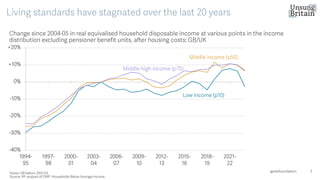
Change since 2004 -05 in real equivalised household disposable income at various points in the income
distribution excluding pensioner benefit units, after housing costs: GB/UK
Notes: GB before 2002 -03.
Source: RF analysis of DWP, Households Below Average Income.
@resfoundation
Living standards have stagnated over the last 20 years
-40%
-30%
-20%
-10%
0%
+10%
+20%
1994-
95
1997-
98
2000-
01
2003-
04
2006-
07
2009-
10
2012-
13
2015-
16
2018-
19
2021-
22
Middle -high income (p75)
Low income (p10)
Middle income (p50)
3
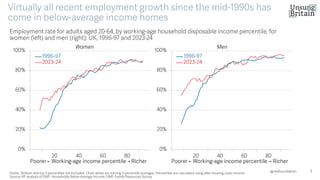
Employment rate for adults aged 20 -64, by working -age household disposable income percentile, for
women (left) and men (right): UK, 1996 -97 and 2023 -24
Notes: Bottom and top 5 percentiles are excluded. Chart series are moving 5 -percentile averages. Percentiles are calculated using afte r housing costs income.
Source: RF analysis of DWP, Households Below Average Income; DWP, Family Resources Survey.
@resfoundation
Virtually all recent employment growth since the mid -1990s has
come in below -average income homes
0%
20%
40%
60%
80%
100%
20 40 60 80
1996-97
2023-24
Women
Poorer ← Working-age income percentile →Richer
0%
20%
40%
60%
80%
100%
20 40 60 80
1996-97
2023-24
Men
Poorer ← Working-age income percentile → Richer
“Sometimes we’ve had cost of living [wage] increases, not
turning my nose up at that at all – but it doesn’t really
touch the sides when your inflation’s been going up by that
amount.”
4
@resfoundation
Quotes from qualitative workshop in Cardiff in September 2025, part of the Resolution Foundation’s ‘Unsung Britain’ research programme.
5
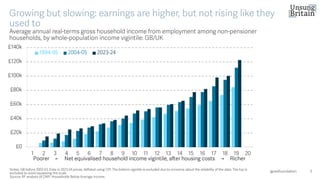
Average annual real -terms gross household income from employment among non -pensioner
households, by whole -population income vigintile: GB/UK
Notes: GB before 2002 -03. Data in 2023 -24 prices, deflated using CPI. The bottom vigintile is excluded due to concerns about the reliability of the data. The top is
excluded to avoid squeezing the scale.
Source: RF analysis of DWP, Households Below Average Income.
@resfoundation
Growing but slowing: earnings are higher, but not rising like they
used to
£0
£20k
£40k
£60k
£80k
£100k
£120k
£140k
1 2 3 4 5 6 7 8 9 10 11 12 13 14 15 16 17 18 19 20
1994-95 2004-05 2023-24
Poorer ← Net equivalised household income vigintile, after housing costs → Richer
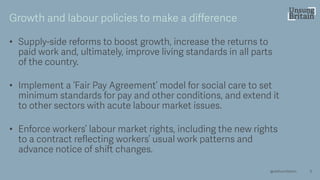
• Supply -side reforms to boost growth, increase the returns to
paid work and, ultimately, improve living standards in all parts
of the country.
• Implement a ‘Fair Pay Agreement’ model for social care to set
minimum standards for pay and other conditions, and extend it
to other sectors with acute labour market issues.
• Enforce workers’ labour market rights, including the new rights
to a contract reflecting workers’ usual work patterns and
advance notice of shift changes.
6
Growth and labour policies to make a difference
@resfoundation
7
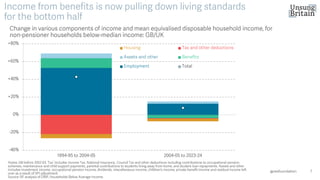
Change in various components of income and mean equivalised disposable household income, for
non -pensioner households below -median income: GB/UK
Notes: GB before 2002 -03. ‘Tax’ includes Income Tax, National Insurance, Council Tax and other deductions including contribution s to occupational pension
schemes, maintenance and child support payments, parental contributions to students living away from home, and student loan r epayments. Assets and other
includes investment income, occupational pension income, dividends, miscellaneous income, children's income, private benefit inc ome and residual income left
over as a result of SPI adjustment.
Source: RF analysis of DWP, Households Below Average Income.
@resfoundation
Income from benefits is now pulling down living standards
for the bottom half
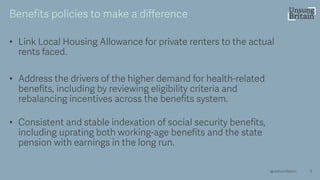
• Link Local Housing Allowance for private renters to the actual
rents faced.
• Address the drivers of the higher demand for health -related
benefits, including by reviewing eligibility criteria and
rebalancing incentives across the benefits system.
• Consistent and stable indexation of social security benefits,
including uprating both working -age benefits and the state
pension with earnings in the long run.
9
Benefits policies to make a difference
@resfoundation
“Whether you’re renting or you have a mortgage, I think it’s
becoming increasingly more difficult for people to manage.”
10
@resfoundation
Quotes from qualitative workshop in Cardiff in September 2025, part of the Resolution Foundation’s ‘Unsung Britain’ research programme.
11
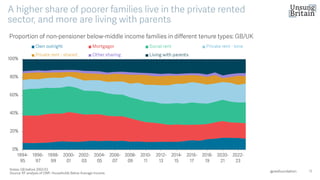
Proportion of non -pensioner below -middle income families in different tenure types: GB/UK
Notes: GB before 2002 -03.
Source: RF analysis of DWP, Households Below Average Income. @resfoundation
A higher share of poorer families live in the private rented
sector, and more are living with parents
12
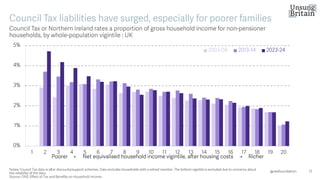
Council Tax liabilities have surged, especially for poorer families
@resfoundation
Notes: Council Tax data is after discounts/support schemes. Data excludes households with a retired member. The bottom vigint ile is excluded due to concerns about
the reliability of the data.
Source: ONS, Effect of Tax and Benefits on Household Income.
Council Tax or Northern Ireland rates a proportion of gross household income for non -pensioner
households, by whole -population vigintile : UK
0%
1%
2%
3%
4%
5%
1 2 3 4 5 6 7 8 9 10 11 12 13 14 15 16 17 18 19 20
2003-04 2013-14 2023-24
Poorer ← Net equivalised household income vigintile, after housing costs → Richer
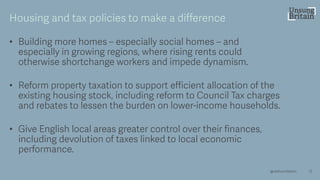
• Building more homes – especially social homes – and
especially in growing regions, where rising rents could
otherwise shortchange workers and impede dynamism.
• Reform property taxation to support efficient allocation of the
existing housing stock, including reform to Council Tax charges
and rebates to lessen the burden on lower -income households.
• Give English local areas greater control over their finances,
including devolution of taxes linked to local economic
performance.
13
Housing and tax policies to make a difference
@resfoundation
14
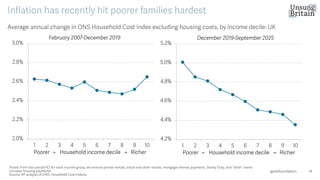
Inflation has recently hit poorer families hardest
@resfoundation
Notes: From the overall HCI for each income group, we remove private rentals, social and other rentals, mortgage interest pay men ts, Stamp Duty, and “other” owner
occupier housing payments.
Source: RF analysis of ONS, Household Cost Indices.
4.2%
4.4%
4.6%
4.8%
5.0%
5.2%
1 2 3 4 5 6 7 8 9 10
Dec ember 2019 -September 2025
Poorer ← Household income decile → Richer
2.0%
2.2%
2.4%
2.6%
2.8%
3.0%
1 2 3 4 5 6 7 8 9 10
Poorer ← Household income decile → Richer
February 2007 -December 2019
Average annual change in ONS Household Cost Index excluding housing costs, by income decile: UK
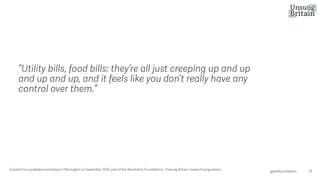
“Utility bills, food bills: they’re all just creeping up and up
and up and up, and it feels like you don’t really have any
control over them.”
15
@resfoundation
Quotes from qualitative workshop in Warrington in September 2025, part of the Resolution Foundation’s ‘Unsung Britain’ resea rch programme.
16
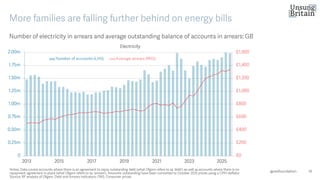
Number of electricity in arrears and average outstanding balance of accounts in arrears: GB
Notes: Data covers accounts where there is an agreement to repay outstanding debt (what Ofgem refers to as ‘debt’) as well as ac counts where there is no
repayment agreement in place (what Ofgem refers to as ‘arrears’). Amounts outstanding have been converted to October 2025 pri ces using a CPIH deflator.
Source: RF analysis of Ofgem, Debt and Arrears Indicators; ONS, Consumer prices.
@resfoundation
More families are falling further behind on energy bills
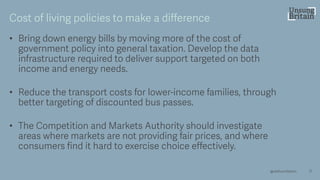
• Bring down energy bills by moving more of the cost of
government policy into general taxation. Develop the data
infrastructure required to deliver support targeted on both
income and energy needs.
• Reduce the transport costs for lower -income families, through
better targeting of discounted bus passes.
• The Competition and Markets Authority should investigate
areas where markets are not providing fair prices, and where
consumers find it hard to exercise choice effectively.
17
Cost of living policies to make a difference
@resfoundation
18
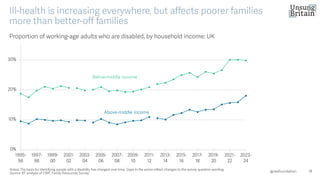
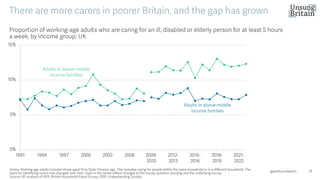
Proportion of working -age adults who are disabled, by household income: UK
Notes: The basis for identifying people with a disability has changed over time. Gaps in the series reflect changes to the su rvey question wording.
Source: RF analysis of DWP, Family Resources Survey. @resfoundation
Ill-health is increasing everywhere, but affects poorer families
more than better -off families
19
Proportion of working -age adults who are caring for an ill, disabled or elderly person for at least 5 hours
a week, by income group: UK
Notes: Working -age adults includes those aged 16 to State Pension age. This includes caring for people within the same household or in a different household. The
basis for identifying carers has changed over time. Gaps in the series reflect changes to the survey question wording and the underlying survey.
Source: RF analysis of ISER, British Household Panel Survey; ISER, Understanding Society.
@resfoundation
There are more carers in poorer Britain, and the gap has grown
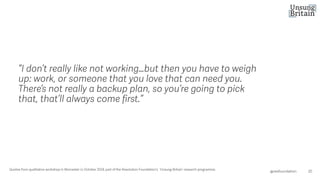
“I don’t really like not working…but then you have to weigh
up: work, or someone that you love that can need you.
There’s not really a backup plan, so you’re going to pick
that, that’ll always come first.”
20
@resfoundation
Quotes from qualitative workshop in Worcester in October 2024, part of the Resolution Foundation’s ‘Unsung Britain’ research programme.
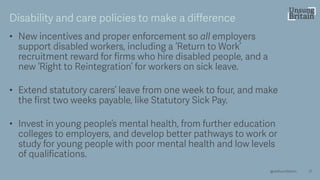
• New incentives and proper enforcement so all employers
support disabled workers, including a ‘Return to Work’
recruitment reward for firms who hire disabled people, and a
new ‘Right to Reintegration’ for workers on sick leave.
• Extend statutory carers’ leave from one week to four, and make
the first two weeks payable, like Statutory Sick Pay.
• Invest in young people’s mental health, from further education
colleges to employers, and develop better pathways to work or
study for young people with poor mental health and low levels
of qualifications.
21
Disability and care policies to make a difference
@resfoundation
#UnsungBritain
resolutionfoundation.org
Unsung Britain
Mike Brewer
Deputy Chief Executive, Resolution Foundation
Lalitha Try
Economist, Resolution Foundation

Unsung Britain conference: Context setting presentation from Resolution Foundation presentation

  • 1.
    #UnsungBritain resolutionfoundation.org Unsung Britain Mike Brewer DeputyChief Executive, Resolution Foundation Lalitha Try Economist, Resolution Foundation
  • 2.
    2 Change since 2004-05 in real equivalised household disposable income at various points in the income distribution excluding pensioner benefit units, after housing costs: GB/UK Notes: GB before 2002 -03. Source: RF analysis of DWP, Households Below Average Income. @resfoundation Living standards have stagnated over the last 20 years -40% -30% -20% -10% 0% +10% +20% 1994- 95 1997- 98 2000- 01 2003- 04 2006- 07 2009- 10 2012- 13 2015- 16 2018- 19 2021- 22 Middle -high income (p75) Low income (p10) Middle income (p50)
  • 3.
    3 Employment rate foradults aged 20 -64, by working -age household disposable income percentile, for women (left) and men (right): UK, 1996 -97 and 2023 -24 Notes: Bottom and top 5 percentiles are excluded. Chart series are moving 5 -percentile averages. Percentiles are calculated using afte r housing costs income. Source: RF analysis of DWP, Households Below Average Income; DWP, Family Resources Survey. @resfoundation Virtually all recent employment growth since the mid -1990s has come in below -average income homes 0% 20% 40% 60% 80% 100% 20 40 60 80 1996-97 2023-24 Women Poorer ← Working-age income percentile →Richer 0% 20% 40% 60% 80% 100% 20 40 60 80 1996-97 2023-24 Men Poorer ← Working-age income percentile → Richer
  • 4.
    “Sometimes we’ve hadcost of living [wage] increases, not turning my nose up at that at all – but it doesn’t really touch the sides when your inflation’s been going up by that amount.” 4 @resfoundation Quotes from qualitative workshop in Cardiff in September 2025, part of the Resolution Foundation’s ‘Unsung Britain’ research programme.
  • 5.
    5 Average annual real-terms gross household income from employment among non -pensioner households, by whole -population income vigintile: GB/UK Notes: GB before 2002 -03. Data in 2023 -24 prices, deflated using CPI. The bottom vigintile is excluded due to concerns about the reliability of the data. The top is excluded to avoid squeezing the scale. Source: RF analysis of DWP, Households Below Average Income. @resfoundation Growing but slowing: earnings are higher, but not rising like they used to £0 £20k £40k £60k £80k £100k £120k £140k 1 2 3 4 5 6 7 8 9 10 11 12 13 14 15 16 17 18 19 20 1994-95 2004-05 2023-24 Poorer ← Net equivalised household income vigintile, after housing costs → Richer
  • 6.
    • Supply -sidereforms to boost growth, increase the returns to paid work and, ultimately, improve living standards in all parts of the country. • Implement a ‘Fair Pay Agreement’ model for social care to set minimum standards for pay and other conditions, and extend it to other sectors with acute labour market issues. • Enforce workers’ labour market rights, including the new rights to a contract reflecting workers’ usual work patterns and advance notice of shift changes. 6 Growth and labour policies to make a difference @resfoundation
  • 7.
    7 Change in variouscomponents of income and mean equivalised disposable household income, for non -pensioner households below -median income: GB/UK Notes: GB before 2002 -03. ‘Tax’ includes Income Tax, National Insurance, Council Tax and other deductions including contribution s to occupational pension schemes, maintenance and child support payments, parental contributions to students living away from home, and student loan r epayments. Assets and other includes investment income, occupational pension income, dividends, miscellaneous income, children's income, private benefit inc ome and residual income left over as a result of SPI adjustment. Source: RF analysis of DWP, Households Below Average Income. @resfoundation Income from benefits is now pulling down living standards for the bottom half
  • 8.
    • Link LocalHousing Allowance for private renters to the actual rents faced. • Address the drivers of the higher demand for health -related benefits, including by reviewing eligibility criteria and rebalancing incentives across the benefits system. • Consistent and stable indexation of social security benefits, including uprating both working -age benefits and the state pension with earnings in the long run. 9 Benefits policies to make a difference @resfoundation
  • 9.
    “Whether you’re rentingor you have a mortgage, I think it’s becoming increasingly more difficult for people to manage.” 10 @resfoundation Quotes from qualitative workshop in Cardiff in September 2025, part of the Resolution Foundation’s ‘Unsung Britain’ research programme.
  • 10.
    11 Proportion of non-pensioner below -middle income families in different tenure types: GB/UK Notes: GB before 2002 -03. Source: RF analysis of DWP, Households Below Average Income. @resfoundation A higher share of poorer families live in the private rented sector, and more are living with parents
  • 11.
    12 Council Tax liabilitieshave surged, especially for poorer families @resfoundation Notes: Council Tax data is after discounts/support schemes. Data excludes households with a retired member. The bottom vigint ile is excluded due to concerns about the reliability of the data. Source: ONS, Effect of Tax and Benefits on Household Income. Council Tax or Northern Ireland rates a proportion of gross household income for non -pensioner households, by whole -population vigintile : UK 0% 1% 2% 3% 4% 5% 1 2 3 4 5 6 7 8 9 10 11 12 13 14 15 16 17 18 19 20 2003-04 2013-14 2023-24 Poorer ← Net equivalised household income vigintile, after housing costs → Richer
  • 12.
    • Building morehomes – especially social homes – and especially in growing regions, where rising rents could otherwise shortchange workers and impede dynamism. • Reform property taxation to support efficient allocation of the existing housing stock, including reform to Council Tax charges and rebates to lessen the burden on lower -income households. • Give English local areas greater control over their finances, including devolution of taxes linked to local economic performance. 13 Housing and tax policies to make a difference @resfoundation
  • 13.
    14 Inflation has recentlyhit poorer families hardest @resfoundation Notes: From the overall HCI for each income group, we remove private rentals, social and other rentals, mortgage interest pay men ts, Stamp Duty, and “other” owner occupier housing payments. Source: RF analysis of ONS, Household Cost Indices. 4.2% 4.4% 4.6% 4.8% 5.0% 5.2% 1 2 3 4 5 6 7 8 9 10 Dec ember 2019 -September 2025 Poorer ← Household income decile → Richer 2.0% 2.2% 2.4% 2.6% 2.8% 3.0% 1 2 3 4 5 6 7 8 9 10 Poorer ← Household income decile → Richer February 2007 -December 2019 Average annual change in ONS Household Cost Index excluding housing costs, by income decile: UK
  • 14.
    “Utility bills, foodbills: they’re all just creeping up and up and up and up, and it feels like you don’t really have any control over them.” 15 @resfoundation Quotes from qualitative workshop in Warrington in September 2025, part of the Resolution Foundation’s ‘Unsung Britain’ resea rch programme.
  • 15.
    16 Number of electricityin arrears and average outstanding balance of accounts in arrears: GB Notes: Data covers accounts where there is an agreement to repay outstanding debt (what Ofgem refers to as ‘debt’) as well as ac counts where there is no repayment agreement in place (what Ofgem refers to as ‘arrears’). Amounts outstanding have been converted to October 2025 pri ces using a CPIH deflator. Source: RF analysis of Ofgem, Debt and Arrears Indicators; ONS, Consumer prices. @resfoundation More families are falling further behind on energy bills
  • 16.
    • Bring downenergy bills by moving more of the cost of government policy into general taxation. Develop the data infrastructure required to deliver support targeted on both income and energy needs. • Reduce the transport costs for lower -income families, through better targeting of discounted bus passes. • The Competition and Markets Authority should investigate areas where markets are not providing fair prices, and where consumers find it hard to exercise choice effectively. 17 Cost of living policies to make a difference @resfoundation
  • 17.
    18 Proportion of working-age adults who are disabled, by household income: UK Notes: The basis for identifying people with a disability has changed over time. Gaps in the series reflect changes to the su rvey question wording. Source: RF analysis of DWP, Family Resources Survey. @resfoundation Ill-health is increasing everywhere, but affects poorer families more than better -off families
  • 18.
    19 Proportion of working-age adults who are caring for an ill, disabled or elderly person for at least 5 hours a week, by income group: UK Notes: Working -age adults includes those aged 16 to State Pension age. This includes caring for people within the same household or in a different household. The basis for identifying carers has changed over time. Gaps in the series reflect changes to the survey question wording and the underlying survey. Source: RF analysis of ISER, British Household Panel Survey; ISER, Understanding Society. @resfoundation There are more carers in poorer Britain, and the gap has grown
  • 19.
    “I don’t reallylike not working…but then you have to weigh up: work, or someone that you love that can need you. There’s not really a backup plan, so you’re going to pick that, that’ll always come first.” 20 @resfoundation Quotes from qualitative workshop in Worcester in October 2024, part of the Resolution Foundation’s ‘Unsung Britain’ research programme.
  • 20.
    • New incentivesand proper enforcement so all employers support disabled workers, including a ‘Return to Work’ recruitment reward for firms who hire disabled people, and a new ‘Right to Reintegration’ for workers on sick leave. • Extend statutory carers’ leave from one week to four, and make the first two weeks payable, like Statutory Sick Pay. • Invest in young people’s mental health, from further education colleges to employers, and develop better pathways to work or study for young people with poor mental health and low levels of qualifications. 21 Disability and care policies to make a difference @resfoundation
  • 21.
    #UnsungBritain resolutionfoundation.org Unsung Britain Mike Brewer DeputyChief Executive, Resolution Foundation Lalitha Try Economist, Resolution Foundation