
By
Sudarshan Kadariya
1
2
The use of valuation models in
investment decisions (i.e., in decisions
on which assets are under valued and
which are over valued) are based upon
 a perception that markets are inefficient
and make mistakes in assessing value
an assumption about how and when
these inefficiencies will get corrected
 In an efficient market, the market price is
the best estimate of value. The purpose of
any valuation model is then the justification
of this value.
3
 In general, the value of an asset is the
equilibrium price that a buyer and a seller is
ready to transact.
 Note that if either the buyer or seller is not
both willing and able, then an offer does not
establish the value of the asset.
4
 Among the several types of value, the
following three are useful for valuation
purpose:
o Book Value - The asset’s accounting value after
depreciation
o Market Value - The price of an asset in the market
determined competitively
o Intrinsic Value - The present value of the expected
future cash flows discounted at the required rate of
return
5
 There are two primary determinants of the
intrinsic value of an asset as:
o The size and timing of the expected future cash
flows
o The individual’s required rate of return
(this is determined by a number of other factors such as risk/return
preferences, returns on competing investments, expected inflation,
etc.)
 Note that the intrinsic value of an asset can
be, and often is, different for each individual
so that the markets exist. (why??)
6
Bonds
 Bonds are long-term fixed income
securities. It is a trade-able instrument
which is also termed as debt securities. Both
the bonds (?) and debentures (?) are the debt
securities. Most commonly, bonds pay
interest periodically (usually semiannually)
and then return the principal at maturity.
 In India, debt securities issued by the
government and public sector are generally
referred as bonds whereas the debt
securities that are issued by the private
sector joint stock companies are called
debentures. The terms - bonds and
debentures are often used interchangeably.
7
 Par or Face Value
The amount of money that is paid to the bondholders at
maturity. For most bonds this amount is $1,000. It also
generally represents the amount of money borrowed by the
bond issuer.
 Coupon Rate
The coupon rate, which is generally fixed, determines the
periodic coupon or interest payments. It is expressed as a
percentage of the bond's face value. It also represents the
interest cost of the bond to the issuer. For example: if the
coupon rate is 12%, $120 is payable to bondholder.
8
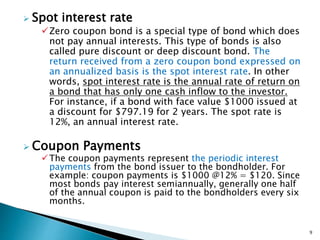
 Spot interest rate
Zero coupon bond is a special type of bond which does
not pay annual interests. This type of bonds is also
called pure discount or deep discount bond. The
return received from a zero coupon bond expressed on
an annualized basis is the spot interest rate. In other
words, spot interest rate is the annual rate of return on
a bond that has only one cash inflow to the investor.
For instance, if a bond with face value $1000 issued at
a discount for $797.19 for 2 years. The spot rate is
12%, an annual interest rate.
 Coupon Payments
The coupon payments represent the periodic interest
payments from the bond issuer to the bondholder. For
example: coupon payments is $1000 @12% = $120. Since
most bonds pay interest semiannually, generally one half
of the annual coupon is paid to the bondholders every six
months.
9
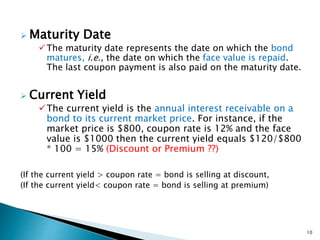
 Maturity Date
The maturity date represents the date on which the bond
matures, i.e., the date on which the face value is repaid.
The last coupon payment is also paid on the maturity date.
 Current Yield
The current yield is the annual interest receivable on a
bond to its current market price. For instance, if the
market price is $800, coupon rate is 12% and the face
value is $1000 then the current yield equals $120/$800
* 100 = 15% (Discount or Premium ??)
(If the current yield > coupon rate = bond is selling at discount,
(If the current yield< coupon rate = bond is selling at premium)
10
THANK YOU
11
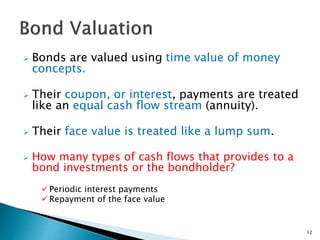
 Bonds are valued using time value of money
concepts.
 Their coupon, or interest, payments are treated
like an equal cash flow stream (annuity).
 Their face value is treated like a lump sum.
 How many types of cash flows that provides to a
bond investments or the bondholder?
 Periodic interest payments
 Repayment of the face value
12
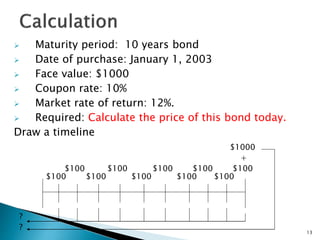
 Maturity period: 10 years bond
 Date of purchase: January 1, 2003
 Face value: $1000
 Coupon rate: 10%
 Market rate of return: 12%.
 Required: Calculate the price of this bond today.
Draw a timeline
13
$100 $100
$100
$100
$100
$100
$100
$100
$100$100
$1000
+
?
?
1. First of all calculate the present value of the coupon
stream
PV = $100/(1+.12)1 + $100/(1+.12)2 + $100/(1+.12)3 +
$100/(1+.12)4 + $100/(1+.12)5 + $100/(1+.12)6 +
$100/(1+.12)7 + $100/(1+.12)8 + $100/(1+.12)9+
$100/(1+.12)10
Or, we can find the PV of an annuity
PVA = $100 * {[1-(1+.12)-10]/.12} (PVIFA12%,10 years = 5.650)
PV = $565.02
2. Find the PV of the face value
PV = CFt / (1+r)t
PV = $1000/ (1+.12)10 (PVIF 12%, 10 years = 0.3219)
PV = $321.97
3. Add the two values to get the total PV
Therefore, the price of bond today is $565.02 + $321.97 =
$886.99
14
 If you purchased a bond for $800 5-years ago and sold
the bond today for $1200. The bond paid an annual 10%
coupon. What is the realized rate of return?
n
 PV = S [CFt / (1+r)t]
t=0
 $800 = [$100/(1+r) + $100/(1+r)2 + $100/(1+r)3 +
$100/(1+r)4 + $100/(1+r)5] + [$1200/(1+r)5]
 To solve, you need to use a “trail and error” approach.
 The realized rate of return on this bond is 19.3%.
 931.8276 (15%) & 781.3143 (20%)
15
16
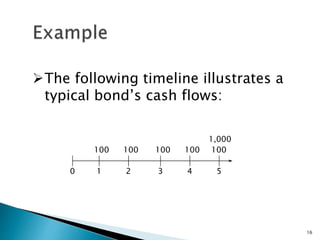
The following timeline illustrates a
typical bond’s cash flows:
0 1 2 3 4 5
100 100 100 100 100
1,000
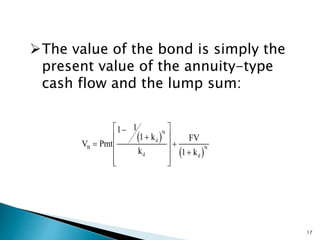
The value of the bond is simply the
present value of the annuity-type
cash flow and the lump sum:
 
 
V Pmt
k
k
FV
k
B
d
N
d d
N

















1 1
1
1
17
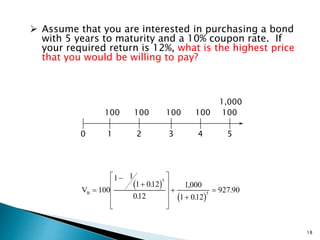
 Assume that you are interested in purchasing a bond
with 5 years to maturity and a 10% coupon rate. If
your required return is 12%, what is the highest price
that you would be willing to pay?
0 1 2 3 4 5
100 100 100 100 100
1,000
 
 
VB 














100
1 1
1 012
012
1 000
1 012
927 90
5
5
.
.
,
.
.
18
19
 Bond prices are sensitive to the market
interest rate
 If interest rates rise, the market value of
bonds fall in order to compete with newly
issued bonds with higher coupon rates.
 Sensitivity to the interest rate change become
more severe for longer term bonds
 Percentage change (rise) in price is not
symmetric with percentage decline.
20
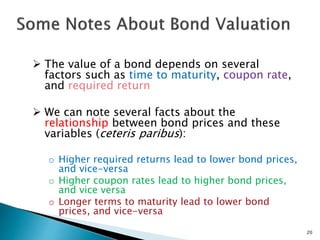
 The value of a bond depends on several
factors such as time to maturity, coupon rate,
and required return
 We can note several facts about the
relationship between bond prices and these
variables (ceteris paribus):
o Higher required returns lead to lower bond prices,
and vice-versa
o Higher coupon rates lead to higher bond prices,
and vice versa
o Longer terms to maturity lead to lower bond
prices, and vice-versa
THANK YOU
21
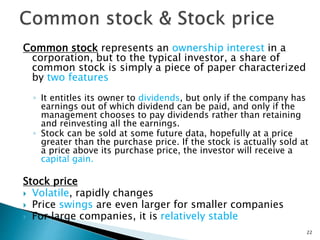
Common stock represents an ownership interest in a
corporation, but to the typical investor, a share of
common stock is simply a piece of paper characterized
by two features
◦ It entitles its owner to dividends, but only if the company has
earnings out of which dividend can be paid, and only if the
management chooses to pay dividends rather than retaining
and reinvesting all the earnings.
◦ Stock can be sold at some future data, hopefully at a price
greater than the purchase price. If the stock is actually sold at
a price above its purchase price, the investor will receive a
capital gain.
Stock price
 Volatile, rapidly changes
 Price swings are even larger for smaller companies
 For large companies, it is relatively stable
22
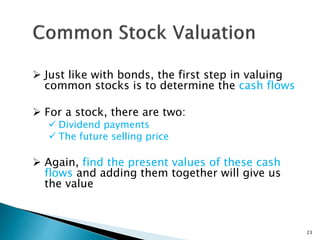
 Just like with bonds, the first step in valuing
common stocks is to determine the cash flows
 For a stock, there are two:
 Dividend payments
 The future selling price
 Again, find the present values of these cash
flows and adding them together will give us
the value
23
24
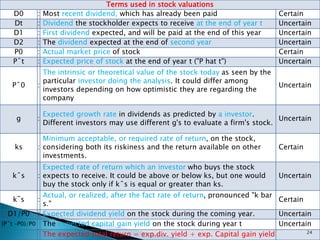
Terms used in stock valuations
D0 : Most recent dividend, which has already been paid Certain
Dt : Dividend the stockholder expects to receive at the end of year t Uncertain
D1 : First dividend expected, and will be paid at the end of this year Uncertain
D2 : The dividend expected at the end of second year Uncertain
P0 : Actual market price of stock Certain
Pˆt : Expected price of stock at the end of year t ("P hat t") Uncertain
Pˆ0 :
The intrinsic or theoretical value of the stock today as seen by the
particular investor doing the analysis. It could differ among
investors depending on how optimistic they are regarding the
company
Uncertain
g :
Expected growth rate in dividends as predicted by a investor.
Different investors may use different g's to evaluate a firm's stock.
Uncertain
ks :
Minimum acceptable, or required rate of return, on the stock,
considering both its riskiness and the return available on other
investments.
Certain
kˆs :
Expected rate of return which an investor who buys the stock
expects to receive. It could be above or below ks, but one would
buy the stock only if kˆs is equal or greater than ks.
Uncertain
k¯s :
Actual, or realized, after the fact rate of return, pronounced "k bar
s."
Certain
D1/P0 : Expected dividend yield on the stock during the coming year. Uncertain
(Pˆt –P0)/P0 The expected capital gain yield on the stock during year t Uncertain
The expected total return = exp.div. yield + exp. Capital gain yield
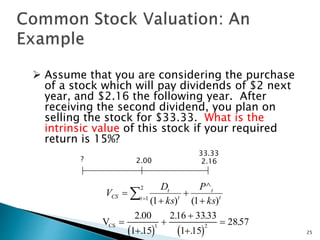
 Assume that you are considering the purchase
of a stock which will pay dividends of $2 next
year, and $2.16 the following year. After
receiving the second dividend, you plan on
selling the stock for $33.33. What is the
intrinsic value of this stock if your required
return is 15%?
   
VCS 





2 00
1 15
216 3333
1 15
28571 2
.
.
. .
.
.
2.00 2.16
33.33
?
25





2
1
)1(
^
)1(t t
t
t
t
CS
ks
P
ks
D
V
 In valuing the common stock, we have
made two assumptions:
o We know the dividends that will be paid in the
future (Di)
o We know the price that we will be able to sell
the stock in the future (Pi)
 Both of these assumptions are unrealistic,
especially knowledge of the future selling
price
 Furthermore, suppose that when we intend
to hold the stock for twenty years, the
calculations would be very tedious!
26
 We cannot value common stock without making
some simplifying assumptions
 If we make the following assumptions, we can
derive a simple model for common stock
valuation:
Assumption 1: The holding period is infinite (i.e., you will
never sell the stock)
Assumption 2: The dividends will grow at a constant rate
forever
 Note that the second assumption allows us to
predict every future dividend, as long as we know
the most recent dividend
27
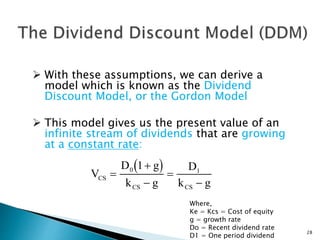
 With these assumptions, we can derive a
model which is known as the Dividend
Discount Model, or the Gordon Model
 This model gives us the present value of an
infinite stream of dividends that are growing
at a constant rate:
 V
D g
k g
D
k g
CS
CS CS





0 1
1
28
Where,
Ke = Kcs = Cost of equity
g = growth rate
Do = Recent dividend rate
D1 = One period dividend
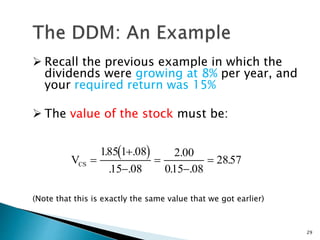
 Recall the previous example in which the
dividends were growing at 8% per year, and
your required return was 15%
 The value of the stock must be:
 VCS 





185 1 08
15 08
2 00
015 08
2857
. .
. .
.
. .
.
(Note that this is exactly the same value that we got earlier)
29
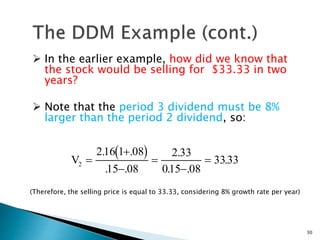
 In the earlier example, how did we know that
the stock would be selling for $33.33 in two
years?
 Note that the period 3 dividend must be 8%
larger than the period 2 dividend, so:
 V2
216 1 08
15 08
2 33
015 08
3333





. .
. .
.
. .
.
30
(Therefore, the selling price is equal to 33.33, considering 8% growth rate per year)
 Preferred stock, like as bonds imposes a fixed
charge & the failure to make this fixed charge
will not lead to bankruptcy.
 Preferred stock represents an ownership claim on
the firm that is superior to common stock in the
event of liquidation.
 Typically, preferred stock pays a fixed dividend
periodically, and
 the preferred stockholders are usually not
entitled to vote as are the common shareholders.
31
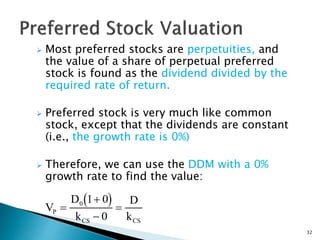
 Most preferred stocks are perpetuities, and
the value of a share of perpetual preferred
stock is found as the dividend divided by the
required rate of return.
 Preferred stock is very much like common
stock, except that the dividends are constant
(i.e., the growth rate is 0%)
 Therefore, we can use the DDM with a 0%
growth rate to find the value:
 V
D
k
D
k
P
CS CS



0 1 0
0
32
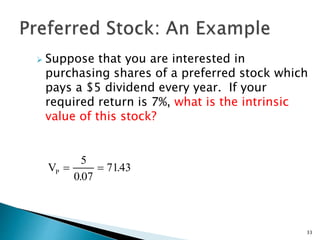
 Suppose that you are interested in
purchasing shares of a preferred stock which
pays a $5 dividend every year. If your
required return is 7%, what is the intrinsic
value of this stock?
VP  
5
0 07
7143
.
.
33
 Two reasons:
First, the returns from investing from bonds
are less imperative and fixed.
Second, the bond prices fluctuate less than
the equity prices
34
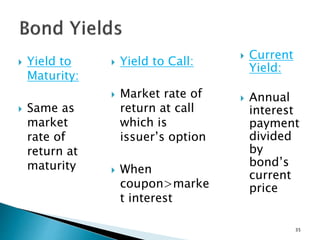
 Yield to
Maturity:
 Same as
market
rate of
return at
maturity
 Yield to Call:
 Market rate of
return at call
which is
issuer’s option
 When
coupon>marke
t interest
35
 Current
Yield:
 Annual
interest
payment
divided
by
bond’s
current
price
36
The yield to maturity (YTM) is the average annual
rate of return that a bondholder will earn. YTM is
generally the same as the market rate of interest,
kd which can be solve as “trial and error” or by
interpolation.
For example, a 14-year, 10 percent coupon with
par value $1000 is offered at a market price
$1494.93. What rate of interest we earn if we
bought the bond and held it to maturity?
(Answer is 5%)
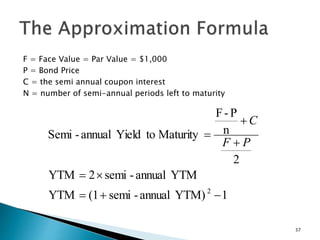
F = Face Value = Par Value = $1,000
P = Bond Price
C = the semi annual coupon interest
N = number of semi-annual periods left to maturity
1YTM)annual-semi(1YTM
YTMannual-semi2YTM
2
n
P-F
MaturitytoYieldannual-Semi
2





PF
C
37
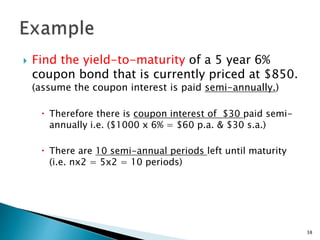
 Find the yield-to-maturity of a 5 year 6%
coupon bond that is currently priced at $850.
(assume the coupon interest is paid semi-annually.)
 Therefore there is coupon interest of $30 paid semi-
annually i.e. ($1000 x 6% = $60 p.a. & $30 s.a.)
 There are 10 semi-annual periods left until maturity
(i.e. nx2 = 5x2 = 10 periods)
38
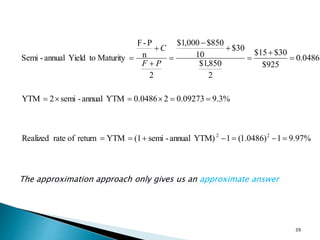
%97.91)0486.1(1YTM)annual-semi(1YTMreturnofrateRealized
9.3%0.0927320.0486YTMannual-semi2YTM
0486.0
925$
30$15$
2
850,1$
30$
10
850$000,1$
2
n
P-F
MaturitytoYieldannual-Semi
22











PF
C
The approximation approach only gives us an approximate answer
39
THANK YOU
40

Security valuation bonds updated

  • 1.
  • 2.
    2 The use ofvaluation models in investment decisions (i.e., in decisions on which assets are under valued and which are over valued) are based upon  a perception that markets are inefficient and make mistakes in assessing value an assumption about how and when these inefficiencies will get corrected
  • 3.
     In anefficient market, the market price is the best estimate of value. The purpose of any valuation model is then the justification of this value. 3
  • 4.
     In general,the value of an asset is the equilibrium price that a buyer and a seller is ready to transact.  Note that if either the buyer or seller is not both willing and able, then an offer does not establish the value of the asset. 4
  • 5.
     Among theseveral types of value, the following three are useful for valuation purpose: o Book Value - The asset’s accounting value after depreciation o Market Value - The price of an asset in the market determined competitively o Intrinsic Value - The present value of the expected future cash flows discounted at the required rate of return 5
  • 6.
     There aretwo primary determinants of the intrinsic value of an asset as: o The size and timing of the expected future cash flows o The individual’s required rate of return (this is determined by a number of other factors such as risk/return preferences, returns on competing investments, expected inflation, etc.)  Note that the intrinsic value of an asset can be, and often is, different for each individual so that the markets exist. (why??) 6
  • 7.
    Bonds  Bonds arelong-term fixed income securities. It is a trade-able instrument which is also termed as debt securities. Both the bonds (?) and debentures (?) are the debt securities. Most commonly, bonds pay interest periodically (usually semiannually) and then return the principal at maturity.  In India, debt securities issued by the government and public sector are generally referred as bonds whereas the debt securities that are issued by the private sector joint stock companies are called debentures. The terms - bonds and debentures are often used interchangeably. 7
  • 8.
     Par orFace Value The amount of money that is paid to the bondholders at maturity. For most bonds this amount is $1,000. It also generally represents the amount of money borrowed by the bond issuer.  Coupon Rate The coupon rate, which is generally fixed, determines the periodic coupon or interest payments. It is expressed as a percentage of the bond's face value. It also represents the interest cost of the bond to the issuer. For example: if the coupon rate is 12%, $120 is payable to bondholder. 8
  • 9.
     Spot interestrate Zero coupon bond is a special type of bond which does not pay annual interests. This type of bonds is also called pure discount or deep discount bond. The return received from a zero coupon bond expressed on an annualized basis is the spot interest rate. In other words, spot interest rate is the annual rate of return on a bond that has only one cash inflow to the investor. For instance, if a bond with face value $1000 issued at a discount for $797.19 for 2 years. The spot rate is 12%, an annual interest rate.  Coupon Payments The coupon payments represent the periodic interest payments from the bond issuer to the bondholder. For example: coupon payments is $1000 @12% = $120. Since most bonds pay interest semiannually, generally one half of the annual coupon is paid to the bondholders every six months. 9
  • 10.
     Maturity Date Thematurity date represents the date on which the bond matures, i.e., the date on which the face value is repaid. The last coupon payment is also paid on the maturity date.  Current Yield The current yield is the annual interest receivable on a bond to its current market price. For instance, if the market price is $800, coupon rate is 12% and the face value is $1000 then the current yield equals $120/$800 * 100 = 15% (Discount or Premium ??) (If the current yield > coupon rate = bond is selling at discount, (If the current yield< coupon rate = bond is selling at premium) 10
  • 11.
  • 12.
     Bonds arevalued using time value of money concepts.  Their coupon, or interest, payments are treated like an equal cash flow stream (annuity).  Their face value is treated like a lump sum.  How many types of cash flows that provides to a bond investments or the bondholder?  Periodic interest payments  Repayment of the face value 12
  • 13.
     Maturity period:10 years bond  Date of purchase: January 1, 2003  Face value: $1000  Coupon rate: 10%  Market rate of return: 12%.  Required: Calculate the price of this bond today. Draw a timeline 13 $100 $100 $100 $100 $100 $100 $100 $100 $100$100 $1000 + ? ?
  • 14.
    1. First ofall calculate the present value of the coupon stream PV = $100/(1+.12)1 + $100/(1+.12)2 + $100/(1+.12)3 + $100/(1+.12)4 + $100/(1+.12)5 + $100/(1+.12)6 + $100/(1+.12)7 + $100/(1+.12)8 + $100/(1+.12)9+ $100/(1+.12)10 Or, we can find the PV of an annuity PVA = $100 * {[1-(1+.12)-10]/.12} (PVIFA12%,10 years = 5.650) PV = $565.02 2. Find the PV of the face value PV = CFt / (1+r)t PV = $1000/ (1+.12)10 (PVIF 12%, 10 years = 0.3219) PV = $321.97 3. Add the two values to get the total PV Therefore, the price of bond today is $565.02 + $321.97 = $886.99 14
  • 15.
     If youpurchased a bond for $800 5-years ago and sold the bond today for $1200. The bond paid an annual 10% coupon. What is the realized rate of return? n  PV = S [CFt / (1+r)t] t=0  $800 = [$100/(1+r) + $100/(1+r)2 + $100/(1+r)3 + $100/(1+r)4 + $100/(1+r)5] + [$1200/(1+r)5]  To solve, you need to use a “trail and error” approach.  The realized rate of return on this bond is 19.3%.  931.8276 (15%) & 781.3143 (20%) 15
  • 16.
    16 The following timelineillustrates a typical bond’s cash flows: 0 1 2 3 4 5 100 100 100 100 100 1,000
  • 17.
    The value ofthe bond is simply the present value of the annuity-type cash flow and the lump sum:     V Pmt k k FV k B d N d d N                  1 1 1 1 17
  • 18.
     Assume thatyou are interested in purchasing a bond with 5 years to maturity and a 10% coupon rate. If your required return is 12%, what is the highest price that you would be willing to pay? 0 1 2 3 4 5 100 100 100 100 100 1,000     VB                100 1 1 1 012 012 1 000 1 012 927 90 5 5 . . , . . 18
  • 19.
    19  Bond pricesare sensitive to the market interest rate  If interest rates rise, the market value of bonds fall in order to compete with newly issued bonds with higher coupon rates.  Sensitivity to the interest rate change become more severe for longer term bonds  Percentage change (rise) in price is not symmetric with percentage decline.
  • 20.
    20  The valueof a bond depends on several factors such as time to maturity, coupon rate, and required return  We can note several facts about the relationship between bond prices and these variables (ceteris paribus): o Higher required returns lead to lower bond prices, and vice-versa o Higher coupon rates lead to higher bond prices, and vice versa o Longer terms to maturity lead to lower bond prices, and vice-versa
  • 21.
  • 22.
    Common stock representsan ownership interest in a corporation, but to the typical investor, a share of common stock is simply a piece of paper characterized by two features ◦ It entitles its owner to dividends, but only if the company has earnings out of which dividend can be paid, and only if the management chooses to pay dividends rather than retaining and reinvesting all the earnings. ◦ Stock can be sold at some future data, hopefully at a price greater than the purchase price. If the stock is actually sold at a price above its purchase price, the investor will receive a capital gain. Stock price  Volatile, rapidly changes  Price swings are even larger for smaller companies  For large companies, it is relatively stable 22
  • 23.
     Just likewith bonds, the first step in valuing common stocks is to determine the cash flows  For a stock, there are two:  Dividend payments  The future selling price  Again, find the present values of these cash flows and adding them together will give us the value 23
  • 24.
    24 Terms used instock valuations D0 : Most recent dividend, which has already been paid Certain Dt : Dividend the stockholder expects to receive at the end of year t Uncertain D1 : First dividend expected, and will be paid at the end of this year Uncertain D2 : The dividend expected at the end of second year Uncertain P0 : Actual market price of stock Certain Pˆt : Expected price of stock at the end of year t ("P hat t") Uncertain Pˆ0 : The intrinsic or theoretical value of the stock today as seen by the particular investor doing the analysis. It could differ among investors depending on how optimistic they are regarding the company Uncertain g : Expected growth rate in dividends as predicted by a investor. Different investors may use different g's to evaluate a firm's stock. Uncertain ks : Minimum acceptable, or required rate of return, on the stock, considering both its riskiness and the return available on other investments. Certain kˆs : Expected rate of return which an investor who buys the stock expects to receive. It could be above or below ks, but one would buy the stock only if kˆs is equal or greater than ks. Uncertain k¯s : Actual, or realized, after the fact rate of return, pronounced "k bar s." Certain D1/P0 : Expected dividend yield on the stock during the coming year. Uncertain (Pˆt –P0)/P0 The expected capital gain yield on the stock during year t Uncertain The expected total return = exp.div. yield + exp. Capital gain yield
  • 25.
     Assume thatyou are considering the purchase of a stock which will pay dividends of $2 next year, and $2.16 the following year. After receiving the second dividend, you plan on selling the stock for $33.33. What is the intrinsic value of this stock if your required return is 15%?     VCS       2 00 1 15 216 3333 1 15 28571 2 . . . . . . 2.00 2.16 33.33 ? 25      2 1 )1( ^ )1(t t t t t CS ks P ks D V
  • 26.
     In valuingthe common stock, we have made two assumptions: o We know the dividends that will be paid in the future (Di) o We know the price that we will be able to sell the stock in the future (Pi)  Both of these assumptions are unrealistic, especially knowledge of the future selling price  Furthermore, suppose that when we intend to hold the stock for twenty years, the calculations would be very tedious! 26
  • 27.
     We cannotvalue common stock without making some simplifying assumptions  If we make the following assumptions, we can derive a simple model for common stock valuation: Assumption 1: The holding period is infinite (i.e., you will never sell the stock) Assumption 2: The dividends will grow at a constant rate forever  Note that the second assumption allows us to predict every future dividend, as long as we know the most recent dividend 27
  • 28.
     With theseassumptions, we can derive a model which is known as the Dividend Discount Model, or the Gordon Model  This model gives us the present value of an infinite stream of dividends that are growing at a constant rate:  V D g k g D k g CS CS CS      0 1 1 28 Where, Ke = Kcs = Cost of equity g = growth rate Do = Recent dividend rate D1 = One period dividend
  • 29.
     Recall theprevious example in which the dividends were growing at 8% per year, and your required return was 15%  The value of the stock must be:  VCS       185 1 08 15 08 2 00 015 08 2857 . . . . . . . . (Note that this is exactly the same value that we got earlier) 29
  • 30.
     In theearlier example, how did we know that the stock would be selling for $33.33 in two years?  Note that the period 3 dividend must be 8% larger than the period 2 dividend, so:  V2 216 1 08 15 08 2 33 015 08 3333      . . . . . . . . 30 (Therefore, the selling price is equal to 33.33, considering 8% growth rate per year)
  • 31.
     Preferred stock,like as bonds imposes a fixed charge & the failure to make this fixed charge will not lead to bankruptcy.  Preferred stock represents an ownership claim on the firm that is superior to common stock in the event of liquidation.  Typically, preferred stock pays a fixed dividend periodically, and  the preferred stockholders are usually not entitled to vote as are the common shareholders. 31
  • 32.
     Most preferredstocks are perpetuities, and the value of a share of perpetual preferred stock is found as the dividend divided by the required rate of return.  Preferred stock is very much like common stock, except that the dividends are constant (i.e., the growth rate is 0%)  Therefore, we can use the DDM with a 0% growth rate to find the value:  V D k D k P CS CS    0 1 0 0 32
  • 33.
     Suppose thatyou are interested in purchasing shares of a preferred stock which pays a $5 dividend every year. If your required return is 7%, what is the intrinsic value of this stock? VP   5 0 07 7143 . . 33
  • 34.
     Two reasons: First,the returns from investing from bonds are less imperative and fixed. Second, the bond prices fluctuate less than the equity prices 34
  • 35.
     Yield to Maturity: Same as market rate of return at maturity  Yield to Call:  Market rate of return at call which is issuer’s option  When coupon>marke t interest 35  Current Yield:  Annual interest payment divided by bond’s current price
  • 36.
    36 The yield tomaturity (YTM) is the average annual rate of return that a bondholder will earn. YTM is generally the same as the market rate of interest, kd which can be solve as “trial and error” or by interpolation. For example, a 14-year, 10 percent coupon with par value $1000 is offered at a market price $1494.93. What rate of interest we earn if we bought the bond and held it to maturity? (Answer is 5%)
  • 37.
    F = FaceValue = Par Value = $1,000 P = Bond Price C = the semi annual coupon interest N = number of semi-annual periods left to maturity 1YTM)annual-semi(1YTM YTMannual-semi2YTM 2 n P-F MaturitytoYieldannual-Semi 2      PF C 37
  • 38.
     Find theyield-to-maturity of a 5 year 6% coupon bond that is currently priced at $850. (assume the coupon interest is paid semi-annually.)  Therefore there is coupon interest of $30 paid semi- annually i.e. ($1000 x 6% = $60 p.a. & $30 s.a.)  There are 10 semi-annual periods left until maturity (i.e. nx2 = 5x2 = 10 periods) 38
  • 39.
  • 40.