Many of the physical properties of liquids (and
certain solids) can be explained in terms of
intermolecular forces, the forces of attraction
between molecules.
Intermolecular forces
– Three types of forces are known to exist between
neutral molecules.
1. Dipole-dipole forces
2. London (or dispersion) forces
3. Hydrogen bonding
2
Dipole-Dipole Forces
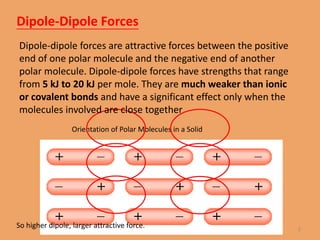
Orientation of Polar Molecules in a Solid
So higher dipole, larger attractive force.
Dipole-dipole forces are attractive forces between the positive
end of one polar molecule and the negative end of another
polar molecule. Dipole-dipole forces have strengths that range
from 5 kJ to 20 kJ per mole. They are much weaker than ionic
or covalent bonds and have a significant effect only when the
molecules involved are close together
•Polar molecules have a partial negative end and a partial
positive end.
•The partially positive end of a polar molecule is attracted to
the partially negative end of another .
4
Ion-Dipole Forces
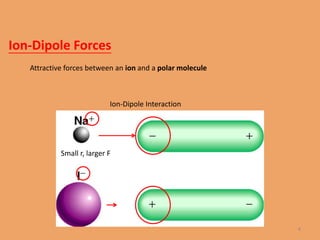
Attractive forces between an ion and a polar molecule
Ion-Dipole Interaction
Small r, larger F
•An ion-dipole force is an attractive force that results
from the electrostatic attraction between an ion and
a neutral molecule that has a dipole.
•Most commonly found in solutions. Especially
important for solutions of ionic compounds in polar
liquids.
•A positive ion (cation) attracts the partially negative
end of a neutral polar molecule.
•A negative ion (anion) attracts the partially positive
end of a neutral polar molecule.
•Ion-dipole attractions become stronger as either the
charge on the ion increases, or as the magnitude of
the dipole of the polar molecule increases.
6
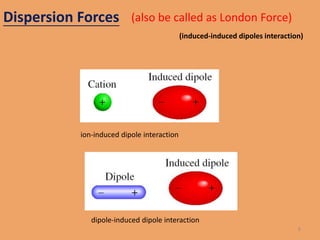
Dispersion Forces
ion-induced dipole interaction
dipole-induced dipole interaction
(also be called as London Force)
(induced-induced dipoles interaction)
7
Hydrogen Bond
A hydrogen bond is the attraction between the lone pair of an
electronegative atom and a hydrogen atom that is bonded to either
nitrogen, oxygen, or fluorine.[3] The hydrogen bond is often described
as a strong electrostatic dipole-dipole interaction. However, it also has
some features of covalent bonding: it is directional, stronger than a
van der Waals interaction, produces interatomic distances shorter
than the sum of van der Waals radius, and usually involves a limited
number of interaction partners, which can be interpreted as a kind of
valence.
It arising from interactions between rotating permanent
dipoles and from the polarizability of atoms and molecules
(induced dipoles). These induced dipoles occur when one
molecule with a permanent dipole repels another
molecule’s electrons. A molecule with permanent dipole
can induce a dipole in a similar neighboring molecule and
cause mutual attraction.
What is induced dipole ?
10
S
What type(s) of intermolecular forces exist
between each of the following molecules?
HBr
HBr is a polar molecule: dipole-dipole forces. There are also dispersion forces
between HBr molecules.
CH4
CH4 is nonpolar: dispersion forces.
SO2
SO2 is a polar molecule: dipole-dipole forces. There are also dispersion forces between
SO2 molecules.
Theory of liquids
• Bernal and scott theory
 This theory tells about the random packing of
the liquid molecules.

Intermolecular forces

  • 1.
    Many of thephysical properties of liquids (and certain solids) can be explained in terms of intermolecular forces, the forces of attraction between molecules. Intermolecular forces – Three types of forces are known to exist between neutral molecules. 1. Dipole-dipole forces 2. London (or dispersion) forces 3. Hydrogen bonding
  • 2.
    2 Dipole-Dipole Forces Orientation ofPolar Molecules in a Solid So higher dipole, larger attractive force. Dipole-dipole forces are attractive forces between the positive end of one polar molecule and the negative end of another polar molecule. Dipole-dipole forces have strengths that range from 5 kJ to 20 kJ per mole. They are much weaker than ionic or covalent bonds and have a significant effect only when the molecules involved are close together
  • 3.
    •Polar molecules havea partial negative end and a partial positive end. •The partially positive end of a polar molecule is attracted to the partially negative end of another .
  • 4.
    4 Ion-Dipole Forces Attractive forcesbetween an ion and a polar molecule Ion-Dipole Interaction Small r, larger F
  • 5.
    •An ion-dipole forceis an attractive force that results from the electrostatic attraction between an ion and a neutral molecule that has a dipole. •Most commonly found in solutions. Especially important for solutions of ionic compounds in polar liquids. •A positive ion (cation) attracts the partially negative end of a neutral polar molecule. •A negative ion (anion) attracts the partially positive end of a neutral polar molecule. •Ion-dipole attractions become stronger as either the charge on the ion increases, or as the magnitude of the dipole of the polar molecule increases.
  • 6.
    6 Dispersion Forces ion-induced dipoleinteraction dipole-induced dipole interaction (also be called as London Force) (induced-induced dipoles interaction)
  • 7.
    7 Hydrogen Bond A hydrogenbond is the attraction between the lone pair of an electronegative atom and a hydrogen atom that is bonded to either nitrogen, oxygen, or fluorine.[3] The hydrogen bond is often described as a strong electrostatic dipole-dipole interaction. However, it also has some features of covalent bonding: it is directional, stronger than a van der Waals interaction, produces interatomic distances shorter than the sum of van der Waals radius, and usually involves a limited number of interaction partners, which can be interpreted as a kind of valence.
  • 8.
    It arising frominteractions between rotating permanent dipoles and from the polarizability of atoms and molecules (induced dipoles). These induced dipoles occur when one molecule with a permanent dipole repels another molecule’s electrons. A molecule with permanent dipole can induce a dipole in a similar neighboring molecule and cause mutual attraction. What is induced dipole ?
  • 10.
    10 S What type(s) ofintermolecular forces exist between each of the following molecules? HBr HBr is a polar molecule: dipole-dipole forces. There are also dispersion forces between HBr molecules. CH4 CH4 is nonpolar: dispersion forces. SO2 SO2 is a polar molecule: dipole-dipole forces. There are also dispersion forces between SO2 molecules.
  • 11.
    Theory of liquids •Bernal and scott theory  This theory tells about the random packing of the liquid molecules.