Intermolecular Forces and
    Liquids and Solids
                               Chapter 11

Copyright © The McGraw-Hill Companies, Inc. Permission required for reproduction or display.
A phase is a homogeneous part of the system in
contact with other parts of the system but
separated from them by a well-defined boundary.
                                    2 Phases

                                Solid phase - ice

                               Liquid phase - water


                                                      11.1
Intermolecular Forces
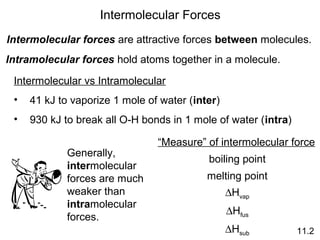
Intermolecular forces are attractive forces between molecules.
Intramolecular forces hold atoms together in a molecule.

 Intermolecular vs Intramolecular
 •   41 kJ to vaporize 1 mole of water (inter)
 •   930 kJ to break all O-H bonds in 1 mole of water (intra)

                                “Measure” of intermolecular force
             Generally,
                                           boiling point
             intermolecular
             forces are much               melting point
             weaker than                         ∆Hvap
             intramolecular
                                                 ∆Hfus
             forces.
                                                 ∆Hsub          11.2
Intermolecular Forces

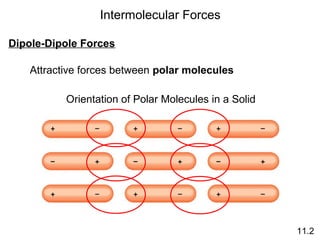
Dipole-Dipole Forces

    Attractive forces between polar molecules

           Orientation of Polar Molecules in a Solid


                                                       11.2
Intermolecular Forces

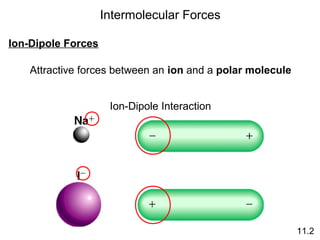
Ion-Dipole Forces

    Attractive forces between an ion and a polar molecule


                     Ion-Dipole Interaction


                                                            11.2
11.2
Intermolecular Forces
Dispersion Forces

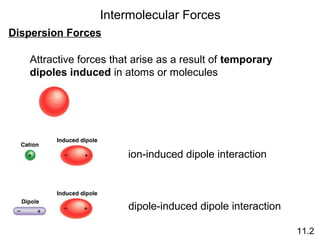
   Attractive forces that arise as a result of temporary
   dipoles induced in atoms or molecules


                        ion-induced dipole interaction


                        dipole-induced dipole interaction

                                                            11.2
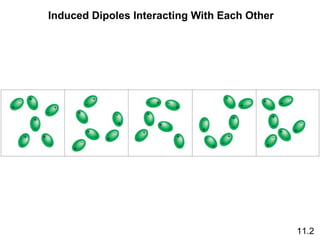
Induced Dipoles Interacting With Each Other


                                              11.2
Intermolecular Forces
Dispersion Forces Continued

Polarizability is the ease with which the electron distribution
in the atom or molecule can be distorted.

 Polarizability increases with:
 •   greater number of electrons
 •   more diffuse electron cloud

            Dispersion
            forces usually
            increase with
            molar mass.

                                                              11.2
What type(s) of intermolecular forces exist between
       each of the following molecules?


HBr
 HBr is a polar molecule: dipole-dipole forces. There are
 also dispersion forces between HBr molecules.

CH4
 CH4 is nonpolar: dispersion forces.

            S   O
SO2    O
 SO2 is a polar molecule: dipole-dipole forces. There are
 also dispersion forces between SO2 molecules.
                                                             11.2
Intermolecular Forces
Hydrogen Bond
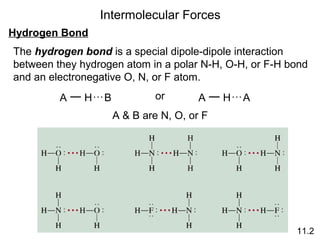
The hydrogen bond is a special dipole-dipole interaction
between they hydrogen atom in a polar N-H, O-H, or F-H bond
and an electronegative O, N, or F atom.
         A    H…B           or        A    H…A
                    A & B are N, O, or F


                                                        11.2
Hydrogen Bond


11.2
Why is the hydrogen bond considered a
“special” dipole-dipole interaction?

                  Decreasing molar mass
                  Decreasing boiling point


                                             11.2
Properties of Liquids

Surface tension is the amount of energy required to stretch
or increase the surface of a liquid by a unit area.


            Strong
        intermolecular
             forces


             High
           surface
           tension


                                                              11.3
Properties of Liquids

Cohesion is the intermolecular attraction between like molecules

Adhesion is an attraction between unlike molecules


               Adhesion


                                       Cohesion


                                                            11.3
Properties of Liquids

Viscosity is a measure of a fluid’s resistance to flow.


          Strong
      intermolecular
           forces


           High
         viscosity


                                                          11.3
Water is a Unique Substance


                               Maximum Density
                                    40C
                                     Density of Water


Ice is less dense than water


                                                        11.3
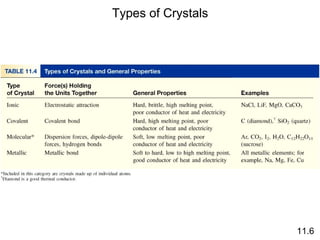
Types of Crystals
Covalent Crystals
• Lattice points occupied by atoms
• Held together by covalent bonds
• Hard, high melting point
• Poor conductor of heat and electricity
                   carbon
                   atoms


         diamond                      graphite   11.6
Types of Crystals
Metallic Crystals
• Lattice points occupied by metal atoms
• Held together by metallic bonds
• Soft to hard, low to high melting point
• Good conductors of heat and electricity
                            Cross Section of a Metallic Crystal
         nucleus &
       inner shell e-

        mobile “sea”
           of e-


                                                              11.6
Crystal Structures of Metals


                               11.6
Types of Crystals


                    11.6
Chemistry In Action: High-Temperature Superconductors
Least
                                        Order


                        Condensation
          Evaporation                  Greatest
                                        Order
T2 > T1
                                          11.8
The equilibrium vapor pressure is the vapor pressure
measured when a dynamic equilibrium exists between
condensation and evaporation

                     H2O (l)    H2O (g)


   Dynamic Equilibrium
   Rate of       Rate of
condensation
             = evaporation


                                                       11.8
Before          At
Evaporation   Equilibrium

                            11.8
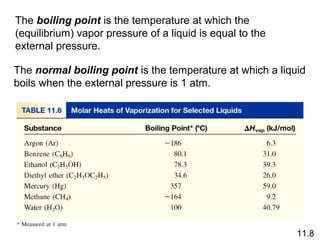
The boiling point is the temperature at which the
(equilibrium) vapor pressure of a liquid is equal to the
external pressure.

The normal boiling point is the temperature at which a liquid
boils when the external pressure is 1 atm.


                                                           11.8
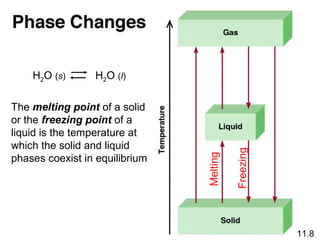
H2O (s)      H2O (l)

The melting point of a solid
or the freezing point of a
liquid is the temperature at
which the solid and liquid


                                          Freezing
                                Melting
phases coexist in equilibrium


                                                     11.8
Molar heat of fusion (∆Hfus) is the energy required to melt
1 mole of a solid substance at its freezing point.


                                                              11.8
Heating Curve


                11.8

Intermolecular forces

  • 1.
    Intermolecular Forces and Liquids and Solids Chapter 11 Copyright © The McGraw-Hill Companies, Inc. Permission required for reproduction or display.
  • 2.
    A phase isa homogeneous part of the system in contact with other parts of the system but separated from them by a well-defined boundary. 2 Phases Solid phase - ice Liquid phase - water 11.1
  • 3.
    Intermolecular Forces Intermolecular forcesare attractive forces between molecules. Intramolecular forces hold atoms together in a molecule. Intermolecular vs Intramolecular • 41 kJ to vaporize 1 mole of water (inter) • 930 kJ to break all O-H bonds in 1 mole of water (intra) “Measure” of intermolecular force Generally, boiling point intermolecular forces are much melting point weaker than ∆Hvap intramolecular ∆Hfus forces. ∆Hsub 11.2
  • 4.
    Intermolecular Forces Dipole-Dipole Forces Attractive forces between polar molecules Orientation of Polar Molecules in a Solid 11.2
  • 5.
    Intermolecular Forces Ion-Dipole Forces Attractive forces between an ion and a polar molecule Ion-Dipole Interaction 11.2
  • 6.
  • 7.
    Intermolecular Forces Dispersion Forces Attractive forces that arise as a result of temporary dipoles induced in atoms or molecules ion-induced dipole interaction dipole-induced dipole interaction 11.2
  • 8.
    Induced Dipoles InteractingWith Each Other 11.2
  • 9.
    Intermolecular Forces Dispersion ForcesContinued Polarizability is the ease with which the electron distribution in the atom or molecule can be distorted. Polarizability increases with: • greater number of electrons • more diffuse electron cloud Dispersion forces usually increase with molar mass. 11.2
  • 10.
    What type(s) ofintermolecular forces exist between each of the following molecules? HBr HBr is a polar molecule: dipole-dipole forces. There are also dispersion forces between HBr molecules. CH4 CH4 is nonpolar: dispersion forces. S O SO2 O SO2 is a polar molecule: dipole-dipole forces. There are also dispersion forces between SO2 molecules. 11.2
  • 11.
    Intermolecular Forces Hydrogen Bond Thehydrogen bond is a special dipole-dipole interaction between they hydrogen atom in a polar N-H, O-H, or F-H bond and an electronegative O, N, or F atom. A H…B or A H…A A & B are N, O, or F 11.2
  • 12.
  • 13.
    Why is thehydrogen bond considered a “special” dipole-dipole interaction? Decreasing molar mass Decreasing boiling point 11.2
  • 14.
    Properties of Liquids Surfacetension is the amount of energy required to stretch or increase the surface of a liquid by a unit area. Strong intermolecular forces High surface tension 11.3
  • 15.
    Properties of Liquids Cohesionis the intermolecular attraction between like molecules Adhesion is an attraction between unlike molecules Adhesion Cohesion 11.3
  • 16.
    Properties of Liquids Viscosityis a measure of a fluid’s resistance to flow. Strong intermolecular forces High viscosity 11.3
  • 17.
    Water is aUnique Substance Maximum Density 40C Density of Water Ice is less dense than water 11.3
  • 18.
    Types of Crystals CovalentCrystals • Lattice points occupied by atoms • Held together by covalent bonds • Hard, high melting point • Poor conductor of heat and electricity carbon atoms diamond graphite 11.6
  • 19.
    Types of Crystals MetallicCrystals • Lattice points occupied by metal atoms • Held together by metallic bonds • Soft to hard, low to high melting point • Good conductors of heat and electricity Cross Section of a Metallic Crystal nucleus & inner shell e- mobile “sea” of e- 11.6
  • 20.
  • 21.
  • 22.
    Chemistry In Action:High-Temperature Superconductors
  • 23.
    Least Order Condensation Evaporation Greatest Order T2 > T1 11.8
  • 24.
    The equilibrium vaporpressure is the vapor pressure measured when a dynamic equilibrium exists between condensation and evaporation H2O (l) H2O (g) Dynamic Equilibrium Rate of Rate of condensation = evaporation 11.8
  • 25.
    Before At Evaporation Equilibrium 11.8
  • 26.
    The boiling pointis the temperature at which the (equilibrium) vapor pressure of a liquid is equal to the external pressure. The normal boiling point is the temperature at which a liquid boils when the external pressure is 1 atm. 11.8
  • 27.
    H2O (s) H2O (l) The melting point of a solid or the freezing point of a liquid is the temperature at which the solid and liquid Freezing Melting phases coexist in equilibrium 11.8
  • 28.
    Molar heat offusion (∆Hfus) is the energy required to melt 1 mole of a solid substance at its freezing point. 11.8
  • 29.