Polar and non-polar bonds are
covalent bonds. Polar bond is unequal
sharing of electrons whereas non-polar
bonds are equal sharing of electrons.
Examples of polar bond exist in
water, ammonia, hydrochloric acid, etc.
Examples of non-polar bond are in H2,
Cl2, Br2, etc.
The type of bond can be
determined from electronegativity
difference between combining atoms.
Electronegativity difference is obtained
by the electronegativity values of
elements obtained from the periodic
table.
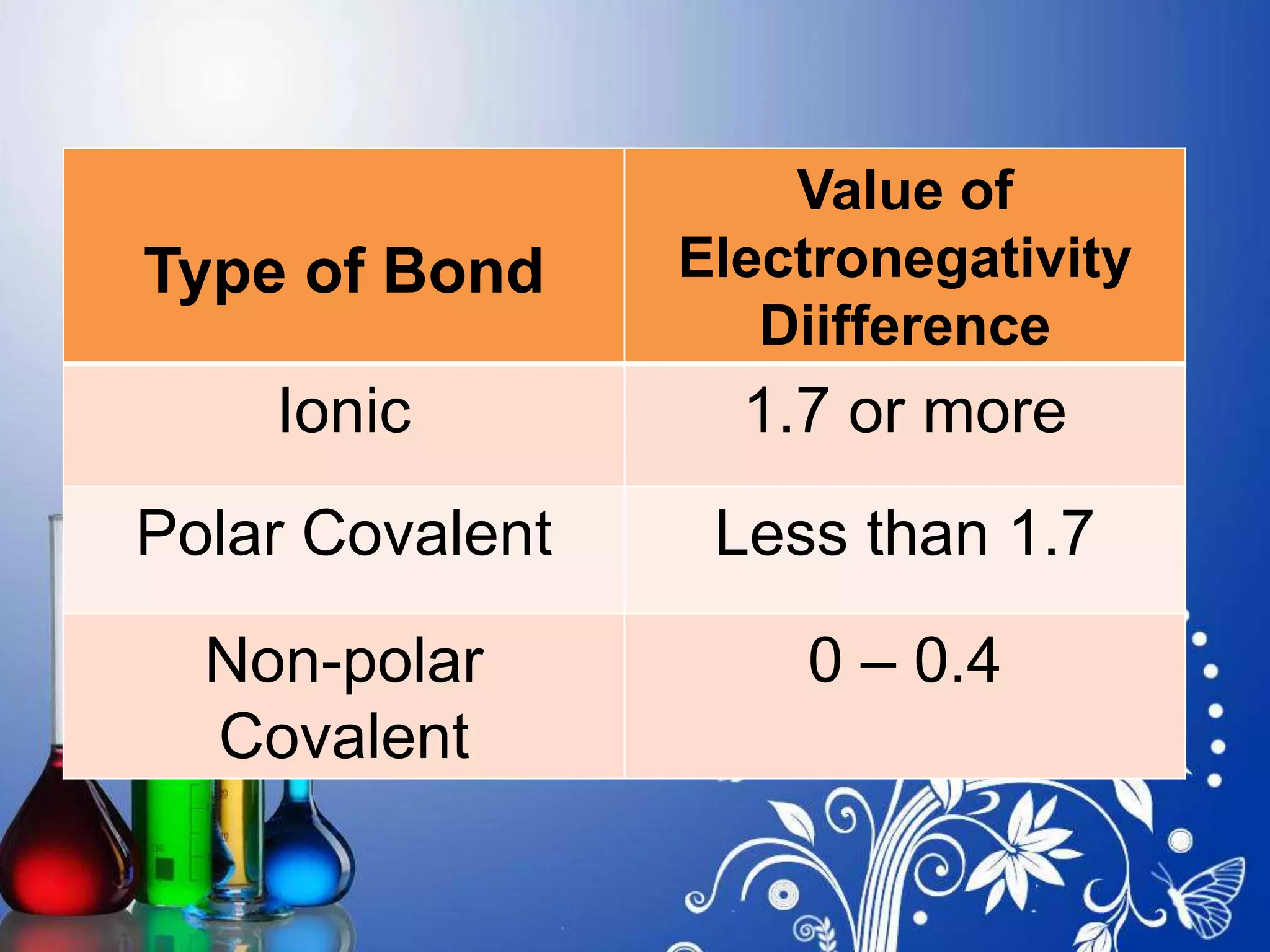
Type of Bond
Value of
Electronegativity
Diifference
Ionic 1.7 or more
Polar Covalent Less than 1.7
Non-polar
Covalent
0 – 0.4
Example:
Compoun
d
Electrone-
gativity
Value
Electrone-
gativity
Difference
Type of
Bond
MgCl2 Mg = 1.2
Cl = 3.0
1.8 Ionic
H2o H = 2.1
O = 3.5
1.4 Polar
Covalent
Br2 Br = 2.8 0 Non-polar
covalent

Polar and Non-Polar Bonds

  • 2.
    Polar and non-polarbonds are covalent bonds. Polar bond is unequal sharing of electrons whereas non-polar bonds are equal sharing of electrons. Examples of polar bond exist in water, ammonia, hydrochloric acid, etc. Examples of non-polar bond are in H2, Cl2, Br2, etc.
  • 3.
    The type ofbond can be determined from electronegativity difference between combining atoms. Electronegativity difference is obtained by the electronegativity values of elements obtained from the periodic table.
  • 4.
    Type of Bond Valueof Electronegativity Diifference Ionic 1.7 or more Polar Covalent Less than 1.7 Non-polar Covalent 0 – 0.4
  • 5.
    Example: Compoun d Electrone- gativity Value Electrone- gativity Difference Type of Bond MgCl2 Mg= 1.2 Cl = 3.0 1.8 Ionic H2o H = 2.1 O = 3.5 1.4 Polar Covalent Br2 Br = 2.8 0 Non-polar covalent