INTERMOLECULAR
FORCES
Intermolecular Forces and Its type
 These attractive forces that holds particle such molecules together
are called intermolecular forces.
 There are four general types of intermolecular forces:
hydrogen bond, dipole-dipole, ion-dipole
and dispersion or London forces. The
dispersion force is the weakest while ion-
dipole is the strongest among the intermolecular
forces.
1. Hydrogen Bond
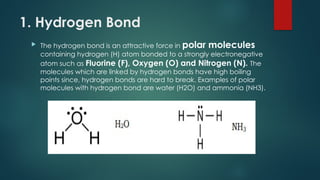
 The hydrogen bond is an attractive force in polar molecules
containing hydrogen (H) atom bonded to a strongly electronegative
atom such as Fluorine (F), Oxygen (O) and Nitrogen (N). The
molecules which are linked by hydrogen bonds have high boiling
points since, hydrogen bonds are hard to break. Examples of polar
molecules with hydrogen bond are water (H2O) and ammonia (NH3).
2. Dipole- Dipole Force
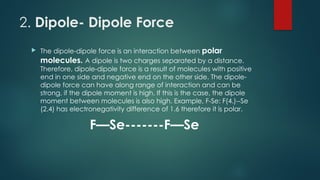
 The dipole-dipole force is an interaction between polar
molecules. A dipole is two charges separated by a distance.
Therefore, dipole-dipole force is a result of molecules with positive
end in one side and negative end on the other side. The dipole-
dipole force can have along range of interaction and can be
strong, if the dipole moment is high. If this is the case, the dipole
moment between molecules is also high. Example, F-Se: F(4.)--Se
(2.4) has electronegativity difference of 1.6 therefore it is polar.
F—Se-------F—Se
3. Ion-Dipole Force
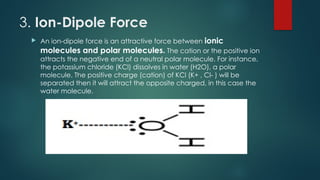
 An ion-dipole force is an attractive force between ionic
molecules and polar molecules. The cation or the positive ion
attracts the negative end of a neutral polar molecule. For instance,
the potassium chloride (KCl) dissolves in water (H2O), a polar
molecule. The positive charge (cation) of KCl (K+ , Cl- ) will be
separated then it will attract the opposite charged, in this case the
water molecule.
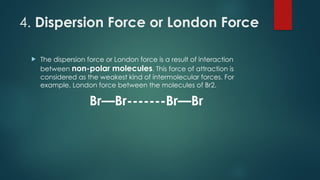
4. Dispersion Force or London Force
 The dispersion force or London force is a result of interaction
between non-polar molecules. This force of attraction is
considered as the weakest kind of intermolecular forces. For
example, London force between the molecules of Br2.
Br—Br-------Br—Br
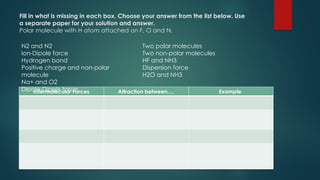
Fill in what is missing in each box. Choose your answer from the list below. Use
a separate paper for your solution and answer.
Polar molecule with H atom attached on F, O and N.
Intermolecular Forces Attraction between…. Example
N2 and N2
Ion-Dipole force
Hydrogen bond
Positive charge and non-polar
molecule
Na+ and O2
Dipole-Dipole force
Two polar molecules
Two non-polar molecules
HF and NH3
Dispersion force
H2O and NH3
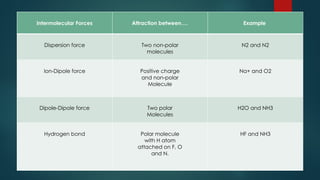
Intermolecular Forces Attraction between…. Example
Dispersion force Two non-polar
molecules
N2 and N2
Ion-Dipole force Positive charge
and non-polar
Molecule
Na+ and O2
Dipole-Dipole force Two polar
Molecules
H2O and NH3
Hydrogen bond Polar molecule
with H atom
attached on F, O
and N.
HF and NH3
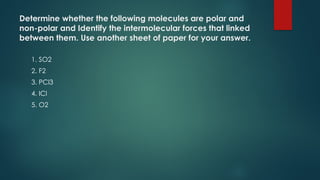
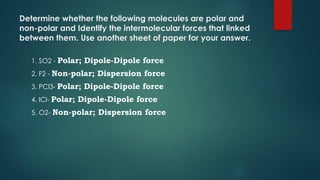
Determine whether the following molecules are polar and
non-polar and Identify the intermolecular forces that linked
between them. Use another sheet of paper for your answer.
1. SO2
2. F2
3. PCl3
4. ICl
5. O2
Determine whether the following molecules are polar and
non-polar and Identify the intermolecular forces that linked
between them. Use another sheet of paper for your answer.
1. SO2 - Polar; Dipole-Dipole force
2. F2 - Non-polar; Dispersion force
3. PCl3- Polar; Dipole-Dipole force
4. ICl- Polar; Dipole-Dipole force
5. O2- Non-polar; Dispersion force
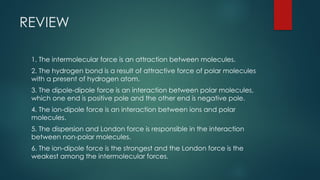
REVIEW
1. The intermolecular force is an attraction between molecules.
2. The hydrogen bond is a result of attractive force of polar molecules
with a present of hydrogen atom.
3. The dipole-dipole force is an interaction between polar molecules,
which one end is positive pole and the other end is negative pole.
4. The ion-dipole force is an interaction between ions and polar
molecules.
5. The dispersion and London force is responsible in the interaction
between non-polar molecules.
6. The ion-dipole force is the strongest and the London force is the
weakest among the intermolecular forces.

INTERMOLECULAR FORCES SENIOR HIGH SCHOOL.pptx

  • 1.
  • 2.
    Intermolecular Forces andIts type  These attractive forces that holds particle such molecules together are called intermolecular forces.  There are four general types of intermolecular forces: hydrogen bond, dipole-dipole, ion-dipole and dispersion or London forces. The dispersion force is the weakest while ion- dipole is the strongest among the intermolecular forces.
  • 3.
    1. Hydrogen Bond The hydrogen bond is an attractive force in polar molecules containing hydrogen (H) atom bonded to a strongly electronegative atom such as Fluorine (F), Oxygen (O) and Nitrogen (N). The molecules which are linked by hydrogen bonds have high boiling points since, hydrogen bonds are hard to break. Examples of polar molecules with hydrogen bond are water (H2O) and ammonia (NH3).
  • 4.
    2. Dipole- DipoleForce  The dipole-dipole force is an interaction between polar molecules. A dipole is two charges separated by a distance. Therefore, dipole-dipole force is a result of molecules with positive end in one side and negative end on the other side. The dipole- dipole force can have along range of interaction and can be strong, if the dipole moment is high. If this is the case, the dipole moment between molecules is also high. Example, F-Se: F(4.)--Se (2.4) has electronegativity difference of 1.6 therefore it is polar. F—Se-------F—Se
  • 5.
    3. Ion-Dipole Force An ion-dipole force is an attractive force between ionic molecules and polar molecules. The cation or the positive ion attracts the negative end of a neutral polar molecule. For instance, the potassium chloride (KCl) dissolves in water (H2O), a polar molecule. The positive charge (cation) of KCl (K+ , Cl- ) will be separated then it will attract the opposite charged, in this case the water molecule.
  • 6.
    4. Dispersion Forceor London Force  The dispersion force or London force is a result of interaction between non-polar molecules. This force of attraction is considered as the weakest kind of intermolecular forces. For example, London force between the molecules of Br2. Br—Br-------Br—Br
  • 7.
    Fill in whatis missing in each box. Choose your answer from the list below. Use a separate paper for your solution and answer. Polar molecule with H atom attached on F, O and N. Intermolecular Forces Attraction between…. Example N2 and N2 Ion-Dipole force Hydrogen bond Positive charge and non-polar molecule Na+ and O2 Dipole-Dipole force Two polar molecules Two non-polar molecules HF and NH3 Dispersion force H2O and NH3
  • 8.
    Intermolecular Forces Attractionbetween…. Example Dispersion force Two non-polar molecules N2 and N2 Ion-Dipole force Positive charge and non-polar Molecule Na+ and O2 Dipole-Dipole force Two polar Molecules H2O and NH3 Hydrogen bond Polar molecule with H atom attached on F, O and N. HF and NH3
  • 9.
    Determine whether thefollowing molecules are polar and non-polar and Identify the intermolecular forces that linked between them. Use another sheet of paper for your answer. 1. SO2 2. F2 3. PCl3 4. ICl 5. O2
  • 10.
    Determine whether thefollowing molecules are polar and non-polar and Identify the intermolecular forces that linked between them. Use another sheet of paper for your answer. 1. SO2 - Polar; Dipole-Dipole force 2. F2 - Non-polar; Dispersion force 3. PCl3- Polar; Dipole-Dipole force 4. ICl- Polar; Dipole-Dipole force 5. O2- Non-polar; Dispersion force
  • 11.
    REVIEW 1. The intermolecularforce is an attraction between molecules. 2. The hydrogen bond is a result of attractive force of polar molecules with a present of hydrogen atom. 3. The dipole-dipole force is an interaction between polar molecules, which one end is positive pole and the other end is negative pole. 4. The ion-dipole force is an interaction between ions and polar molecules. 5. The dispersion and London force is responsible in the interaction between non-polar molecules. 6. The ion-dipole force is the strongest and the London force is the weakest among the intermolecular forces.