MOLECULAR SHAPE AND
POLARITY
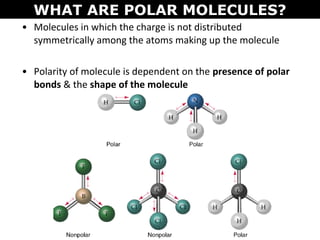
• Molecules in which the charge is not distributed
symmetrically among the atoms making up the molecule
• Polarity of molecule is dependent on the presence of polar
bonds & the shape of the molecule
WHAT ARE POLAR MOLECULES?
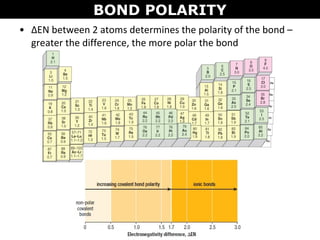
• ΔEN between 2 atoms determines the polarity of the bond –
greater the difference, the more polar the bond
BOND POLARITY
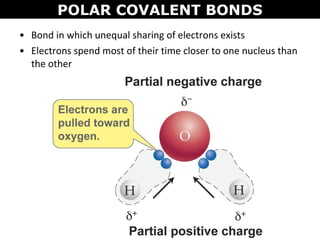
• Bond in which unequal sharing of electrons exists
• Electrons spend most of their time closer to one nucleus than
the other
POLAR COVALENT BONDS
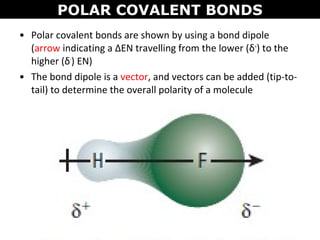
• Polar covalent bonds are shown by using a bond dipole
(arrow indicating a ΔEN travelling from the lower (δ+
) to the
higher (δ-
) EN)
• The bond dipole is a vector, and vectors can be added (tip-to-
tail) to determine the overall polarity of a molecule
POLAR COVALENT BONDS
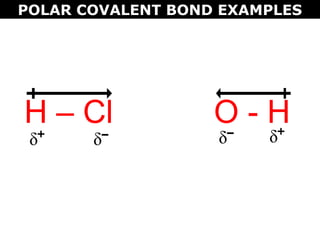
H – Cl O - H
POLAR COVALENT BOND EXAMPLES
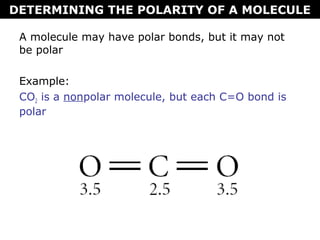
A molecule may have polar bonds, but it may not
be polar
Example:
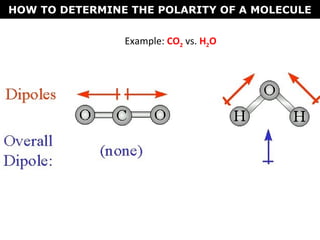
CO2 is a nonpolar molecule, but each C=O bond is
polar
DETERMINING THE POLARITY OF A MOLECULE
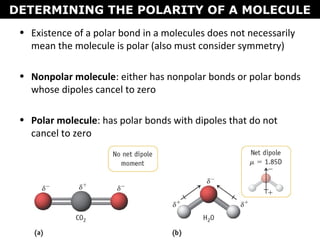
• Existence of a polar bond in a molecules does not necessarily
mean the molecule is polar (also must consider symmetry)
• Nonpolar molecule: either has nonpolar bonds or polar bonds
whose dipoles cancel to zero
• Polar molecule: has polar bonds with dipoles that do not
cancel to zero
DETERMINING THE POLARITY OF A MOLECULE
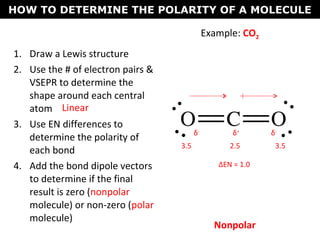
1. Draw a Lewis structure
2. Use the # of electron pairs &
VSEPR to determine the
shape around each central
atom
3. Use EN differences to
determine the polarity of
each bond
4. Add the bond dipole vectors
to determine if the final
result is zero (nonpolar
molecule) or non-zero (polar
molecule)
HOW TO DETERMINE THE POLARITY OF A MOLECULE
Example: CO2
Linear
Nonpolar
ΔEN = 1.0
3.5 2.5 3.5
δ+
δ-
δ-
1. Draw a Lewis structure
2. Use the # of electron pairs &
VSEPR to determine the
shape around each central
atom
3. Use EN differences to
determine the polarity of
each bond
4. Add the bond dipole vectors
to determine if the final
result is zero (nonpolar
molecule) or non-zero (polar
molecule)
HOW TO DETERMINE THE POLARITY OF A MOLECULE
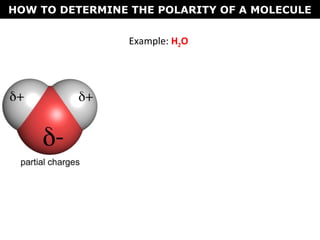
Example: H2O
Angular/bent
Polar
2.12.1
3.5
ΔEN = 1.4
HOW TO DETERMINE THE POLARITY OF A MOLECULE
Example: H2O
HOW TO DETERMINE THE POLARITY OF A MOLECULE
Example: CO2 vs. H2O
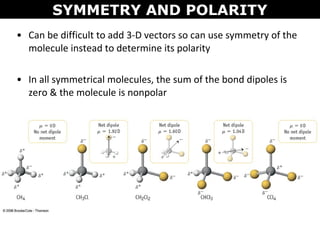
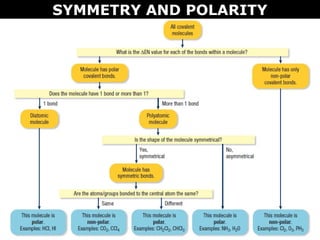
• Can be difficult to add 3-D vectors so can use symmetry of the
molecule instead to determine its polarity
• In all symmetrical molecules, the sum of the bond dipoles is
zero & the molecule is nonpolar
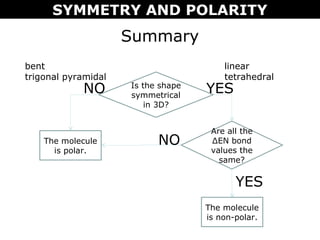
SYMMETRY AND POLARITY
Is the shape
symmetrical
in 3D?
The molecule
is polar.
Are all the
∆EN bond
values the
same?
The molecule
is non-polar.
NO YES
bent
trigonal pyramidal
linear
tetrahedral
NO
YES
SYMMETRY AND POLARITY
Summary
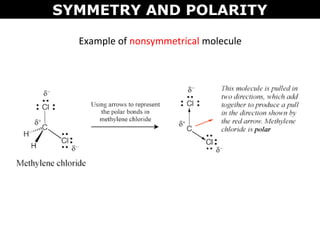
SYMMETRY AND POLARITY
Example of nonsymmetrical molecule
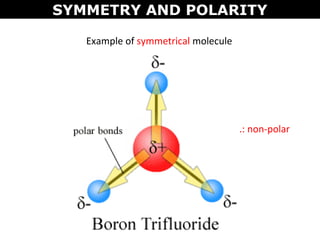
SYMMETRY AND POLARITY
Example of symmetrical molecule
.: non-polar
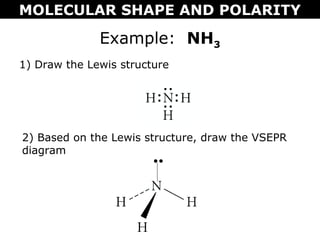
Example: NH3
1) Draw the Lewis structure
2) Based on the Lewis structure, draw the VSEPR
diagram
MOLECULAR SHAPE AND POLARITY
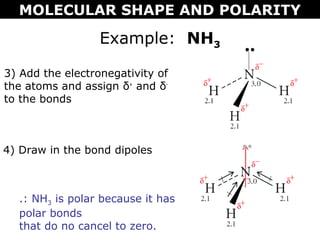
3) Add the electronegativity of
the atoms and assign δ+
and δ-
to the bonds
.: NH3 is polar because it has
polar bonds
that do no cancel to zero.
4) Draw in the bond dipoles
Example: NH3
MOLECULAR SHAPE AND POLARITY
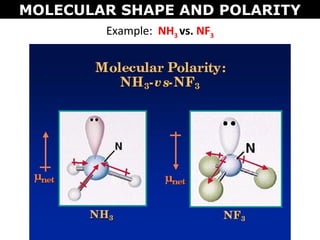
Example: NH3 vs. NF3
MOLECULAR SHAPE AND POLARITY
Homework
• Page 221 # 1 – 7
• Page 229 # 1 – 8
MOLECULAR SHAPE AND POLARITY

Tang 08 polarity

  • 1.
  • 2.
    • Molecules inwhich the charge is not distributed symmetrically among the atoms making up the molecule • Polarity of molecule is dependent on the presence of polar bonds & the shape of the molecule WHAT ARE POLAR MOLECULES?
  • 3.
    • ΔEN between2 atoms determines the polarity of the bond – greater the difference, the more polar the bond BOND POLARITY
  • 4.
    • Bond inwhich unequal sharing of electrons exists • Electrons spend most of their time closer to one nucleus than the other POLAR COVALENT BONDS
  • 5.
    • Polar covalentbonds are shown by using a bond dipole (arrow indicating a ΔEN travelling from the lower (δ+ ) to the higher (δ- ) EN) • The bond dipole is a vector, and vectors can be added (tip-to- tail) to determine the overall polarity of a molecule POLAR COVALENT BONDS
  • 6.
    H – ClO - H POLAR COVALENT BOND EXAMPLES
  • 7.
    A molecule mayhave polar bonds, but it may not be polar Example: CO2 is a nonpolar molecule, but each C=O bond is polar DETERMINING THE POLARITY OF A MOLECULE
  • 8.
    • Existence ofa polar bond in a molecules does not necessarily mean the molecule is polar (also must consider symmetry) • Nonpolar molecule: either has nonpolar bonds or polar bonds whose dipoles cancel to zero • Polar molecule: has polar bonds with dipoles that do not cancel to zero DETERMINING THE POLARITY OF A MOLECULE
  • 9.
    1. Draw aLewis structure 2. Use the # of electron pairs & VSEPR to determine the shape around each central atom 3. Use EN differences to determine the polarity of each bond 4. Add the bond dipole vectors to determine if the final result is zero (nonpolar molecule) or non-zero (polar molecule) HOW TO DETERMINE THE POLARITY OF A MOLECULE Example: CO2 Linear Nonpolar ΔEN = 1.0 3.5 2.5 3.5 δ+ δ- δ-
  • 10.
    1. Draw aLewis structure 2. Use the # of electron pairs & VSEPR to determine the shape around each central atom 3. Use EN differences to determine the polarity of each bond 4. Add the bond dipole vectors to determine if the final result is zero (nonpolar molecule) or non-zero (polar molecule) HOW TO DETERMINE THE POLARITY OF A MOLECULE Example: H2O Angular/bent Polar 2.12.1 3.5 ΔEN = 1.4
  • 11.
    HOW TO DETERMINETHE POLARITY OF A MOLECULE Example: H2O
  • 12.
    HOW TO DETERMINETHE POLARITY OF A MOLECULE Example: CO2 vs. H2O
  • 13.
    • Can bedifficult to add 3-D vectors so can use symmetry of the molecule instead to determine its polarity • In all symmetrical molecules, the sum of the bond dipoles is zero & the molecule is nonpolar SYMMETRY AND POLARITY
  • 14.
  • 15.
    Is the shape symmetrical in3D? The molecule is polar. Are all the ∆EN bond values the same? The molecule is non-polar. NO YES bent trigonal pyramidal linear tetrahedral NO YES SYMMETRY AND POLARITY Summary
  • 16.
    SYMMETRY AND POLARITY Exampleof nonsymmetrical molecule
  • 17.
    SYMMETRY AND POLARITY Exampleof symmetrical molecule .: non-polar
  • 18.
    Example: NH3 1) Drawthe Lewis structure 2) Based on the Lewis structure, draw the VSEPR diagram MOLECULAR SHAPE AND POLARITY
  • 19.
    3) Add theelectronegativity of the atoms and assign δ+ and δ- to the bonds .: NH3 is polar because it has polar bonds that do no cancel to zero. 4) Draw in the bond dipoles Example: NH3 MOLECULAR SHAPE AND POLARITY
  • 20.
    Example: NH3 vs.NF3 MOLECULAR SHAPE AND POLARITY
  • 21.
    Homework • Page 221# 1 – 7 • Page 229 # 1 – 8 MOLECULAR SHAPE AND POLARITY

Editor's Notes

  • #2 http://www.youtube.com/watch?v=rMIPyOuQu08&feature=related