Part 3
Truncation Errors


                    1
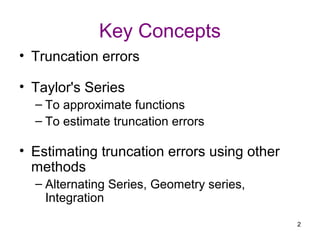
Key Concepts
• Truncation errors

• Taylor's Series
  – To approximate functions
  – To estimate truncation errors

• Estimating truncation errors using other
  methods
  – Alternating Series, Geometry series,
    Integration
                                             2
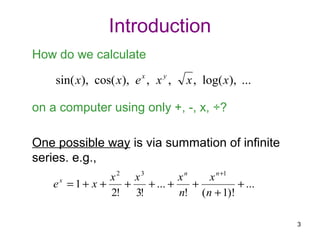
Introduction
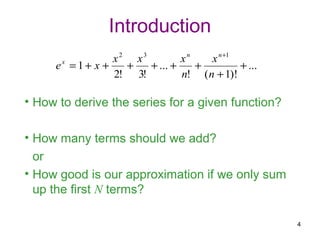
How do we calculate

    sin( x), cos( x), e x , x y ,   x , log( x), ...

on a computer using only +, -, x, ÷?

One possible way is via summation of infinite
series. e.g.,
                x2 x3         xn    x n +1
   ex = 1 + x +   +   + ... +    +         + ...
                2! 3!         n! ( n + 1)!

                                                       3
Introduction
               x2 x3         xn    x n +1
     e =1+ x +
      x
                 +   + ... +    +         + ...
               2! 3!         n! ( n + 1)!

• How to derive the series for a given function?

• How many terms should we add?
  or
• How good is our approximation if we only sum
  up the first N terms?

                                                   4
A general form of approximation is in
terms of Taylor Series.


                                        5
Taylor's Theorem
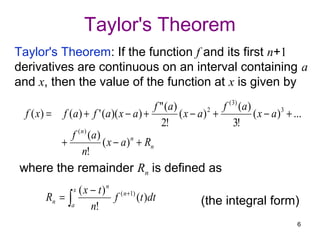
Taylor's Theorem: If the function f and its first n+1
derivatives are continuous on an interval containing a
and x, then the value of the function at x is given by
                                           f " (a)              f ( 3) ( a )
  f ( x) = f (a) + f ' (a)( x − a ) +              ( x − a) 2 +              ( x − a )3 + ...
                                             2!                     3!
              f ( n ) (a)
           +              ( x − a ) n + Rn
                  n!
where the remainder Rn is defined as
                    x   ( x − t ) n ( n +1)
        Rn =    ∫a          n!
                                    f       (t )dt         (the integral form)
                                                                                           6
Derivative or Lagrange Form of the remainder


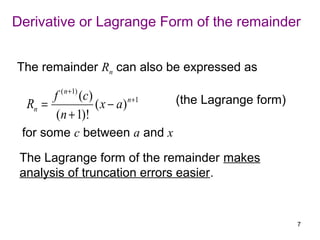
The remainder Rn can also be expressed as
           ( n +1)
       f     (c )                  (the Lagrange form)
  Rn =            ( x − a ) n +1
        (n + 1)!
 for some c between a and x

 The Lagrange form of the remainder makes
 analysis of truncation errors easier.


                                                         7
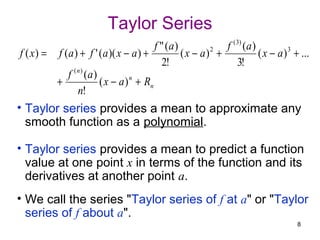
Taylor Series
                                            f " (a )             f ( 3) ( a )
f ( x ) = f ( a ) + f ' ( a )( x − a ) +             ( x − a)2 +              ( x − a ) 3 + ...
                                               2!                    3!
              f ( n ) (a )
          +                ( x − a ) n + Rn
                  n!
• Taylor series provides a mean to approximate any
  smooth function as a polynomial.

• Taylor series provides a mean to predict a function
  value at one point x in terms of the function and its
  derivatives at another point a.
• We call the series "Taylor series of f at a" or "Taylor
  series of f about a".
                                                                                           8
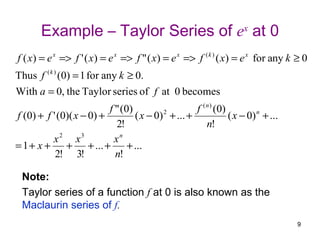
Example – Taylor Series of ex at 0
f ( x) = e x => f ' ( x) = e x => f " ( x) = e x => f ( k ) ( x) = e x for any k ≥ 0
Thus f ( k ) (0) = 1 for any k ≥ 0.
With a = 0, the Taylor series of f at 0 becomes
                          f " ( 0)                    f ( n ) (0)
f (0) + f ' (0)( x − 0) +          ( x − 0) 2 + ... +             ( x − 0) n + ...
                             2!                           n!
          x 2 x3            xn
= 1 + x + + + ... + + ...
           2! 3!            n!

  Note:
  Taylor series of a function f at 0 is also known as the
  Maclaurin series of f.
                                                                                     9
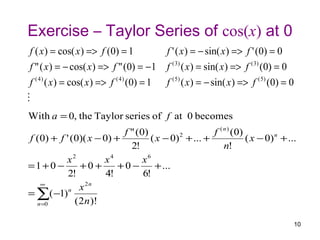
Exercise – Taylor Series of cos(x) at 0
 f ( x ) = cos( x ) => f (0) = 1               f ' ( x ) = − sin( x ) => f ' (0) = 0
 f " ( x ) = − cos( x ) => f " (0) = −1        f ( 3) ( x ) = sin( x ) => f ( 3) (0) = 0
 f ( 4 ) ( x ) = cos( x ) => f ( 4 ) (0) = 1   f ( 5) ( x ) = − sin( x ) => f ( 5) (0) = 0

With a = 0, the Taylor series of f at 0 becomes
                          f " ( 0)                  f ( n ) ( 0)
f (0) + f ' (0)( x − 0) +          ( x − 0) + ... +
                                           2
                                                                 ( x − 0) n + ...
                            2!                          n!
          x2         x4          x6
=1+ 0 −        +0 +      +0 −        + ...
           2!         4!         6!
   ∞            2n
           n x
= ∑( −1)
  n =0       ( 2n )!

                                                                                             10
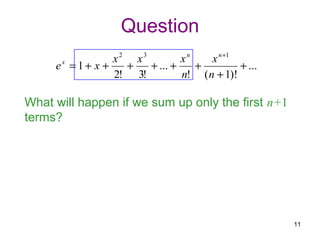
Question
                  x2 x3         xn    x n +1
     ex = 1 + x +   +   + ... +    +         + ...
                  2! 3!         n! ( n + 1)!

What will happen if we sum up only the first n+1
terms?


                                                     11
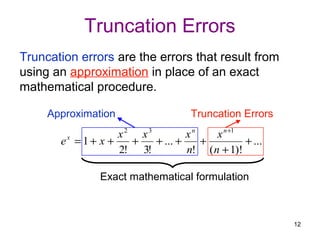
Truncation Errors
Truncation errors are the errors that result from
using an approximation in place of an exact
mathematical procedure.

     Approximation                  Truncation Errors
                    x2 x3         xn    x n +1
       ex = 1 + x +   +   + ... +    +         + ...
                    2! 3!         n! ( n + 1)!

               Exact mathematical formulation


                                                        12
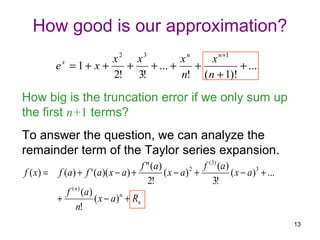
How good is our approximation?
                        x2 x3         xn    x n +1
           ex = 1 + x +   +   + ... +    +         + ...
                        2! 3!         n! ( n + 1)!

How big is the truncation error if we only sum up
the first n+1 terms?
To answer the question, we can analyze the
remainder term of the Taylor series expansion.
                                        f " (a)              f ( 3) ( a )
f ( x) = f (a) + f ' (a)( x − a) +              ( x − a) 2 +              ( x − a)3 + ...
                                          2!                     3!
            f ( n ) (a)
         +              ( x − a) n + Rn
                n!
                                                                                            13
Analyzing the remainder term of the
   Taylor series expansion of f(x)=ex at 0
The remainder Rn in the Lagrange form is
         ( n +1)
      f     (c )
 Rn =            ( x − a ) n +1
       (n + 1)!                 for some c between a and x

For f(x) = ex and a = 0, we have f(n+1)(x) = ex. Thus
        ec
 Rn =          x n +1 for some c in [0 , x]
      (n + 1)!
             x
        e               We can estimate the largest possible
    ≤          x n +1   truncation error through analyzing Rn.
      (n + 1)!
                                                             14
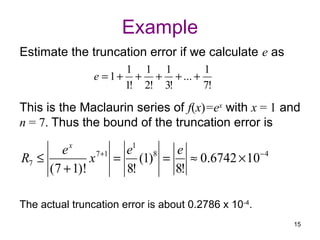
Example
Estimate the truncation error if we calculate e as
                       1 1 1        1
                e = 1 + + + + ... +
                       1! 2! 3!     7!

This is the Maclaurin series of f(x)=ex with x = 1 and
n = 7. Thus the bound of the truncation error is

       ex      7 +1 e1 8 e                −4
R7 ≤          x = (1) =     ≈ 0.6742 × 10
     (7 + 1)!       8!   8!

The actual truncation error is about 0.2786 x 10⁻⁴.
                                                      15
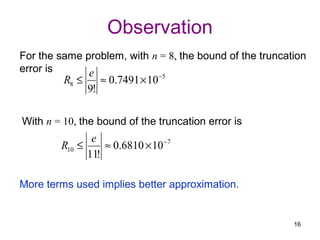
Observation
For the same problem, with n = 8, the bound of the truncation
error is      e
         R8 ≤        ≈ 0.7491 × 10⁻⁵
                9!

With n = 10, the bound of the truncation error is
               e
        R10 ≤     ≈ 0.6810 × 10⁻⁷
              11!

More terms used implies better approximation.


                                                          16
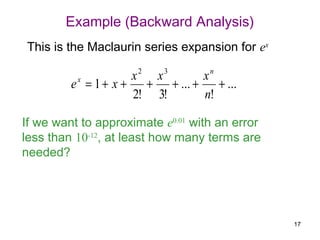
Example (Backward Analysis)
This is the Maclaurin series expansion for ex

                      x2 x3      xn
         e x = 1 + x + + + ... +    + ...
                      2! 3!      n!

If we want to approximate e0.01 with an error
less than 10-12, at least how many terms are
needed?


                                                17
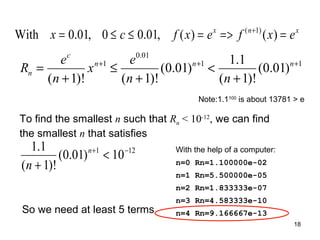
With x = 0.01, 0 ≤ c ≤ 0.01,       f ( x ) = e x => f ( n +1) ( x ) = e x
         ec      n +1    e0.01        n +1    1.1
 Rn =           x ≤             (0.01) <             (0.01) n +1
      ( n + 1)!       ( n + 1)!            ( n + 1)!
                                          Note:1.1100 is about 13781 > e

To find the smallest n such that Rn < 10-12, we can find
the smallest n that satisfies
    1.1          n +1  −12         With the help of a computer:
           (0.01) < 10
 ( n + 1)!                         n=0 Rn=1.100000e-02
                                   n=1 Rn=5.500000e-05
                                   n=2 Rn=1.833333e-07
                                   n=3 Rn=4.583333e-10
 So we need at least 5 terms       n=4 Rn=9.166667e-13
                                                                       18
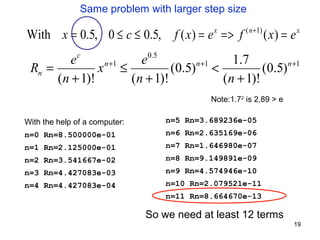
Same problem with larger step size

With x = 0.5, 0 ≤ c ≤ 0.5,          f ( x ) = e x => f ( n +1) ( x ) = e x
          ec     n +1    e0.5        n +1    1.7
 Rn =           x ≤             (0.5) <             (0.5) n +1
      ( n + 1)!       ( n + 1)!           ( n + 1)!
                                               Note:1.72 is 2.89 > e

With the help of a computer:       n=5 Rn=3.689236e-05
n=0 Rn=8.500000e-01                n=6 Rn=2.635169e-06
n=1 Rn=2.125000e-01                n=7 Rn=1.646980e-07
n=2 Rn=3.541667e-02                n=8 Rn=9.149891e-09
n=3 Rn=4.427083e-03                n=9 Rn=4.574946e-10
n=4 Rn=4.427083e-04                n=10 Rn=2.079521e-11
                                   n=11 Rn=8.664670e-13

                               So we need at least 12 terms
                                                                        19
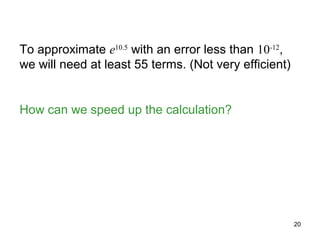
To approximate e10.5 with an error less than 10-12,
we will need at least 55 terms. (Not very efficient)


How can we speed up the calculation?


                                                       20
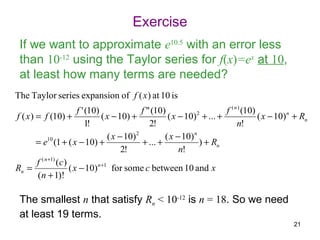
Exercise
 If we want to approximate e10.5 with an error less
 than 10-12 using the Taylor series for f(x)=ex at 10,
 at least how many terms are needed?
The Taylor series expansion of f ( x ) at 10 is
                           f ' (10)               f " (10)                   f ( n ) (10)
f ( x ) = f (10) +                  ( x − 10) +            ( x − 10) + ... +
                                                                     2
                                                                                          ( x − 10) n + Rn
                               1!                    2!                           n!
                                      ( x − 10) 2         ( x − 10) n
        = e (1 + ( x − 10) +
             10
                                                  + ... +             ) + Rn
                                           2!                  n!
        f ( n +1) ( c )
Rn =                    ( x − 10) n +1 for some c between 10 and x
        ( n + 1)!

 The smallest n that satisfy Rn < 10-12 is n = 18. So we need
 at least 19 terms.
                                                                                                     21
Observation
• A Taylor series converges rapidly near the
  point of expansion and slowly (or not at
  all) at more remote points.


                                           22
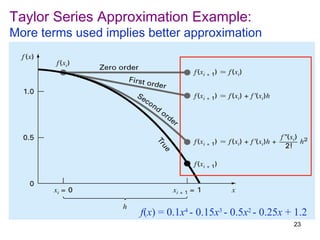
Taylor Series Approximation Example:
More terms used implies better approximation


                      f(x) = 0.1x4 - 0.15x3 - 0.5x2 - 0.25x + 1.2
                                                             23
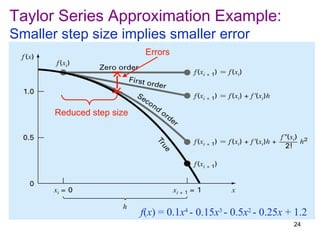
Taylor Series Approximation Example:
Smaller step size implies smaller error
                            Errors


       Reduced step size


                           f(x) = 0.1x4 - 0.15x3 - 0.5x2 - 0.25x + 1.2
                                                                  24
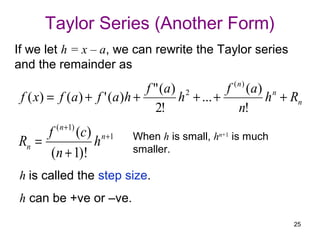
Taylor Series (Another Form)
If we let h = x – a, we can rewrite the Taylor series
and the remainder as
                                               (n)
                             f " (a) 2        f (a) n
 f ( x) = f (a) + f ' (a)h +        h + ... +      h + Rn
                               2!               n!
     f ( n +1) (c) n +1   When h is small, hn+1 is much
Rn =              h
      (n + 1)!            smaller.

h is called the step size.
h can be +ve or –ve.
                                                          25
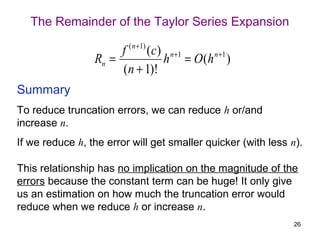
The Remainder of the Taylor Series Expansion

                      f ( n +1) ( c) n +1   n +1
                 Rn =               h = O (h )
                      ( n + 1)!
Summary
To reduce truncation errors, we can reduce h or/and
increase n.
If we reduce h, the error will get smaller quicker (with less n).

This relationship has no implication on the magnitude of the
errors because the constant term can be huge! It only give
us an estimation on how much the truncation error would
reduce when we reduce h or increase n.
                                                               26
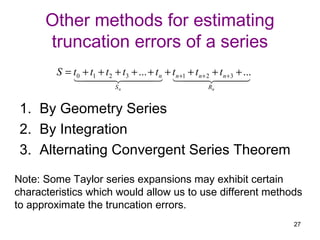
Other methods for estimating
      truncation errors of a series
        S = t0 + t1 + t 2 + t3 + ... + t n + t n +1 + t n + 2 + t n +3 + ...
                                                       
                            Sn                              Rn


 1. By Geometry Series
 2. By Integration
 3. Alternating Convergent Series Theorem
Note: Some Taylor series expansions may exhibit certain
characteristics which would allow us to use different methods
to approximate the truncation errors.
                                                                               27
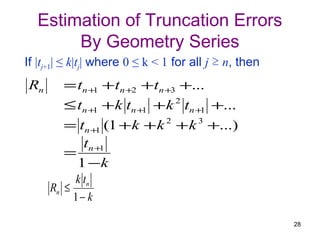
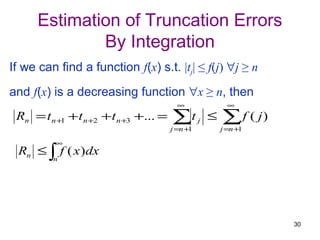
Estimation of Truncation Errors
       By Geometry Series
If |tj+1| ≤ k|tj| where 0 ≤ k < 1 for all j ≥ n, then
Rn      = tn +1 + tn +2 + tn +3 +...
        ≤ tn +1 + k tn +1 + k 2 tn +1 +...
        = tn +1 (1 + k + k 2 + k 3 +...)
           tn +1
        =
          1 −k
          k tn
     Rn ≤
          1− k

                                                        28
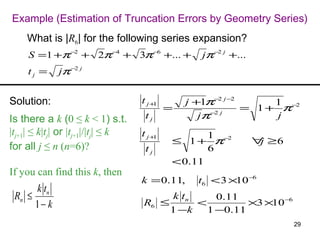
Example (Estimation of Truncation Errors by Geometry Series)
    What is |R6| for the following series expansion?
     S =1 +π −2 + 2π −4 + 3π −6 +... +              jπ −2 j +...
     tj =    jπ −2 j


Solution:                           t j +1       j +1π−2 j −2      1
                                             =                = 1 + π−2
Is there a k (0 ≤ k < 1) s.t.        tj             jπ−2 j         j
|tj+1| ≤ k|tj| or |tj+1|/|tj| ≤ k   t j +1          1
                                             ≤ 1 + π−2             ∀ ≥6
                                                                    j
for all j ≤ n (n=6)?                 tj             6
                                             < 0.11
If you can find this k, then
                                    k = 0.11,      t6 < 3 ×10 −6
      k tn
 Rn ≤                                    k tn     0.11
      1− k                          R6 ≤      <         ×3 ×10 −6
                                         1 −k   1 −0.11
                                                                          29
Estimation of Truncation Errors
              By Integration
If we can find a function f(x) s.t. |tj| ≤ f(j) ∀j ≥ n
and f(x) is a decreasing function ∀x ≥ n, then
                                          ∞                 ∞
 Rn = t n +1 + t n +2 + t n +3 +... =   ∑t
                                        j =n +1
                                                  j   ≤   ∑ f ( j)
                                                          j =n +1

          ∞
 Rn ≤ ∫ f ( x )dx
         n


                                                                     30
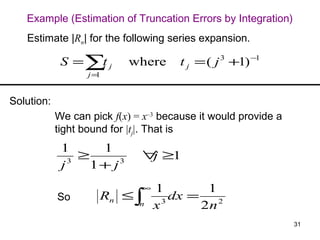
Example (Estimation of Truncation Errors by Integration)
   Estimate |Rn| for the following series expansion.

             S =∑ j
                 t         where       t j = ( j 3 +1) −1
                   j=1


Solution:
            We can pick f(x) = x–3 because it would provide a
            tight bound for |tj|. That is
             1      1
                 ≥            ∀ ≥1
                               j
             j 3
                   1+ j3
                              ∞   1         1
            So       Rn ≤ ∫         3
                                      dx =
                              n   x        2n 2
                                                                31
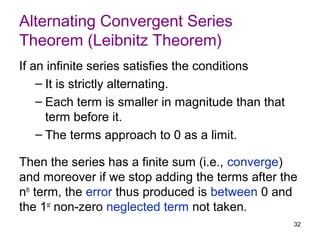
Alternating Convergent Series
Theorem (Leibnitz Theorem)
If an infinite series satisfies the conditions
    – It is strictly alternating.
    – Each term is smaller in magnitude than that
      term before it.
    – The terms approach to 0 as a limit.

Then the series has a finite sum (i.e., converge)
and moreover if we stop adding the terms after the
nth term, the error thus produced is between 0 and
the 1st non-zero neglected term not taken.
                                                    32
Alternating Convergent Series Theorem
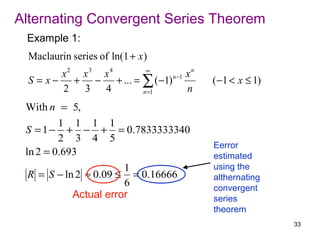
 Example 1:
  Maclaurin series of ln(1 + x )
                       ∞
         x2 x3 x4                  xn
  S = x − + − + ... = ∑ ( −1) n −1      ( −1 < x ≤ 1)
         2  3 4       n =1         n
 With n = 5,
         1 1 1 1
 S = 1 − + − + = 0.7833333340
         2 3 4 5
                                        Eerror
 ln 2 = 0.693                           estimated
                       1                using the
  R = S − ln 2 ≈ 0.09 ≤ = 0.16666       althernating
                       6                convergent
            Actual error                series
                                        theorem
                                                        33
Alternating Convergent Series Theorem
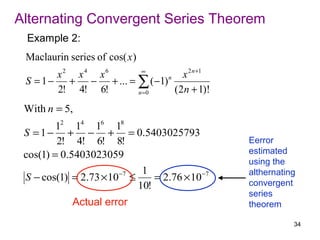
 Example 2:
 Maclaurin series of cos( x )
        x2 x4 x6      ∞
                                  x 2 n +1
 S = 1 − + − + ... = ∑ ( −1) n
        2! 4! 6!     n =0      ( 2n + 1)!
 With n = 5,
         12 14 16 18
 S = 1 − + − + = 0.5403025793
         2! 4! 6! 8!                          Eerror
 cos(1) = 0.5403023059                        estimated
                                              using the
                       −7  1                  althernating
 S − cos(1) = 2.73 × 10 ≤     = 2.76 × 10⁻⁷
                          10!                 convergent
                                              series
            Actual error                      theorem

                                                         34
Exercise
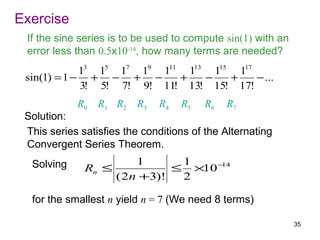
 If the sine series is to be used to compute sin(1) with an
 error less than 0.5x10⁻¹⁴, how many terms are needed?
             13 15 17 19 111 113 115 117
 sin(1) = 1 − + − + −       +   −   +    − ...
             3! 5! 7! 9! 11! 13! 15! 17!
            R0   R1 R2    R3   R4   R5   R6   R7
 Solution:
 This series satisfies the conditions of the Alternating
 Convergent Series Theorem.
  Solving              1      1
              Rn ≤           ≤ ×10 −14
                   ( 2n +3)!  2

  for the smallest n yield n = 7 (We need 8 terms)

                                                              35
Exercise
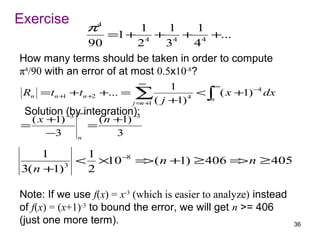
                 π4        1      1     1
                    =1 + 4 + 4 + 4 +...
               90          2     3     4
How many terms should be taken in order to compute
π4/90 with an error of at most 0.5x10⁻⁸?
                             ∞
                                      1         ∞
 Rn = tn +1 +tn +2   +... = ∑               < ∫ ( x +1) −4 dx
                            j= +
                              n 1 ( j +1) 4    n

 Solution −3 ∞integration):
          (by            −
  ( x +1)          ( n +1)3
=                =
      −3     n
                       3

    1       1
           < ×10 −8 = ( n +1) ≥ 406 = n ≥ 405
                     >               >
3( n +1) 3
            2

Note: If we use f(x) = x-3 (which is easier to analyze) instead
of f(x) = (x+1)-3 to bound the error, we will get n >= 406
(just one more term).                                             36
Summary
• Understand what truncation errors are

• Taylor's Series
  – Derive Taylor's series for a "smooth" function
  – Understand the characteristics of Taylor's Series
    approximation
  – Estimate truncation errors using the remainder term

• Estimating truncation errors using other methods
  – Alternating Series, Geometry series, Integration

                                                          37

03 truncation errors

  • 1.
  • 2.
    Key Concepts • Truncationerrors • Taylor's Series – To approximate functions – To estimate truncation errors • Estimating truncation errors using other methods – Alternating Series, Geometry series, Integration 2
  • 3.
    Introduction How do wecalculate sin( x), cos( x), e x , x y , x , log( x), ... on a computer using only +, -, x, ÷? One possible way is via summation of infinite series. e.g., x2 x3 xn x n +1 ex = 1 + x + + + ... + + + ... 2! 3! n! ( n + 1)! 3
  • 4.
    Introduction x2 x3 xn x n +1 e =1+ x + x + + ... + + + ... 2! 3! n! ( n + 1)! • How to derive the series for a given function? • How many terms should we add? or • How good is our approximation if we only sum up the first N terms? 4
  • 5.
    A general formof approximation is in terms of Taylor Series. 5
  • 6.
    Taylor's Theorem Taylor's Theorem:If the function f and its first n+1 derivatives are continuous on an interval containing a and x, then the value of the function at x is given by f " (a) f ( 3) ( a ) f ( x) = f (a) + f ' (a)( x − a ) + ( x − a) 2 + ( x − a )3 + ... 2! 3! f ( n ) (a) + ( x − a ) n + Rn n! where the remainder Rn is defined as x ( x − t ) n ( n +1) Rn = ∫a n! f (t )dt (the integral form) 6
  • 7.
    Derivative or LagrangeForm of the remainder The remainder Rn can also be expressed as ( n +1) f (c ) (the Lagrange form) Rn = ( x − a ) n +1 (n + 1)! for some c between a and x The Lagrange form of the remainder makes analysis of truncation errors easier. 7
  • 8.
    Taylor Series f " (a ) f ( 3) ( a ) f ( x ) = f ( a ) + f ' ( a )( x − a ) + ( x − a)2 + ( x − a ) 3 + ... 2! 3! f ( n ) (a ) + ( x − a ) n + Rn n! • Taylor series provides a mean to approximate any smooth function as a polynomial. • Taylor series provides a mean to predict a function value at one point x in terms of the function and its derivatives at another point a. • We call the series "Taylor series of f at a" or "Taylor series of f about a". 8
  • 9.
    Example – TaylorSeries of ex at 0 f ( x) = e x => f ' ( x) = e x => f " ( x) = e x => f ( k ) ( x) = e x for any k ≥ 0 Thus f ( k ) (0) = 1 for any k ≥ 0. With a = 0, the Taylor series of f at 0 becomes f " ( 0) f ( n ) (0) f (0) + f ' (0)( x − 0) + ( x − 0) 2 + ... + ( x − 0) n + ... 2! n! x 2 x3 xn = 1 + x + + + ... + + ... 2! 3! n! Note: Taylor series of a function f at 0 is also known as the Maclaurin series of f. 9
  • 10.
    Exercise – TaylorSeries of cos(x) at 0 f ( x ) = cos( x ) => f (0) = 1 f ' ( x ) = − sin( x ) => f ' (0) = 0 f " ( x ) = − cos( x ) => f " (0) = −1 f ( 3) ( x ) = sin( x ) => f ( 3) (0) = 0 f ( 4 ) ( x ) = cos( x ) => f ( 4 ) (0) = 1 f ( 5) ( x ) = − sin( x ) => f ( 5) (0) = 0  With a = 0, the Taylor series of f at 0 becomes f " ( 0) f ( n ) ( 0) f (0) + f ' (0)( x − 0) + ( x − 0) + ... + 2 ( x − 0) n + ... 2! n! x2 x4 x6 =1+ 0 − +0 + +0 − + ... 2! 4! 6! ∞ 2n n x = ∑( −1) n =0 ( 2n )! 10
  • 11.
    Question x2 x3 xn x n +1 ex = 1 + x + + + ... + + + ... 2! 3! n! ( n + 1)! What will happen if we sum up only the first n+1 terms? 11
  • 12.
    Truncation Errors Truncation errorsare the errors that result from using an approximation in place of an exact mathematical procedure. Approximation Truncation Errors x2 x3 xn x n +1 ex = 1 + x + + + ... + + + ... 2! 3! n! ( n + 1)! Exact mathematical formulation 12
  • 13.
    How good isour approximation? x2 x3 xn x n +1 ex = 1 + x + + + ... + + + ... 2! 3! n! ( n + 1)! How big is the truncation error if we only sum up the first n+1 terms? To answer the question, we can analyze the remainder term of the Taylor series expansion. f " (a) f ( 3) ( a ) f ( x) = f (a) + f ' (a)( x − a) + ( x − a) 2 + ( x − a)3 + ... 2! 3! f ( n ) (a) + ( x − a) n + Rn n! 13
  • 14.
    Analyzing the remainderterm of the Taylor series expansion of f(x)=ex at 0 The remainder Rn in the Lagrange form is ( n +1) f (c ) Rn = ( x − a ) n +1 (n + 1)! for some c between a and x For f(x) = ex and a = 0, we have f(n+1)(x) = ex. Thus ec Rn = x n +1 for some c in [0 , x] (n + 1)! x e We can estimate the largest possible ≤ x n +1 truncation error through analyzing Rn. (n + 1)! 14
  • 15.
    Example Estimate the truncationerror if we calculate e as 1 1 1 1 e = 1 + + + + ... + 1! 2! 3! 7! This is the Maclaurin series of f(x)=ex with x = 1 and n = 7. Thus the bound of the truncation error is ex 7 +1 e1 8 e −4 R7 ≤ x = (1) = ≈ 0.6742 × 10 (7 + 1)! 8! 8! The actual truncation error is about 0.2786 x 10⁻⁴. 15
  • 16.
    Observation For the sameproblem, with n = 8, the bound of the truncation error is e R8 ≤ ≈ 0.7491 × 10⁻⁵ 9! With n = 10, the bound of the truncation error is e R10 ≤ ≈ 0.6810 × 10⁻⁷ 11! More terms used implies better approximation. 16
  • 17.
    Example (Backward Analysis) Thisis the Maclaurin series expansion for ex x2 x3 xn e x = 1 + x + + + ... + + ... 2! 3! n! If we want to approximate e0.01 with an error less than 10-12, at least how many terms are needed? 17
  • 18.
    With x =0.01, 0 ≤ c ≤ 0.01, f ( x ) = e x => f ( n +1) ( x ) = e x ec n +1 e0.01 n +1 1.1 Rn = x ≤ (0.01) < (0.01) n +1 ( n + 1)! ( n + 1)! ( n + 1)! Note:1.1100 is about 13781 > e To find the smallest n such that Rn < 10-12, we can find the smallest n that satisfies 1.1 n +1 −12 With the help of a computer: (0.01) < 10 ( n + 1)! n=0 Rn=1.100000e-02 n=1 Rn=5.500000e-05 n=2 Rn=1.833333e-07 n=3 Rn=4.583333e-10 So we need at least 5 terms n=4 Rn=9.166667e-13 18
  • 19.
    Same problem withlarger step size With x = 0.5, 0 ≤ c ≤ 0.5, f ( x ) = e x => f ( n +1) ( x ) = e x ec n +1 e0.5 n +1 1.7 Rn = x ≤ (0.5) < (0.5) n +1 ( n + 1)! ( n + 1)! ( n + 1)! Note:1.72 is 2.89 > e With the help of a computer: n=5 Rn=3.689236e-05 n=0 Rn=8.500000e-01 n=6 Rn=2.635169e-06 n=1 Rn=2.125000e-01 n=7 Rn=1.646980e-07 n=2 Rn=3.541667e-02 n=8 Rn=9.149891e-09 n=3 Rn=4.427083e-03 n=9 Rn=4.574946e-10 n=4 Rn=4.427083e-04 n=10 Rn=2.079521e-11 n=11 Rn=8.664670e-13 So we need at least 12 terms 19
  • 20.
    To approximate e10.5with an error less than 10-12, we will need at least 55 terms. (Not very efficient) How can we speed up the calculation? 20
  • 21.
    Exercise If wewant to approximate e10.5 with an error less than 10-12 using the Taylor series for f(x)=ex at 10, at least how many terms are needed? The Taylor series expansion of f ( x ) at 10 is f ' (10) f " (10) f ( n ) (10) f ( x ) = f (10) + ( x − 10) + ( x − 10) + ... + 2 ( x − 10) n + Rn 1! 2! n! ( x − 10) 2 ( x − 10) n = e (1 + ( x − 10) + 10 + ... + ) + Rn 2! n! f ( n +1) ( c ) Rn = ( x − 10) n +1 for some c between 10 and x ( n + 1)! The smallest n that satisfy Rn < 10-12 is n = 18. So we need at least 19 terms. 21
  • 22.
    Observation • A Taylorseries converges rapidly near the point of expansion and slowly (or not at all) at more remote points. 22
  • 23.
    Taylor Series ApproximationExample: More terms used implies better approximation f(x) = 0.1x4 - 0.15x3 - 0.5x2 - 0.25x + 1.2 23
  • 24.
    Taylor Series ApproximationExample: Smaller step size implies smaller error Errors Reduced step size f(x) = 0.1x4 - 0.15x3 - 0.5x2 - 0.25x + 1.2 24
  • 25.
    Taylor Series (AnotherForm) If we let h = x – a, we can rewrite the Taylor series and the remainder as (n) f " (a) 2 f (a) n f ( x) = f (a) + f ' (a)h + h + ... + h + Rn 2! n! f ( n +1) (c) n +1 When h is small, hn+1 is much Rn = h (n + 1)! smaller. h is called the step size. h can be +ve or –ve. 25
  • 26.
    The Remainder ofthe Taylor Series Expansion f ( n +1) ( c) n +1 n +1 Rn = h = O (h ) ( n + 1)! Summary To reduce truncation errors, we can reduce h or/and increase n. If we reduce h, the error will get smaller quicker (with less n). This relationship has no implication on the magnitude of the errors because the constant term can be huge! It only give us an estimation on how much the truncation error would reduce when we reduce h or increase n. 26
  • 27.
    Other methods forestimating truncation errors of a series S = t0 + t1 + t 2 + t3 + ... + t n + t n +1 + t n + 2 + t n +3 + ...         Sn Rn 1. By Geometry Series 2. By Integration 3. Alternating Convergent Series Theorem Note: Some Taylor series expansions may exhibit certain characteristics which would allow us to use different methods to approximate the truncation errors. 27
  • 28.
    Estimation of TruncationErrors By Geometry Series If |tj+1| ≤ k|tj| where 0 ≤ k < 1 for all j ≥ n, then Rn = tn +1 + tn +2 + tn +3 +... ≤ tn +1 + k tn +1 + k 2 tn +1 +... = tn +1 (1 + k + k 2 + k 3 +...) tn +1 = 1 −k k tn Rn ≤ 1− k 28
  • 29.
    Example (Estimation ofTruncation Errors by Geometry Series) What is |R6| for the following series expansion? S =1 +π −2 + 2π −4 + 3π −6 +... + jπ −2 j +... tj = jπ −2 j Solution: t j +1 j +1π−2 j −2 1 = = 1 + π−2 Is there a k (0 ≤ k < 1) s.t. tj jπ−2 j j |tj+1| ≤ k|tj| or |tj+1|/|tj| ≤ k t j +1 1 ≤ 1 + π−2 ∀ ≥6 j for all j ≤ n (n=6)? tj 6 < 0.11 If you can find this k, then k = 0.11, t6 < 3 ×10 −6 k tn Rn ≤ k tn 0.11 1− k R6 ≤ < ×3 ×10 −6 1 −k 1 −0.11 29
  • 30.
    Estimation of TruncationErrors By Integration If we can find a function f(x) s.t. |tj| ≤ f(j) ∀j ≥ n and f(x) is a decreasing function ∀x ≥ n, then ∞ ∞ Rn = t n +1 + t n +2 + t n +3 +... = ∑t j =n +1 j ≤ ∑ f ( j) j =n +1 ∞ Rn ≤ ∫ f ( x )dx n 30
  • 31.
    Example (Estimation ofTruncation Errors by Integration) Estimate |Rn| for the following series expansion. S =∑ j t where t j = ( j 3 +1) −1 j=1 Solution: We can pick f(x) = x–3 because it would provide a tight bound for |tj|. That is 1 1 ≥ ∀ ≥1 j j 3 1+ j3 ∞ 1 1 So Rn ≤ ∫ 3 dx = n x 2n 2 31
  • 32.
    Alternating Convergent Series Theorem(Leibnitz Theorem) If an infinite series satisfies the conditions – It is strictly alternating. – Each term is smaller in magnitude than that term before it. – The terms approach to 0 as a limit. Then the series has a finite sum (i.e., converge) and moreover if we stop adding the terms after the nth term, the error thus produced is between 0 and the 1st non-zero neglected term not taken. 32
  • 33.
    Alternating Convergent SeriesTheorem Example 1: Maclaurin series of ln(1 + x ) ∞ x2 x3 x4 xn S = x − + − + ... = ∑ ( −1) n −1 ( −1 < x ≤ 1) 2 3 4 n =1 n With n = 5, 1 1 1 1 S = 1 − + − + = 0.7833333340 2 3 4 5 Eerror ln 2 = 0.693 estimated 1 using the R = S − ln 2 ≈ 0.09 ≤ = 0.16666 althernating 6 convergent Actual error series theorem 33
  • 34.
    Alternating Convergent SeriesTheorem Example 2: Maclaurin series of cos( x ) x2 x4 x6 ∞ x 2 n +1 S = 1 − + − + ... = ∑ ( −1) n 2! 4! 6! n =0 ( 2n + 1)! With n = 5, 12 14 16 18 S = 1 − + − + = 0.5403025793 2! 4! 6! 8! Eerror cos(1) = 0.5403023059 estimated using the −7 1 althernating S − cos(1) = 2.73 × 10 ≤ = 2.76 × 10⁻⁷ 10! convergent series Actual error theorem 34
  • 35.
    Exercise If thesine series is to be used to compute sin(1) with an error less than 0.5x10⁻¹⁴, how many terms are needed? 13 15 17 19 111 113 115 117 sin(1) = 1 − + − + − + − + − ... 3! 5! 7! 9! 11! 13! 15! 17! R0 R1 R2 R3 R4 R5 R6 R7 Solution: This series satisfies the conditions of the Alternating Convergent Series Theorem. Solving 1 1 Rn ≤ ≤ ×10 −14 ( 2n +3)! 2 for the smallest n yield n = 7 (We need 8 terms) 35
  • 36.
    Exercise π4 1 1 1 =1 + 4 + 4 + 4 +... 90 2 3 4 How many terms should be taken in order to compute π4/90 with an error of at most 0.5x10⁻⁸? ∞ 1 ∞ Rn = tn +1 +tn +2 +... = ∑ < ∫ ( x +1) −4 dx j= + n 1 ( j +1) 4 n Solution −3 ∞integration): (by − ( x +1) ( n +1)3 = = −3 n 3 1 1 < ×10 −8 = ( n +1) ≥ 406 = n ≥ 405 > > 3( n +1) 3 2 Note: If we use f(x) = x-3 (which is easier to analyze) instead of f(x) = (x+1)-3 to bound the error, we will get n >= 406 (just one more term). 36
  • 37.
    Summary • Understand whattruncation errors are • Taylor's Series – Derive Taylor's series for a "smooth" function – Understand the characteristics of Taylor's Series approximation – Estimate truncation errors using the remainder term • Estimating truncation errors using other methods – Alternating Series, Geometry series, Integration 37