
VCLA

(Vector Calculus & Linear
Algebra )
Linear
Transformation
Guided by:-
Gayatri Mam
1/78
Sr no NAME ENROLL.NO.
1). Mansi Acharya 150450116001
2). Drashti Patel 150450116024
3). Jyoti Mishra 150450116018
MADE BY:-
CONTENTS
 Introduction to Linear Transformations
 The Kernel and Range of a Linear Transformation
 Matrices for Linear Transformations
 Transition Matrices and Similarity
Introduction to Linear Transformations

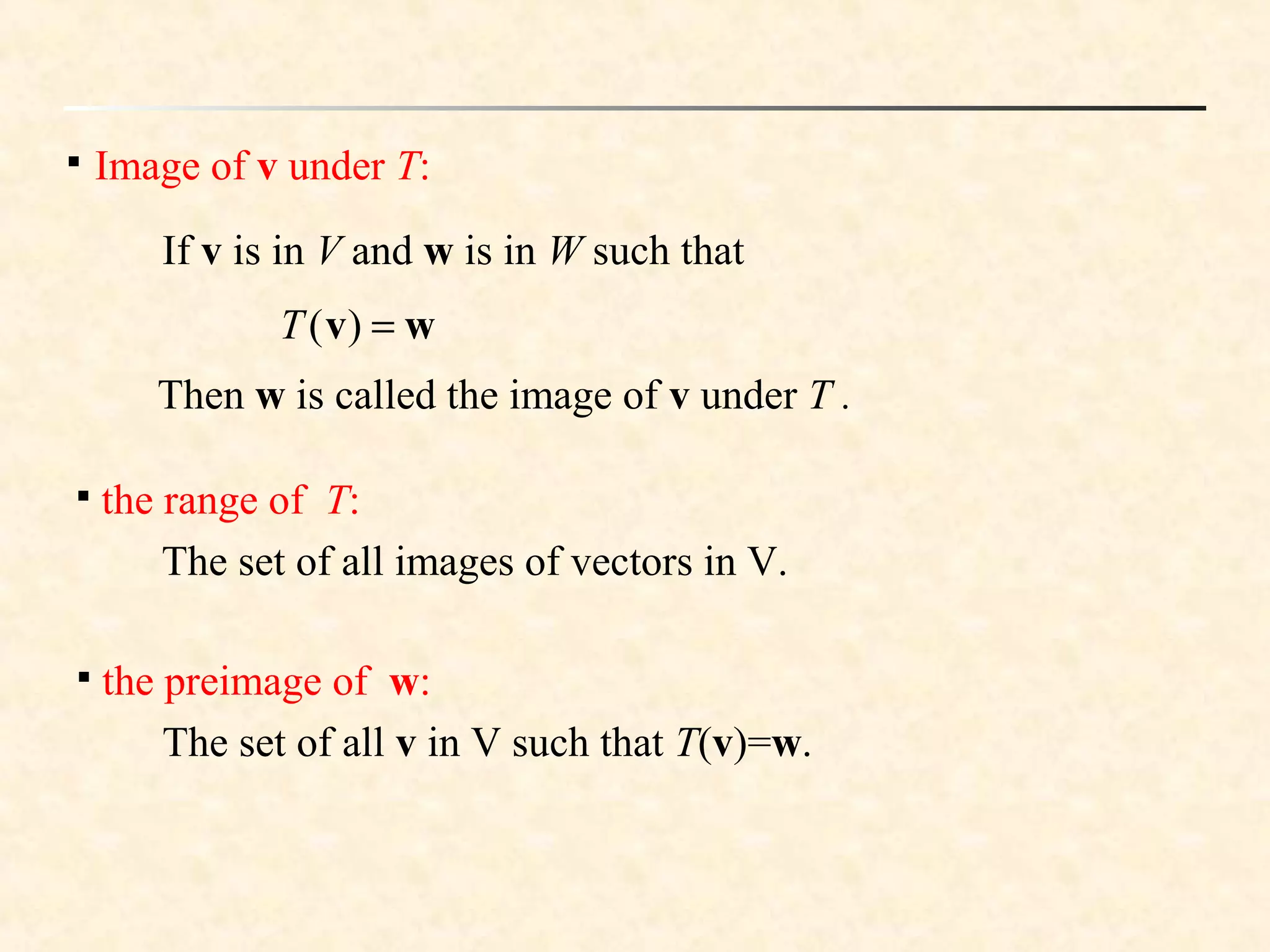
Function T that maps a vector space V into a vector space W:
spacevector:,,: mapping
WVWVT  →
V: the domain of T
W: the codomain of T

Image of v under T:
If v is in V and w is in W such that
wv =)(T
Then w is called the image of v under T .

the range of T:
The set of all images of vectors in V.

the preimage of w:
The set of all v in V such that T(v)=w.

Ex 1: (A function from R2
into R2
)
22
: RRT →
)2,(),( 212121 vvvvvvT +−=
2
21 ),( Rvv ∈=v
(a) Find the image of v=(-1,2). (b) Find the preimage of w=(-1,11)
Sol:
)3,3())2(21,21()2,1()(
)2,1()(
−=+−−−=−=⇒
−=
TT
a
v
v
)11,1()()( −== wvTb
)11,1()2,(),( 212121 −=+−= vvvvvvT
112
1
21
21
=+
−=−⇒
vv
vv
4,3 21 ==⇒ vv Thus {(3, 4)} is the preimage of w=(-1,
11).

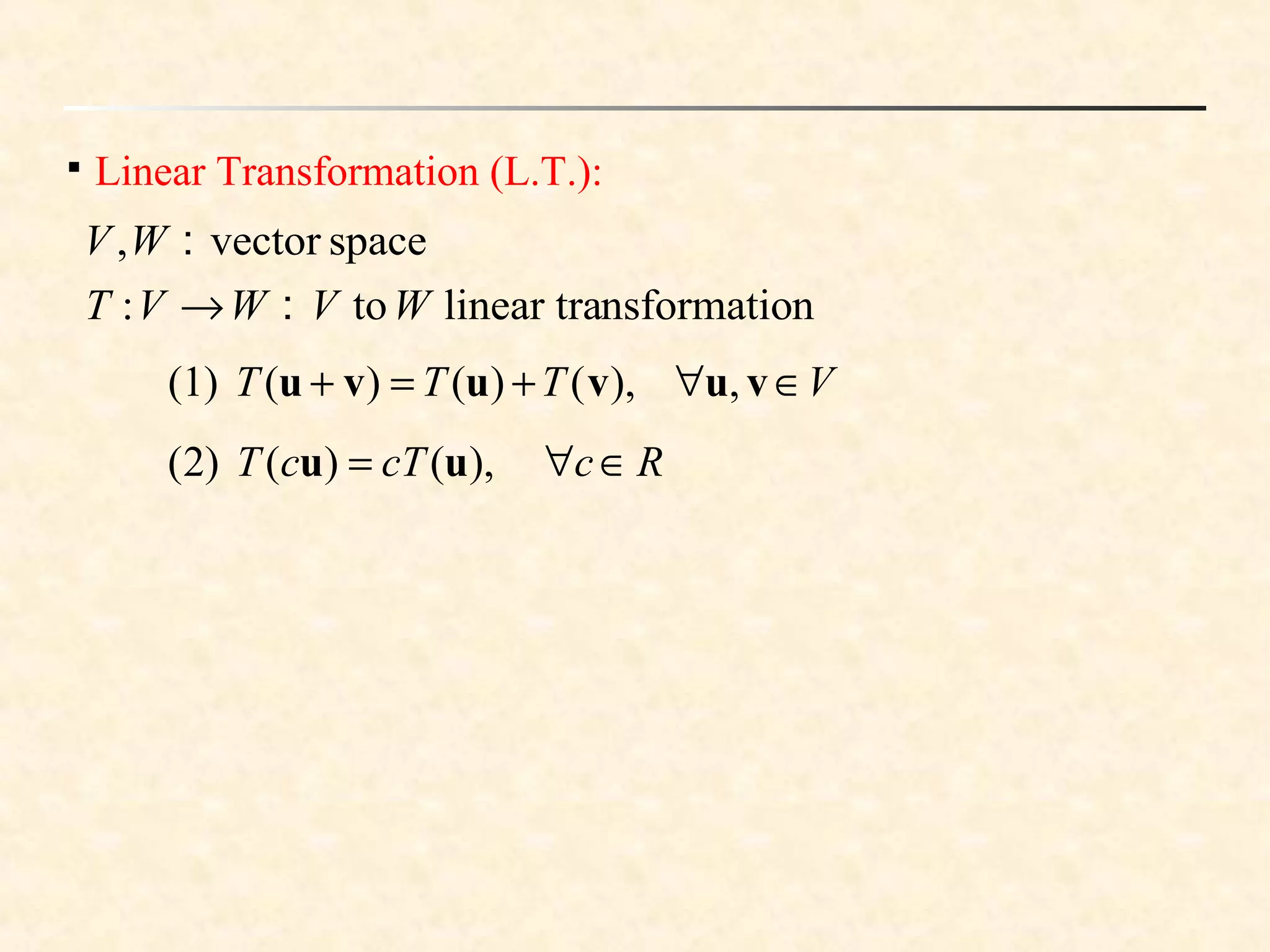
Linear Transformation (L.T.):
nnsformatiolinear trato::
spacevector:,
WVWVT
WV
→
VTTT ∈∀+=+ vuvuvu ,),()()((1)
RccTcT ∈∀= ),()()2( uu

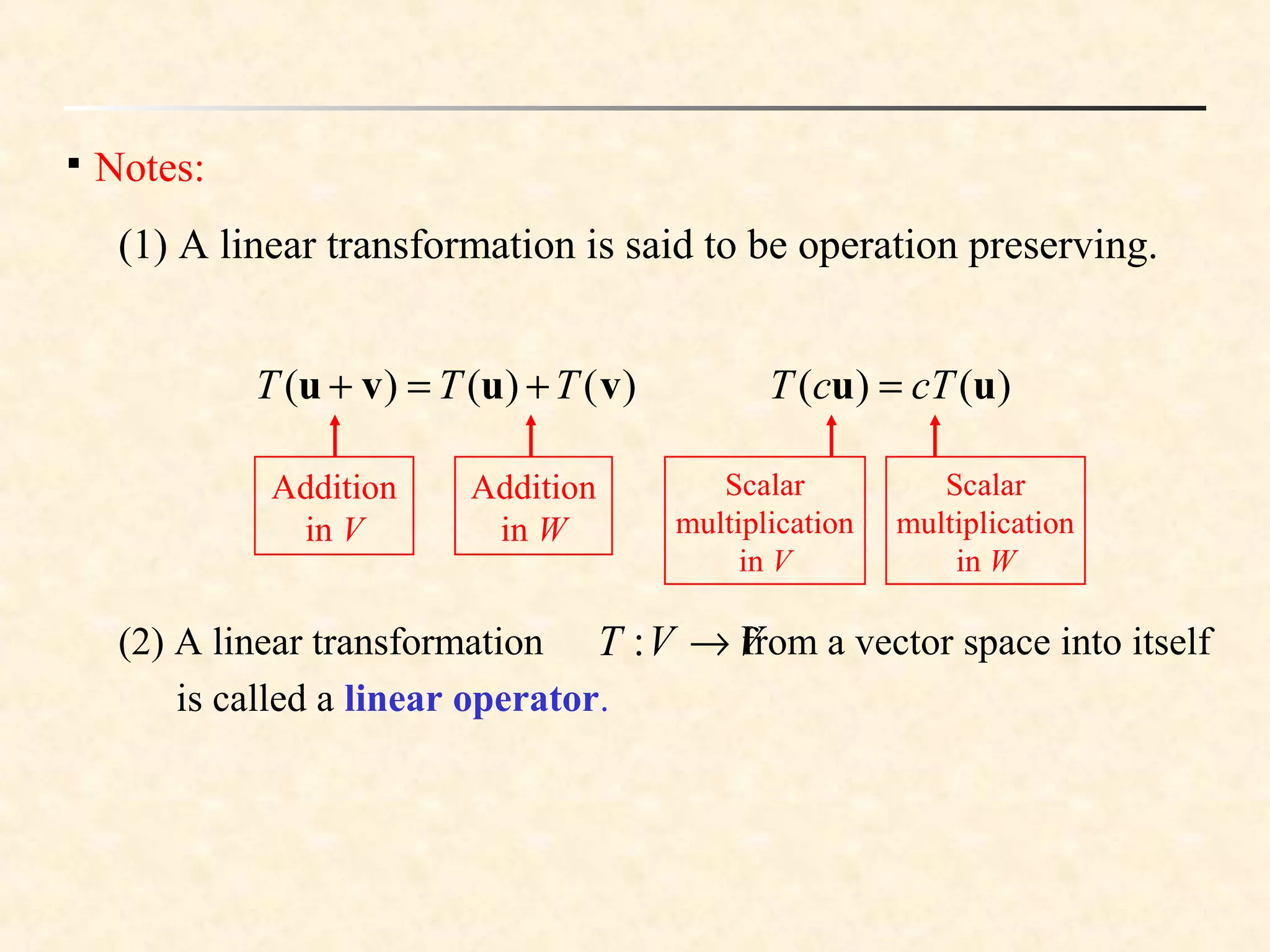
Notes:
(1) A linear transformation is said to be operation preserving.
)()()( vuvu TTT +=+
Addition
in V
Addition
in W
)()( uu cTcT =
Scalar
multiplication
in V
Scalar
multiplication
in W
(2) A linear transformation from a vector space into itself
is called a linear operator.
VVT →:
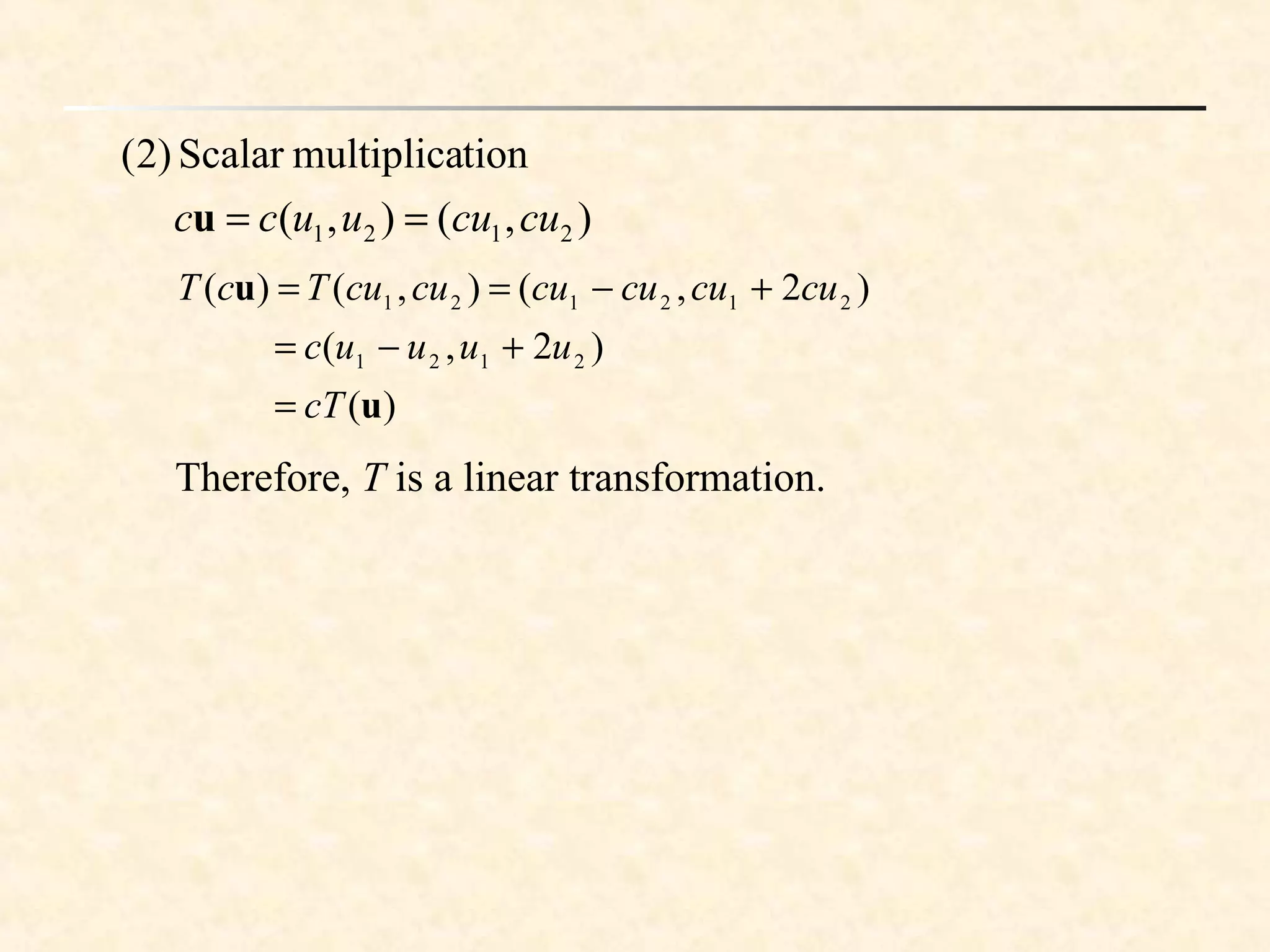
),(),(
tionmultiplicaScalar)2(
2121 cucuuucc ==u
)(
)2,(
)2,(),()(
2121
212121
u
u
cT
uuuuc
cucucucucucuTcT
=
+−=
+−==
Therefore, T is a linear transformation.

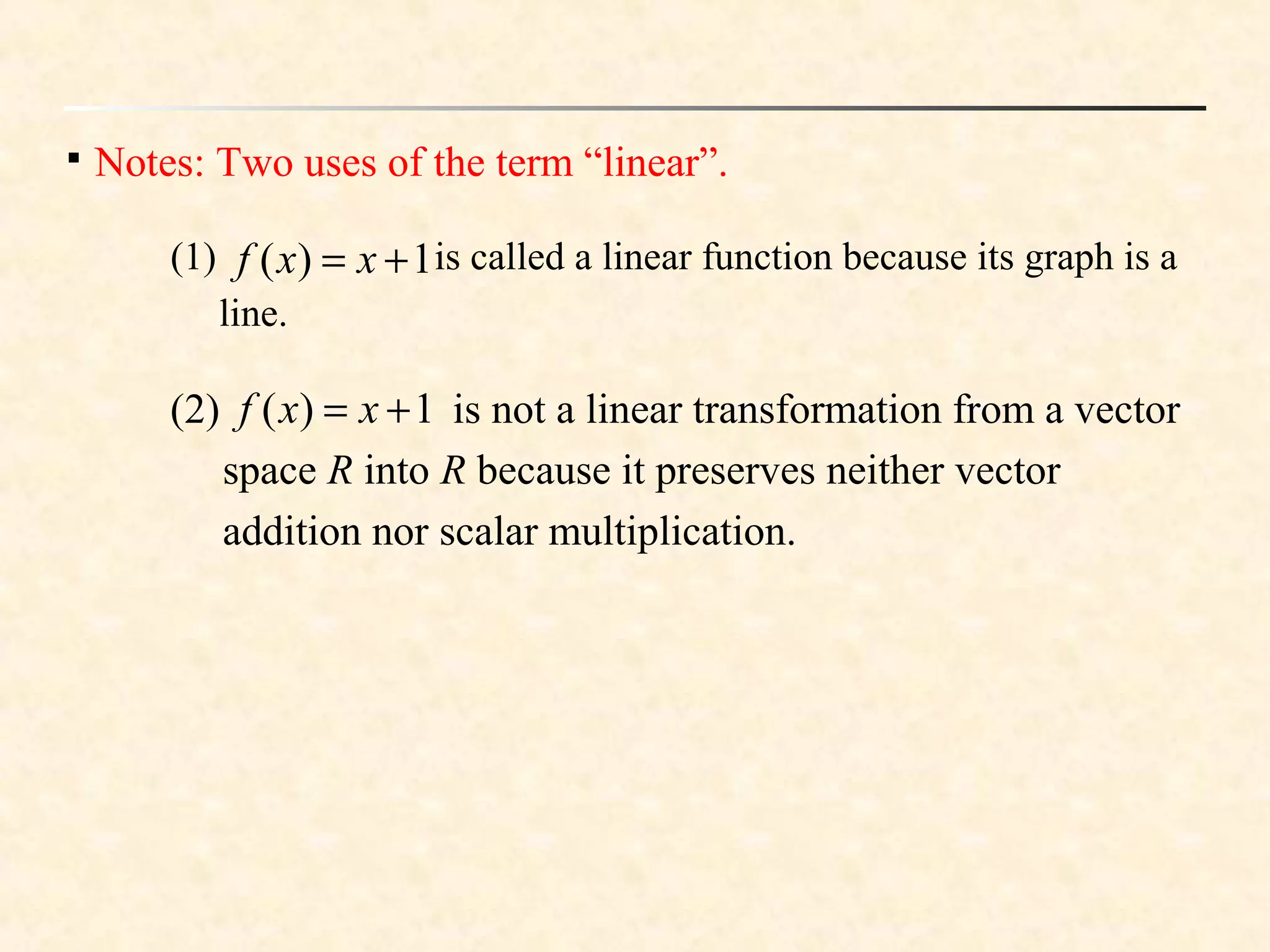
Notes: Two uses of the term “linear”.
(1) is called a linear function because its graph is a
line.
1)( += xxf
(2) is not a linear transformation from a vector
space R into R because it preserves neither vector
addition nor scalar multiplication.
1)( += xxf

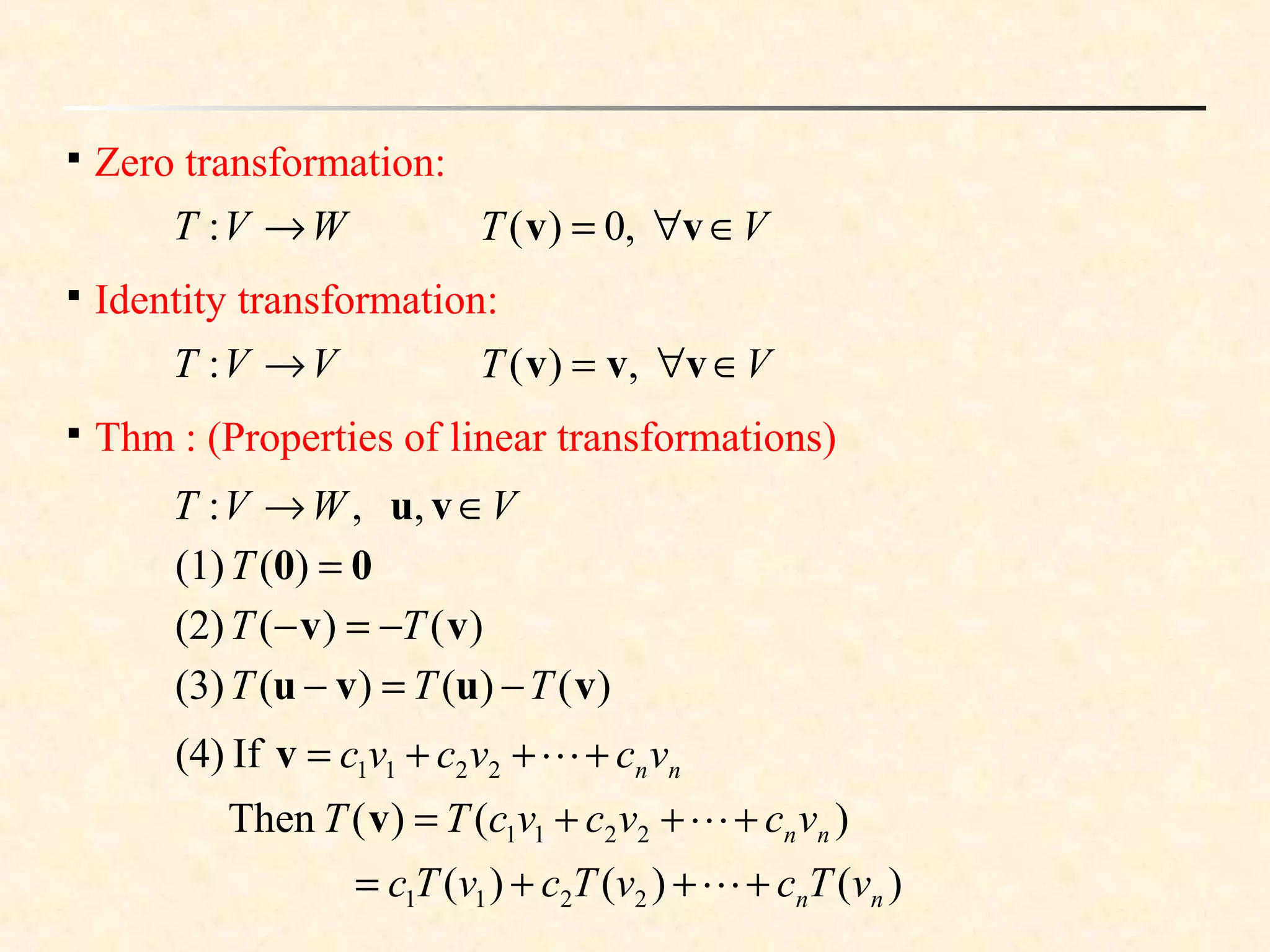
Zero transformation:
VWVT ∈→ vu,,:
VT ∈∀= vv ,0)(

Identity transformation:
VVT →: VT ∈∀= vvv ,)(

Thm : (Properties of linear transformations)
WVT →:
00 =)((1)T
)()((2) vv TT −=−
)()()((3) vuvu TTT −=−
)()()(
)()(Then
If(4)
2211
2211
2211
nn
nn
nn
vTcvTcvTc
vcvcvcTT
vcvcvc
+++=
+++=
+++=



v
v

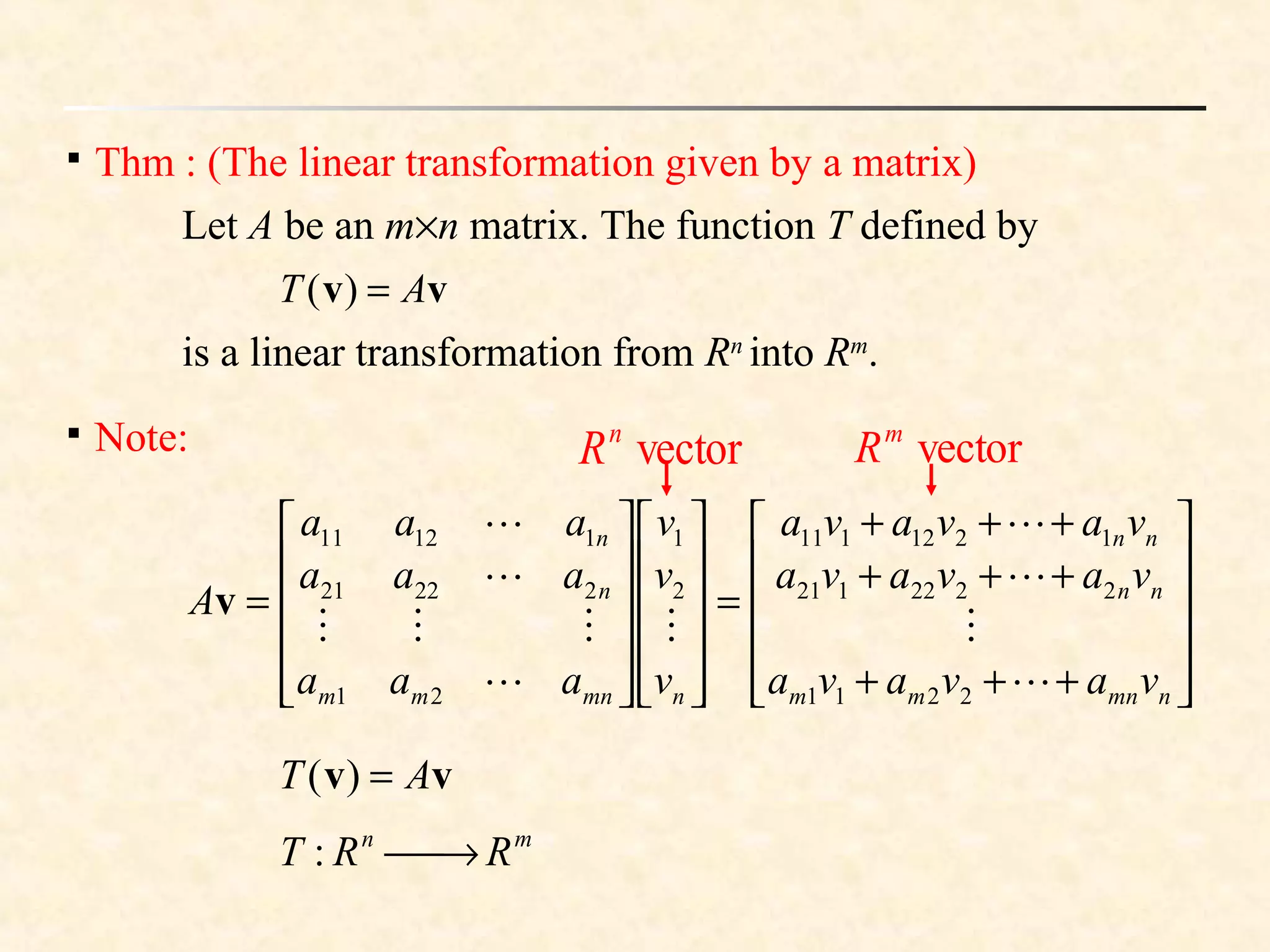
Thm : (The linear transformation given by a matrix)
Let A be an m×n matrix. The function T defined by
vv AT =)(
is a linear transformation from Rn
into Rm
.

Note:












+++
+++
+++
=
























=
nmnmm
nn
nn
nmnmm
n
n
vavava
vavava
vavava
v
v
v
aaa
aaa
aaa
A









2211
2222121
1212111
2
1
21
22221
11211
v
vv AT =)(
mn
RRT →:
vectorn
R vectorm
R
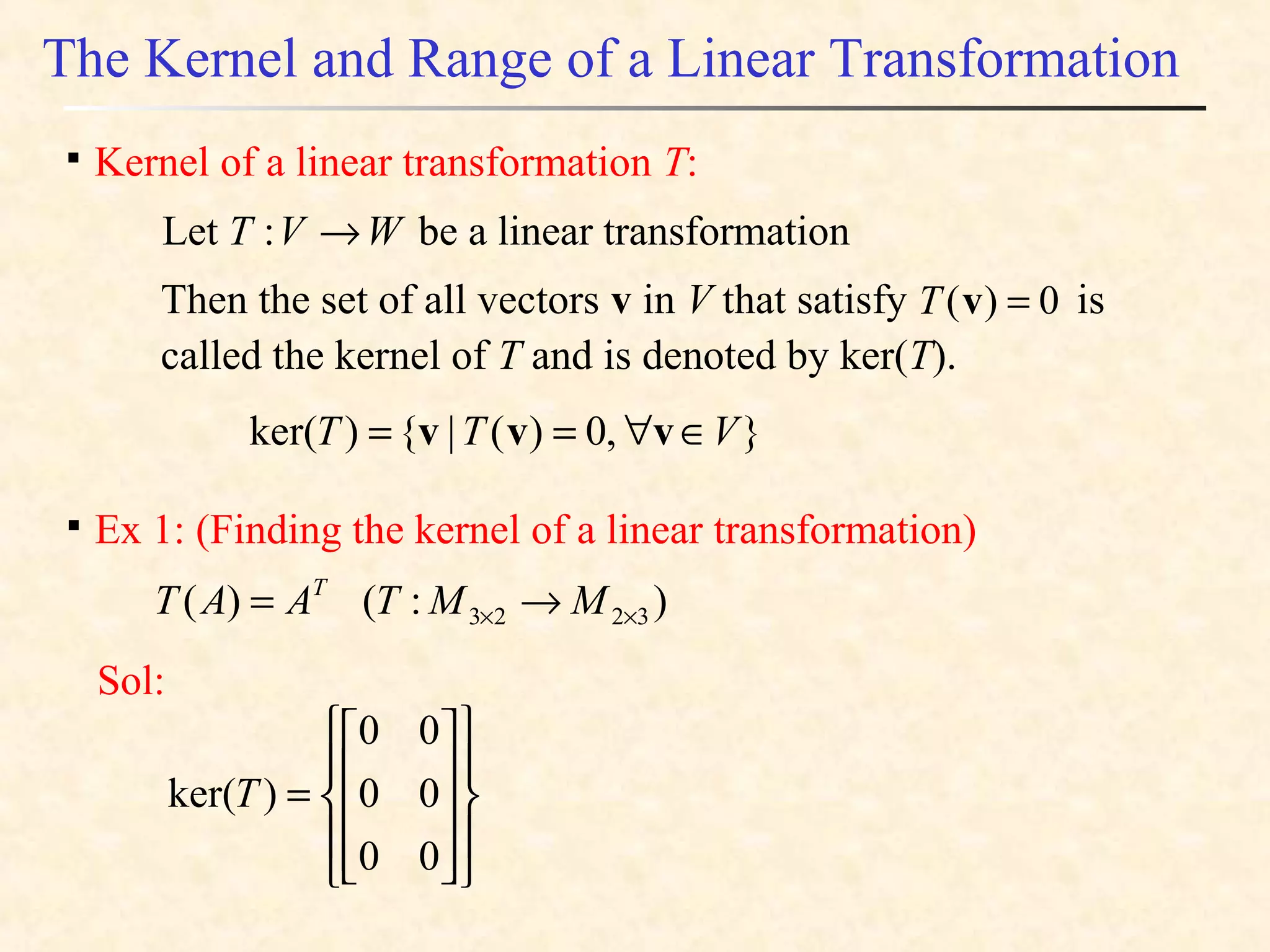
The Kernel and Range of a Linear Transformation

Kernel of a linear transformation T:
Let be a linear transformationWVT →:
Then the set of all vectors v in V that satisfy is
called the kernel of T and is denoted by ker(T).
0)( =vT
},0)(|{)ker( VTT ∈∀== vvv

Ex 1: (Finding the kernel of a linear transformation)
):()( 3223 ×× →= MMTAAT T
Sol:




















=
00
00
00
)ker(T

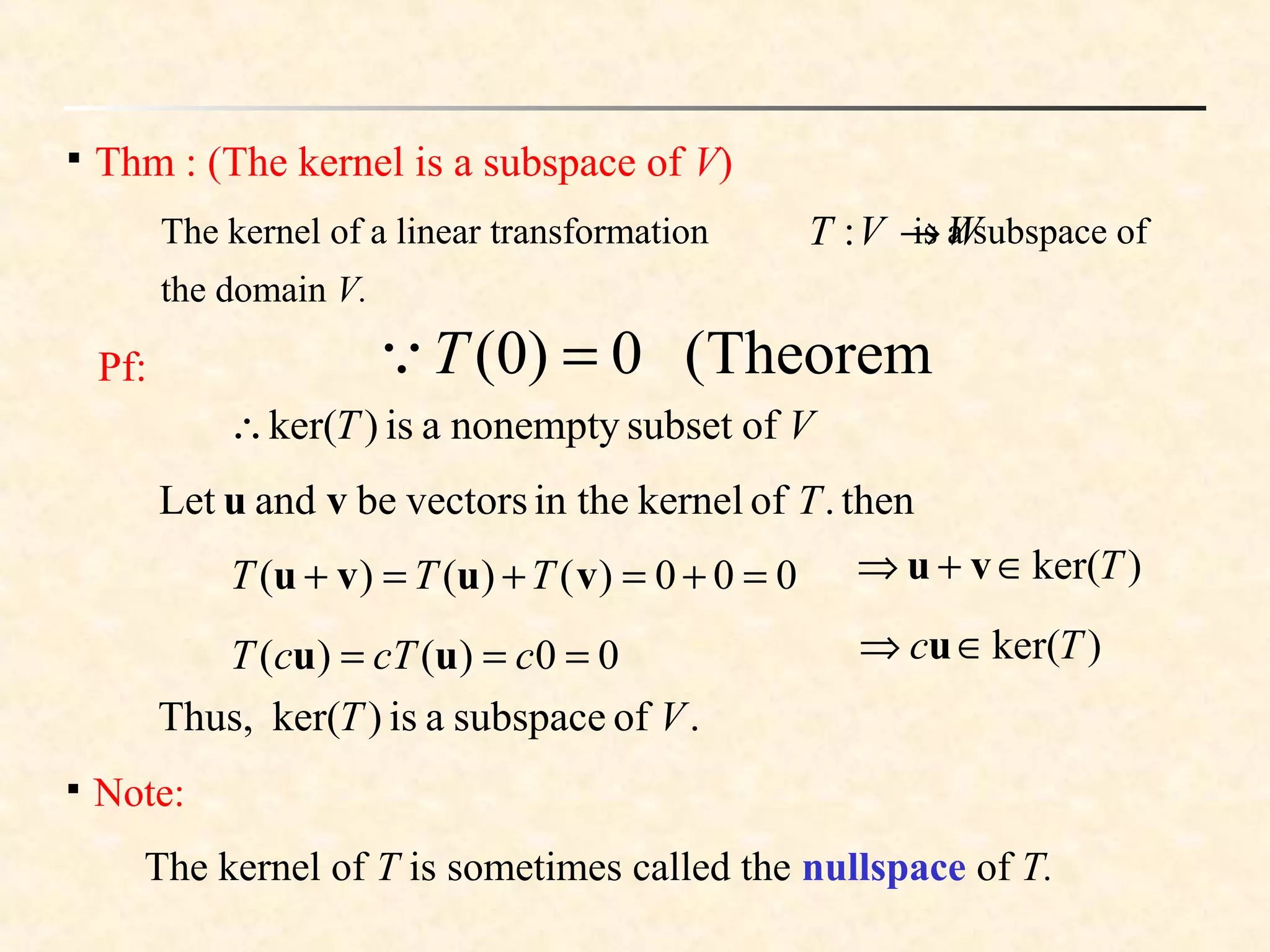
Thm : (The kernel is a subspace of V)
The kernel of a linear transformation is a subspace of
the domain V.
WVT →:
Pf:
VT ofsubsetnonemptyais)ker(∴
then.ofkernelin thevectorsbeandLet Tvu
000)()()( =+=+=+ vuvu TTT
00)()( === ccTcT uu )ker(Tc ∈⇒ u
)ker(T∈+⇒ vu
.ofsubspaceais)ker(Thus, VT

Note:
The kernel of T is sometimes called the nullspace of T.
Theorem(0)0( =T

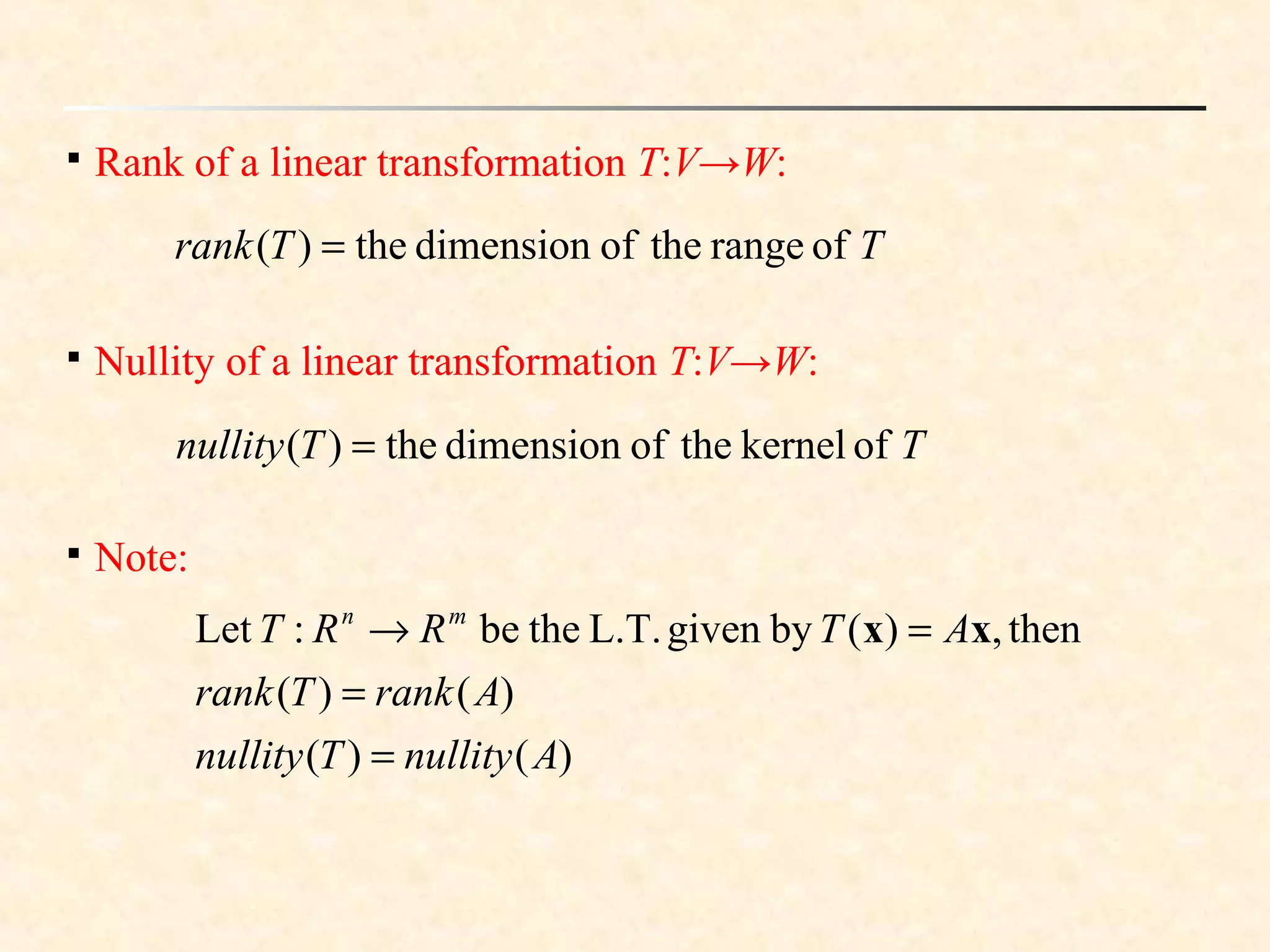
Rank of a linear transformation T:V→W:
TTrank ofrangetheofdimensionthe)( =

Nullity of a linear transformation T:V→W:
TTnullity ofkerneltheofdimensionthe)( =

Note:
)()(
)()(
then,)(bygivenL.T.thebe:Let
AnullityTnullity
ArankTrank
ATRRT mn
=
=
=→ xx
then.spacevectorainto
spacevectorldimensiona-nanformL.T.abe:Let
W
VWVT →

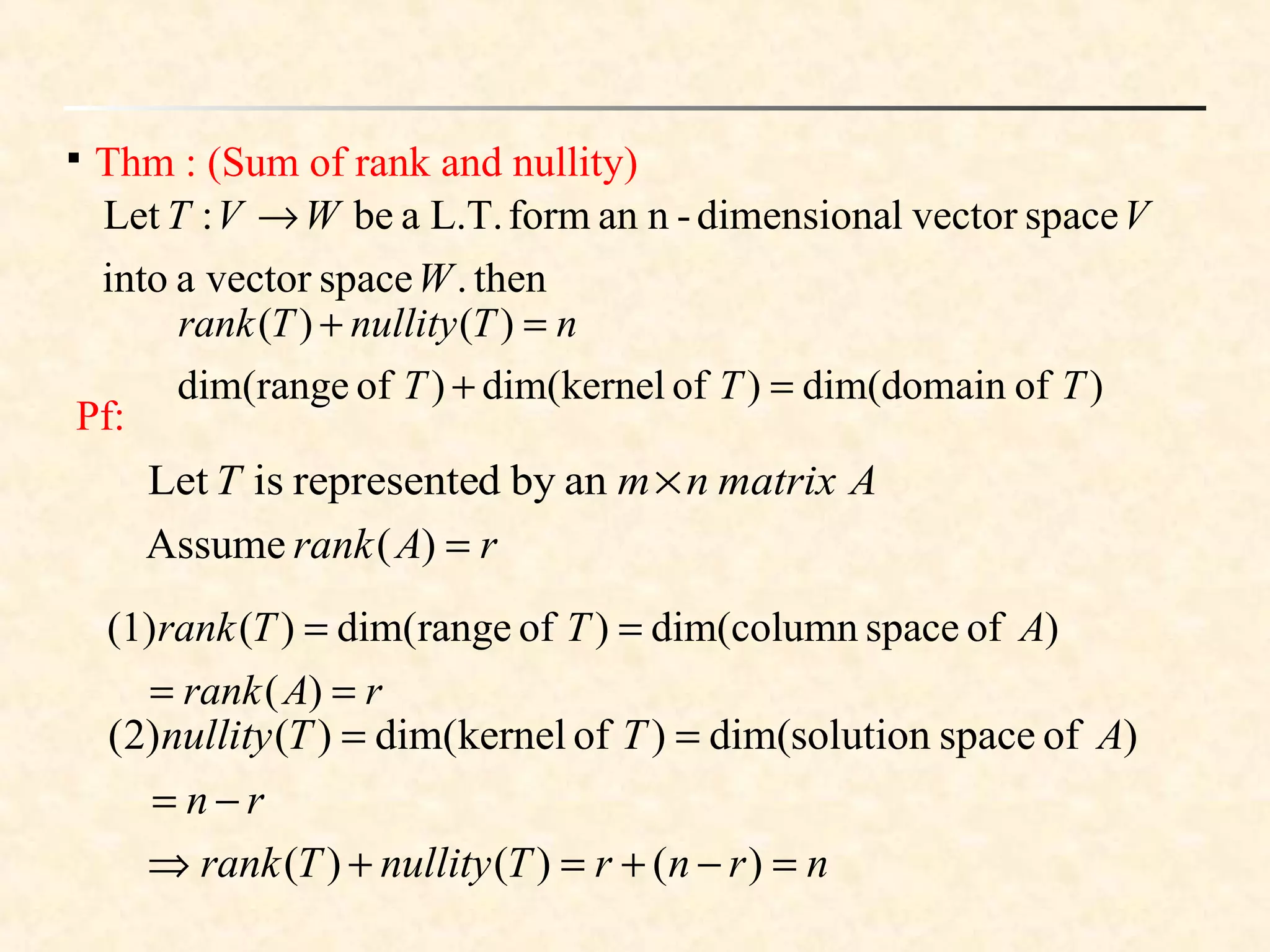
Thm : (Sum of rank and nullity)
Pf:
AmatrixnmT anbydrepresenteisLet ×
)ofdomaindim()ofkerneldim()ofrangedim(
)()(
TTT
nTnullityTrank
=+
=+
rArank =)(Assume
rArank
ATTrank
==
==
)(
)ofspacecolumndim()ofrangedim()((1)
nrnrTnullityTrank =−+=+⇒ )()()(
rn
ATTnullity
−=
== )ofspacesolutiondim()ofkerneldim()()2(

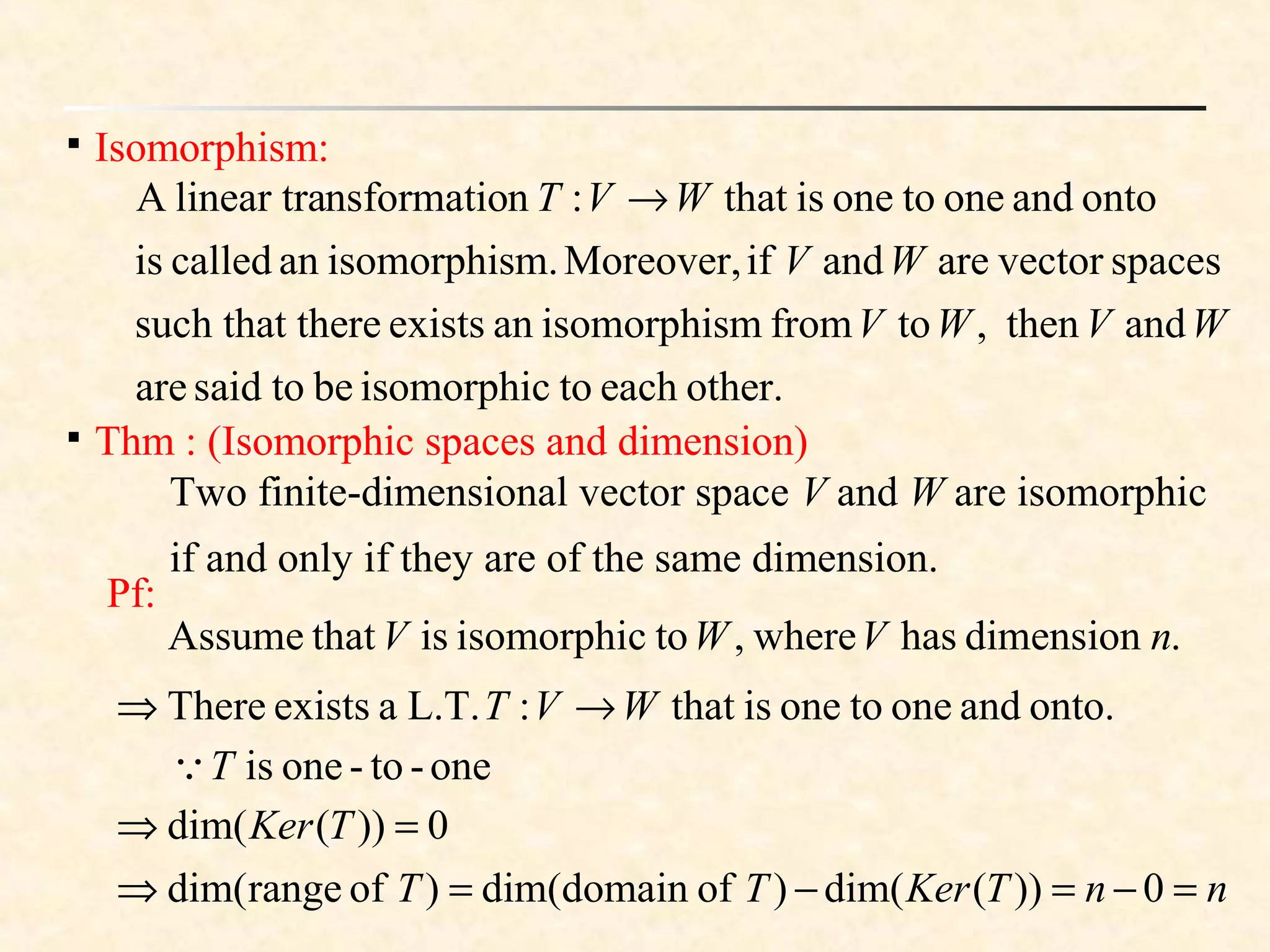
Isomorphism:
other.eachtoisomorphicbetosaidare
andthen,tofrommisomorphisanexiststheresuch that
spacesvectorareandifMoreover,m.isomorphisancalledis
ontoandonetooneisthat:nnsformatiolinear traA
WVWV
WV
WVT →

Thm : (Isomorphic spaces and dimension)
Pf:
.dimensionhaswhere,toisomorphicisthatAssume nVWV
onto.andonetooneisthat:L.T.aexistsThere WVT →⇒
one-to-oneisT
nnTKerTT
TKer
=−=−=⇒
=⇒
0))(dim()ofdomaindim()ofrangedim(
0))(dim(
Two finite-dimensional vector space V and W are isomorphic
if and only if they are of the same dimension.
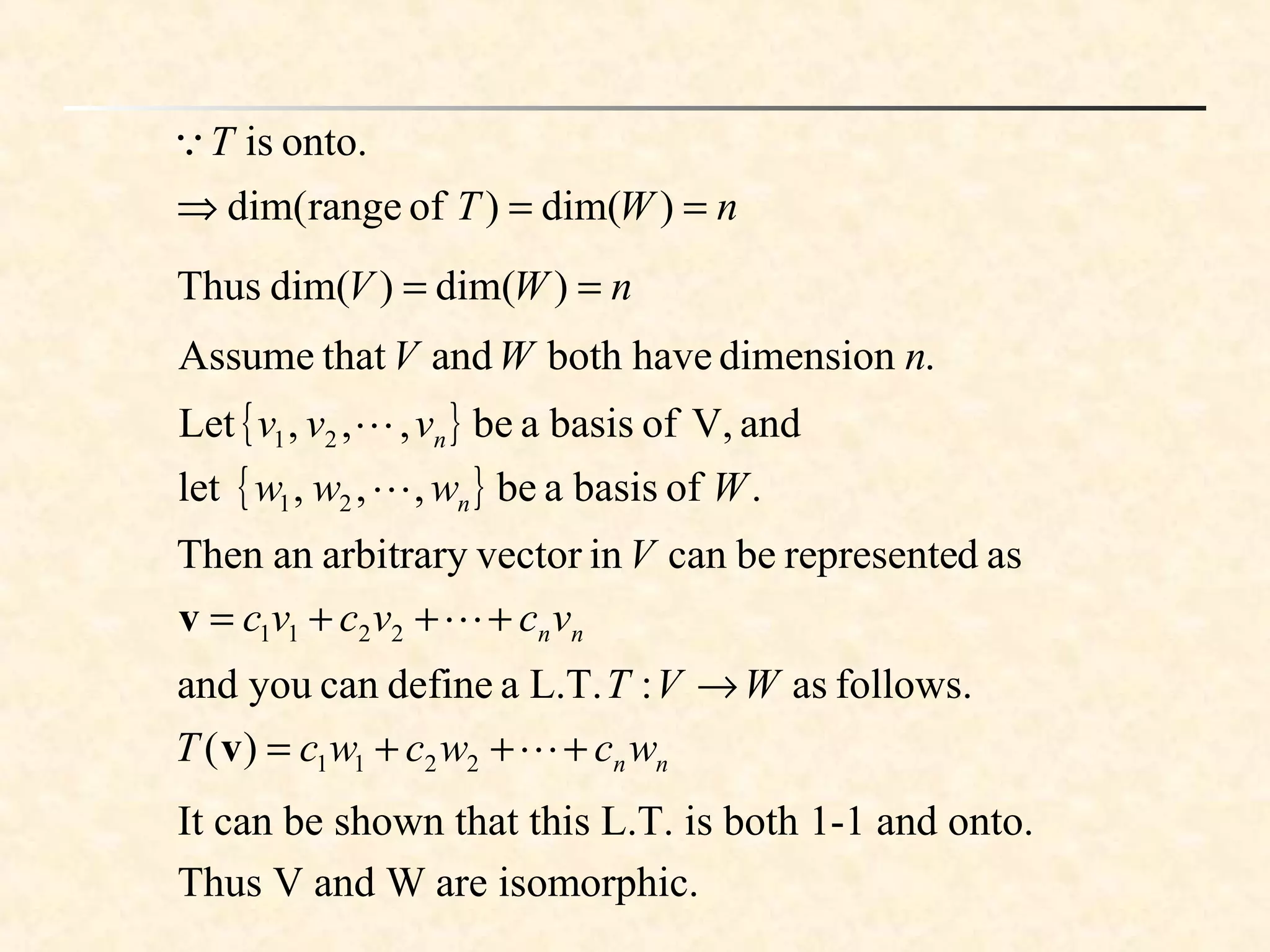
.dimensionhavebothandthatAssume nWV
onto.isT
nWT ==⇒ )dim()ofrangedim(
nWV == )dim()dim(Thus
{ }
{ } .ofbasisabe,,,let
andV,ofbasisabe,,,Let
21
21
Wwww
vvv
n
n


nnvcvcvc
V
+++= 2211
asdrepresentebecaninvectorarbitraryanThen
v
nnwcwcwcT
WVT
+++=
→
2211)(
follows.as:L.T.adefinecanyouand
v
It can be shown that this L.T. is both 1-1 and onto.
Thus V and W are isomorphic.
Matrices for Linear Transformations
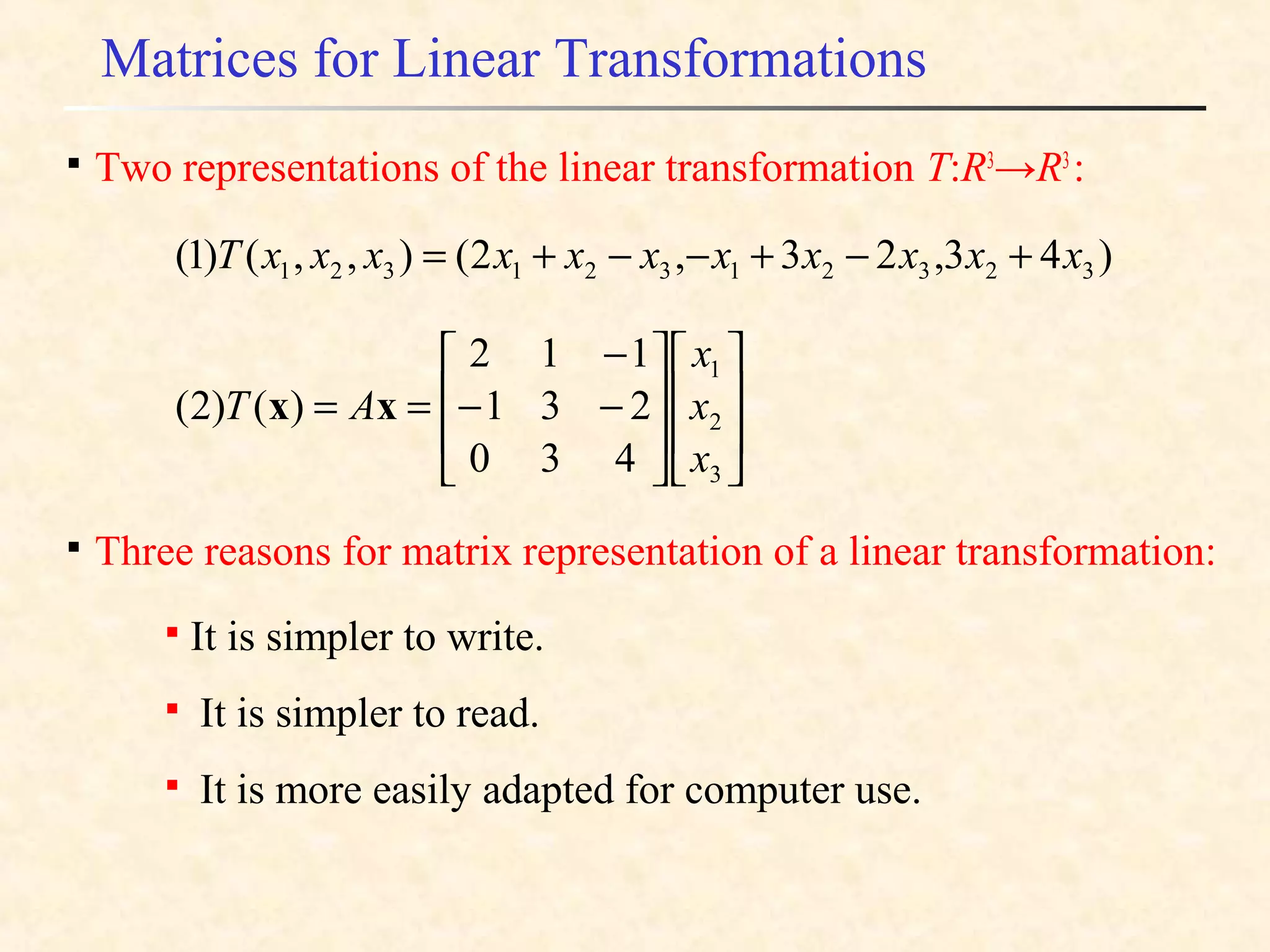
)43,23,2(),,()1( 32321321321 xxxxxxxxxxxT +−+−−+=

Three reasons for matrix representation of a linear transformation:
















−−
−
==
3
2
1
430
231
112
)()2(
x
x
x
AT xx

It is simpler to write.

It is simpler to read.

It is more easily adapted for computer use.

Two representations of the linear transformation T:R3
→R3
:

Thm : (Standard matrix for a linear transformation)
such thatonansformatilinear trtabe:Let mn
RRT →
,)(,,)(,)( 2
1
2
22
12
2
1
21
11
1












=












=












=
mn
n
n
n
mm a
a
a
eT
a
a
a
eT
a
a
a
eT



)(tocorrespondcolumnssematrix whoThen the i
eTnnm×
.formatrixstandardthecalledisA
.ineveryfor)(such thatis
T
RAT n
vvv =
[ ]












==
mnmm
n
n
n
aaa
aaa
aaa
eTeTeTA





21
22221
11211
21 )()()(

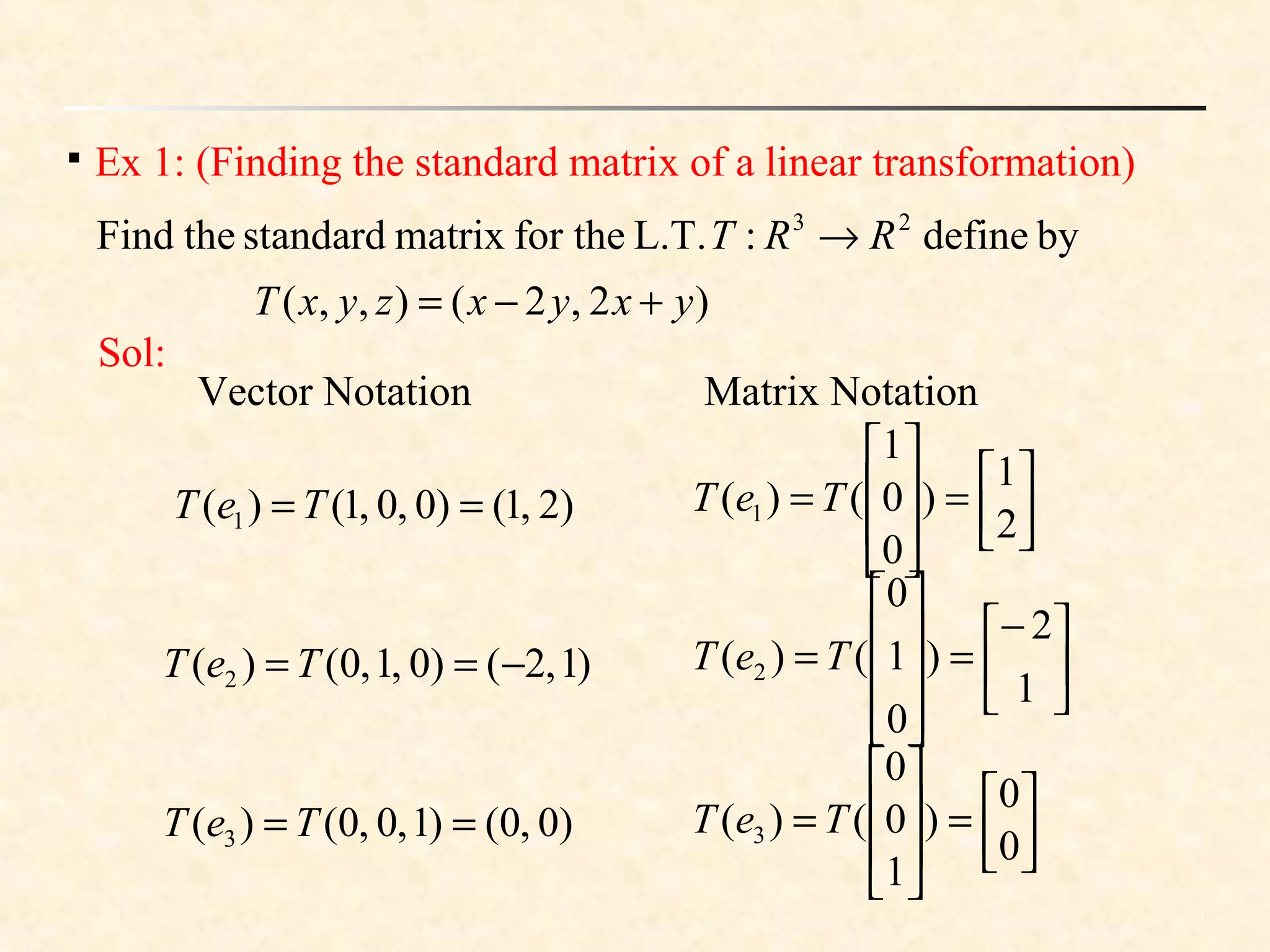
Ex 1: (Finding the standard matrix of a linear transformation)
bydefine:L.T.for thematrixstandardtheFind 23
RRT →
)2,2(),,( yxyxzyxT +−=
Sol:
)2,1()0,0,1()( 1 == TeT
)1,2()0,1,0()( 2 −== TeT
)0,0()1,0,0()( 3 == TeT
2
1
)
0
0
1
()( 1 



=








= TeT
1
2
)
0
1
0
()( 2 




−
=










= TeT
0
0
)
1
0
0
()( 3 



=








= TeT
Vector Notation Matrix Notation
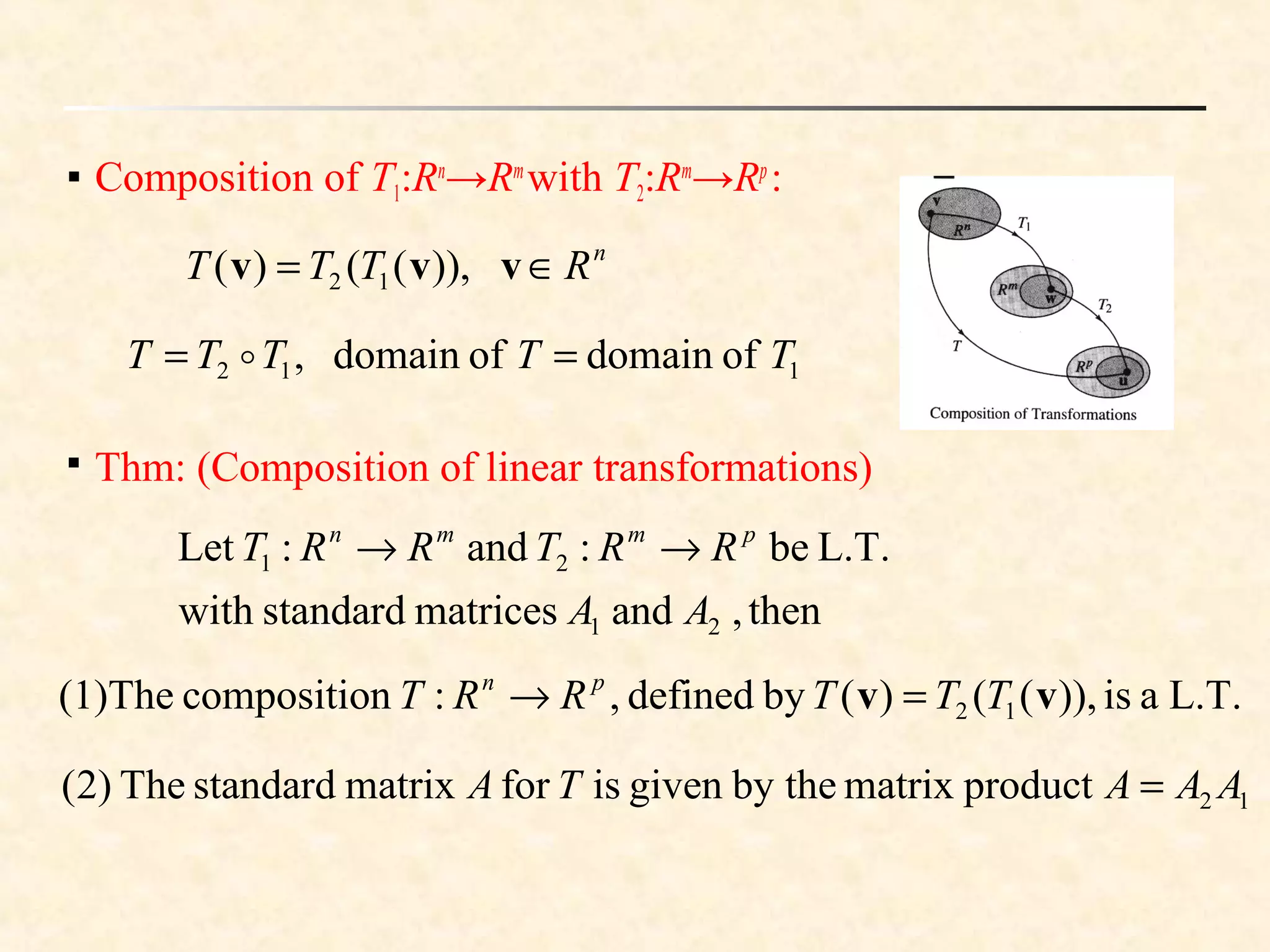
 Composition of T1:Rn
→Rm
with T2:Rm
→Rp
:
n
RTTT ∈= vvv )),(()( 12
112 ofdomainofdomain, TTTTT == 

Thm: (Composition of linear transformations)
then,andmatricesstandardwith
L.T.be:and:Let
21
21
AA
RRTRRT pmmn
→→
L.T.ais)),(()(bydefined,:ncompositioThe(1) 12 vv TTTRRT pn
=→
12productmatrixby thegivenisformatrixstandardThe)2( AAATA =

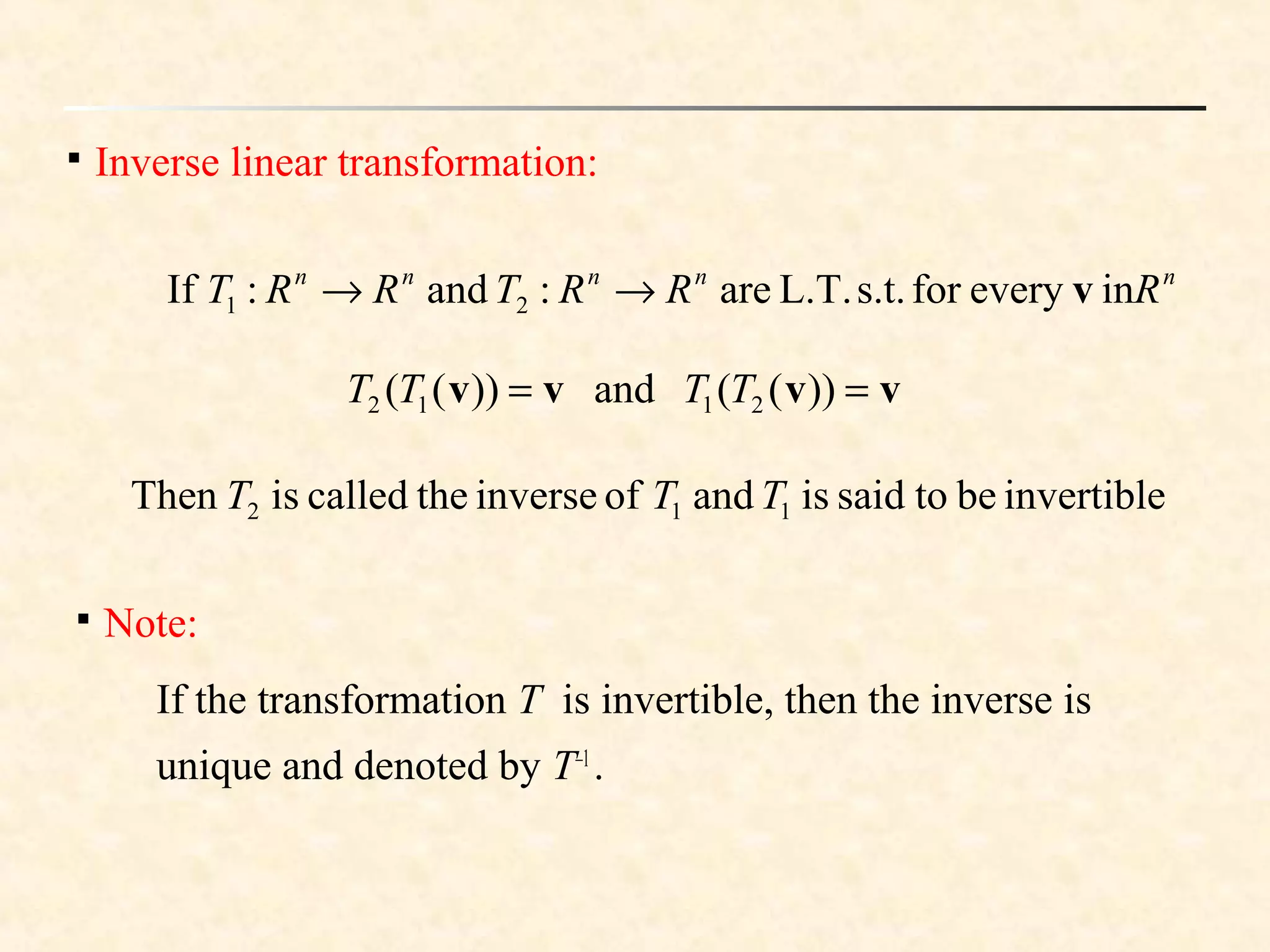
Inverse linear transformation:
ineveryfors.t.L.T.are:and:If 21
nnnnn
RRRTRRT v→→
))((and))(( 2112 vvvv == TTTT
invertiblebetosaidisandofinversethecalledisThen 112 TTT

Note:
If the transformation T is invertible, then the inverse is
unique and denoted by T–1
.

the matrix of T relative to the bases B and B':
)forbasis(a},,,{'
)forbasis(a},,,{
)L.T.a(:
21
21
WwwwB
VvvvB
WVT
m
n


=
=
→
Thus, the matrix of T relative to the bases B and B' is
[ ] [ ] [ ][ ] nmBnBB
MvTvTvTA ×∈= ''2'1 )(,,)(,)( 
Transition Matrices and Similarity
)ofbasis(a},,,{'
)ofbasisa(},,,{
)L.T.a(:
21
21
VwwwB
VvvvB
VVT
n
n


=
=
→
[ ] [ ] [ ][ ] )torelativeofmatrix()(,,)(,)( 21 BTvTvTvTA BnBB
=
[ ] [ ] [ ][ ] )'torelativeof(matrix)(,,)(,)(' ''2'1 BTwTwTwTA BnBB
=
[ ] [ ] [ ][ ] )to'frommatrixntransitio(,,, 21 BBwwwP BnBB
=
[ ] [ ] [ ][ ] )'tofrommatrixntransitio(,,, ''2'1
1
BBvvvP BnBB
=−
[ ] [ ] [ ] [ ]BBBB PP vvvv 1
'', −
==∴
[ ] [ ]
[ ] [ ] '' ')(
)(
BB
BB
AT
AT
vv
vv
=
=

Two ways to get from to :
'' )]([]['
)direct)(1(
BB TA vv =
[ ] 'Bv [ ] ')( BT v
''
1
)]([][
(indirect))2(
BB TAPP vv =−
APPA 1
' −
=⇒
direct
indirect

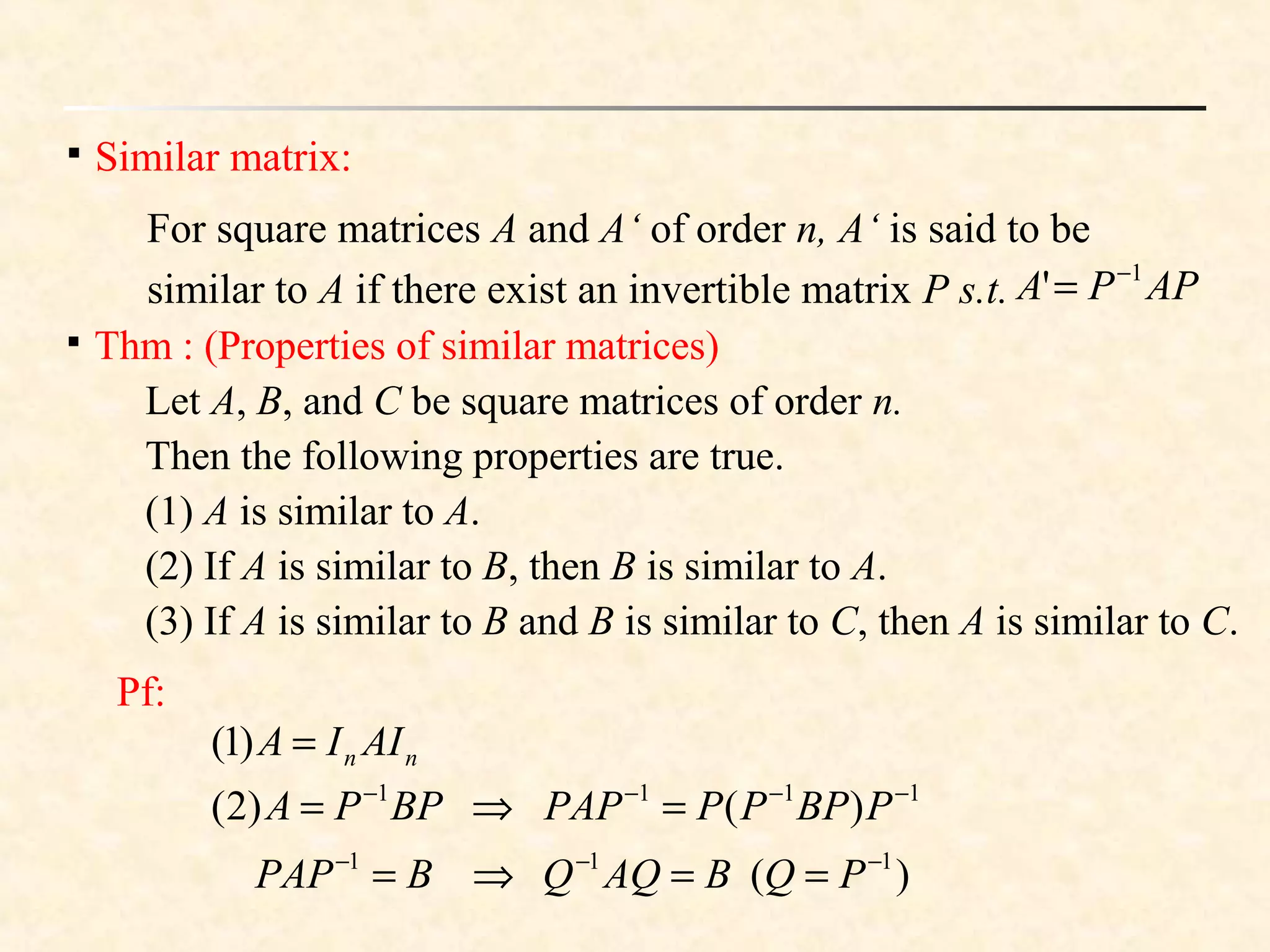
Similar matrix:
For square matrices A and A‘ of order n, A‘ is said to be
similar to A if there exist an invertible matrix P s.t. APPA 1
' −
=

Thm : (Properties of similar matrices)
Let A, B, and C be square matrices of order n.
Then the following properties are true.
(1) A is similar to A.
(2) If A is similar to B, then B is similar to A.
(3) If A is similar to B and B is similar to C, then A is similar to C.
Pf:
nn AIIA =)1(
)(
)()2(
111
1111
−−−
−−−−
==⇒=
=⇒=
PQBAQQBPAP
PBPPPPAPBPPA

linear transformation

  • 1.
     VCLA  (Vector Calculus &Linear Algebra ) Linear Transformation Guided by:- Gayatri Mam 1/78 Sr no NAME ENROLL.NO. 1). Mansi Acharya 150450116001 2). Drashti Patel 150450116024 3). Jyoti Mishra 150450116018 MADE BY:-
  • 2.
    CONTENTS  Introduction toLinear Transformations  The Kernel and Range of a Linear Transformation  Matrices for Linear Transformations  Transition Matrices and Similarity
  • 3.
    Introduction to LinearTransformations  Function T that maps a vector space V into a vector space W: spacevector:,,: mapping WVWVT  → V: the domain of T W: the codomain of T
  • 4.
     Image of vunder T: If v is in V and w is in W such that wv =)(T Then w is called the image of v under T .  the range of T: The set of all images of vectors in V.  the preimage of w: The set of all v in V such that T(v)=w.
  • 5.
     Ex 1: (Afunction from R2 into R2 ) 22 : RRT → )2,(),( 212121 vvvvvvT +−= 2 21 ),( Rvv ∈=v (a) Find the image of v=(-1,2). (b) Find the preimage of w=(-1,11) Sol: )3,3())2(21,21()2,1()( )2,1()( −=+−−−=−=⇒ −= TT a v v )11,1()()( −== wvTb )11,1()2,(),( 212121 −=+−= vvvvvvT 112 1 21 21 =+ −=−⇒ vv vv 4,3 21 ==⇒ vv Thus {(3, 4)} is the preimage of w=(-1, 11).
  • 6.
     Linear Transformation (L.T.): nnsformatiolineartrato:: spacevector:, WVWVT WV → VTTT ∈∀+=+ vuvuvu ,),()()((1) RccTcT ∈∀= ),()()2( uu
  • 7.
     Notes: (1) A lineartransformation is said to be operation preserving. )()()( vuvu TTT +=+ Addition in V Addition in W )()( uu cTcT = Scalar multiplication in V Scalar multiplication in W (2) A linear transformation from a vector space into itself is called a linear operator. VVT →:
  • 8.
  • 9.
     Notes: Two usesof the term “linear”. (1) is called a linear function because its graph is a line. 1)( += xxf (2) is not a linear transformation from a vector space R into R because it preserves neither vector addition nor scalar multiplication. 1)( += xxf
  • 10.
     Zero transformation: VWVT ∈→vu,,: VT ∈∀= vv ,0)(  Identity transformation: VVT →: VT ∈∀= vvv ,)(  Thm : (Properties of linear transformations) WVT →: 00 =)((1)T )()((2) vv TT −=− )()()((3) vuvu TTT −=− )()()( )()(Then If(4) 2211 2211 2211 nn nn nn vTcvTcvTc vcvcvcTT vcvcvc +++= +++= +++=    v v
  • 11.
     Thm : (Thelinear transformation given by a matrix) Let A be an m×n matrix. The function T defined by vv AT =)( is a linear transformation from Rn into Rm .  Note:             +++ +++ +++ =                         = nmnmm nn nn nmnmm n n vavava vavava vavava v v v aaa aaa aaa A          2211 2222121 1212111 2 1 21 22221 11211 v vv AT =)( mn RRT →: vectorn R vectorm R
  • 12.
    The Kernel andRange of a Linear Transformation  Kernel of a linear transformation T: Let be a linear transformationWVT →: Then the set of all vectors v in V that satisfy is called the kernel of T and is denoted by ker(T). 0)( =vT },0)(|{)ker( VTT ∈∀== vvv  Ex 1: (Finding the kernel of a linear transformation) ):()( 3223 ×× →= MMTAAT T Sol:                     = 00 00 00 )ker(T
  • 13.
     Thm : (Thekernel is a subspace of V) The kernel of a linear transformation is a subspace of the domain V. WVT →: Pf: VT ofsubsetnonemptyais)ker(∴ then.ofkernelin thevectorsbeandLet Tvu 000)()()( =+=+=+ vuvu TTT 00)()( === ccTcT uu )ker(Tc ∈⇒ u )ker(T∈+⇒ vu .ofsubspaceais)ker(Thus, VT  Note: The kernel of T is sometimes called the nullspace of T. Theorem(0)0( =T
  • 14.
     Rank of alinear transformation T:V→W: TTrank ofrangetheofdimensionthe)( =  Nullity of a linear transformation T:V→W: TTnullity ofkerneltheofdimensionthe)( =  Note: )()( )()( then,)(bygivenL.T.thebe:Let AnullityTnullity ArankTrank ATRRT mn = = =→ xx
  • 15.
    then.spacevectorainto spacevectorldimensiona-nanformL.T.abe:Let W VWVT →  Thm :(Sum of rank and nullity) Pf: AmatrixnmT anbydrepresenteisLet × )ofdomaindim()ofkerneldim()ofrangedim( )()( TTT nTnullityTrank =+ =+ rArank =)(Assume rArank ATTrank == == )( )ofspacecolumndim()ofrangedim()((1) nrnrTnullityTrank =−+=+⇒ )()()( rn ATTnullity −= == )ofspacesolutiondim()ofkerneldim()()2(
  • 16.
     Isomorphism: other.eachtoisomorphicbetosaidare andthen,tofrommisomorphisanexiststheresuch that spacesvectorareandifMoreover,m.isomorphisancalledis ontoandonetooneisthat:nnsformatiolinear traA WVWV WV WVT→  Thm : (Isomorphic spaces and dimension) Pf: .dimensionhaswhere,toisomorphicisthatAssume nVWV onto.andonetooneisthat:L.T.aexistsThere WVT →⇒ one-to-oneisT nnTKerTT TKer =−=−=⇒ =⇒ 0))(dim()ofdomaindim()ofrangedim( 0))(dim( Two finite-dimensional vector space V and W are isomorphic if and only if they are of the same dimension.
  • 17.
    .dimensionhavebothandthatAssume nWV onto.isT nWT ==⇒)dim()ofrangedim( nWV == )dim()dim(Thus { } { } .ofbasisabe,,,let andV,ofbasisabe,,,Let 21 21 Wwww vvv n n   nnvcvcvc V +++= 2211 asdrepresentebecaninvectorarbitraryanThen v nnwcwcwcT WVT +++= → 2211)( follows.as:L.T.adefinecanyouand v It can be shown that this L.T. is both 1-1 and onto. Thus V and W are isomorphic.
  • 18.
    Matrices for LinearTransformations )43,23,2(),,()1( 32321321321 xxxxxxxxxxxT +−+−−+=  Three reasons for matrix representation of a linear transformation:                 −− − == 3 2 1 430 231 112 )()2( x x x AT xx  It is simpler to write.  It is simpler to read.  It is more easily adapted for computer use.  Two representations of the linear transformation T:R3 →R3 :
  • 19.
     Thm : (Standardmatrix for a linear transformation) such thatonansformatilinear trtabe:Let mn RRT → ,)(,,)(,)( 2 1 2 22 12 2 1 21 11 1             =             =             = mn n n n mm a a a eT a a a eT a a a eT    )(tocorrespondcolumnssematrix whoThen the i eTnnm× .formatrixstandardthecalledisA .ineveryfor)(such thatis T RAT n vvv = [ ]             == mnmm n n n aaa aaa aaa eTeTeTA      21 22221 11211 21 )()()(
  • 20.
     Ex 1: (Findingthe standard matrix of a linear transformation) bydefine:L.T.for thematrixstandardtheFind 23 RRT → )2,2(),,( yxyxzyxT +−= Sol: )2,1()0,0,1()( 1 == TeT )1,2()0,1,0()( 2 −== TeT )0,0()1,0,0()( 3 == TeT 2 1 ) 0 0 1 ()( 1     =         = TeT 1 2 ) 0 1 0 ()( 2      − =           = TeT 0 0 ) 1 0 0 ()( 3     =         = TeT Vector Notation Matrix Notation
  • 21.
     Composition ofT1:Rn →Rm with T2:Rm →Rp : n RTTT ∈= vvv )),(()( 12 112 ofdomainofdomain, TTTTT ==   Thm: (Composition of linear transformations) then,andmatricesstandardwith L.T.be:and:Let 21 21 AA RRTRRT pmmn →→ L.T.ais)),(()(bydefined,:ncompositioThe(1) 12 vv TTTRRT pn =→ 12productmatrixby thegivenisformatrixstandardThe)2( AAATA =
  • 22.
     Inverse linear transformation: ineveryfors.t.L.T.are:and:If21 nnnnn RRRTRRT v→→ ))((and))(( 2112 vvvv == TTTT invertiblebetosaidisandofinversethecalledisThen 112 TTT  Note: If the transformation T is invertible, then the inverse is unique and denoted by T–1 .
  • 23.
     the matrix ofT relative to the bases B and B': )forbasis(a},,,{' )forbasis(a},,,{ )L.T.a(: 21 21 WwwwB VvvvB WVT m n   = = → Thus, the matrix of T relative to the bases B and B' is [ ] [ ] [ ][ ] nmBnBB MvTvTvTA ×∈= ''2'1 )(,,)(,)( 
  • 24.
    Transition Matrices andSimilarity )ofbasis(a},,,{' )ofbasisa(},,,{ )L.T.a(: 21 21 VwwwB VvvvB VVT n n   = = → [ ] [ ] [ ][ ] )torelativeofmatrix()(,,)(,)( 21 BTvTvTvTA BnBB = [ ] [ ] [ ][ ] )'torelativeof(matrix)(,,)(,)(' ''2'1 BTwTwTwTA BnBB = [ ] [ ] [ ][ ] )to'frommatrixntransitio(,,, 21 BBwwwP BnBB = [ ] [ ] [ ][ ] )'tofrommatrixntransitio(,,, ''2'1 1 BBvvvP BnBB =− [ ] [ ] [ ] [ ]BBBB PP vvvv 1 '', − ==∴ [ ] [ ] [ ] [ ] '' ')( )( BB BB AT AT vv vv = =
  • 25.
     Two ways toget from to : '' )]([][' )direct)(1( BB TA vv = [ ] 'Bv [ ] ')( BT v '' 1 )]([][ (indirect))2( BB TAPP vv =− APPA 1 ' − =⇒ direct indirect
  • 26.
     Similar matrix: For squarematrices A and A‘ of order n, A‘ is said to be similar to A if there exist an invertible matrix P s.t. APPA 1 ' − =  Thm : (Properties of similar matrices) Let A, B, and C be square matrices of order n. Then the following properties are true. (1) A is similar to A. (2) If A is similar to B, then B is similar to A. (3) If A is similar to B and B is similar to C, then A is similar to C. Pf: nn AIIA =)1( )( )()2( 111 1111 −−− −−−− ==⇒= =⇒= PQBAQQBPAP PBPPPPAPBPPA