10 Fourier Series 
10.1 Introduction 
When the French mathematician Joseph Fourier (1768-1830) was trying to 
study the flow of heat in a metal plate, he had the idea of expressing the 
heat source as an infinite series of sine and cosine functions. Although the 
original motivation was to solve the heat equation, it later became obvious 
that the same techniques could be applied to a wide array of mathematical 
and physical problems. 
In this course, we will learn how to find Fourier series to represent periodic 
functions as an infinite series of sine and cosine terms. 
A function f(x) is said to be periodic with period T, if 
f(x + T) = f(x), for all x. 
The period of the function f(t) is the interval between two successive repe-titions. 
10.2 Definition of a Fourier Series 
Let f be a bounded function defined on the [−, ] with at most a finite 
number of maxima and minima and at most a finite number of discontinuities 
in the interval. Then the Fourier series of f is the series 
f(x) = 
1 
2 
a0 + a1 cos x + a2 cos 2x + a3 cos 3x + ... 
+ b1 sin x + b2 sin 2x + b3 sin 3x + ... 
where the coefficients an and bn are given by the formulae 
a0 = 
1 
 
Z  
− 
f(x)dx 
an = 
1 
 
Z  
− 
f(x)cos(nx)dx 
bn = 
1 
 
Z  
− 
f(x)sin(nx)dx
10.3 Why the coefficients are found as they are 
We want to derive formulas for a0, an and bn. To do this we take advantage 
of some properies of sinusoidal signals. We use the following orthogonality 
conditions: 
Orthogonality conditions 
(i) The average value of cos(nx) and sin(nx) over a period is zero. 
Z  
− 
cos(nx)dx = 0 
Z  
− 
sin(nx)dx = 0 
(ii) The average value of sin(mx)cos(nx) over a period is zero. 
Z  
− 
sin(mx)cos(nx)dx = 0 
(iii) The average value of sin(mx)sin(nx) over a period, 
Z  
− 
sin(mx)sin(nx)dx = 
 
 if m = n6= 0 
0 otherwise 
(iv) The average value of cos(mx)cos(nx) over a period, 
Z  
− 
cos(mx)cos(nx)dx = 
8 
: 
2 if m = n = 0 
 if m = n6= 0 
0 if m6= n 
Remark. The following trigonometric identities are useful to prove the 
above orthogonality conditions: 
cosAcosB = 
1 
2 
[cos(A − B) + cos(A + B)] 
sinAsinB = 
1 
2 
[cos(A − B) − cos(A + B)] 
sinAcosB = 
1 
2 
[sin(A − B) + sin(A + B)]
Finding an 
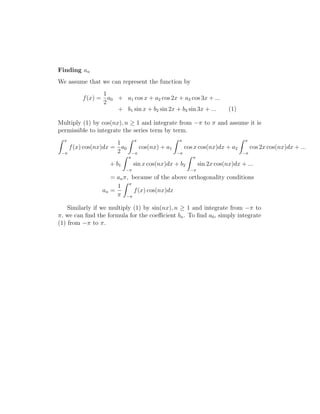
We assume that we can represent the function by 
f(x) = 
1 
2 
a0 + a1 cos x + a2 cos 2x + a3 cos 3x + ... 
+ b1 sin x + b2 sin 2x + b3 sin 3x + ... (1) 
Multiply (1) by cos(nx), n  1 and integrate from − to  and assume it is 
permissible to integrate the series term by term. 
Z  
− 
f(x) cos(nx)dx = 
1 
2 
a0 
Z  
− 
cos(nx) + a1 
Z  
− 
cos x cos(nx)dx + a2 
Z  
− 
cos 2x cos(nx)dx + ... 
+ b1 
Z  
− 
sin x cos(nx)dx + b2 
Z  
− 
sin 2x cos(nx)dx + ... 
= an, because of the above orthogonality conditions 
an = 
1 
 
Z  
− 
f(x) cos(nx)dx 
Similarly if we multiply (1) by sin(nx), n  1 and integrate from − to 
, we can find the formula for the coefficient bn. To find a0, simply integrate 
(1) from − to .
10.4 Fourier Series 
Definition. Let f(x) be a 2-periodic function which is integrable on [−, ]. 
Set 
a0 = 
1 
 
Z  
− 
f(x)dx 
an = 
1 
 
Z  
− 
f(x)cos(nx)dx 
bn = 
1 
 
Z  
− 
f(x)sin(nx)dx 
then the trigonometric series 
1 
2 
a0 + 
X1 
n=1 
(ancos(nx) + bnsin(nx)) 
is called the Fourier series associated to the function f(x). 
Remark. Notice that we are not saying f(x) is equal to its Fourier Series. 
Later we will discuss conditions under which that is actually true. 
Example. Find the Fourier coefficients and the Fourier series of the square-wave 
function f defined by 
f(x) = 
 
0 if −  x  0 
1 if 0  x   
and f(x + 2) = f(x) 
Solution: So f is periodic with period 2 and its graph is:
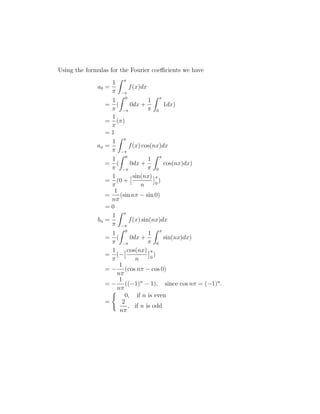
Using the formulas for the Fourier coefficients we have 
a0 = 
1 
 
Z  
− 
f(x)dx 
= 
1 
 
Z 0 
( 
− 
0dx + 
1 
 
Z  
0 
1dx) 
= 
1 
 
() 
= 1 
an = 
1 
 
Z  
− 
f(x) cos(nx)dx 
= 
1 
 
Z 0 
( 
− 
0dx + 
1 
 
Z  
0 
cos(nx)dx) 
= 
1 
 
(0 + 
sin(nx) 
n 
 
0 ) 
= 
1 
n 
(sin n − sin 0) 
= 0 
bn = 
1 
 
Z  
− 
f(x) sin(nx)dx 
= 
1 
 
Z 0 
( 
− 
0dx + 
1 
 
Z  
0 
sin(nx)dx) 
= 
1 
 
cos(nx) 
(− 
n 
 
0 ) 
= − 
1 
n 
(cos n − cos 0) 
= − 
1 
n 
((−1)n − 1), since cos n = (−1)n. 
= 
( 
0, if n is even 
2 
, if n is odd 
n
The Fourier Series of f is therefore 
f(x) = 
1 
2 
a0 + a1 cos x + a2 cos 2x + a3 cos 3x + ... 
+ b1 sin x + b2 sin 2x + b3 sin 3x + ... 
= 
1 
2 
+ 0 + 0 + 0 + ... 
+ 
2 
 
sin x + 0 sin 2x + 
2 
3 
sin 3x + 0 sin 4x + 
2 
5 
sin 5x + ... 
= 
1 
2 
+ 
2 
 
sin x + 
2 
3 
sin 3x + 
2 
5 
sin 5x + ... 
Remark. In the above example we have found the Fourier Series of the 
square-wave function, but we don’t know yet whether this function is equal 
to its Fourier series. If we plot 
1 
2 
+ 
sin x 
2 
 
1 
2 
+ 
2 
 
sin x + 
2 
3 
sin 3x 
1 
2 
+ 
2 
 
sin x + 
2 
3 
sin 3x + 
2 
5 
sin 5x+ 
1 
2 
+ 
2 
 
sin x + 
2 
3 
sin 3x + 
2 
5 
sin 5x + 
2 
7 
sin 7x+ 
1 
2 
+ 
2 
 
sin x + 
2 
3 
sin 3x + 
2 
5 
sin 5x + 
2 
7 
sin 7x + 
2 
9 
sin 9x + 
2 
11 
sin 11x + 
2 
13 
sin 13x, 
we see that as we take more terms, we get a better approximation to the 
square-wave function. The following theorem tells us that for almost all 
points (except at the discontinuities), the Fourier series equals the function. 
Theorem (Fourier Convergence Theorem) If f is a periodic func-tion 
with period 2 and f and f0 are piecewise continuous on [−, ], then 
the Fourier series is convergent. The sum of the Fourier series is equal to 
f(x) at all numbers x where f is continuous. At the numbers x where f is 
discontinuous, the sum of the Fourier series is the average value. i.e. 
1 
2 
[f(x+) + f(x−)].
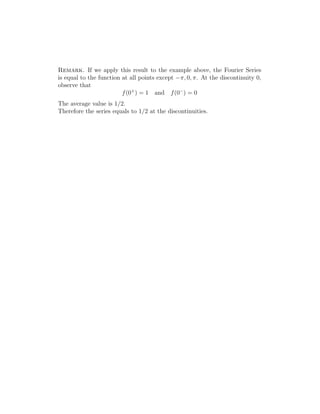
Remark. If we apply this result to the example above, the Fourier Series 
is equal to the function at all points except −, 0, . At the discontinuity 0, 
observe that 
f(0+) = 1 and f(0−) = 0 
The average value is 1/2. 
Therefore the series equals to 1/2 at the discontinuities.
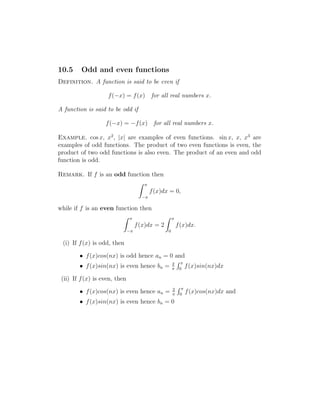
10.5 Odd and even functions 
Definition. A function is said to be even if 
f(−x) = f(x) for all real numbers x. 
A function is said to be odd if 
f(−x) = −f(x) for all real numbers x. 
Example. cos x, x2, |x| are examples of even functions. sin x, x, x3 are 
examples of odd functions. The product of two even functions is even, the 
product of two odd functions is also even. The product of an even and odd 
function is odd. 
Remark. If f is an odd function then 
Z  
− 
f(x)dx = 0, 
while if f is an even function then 
Z  
− 
f(x)dx = 2 
Z  
0 
f(x)dx. 
(i) If f(x) is odd, then 
• f(x)cos(nx) is odd hence an = 0 and 
• f(x)sin(nx) is even hence bn = 2 
 
R  
0 f(x)sin(nx)dx 
(ii) If f(x) is even, then 
• f(x)cos(nx) is even hence an = 2 
 
R  
0 f(x)cos(nx)dx and 
• f(x)sin(nx) is even hence bn = 0
Example. 1. Let f be a periodic function of period 2 such that 
f(x) = x for −   x   
Find the Fourier series associated to f. 
Solution: So f is periodic with period 2 and its graph is: 
We first check if f is even or odd. 
f(−x) = −x = −f(x), so f(x) is odd. 
Therefore, 
an = 0 
bn = 
2 
 
Z  
0 
f(x)sin(nx)dx 
Using the formulas for the Fourier coefficients we have 
bn = 
2 
 
Z  
0 
x sin(nx)dx 
= 
2 
 
 
− x 
( 
cos nx 
n 
 
0 
− 
Z  
0 
(− 
cos nx 
n 
)dx) 
= 
2 
 
( 
1 
n 
[− cos n] + [ 
sin nx 
n2 ]0 
) 
= − 
2 
n 
cos n 
= 
 
−2/n if n is even 
2/n if n is odd 
The Fourier Series of f is therefore 
f(x) = b1 sin x + b2 sin 2x + b3 sin 3x + ... 
= 2 sin x − 
2 
2 
sin 2x + 
2 
3 
sin 3x − 
2 
4 
sin 4x + 
2 
5 
sin 5x + ...
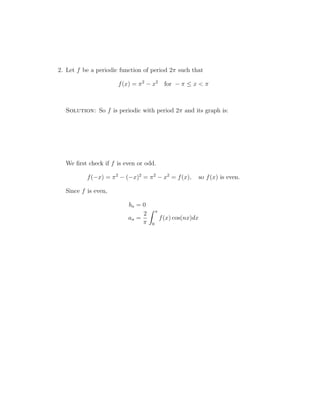
2. Let f be a periodic function of period 2 such that 
f(x) = 2 − x2 for −   x   
Solution: So f is periodic with period 2 and its graph is: 
We first check if f is even or odd. 
f(−x) = 2 − (−x)2 = 2 − x2 = f(x), so f(x) is even. 
Since f is even, 
bn = 0 
an = 
2 
 
Z  
0 
f(x) cos(nx)dx
Using the formulas for the Fourier coefficients we have 
an = 
2 
 
Z  
0 
f(x) cos(nx)dx 
= 
2 
 
Z  
0 
(2 − x2) cos(nx)dx 
= 
2 
 
 
(2 − x2) 
( 
sin nx 
n 
 
0 
− 
Z  
0 
−2x 
sin nx 
n 
dx) 
= 
2 
 
([(2 − 2) 
sin n 
n 
− (2 − 0) 
sin 0 
n 
] + 
Z  
0 
2x 
sin nx 
n 
dx) 
= 
2 
 
2 
n 
Z  
0 
x sin(nx)dx 
= 
2 
 
2 
n 
 
− x 
( 
cos nx 
n 
 
0 
− 
Z  
0 
(− 
cos nx 
n 
)dx) 
= 
2 
 
2 
n 
1 
n 
([− cos n] + [ 
sin nx 
n2 ]0 
) 
= − 
4 
n2 cos n 
= 
 
−4/n2 if n is even 
4/n2 if n is odd 
It remains to calculate a0. 
a0 = 
2 
 
Z  
0 
(2 − x2)dx 
= 
2 
 
[2x − 
x3 
3 
]0 
= 
42 
3 
The Fourier Series of f is therefore 
f(x) = 
1 
2 
a0 + a1 cos x + a2 cos 2x + a3 cos 3x + ... 
b1 sin x + b2 sin 2x + b3 sin 3x + ... 
= 
22 
3 
+ 4(cos x − 
1 
4 
cos 2x + 
1 
9 
cos 3x − 
1 
16 
cos 4x + 
1 
25 
cos 5x + ....)

Fourier 3

  • 1.
    10 Fourier Series 10.1 Introduction When the French mathematician Joseph Fourier (1768-1830) was trying to study the flow of heat in a metal plate, he had the idea of expressing the heat source as an infinite series of sine and cosine functions. Although the original motivation was to solve the heat equation, it later became obvious that the same techniques could be applied to a wide array of mathematical and physical problems. In this course, we will learn how to find Fourier series to represent periodic functions as an infinite series of sine and cosine terms. A function f(x) is said to be periodic with period T, if f(x + T) = f(x), for all x. The period of the function f(t) is the interval between two successive repe-titions. 10.2 Definition of a Fourier Series Let f be a bounded function defined on the [−, ] with at most a finite number of maxima and minima and at most a finite number of discontinuities in the interval. Then the Fourier series of f is the series f(x) = 1 2 a0 + a1 cos x + a2 cos 2x + a3 cos 3x + ... + b1 sin x + b2 sin 2x + b3 sin 3x + ... where the coefficients an and bn are given by the formulae a0 = 1 Z − f(x)dx an = 1 Z − f(x)cos(nx)dx bn = 1 Z − f(x)sin(nx)dx
  • 2.
    10.3 Why thecoefficients are found as they are We want to derive formulas for a0, an and bn. To do this we take advantage of some properies of sinusoidal signals. We use the following orthogonality conditions: Orthogonality conditions (i) The average value of cos(nx) and sin(nx) over a period is zero. Z − cos(nx)dx = 0 Z − sin(nx)dx = 0 (ii) The average value of sin(mx)cos(nx) over a period is zero. Z − sin(mx)cos(nx)dx = 0 (iii) The average value of sin(mx)sin(nx) over a period, Z − sin(mx)sin(nx)dx = if m = n6= 0 0 otherwise (iv) The average value of cos(mx)cos(nx) over a period, Z − cos(mx)cos(nx)dx = 8 : 2 if m = n = 0 if m = n6= 0 0 if m6= n Remark. The following trigonometric identities are useful to prove the above orthogonality conditions: cosAcosB = 1 2 [cos(A − B) + cos(A + B)] sinAsinB = 1 2 [cos(A − B) − cos(A + B)] sinAcosB = 1 2 [sin(A − B) + sin(A + B)]
  • 3.
    Finding an Weassume that we can represent the function by f(x) = 1 2 a0 + a1 cos x + a2 cos 2x + a3 cos 3x + ... + b1 sin x + b2 sin 2x + b3 sin 3x + ... (1) Multiply (1) by cos(nx), n 1 and integrate from − to and assume it is permissible to integrate the series term by term. Z − f(x) cos(nx)dx = 1 2 a0 Z − cos(nx) + a1 Z − cos x cos(nx)dx + a2 Z − cos 2x cos(nx)dx + ... + b1 Z − sin x cos(nx)dx + b2 Z − sin 2x cos(nx)dx + ... = an, because of the above orthogonality conditions an = 1 Z − f(x) cos(nx)dx Similarly if we multiply (1) by sin(nx), n 1 and integrate from − to , we can find the formula for the coefficient bn. To find a0, simply integrate (1) from − to .
  • 4.
    10.4 Fourier Series Definition. Let f(x) be a 2-periodic function which is integrable on [−, ]. Set a0 = 1 Z − f(x)dx an = 1 Z − f(x)cos(nx)dx bn = 1 Z − f(x)sin(nx)dx then the trigonometric series 1 2 a0 + X1 n=1 (ancos(nx) + bnsin(nx)) is called the Fourier series associated to the function f(x). Remark. Notice that we are not saying f(x) is equal to its Fourier Series. Later we will discuss conditions under which that is actually true. Example. Find the Fourier coefficients and the Fourier series of the square-wave function f defined by f(x) = 0 if − x 0 1 if 0 x and f(x + 2) = f(x) Solution: So f is periodic with period 2 and its graph is:
  • 5.
    Using the formulasfor the Fourier coefficients we have a0 = 1 Z − f(x)dx = 1 Z 0 ( − 0dx + 1 Z 0 1dx) = 1 () = 1 an = 1 Z − f(x) cos(nx)dx = 1 Z 0 ( − 0dx + 1 Z 0 cos(nx)dx) = 1 (0 + sin(nx) n 0 ) = 1 n (sin n − sin 0) = 0 bn = 1 Z − f(x) sin(nx)dx = 1 Z 0 ( − 0dx + 1 Z 0 sin(nx)dx) = 1 cos(nx) (− n 0 ) = − 1 n (cos n − cos 0) = − 1 n ((−1)n − 1), since cos n = (−1)n. = ( 0, if n is even 2 , if n is odd n
  • 6.
    The Fourier Seriesof f is therefore f(x) = 1 2 a0 + a1 cos x + a2 cos 2x + a3 cos 3x + ... + b1 sin x + b2 sin 2x + b3 sin 3x + ... = 1 2 + 0 + 0 + 0 + ... + 2 sin x + 0 sin 2x + 2 3 sin 3x + 0 sin 4x + 2 5 sin 5x + ... = 1 2 + 2 sin x + 2 3 sin 3x + 2 5 sin 5x + ... Remark. In the above example we have found the Fourier Series of the square-wave function, but we don’t know yet whether this function is equal to its Fourier series. If we plot 1 2 + sin x 2 1 2 + 2 sin x + 2 3 sin 3x 1 2 + 2 sin x + 2 3 sin 3x + 2 5 sin 5x+ 1 2 + 2 sin x + 2 3 sin 3x + 2 5 sin 5x + 2 7 sin 7x+ 1 2 + 2 sin x + 2 3 sin 3x + 2 5 sin 5x + 2 7 sin 7x + 2 9 sin 9x + 2 11 sin 11x + 2 13 sin 13x, we see that as we take more terms, we get a better approximation to the square-wave function. The following theorem tells us that for almost all points (except at the discontinuities), the Fourier series equals the function. Theorem (Fourier Convergence Theorem) If f is a periodic func-tion with period 2 and f and f0 are piecewise continuous on [−, ], then the Fourier series is convergent. The sum of the Fourier series is equal to f(x) at all numbers x where f is continuous. At the numbers x where f is discontinuous, the sum of the Fourier series is the average value. i.e. 1 2 [f(x+) + f(x−)].
  • 7.
    Remark. If weapply this result to the example above, the Fourier Series is equal to the function at all points except −, 0, . At the discontinuity 0, observe that f(0+) = 1 and f(0−) = 0 The average value is 1/2. Therefore the series equals to 1/2 at the discontinuities.
  • 8.
    10.5 Odd andeven functions Definition. A function is said to be even if f(−x) = f(x) for all real numbers x. A function is said to be odd if f(−x) = −f(x) for all real numbers x. Example. cos x, x2, |x| are examples of even functions. sin x, x, x3 are examples of odd functions. The product of two even functions is even, the product of two odd functions is also even. The product of an even and odd function is odd. Remark. If f is an odd function then Z − f(x)dx = 0, while if f is an even function then Z − f(x)dx = 2 Z 0 f(x)dx. (i) If f(x) is odd, then • f(x)cos(nx) is odd hence an = 0 and • f(x)sin(nx) is even hence bn = 2 R 0 f(x)sin(nx)dx (ii) If f(x) is even, then • f(x)cos(nx) is even hence an = 2 R 0 f(x)cos(nx)dx and • f(x)sin(nx) is even hence bn = 0
  • 9.
    Example. 1. Letf be a periodic function of period 2 such that f(x) = x for − x Find the Fourier series associated to f. Solution: So f is periodic with period 2 and its graph is: We first check if f is even or odd. f(−x) = −x = −f(x), so f(x) is odd. Therefore, an = 0 bn = 2 Z 0 f(x)sin(nx)dx Using the formulas for the Fourier coefficients we have bn = 2 Z 0 x sin(nx)dx = 2 − x ( cos nx n 0 − Z 0 (− cos nx n )dx) = 2 ( 1 n [− cos n] + [ sin nx n2 ]0 ) = − 2 n cos n = −2/n if n is even 2/n if n is odd The Fourier Series of f is therefore f(x) = b1 sin x + b2 sin 2x + b3 sin 3x + ... = 2 sin x − 2 2 sin 2x + 2 3 sin 3x − 2 4 sin 4x + 2 5 sin 5x + ...
  • 10.
    2. Let fbe a periodic function of period 2 such that f(x) = 2 − x2 for − x Solution: So f is periodic with period 2 and its graph is: We first check if f is even or odd. f(−x) = 2 − (−x)2 = 2 − x2 = f(x), so f(x) is even. Since f is even, bn = 0 an = 2 Z 0 f(x) cos(nx)dx
  • 11.
    Using the formulasfor the Fourier coefficients we have an = 2 Z 0 f(x) cos(nx)dx = 2 Z 0 (2 − x2) cos(nx)dx = 2 (2 − x2) ( sin nx n 0 − Z 0 −2x sin nx n dx) = 2 ([(2 − 2) sin n n − (2 − 0) sin 0 n ] + Z 0 2x sin nx n dx) = 2 2 n Z 0 x sin(nx)dx = 2 2 n − x ( cos nx n 0 − Z 0 (− cos nx n )dx) = 2 2 n 1 n ([− cos n] + [ sin nx n2 ]0 ) = − 4 n2 cos n = −4/n2 if n is even 4/n2 if n is odd It remains to calculate a0. a0 = 2 Z 0 (2 − x2)dx = 2 [2x − x3 3 ]0 = 42 3 The Fourier Series of f is therefore f(x) = 1 2 a0 + a1 cos x + a2 cos 2x + a3 cos 3x + ... b1 sin x + b2 sin 2x + b3 sin 3x + ... = 22 3 + 4(cos x − 1 4 cos 2x + 1 9 cos 3x − 1 16 cos 4x + 1 25 cos 5x + ....)