Dept. of PathologyDept. of Pathology
Medical CollegeMedical College
Hunan Normal UniversityHunan Normal University
(( 湖南 范大学医学院病理学教研室师湖南 范大学医学院病理学教研室师 )) 1
Chapter 3Chapter 3
Acid-Base Balance andAcid-Base Balance and
ImbalanceImbalance
(酸 平衡紊乱)碱(酸 平衡紊乱)碱
22
Acid-Base Balance and ImbalanceAcid-Base Balance and Imbalance
a.a. Acid-base homeostasisAcid-base homeostasis
b.b. Parameters of acid-baseParameters of acid-base
balancebalance
c.c. Simple acid-base disturbanceSimple acid-base disturbance
 Metabolic acidosisMetabolic acidosis
 Respiratory acidosisRespiratory acidosis
 Metabolic alkalosisMetabolic alkalosis
 Respiratory alkalosisRespiratory alkalosis
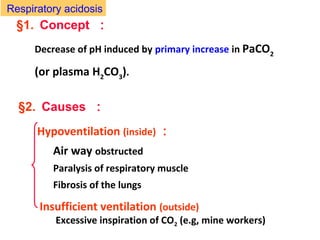
§1. Concept :
Decrease of pH induced by primary increase in PaCO2
(or plasma H2
CO3
).
§2. Causes :
Hypoventilation (inside) :
Air way obstructed
Paralysis of respiratory muscle
Fibrosis of the lungs
Insufficient ventilation (outside)
Excessive inspiration of CO2 (e.g, mine workers)
Respiratory acidosis
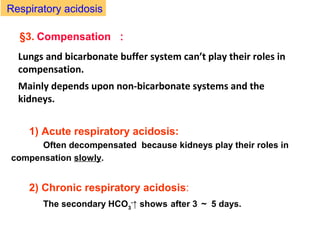
§3. Compensation :
1) Acute respiratory acidosis:
Often decompensated because kidneys play their roles in
compensation slowly.
2) Chronic respiratory acidosis:
The secondary HCO3
-
↑ shows after 3 ~ 5 days.
Respiratory acidosis
Lungs and bicarbonate buffer system can’t play their roles in
compensation.
Mainly depends upon non-bicarbonate systems and the
kidneys.
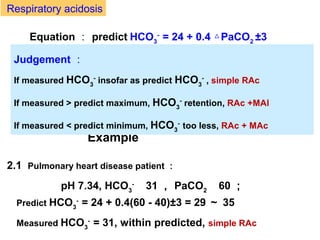
2.1 Pulmonary heart disease patient :
pH 7.34, HCO3
-  
31 , PaCO2  
60 ;
Predict HCO3
-
= 24 + 0.4(60 - 40)±3 = 29 ~ 35
Measured HCO3
-
= 31, within predicted, simple RAc
Equation : predict HCO3
-
= 24 + 0.4 PaCO△ 2
±3
Example
Judgement :
If measured HCO3
-
insofar as predict HCO3
-
, simple RAc
If measured > predict maximum, HCO3
-
retention, RAc +MAl
If measured < predict minimum, HCO3
-
too less, RAc + MAc
Respiratory acidosis
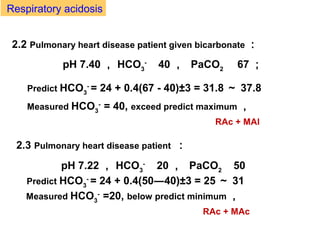
2.2 Pulmonary heart disease patient given bicarbonate :
pH 7.40 , HCO3
-  
40 , PaCO2  
67 ;
Predict HCO3
-
= 24 + 0.4(67 - 40)±3 = 31.8 ~ 37.8
Measured HCO3
-
= 40, exceed predict maximum ,
RAc + MAl
2.3 Pulmonary heart disease patient :
pH 7.22 , HCO3
-  
20 , PaCO2  
50   
Predict HCO3
-
= 24 + 0.4(50―40)±3 = 25 ~ 31
Measured HCO3
-
=20, below predict minimum ,
RAc + MAc
Respiratory acidosis
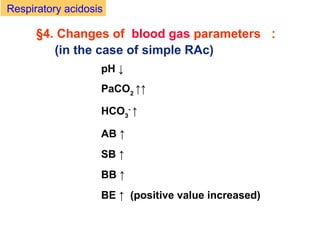
§4. Changes of blood gas parameters :
Respiratory acidosis
pH ↓
PaCO2
↑↑
HCO3
-
↑
AB ↑
SB ↑
BB ↑
BE ↑ (positive value increased)
(in the case of simple RAc)
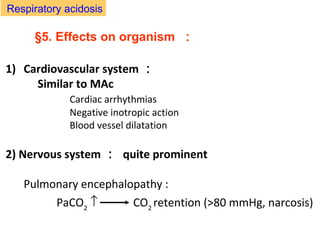
§5. Effects on organism :
Respiratory acidosis
1) Cardiovascular system :
Similar to MAc
Cardiac arrhythmias
Negative inotropic action
Blood vessel dilatation
2) Nervous system : quite prominent
Pulmonary encephalopathy :
PaCO2
↑ CO2
retention (>80 mmHg, narcosis)
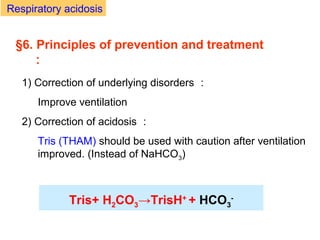
1) Correction of underlying disorders :
Improve ventilation
2) Correction of acidosis :
Tris (THAM) should be used with caution after ventilation
improved. (Instead of NaHCO3)
Tris+ H2CO3→TrisH+
+ HCO3
-
§6. Principles of prevention and treatment
:
Respiratory acidosis
1010
Acid-Base Balance and ImbalanceAcid-Base Balance and Imbalance
a.a. Acid-base homeostasisAcid-base homeostasis
b.b. Parameters of acid-baseParameters of acid-base
balancebalance
c.c. Simple acid-base disturbanceSimple acid-base disturbance
 Metabolic acidosisMetabolic acidosis
 Respiratory acidosisRespiratory acidosis
 Metabolic alkalosisMetabolic alkalosis
 Respiratory alkalosisRespiratory alkalosis
§1. Concept :
Increase of pH induced by primary increase in plasma HCO3
-
.
§2. Causes :
Acids too little
Bases too much
Metabolic alkalosis
H+
Loss ↑ from the stomach : bad vomiting and/or
gastric suction
H+
Loss ↑ from the
kidneys
Long term use of diuretics:
primary or secondary
hyperaldosteronism
Cushing Syndrome
(↑ cortisol →↑ glucocorticoid
[similar to ADS])
Hypokalemia: H+
exchanged into cells
ADS↑:
1) Acids
too little
Metabolic alkalosis
Ammonia (NH3) poisoning during hepatic failure
NH3 + H+
→ NH4
+
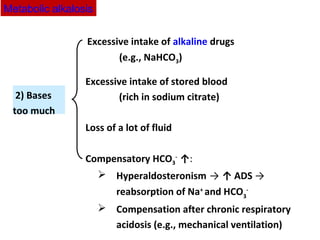
2) Bases
too much
Excessive intake of alkaline drugs
(e.g., NaHCO3)
Excessive intake of stored blood
(rich in sodium citrate)
Loss of a lot of fluid
Compensatory HCO3
-
↑:
 Hyperaldosteronism → ↑ ADS →
reabsorption of Na+
and HCO3
-
 Compensation after chronic respiratory
acidosis (e.g., mechanical ventilation)
Metabolic alkalosis
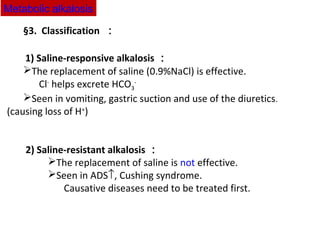
§3. Classification :
1) Saline-responsive alkalosis :
The replacement of saline (0.9%NaCl) is effective.
Cl-
helps excrete HCO3
-
Seen in vomiting, gastric suction and use of the diuretics.
(causing loss of H+
)
2) Saline-resistant alkalosis :
The replacement of saline is not effective.
Seen in ADS↑, Cushing syndrome.
Causative diseases need to be treated first.
Metabolic alkalosis
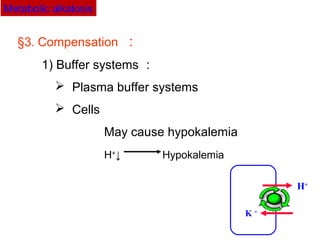
§3. Compensation :
1) Buffer systems :
 Plasma buffer systems
 Cells
May cause hypokalemia
H+
↓ Hypokalemia
K +
H+
Metabolic alkalosis
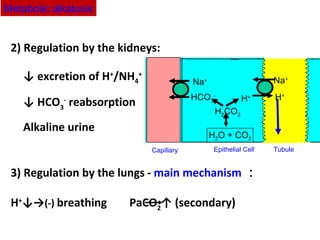
2) Regulation by the kidneys:
↓ excretion of H+
/NH4
+
↓ HCO3
-
reabsorption
Alkaline urine
3) Regulation by the lungs - main mechanism :
H+
↓→(-) breathing PaCO2
↑ (secondary)
Metabolic alkalosis
Na+
Capillary Epithelial Cell Tubule
H2O + CO2
H+
Na+
H2CO3
HCO3
-
H+
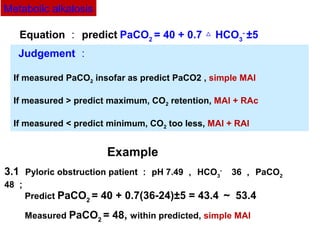
3.1 Pyloric obstruction patient : pH 7.49 , HCO3
-  
36 , PaCO2
48 ;
Predict PaCO2
= 40 + 0.7(36-24)±5 = 43.4 ~ 53.4
Measured PaCO2
= 48, within predicted, simple MAl
Equation : predict PaCO2
= 40 + 0.7 HCO△ 3
-
±5  
Example
Judgement :
If measured PaCO2 insofar as predict PaCO2 , simple MAl
If measured > predict maximum, CO2 retention, MAl + RAc
If measured < predict minimum, CO2 too less, MAl + RAl
Metabolic alkalosis
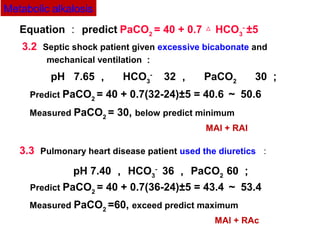
3.2 Septic shock patient given excessive bicabonate and
mechanical ventilation :
pH 7.65 ,  HCO3
-  
32 ,  PaCO2   
30 ;
Predict PaCO2
= 40 + 0.7(32-24)±5 = 40.6 ~ 50.6
Measured PaCO2
= 30, below predict minimum
MAl + RAl
3.3 Pulmonary heart disease patient used the diuretics :
pH 7.40 , HCO3
-
36 , PaCO2
60 ;
Predict PaCO2
= 40 + 0.7(36-24)±5 = 43.4 ~ 53.4
Measured PaCO2
=60, exceed predict maximum
MAl + RAc
Equation : predict PaCO2
= 40 + 0.7 HCO△ 3
-
±5  
Metabolic alkalosis
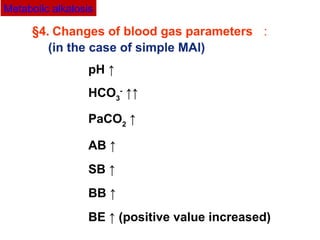
§4. Changes of blood gas parameters :
pH ↑
HCO3
-
↑↑
PaCO2
↑
AB ↑
SB ↑
BB ↑
BE ↑ (positive value increased)
Metabolic alkalosis
(in the case of simple MAl)
§5. Effects on organism :
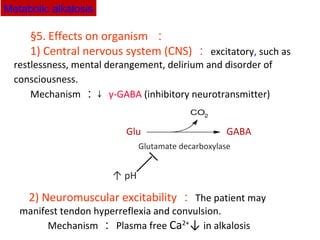
1) Central nervous system (CNS) : excitatory, such as
restlessness, mental derangement, delirium and disorder of
consciousness.  
Mechanism :↓ γ-GABA (inhibitory neurotransmitter)
2) Neuromuscular excitability : The patient may
manifest tendon hyperreflexia and convulsion.
  Mechanism : Plasma free Ca2+
↓ in alkalosis
Glutamate decarboxylase
↑ pH
Glu GABA
Metabolic alkalosis
4) Hypokalemia (arrhythmia) :
5) Urine: usually alkali
But in hypokalemia-alkalosis:
paradoxical acidic urine
Metabolic alkalosis
3) Hypoxia :
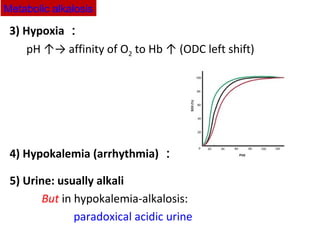
pH ↑→ affinity of O2 to Hb ↑ (ODC left shift)
§6. Principles of prevention and treatment :
1) Saline-responsive MAl
Saline (NaCl or KCl) infusion
2) Saline-resistant MAl
 Carbonic anhydrase (CA) inhibitor
- Acetazolamide (diamox)
- Inhibits generation and secretion of H+
 ADS inhibitor
- Spironolactone [ 螺内脂 ]
- Inhibits reabsorption of Na+
and H2CO3
+
Metabolic alkalosis
2323
Acid-Base Balance and ImbalanceAcid-Base Balance and Imbalance
a.a. Acid-base homeostasisAcid-base homeostasis
b.b. Parameters of acid-baseParameters of acid-base
balancebalance
c.c. Simple acid-base disturbanceSimple acid-base disturbance
 Metabolic acidosisMetabolic acidosis
 Respiratory acidosisRespiratory acidosis
 Metabolic alkalosisMetabolic alkalosis
 Respiratory alkalosisRespiratory alkalosis
§1. Concept :
Increase of pH induced by primary decrease in PaCO2
(or plasma
H2CO3).
§2. Causes : Hyperventilation is the fundamental
mechanism of respiratory alkalosis.
1) Excitement of respiratory center
Fever, hysteria.
2) Hypoxia
3) Lung diseases
ARDS, interstitial pneumonia.
4) Misuse of mechanical ventilator
Respiratory alkalosis
§3. Classification :
 1 ) Acute respiratoy alkalosis :
High fever, misuse of mechanical ventilator
     2) Chronic respiratory alkalosis :
Chronic hypoxia, lung diseases
Respiratory alkalosis
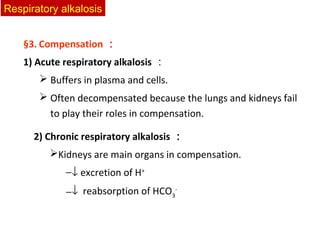
2) Chronic respiratory alkalosis :
Kidneys are main organs in compensation.
−↓ excretion of H+
−↓ reabsorption of HCO3
-
§3. Compensation :
1) Acute respiratory alkalosis :
 Buffers in plasma and cells.
 Often decompensated because the lungs and kidneys fail
to play their roles in compensation.
Respiratory alkalosis
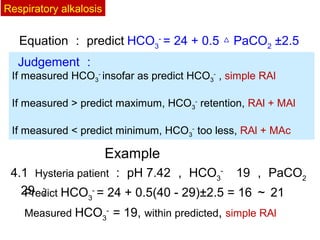
4.1 Hysteria patient : pH 7.42 , HCO3
-  
19 , PaCO2
 
29 ;Predict HCO3
-
= 24 + 0.5(40 - 29)±2.5 = 16 ~ 21
Measured HCO3
-
= 19, within predicted, simple RAl
Equation : predict HCO3
-
= 24 + 0.5 PaCO△ 2
±2.5
Example
Judgement :
If measured HCO3
-
insofar as predict HCO3
-
, simple RAl
If measured > predict maximum, HCO3
-
retention, RAl + MAl
If measured < predict minimum, HCO3
-
too less, RAl + MAc
Respiratory alkalosis
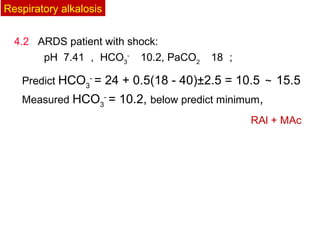
4.2 ARDS patient with shock:
pH 7.41 , HCO3
-  
10.2, PaCO2  
18 ;
Predict HCO3
-
= 24 + 0.5(18 - 40)±2.5 = 10.5 ~ 15.5
Measured HCO3
-
= 10.2, below predict minimum,
RAl + MAc
Respiratory alkalosis
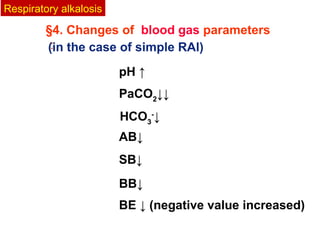
§4. Changes of blood gas parameters
:
pH ↑
HCO3
-
↓
AB↓
SB↓
BB↓
BE ↓ (negative value increased)
Respiratory alkalosis
(in the case of simple RAl)
PaCO2
↓↓
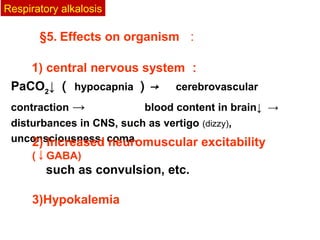
1) central nervous system :
PaCO2
↓ ( hypocapnia )→  cerebrovascular
contraction →      blood content in brain↓ →
disturbances in CNS, such as vertigo (dizzy),
unconsciousness, coma.
§5. Effects on organism :
2) Increased neuromuscular excitability
(↓GABA)
such as convulsion, etc.
3)Hypokalemia
Respiratory alkalosis
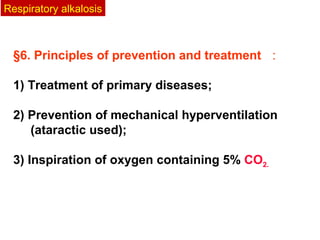
§6. Principles of prevention and treatment :
1) Treatment of primary diseases;
2) Prevention of mechanical hyperventilation
(ataractic used);
3) Inspiration of oxygen containing 5% CO2.
Respiratory alkalosis
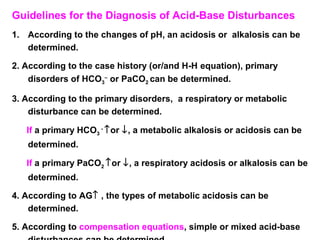
Guidelines for the Diagnosis of Acid-Base Disturbances
1. According to the changes of pH, an acidosis or alkalosis can be
determined.
2. According to the case history (or/and H-H equation), primary
disorders of HCO3
–
or PaCO2 can be determined.
3. According to the primary disorders, a respiratory or metabolic
disturbance can be determined.
If a primary HCO3
-
↑or ↓, a metabolic alkalosis or acidosis can be
determined.
If a primary PaCO2 ↑or ↓, a respiratory acidosis or alkalosis can be
determined.
4. According to AG↑ , the types of metabolic acidosis can be
determined.
5. According to compensation equations, simple or mixed acid-base
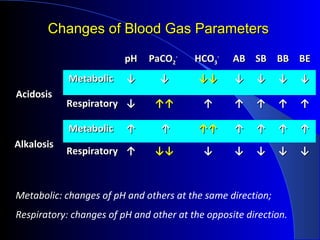
Changes of Blood Gas ParametersChanges of Blood Gas Parameters
pHpH PaCOPaCO22
--
HHCOCO33
--
ABAB SBSB BBBB BEBE
AcidosisAcidosis
MetabolicMetabolic ↓↓ ↓↓ ↓↓↓↓ ↓↓ ↓↓ ↓↓ ↓↓
RespiratoryRespiratory ↓↓ ↑↑↑↑ ↑↑ ↑↑ ↑↑ ↑↑ ↑↑
AlkalosisAlkalosis
MetabolicMetabolic ↑↑ ↑↑ ↑↑↑↑ ↑↑ ↑↑ ↑↑ ↑↑
RespiratoryRespiratory ↑↑ ↓↓↓↓ ↓↓ ↓↓ ↓↓ ↓↓ ↓↓
Metabolic: changes of pH and others at the same direction;
Respiratory: changes of pH and other at the opposite direction.
Example :
A 45-year-old women was admitted to the local hospital with nausea,
vomiting, anorexia. She has suffered a 5-year history of hypertension
and a 3-year history of albuminuria. Doctor told her kidneys damaged
one year ago. Now edema and hypertension has been checked out. Her
laboratory results were as follows: pH 7.30 , PaCO2   20
mmHg , HCO3
–
9 mmol/ L , Na+
127 mmol/L , K+
6.7 mmol/L , Cl-
88
mmol/L , BUN 1.5g/L [0.09 – 0.2] 。
1 , Is there acid-base disorders?
2 , Why does PaCO2 decrease too ?
3 , Why her AG ↑ ?
[acids not eliminated from damaged kidneys]
4 , Is there any other acid-base disorders except metabolic
acidosis ?
Equation : predict PaCO2
= 1.5×[HCO3
-
] + 8±2
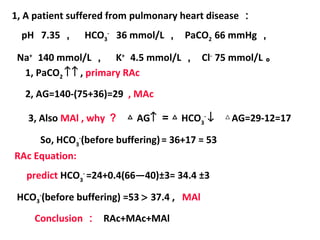
1, A patient suffered from pulmonary heart disease :
pH 7.35 , HCO3
-
36 mmol/L , PaCO2 66 mmHg ,
1, PaCO2 ↑↑ , primary RAc
2, AG=140-(75+36)=29 , MAc
3, Also MAl , why ? △ AG↑ =△ HCO3
-
↓ AG=29-12=17△
So, HCO3
-
(before buffering)= 36+17 = 53
RAc Equation:
predict HCO3
-
=24+0.4(66―40)±3= 34.4 ±3
HCO3
-
(before buffering) =53 > 37.4 , MAl
Conclusion : RAc+MAc+MAl
Na+
140 mmol/L , K+
4.5 mmol/L , Cl-
75 mmol/L 。
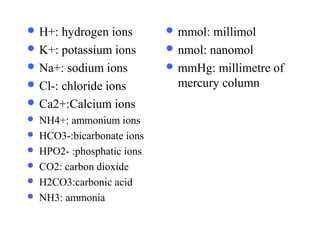
H+: hydrogen ion
 H+: hydrogen ions
 K+: potassium ions
 Na+: sodium ions
 Cl-: chloride ions
 Ca2+:Calcium ions
 NH4+: ammonium ions
 HCO3-:bicarbonate ions
 HPO2- :phosphatic ions
 CO2: carbon dioxide
 H2CO3:carbonic acid
 NH3: ammonia
 mmol: millimol
 nmol: nanomol
 mmHg: millimetre of
mercury column

03 acid basedisturbance_ptii

  • 1.
    Dept. of PathologyDept.of Pathology Medical CollegeMedical College Hunan Normal UniversityHunan Normal University (( 湖南 范大学医学院病理学教研室师湖南 范大学医学院病理学教研室师 )) 1 Chapter 3Chapter 3 Acid-Base Balance andAcid-Base Balance and ImbalanceImbalance (酸 平衡紊乱)碱(酸 平衡紊乱)碱
  • 2.
    22 Acid-Base Balance andImbalanceAcid-Base Balance and Imbalance a.a. Acid-base homeostasisAcid-base homeostasis b.b. Parameters of acid-baseParameters of acid-base balancebalance c.c. Simple acid-base disturbanceSimple acid-base disturbance  Metabolic acidosisMetabolic acidosis  Respiratory acidosisRespiratory acidosis  Metabolic alkalosisMetabolic alkalosis  Respiratory alkalosisRespiratory alkalosis
  • 3.
    §1. Concept : Decreaseof pH induced by primary increase in PaCO2 (or plasma H2 CO3 ). §2. Causes : Hypoventilation (inside) : Air way obstructed Paralysis of respiratory muscle Fibrosis of the lungs Insufficient ventilation (outside) Excessive inspiration of CO2 (e.g, mine workers) Respiratory acidosis
  • 4.
    §3. Compensation : 1)Acute respiratory acidosis: Often decompensated because kidneys play their roles in compensation slowly. 2) Chronic respiratory acidosis: The secondary HCO3 - ↑ shows after 3 ~ 5 days. Respiratory acidosis Lungs and bicarbonate buffer system can’t play their roles in compensation. Mainly depends upon non-bicarbonate systems and the kidneys.
  • 5.
    2.1 Pulmonary heartdisease patient : pH 7.34, HCO3 -   31 , PaCO2   60 ; Predict HCO3 - = 24 + 0.4(60 - 40)±3 = 29 ~ 35 Measured HCO3 - = 31, within predicted, simple RAc Equation : predict HCO3 - = 24 + 0.4 PaCO△ 2 ±3 Example Judgement : If measured HCO3 - insofar as predict HCO3 - , simple RAc If measured > predict maximum, HCO3 - retention, RAc +MAl If measured < predict minimum, HCO3 - too less, RAc + MAc Respiratory acidosis
  • 6.
    2.2 Pulmonary heartdisease patient given bicarbonate : pH 7.40 , HCO3 -   40 , PaCO2   67 ; Predict HCO3 - = 24 + 0.4(67 - 40)±3 = 31.8 ~ 37.8 Measured HCO3 - = 40, exceed predict maximum , RAc + MAl 2.3 Pulmonary heart disease patient : pH 7.22 , HCO3 -   20 , PaCO2   50    Predict HCO3 - = 24 + 0.4(50―40)±3 = 25 ~ 31 Measured HCO3 - =20, below predict minimum , RAc + MAc Respiratory acidosis
  • 7.
    §4. Changes ofblood gas parameters : Respiratory acidosis pH ↓ PaCO2 ↑↑ HCO3 - ↑ AB ↑ SB ↑ BB ↑ BE ↑ (positive value increased) (in the case of simple RAc)
  • 8.
    §5. Effects onorganism : Respiratory acidosis 1) Cardiovascular system : Similar to MAc Cardiac arrhythmias Negative inotropic action Blood vessel dilatation 2) Nervous system : quite prominent Pulmonary encephalopathy : PaCO2 ↑ CO2 retention (>80 mmHg, narcosis)
  • 9.
    1) Correction ofunderlying disorders : Improve ventilation 2) Correction of acidosis : Tris (THAM) should be used with caution after ventilation improved. (Instead of NaHCO3) Tris+ H2CO3→TrisH+ + HCO3 - §6. Principles of prevention and treatment : Respiratory acidosis
  • 10.
    1010 Acid-Base Balance andImbalanceAcid-Base Balance and Imbalance a.a. Acid-base homeostasisAcid-base homeostasis b.b. Parameters of acid-baseParameters of acid-base balancebalance c.c. Simple acid-base disturbanceSimple acid-base disturbance  Metabolic acidosisMetabolic acidosis  Respiratory acidosisRespiratory acidosis  Metabolic alkalosisMetabolic alkalosis  Respiratory alkalosisRespiratory alkalosis
  • 11.
    §1. Concept : Increaseof pH induced by primary increase in plasma HCO3 - . §2. Causes : Acids too little Bases too much Metabolic alkalosis
  • 12.
    H+ Loss ↑ fromthe stomach : bad vomiting and/or gastric suction H+ Loss ↑ from the kidneys Long term use of diuretics: primary or secondary hyperaldosteronism Cushing Syndrome (↑ cortisol →↑ glucocorticoid [similar to ADS]) Hypokalemia: H+ exchanged into cells ADS↑: 1) Acids too little Metabolic alkalosis Ammonia (NH3) poisoning during hepatic failure NH3 + H+ → NH4 +
  • 13.
    2) Bases too much Excessiveintake of alkaline drugs (e.g., NaHCO3) Excessive intake of stored blood (rich in sodium citrate) Loss of a lot of fluid Compensatory HCO3 - ↑:  Hyperaldosteronism → ↑ ADS → reabsorption of Na+ and HCO3 -  Compensation after chronic respiratory acidosis (e.g., mechanical ventilation) Metabolic alkalosis
  • 14.
    §3. Classification : 1)Saline-responsive alkalosis : The replacement of saline (0.9%NaCl) is effective. Cl- helps excrete HCO3 - Seen in vomiting, gastric suction and use of the diuretics. (causing loss of H+ ) 2) Saline-resistant alkalosis : The replacement of saline is not effective. Seen in ADS↑, Cushing syndrome. Causative diseases need to be treated first. Metabolic alkalosis
  • 15.
    §3. Compensation : 1)Buffer systems :  Plasma buffer systems  Cells May cause hypokalemia H+ ↓ Hypokalemia K + H+ Metabolic alkalosis
  • 16.
    2) Regulation bythe kidneys: ↓ excretion of H+ /NH4 + ↓ HCO3 - reabsorption Alkaline urine 3) Regulation by the lungs - main mechanism : H+ ↓→(-) breathing PaCO2 ↑ (secondary) Metabolic alkalosis Na+ Capillary Epithelial Cell Tubule H2O + CO2 H+ Na+ H2CO3 HCO3 - H+
  • 17.
    3.1 Pyloric obstructionpatient : pH 7.49 , HCO3 -   36 , PaCO2 48 ; Predict PaCO2 = 40 + 0.7(36-24)±5 = 43.4 ~ 53.4 Measured PaCO2 = 48, within predicted, simple MAl Equation : predict PaCO2 = 40 + 0.7 HCO△ 3 - ±5   Example Judgement : If measured PaCO2 insofar as predict PaCO2 , simple MAl If measured > predict maximum, CO2 retention, MAl + RAc If measured < predict minimum, CO2 too less, MAl + RAl Metabolic alkalosis
  • 18.
    3.2 Septic shockpatient given excessive bicabonate and mechanical ventilation : pH 7.65 ,  HCO3 -   32 ,  PaCO2    30 ; Predict PaCO2 = 40 + 0.7(32-24)±5 = 40.6 ~ 50.6 Measured PaCO2 = 30, below predict minimum MAl + RAl 3.3 Pulmonary heart disease patient used the diuretics : pH 7.40 , HCO3 - 36 , PaCO2 60 ; Predict PaCO2 = 40 + 0.7(36-24)±5 = 43.4 ~ 53.4 Measured PaCO2 =60, exceed predict maximum MAl + RAc Equation : predict PaCO2 = 40 + 0.7 HCO△ 3 - ±5   Metabolic alkalosis
  • 19.
    §4. Changes ofblood gas parameters : pH ↑ HCO3 - ↑↑ PaCO2 ↑ AB ↑ SB ↑ BB ↑ BE ↑ (positive value increased) Metabolic alkalosis (in the case of simple MAl)
  • 20.
    §5. Effects onorganism : 1) Central nervous system (CNS) : excitatory, such as restlessness, mental derangement, delirium and disorder of consciousness.   Mechanism :↓ γ-GABA (inhibitory neurotransmitter) 2) Neuromuscular excitability : The patient may manifest tendon hyperreflexia and convulsion.   Mechanism : Plasma free Ca2+ ↓ in alkalosis Glutamate decarboxylase ↑ pH Glu GABA Metabolic alkalosis
  • 21.
    4) Hypokalemia (arrhythmia): 5) Urine: usually alkali But in hypokalemia-alkalosis: paradoxical acidic urine Metabolic alkalosis 3) Hypoxia : pH ↑→ affinity of O2 to Hb ↑ (ODC left shift)
  • 22.
    §6. Principles ofprevention and treatment : 1) Saline-responsive MAl Saline (NaCl or KCl) infusion 2) Saline-resistant MAl  Carbonic anhydrase (CA) inhibitor - Acetazolamide (diamox) - Inhibits generation and secretion of H+  ADS inhibitor - Spironolactone [ 螺内脂 ] - Inhibits reabsorption of Na+ and H2CO3 + Metabolic alkalosis
  • 23.
    2323 Acid-Base Balance andImbalanceAcid-Base Balance and Imbalance a.a. Acid-base homeostasisAcid-base homeostasis b.b. Parameters of acid-baseParameters of acid-base balancebalance c.c. Simple acid-base disturbanceSimple acid-base disturbance  Metabolic acidosisMetabolic acidosis  Respiratory acidosisRespiratory acidosis  Metabolic alkalosisMetabolic alkalosis  Respiratory alkalosisRespiratory alkalosis
  • 24.
    §1. Concept : Increaseof pH induced by primary decrease in PaCO2 (or plasma H2CO3). §2. Causes : Hyperventilation is the fundamental mechanism of respiratory alkalosis. 1) Excitement of respiratory center Fever, hysteria. 2) Hypoxia 3) Lung diseases ARDS, interstitial pneumonia. 4) Misuse of mechanical ventilator Respiratory alkalosis
  • 25.
    §3. Classification :  1) Acute respiratoy alkalosis : High fever, misuse of mechanical ventilator      2) Chronic respiratory alkalosis : Chronic hypoxia, lung diseases Respiratory alkalosis
  • 26.
    2) Chronic respiratoryalkalosis : Kidneys are main organs in compensation. −↓ excretion of H+ −↓ reabsorption of HCO3 - §3. Compensation : 1) Acute respiratory alkalosis :  Buffers in plasma and cells.  Often decompensated because the lungs and kidneys fail to play their roles in compensation. Respiratory alkalosis
  • 27.
    4.1 Hysteria patient: pH 7.42 , HCO3 -   19 , PaCO2   29 ;Predict HCO3 - = 24 + 0.5(40 - 29)±2.5 = 16 ~ 21 Measured HCO3 - = 19, within predicted, simple RAl Equation : predict HCO3 - = 24 + 0.5 PaCO△ 2 ±2.5 Example Judgement : If measured HCO3 - insofar as predict HCO3 - , simple RAl If measured > predict maximum, HCO3 - retention, RAl + MAl If measured < predict minimum, HCO3 - too less, RAl + MAc Respiratory alkalosis
  • 28.
    4.2 ARDS patientwith shock: pH 7.41 , HCO3 -   10.2, PaCO2   18 ; Predict HCO3 - = 24 + 0.5(18 - 40)±2.5 = 10.5 ~ 15.5 Measured HCO3 - = 10.2, below predict minimum, RAl + MAc Respiratory alkalosis
  • 29.
    §4. Changes ofblood gas parameters : pH ↑ HCO3 - ↓ AB↓ SB↓ BB↓ BE ↓ (negative value increased) Respiratory alkalosis (in the case of simple RAl) PaCO2 ↓↓
  • 30.
    1) central nervoussystem : PaCO2 ↓ ( hypocapnia )→  cerebrovascular contraction →      blood content in brain↓ → disturbances in CNS, such as vertigo (dizzy), unconsciousness, coma. §5. Effects on organism : 2) Increased neuromuscular excitability (↓GABA) such as convulsion, etc. 3)Hypokalemia Respiratory alkalosis
  • 31.
    §6. Principles ofprevention and treatment : 1) Treatment of primary diseases; 2) Prevention of mechanical hyperventilation (ataractic used); 3) Inspiration of oxygen containing 5% CO2. Respiratory alkalosis
  • 32.
    Guidelines for theDiagnosis of Acid-Base Disturbances 1. According to the changes of pH, an acidosis or alkalosis can be determined. 2. According to the case history (or/and H-H equation), primary disorders of HCO3 – or PaCO2 can be determined. 3. According to the primary disorders, a respiratory or metabolic disturbance can be determined. If a primary HCO3 - ↑or ↓, a metabolic alkalosis or acidosis can be determined. If a primary PaCO2 ↑or ↓, a respiratory acidosis or alkalosis can be determined. 4. According to AG↑ , the types of metabolic acidosis can be determined. 5. According to compensation equations, simple or mixed acid-base
  • 33.
    Changes of BloodGas ParametersChanges of Blood Gas Parameters pHpH PaCOPaCO22 -- HHCOCO33 -- ABAB SBSB BBBB BEBE AcidosisAcidosis MetabolicMetabolic ↓↓ ↓↓ ↓↓↓↓ ↓↓ ↓↓ ↓↓ ↓↓ RespiratoryRespiratory ↓↓ ↑↑↑↑ ↑↑ ↑↑ ↑↑ ↑↑ ↑↑ AlkalosisAlkalosis MetabolicMetabolic ↑↑ ↑↑ ↑↑↑↑ ↑↑ ↑↑ ↑↑ ↑↑ RespiratoryRespiratory ↑↑ ↓↓↓↓ ↓↓ ↓↓ ↓↓ ↓↓ ↓↓ Metabolic: changes of pH and others at the same direction; Respiratory: changes of pH and other at the opposite direction.
  • 34.
    Example : A 45-year-oldwomen was admitted to the local hospital with nausea, vomiting, anorexia. She has suffered a 5-year history of hypertension and a 3-year history of albuminuria. Doctor told her kidneys damaged one year ago. Now edema and hypertension has been checked out. Her laboratory results were as follows: pH 7.30 , PaCO2   20 mmHg , HCO3 – 9 mmol/ L , Na+ 127 mmol/L , K+ 6.7 mmol/L , Cl- 88 mmol/L , BUN 1.5g/L [0.09 – 0.2] 。 1 , Is there acid-base disorders? 2 , Why does PaCO2 decrease too ? 3 , Why her AG ↑ ? [acids not eliminated from damaged kidneys] 4 , Is there any other acid-base disorders except metabolic acidosis ? Equation : predict PaCO2 = 1.5×[HCO3 - ] + 8±2
  • 36.
    1, A patientsuffered from pulmonary heart disease : pH 7.35 , HCO3 - 36 mmol/L , PaCO2 66 mmHg , 1, PaCO2 ↑↑ , primary RAc 2, AG=140-(75+36)=29 , MAc 3, Also MAl , why ? △ AG↑ =△ HCO3 - ↓ AG=29-12=17△ So, HCO3 - (before buffering)= 36+17 = 53 RAc Equation: predict HCO3 - =24+0.4(66―40)±3= 34.4 ±3 HCO3 - (before buffering) =53 > 37.4 , MAl Conclusion : RAc+MAc+MAl Na+ 140 mmol/L , K+ 4.5 mmol/L , Cl- 75 mmol/L 。
  • 37.
    H+: hydrogen ion H+: hydrogen ions  K+: potassium ions  Na+: sodium ions  Cl-: chloride ions  Ca2+:Calcium ions  NH4+: ammonium ions  HCO3-:bicarbonate ions  HPO2- :phosphatic ions  CO2: carbon dioxide  H2CO3:carbonic acid  NH3: ammonia  mmol: millimol  nmol: nanomol  mmHg: millimetre of mercury column

Editor's Notes

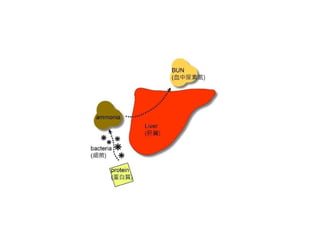
  • #2 Disorders are big problems in clinic. http://v.qihuang99.com/player/1777.html?1777-0-2
  • #4 Workers at mine with insufficient ventilation (鼓风机障碍) leading to too much CO2 inspiration。
  • #5 Because of the impairment of the respiratory function, the lungs and HCO3-/H2CO3 can’t function well. Compensation limit : HCO3-↑ = 45 mmol/L
  • #8 HCO3- accounts for half of BB. AB &amp;gt; SB (Because PaCO2 increases, AB &amp;gt; SB).
  • #9 Pulmonary encephalopathy: first excitement and then inhibitory (when PaCO2 exceeds 80). Narcosis:麻醉;昏迷状态
  • #10 In Rac, HCO3- (BE) already increased, better not to give alkali. Tris (tris(hydroxymethyl)aminomethane, THAM) is an organic compound with the formula (HOCH2)3CNH2. Tris is extensively used in biochemistry and molecular biology.[1] In biochemistry, Tris is widely used as a component of buffer solutions, such as in TAE and TBE buffer, especially for solutions of nucleic acids. It contains a primary amine and thus undergoes the reactions associated with typical amines, e.g. condensations with aldehydes. Tris (usually known as THAM in this context) is used as alternative to sodium bicarbonate in the treatment of metabolic acidosis.[8][9]
  • #13 ADS: Na+-H+ exchange. (Na+ and HCO3- co-reabsorbed) NH3: Ammonia NH4+: Ammonium
  • #14 Alkaline drugs such as morphine (one of the at least 50 alkaloids).
  • #16 HCO3-↑ can be buffered by weak acids in plasma.
  • #17 Regulation by the lungs are the main mechanisms for metabolic acid-base imbalances; whereas regulation by the kidneys are the main mechanisms for respiratory ones. Inhibition of the activities of CA will cause decreased excretion of H+; Inhibition of the activities of glutaminase will decrease the excretion of NH4+. Compensation limit by the lungs to increase PaCO2 = 55 mmHg.
  • #18 Pyloric obstruction leads to vomiting.
  • #20 The only difference with respiratory acidosis is pH. AB &amp;gt; SB
  • #21 Ca++ binds to plasma protein under alkalosis.
  • #23 Spironolactone inhibits the effects of mineralocorticoids, namely, aldosterone, by displacing them from mineralocorticoid receptors (MR) in the cortical collecting duct of renal nephrons.  Mechaisms of NaCl treatment of MAl: 1) Increasing extracellular fluid to eliminate concentrated alkalosisl; 2) Circulating blood ↑→ excretion of HCO3- from urine ↑
  • #25 Reflective stimulation such as hypoxia, fever, pain, also causes respiratory alkalosis. Hypoxemia is hypoxia in the blood.
  • #27 Compensation limit: HCO3-  = 15 mmol/L
  • #30 The only difference with metabolic acidosis is pH. AB &amp;lt; SB BE negative value increase is because of compensation.
  • #34 pH, PaCO2, HCO3-, AG.
  • #35 在原发呼吸障碍时,pH值和PaCO2改变方向相反;在原发代谢障碍时,pH值和PaCO2改变方向相同。
  • #36 The patient have suffered from metabolic acidosis according to her history and HCO3 - ↓ 1.5 x 9 + 8 +/- 2 = 19.5 – 23.5 血尿素氮(BUN, blood urea nitrogen )的正常值为:3.2-7.1mmol/L(90-200mg/L)
  • #37 http://baike.sogou.com/PicBooklet.v?relateImageGroupIds=&amp;lemmaId=7543079&amp;now=&amp;type=1#simple_0 血尿素氮(BUN, blood urea nitrogen )的正常值为:3.2-7.1mmol/L(90-200mg/L)