Marc D. Berg, MD – DeVos Children’s Hospital Rita R. Ongjoco, DO – Sinai Hospital of Baltimore 12/30/02 ABG Interpretation
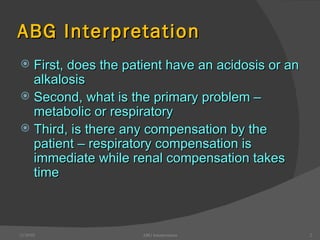
ABG Interpretation First, does the patient have an acidosis or an alkalosis Second, what is the primary problem – metabolic or respiratory Third, is there any compensation by the patient – respiratory compensation is immediate while renal compensation takes time 12/30/02 ABG Interpretation
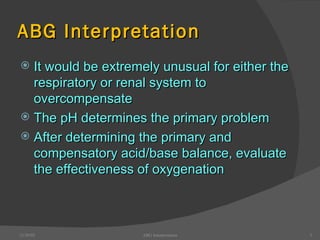
ABG Interpretation It would be extremely unusual for either the respiratory or renal system to overcompensate The pH determines the primary problem After determining the primary and compensatory acid/base balance, evaluate the effectiveness of oxygenation 12/30/02 ABG Interpretation
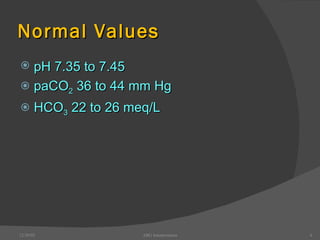
Normal Values pH 7.35 to 7.45 paCO 2  36 to 44 mm Hg HCO 3  22 to 26 meq/L 12/30/02 ABG Interpretation
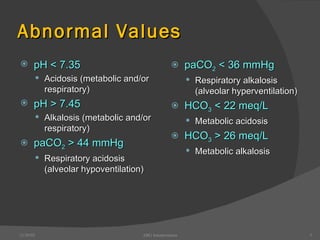
Abnormal Values pH < 7.35 Acidosis (metabolic and/or respiratory) pH > 7.45 Alkalosis (metabolic and/or respiratory) paCO 2  > 44 mmHg Respiratory acidosis (alveolar hypoventilation) paCO 2  < 36 mmHg Respiratory alkalosis (alveolar hyperventilation) HCO 3  < 22 meq/L Metabolic acidosis  HCO 3  > 26 meq/L Metabolic alkalosis 12/30/02 ABG Interpretation
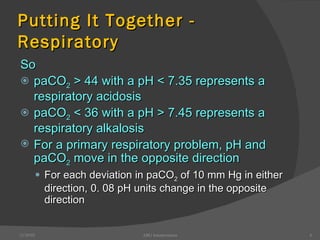
Putting It Together - Respiratory So paCO 2  > 44 with a pH < 7.35 represents a respiratory acidosis paCO 2  < 36 with a pH > 7.45 represents a respiratory alkalosis For a primary respiratory problem, pH and paCO 2  move in the opposite direction For each deviation in paCO 2  of 10 mm Hg in either direction, 0. 08 pH units change in the opposite direction 12/30/02 ABG Interpretation
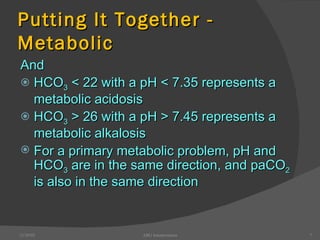
Putting It Together - Metabolic And HCO 3  < 22 with a pH < 7.35 represents a metabolic acidosis  HCO 3  > 26 with a pH > 7.45 represents a metabolic alkalosis For a primary metabolic problem, pH and HCO 3  are in the same direction, and paCO 2  is also in the same direction 12/30/02 ABG Interpretation
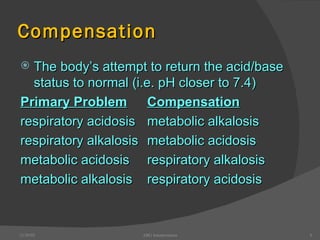
Compensation The body’s attempt to return the acid/base status to normal (i.e. pH closer to 7.4) Primary Problem Compensation respiratory acidosis metabolic alkalosis respiratory alkalosis metabolic acidosis metabolic acidosis respiratory alkalosis metabolic alkalosis respiratory acidosis 12/30/02 ABG Interpretation
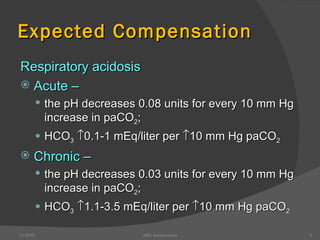
Expected Compensation Respiratory acidosis Acute –  the pH decreases 0.08 units for every 10 mm Hg increase in paCO 2 ;  HCO 3    0.1-1 mEq/liter per   10 mm Hg paCO 2 Chronic –  the pH decreases 0.03 units for every 10 mm Hg increase in paCO 2 ;  HCO 3    1.1-3.5 mEq/liter per   10 mm Hg paCO 2 12/30/02 ABG Interpretation
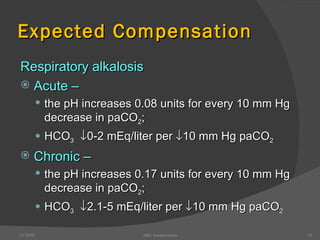
Expected Compensation Respiratory alkalosis Acute –  the pH increases 0.08 units for every 10 mm Hg decrease in paCO 2 ;  HCO 3    0-2 mEq/liter per   10 mm Hg paCO 2 Chronic –  the pH increases 0.17 units for every 10 mm Hg decrease in paCO 2 ;  HCO 3    2.1-5 mEq/liter per   10 mm Hg paCO 2 12/30/02 ABG Interpretation
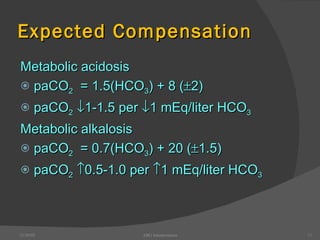
Expected Compensation Metabolic acidosis paCO 2   = 1.5(HCO 3 ) + 8 (  2) paCO 2    1-1.5 per   1 mEq/liter HCO 3 Metabolic alkalosis paCO 2   = 0.7(HCO 3 ) + 20 (  1.5) paCO 2    0.5-1.0 per   1 mEq/liter HCO 3 12/30/02 ABG Interpretation
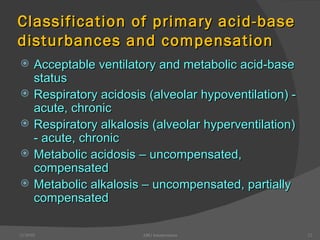
Classification of primary acid-base disturbances and compensation Acceptable ventilatory and metabolic acid-base status Respiratory acidosis (alveolar hypoventilation) - acute, chronic  Respiratory alkalosis (alveolar hyperventilation) - acute, chronic Metabolic acidosis – uncompensated, compensated  Metabolic alkalosis – uncompensated, partially compensated 12/30/02 ABG Interpretation
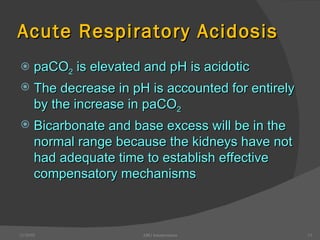
Acute Respiratory Acidosis paCO 2  is elevated and pH is acidotic The decrease in pH is accounted for entirely by the increase in paCO 2 Bicarbonate and base excess will be in the normal range because the kidneys have not had adequate time to establish effective compensatory mechanisms 12/30/02 ABG Interpretation
Acute Respiratory Acidosis Causes Respiratory pathophysiology - airway obstruction, severe pneumonia, chest trauma/pneumothorax Acute drug intoxication (narcotics, sedatives) Residual neuromuscular blockade CNS disease (head trauma) 12/30/02 ABG Interpretation
Chronic Respiratory Acidosis paCO 2  is elevated with a pH in the acceptable range Renal mechanisms increase the excretion of H +  within 24 hours and may correct the resulting acidosis caused by chronic retention of CO 2  to a certain extent 12/30/02 ABG Interpretation
Chronic Respiratory Acidosis Causes Chronic lung disease (BPD, COPD) Neuromuscular disease Extreme obesity Chest wall deformity 12/30/02 ABG Interpretation
Acute Respiratory Alkalosis paCO 2  is low and the pH is alkalotic The increase in pH is accounted for entirely by the decrease in paCO 2 Bicarbonate and base excess will be in the normal range because the kidneys have not had sufficient time to establish effective compensatory mechanisms 12/30/02 ABG Interpretation
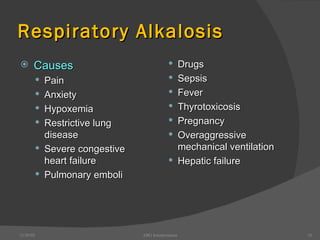
Respiratory Alkalosis Causes Pain Anxiety Hypoxemia Restrictive lung disease Severe congestive heart failure Pulmonary emboli Drugs Sepsis Fever Thyrotoxicosis Pregnancy Overaggressive mechanical ventilation Hepatic failure 12/30/02 ABG Interpretation
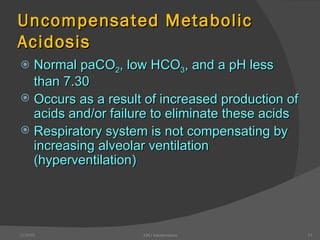
Uncompensated Metabolic Acidosis Normal paCO 2 , low HCO 3 , and a pH less than 7.30 Occurs as a result of increased production of acids and/or failure to eliminate these acids Respiratory system is not compensating by increasing alveolar ventilation (hyperventilation) 12/30/02 ABG Interpretation
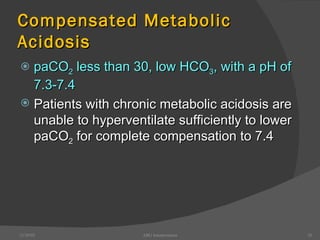
Compensated Metabolic Acidosis paCO 2  less than 30, low HCO 3 , with a pH of 7.3-7.4 Patients with chronic metabolic acidosis are unable to hyperventilate sufficiently to lower paCO 2  for complete compensation to 7.4 12/30/02 ABG Interpretation
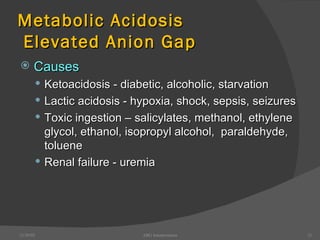
Metabolic Acidosis  Elevated Anion Gap Causes Ketoacidosis - diabetic, alcoholic, starvation Lactic acidosis - hypoxia, shock, sepsis, seizures Toxic ingestion – salicylates, methanol, ethylene glycol, ethanol, isopropyl alcohol,  paraldehyde, toluene Renal failure - uremia 12/30/02 ABG Interpretation
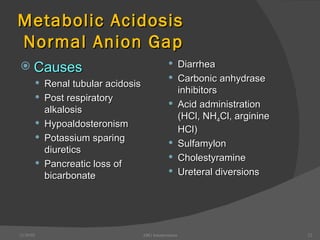
Metabolic Acidosis  Normal Anion Gap Causes Renal tubular acidosis Post respiratory alkalosis Hypoaldosteronism Potassium sparing diuretics Pancreatic loss of bicarbonate Diarrhea Carbonic anhydrase inhibitors Acid administration (HCl, NH 4 Cl, arginine HCl) Sulfamylon Cholestyramine Ureteral diversions 12/30/02 ABG Interpretation
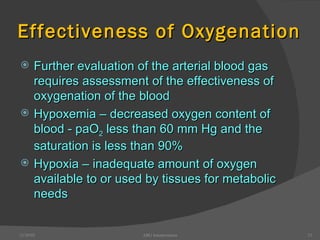
Effectiveness of Oxygenation Further evaluation of the arterial blood gas requires assessment of the effectiveness of oxygenation of the blood Hypoxemia – decreased oxygen content of blood - paO 2  less than 60 mm Hg and the saturation is less than 90% Hypoxia – inadequate amount of oxygen available to or used by tissues for metabolic needs 12/30/02 ABG Interpretation
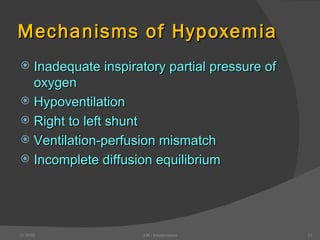
Mechanisms of Hypoxemia Inadequate inspiratory partial pressure of oxygen Hypoventilation Right to left shunt Ventilation-perfusion mismatch Incomplete diffusion equilibrium 12/30/02 ABG Interpretation
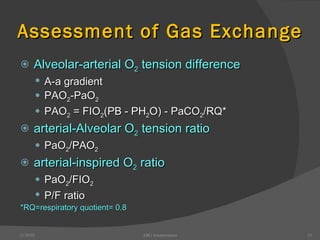
Assessment of Gas Exchange Alveolar-arterial O 2  tension difference A-a gradient PAO 2 -PaO 2 PAO 2  = FIO 2 (PB - PH 2 O) - PaCO 2 /RQ* arterial-Alveolar O 2  tension ratio PaO 2 /PAO 2 arterial-inspired O 2  ratio PaO 2 /FIO 2 P/F ratio *RQ=respiratory quotient= 0.8 12/30/02 ABG Interpretation
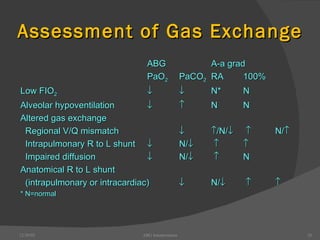
Assessment of Gas Exchange ABG A-a grad PaO 2 PaCO 2 RA 100% Low FIO 2       N* N Alveolar hypoventilation   N N Altered gas exchange Regional V/Q mismatch     /N/         N/  Intrapulmonary R to L shunt    N/          Impaired diffusion    N/         N Anatomical R to L shunt (intrapulmonary or intracardiac)    N/          * N=normal 12/30/02 ABG Interpretation
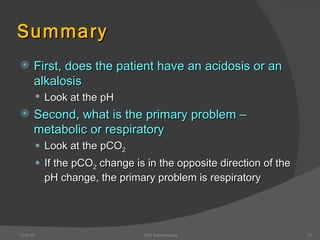
Summary First, does the patient have an acidosis or an alkalosis  Look at the pH Second, what is the primary problem – metabolic or respiratory Look at the pCO 2 If the pCO 2  change is in the opposite direction of the pH change, the primary problem is respiratory 12/30/02 ABG Interpretation
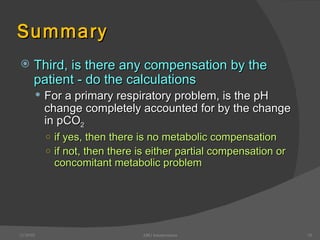
Summary Third, is there any compensation by the patient - do the calculations For a primary respiratory problem, is the pH change completely accounted for by the change in pCO 2 if yes, then there is no metabolic compensation if not, then there is either partial compensation or concomitant metabolic problem 12/30/02 ABG Interpretation
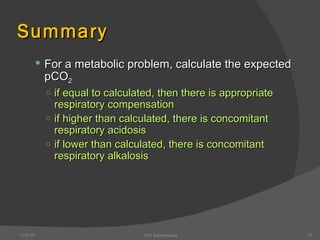
Summary For a metabolic problem, calculate the expected pCO 2 if equal to calculated, then there is appropriate respiratory compensation if higher than calculated, there is concomitant respiratory acidosis if lower than calculated, there is concomitant respiratory alkalosis 12/30/02 ABG Interpretation
Summary Next, don’t forget to look at the effectiveness of oxygenation, (and look at the patient) your patient may have a significantly increased work of breathing in order to maintain a “normal” blood gas metabolic acidosis with a concomitant respiratory acidosis is concerning 12/30/02 ABG Interpretation
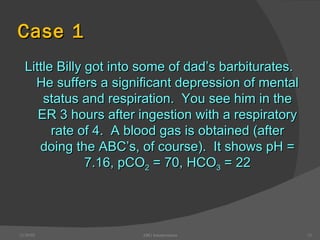
Case 1 Little Billy got into some of dad’s barbiturates.  He suffers a significant depression of mental status and respiration.  You see him in the ER 3 hours after ingestion with a respiratory rate of 4.  A blood gas is obtained (after doing the ABC’s, of course).  It shows pH = 7.16, pCO 2  = 70, HCO 3  = 22 12/30/02 ABG Interpretation
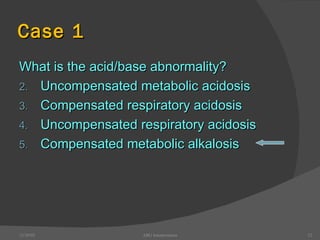
Case 1 What is the acid/base abnormality? Uncompensated metabolic acidosis Compensated respiratory acidosis Uncompensated respiratory acidosis Compensated metabolic alkalosis 12/30/02 ABG Interpretation
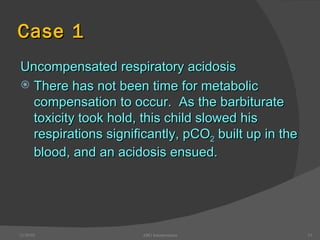
Case 1 Uncompensated respiratory acidosis There has not been time for metabolic compensation to occur.  As the barbiturate toxicity took hold, this child slowed his respirations significantly, pCO 2  built up in the blood, and an acidosis ensued. 12/30/02 ABG Interpretation
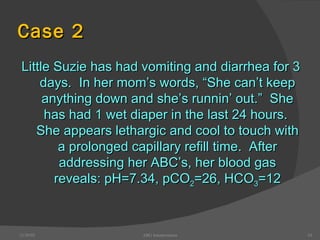
Case 2 Little Suzie has had vomiting and diarrhea for 3 days.  In her mom’s words, “She can’t keep anything down and she’s runnin’ out.”  She has had 1 wet diaper in the last 24 hours.  She appears lethargic and cool to touch with a prolonged capillary refill time.  After addressing her ABC’s, her blood gas reveals: pH=7.34, pCO 2 =26, HCO 3 =12 12/30/02 ABG Interpretation
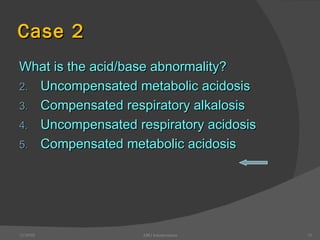
Case 2 What is the acid/base abnormality? Uncompensated metabolic acidosis Compensated respiratory alkalosis Uncompensated respiratory acidosis Compensated metabolic acidosis 12/30/02 ABG Interpretation
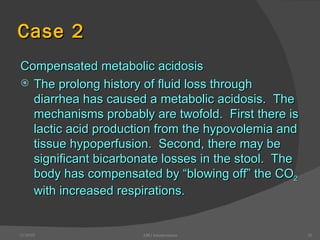
Case 2 Compensated metabolic acidosis The prolong history of fluid loss through diarrhea has caused a metabolic acidosis.  The mechanisms probably are twofold.  First there is lactic acid production from the hypovolemia and tissue hypoperfusion.  Second, there may be significant bicarbonate losses in the stool.  The body has compensated by “blowing off” the CO 2  with increased respirations. 12/30/02 ABG Interpretation
Case 3 You are evaluating a 15 year old female in the ER who was brought in by EMS from school because of abdominal pain and vomiting.  Review of system is negative except for a 10 lb. weight loss over the past 2 months and polyuria for the past 2 weeks.  She has no other medical problems and denies any sexual activity or drug use.  On exam, she is alert and oriented, afebrile, HR 115, RR 26 and regular, BP 114/75, pulse ox 95% on RA. 12/30/02 ABG Interpretation
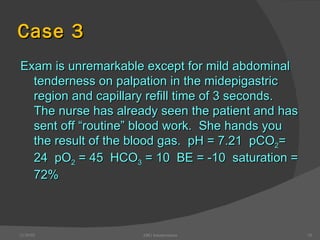
Case 3 Exam is unremarkable except for mild abdominal tenderness on palpation in the midepigastric region and capillary refill time of 3 seconds.  The nurse has already seen the patient and has sent off “routine” blood work.  She hands you the result of the blood gas.  pH = 7.21  pCO 2 =   24  pO 2  = 45  HCO 3  = 10  BE = -10  saturation = 72% 12/30/02 ABG Interpretation
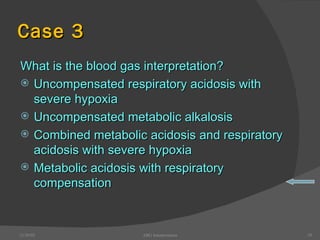
Case 3 What is the blood gas interpretation? Uncompensated respiratory acidosis with severe hypoxia Uncompensated metabolic alkalosis Combined metabolic acidosis and respiratory acidosis with severe hypoxia Metabolic acidosis with respiratory compensation 12/30/02 ABG Interpretation
Case 3 Metabolic acidosis with respiratory compensation This is a patient with new onset diabetes mellitus in ketoacidosis.  Her pulse oximetry saturation and clinical examination do not reveal any respiratory problems except for tachypnea which is her compensatory mechanism for the metabolic acidosis.  The nurse obtained the blood gas sample from the venous stick when she sent off the other labs. 12/30/02 ABG Interpretation
References The ICU Book – Paul L. Marino, 1991, Algorithms for acid-base interpretations, p415-426 Textbook of Pediatric Intensive Care 3 rd  Edition – edited by Mark C. Rogers, 1996, Respiratory Monitoring: Interpretation of clinical blood gas values, p355-361 Pediatric Critical Care – Bradley Fuhrman and Jerry Zimmerman, 1992, Acid-Base Balance and Disorders, p689-696 Critical Care Physiology – Robert Bartlett, 1996, Acid-Base physiology p165-173. 12/30/02 ABG Interpretation

02 Blood Gas

  • 1.
    Marc D. Berg,MD – DeVos Children’s Hospital Rita R. Ongjoco, DO – Sinai Hospital of Baltimore 12/30/02 ABG Interpretation
  • 2.
    ABG Interpretation First,does the patient have an acidosis or an alkalosis Second, what is the primary problem – metabolic or respiratory Third, is there any compensation by the patient – respiratory compensation is immediate while renal compensation takes time 12/30/02 ABG Interpretation
  • 3.
    ABG Interpretation Itwould be extremely unusual for either the respiratory or renal system to overcompensate The pH determines the primary problem After determining the primary and compensatory acid/base balance, evaluate the effectiveness of oxygenation 12/30/02 ABG Interpretation
  • 4.
    Normal Values pH7.35 to 7.45 paCO 2 36 to 44 mm Hg HCO 3 22 to 26 meq/L 12/30/02 ABG Interpretation
  • 5.
    Abnormal Values pH< 7.35 Acidosis (metabolic and/or respiratory) pH > 7.45 Alkalosis (metabolic and/or respiratory) paCO 2 > 44 mmHg Respiratory acidosis (alveolar hypoventilation) paCO 2 < 36 mmHg Respiratory alkalosis (alveolar hyperventilation) HCO 3 < 22 meq/L Metabolic acidosis HCO 3 > 26 meq/L Metabolic alkalosis 12/30/02 ABG Interpretation
  • 6.
    Putting It Together- Respiratory So paCO 2 > 44 with a pH < 7.35 represents a respiratory acidosis paCO 2 < 36 with a pH > 7.45 represents a respiratory alkalosis For a primary respiratory problem, pH and paCO 2 move in the opposite direction For each deviation in paCO 2 of 10 mm Hg in either direction, 0. 08 pH units change in the opposite direction 12/30/02 ABG Interpretation
  • 7.
    Putting It Together- Metabolic And HCO 3 < 22 with a pH < 7.35 represents a metabolic acidosis HCO 3 > 26 with a pH > 7.45 represents a metabolic alkalosis For a primary metabolic problem, pH and HCO 3 are in the same direction, and paCO 2 is also in the same direction 12/30/02 ABG Interpretation
  • 8.
    Compensation The body’sattempt to return the acid/base status to normal (i.e. pH closer to 7.4) Primary Problem Compensation respiratory acidosis metabolic alkalosis respiratory alkalosis metabolic acidosis metabolic acidosis respiratory alkalosis metabolic alkalosis respiratory acidosis 12/30/02 ABG Interpretation
  • 9.
    Expected Compensation Respiratoryacidosis Acute – the pH decreases 0.08 units for every 10 mm Hg increase in paCO 2 ; HCO 3  0.1-1 mEq/liter per  10 mm Hg paCO 2 Chronic – the pH decreases 0.03 units for every 10 mm Hg increase in paCO 2 ; HCO 3  1.1-3.5 mEq/liter per  10 mm Hg paCO 2 12/30/02 ABG Interpretation
  • 10.
    Expected Compensation Respiratoryalkalosis Acute – the pH increases 0.08 units for every 10 mm Hg decrease in paCO 2 ; HCO 3  0-2 mEq/liter per  10 mm Hg paCO 2 Chronic – the pH increases 0.17 units for every 10 mm Hg decrease in paCO 2 ; HCO 3  2.1-5 mEq/liter per  10 mm Hg paCO 2 12/30/02 ABG Interpretation
  • 11.
    Expected Compensation Metabolicacidosis paCO 2 = 1.5(HCO 3 ) + 8 (  2) paCO 2  1-1.5 per  1 mEq/liter HCO 3 Metabolic alkalosis paCO 2 = 0.7(HCO 3 ) + 20 (  1.5) paCO 2  0.5-1.0 per  1 mEq/liter HCO 3 12/30/02 ABG Interpretation
  • 12.
    Classification of primaryacid-base disturbances and compensation Acceptable ventilatory and metabolic acid-base status Respiratory acidosis (alveolar hypoventilation) - acute, chronic Respiratory alkalosis (alveolar hyperventilation) - acute, chronic Metabolic acidosis – uncompensated, compensated Metabolic alkalosis – uncompensated, partially compensated 12/30/02 ABG Interpretation
  • 13.
    Acute Respiratory AcidosispaCO 2 is elevated and pH is acidotic The decrease in pH is accounted for entirely by the increase in paCO 2 Bicarbonate and base excess will be in the normal range because the kidneys have not had adequate time to establish effective compensatory mechanisms 12/30/02 ABG Interpretation
  • 14.
    Acute Respiratory AcidosisCauses Respiratory pathophysiology - airway obstruction, severe pneumonia, chest trauma/pneumothorax Acute drug intoxication (narcotics, sedatives) Residual neuromuscular blockade CNS disease (head trauma) 12/30/02 ABG Interpretation
  • 15.
    Chronic Respiratory AcidosispaCO 2 is elevated with a pH in the acceptable range Renal mechanisms increase the excretion of H + within 24 hours and may correct the resulting acidosis caused by chronic retention of CO 2 to a certain extent 12/30/02 ABG Interpretation
  • 16.
    Chronic Respiratory AcidosisCauses Chronic lung disease (BPD, COPD) Neuromuscular disease Extreme obesity Chest wall deformity 12/30/02 ABG Interpretation
  • 17.
    Acute Respiratory AlkalosispaCO 2 is low and the pH is alkalotic The increase in pH is accounted for entirely by the decrease in paCO 2 Bicarbonate and base excess will be in the normal range because the kidneys have not had sufficient time to establish effective compensatory mechanisms 12/30/02 ABG Interpretation
  • 18.
    Respiratory Alkalosis CausesPain Anxiety Hypoxemia Restrictive lung disease Severe congestive heart failure Pulmonary emboli Drugs Sepsis Fever Thyrotoxicosis Pregnancy Overaggressive mechanical ventilation Hepatic failure 12/30/02 ABG Interpretation
  • 19.
    Uncompensated Metabolic AcidosisNormal paCO 2 , low HCO 3 , and a pH less than 7.30 Occurs as a result of increased production of acids and/or failure to eliminate these acids Respiratory system is not compensating by increasing alveolar ventilation (hyperventilation) 12/30/02 ABG Interpretation
  • 20.
    Compensated Metabolic AcidosispaCO 2 less than 30, low HCO 3 , with a pH of 7.3-7.4 Patients with chronic metabolic acidosis are unable to hyperventilate sufficiently to lower paCO 2 for complete compensation to 7.4 12/30/02 ABG Interpretation
  • 21.
    Metabolic Acidosis Elevated Anion Gap Causes Ketoacidosis - diabetic, alcoholic, starvation Lactic acidosis - hypoxia, shock, sepsis, seizures Toxic ingestion – salicylates, methanol, ethylene glycol, ethanol, isopropyl alcohol, paraldehyde, toluene Renal failure - uremia 12/30/02 ABG Interpretation
  • 22.
    Metabolic Acidosis Normal Anion Gap Causes Renal tubular acidosis Post respiratory alkalosis Hypoaldosteronism Potassium sparing diuretics Pancreatic loss of bicarbonate Diarrhea Carbonic anhydrase inhibitors Acid administration (HCl, NH 4 Cl, arginine HCl) Sulfamylon Cholestyramine Ureteral diversions 12/30/02 ABG Interpretation
  • 23.
    Effectiveness of OxygenationFurther evaluation of the arterial blood gas requires assessment of the effectiveness of oxygenation of the blood Hypoxemia – decreased oxygen content of blood - paO 2 less than 60 mm Hg and the saturation is less than 90% Hypoxia – inadequate amount of oxygen available to or used by tissues for metabolic needs 12/30/02 ABG Interpretation
  • 24.
    Mechanisms of HypoxemiaInadequate inspiratory partial pressure of oxygen Hypoventilation Right to left shunt Ventilation-perfusion mismatch Incomplete diffusion equilibrium 12/30/02 ABG Interpretation
  • 25.
    Assessment of GasExchange Alveolar-arterial O 2 tension difference A-a gradient PAO 2 -PaO 2 PAO 2 = FIO 2 (PB - PH 2 O) - PaCO 2 /RQ* arterial-Alveolar O 2 tension ratio PaO 2 /PAO 2 arterial-inspired O 2 ratio PaO 2 /FIO 2 P/F ratio *RQ=respiratory quotient= 0.8 12/30/02 ABG Interpretation
  • 26.
    Assessment of GasExchange ABG A-a grad PaO 2 PaCO 2 RA 100% Low FIO 2   N* N Alveolar hypoventilation   N N Altered gas exchange Regional V/Q mismatch   /N/   N/  Intrapulmonary R to L shunt  N/    Impaired diffusion  N/   N Anatomical R to L shunt (intrapulmonary or intracardiac)  N/    * N=normal 12/30/02 ABG Interpretation
  • 27.
    Summary First, doesthe patient have an acidosis or an alkalosis Look at the pH Second, what is the primary problem – metabolic or respiratory Look at the pCO 2 If the pCO 2 change is in the opposite direction of the pH change, the primary problem is respiratory 12/30/02 ABG Interpretation
  • 28.
    Summary Third, isthere any compensation by the patient - do the calculations For a primary respiratory problem, is the pH change completely accounted for by the change in pCO 2 if yes, then there is no metabolic compensation if not, then there is either partial compensation or concomitant metabolic problem 12/30/02 ABG Interpretation
  • 29.
    Summary For ametabolic problem, calculate the expected pCO 2 if equal to calculated, then there is appropriate respiratory compensation if higher than calculated, there is concomitant respiratory acidosis if lower than calculated, there is concomitant respiratory alkalosis 12/30/02 ABG Interpretation
  • 30.
    Summary Next, don’tforget to look at the effectiveness of oxygenation, (and look at the patient) your patient may have a significantly increased work of breathing in order to maintain a “normal” blood gas metabolic acidosis with a concomitant respiratory acidosis is concerning 12/30/02 ABG Interpretation
  • 31.
    Case 1 LittleBilly got into some of dad’s barbiturates. He suffers a significant depression of mental status and respiration. You see him in the ER 3 hours after ingestion with a respiratory rate of 4. A blood gas is obtained (after doing the ABC’s, of course). It shows pH = 7.16, pCO 2 = 70, HCO 3 = 22 12/30/02 ABG Interpretation
  • 32.
    Case 1 Whatis the acid/base abnormality? Uncompensated metabolic acidosis Compensated respiratory acidosis Uncompensated respiratory acidosis Compensated metabolic alkalosis 12/30/02 ABG Interpretation
  • 33.
    Case 1 Uncompensatedrespiratory acidosis There has not been time for metabolic compensation to occur. As the barbiturate toxicity took hold, this child slowed his respirations significantly, pCO 2 built up in the blood, and an acidosis ensued. 12/30/02 ABG Interpretation
  • 34.
    Case 2 LittleSuzie has had vomiting and diarrhea for 3 days. In her mom’s words, “She can’t keep anything down and she’s runnin’ out.” She has had 1 wet diaper in the last 24 hours. She appears lethargic and cool to touch with a prolonged capillary refill time. After addressing her ABC’s, her blood gas reveals: pH=7.34, pCO 2 =26, HCO 3 =12 12/30/02 ABG Interpretation
  • 35.
    Case 2 Whatis the acid/base abnormality? Uncompensated metabolic acidosis Compensated respiratory alkalosis Uncompensated respiratory acidosis Compensated metabolic acidosis 12/30/02 ABG Interpretation
  • 36.
    Case 2 Compensatedmetabolic acidosis The prolong history of fluid loss through diarrhea has caused a metabolic acidosis. The mechanisms probably are twofold. First there is lactic acid production from the hypovolemia and tissue hypoperfusion. Second, there may be significant bicarbonate losses in the stool. The body has compensated by “blowing off” the CO 2 with increased respirations. 12/30/02 ABG Interpretation
  • 37.
    Case 3 Youare evaluating a 15 year old female in the ER who was brought in by EMS from school because of abdominal pain and vomiting. Review of system is negative except for a 10 lb. weight loss over the past 2 months and polyuria for the past 2 weeks. She has no other medical problems and denies any sexual activity or drug use. On exam, she is alert and oriented, afebrile, HR 115, RR 26 and regular, BP 114/75, pulse ox 95% on RA. 12/30/02 ABG Interpretation
  • 38.
    Case 3 Examis unremarkable except for mild abdominal tenderness on palpation in the midepigastric region and capillary refill time of 3 seconds. The nurse has already seen the patient and has sent off “routine” blood work. She hands you the result of the blood gas. pH = 7.21 pCO 2 = 24 pO 2 = 45 HCO 3 = 10 BE = -10 saturation = 72% 12/30/02 ABG Interpretation
  • 39.
    Case 3 Whatis the blood gas interpretation? Uncompensated respiratory acidosis with severe hypoxia Uncompensated metabolic alkalosis Combined metabolic acidosis and respiratory acidosis with severe hypoxia Metabolic acidosis with respiratory compensation 12/30/02 ABG Interpretation
  • 40.
    Case 3 Metabolicacidosis with respiratory compensation This is a patient with new onset diabetes mellitus in ketoacidosis. Her pulse oximetry saturation and clinical examination do not reveal any respiratory problems except for tachypnea which is her compensatory mechanism for the metabolic acidosis. The nurse obtained the blood gas sample from the venous stick when she sent off the other labs. 12/30/02 ABG Interpretation
  • 41.
    References The ICUBook – Paul L. Marino, 1991, Algorithms for acid-base interpretations, p415-426 Textbook of Pediatric Intensive Care 3 rd Edition – edited by Mark C. Rogers, 1996, Respiratory Monitoring: Interpretation of clinical blood gas values, p355-361 Pediatric Critical Care – Bradley Fuhrman and Jerry Zimmerman, 1992, Acid-Base Balance and Disorders, p689-696 Critical Care Physiology – Robert Bartlett, 1996, Acid-Base physiology p165-173. 12/30/02 ABG Interpretation

Editor's Notes

  • #2 5/18/01 ABG Interpretation
  • #3 5/18/01 ABG Interpretation
  • #4 5/18/01 ABG Interpretation
  • #5 5/18/01 ABG Interpretation
  • #6 5/18/01 ABG Interpretation
  • #7 5/18/01 ABG Interpretation
  • #8 5/18/01 ABG Interpretation
  • #9 5/18/01 ABG Interpretation
  • #10 5/18/01 ABG Interpretation
  • #11 5/18/01 ABG Interpretation
  • #12 5/18/01 ABG Interpretation
  • #13 5/18/01 ABG Interpretation
  • #14 5/18/01 ABG Interpretation
  • #15 5/18/01 ABG Interpretation
  • #16 5/18/01 ABG Interpretation
  • #17 5/18/01 ABG Interpretation
  • #18 5/18/01 ABG Interpretation
  • #19 5/18/01 ABG Interpretation
  • #20 5/18/01 ABG Interpretation
  • #21 5/18/01 ABG Interpretation
  • #22 5/18/01 ABG Interpretation MUDPILES Methanol Uremia DKA Paraldehyde Isopropyl alcohol Lactic acidosis Ethylene glycol, ethanol Salicylates
  • #23 5/18/01 ABG Interpretation Fall in HCO 3 matched by equal rise in Cl, with no overall change in anion gap  hyperchloremic metabolic acidosis Sulfamylon mafenide acetate used for burns inhibits carbonic anhydrase Cholestyramine - Questran cholesterol lowering agent - chloride form of anion exchange resin produces hyperchloremic acidosis
  • #24 5/18/01 ABG Interpretation
  • #25 5/18/01 ABG Interpretation
  • #26 5/18/01 ABG Interpretation
  • #27 5/18/01 ABG Interpretation
  • #28 5/18/01 ABG Interpretation
  • #29 5/18/01 ABG Interpretation
  • #30 5/18/01 ABG Interpretation
  • #31 5/18/01 ABG Interpretation
  • #32 5/18/01 ABG Interpretation
  • #33 5/18/01 ABG Interpretation
  • #34 5/18/01 ABG Interpretation
  • #35 5/18/01 ABG Interpretation
  • #36 5/18/01 ABG Interpretation
  • #37 5/18/01 ABG Interpretation
  • #38 5/18/01 ABG Interpretation
  • #40 5/18/01 ABG Interpretation
  • #41 5/18/01 ABG Interpretation