Acid- Base disorders: an
understanding
Pratap Sagar Tiwari, MD, Internal Medicine
Why pH is important ?
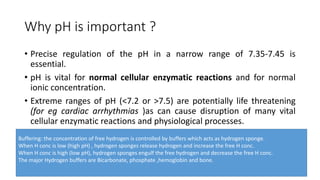
• Precise regulation of the pH in a narrow range of 7.35-7.45 is
essential.
• pH is vital for normal cellular enzymatic reactions and for normal
ionic concentration.
• Extreme ranges of pH (<7.2 or >7.5) are potentially life threatening
(for eg cardiac arrhythmias )as can cause disruption of many vital
cellular enzymatic reactions and physiological processes.
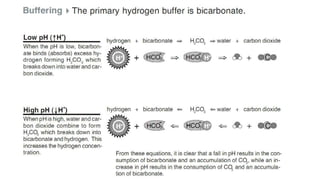
Buffering: the concentration of free hydrogen is controlled by buffers which acts as hydrogen sponge.
When H conc is low (high pH) , hydrogen sponges release hydrogen and increase the free H conc.
When H conc is high (low pH), hydrogen sponges engulf the free hydrogen and decrease the free H conc.
The major Hydrogen buffers are Bicarbonate, phosphate ,hemoglobin and bone.
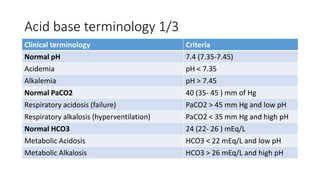
Acid base terminology 1/3
Clinical terminology Criteria
Normal pH 7.4 (7.35-7.45)
Acidemia pH < 7.35
Alkalemia pH > 7.45
Normal PaCO2 40 (35- 45 ) mm of Hg
Respiratory acidosis (failure) PaCO2 > 45 mm Hg and low pH
Respiratory alkalosis (hyperventilation) PaCO2 < 35 mm Hg and high pH
Normal HCO3 24 (22- 26 ) mEq/L
Metabolic Acidosis HCO3 < 22 mEq/L and low pH
Metabolic Alkalosis HCO3 > 26 mEq/L and high pH
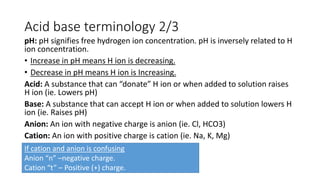
Acid base terminology 2/3
pH: pH signifies free hydrogen ion concentration. pH is inversely related to H
ion concentration.
• Increase in pH means H ion is decreasing.
• Decrease in pH means H ion is Increasing.
Acid: A substance that can “donate” H ion or when added to solution raises
H ion (ie. Lowers pH)
Base: A substance that can accept H ion or when added to solution lowers H
ion (ie. Raises pH)
Anion: An ion with negative charge is anion (ie. Cl, HCO3)
Cation: An ion with positive charge is cation (ie. Na, K, Mg)
If cation and anion is confusing
Anion “n” –negative charge.
Cation “t” – Positive (+) charge.
Extra note
• Measuring hydrogen : Hydrogen concentration ,like earthquake is measured on a
logarithmic scale..
• H conc is not usually expressed simply as nanomoles/L. Instead expressed as a
negative log of its concentration, The symbol for negative log is p; thus pH is the
negative log of the hydrogen concentration and is how H conc is usually
expressed. So as pH decreases hydrogen concentration increases.
• Like other important ions, only free hydrogen ion is physiologically active.
• Free hydrogen is a rather destructive particle. It is able to bind to proteins,
altering both structure and function. With an increase in hydrogen ion
concentration, structural proteins weaken and enzymes loose their activity.
• An increase in hydrogen concentration in blood, academia, has a wide range of
severer consequences due to destructive nature of hydrogen. On the other hand,
the destructive action of hydrogen ion is used advantageously in the stomach to
aid digestion.
Acid base terminology 3/3
• Acidemia and alkalemia : The “-aemia” is the same suffix found in
anemia . It means “blood”.
• Acidemia : means “acid blood” refers to a blood pH below normal (pH
< 7.35) and increased H ion concentration.
• Alkalemia : means “alkaline blood” refers to a blood pH above normal
(pH > 7.35) and decrease H ion concentration.
• Acidosis : Abnormal process or disease which reduce pH due to
increase in acid or decrease in alkali is called acidosis.
• Alkalosis : Abnormal process or disease which increases pH due to
decrease in acid or increase in alkali is called alkalosis.
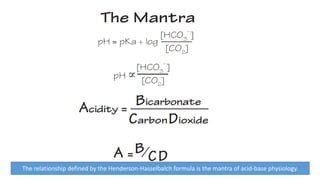
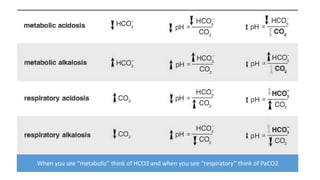
The relationship defined by the Henderson-Hasselbalch formula is the mantra of acid-base physiology.
Extra note (of previous slide)
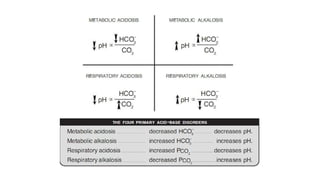
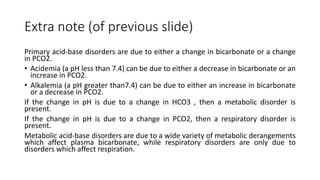
Primary acid-base disorders are due to either a change in bicarbonate or a change
in PCO2.
• Acidemia (a pH less than 7.4) can be due to either a decrease in bicarbonate or an
increase in PCO2.
• Alkalemia (a pH greater than7.4) can be due to either an increase in bicarbonate
or a decrease in PCO2.
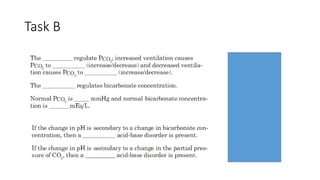
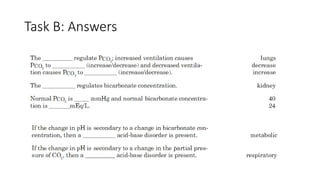
If the change in pH is due to a change in HCO3 , then a metabolic disorder is
present.
If the change in pH is due to a change in PCO2, then a respiratory disorder is
present.
Metabolic acid-base disorders are due to a wide variety of metabolic derangements
which affect plasma bicarbonate, while respiratory disorders are only due to
disorders which affect respiration.
Respiratory regulation
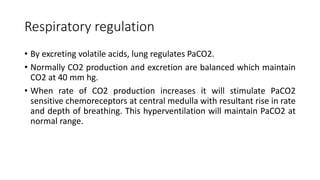
• By excreting volatile acids, lung regulates PaCO2.
• Normally CO2 production and excretion are balanced which maintain
CO2 at 40 mm hg.
• When rate of CO2 production increases it will stimulate PaCO2
sensitive chemoreceptors at central medulla with resultant rise in rate
and depth of breathing. This hyperventilation will maintain PaCO2 at
normal range.
When the respiratory regulation falls what
will be the consequences ?
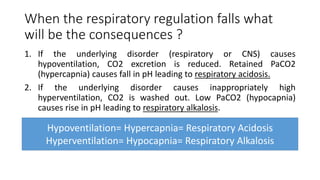
1. If the underlying disorder (respiratory or CNS) causes
hypoventilation, CO2 excretion is reduced. Retained PaCO2
(hypercapnia) causes fall in pH leading to respiratory acidosis.
2. If the underlying disorder causes inappropriately high
hyperventilation, CO2 is washed out. Low PaCO2 (hypocapnia)
causes rise in pH leading to respiratory alkalosis.
Hypoventilation= Hypercapnia= Respiratory Acidosis
Hyperventilation= Hypocapnia= Respiratory Alkalosis
Renal regulation
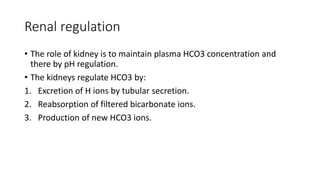
• The role of kidney is to maintain plasma HCO3 concentration and
there by pH regulation.
• The kidneys regulate HCO3 by:
1. Excretion of H ions by tubular secretion.
2. Reabsorption of filtered bicarbonate ions.
3. Production of new HCO3 ions.
How kidney responds to metabolic ABD and
regulate HCO3 ?
1. In response to acid load, normal kidneys are able to increase net
acid excretion greatly. Increased excretion of H ions along with
regeneration of HCO3 will correct plasma HCO3 to normal range.
2. When there is primary increase in plasma HCO3 ,there will be
increase renal excretion of HCO3 in urine.
When does metabolic regulation falls ?
• Metabolic acidosis occurs when excess HCO3 is lost
(diarrhea), acids are added (DKA/lactic acidosis)/Salicyclate
overdose or bicarbonate is not generated (renal failure ).
• Metabolic alkalosis occurs when excess H ion is lost
(vomiting), or renal bicarbonate excretion fails
(hypovolemia).
Extra note (of previous slide)
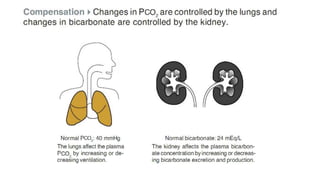
• The compensation for acid-base disorders is the adjustment of PCO2 or
bicarbonate.
• PCO2 is regulated by the lungs and bicarbonate is regulated by the kidney.
• A primary function of the lungs is to deliver oxygen and eliminate CO2. The rate of
CO2 elimination is dependent on ventilation (respiratory rate × tidal volume).
Normally, PCO2 is kept at 40 mmHg. Increased ventilation increases the removal
of CO2 and decreases plasma PCO2. Decreased ventilation decreases the removal
of CO2, increasing plasma PCO2.
• A primary function of the kidney is to maintain a consistent level of plasma
electrolytes, including bicarbonate. The kidney regulates plasma bicarbonate by
altering its excretion and production. Normally, plasma bicarbonate is kept at 24
mEq/L. Increased bicarbonate excretion in the urine decreases plasma
bicarbonate concentration. Decreased excretion and increased production of
bicarbonate increase plasma bicarbonate.
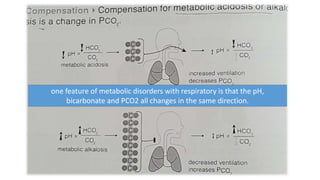
one feature of metabolic disorders with respiratory is that the pH,
bicarbonate and PCO2 all changes in the same direction.
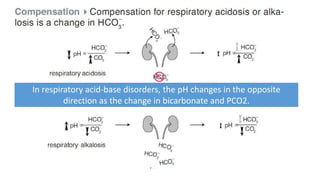
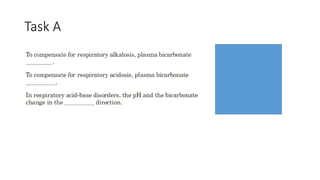
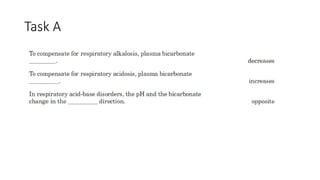
In respiratory acid-base disorders, the pH changes in the opposite
direction as the change in bicarbonate and PCO2.
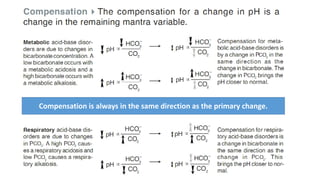
Compensation is always in the same direction as the primary change.
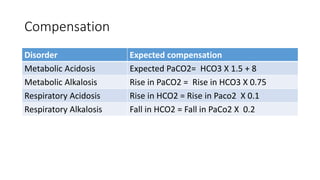
Compensation
Disorder Expected compensation
Metabolic Acidosis Expected PaCO2= HCO3 X 1.5 + 8
Metabolic Alkalosis Rise in PaCO2 = Rise in HCO3 X 0.75
Respiratory Acidosis Rise in HCO2 = Rise in Paco2 X 0.1
Respiratory Alkalosis Fall in HCO2 = Fall in PaCo2 X 0.2
Extra note (of previous 2 slides)
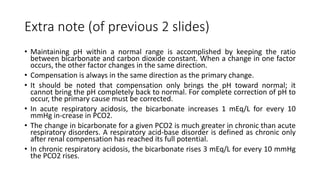
• Maintaining pH within a normal range is accomplished by keeping the ratio
between bicarbonate and carbon dioxide constant. When a change in one factor
occurs, the other factor changes in the same direction.
• Compensation is always in the same direction as the primary change.
• It should be noted that compensation only brings the pH toward normal; it
cannot bring the pH completely back to normal. For complete correction of pH to
occur, the primary cause must be corrected.
• In acute respiratory acidosis, the bicarbonate increases 1 mEq/L for every 10
mmHg in-crease in PCO2.
• The change in bicarbonate for a given PCO2 is much greater in chronic than acute
respiratory disorders. A respiratory acid-base disorder is defined as chronic only
after renal compensation has reached its full potential.
• In chronic respiratory acidosis, the bicarbonate rises 3 mEq/L for every 10 mmHg
the PCO2 rises.
Task A
Task A
Task B
Task B: Answers
When you see “metabolic” think of HCO3 and when you see “respiratory” think of PaCO2
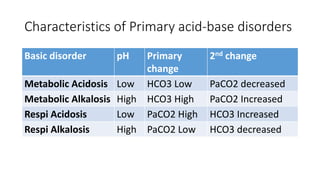
Characteristics of Primary acid-base disorders
Basic disorder pH Primary
change
2nd change
Metabolic Acidosis Low HCO3 Low PaCO2 decreased
Metabolic Alkalosis High HCO3 High PaCO2 Increased
Respi Acidosis Low PaCO2 High HCO3 Increased
Respi Alkalosis High PaCO2 Low HCO3 decreased
High
Extra notes (of previous slide)
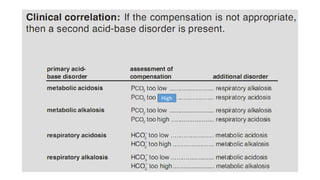
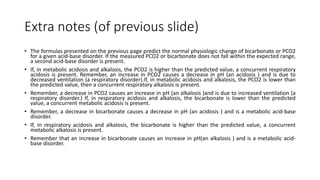
• The formulas presented on the previous page predict the normal physiologic change of bicarbonate or PCO2
for a given acid-base disorder. If the measured PCO2 or bicarbonate does not fall within the expected range,
a second acid-base disorder is present.
• If, in metabolic acidosis and alkalosis, the PCO2 is higher than the predicted value, a concurrent respiratory
acidosis is present. Remember, an increase in PCO2 causes a decrease in pH (an acidosis ) and is due to
decreased ventilation (a respiratory disorder).If, in metabolic acidosis and alkalosis, the PCO2 is lower than
the predicted value, then a concurrent respiratory alkalosis is present.
• Remember, a decrease in PCO2 causes an increase in pH (an alkalosis )and is due to increased ventilation (a
respiratory disorder.) If, in respiratory acidosis and alkalosis, the bicarbonate is lower than the predicted
value, a concurrent metabolic acidosis is present.
• Remember, a decrease in bicarbonate causes a decrease in pH (an acidosis ) and is a metabolic acid-base
disorder.
• If, in respiratory acidosis and alkalosis, the bicarbonate is higher than the predicted value, a concurrent
metabolic alkalosis is present.
• Remember that an increase in bicarbonate causes an increase in pH(an alkalosis ) and is a metabolic acid-
base disorder.
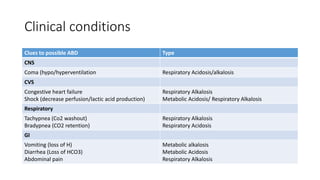
Clinical conditions
Clues to possible ABD Type
CNS
Coma (hypo/hyperventilation Respiratory Acidosis/alkalosis
CVS
Congestive heart failure
Shock (decrease perfusion/lactic acid production)
Respiratory Alkalosis
Metabolic Acidosis/ Respiratory Alkalosis
Respiratory
Tachypnea (Co2 washout)
Bradypnea (CO2 retention)
Respiratory Alkalosis
Respiratory Acidosis
GI
Vomiting (loss of H)
Diarrhea (Loss of HCO3)
Abdominal pain
Metabolic alkalosis
Metabolic Acidosis
Respiratory Alkalosis
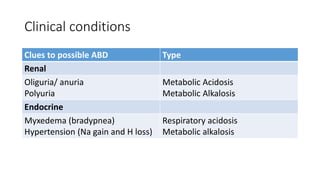
Clinical conditions
Clues to possible ABD Type
Renal
Oliguria/ anuria
Polyuria
Metabolic Acidosis
Metabolic Alkalosis
Endocrine
Myxedema (bradypnea)
Hypertension (Na gain and H loss)
Respiratory acidosis
Metabolic alkalosis
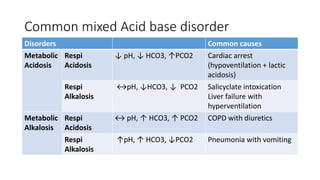
Common mixed Acid base disorder
Disorders Common causes
Metabolic
Acidosis
Respi
Acidosis
↓ pH, ↓ HCO3, ↑PCO2 Cardiac arrest
(hypoventilation + lactic
acidosis)
Respi
Alkalosis
↔pH, ↓HCO3, ↓ PCO2 Salicyclate intoxication
Liver failure with
hyperventilation
Metabolic
Alkalosis
Respi
Acidosis
↔ pH, ↑ HCO3, ↑ PCO2 COPD with diuretics
Respi
Alkalosis
↑pH, ↑ HCO3, ↓PCO2 Pneumonia with vomiting
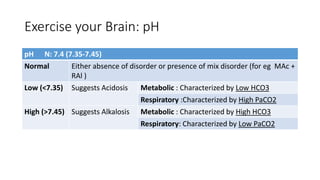
Exercise your Brain: pH
pH N: 7.4 (7.35-7.45)
Normal Either absence of disorder or presence of mix disorder (for eg MAc +
RAl )
Low (<7.35) Suggests Acidosis Metabolic : Characterized by Low HCO3
Respiratory :Characterized by High PaCO2
High (>7.45) Suggests Alkalosis Metabolic : Characterized by High HCO3
Respiratory: Characterized by Low PaCO2
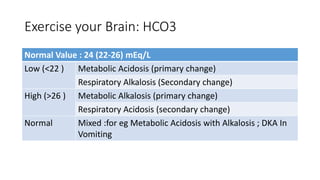
Exercise your Brain: HCO3
Normal Value : 24 (22-26) mEq/L
Low (<22 ) Metabolic Acidosis (primary change)
Respiratory Alkalosis (Secondary change)
High (>26 ) Metabolic Alkalosis (primary change)
Respiratory Acidosis (secondary change)
Normal Mixed :for eg Metabolic Acidosis with Alkalosis ; DKA In
Vomiting
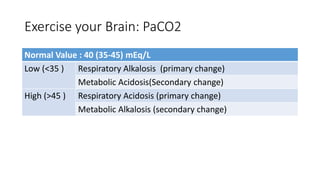
Exercise your Brain: PaCO2
Normal Value : 40 (35-45) mEq/L
Low (<35 ) Respiratory Alkalosis (primary change)
Metabolic Acidosis(Secondary change)
High (>45 ) Respiratory Acidosis (primary change)
Metabolic Alkalosis (secondary change)
Anion Gap (AG)
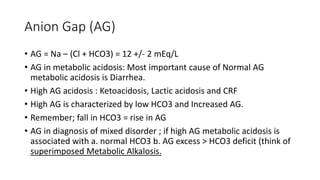
• AG = Na – (Cl + HCO3) = 12 +/- 2 mEq/L
• AG in metabolic acidosis: Most important cause of Normal AG
metabolic acidosis is Diarrhea.
• High AG acidosis : Ketoacidosis, Lactic acidosis and CRF
• High AG is characterized by low HCO3 and Increased AG.
• Remember; fall in HCO3 = rise in AG
• AG in diagnosis of mixed disorder ; if high AG metabolic acidosis is
associated with a. normal HCO3 b. AG excess > HCO3 deficit (think of
superimposed Metabolic Alkalosis.
Hint: Anion Gap
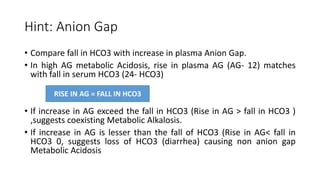
• Compare fall in HCO3 with increase in plasma Anion Gap.
• In high AG metabolic Acidosis, rise in plasma AG (AG- 12) matches
with fall in serum HCO3 (24- HCO3)
• If increase in AG exceed the fall in HCO3 (Rise in AG > fall in HCO3 )
,suggests coexisting Metabolic Alkalosis.
• If increase in AG is lesser than the fall of HCO3 (Rise in AG< fall in
HCO3 0, suggests loss of HCO3 (diarrhea) causing non anion gap
Metabolic Acidosis
RISE IN AG = FALL IN HCO3
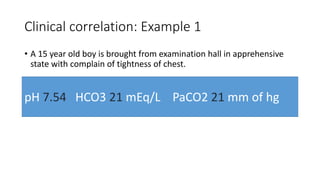
Clinical correlation: Example 1
• A 15 year old boy is brought from examination hall in apprehensive
state with complain of tightness of chest.
pH 7.54 HCO3 21 mEq/L PaCO2 21 mm of hg
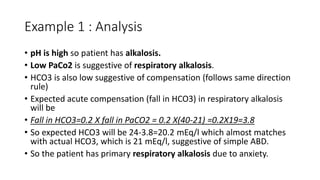
Example 1 : Analysis
• pH is high so patient has alkalosis.
• Low PaCo2 is suggestive of respiratory alkalosis.
• HCO3 is also low suggestive of compensation (follows same direction
rule)
• Expected acute compensation (fall in HCO3) in respiratory alkalosis
will be
• Fall in HCO3=0.2 X fall in PaCO2 = 0.2 X(40-21) =0.2X19=3.8
• So expected HCO3 will be 24-3.8=20.2 mEq/l which almost matches
with actual HCO3, which is 21 mEq/l, suggestive of simple ABD.
• So the patient has primary respiratory alkalosis due to anxiety.
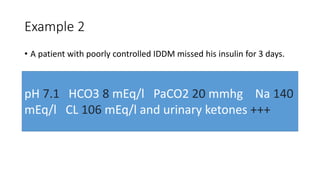
Example 2
• A patient with poorly controlled IDDM missed his insulin for 3 days.
pH 7.1 HCO3 8 mEq/l PaCO2 20 mmhg Na 140
mEq/l CL 106 mEq/l and urinary ketones +++
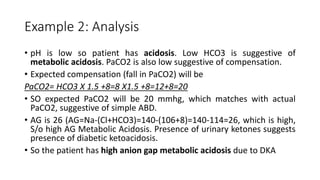
Example 2: Analysis
• pH is low so patient has acidosis. Low HCO3 is suggestive of
metabolic acidosis. PaCO2 is also low suggestive of compensation.
• Expected compensation (fall in PaCO2) will be
PaCO2= HCO3 X 1.5 +8=8 X1.5 +8=12+8=20
• SO expected PaCO2 will be 20 mmhg, which matches with actual
PaCO2, suggestive of simple ABD.
• AG is 26 (AG=Na-(Cl+HCO3)=140-(106+8)=140-114=26, which is high,
S/o high AG Metabolic Acidosis. Presence of urinary ketones suggests
presence of diabetic ketoacidosis.
• So the patient has high anion gap metabolic acidosis due to DKA
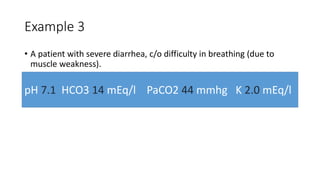
Example 3
• A patient with severe diarrhea, c/o difficulty in breathing (due to
muscle weakness).
pH 7.1 HCO3 14 mEq/l PaCO2 44 mmhg K 2.0 mEq/l
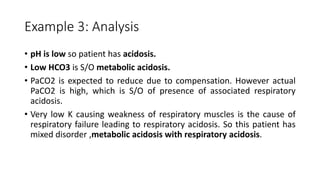
Example 3: Analysis
• pH is low so patient has acidosis.
• Low HCO3 is S/O metabolic acidosis.
• PaCO2 is expected to reduce due to compensation. However actual
PaCO2 is high, which is S/O of presence of associated respiratory
acidosis.
• Very low K causing weakness of respiratory muscles is the cause of
respiratory failure leading to respiratory acidosis. So this patient has
mixed disorder ,metabolic acidosis with respiratory acidosis.
Example 4
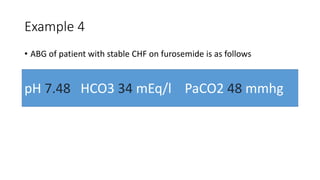
• ABG of patient with stable CHF on furosemide is as follows
pH 7.48 HCO3 34 mEq/l PaCO2 48 mmhg
Example 4 : Analysis
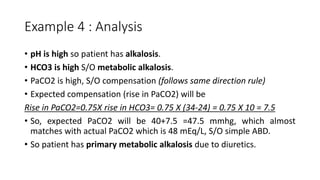
• pH is high so patient has alkalosis.
• HCO3 is high S/O metabolic alkalosis.
• PaCO2 is high, S/O compensation (follows same direction rule)
• Expected compensation (rise in PaCO2) will be
Rise in PaCO2=0.75X rise in HCO3= 0.75 X (34-24) = 0.75 X 10 = 7.5
• So, expected PaCO2 will be 40+7.5 =47.5 mmhg, which almost
matches with actual PaCO2 which is 48 mEq/L, S/O simple ABD.
• So patient has primary metabolic alkalosis due to diuretics.
Example 5
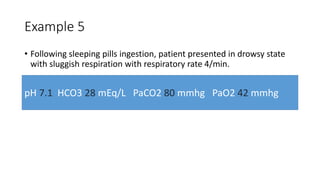
• Following sleeping pills ingestion, patient presented in drowsy state
with sluggish respiration with respiratory rate 4/min.
pH 7.1 HCO3 28 mEq/L PaCO2 80 mmhg PaO2 42 mmhg
Example 5 : Analysis
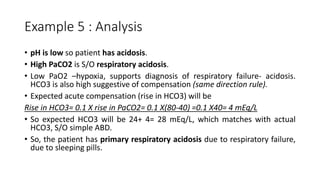
• pH is low so patient has acidosis.
• High PaCO2 is S/O respiratory acidosis.
• Low PaO2 –hypoxia, supports diagnosis of respiratory failure- acidosis.
HCO3 is also high suggestive of compensation (same direction rule).
• Expected acute compensation (rise in HCO3) will be
Rise in HCO3= 0.1 X rise in PaCO2= 0.1 X(80-40) =0.1 X40= 4 mEq/L
• So expected HCO3 will be 24+ 4= 28 mEq/L, which matches with actual
HCO3, S/O simple ABD.
• So, the patient has primary respiratory acidosis due to respiratory failure,
due to sleeping pills.
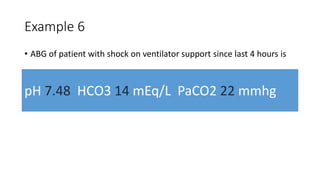
Example 6
• ABG of patient with shock on ventilator support since last 4 hours is
pH 7.48 HCO3 14 mEq/L PaCO2 22 mmhg
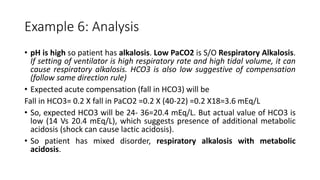
Example 6: Analysis
• pH is high so patient has alkalosis. Low PaCO2 is S/O Respiratory Alkalosis.
If setting of ventilator is high respiratory rate and high tidal volume, it can
cause respiratory alkalosis. HCO3 is also low suggestive of compensation
(follow same direction rule)
• Expected acute compensation (fall in HCO3) will be
Fall in HCO3= 0.2 X fall in PaCO2 =0.2 X (40-22) =0.2 X18=3.6 mEq/L
• So, expected HCO3 will be 24- 36=20.4 mEq/L. But actual value of HCO3 is
low (14 Vs 20.4 mEq/L), which suggests presence of additional metabolic
acidosis (shock can cause lactic acidosis).
• So patient has mixed disorder, respiratory alkalosis with metabolic
acidosis.
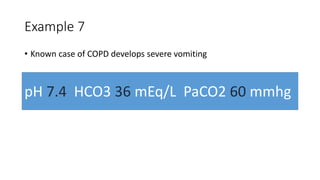
Example 7
• Known case of COPD develops severe vomiting
pH 7.4 HCO3 36 mEq/L PaCO2 60 mmhg
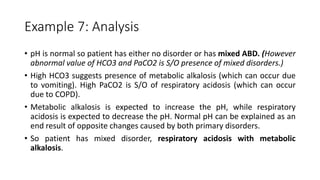
Example 7: Analysis
• pH is normal so patient has either no disorder or has mixed ABD. (However
abnormal value of HCO3 and PaCO2 is S/O presence of mixed disorders.)
• High HCO3 suggests presence of metabolic alkalosis (which can occur due
to vomiting). High PaCO2 is S/O of respiratory acidosis (which can occur
due to COPD).
• Metabolic alkalosis is expected to increase the pH, while respiratory
acidosis is expected to decrease the pH. Normal pH can be explained as an
end result of opposite changes caused by both primary disorders.
• So patient has mixed disorder, respiratory acidosis with metabolic
alkalosis.
Example 8
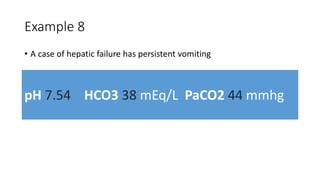
• A case of hepatic failure has persistent vomiting
pH 7.54 HCO3 38 mEq/L PaCO2 44 mmhg
Example 8: Analysis
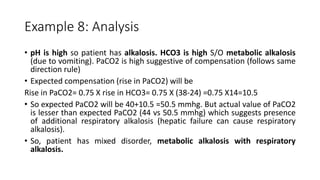
• pH is high so patient has alkalosis. HCO3 is high S/O metabolic alkalosis
(due to vomiting). PaCO2 is high suggestive of compensation (follows same
direction rule)
• Expected compensation (rise in PaCO2) will be
Rise in PaCO2= 0.75 X rise in HCO3= 0.75 X (38-24) =0.75 X14=10.5
• So expected PaCO2 will be 40+10.5 =50.5 mmhg. But actual value of PaCO2
is lesser than expected PaCO2 (44 vs 50.5 mmhg) which suggests presence
of additional respiratory alkalosis (hepatic failure can cause respiratory
alkalosis).
• So, patient has mixed disorder, metabolic alkalosis with respiratory
alkalosis.
End of slides
References:
• Dr Sanjay Pandaya. Practical Guidelines on Fluid Therapy.
• S. Faubel. Introduction to Acid Base Physiology

Acid base disorders

  • 1.
    Acid- Base disorders:an understanding Pratap Sagar Tiwari, MD, Internal Medicine
  • 2.
    Why pH isimportant ? • Precise regulation of the pH in a narrow range of 7.35-7.45 is essential. • pH is vital for normal cellular enzymatic reactions and for normal ionic concentration. • Extreme ranges of pH (<7.2 or >7.5) are potentially life threatening (for eg cardiac arrhythmias )as can cause disruption of many vital cellular enzymatic reactions and physiological processes. Buffering: the concentration of free hydrogen is controlled by buffers which acts as hydrogen sponge. When H conc is low (high pH) , hydrogen sponges release hydrogen and increase the free H conc. When H conc is high (low pH), hydrogen sponges engulf the free hydrogen and decrease the free H conc. The major Hydrogen buffers are Bicarbonate, phosphate ,hemoglobin and bone.
  • 4.
    Acid base terminology1/3 Clinical terminology Criteria Normal pH 7.4 (7.35-7.45) Acidemia pH < 7.35 Alkalemia pH > 7.45 Normal PaCO2 40 (35- 45 ) mm of Hg Respiratory acidosis (failure) PaCO2 > 45 mm Hg and low pH Respiratory alkalosis (hyperventilation) PaCO2 < 35 mm Hg and high pH Normal HCO3 24 (22- 26 ) mEq/L Metabolic Acidosis HCO3 < 22 mEq/L and low pH Metabolic Alkalosis HCO3 > 26 mEq/L and high pH
  • 5.
    Acid base terminology2/3 pH: pH signifies free hydrogen ion concentration. pH is inversely related to H ion concentration. • Increase in pH means H ion is decreasing. • Decrease in pH means H ion is Increasing. Acid: A substance that can “donate” H ion or when added to solution raises H ion (ie. Lowers pH) Base: A substance that can accept H ion or when added to solution lowers H ion (ie. Raises pH) Anion: An ion with negative charge is anion (ie. Cl, HCO3) Cation: An ion with positive charge is cation (ie. Na, K, Mg) If cation and anion is confusing Anion “n” –negative charge. Cation “t” – Positive (+) charge.
  • 6.
    Extra note • Measuringhydrogen : Hydrogen concentration ,like earthquake is measured on a logarithmic scale.. • H conc is not usually expressed simply as nanomoles/L. Instead expressed as a negative log of its concentration, The symbol for negative log is p; thus pH is the negative log of the hydrogen concentration and is how H conc is usually expressed. So as pH decreases hydrogen concentration increases. • Like other important ions, only free hydrogen ion is physiologically active. • Free hydrogen is a rather destructive particle. It is able to bind to proteins, altering both structure and function. With an increase in hydrogen ion concentration, structural proteins weaken and enzymes loose their activity. • An increase in hydrogen concentration in blood, academia, has a wide range of severer consequences due to destructive nature of hydrogen. On the other hand, the destructive action of hydrogen ion is used advantageously in the stomach to aid digestion.
  • 7.
    Acid base terminology3/3 • Acidemia and alkalemia : The “-aemia” is the same suffix found in anemia . It means “blood”. • Acidemia : means “acid blood” refers to a blood pH below normal (pH < 7.35) and increased H ion concentration. • Alkalemia : means “alkaline blood” refers to a blood pH above normal (pH > 7.35) and decrease H ion concentration. • Acidosis : Abnormal process or disease which reduce pH due to increase in acid or decrease in alkali is called acidosis. • Alkalosis : Abnormal process or disease which increases pH due to decrease in acid or increase in alkali is called alkalosis.
  • 8.
    The relationship definedby the Henderson-Hasselbalch formula is the mantra of acid-base physiology.
  • 10.
    Extra note (ofprevious slide) Primary acid-base disorders are due to either a change in bicarbonate or a change in PCO2. • Acidemia (a pH less than 7.4) can be due to either a decrease in bicarbonate or an increase in PCO2. • Alkalemia (a pH greater than7.4) can be due to either an increase in bicarbonate or a decrease in PCO2. If the change in pH is due to a change in HCO3 , then a metabolic disorder is present. If the change in pH is due to a change in PCO2, then a respiratory disorder is present. Metabolic acid-base disorders are due to a wide variety of metabolic derangements which affect plasma bicarbonate, while respiratory disorders are only due to disorders which affect respiration.
  • 11.
    Respiratory regulation • Byexcreting volatile acids, lung regulates PaCO2. • Normally CO2 production and excretion are balanced which maintain CO2 at 40 mm hg. • When rate of CO2 production increases it will stimulate PaCO2 sensitive chemoreceptors at central medulla with resultant rise in rate and depth of breathing. This hyperventilation will maintain PaCO2 at normal range.
  • 12.
    When the respiratoryregulation falls what will be the consequences ? 1. If the underlying disorder (respiratory or CNS) causes hypoventilation, CO2 excretion is reduced. Retained PaCO2 (hypercapnia) causes fall in pH leading to respiratory acidosis. 2. If the underlying disorder causes inappropriately high hyperventilation, CO2 is washed out. Low PaCO2 (hypocapnia) causes rise in pH leading to respiratory alkalosis. Hypoventilation= Hypercapnia= Respiratory Acidosis Hyperventilation= Hypocapnia= Respiratory Alkalosis
  • 13.
    Renal regulation • Therole of kidney is to maintain plasma HCO3 concentration and there by pH regulation. • The kidneys regulate HCO3 by: 1. Excretion of H ions by tubular secretion. 2. Reabsorption of filtered bicarbonate ions. 3. Production of new HCO3 ions.
  • 14.
    How kidney respondsto metabolic ABD and regulate HCO3 ? 1. In response to acid load, normal kidneys are able to increase net acid excretion greatly. Increased excretion of H ions along with regeneration of HCO3 will correct plasma HCO3 to normal range. 2. When there is primary increase in plasma HCO3 ,there will be increase renal excretion of HCO3 in urine.
  • 15.
    When does metabolicregulation falls ? • Metabolic acidosis occurs when excess HCO3 is lost (diarrhea), acids are added (DKA/lactic acidosis)/Salicyclate overdose or bicarbonate is not generated (renal failure ). • Metabolic alkalosis occurs when excess H ion is lost (vomiting), or renal bicarbonate excretion fails (hypovolemia).
  • 17.
    Extra note (ofprevious slide) • The compensation for acid-base disorders is the adjustment of PCO2 or bicarbonate. • PCO2 is regulated by the lungs and bicarbonate is regulated by the kidney. • A primary function of the lungs is to deliver oxygen and eliminate CO2. The rate of CO2 elimination is dependent on ventilation (respiratory rate × tidal volume). Normally, PCO2 is kept at 40 mmHg. Increased ventilation increases the removal of CO2 and decreases plasma PCO2. Decreased ventilation decreases the removal of CO2, increasing plasma PCO2. • A primary function of the kidney is to maintain a consistent level of plasma electrolytes, including bicarbonate. The kidney regulates plasma bicarbonate by altering its excretion and production. Normally, plasma bicarbonate is kept at 24 mEq/L. Increased bicarbonate excretion in the urine decreases plasma bicarbonate concentration. Decreased excretion and increased production of bicarbonate increase plasma bicarbonate.
  • 18.
    one feature ofmetabolic disorders with respiratory is that the pH, bicarbonate and PCO2 all changes in the same direction.
  • 19.
    In respiratory acid-basedisorders, the pH changes in the opposite direction as the change in bicarbonate and PCO2.
  • 20.
    Compensation is alwaysin the same direction as the primary change.
  • 21.
    Compensation Disorder Expected compensation MetabolicAcidosis Expected PaCO2= HCO3 X 1.5 + 8 Metabolic Alkalosis Rise in PaCO2 = Rise in HCO3 X 0.75 Respiratory Acidosis Rise in HCO2 = Rise in Paco2 X 0.1 Respiratory Alkalosis Fall in HCO2 = Fall in PaCo2 X 0.2
  • 22.
    Extra note (ofprevious 2 slides) • Maintaining pH within a normal range is accomplished by keeping the ratio between bicarbonate and carbon dioxide constant. When a change in one factor occurs, the other factor changes in the same direction. • Compensation is always in the same direction as the primary change. • It should be noted that compensation only brings the pH toward normal; it cannot bring the pH completely back to normal. For complete correction of pH to occur, the primary cause must be corrected. • In acute respiratory acidosis, the bicarbonate increases 1 mEq/L for every 10 mmHg in-crease in PCO2. • The change in bicarbonate for a given PCO2 is much greater in chronic than acute respiratory disorders. A respiratory acid-base disorder is defined as chronic only after renal compensation has reached its full potential. • In chronic respiratory acidosis, the bicarbonate rises 3 mEq/L for every 10 mmHg the PCO2 rises.
  • 23.
  • 24.
  • 25.
  • 26.
  • 27.
    When you see“metabolic” think of HCO3 and when you see “respiratory” think of PaCO2
  • 28.
    Characteristics of Primaryacid-base disorders Basic disorder pH Primary change 2nd change Metabolic Acidosis Low HCO3 Low PaCO2 decreased Metabolic Alkalosis High HCO3 High PaCO2 Increased Respi Acidosis Low PaCO2 High HCO3 Increased Respi Alkalosis High PaCO2 Low HCO3 decreased
  • 29.
  • 30.
    Extra notes (ofprevious slide) • The formulas presented on the previous page predict the normal physiologic change of bicarbonate or PCO2 for a given acid-base disorder. If the measured PCO2 or bicarbonate does not fall within the expected range, a second acid-base disorder is present. • If, in metabolic acidosis and alkalosis, the PCO2 is higher than the predicted value, a concurrent respiratory acidosis is present. Remember, an increase in PCO2 causes a decrease in pH (an acidosis ) and is due to decreased ventilation (a respiratory disorder).If, in metabolic acidosis and alkalosis, the PCO2 is lower than the predicted value, then a concurrent respiratory alkalosis is present. • Remember, a decrease in PCO2 causes an increase in pH (an alkalosis )and is due to increased ventilation (a respiratory disorder.) If, in respiratory acidosis and alkalosis, the bicarbonate is lower than the predicted value, a concurrent metabolic acidosis is present. • Remember, a decrease in bicarbonate causes a decrease in pH (an acidosis ) and is a metabolic acid-base disorder. • If, in respiratory acidosis and alkalosis, the bicarbonate is higher than the predicted value, a concurrent metabolic alkalosis is present. • Remember that an increase in bicarbonate causes an increase in pH(an alkalosis ) and is a metabolic acid- base disorder.
  • 31.
    Clinical conditions Clues topossible ABD Type CNS Coma (hypo/hyperventilation Respiratory Acidosis/alkalosis CVS Congestive heart failure Shock (decrease perfusion/lactic acid production) Respiratory Alkalosis Metabolic Acidosis/ Respiratory Alkalosis Respiratory Tachypnea (Co2 washout) Bradypnea (CO2 retention) Respiratory Alkalosis Respiratory Acidosis GI Vomiting (loss of H) Diarrhea (Loss of HCO3) Abdominal pain Metabolic alkalosis Metabolic Acidosis Respiratory Alkalosis
  • 32.
    Clinical conditions Clues topossible ABD Type Renal Oliguria/ anuria Polyuria Metabolic Acidosis Metabolic Alkalosis Endocrine Myxedema (bradypnea) Hypertension (Na gain and H loss) Respiratory acidosis Metabolic alkalosis
  • 33.
    Common mixed Acidbase disorder Disorders Common causes Metabolic Acidosis Respi Acidosis ↓ pH, ↓ HCO3, ↑PCO2 Cardiac arrest (hypoventilation + lactic acidosis) Respi Alkalosis ↔pH, ↓HCO3, ↓ PCO2 Salicyclate intoxication Liver failure with hyperventilation Metabolic Alkalosis Respi Acidosis ↔ pH, ↑ HCO3, ↑ PCO2 COPD with diuretics Respi Alkalosis ↑pH, ↑ HCO3, ↓PCO2 Pneumonia with vomiting
  • 34.
    Exercise your Brain:pH pH N: 7.4 (7.35-7.45) Normal Either absence of disorder or presence of mix disorder (for eg MAc + RAl ) Low (<7.35) Suggests Acidosis Metabolic : Characterized by Low HCO3 Respiratory :Characterized by High PaCO2 High (>7.45) Suggests Alkalosis Metabolic : Characterized by High HCO3 Respiratory: Characterized by Low PaCO2
  • 35.
    Exercise your Brain:HCO3 Normal Value : 24 (22-26) mEq/L Low (<22 ) Metabolic Acidosis (primary change) Respiratory Alkalosis (Secondary change) High (>26 ) Metabolic Alkalosis (primary change) Respiratory Acidosis (secondary change) Normal Mixed :for eg Metabolic Acidosis with Alkalosis ; DKA In Vomiting
  • 36.
    Exercise your Brain:PaCO2 Normal Value : 40 (35-45) mEq/L Low (<35 ) Respiratory Alkalosis (primary change) Metabolic Acidosis(Secondary change) High (>45 ) Respiratory Acidosis (primary change) Metabolic Alkalosis (secondary change)
  • 37.
    Anion Gap (AG) •AG = Na – (Cl + HCO3) = 12 +/- 2 mEq/L • AG in metabolic acidosis: Most important cause of Normal AG metabolic acidosis is Diarrhea. • High AG acidosis : Ketoacidosis, Lactic acidosis and CRF • High AG is characterized by low HCO3 and Increased AG. • Remember; fall in HCO3 = rise in AG • AG in diagnosis of mixed disorder ; if high AG metabolic acidosis is associated with a. normal HCO3 b. AG excess > HCO3 deficit (think of superimposed Metabolic Alkalosis.
  • 38.
    Hint: Anion Gap •Compare fall in HCO3 with increase in plasma Anion Gap. • In high AG metabolic Acidosis, rise in plasma AG (AG- 12) matches with fall in serum HCO3 (24- HCO3) • If increase in AG exceed the fall in HCO3 (Rise in AG > fall in HCO3 ) ,suggests coexisting Metabolic Alkalosis. • If increase in AG is lesser than the fall of HCO3 (Rise in AG< fall in HCO3 0, suggests loss of HCO3 (diarrhea) causing non anion gap Metabolic Acidosis RISE IN AG = FALL IN HCO3
  • 39.
    Clinical correlation: Example1 • A 15 year old boy is brought from examination hall in apprehensive state with complain of tightness of chest. pH 7.54 HCO3 21 mEq/L PaCO2 21 mm of hg
  • 40.
    Example 1 :Analysis • pH is high so patient has alkalosis. • Low PaCo2 is suggestive of respiratory alkalosis. • HCO3 is also low suggestive of compensation (follows same direction rule) • Expected acute compensation (fall in HCO3) in respiratory alkalosis will be • Fall in HCO3=0.2 X fall in PaCO2 = 0.2 X(40-21) =0.2X19=3.8 • So expected HCO3 will be 24-3.8=20.2 mEq/l which almost matches with actual HCO3, which is 21 mEq/l, suggestive of simple ABD. • So the patient has primary respiratory alkalosis due to anxiety.
  • 41.
    Example 2 • Apatient with poorly controlled IDDM missed his insulin for 3 days. pH 7.1 HCO3 8 mEq/l PaCO2 20 mmhg Na 140 mEq/l CL 106 mEq/l and urinary ketones +++
  • 42.
    Example 2: Analysis •pH is low so patient has acidosis. Low HCO3 is suggestive of metabolic acidosis. PaCO2 is also low suggestive of compensation. • Expected compensation (fall in PaCO2) will be PaCO2= HCO3 X 1.5 +8=8 X1.5 +8=12+8=20 • SO expected PaCO2 will be 20 mmhg, which matches with actual PaCO2, suggestive of simple ABD. • AG is 26 (AG=Na-(Cl+HCO3)=140-(106+8)=140-114=26, which is high, S/o high AG Metabolic Acidosis. Presence of urinary ketones suggests presence of diabetic ketoacidosis. • So the patient has high anion gap metabolic acidosis due to DKA
  • 43.
    Example 3 • Apatient with severe diarrhea, c/o difficulty in breathing (due to muscle weakness). pH 7.1 HCO3 14 mEq/l PaCO2 44 mmhg K 2.0 mEq/l
  • 44.
    Example 3: Analysis •pH is low so patient has acidosis. • Low HCO3 is S/O metabolic acidosis. • PaCO2 is expected to reduce due to compensation. However actual PaCO2 is high, which is S/O of presence of associated respiratory acidosis. • Very low K causing weakness of respiratory muscles is the cause of respiratory failure leading to respiratory acidosis. So this patient has mixed disorder ,metabolic acidosis with respiratory acidosis.
  • 45.
    Example 4 • ABGof patient with stable CHF on furosemide is as follows pH 7.48 HCO3 34 mEq/l PaCO2 48 mmhg
  • 46.
    Example 4 :Analysis • pH is high so patient has alkalosis. • HCO3 is high S/O metabolic alkalosis. • PaCO2 is high, S/O compensation (follows same direction rule) • Expected compensation (rise in PaCO2) will be Rise in PaCO2=0.75X rise in HCO3= 0.75 X (34-24) = 0.75 X 10 = 7.5 • So, expected PaCO2 will be 40+7.5 =47.5 mmhg, which almost matches with actual PaCO2 which is 48 mEq/L, S/O simple ABD. • So patient has primary metabolic alkalosis due to diuretics.
  • 47.
    Example 5 • Followingsleeping pills ingestion, patient presented in drowsy state with sluggish respiration with respiratory rate 4/min. pH 7.1 HCO3 28 mEq/L PaCO2 80 mmhg PaO2 42 mmhg
  • 48.
    Example 5 :Analysis • pH is low so patient has acidosis. • High PaCO2 is S/O respiratory acidosis. • Low PaO2 –hypoxia, supports diagnosis of respiratory failure- acidosis. HCO3 is also high suggestive of compensation (same direction rule). • Expected acute compensation (rise in HCO3) will be Rise in HCO3= 0.1 X rise in PaCO2= 0.1 X(80-40) =0.1 X40= 4 mEq/L • So expected HCO3 will be 24+ 4= 28 mEq/L, which matches with actual HCO3, S/O simple ABD. • So, the patient has primary respiratory acidosis due to respiratory failure, due to sleeping pills.
  • 49.
    Example 6 • ABGof patient with shock on ventilator support since last 4 hours is pH 7.48 HCO3 14 mEq/L PaCO2 22 mmhg
  • 50.
    Example 6: Analysis •pH is high so patient has alkalosis. Low PaCO2 is S/O Respiratory Alkalosis. If setting of ventilator is high respiratory rate and high tidal volume, it can cause respiratory alkalosis. HCO3 is also low suggestive of compensation (follow same direction rule) • Expected acute compensation (fall in HCO3) will be Fall in HCO3= 0.2 X fall in PaCO2 =0.2 X (40-22) =0.2 X18=3.6 mEq/L • So, expected HCO3 will be 24- 36=20.4 mEq/L. But actual value of HCO3 is low (14 Vs 20.4 mEq/L), which suggests presence of additional metabolic acidosis (shock can cause lactic acidosis). • So patient has mixed disorder, respiratory alkalosis with metabolic acidosis.
  • 51.
    Example 7 • Knowncase of COPD develops severe vomiting pH 7.4 HCO3 36 mEq/L PaCO2 60 mmhg
  • 52.
    Example 7: Analysis •pH is normal so patient has either no disorder or has mixed ABD. (However abnormal value of HCO3 and PaCO2 is S/O presence of mixed disorders.) • High HCO3 suggests presence of metabolic alkalosis (which can occur due to vomiting). High PaCO2 is S/O of respiratory acidosis (which can occur due to COPD). • Metabolic alkalosis is expected to increase the pH, while respiratory acidosis is expected to decrease the pH. Normal pH can be explained as an end result of opposite changes caused by both primary disorders. • So patient has mixed disorder, respiratory acidosis with metabolic alkalosis.
  • 53.
    Example 8 • Acase of hepatic failure has persistent vomiting pH 7.54 HCO3 38 mEq/L PaCO2 44 mmhg
  • 54.
    Example 8: Analysis •pH is high so patient has alkalosis. HCO3 is high S/O metabolic alkalosis (due to vomiting). PaCO2 is high suggestive of compensation (follows same direction rule) • Expected compensation (rise in PaCO2) will be Rise in PaCO2= 0.75 X rise in HCO3= 0.75 X (38-24) =0.75 X14=10.5 • So expected PaCO2 will be 40+10.5 =50.5 mmhg. But actual value of PaCO2 is lesser than expected PaCO2 (44 vs 50.5 mmhg) which suggests presence of additional respiratory alkalosis (hepatic failure can cause respiratory alkalosis). • So, patient has mixed disorder, metabolic alkalosis with respiratory alkalosis.
  • 55.
    End of slides References: •Dr Sanjay Pandaya. Practical Guidelines on Fluid Therapy. • S. Faubel. Introduction to Acid Base Physiology

Editor's Notes

  • #9 These equations show that pH is simply the ratio of bicarbonate to CO2. Since pH is the ratio of bicarbonate to PCO2 , keeping the pH constant depends on keeping the ratio constant. If one component changes, then the other must change in the same direction in order to maintain a constantration (and hence a constant pH).
  • #19 Inorder to compensate for metabolic acid base disorders, the lungs increase or decrease the PCO2 through changes in ventilation. In metabolic acidosis (decrease bicarbonate), the PCO2 must decrease to maintain the ratio of bicarbonate to PCO2. A decrease in plasma PCO2 is achieved by an increase in ventilation. In metabolic alkalosis (increased bicarbonate), the PCO2 must increase to maintain the ratio of bicarbonate to PCO2. An increase in plasma PCO2 is achieved by a decrease in ventilation. one feature of metabolic disorders with respiratory is that the pH, bicarbonate and PCO2 all changes in the same direction.
  • #20 Respiratory acid-base disorders are compensated by a change in plasma bicarbonate concentration. Changes in plasma bicarbonate are controlled through changes in its excretion by the kidney. Unlike respiratory compensation which occurs immediately after a change in pH, renal compensation takes hours to days to occur. In respiratory acidosis , the bicarbonate must increase to maintain the ratio between bicarbonate and PCO2. An increase in plasma bicarbonate is achieved by decreased excretion and increased production of bicarbonate. In respiratory alkalosis, the bicarbonate must decrease to maintain the ratio between bicarbonate and PCO2. A decrease in plasma bicarbonate is achieved by increased renal excretion of bicarbonate. In respiratory acid-base disorders, the pH changes in the opposite direction as the change in bicarbonate and PCO2.
  • #22 in acute respiratory acidosis, the bicarbonate increases 1 mEq/L for every 10 mmHg in-crease in PCO2. The change in bicarbonate for a given PCO2 is much greater in chronic than acute respiratory disorders. A respiratory acid-base disorder is defined as chronic only after renal compensation has reached its full potential. In chronic respiratory acidosis, the bicarbonate rises 3 mEq/L for every 10 mmHg the PCO2 rises.
  • #32 Loss of hydrogen ions - Most often occurs via two mechanisms, either vomiting or via the kidney. Vomiting results in the loss of hydrochloric acid (hydrogen and chloride ions) with the stomach contents. In the hospital setting this can commonly occur from nasogastric suction tubes. Severe vomiting also causes loss of potassium (hypokalaemia) and sodium (hyponatremia). The kidneys compensate for these losses by retaining sodium in the collecting ducts at the expense of hydrogen ions (sparing sodium/potassium pumps to prevent further loss of potassium), leading to metabolic alkalosis.
  • #34 Liver failure : along with renal dysfun cannot generate hco3 and increased lactate level = metabolic acidosis Along loop diuretics :increased urinary hydrogen loss :metabolic alkalosis