Arterial blood gas
analysis
1
Acid-base Terminology
Acidemia: blood pH < 7.35
Acidosis: a primary physiologic process that, occurring alone,
tends to cause acidemia.
Alkalemia: blood pH > 7.45
Alkalosis: a primary physiologic process that, occurring alone,
tends to cause alkalemia..
2
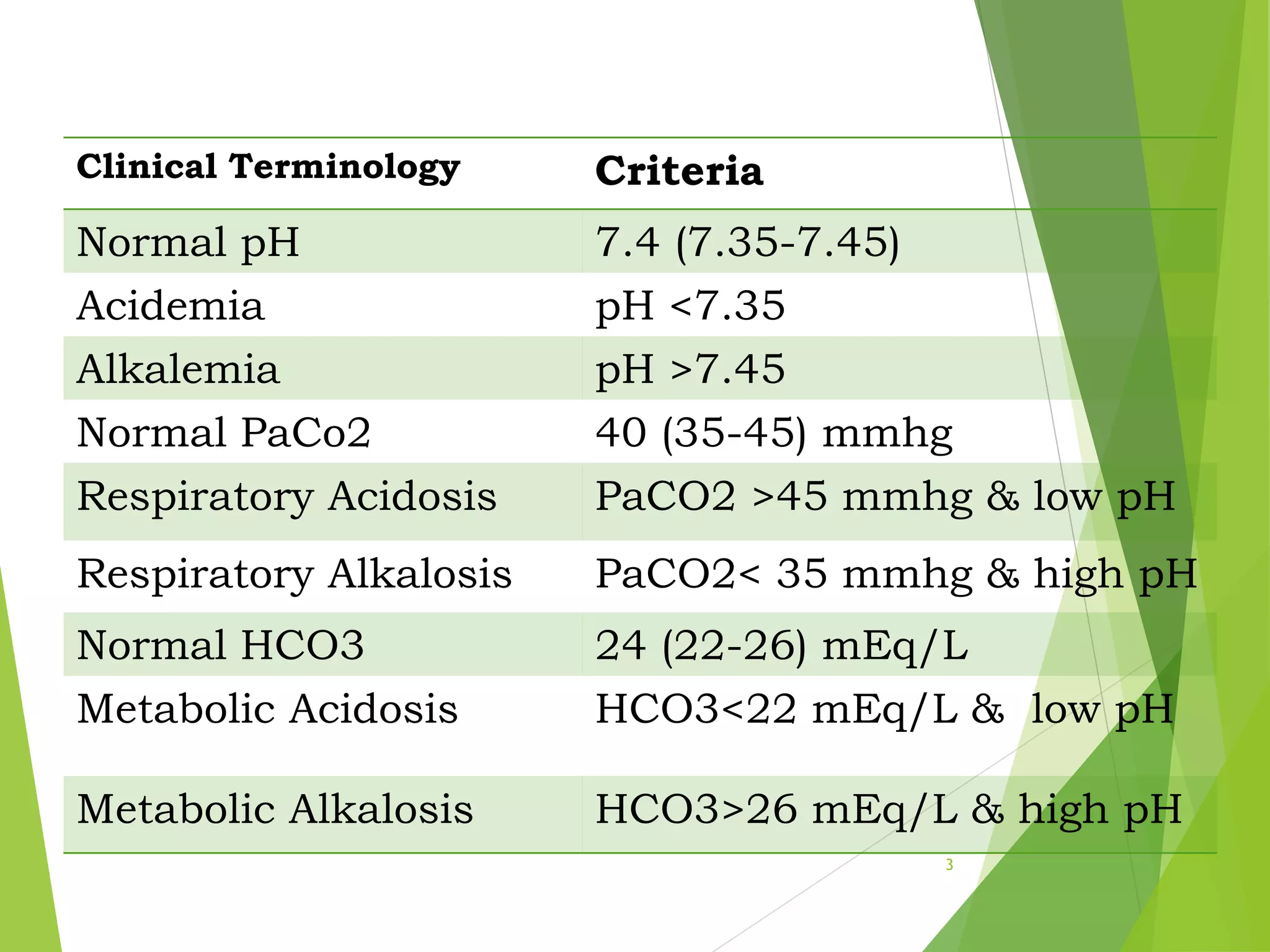
Clinical Terminology Criteria
Normal pH 7.4 (7.35-7.45)
Acidemia pH <7.35
Alkalemia pH >7.45
Normal PaCo2 40 (35-45) mmhg
Respiratory Acidosis PaCO2 >45 mmhg & low pH
Respiratory Alkalosis PaCO2< 35 mmhg & high pH
Normal HCO3 24 (22-26) mEq/L
Metabolic Acidosis HCO3<22 mEq/L & low pH
Metabolic Alkalosis HCO3>26 mEq/L & high pH
3
Anion gap
 AG = Na-(Cl+HCO3) = 12+/- 2 mEq/L
Definition : Charge difference between unmeasured anion &
cation.
anion : anionic protein, phosphate, sulphate & organic acids
cations : calcium, magnesium, potassium
4
 Albumin normally compromises most of the AG.
For every 1g/dL decline of albumin there is 2mEq/L decline in
AG
Importance of AG :
1. Most useful to establish etiological diagnosis of metabolic
acidosis.
2.useful in diagnosis of mixed disorders :
if metabolic acidosis a/w (a) normal HCO3 levels or (b) AG
excess > HCO3 deficit, think of superimposed metabolic
alkalosis
5
6
 Simple Acid Base Disorders: are those in which there is a single primary
etiological acid base disorder.
 Mixed Acid Base Disorder: are those in which two / more primary etiological
disorders are present simultaneously.
 Respiratory Disorders: are caused by abnormal processes which tend to alter the
pH because of a primary change in PaCO2 levels
 Metabolic Disorders: are caused by abnormal processes which tend to alter pH
because of a primary change in HCO3 levels.
7
ABG analysis
Indications
 to evaluate the adequacy of ventilation, acid base
status, oxygenation
 To aid for diagnosis/ to see the patient’s response to
therapy
 To monitor the severity and progression of a known
disease
 Severe metabolic /respiratory disorders, during
features of hypoxia/ hypercapnia.
8
 Shock /Sepsis
 Decreased cardiac output
 Renal failure
 When patient is on oxygen therapy
 Inborn errors of metabolism
 Ventilated patient
9
Steps for ABG analysis
1. What is the pH? Is it normal?Acidemia or
Alkalemia?
2. Is the CO2 normal? Is HCO3 normal?
3. Match the CO2 or HCO3 with pH
4. What is the primary disorder present?
5. Is there appropriate compensation?
6. Is there an anion gap?
7. What is the differential for the clinical processes?
10
 Step 1: Analyze the pH
The first step in analyzing ABGs is to look at the
pH. Normal blood pH is 7.4, plus or minus 0.05,
forming the range 7.35 to 7.45.
 Step2: Analyze the CO2
The second step is to examine the pCO2. Normal
pCO2 levels are 35-‐45mmHg..
11
 Step 3: Analyze the HCO3
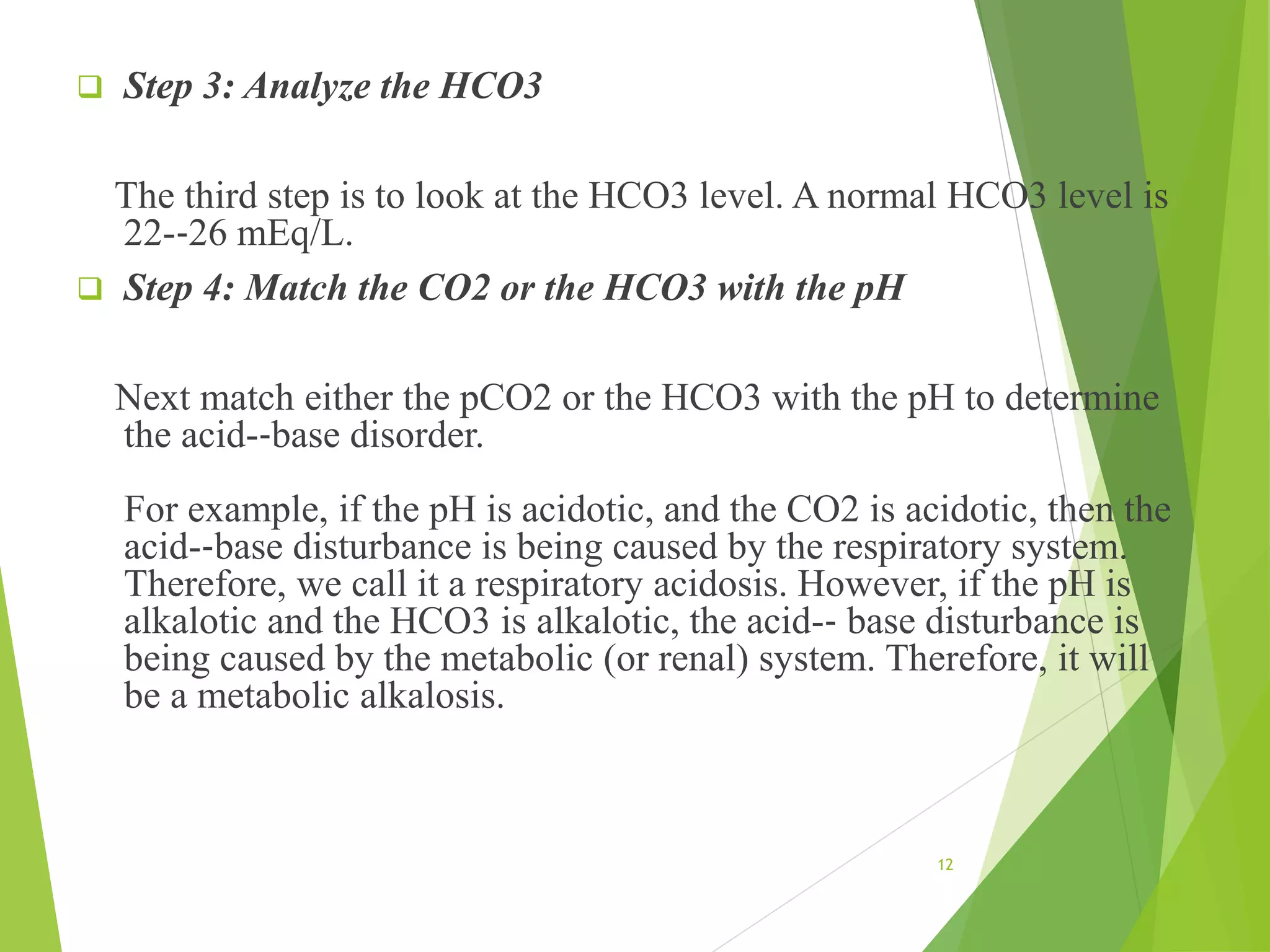
The third step is to look at the HCO3 level. A normal HCO3 level is
22-‐26 mEq/L.
 Step 4: Match the CO2 or the HCO3 with the pH
Next match either the pCO2 or the HCO3 with the pH to determine
the acid-‐base disorder.
For example, if the pH is acidotic, and the CO2 is acidotic, then the
acid-‐base disturbance is being caused by the respiratory system.
Therefore, we call it a respiratory acidosis. However, if the pH is
alkalotic and the HCO3 is alkalotic, the acid-‐ base disturbance is
being caused by the metabolic (or renal) system. Therefore, it will
be a metabolic alkalosis.
12
 Step 5: Does the CO2 or HCO3 go the opposite direction of the
pH?
Fifth, does either the CO2 or HCO3 go in the opposite direction of
the pH? If so, there is compensation by that system.
For example, the pH is acidotic, the CO2 is acidotic, and the HCO3
is alkalotic. The CO2 matches the pH making the primary acid-‐base
disorder respiratory acidosis. The HCO3 is opposite of the pH and
would be evidence of compensation from the metabolic system.
 Step 6: Analyze the pO2 and the O2 saturation.
Finally, evaluate the PaO2 and O2 sat. If they are below normal there
is evidence of hypoxemia.
13
 Prediction Of Compensatory Changes
14
Disorder Expected change
Metabolic acidosis PaCO2 = (1.5 * HCO3)+8
Metabolic alkalosis PaCO2 = 0.75 * rise in HCO3
Respiratory acidosis (rise in PaCO2)
Acute: rise in HCO3 = 0.1 * rise in PaCO2
(6-24 hrs)Fall in pH = 0.01 * rise in PaCO2
Chronic: rise in HCO3 = 0.4 * rise in PaCO2
(>24hrs) Fall in pH = 0.003 * rise in PaCO2
15
compensation
Respiratory alkalosis fall in PaCO2
Acute : fall in HCO3 = 0.2 * fall in PaCO2
Acute : rise in pH = 0.01 * fall in PaCO2
Chronic : fall in HCO3 = 0.4 * fall in PaCO2
Chronic : rise in pH = 0.002 * fall in PaCO2
16
compensation
Primary Acid-base Disorders:
Metabolic acidosis - A primary acid-base
disorder where the first change is a lowering of
HCO3
-, resulting in decreased pH.
Primary Event: ↓ HCO3
- ↓ pH
Compensatory event ↓HCO3
- ↓ pH ↓ PaCO2
(Same direction rule)
17
Causes of metabolic acidosis
with Normal Anion Gap
1.loss of HCO3 : diarrhea, CA inhibitors,
ureterosigmoidostomy, proximal RTA
2.Failure to excrete H+ : distal RTA
3.Addition of H+ : NH4Cl infusion
18
With Increased anion gap
1.Metabolic disorders : lactic acidosis, DKA,
alcoholic ketoacidosis
2.Addition of exogenous acids : salicylates/methanol
poisoning
3.Failure to excrete acid : acute/chronic renal failure
19
 Indications for alkaline therapy
pH < 7.15
HCO3 < 10 mEq/L
Hyperkalemia
hyperchloremic acidosis
 How much to correct ?
Amount of HCO3 required = desired HCO3 – actual
HCO3 ) * 0.5 * body wt in kg
20
Metabolic alkalosis - A primary acid-base disorder where the
first change is an elevation of HCO3
-, resulting in increased
pH.
Primary Event-HCO3↑ pH↑
Compensatory Event- HCO3↑ pH↑ PaCO2 ↑
(same direction rule)
21
 causes of metabolic alkalosis
SALINE RESPONSIVE :
ECF vol.depletion :
vomiting,
gastric suction,
diuretics,
hypercapnia correction.
Without ECF vol.depletion :
NaHCO3 infusion,
multiple transfusion.
22
SALINE RESISTANT
Normal/increased ECF vol. Hypertensive :4
hyperaldosteronism
cushing syndrome.
Normotensive :
barrter syndrome
severe k+ depletion
23
 Respiratory acidosis : clinical disorder, elevation in
PaCO2 (hypercapnia) leading to decrease in pH & variable
compensatory increase in the plasma HCO3.
PaCO2 high, pH low
due to failure of effective alveolar ventilation
metabolic(renal) compensation -
Acute: every 10 mmHg rise in PaCO2 causes
1 mEq/L rise in HCO3 & 0.1 fall in pH.
Chronic : every 10 mmHg rise in PaCO2 causes
4 mEq/L rise in HCO3 & 0.03 fall in pH.
24
 Causes - failure of effective alveolar ventilation
CNS depression : drugs(anesthesia, sedative), infection, stroke
Neuromuscular impairments : MG, myopathy, hypokalemia
Airway : obstruction, asthma
Alveolar diseases : COPD, pulmonary oedema , ARDS,
Pneumonitis
Ventilaton restriction: rib fracture, Pneumothorax, hemothorax .
25
 Respiratory alkalosis : occurs when hyperventilation
reduces the PaCO2 (hypocapnia) & leads to increase in pH &
compensatory HCO3 changes. PaCO2 low, pH high
Occurs due to excessive pulmonary excretion of CO2
exceeding the metabolic production of CO2 by tissues.
Compensation :
Acute : every 10mmHg fall in PaCO2 causes 2 mEq/L fall in
HCO3 & 0.1 rise in pH
Chronic : every 10mmHg fall in PaCO2 causes 4 mEq/L fall
in HCO3 & 0.03 rise in pH
26
 Causes of metabolic alkalosis
1. Hypoxemia :
a. Pulmonary diseases : pneumonia, interstitial fibrosis, emboli
& edema
b. CHF, hypotension, or severe anemia
c. High altitude residence.
2. Direct stimulation of medulary respiratory center :
pain, psychogenic, pregnancy, rapid correction of metabolic
acidosis
27
Basic disorder pH H+ 10 Change 20 change
Metabolic acidosis Low High HCO3 low PaCO2 low
Metabolic alkalosis High Low HCO3 high PaCO2 high
Respiratory acidosis Low High PaCO2 high HCO3 high
Respiratory alkalosis High Low PaCO2 low HCO3 low
28
Characteristics of primary acid-base disorders
Mixed acid –base disorder
 Existence of one or more primary acid base disorder. Seen in
critically ill patients
Most common mixed acid base disorder is respiratory acidosis
with metabolic acidosis
29
Common mixed acid base disorders
Metabolic acidosis & respiratory acidosis (low pH,
low HCO3, high PaCO2)
causes : cardiac arrest (hypoventilation + lactic acidosis),
shock with respiratory failure, DKA.
30
Metabolic alkalosis & respiratory alkalosis. ( high
pH, high HCO3, low PaCO2)
causes : liver failure with vomiting, patient on
ventilator with continuos nasogastric aspiration
31
Metabolic alkalosis & respiratory alkalosis (high
pH, high HCO3, low PaCO2).
Causes : COPD with diuretics, metabolic alkalosis
with sev. Hypokalemia & respiratory weakness leads
to hypoventilation
32
 Examples of acid base disorders
Case : 1
A 15 year old boy is brought from examination
hall in apprehensive state with complain of
tightness in the chest
pH-7.54, HCO3-21mEq/L, PaCO2-21mmhg
33
 pH : 7.54 - alkalosis
PaCO2 : 21mmHg – low – respiratory alkalosis
HCO3 : 21 mEq/L – low – compensation
fall in HCO3 = 0.2 * fall in PaCO2
= 0.2 * (40-21)
= 0.2 * 19 = 3.8
so expected HCO3 will 24-3.8=20.2≈21
expected deficit = actual deficit
s/o simple acid base disorder.
∆ : Primary respiratory alkalosis due to anxiety
34
Case : 2
A patient with poorly controlled IDDM missed his insulin
for 3 days.
pH- 7.1, HCO3-8mEq/L PaCO2-20mmhg, Na-140mEq/L,
Cl-106 mEq/L, urinary ketone bodies+++
35
pH- 7.1- acidic
HCO3- 8mEq/L – low – metabolic acidosis
PaCO2 – 20mmhg – low – compensation
Expected compensation -
fall in PaCO2 = HCO3 * 1.5 + 8
= 8 * 1.5 + 8
= 12 + 8 = 20mEq/L
expected PaCO2 matches the actual PaCO2 hence it is
s/o simple acid base disorder
36
Anion gap(AG) = Na-(Cl+HCO3)
= 140-(106+8) = 26
26 vs 12 – high anion gap
It is high AG metabolic acidosis
∆ : high AG metabolic acidosis due to DKA
37
Case : 3
K/C/O COPD develops severe Vomiting
pH-7.4, HCO3-36 mEq/L, PaCO2-60mmhg
38
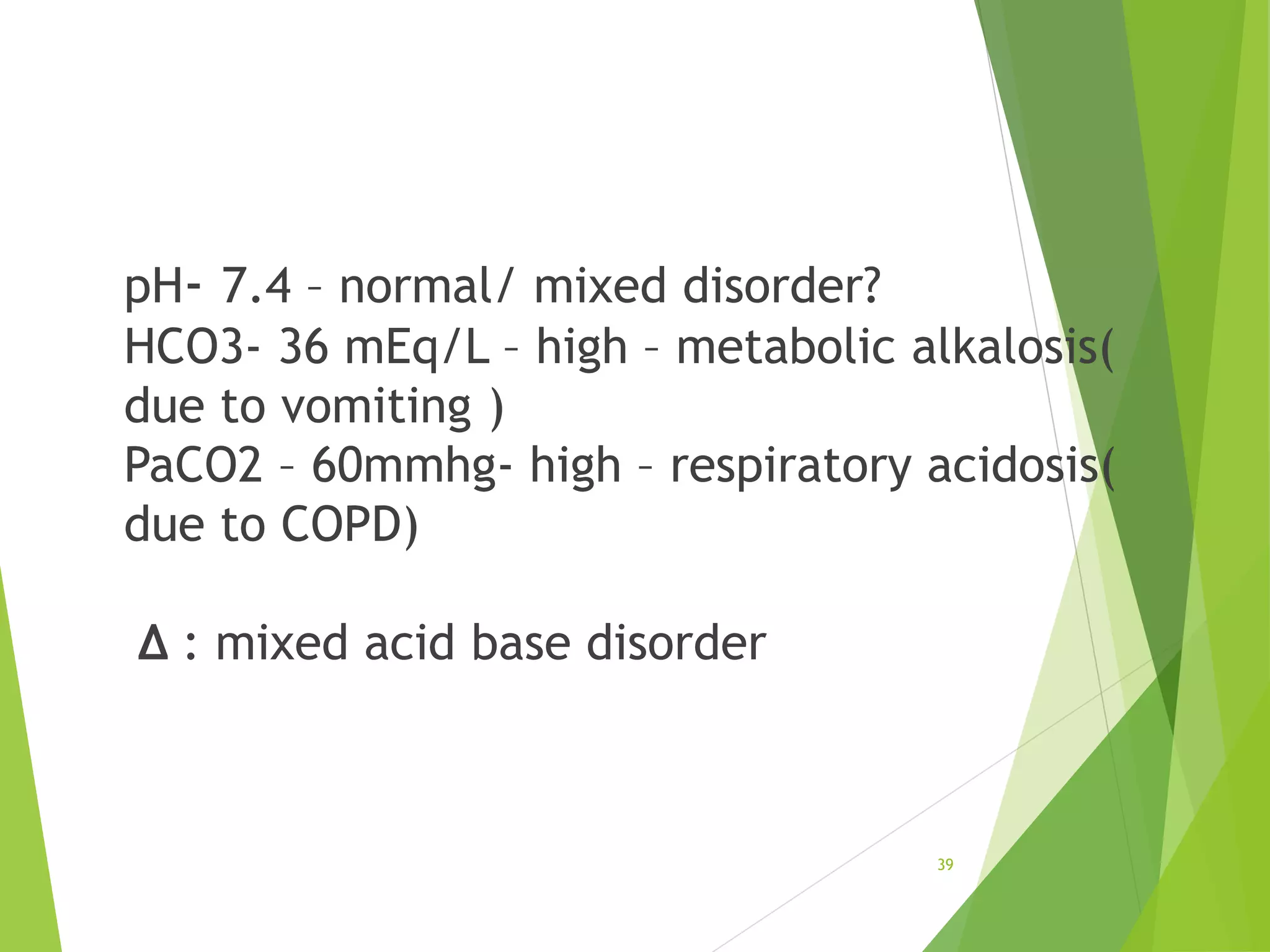
pH- 7.4 – normal/ mixed disorder?
HCO3- 36 mEq/L – high – metabolic alkalosis(
due to vomiting )
PaCO2 – 60mmhg- high – respiratory acidosis(
due to COPD)
∆ : mixed acid base disorder
39
Case : 4
ABG of patient with shock on ventilator support
since last 4 hours is
pH-7.48, HCO3-14mEq/L, PaCO2-22mmhg
40
pH- 7.48 – high - alkalosis
PaCO2 - 22mmhg- low – respiratory alkalosis.
HCO3- 14 mEq/L – low – compensation
respiratory alkalosis due increased TV, RR?
Expected compensation-
fall in HCO3 = 0.2 * fall in PaCO2
= 0.2 * (40-22)
= 0.2 * 18 = 3.6mEq/L
so expected HCO3 levels will be 24-3.6 = 20.4
actual is 14( low compared to 20.4) which suggests
additional metabolic acidosis (due to shock)
∆ : respiratory alkalosis with metabolic acidosis
41
42

Arterial blood gas analysis 1

  • 1.
  • 2.
    Acid-base Terminology Acidemia: bloodpH < 7.35 Acidosis: a primary physiologic process that, occurring alone, tends to cause acidemia. Alkalemia: blood pH > 7.45 Alkalosis: a primary physiologic process that, occurring alone, tends to cause alkalemia.. 2
  • 3.
    Clinical Terminology Criteria NormalpH 7.4 (7.35-7.45) Acidemia pH <7.35 Alkalemia pH >7.45 Normal PaCo2 40 (35-45) mmhg Respiratory Acidosis PaCO2 >45 mmhg & low pH Respiratory Alkalosis PaCO2< 35 mmhg & high pH Normal HCO3 24 (22-26) mEq/L Metabolic Acidosis HCO3<22 mEq/L & low pH Metabolic Alkalosis HCO3>26 mEq/L & high pH 3
  • 4.
    Anion gap  AG= Na-(Cl+HCO3) = 12+/- 2 mEq/L Definition : Charge difference between unmeasured anion & cation. anion : anionic protein, phosphate, sulphate & organic acids cations : calcium, magnesium, potassium 4
  • 5.
     Albumin normallycompromises most of the AG. For every 1g/dL decline of albumin there is 2mEq/L decline in AG Importance of AG : 1. Most useful to establish etiological diagnosis of metabolic acidosis. 2.useful in diagnosis of mixed disorders : if metabolic acidosis a/w (a) normal HCO3 levels or (b) AG excess > HCO3 deficit, think of superimposed metabolic alkalosis 5
  • 6.
  • 7.
     Simple AcidBase Disorders: are those in which there is a single primary etiological acid base disorder.  Mixed Acid Base Disorder: are those in which two / more primary etiological disorders are present simultaneously.  Respiratory Disorders: are caused by abnormal processes which tend to alter the pH because of a primary change in PaCO2 levels  Metabolic Disorders: are caused by abnormal processes which tend to alter pH because of a primary change in HCO3 levels. 7
  • 8.
    ABG analysis Indications  toevaluate the adequacy of ventilation, acid base status, oxygenation  To aid for diagnosis/ to see the patient’s response to therapy  To monitor the severity and progression of a known disease  Severe metabolic /respiratory disorders, during features of hypoxia/ hypercapnia. 8
  • 9.
     Shock /Sepsis Decreased cardiac output  Renal failure  When patient is on oxygen therapy  Inborn errors of metabolism  Ventilated patient 9
  • 10.
    Steps for ABGanalysis 1. What is the pH? Is it normal?Acidemia or Alkalemia? 2. Is the CO2 normal? Is HCO3 normal? 3. Match the CO2 or HCO3 with pH 4. What is the primary disorder present? 5. Is there appropriate compensation? 6. Is there an anion gap? 7. What is the differential for the clinical processes? 10
  • 11.
     Step 1:Analyze the pH The first step in analyzing ABGs is to look at the pH. Normal blood pH is 7.4, plus or minus 0.05, forming the range 7.35 to 7.45.  Step2: Analyze the CO2 The second step is to examine the pCO2. Normal pCO2 levels are 35-‐45mmHg.. 11
  • 12.
     Step 3:Analyze the HCO3 The third step is to look at the HCO3 level. A normal HCO3 level is 22-‐26 mEq/L.  Step 4: Match the CO2 or the HCO3 with the pH Next match either the pCO2 or the HCO3 with the pH to determine the acid-‐base disorder. For example, if the pH is acidotic, and the CO2 is acidotic, then the acid-‐base disturbance is being caused by the respiratory system. Therefore, we call it a respiratory acidosis. However, if the pH is alkalotic and the HCO3 is alkalotic, the acid-‐ base disturbance is being caused by the metabolic (or renal) system. Therefore, it will be a metabolic alkalosis. 12
  • 13.
     Step 5:Does the CO2 or HCO3 go the opposite direction of the pH? Fifth, does either the CO2 or HCO3 go in the opposite direction of the pH? If so, there is compensation by that system. For example, the pH is acidotic, the CO2 is acidotic, and the HCO3 is alkalotic. The CO2 matches the pH making the primary acid-‐base disorder respiratory acidosis. The HCO3 is opposite of the pH and would be evidence of compensation from the metabolic system.  Step 6: Analyze the pO2 and the O2 saturation. Finally, evaluate the PaO2 and O2 sat. If they are below normal there is evidence of hypoxemia. 13
  • 14.
     Prediction OfCompensatory Changes 14 Disorder Expected change Metabolic acidosis PaCO2 = (1.5 * HCO3)+8 Metabolic alkalosis PaCO2 = 0.75 * rise in HCO3
  • 15.
    Respiratory acidosis (risein PaCO2) Acute: rise in HCO3 = 0.1 * rise in PaCO2 (6-24 hrs)Fall in pH = 0.01 * rise in PaCO2 Chronic: rise in HCO3 = 0.4 * rise in PaCO2 (>24hrs) Fall in pH = 0.003 * rise in PaCO2 15 compensation
  • 16.
    Respiratory alkalosis fallin PaCO2 Acute : fall in HCO3 = 0.2 * fall in PaCO2 Acute : rise in pH = 0.01 * fall in PaCO2 Chronic : fall in HCO3 = 0.4 * fall in PaCO2 Chronic : rise in pH = 0.002 * fall in PaCO2 16 compensation
  • 17.
    Primary Acid-base Disorders: Metabolicacidosis - A primary acid-base disorder where the first change is a lowering of HCO3 -, resulting in decreased pH. Primary Event: ↓ HCO3 - ↓ pH Compensatory event ↓HCO3 - ↓ pH ↓ PaCO2 (Same direction rule) 17
  • 18.
    Causes of metabolicacidosis with Normal Anion Gap 1.loss of HCO3 : diarrhea, CA inhibitors, ureterosigmoidostomy, proximal RTA 2.Failure to excrete H+ : distal RTA 3.Addition of H+ : NH4Cl infusion 18
  • 19.
    With Increased aniongap 1.Metabolic disorders : lactic acidosis, DKA, alcoholic ketoacidosis 2.Addition of exogenous acids : salicylates/methanol poisoning 3.Failure to excrete acid : acute/chronic renal failure 19
  • 20.
     Indications foralkaline therapy pH < 7.15 HCO3 < 10 mEq/L Hyperkalemia hyperchloremic acidosis  How much to correct ? Amount of HCO3 required = desired HCO3 – actual HCO3 ) * 0.5 * body wt in kg 20
  • 21.
    Metabolic alkalosis -A primary acid-base disorder where the first change is an elevation of HCO3 -, resulting in increased pH. Primary Event-HCO3↑ pH↑ Compensatory Event- HCO3↑ pH↑ PaCO2 ↑ (same direction rule) 21
  • 22.
     causes ofmetabolic alkalosis SALINE RESPONSIVE : ECF vol.depletion : vomiting, gastric suction, diuretics, hypercapnia correction. Without ECF vol.depletion : NaHCO3 infusion, multiple transfusion. 22
  • 23.
    SALINE RESISTANT Normal/increased ECFvol. Hypertensive :4 hyperaldosteronism cushing syndrome. Normotensive : barrter syndrome severe k+ depletion 23
  • 24.
     Respiratory acidosis: clinical disorder, elevation in PaCO2 (hypercapnia) leading to decrease in pH & variable compensatory increase in the plasma HCO3. PaCO2 high, pH low due to failure of effective alveolar ventilation metabolic(renal) compensation - Acute: every 10 mmHg rise in PaCO2 causes 1 mEq/L rise in HCO3 & 0.1 fall in pH. Chronic : every 10 mmHg rise in PaCO2 causes 4 mEq/L rise in HCO3 & 0.03 fall in pH. 24
  • 25.
     Causes -failure of effective alveolar ventilation CNS depression : drugs(anesthesia, sedative), infection, stroke Neuromuscular impairments : MG, myopathy, hypokalemia Airway : obstruction, asthma Alveolar diseases : COPD, pulmonary oedema , ARDS, Pneumonitis Ventilaton restriction: rib fracture, Pneumothorax, hemothorax . 25
  • 26.
     Respiratory alkalosis: occurs when hyperventilation reduces the PaCO2 (hypocapnia) & leads to increase in pH & compensatory HCO3 changes. PaCO2 low, pH high Occurs due to excessive pulmonary excretion of CO2 exceeding the metabolic production of CO2 by tissues. Compensation : Acute : every 10mmHg fall in PaCO2 causes 2 mEq/L fall in HCO3 & 0.1 rise in pH Chronic : every 10mmHg fall in PaCO2 causes 4 mEq/L fall in HCO3 & 0.03 rise in pH 26
  • 27.
     Causes ofmetabolic alkalosis 1. Hypoxemia : a. Pulmonary diseases : pneumonia, interstitial fibrosis, emboli & edema b. CHF, hypotension, or severe anemia c. High altitude residence. 2. Direct stimulation of medulary respiratory center : pain, psychogenic, pregnancy, rapid correction of metabolic acidosis 27
  • 28.
    Basic disorder pHH+ 10 Change 20 change Metabolic acidosis Low High HCO3 low PaCO2 low Metabolic alkalosis High Low HCO3 high PaCO2 high Respiratory acidosis Low High PaCO2 high HCO3 high Respiratory alkalosis High Low PaCO2 low HCO3 low 28 Characteristics of primary acid-base disorders
  • 29.
    Mixed acid –basedisorder  Existence of one or more primary acid base disorder. Seen in critically ill patients Most common mixed acid base disorder is respiratory acidosis with metabolic acidosis 29
  • 30.
    Common mixed acidbase disorders Metabolic acidosis & respiratory acidosis (low pH, low HCO3, high PaCO2) causes : cardiac arrest (hypoventilation + lactic acidosis), shock with respiratory failure, DKA. 30
  • 31.
    Metabolic alkalosis &respiratory alkalosis. ( high pH, high HCO3, low PaCO2) causes : liver failure with vomiting, patient on ventilator with continuos nasogastric aspiration 31
  • 32.
    Metabolic alkalosis &respiratory alkalosis (high pH, high HCO3, low PaCO2). Causes : COPD with diuretics, metabolic alkalosis with sev. Hypokalemia & respiratory weakness leads to hypoventilation 32
  • 33.
     Examples ofacid base disorders Case : 1 A 15 year old boy is brought from examination hall in apprehensive state with complain of tightness in the chest pH-7.54, HCO3-21mEq/L, PaCO2-21mmhg 33
  • 34.
     pH :7.54 - alkalosis PaCO2 : 21mmHg – low – respiratory alkalosis HCO3 : 21 mEq/L – low – compensation fall in HCO3 = 0.2 * fall in PaCO2 = 0.2 * (40-21) = 0.2 * 19 = 3.8 so expected HCO3 will 24-3.8=20.2≈21 expected deficit = actual deficit s/o simple acid base disorder. ∆ : Primary respiratory alkalosis due to anxiety 34
  • 35.
    Case : 2 Apatient with poorly controlled IDDM missed his insulin for 3 days. pH- 7.1, HCO3-8mEq/L PaCO2-20mmhg, Na-140mEq/L, Cl-106 mEq/L, urinary ketone bodies+++ 35
  • 36.
    pH- 7.1- acidic HCO3-8mEq/L – low – metabolic acidosis PaCO2 – 20mmhg – low – compensation Expected compensation - fall in PaCO2 = HCO3 * 1.5 + 8 = 8 * 1.5 + 8 = 12 + 8 = 20mEq/L expected PaCO2 matches the actual PaCO2 hence it is s/o simple acid base disorder 36
  • 37.
    Anion gap(AG) =Na-(Cl+HCO3) = 140-(106+8) = 26 26 vs 12 – high anion gap It is high AG metabolic acidosis ∆ : high AG metabolic acidosis due to DKA 37
  • 38.
    Case : 3 K/C/OCOPD develops severe Vomiting pH-7.4, HCO3-36 mEq/L, PaCO2-60mmhg 38
  • 39.
    pH- 7.4 –normal/ mixed disorder? HCO3- 36 mEq/L – high – metabolic alkalosis( due to vomiting ) PaCO2 – 60mmhg- high – respiratory acidosis( due to COPD) ∆ : mixed acid base disorder 39
  • 40.
    Case : 4 ABGof patient with shock on ventilator support since last 4 hours is pH-7.48, HCO3-14mEq/L, PaCO2-22mmhg 40
  • 41.
    pH- 7.48 –high - alkalosis PaCO2 - 22mmhg- low – respiratory alkalosis. HCO3- 14 mEq/L – low – compensation respiratory alkalosis due increased TV, RR? Expected compensation- fall in HCO3 = 0.2 * fall in PaCO2 = 0.2 * (40-22) = 0.2 * 18 = 3.6mEq/L so expected HCO3 levels will be 24-3.6 = 20.4 actual is 14( low compared to 20.4) which suggests additional metabolic acidosis (due to shock) ∆ : respiratory alkalosis with metabolic acidosis 41
  • 42.