ACID-BASE DISORDERS 
By: Leonardo Paskah S, MD 
Cardiology & Vascular Medicine of Universitas Padjadjaran 
Bandung-Indonesia
INTRODUCTION 
• Blood [H+] is only 0.00004 mEq/L & tightly 
controlled 
• [H+] is common represented in pH 
pH = -log10 [H+]2
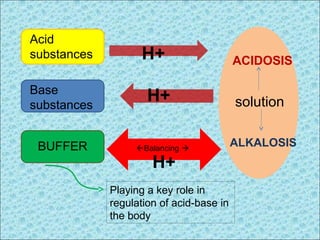
Acid 
substances 
Base 
substances 
solution 
BUFFER 
H+ 
H+ 
Balancing  
H+ 
Playing a key role in 
regulation of acid-base in 
the body 
ACIDOSIS 
ALKALOSIS
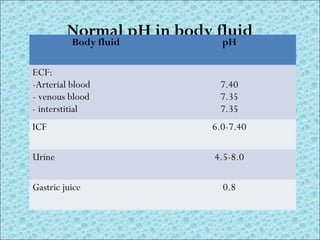
Normal pH in body fluid 
Body fluid pH 
ECF: 
-Arterial blood 
- venous blood 
- interstitial 
7.40 
7.35 
7.35 
ICF 6.0-7.40 
Urine 4.5-8.0 
Gastric juice 0.8
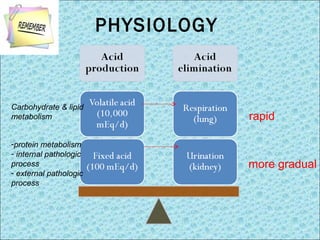
PHYSIOLOGY 
Carbohydrate & lipid 
metabolism 
-protein metabolism 
- internal pathologic 
process 
- external pathologic 
process 
rapid 
more gradual
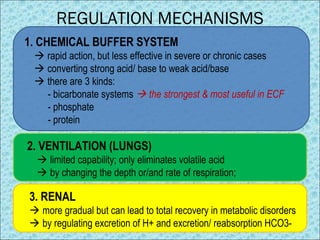
REGULATION MECHANISMS 
1. CHEMICAL BUFFER SYSTEM 
 rapid action, but less effective in severe or chronic cases 
 converting strong acid/ base to weak acid/base 
 there are 3 kinds: 
- bicarbonate systems  the strongest & most useful in ECF 
- phosphate 
- protein 
2. VENTILATION (LUNGS) 
 limited capability; only eliminates volatile acid 
 by changing the depth or/and rate of respiration; 
3. RENAL 
 more gradual but can lead to total recovery in metabolic disorders 
 by regulating excretion of H+ and excretion/ reabsorption HCO3-
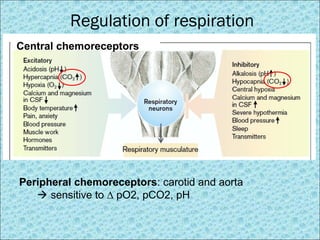
Regulation of respiration 
Central chemoreceptors 
Peripheral chemoreceptors: carotid and aorta 
 sensitive to Δ pO2, pCO2, pH
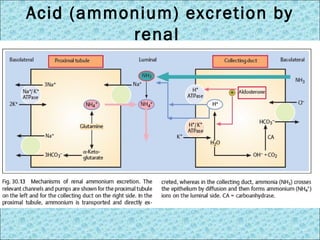
Acid (ammonium) excretion by 
renal
Henderson-Hasselbalch equation 
[H+] = (7.80-pH)x100 mEq/L 
[H+] in normal pH 7.40 = 40 mEq/L 
Respiration 
Renal
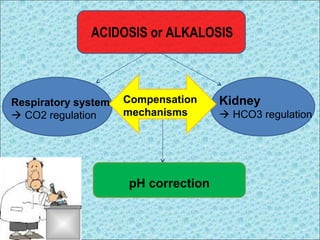
ACIDOSIS or ALKALOSIS 
pH correction 
Respiratory system 
 CO2 regulation 
Kidney 
 HCO3 regulation 
Compensation 
mechanisms
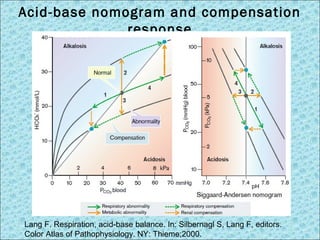
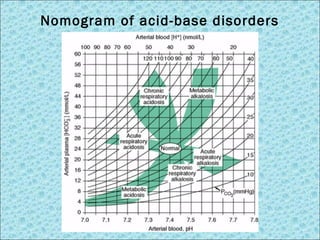
Acid-base nomogram and compensation 
response 
Lang F. Respiration, acid-base balance. In: Silbernagl S, Lang F, editors. 
Color Atlas of Pathophysiology. NY: Thieme;2000.
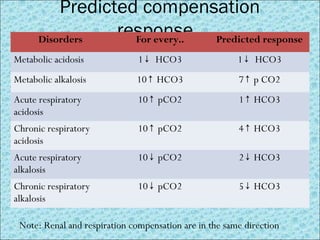
Predicted compensation 
response 
Disorders For every.. Predicted response 
Metabolic acidosis 1↓ HCO3 1↓ HCO3 
Metabolic alkalosis 10↑ HCO3 7↑ p CO2 
Acute respiratory 
10↑ pCO2 1↑ HCO3 
acidosis 
Chronic respiratory 
acidosis 
10↑ pCO2 4↑ HCO3 
Acute respiratory 
alkalosis 
10↓ pCO2 2↓ HCO3 
Chronic respiratory 
alkalosis 
10↓ pCO2 5↓ HCO3 
Note: Renal and respiration compensation are in the same direction
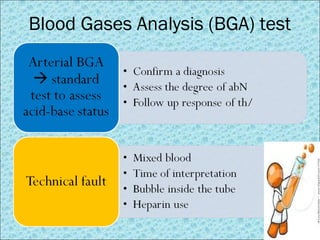
Blood Gases Analysis (BGA) test
Interpretation of BGA 
Oxygenation status Acid-base status 
pH correlated to [H+]  acid-base degree 
pCO2 Oxygen partial pressure in blood; normal 80-100 mmHg 
SaO2 Arterial oxygen saturation; normal 95-100% 
pCO2 CO2 partial pressure in blood; normal 35-45 mmHg 
HCO3- Bicarbonate in circulation (calculated); normal 22-26 
mEq/L 
Base Excess (BE) Deficit or excess of bicarbonate in blood; normal -2 to +2 
mEq/L 
Parameters in BGA test
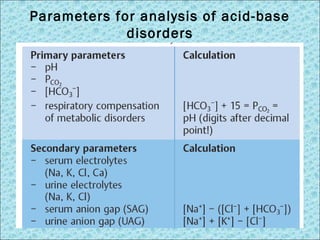
Parameters for analysis of acid-base 
disorders
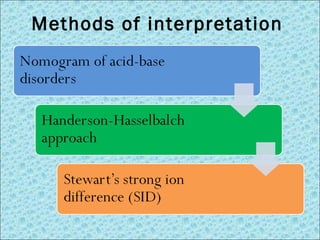
Methods of interpretation
Nomogram of acid-base disorders
Stewart’s SID 
• Dependent variables: [H+], [OH-], [HCO3-], [CO3 2-], [HA], 
[A-] 
• Independent variables: pCO2, [A-tot], [SID] 
– [SID]= [Na]+[K]+[Ca]+[Mg] – [Cl] – [other strong anions] 
 normal = 40 mEq/L  similar numerical value as BE 
– [A-tot]= [Pi-tot] + [Pro-tot] + albumin 
– [CO2] = pCO2 in blood 
• Limitation: 
– Complexity of the chemistry & mathematics 
– Lack of clinical correlation 
– SID neglects Hb as a buffer  less accurate than BE 
www.acid-base.com/strongion.php
Interpretation of Handerson Hasselbalch approach 
STEP 1 Re-check the data  [H+]=24 x pCO2 / [HCO3-] 
[H+] mEq/L= (7.80-pH)x100 
STEP 2 Acidemia (pH <7.37) or alkalemia (pH 
>7.42) ? 
STEP 3 Determining the primary disorder; metabolic or 
respiratory ?  look any Δ pCO2 and HCO3- 
STEP 4 Determining compensatory mechanisms  expected 
or excessive deviation ? 
STEP 5 
(for metab acidosis) 
Anion Gap= [Na]- ( [Cl] + [HCO3])…...... n<12 
Hypoalbuminemia AGc= AG + (2.5x Δ albumin) 
STEP 6 
(for AG > 12) 
Delta/delta = ΔAG/ΔHCO3 = (AG-12)/(24-HCO3) 
Delta/delta > 1 = metab acidosis + alkalosis 
Delta/delta < 1 = metab.acidosis gap + non-gap
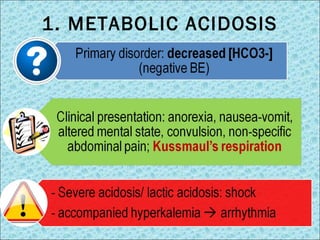
1. METABOLIC ACIDOSIS
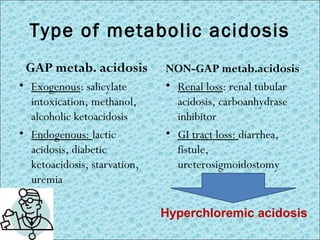
Type of metabolic acidosis 
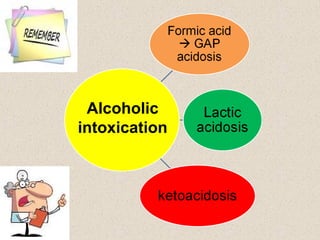
GAP metab. acidosis 
• Exogenous: salicylate 
intoxication, methanol, 
alcoholic ketoacidosis 
• Endogenous: lactic 
acidosis, diabetic 
ketoacidosis, starvation, 
uremia 
NON-GAP metab.acidosis 
• Renal loss: renal tubular 
acidosis, carboanhydrase 
inhibitor 
• GI tract loss: diarrhea, 
fistule, 
ureterosigmoidostomy 
Hyperchloremic acidosis
Alcoholic 
intoxication
Therapy of metabolic 
acidosis 
• Correct underlying disease 
• Correct hydration state and electrolyte imbalance 
• Bicarbonate  controversial 
- Indicated for severe acidosis (pH < 7.20), esp. 
GAP metabolic acidosis 
- total needed (mEq)= Base deficit x BW(kg)/4  ½ doses is given 
within first 8 h 
• Chronic non-severe acidosis: bicarbonate oral for 
[HCO3-] <18 mmol/L + clinical symptoms
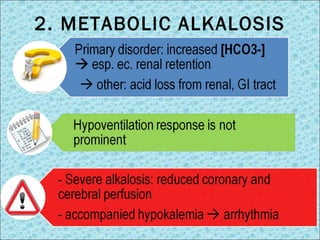
2. METABOLIC ALKALOSIS
Type and therapy of metabolic 
alkalosis 
Chloride-sensitive Chloride-insensitive 
* [Cl-] urine < 10 mEq/L 
* prolonged Cl (and H+) loss 
via urine/GI tract  Na and 
HCO3 retention by renal 
* GI tract loss: vomit, NGT 
suction, diarrhrea 
* renal loss: diuretic 
* response to NaCl therapy 
• [Cl-] > 10 mEq/L 
• direct stimulation to renal 
• causa: hyperaldosteronism, 
steroid therapy, alkali intake 
• not response to NaCl 
therapy; therapy focused on 
underlying cause (ex. stop 
consuming steroid) 
Therapy with strong acid (HCl, NH4Cl) is only for severe alkalosis and 
resistant with standard therapy
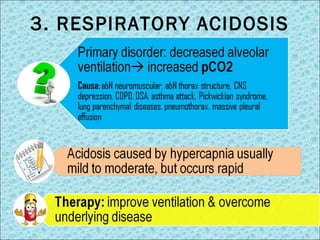
3. RESPIRATORY ACIDOSIS
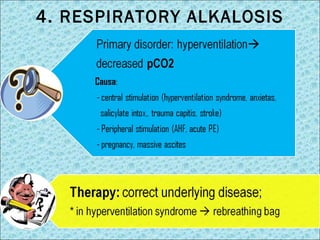
4. RESPIRATORY ALKALOSIS
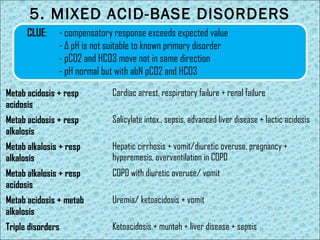
5. MIXED ACID-BASE DISORDERS 
CLUE: - compensatory response exceeds expected value 
- Δ pH is not suitable to known primary disorder 
- pCO2 and HCO3 move not in same direction 
- pH normal but with abN pCO2 and HCO3 
Metab acidosis + resp 
acidosis 
Cardiac arrest, respiratory failure + renal failure 
Metab acidosis + resp 
alkalosis 
Salicylate intox., sepsis, advanced liver disease + lactic acidosis 
Metab alkalosis + resp 
alkalosis 
Hepatic cirrhosis + vomit/diuretic overuse, pregnancy + 
hyperemesis, overventilation in COPD 
Metab alkalosis + resp 
acidosis 
COPD with diuretic overuse/ vomit 
Metab acidosis + metab 
alkalosis 
Uremia/ ketoacidosis + vomit 
Triple disorders Ketoacidosis + muntah + liver disease + sepsis
REFERENCES 
1. Guyton AC, Hall JE. Textbook of Medical Physiology. 11th ed. Philadelphia: Elsevier Saunders; 2006 
2. Costanzo LS. Physiology. 4th ed. Philadelphia: Elsevier Saunders; 2009 
3. Ganong WF. Review of Medical Physiology. 22nd ed. US: McGraw-Hill; 2005 
4. Hennessey IAM, Japp AG. Arterial Blood Gases Made Easy. Philadelphia: Churchill Livingstone; 2007 
5. Al-Khadra E. Disorders of the Acid-Base Status. In: Kiessling SG, Goebel J, Somers MJG, editors. Pediatric 
Nephrology in the ICU. Berlin: Springer-Verlag;2009 
6. Gomella LG, Haist SA. Clinician’s Pocket Reference. 10th ed. US: McGraw-Hill; 2004 
7. West JB. Respiratory Physiology: The Essentials. 7th ed. Philadelphia: Lippincott Williams & Wilkins; 2005 
8. Interpretation of the Arterial Blood Gas. Orlando Health, Education & Development. 2010 
9. Fehr T, Wuethrich RP. Water, electrolyte, and acid-base disorders. In: Siegenthaler W, editor. Differential 
Diagnosis in Internal Medicine. NY: Thieme; 2007.p916-28 
10. Grogono AW. Acid-Base Tutorial. www.acid-base.com. Tulane University Department of Anesthesiology. 
11. Seifter JL. Acid-base disorders. In:Goldman L, Ausiello D, editors. Cecil Medicine. 23rd ed. Philadelphia: Saunders 
Elsevier; 2007.Ch.119 
12. Kasper, Braunwald, Fauci, et al. Harrison’s Principles of Internal Medicine. 16th ed. Volume 1. NY: McGrawHill; 
2005 
13. Sue DY, Vintch JRE. Current Essentials of Critical Care. NY: McGraw-Hill; 2005.p65-70 
14. Lang F. Respiration, acid-base balance. In: Silbernagl S, Lang F, editors. Color Atlas of Pathophysiology. NY: 
Thieme;2000.p66-91
THANK YOU

Acid base disorders

  • 1.
    ACID-BASE DISORDERS By:Leonardo Paskah S, MD Cardiology & Vascular Medicine of Universitas Padjadjaran Bandung-Indonesia
  • 2.
    INTRODUCTION • Blood[H+] is only 0.00004 mEq/L & tightly controlled • [H+] is common represented in pH pH = -log10 [H+]2
  • 3.
    Acid substances Base substances solution BUFFER H+ H+ Balancing  H+ Playing a key role in regulation of acid-base in the body ACIDOSIS ALKALOSIS
  • 4.
    Normal pH inbody fluid Body fluid pH ECF: -Arterial blood - venous blood - interstitial 7.40 7.35 7.35 ICF 6.0-7.40 Urine 4.5-8.0 Gastric juice 0.8
  • 5.
    PHYSIOLOGY Carbohydrate &lipid metabolism -protein metabolism - internal pathologic process - external pathologic process rapid more gradual
  • 6.
    REGULATION MECHANISMS 1.CHEMICAL BUFFER SYSTEM  rapid action, but less effective in severe or chronic cases  converting strong acid/ base to weak acid/base  there are 3 kinds: - bicarbonate systems  the strongest & most useful in ECF - phosphate - protein 2. VENTILATION (LUNGS)  limited capability; only eliminates volatile acid  by changing the depth or/and rate of respiration; 3. RENAL  more gradual but can lead to total recovery in metabolic disorders  by regulating excretion of H+ and excretion/ reabsorption HCO3-
  • 7.
    Regulation of respiration Central chemoreceptors Peripheral chemoreceptors: carotid and aorta  sensitive to Δ pO2, pCO2, pH
  • 8.
  • 9.
    Henderson-Hasselbalch equation [H+]= (7.80-pH)x100 mEq/L [H+] in normal pH 7.40 = 40 mEq/L Respiration Renal
  • 10.
    ACIDOSIS or ALKALOSIS pH correction Respiratory system  CO2 regulation Kidney  HCO3 regulation Compensation mechanisms
  • 11.
    Acid-base nomogram andcompensation response Lang F. Respiration, acid-base balance. In: Silbernagl S, Lang F, editors. Color Atlas of Pathophysiology. NY: Thieme;2000.
  • 12.
    Predicted compensation response Disorders For every.. Predicted response Metabolic acidosis 1↓ HCO3 1↓ HCO3 Metabolic alkalosis 10↑ HCO3 7↑ p CO2 Acute respiratory 10↑ pCO2 1↑ HCO3 acidosis Chronic respiratory acidosis 10↑ pCO2 4↑ HCO3 Acute respiratory alkalosis 10↓ pCO2 2↓ HCO3 Chronic respiratory alkalosis 10↓ pCO2 5↓ HCO3 Note: Renal and respiration compensation are in the same direction
  • 13.
  • 14.
    Interpretation of BGA Oxygenation status Acid-base status pH correlated to [H+]  acid-base degree pCO2 Oxygen partial pressure in blood; normal 80-100 mmHg SaO2 Arterial oxygen saturation; normal 95-100% pCO2 CO2 partial pressure in blood; normal 35-45 mmHg HCO3- Bicarbonate in circulation (calculated); normal 22-26 mEq/L Base Excess (BE) Deficit or excess of bicarbonate in blood; normal -2 to +2 mEq/L Parameters in BGA test
  • 15.
    Parameters for analysisof acid-base disorders
  • 16.
  • 17.
  • 18.
    Stewart’s SID •Dependent variables: [H+], [OH-], [HCO3-], [CO3 2-], [HA], [A-] • Independent variables: pCO2, [A-tot], [SID] – [SID]= [Na]+[K]+[Ca]+[Mg] – [Cl] – [other strong anions]  normal = 40 mEq/L  similar numerical value as BE – [A-tot]= [Pi-tot] + [Pro-tot] + albumin – [CO2] = pCO2 in blood • Limitation: – Complexity of the chemistry & mathematics – Lack of clinical correlation – SID neglects Hb as a buffer  less accurate than BE www.acid-base.com/strongion.php
  • 19.
    Interpretation of HandersonHasselbalch approach STEP 1 Re-check the data  [H+]=24 x pCO2 / [HCO3-] [H+] mEq/L= (7.80-pH)x100 STEP 2 Acidemia (pH <7.37) or alkalemia (pH >7.42) ? STEP 3 Determining the primary disorder; metabolic or respiratory ?  look any Δ pCO2 and HCO3- STEP 4 Determining compensatory mechanisms  expected or excessive deviation ? STEP 5 (for metab acidosis) Anion Gap= [Na]- ( [Cl] + [HCO3])…...... n<12 Hypoalbuminemia AGc= AG + (2.5x Δ albumin) STEP 6 (for AG > 12) Delta/delta = ΔAG/ΔHCO3 = (AG-12)/(24-HCO3) Delta/delta > 1 = metab acidosis + alkalosis Delta/delta < 1 = metab.acidosis gap + non-gap
  • 20.
  • 21.
    Type of metabolicacidosis GAP metab. acidosis • Exogenous: salicylate intoxication, methanol, alcoholic ketoacidosis • Endogenous: lactic acidosis, diabetic ketoacidosis, starvation, uremia NON-GAP metab.acidosis • Renal loss: renal tubular acidosis, carboanhydrase inhibitor • GI tract loss: diarrhea, fistule, ureterosigmoidostomy Hyperchloremic acidosis
  • 22.
  • 23.
    Therapy of metabolic acidosis • Correct underlying disease • Correct hydration state and electrolyte imbalance • Bicarbonate  controversial - Indicated for severe acidosis (pH < 7.20), esp. GAP metabolic acidosis - total needed (mEq)= Base deficit x BW(kg)/4  ½ doses is given within first 8 h • Chronic non-severe acidosis: bicarbonate oral for [HCO3-] <18 mmol/L + clinical symptoms
  • 24.
  • 25.
    Type and therapyof metabolic alkalosis Chloride-sensitive Chloride-insensitive * [Cl-] urine < 10 mEq/L * prolonged Cl (and H+) loss via urine/GI tract  Na and HCO3 retention by renal * GI tract loss: vomit, NGT suction, diarrhrea * renal loss: diuretic * response to NaCl therapy • [Cl-] > 10 mEq/L • direct stimulation to renal • causa: hyperaldosteronism, steroid therapy, alkali intake • not response to NaCl therapy; therapy focused on underlying cause (ex. stop consuming steroid) Therapy with strong acid (HCl, NH4Cl) is only for severe alkalosis and resistant with standard therapy
  • 26.
  • 27.
  • 28.
    5. MIXED ACID-BASEDISORDERS CLUE: - compensatory response exceeds expected value - Δ pH is not suitable to known primary disorder - pCO2 and HCO3 move not in same direction - pH normal but with abN pCO2 and HCO3 Metab acidosis + resp acidosis Cardiac arrest, respiratory failure + renal failure Metab acidosis + resp alkalosis Salicylate intox., sepsis, advanced liver disease + lactic acidosis Metab alkalosis + resp alkalosis Hepatic cirrhosis + vomit/diuretic overuse, pregnancy + hyperemesis, overventilation in COPD Metab alkalosis + resp acidosis COPD with diuretic overuse/ vomit Metab acidosis + metab alkalosis Uremia/ ketoacidosis + vomit Triple disorders Ketoacidosis + muntah + liver disease + sepsis
  • 29.
    REFERENCES 1. GuytonAC, Hall JE. Textbook of Medical Physiology. 11th ed. Philadelphia: Elsevier Saunders; 2006 2. Costanzo LS. Physiology. 4th ed. Philadelphia: Elsevier Saunders; 2009 3. Ganong WF. Review of Medical Physiology. 22nd ed. US: McGraw-Hill; 2005 4. Hennessey IAM, Japp AG. Arterial Blood Gases Made Easy. Philadelphia: Churchill Livingstone; 2007 5. Al-Khadra E. Disorders of the Acid-Base Status. In: Kiessling SG, Goebel J, Somers MJG, editors. Pediatric Nephrology in the ICU. Berlin: Springer-Verlag;2009 6. Gomella LG, Haist SA. Clinician’s Pocket Reference. 10th ed. US: McGraw-Hill; 2004 7. West JB. Respiratory Physiology: The Essentials. 7th ed. Philadelphia: Lippincott Williams & Wilkins; 2005 8. Interpretation of the Arterial Blood Gas. Orlando Health, Education & Development. 2010 9. Fehr T, Wuethrich RP. Water, electrolyte, and acid-base disorders. In: Siegenthaler W, editor. Differential Diagnosis in Internal Medicine. NY: Thieme; 2007.p916-28 10. Grogono AW. Acid-Base Tutorial. www.acid-base.com. Tulane University Department of Anesthesiology. 11. Seifter JL. Acid-base disorders. In:Goldman L, Ausiello D, editors. Cecil Medicine. 23rd ed. Philadelphia: Saunders Elsevier; 2007.Ch.119 12. Kasper, Braunwald, Fauci, et al. Harrison’s Principles of Internal Medicine. 16th ed. Volume 1. NY: McGrawHill; 2005 13. Sue DY, Vintch JRE. Current Essentials of Critical Care. NY: McGraw-Hill; 2005.p65-70 14. Lang F. Respiration, acid-base balance. In: Silbernagl S, Lang F, editors. Color Atlas of Pathophysiology. NY: Thieme;2000.p66-91
  • 30.