Distillation
Distillation
•A process in which a liquid or vapour
mixture of two or more substances is
separated into its component fractions
of desired purity, by the application and
removal of heat.
•Distillation is based on the fact that the
vapour of a boiling mixture will be richer in
the components that have lower boiling
points.
tYPEs oF Distillation
ColUMns
•There are many types of distillation
columns
•Batch and Continuous Columns
•One way of classifying distillation column
type is to look at how they are operated.
Thus we have:
batch and continuous columns.
BatCh ColUMns
•In batch operation, the feed to the
column is introduced batch-wise.
That is, the column is charged with
a 'batch' and then the distillation
process is carried out. When the
desired task is achieved, a next
batch of feed is introduced.
ContinUoUs ColUMns
•In contrast, continuous columns
process a continuous feed stream. No
interruptions occur unless there is a
problem with the column or
surrounding process units. They are
capable of handling high throughputs
and are the most common of the two
types
Main CoMPonEnts oF Distillation ColUMns
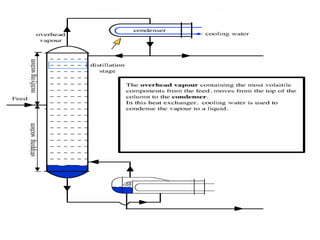
• Distillation columns are made up of several components,
each of which is used either to tranfer heat energy or
enhance materail transfer. A typical distillation contains
several major components:
1. a vertical shell where the separation of liquid components is
carried out
2. column internals such as trays/plates and/or packings which
are used to enhance component separations
3. a reboiler to provide the necessary vaporisation for the
distillation
4. a condenser to cool and condense the vapour leaving the
top of the column
5. a reflux drum to hold the condensed vapour from the top of
the column so that liquid (reflux) can be recycled back to the
column
Basic OperatiOn and
terminOlOgy
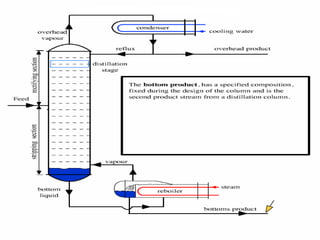
•Heat is supplied to the reboiler to generate
vapour. The source of heat input can be any
suitable fluid, although in most chemical plants
this is normally steam
•The liquid removed from the reboiler is known
as the bottoms product or simply, bottoms.
•The vapour moves up the column, and as it exits
the top of the unit, it is cooled by a condenser.
The condensed liquid is stored in a holding
vessel known as the reflux drum. Some of this
liquid is recycled back to the top of the column
and this is called the reflux. The condensed
liquid that is removed from the system is known
as the distillate or top product.
distillatiOn principles
•Separation of components from a liquid
mixture via distillation depends on the
differences in boiling points of the individual
components
•Also, depending on the concentrations of
the components present, the liquid mixture
will have different boiling point
characteristics. Therefore, distillation
processes depends on the vapour pressure
characteristics of liquid mixtures.
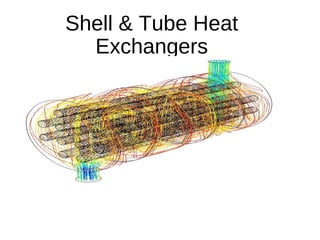
Shell & Tube Heat
Exchangers
Heat excHanger
•A device whose primary purpose is
the transfer of heat energy between
two fluids.
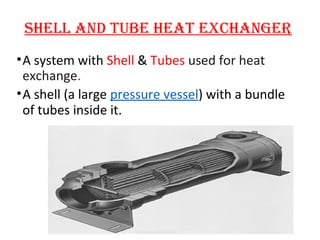
SHell and tube Heat excHanger
•A system with Shell & Tubes used for heat
exchange.
•A shell (a large pressure vessel) with a bundle
of tubes inside it.
Working
•One fluid runs through the tubes,
and another fluid flows over the
tubes (through the shell) to transfer
heat between the two fluids.
•The set of tubes is called a tube
bundle.
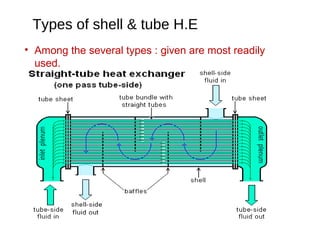
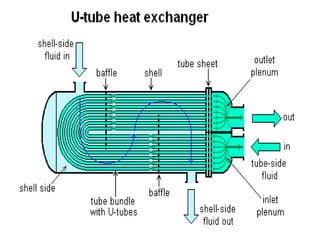
Types of shell & tube H.E
• Among the several types : given are most readily
used.
baffleS
• Device used to restrain the flow of a
fluid or to prevent the spreading of fluid
in a particular direction.
•Flow-directing panel in some vessels
such as shell and tube heat exchangers,
chemical reactors, or static mixers.
Use of Baffle
•Hold tubes in position both in production
and operation
•Prevent the effects of vibration which is
increased with both fluid velocity and the
length of the exchanger
•Direct shell side fluid flow along tube
field.
•This increases fluid velocity and the
effective heat transfer coefficient of the
exchanger
applications
•Cooling of Hydraulic fluid
•Cooling of engine oil
• Transmissions
•Hydraulic power packs
•Cooling or heating of swimming
pool water or charge air.
•Used in floating tube bundle (where
the tube plates are not welded to the
outer shell).
Distillation

Distillation

  • 1.
  • 2.
    Distillation •A process inwhich a liquid or vapour mixture of two or more substances is separated into its component fractions of desired purity, by the application and removal of heat. •Distillation is based on the fact that the vapour of a boiling mixture will be richer in the components that have lower boiling points.
  • 4.
    tYPEs oF Distillation ColUMns •Thereare many types of distillation columns •Batch and Continuous Columns •One way of classifying distillation column type is to look at how they are operated. Thus we have: batch and continuous columns.
  • 5.
    BatCh ColUMns •In batchoperation, the feed to the column is introduced batch-wise. That is, the column is charged with a 'batch' and then the distillation process is carried out. When the desired task is achieved, a next batch of feed is introduced.
  • 6.
    ContinUoUs ColUMns •In contrast,continuous columns process a continuous feed stream. No interruptions occur unless there is a problem with the column or surrounding process units. They are capable of handling high throughputs and are the most common of the two types
  • 7.
    Main CoMPonEnts oFDistillation ColUMns • Distillation columns are made up of several components, each of which is used either to tranfer heat energy or enhance materail transfer. A typical distillation contains several major components: 1. a vertical shell where the separation of liquid components is carried out 2. column internals such as trays/plates and/or packings which are used to enhance component separations 3. a reboiler to provide the necessary vaporisation for the distillation 4. a condenser to cool and condense the vapour leaving the top of the column 5. a reflux drum to hold the condensed vapour from the top of the column so that liquid (reflux) can be recycled back to the column
  • 8.
  • 9.
    •Heat is suppliedto the reboiler to generate vapour. The source of heat input can be any suitable fluid, although in most chemical plants this is normally steam •The liquid removed from the reboiler is known as the bottoms product or simply, bottoms. •The vapour moves up the column, and as it exits the top of the unit, it is cooled by a condenser. The condensed liquid is stored in a holding vessel known as the reflux drum. Some of this liquid is recycled back to the top of the column and this is called the reflux. The condensed liquid that is removed from the system is known as the distillate or top product.
  • 13.
    distillatiOn principles •Separation ofcomponents from a liquid mixture via distillation depends on the differences in boiling points of the individual components •Also, depending on the concentrations of the components present, the liquid mixture will have different boiling point characteristics. Therefore, distillation processes depends on the vapour pressure characteristics of liquid mixtures.
  • 14.
    Shell & TubeHeat Exchangers
  • 15.
    Heat excHanger •A devicewhose primary purpose is the transfer of heat energy between two fluids.
  • 16.
    SHell and tubeHeat excHanger •A system with Shell & Tubes used for heat exchange. •A shell (a large pressure vessel) with a bundle of tubes inside it.
  • 17.
    Working •One fluid runsthrough the tubes, and another fluid flows over the tubes (through the shell) to transfer heat between the two fluids. •The set of tubes is called a tube bundle.
  • 18.
    Types of shell& tube H.E • Among the several types : given are most readily used.
  • 21.
    baffleS • Device usedto restrain the flow of a fluid or to prevent the spreading of fluid in a particular direction. •Flow-directing panel in some vessels such as shell and tube heat exchangers, chemical reactors, or static mixers.
  • 23.
    Use of Baffle •Holdtubes in position both in production and operation •Prevent the effects of vibration which is increased with both fluid velocity and the length of the exchanger •Direct shell side fluid flow along tube field. •This increases fluid velocity and the effective heat transfer coefficient of the exchanger
  • 24.
    applications •Cooling of Hydraulicfluid •Cooling of engine oil • Transmissions •Hydraulic power packs •Cooling or heating of swimming pool water or charge air. •Used in floating tube bundle (where the tube plates are not welded to the outer shell).