Distillation
Index
1) What is distillation?
2) Comparison of Distillation with other Mass
transfer operation
3) Reflux ratio, Relative volatility
4) Problems in distillation
5)Types of Distillation
6) Packed tower and tray tower
https://chemicalengineeringworld.com
1) What is distillation?
• Distillation is a method of separating the components
of a solution which depends upon distribution of the
substances between a gas and liquid phase, applied
to cases where all components are present in both
phases.
• Distillation is a method of separating mixtures based
on differences in volatilities (volatility is the
tendency of a substance to vaporize. Volatility is
directly related to a substance's vapor
pressure.) of components in a boiling liquid mixture.
Distillation is aunit operation, or a physical separation
process, and not a chemical reaction.
https://chemicalengineeringworld.com
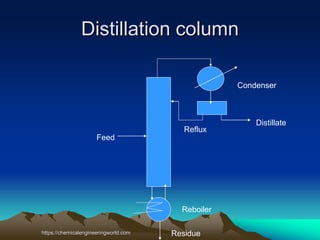
Distillation column
Reboiler
Residue
Condenser
Distillate
Reflux
Feed
https://chemicalengineeringworld.com
• In Distillation vapor rising in the section above
the feed (called the absorption, enriching, or
rectifying section) is washed with liquid to
remove or absorb the less volatile component.
• The liquid returned to the top of the tower is
called reflux and the material permanently
removed is the distillate.
• The section below the feed (stripping or
exhausting section) the liquid is stripped of
volatile component by vapor produced in
reboiler.
https://chemicalengineeringworld.com
Difference between Distillation and
other MTO
Distillation
> foreign substance is not required.
> So there is no choice required for
selection of new substance.
> Give pure product, Further purification is
not required.
https://chemicalengineeringworld.com
Other MTO
> foreign substance required.
> So there is choice required for selection
of new substance.
> Not give pure product, Further
purification is required.
https://chemicalengineeringworld.com
Important parameters for
Distillation
• Relative volatility
• Reflux
• Reflux ratio
https://chemicalengineeringworld.com
Relative volatility
• It is the ratio of concentration ratio of one
component to other in one phase to other phase.
• Relative volatility is usually denoted as α.
• It indicates the ease or difficulty of using
distillation to separate the
more volatile components from the less volatile
components in a mixture
• For separation,it should be greater than 1.
https://chemicalengineeringworld.com
Reflux Ratio
• Reflux = Liquid return to column/ Distillate
• Minimum Reflux ratio ,Maximum Reflux
ratio , Optimum reflux ratio
• Increasing reflux ratio
– Improves separation
– Increases cycle time
– Increases energy consumption
https://chemicalengineeringworld.com
Types of Distillation
• 1) Single stage operation (Flash
Vaporization )
• 2) Batch Distillation
• 3) Azeotropic Distillation
• 4) Extractive Distillation
https://chemicalengineeringworld.com
Single stage operation- Flash
vaporization
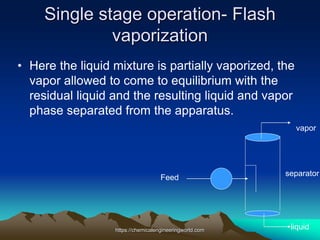
• Here the liquid mixture is partially vaporized, the
vapor allowed to come to equilibrium with the
residual liquid and the resulting liquid and vapor
phase separated from the apparatus.
vapor
liquid
separator
Feed
https://chemicalengineeringworld.com
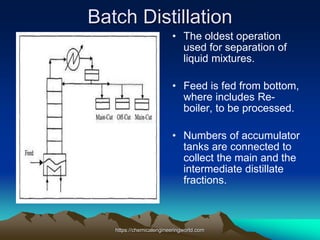
Batch Distillation
• The oldest operation
used for separation of
liquid mixtures.
• Feed is fed from bottom,
where includes Re-
boiler, to be processed.
• Numbers of accumulator
tanks are connected to
collect the main and the
intermediate distillate
fractions.
https://chemicalengineeringworld.com
Azeotropic Distillation
• What is Azeotrope ?
• It is constant Boiling mixture.
• Azeotropic distillation usually refers to the
specific technique of adding another component
to generate a new, lower-boiling azeotrope, such
as the example below with the addition of
benzene to water and ethanol.
https://chemicalengineeringworld.com
Extractive Distillation
• The method of extractive distillation uses a
separation solvent, which is generally nonvolatile,
has a high boiling point and is miscible with the
mixture, but doesn't form an azeotropic mixture.
• Third component change the relative volatility of the
mixture.
• A classic example to be cited here is the separation
of an azeotropic mixture
of benzene and cyclohexane, where aniline is one
suitable solvent.
https://chemicalengineeringworld.com
Problems in tray towers
• For high tray efficiency we require deep pools of liquid
and relatively high gas velocities. These conditions
however lead to a number of difficulties. One is the
mechanical entrainment in which small droplets of liquid
will be carried by the gas to the tray above.
• Great depth of liquid and high gas velocities both result
in high pressure drop for the gas in flowing through the
tray.
• In absorber and humidifiers high pressure drop result in
high fan power to blow the gas to the tower which result
in high operating cost.
• In distillation high pressure at the bottom of the tower
results in high boiling temperatures, which in turn may
lead to heating difficulties and possibly damaged to heat
sensitive compounds.
https://chemicalengineeringworld.com
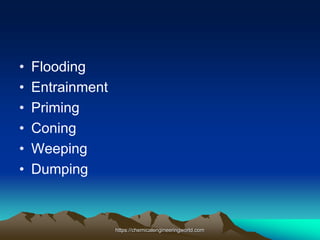
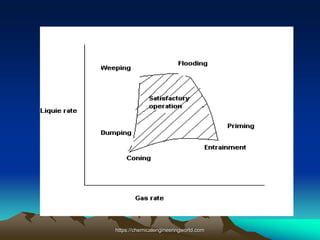
• Flooding
• Entrainment
• Priming
• Coning
• Weeping
• Dumping
https://chemicalengineeringworld.com
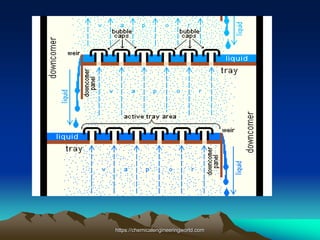
Flooding
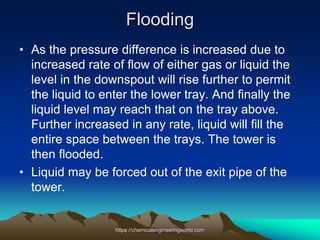
• As the pressure difference is increased due to
increased rate of flow of either gas or liquid the
level in the downspout will rise further to permit
the liquid to enter the lower tray. And finally the
liquid level may reach that on the tray above.
Further increased in any rate, liquid will fill the
entire space between the trays. The tower is
then flooded.
• Liquid may be forced out of the exit pipe of the
tower.
https://chemicalengineeringworld.com
Priming
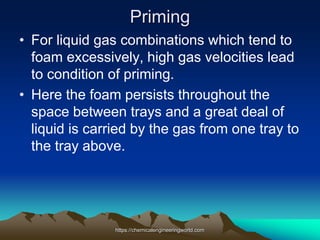
• For liquid gas combinations which tend to
foam excessively, high gas velocities lead
to condition of priming.
• Here the foam persists throughout the
space between trays and a great deal of
liquid is carried by the gas from one tray to
the tray above.
https://chemicalengineeringworld.com
Coning
• If liquid rate are too low, the gas rising
through the openings of the tray may push
the liquid away and the contact of the gas
and the liquid is poor. That is called
coning.
https://chemicalengineeringworld.com
Weeping
• If the gas rate is too low, much of the liquid
may rain down through the openings of the
tray. Its called weeping.
Dumping
And at very low gas rates, none of the
liquid reaches the downspouts. Its called
dumping.
https://chemicalengineeringworld.com
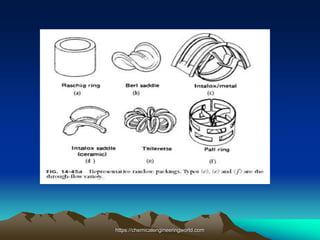
Packed Column
In industry, a packed column is a type of
packed bed used to perform separation
processes, such as absorption, stripping,
and distillation. A packed column is
a pressure vessel that has a packed
section
https://chemicalengineeringworld.com
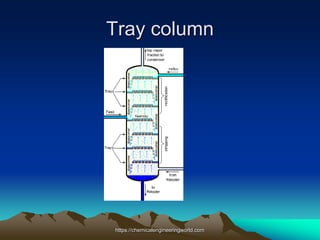
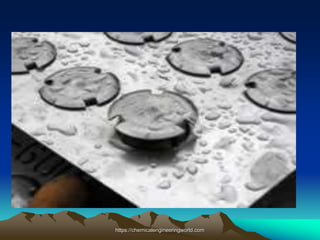
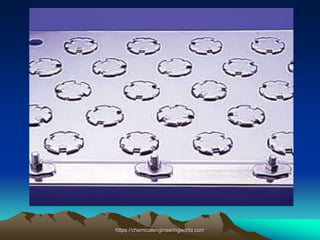
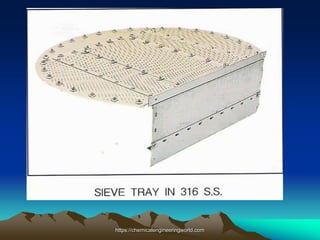
Tray column
https://chemicalengineeringworld.com
Tray Column v/s Packed
Column
• Tray tower
• Tray is used
• Cleaning is Easy. Dirty service (plate columns are
easier to clean)
• Pressure drop is high
• Side stream withdrawal is possible.
• Presence of thermal or mechanical stress due to large
temperature changes which might lead to cracked
packings
https://chemicalengineeringworld.com
Packed Column
• Packing used in packed column
• Side stream withdrawal is not possible.
• Cleaning is Difficult.
• More choices in materials of construction for packings
especially in corrosive service (e.g. plastic, ceramic,
metal alloys)
• lower pressure drop (important in vacuum distillation)
• less liquid entrainment · low liquid hold-up, especially
suitable for thermally sensitive material
https://chemicalengineeringworld.com
• Thank You
https://chemicalengineeringworld.com

Types of Distillation & column internals

  • 1.
    Distillation Index 1) What isdistillation? 2) Comparison of Distillation with other Mass transfer operation 3) Reflux ratio, Relative volatility 4) Problems in distillation 5)Types of Distillation 6) Packed tower and tray tower https://chemicalengineeringworld.com
  • 2.
    1) What isdistillation? • Distillation is a method of separating the components of a solution which depends upon distribution of the substances between a gas and liquid phase, applied to cases where all components are present in both phases. • Distillation is a method of separating mixtures based on differences in volatilities (volatility is the tendency of a substance to vaporize. Volatility is directly related to a substance's vapor pressure.) of components in a boiling liquid mixture. Distillation is aunit operation, or a physical separation process, and not a chemical reaction. https://chemicalengineeringworld.com
  • 3.
  • 4.
    • In Distillationvapor rising in the section above the feed (called the absorption, enriching, or rectifying section) is washed with liquid to remove or absorb the less volatile component. • The liquid returned to the top of the tower is called reflux and the material permanently removed is the distillate. • The section below the feed (stripping or exhausting section) the liquid is stripped of volatile component by vapor produced in reboiler. https://chemicalengineeringworld.com
  • 5.
    Difference between Distillationand other MTO Distillation > foreign substance is not required. > So there is no choice required for selection of new substance. > Give pure product, Further purification is not required. https://chemicalengineeringworld.com
  • 6.
    Other MTO > foreignsubstance required. > So there is choice required for selection of new substance. > Not give pure product, Further purification is required. https://chemicalengineeringworld.com
  • 7.
    Important parameters for Distillation •Relative volatility • Reflux • Reflux ratio https://chemicalengineeringworld.com
  • 8.
    Relative volatility • Itis the ratio of concentration ratio of one component to other in one phase to other phase. • Relative volatility is usually denoted as α. • It indicates the ease or difficulty of using distillation to separate the more volatile components from the less volatile components in a mixture • For separation,it should be greater than 1. https://chemicalengineeringworld.com
  • 9.
    Reflux Ratio • Reflux= Liquid return to column/ Distillate • Minimum Reflux ratio ,Maximum Reflux ratio , Optimum reflux ratio • Increasing reflux ratio – Improves separation – Increases cycle time – Increases energy consumption https://chemicalengineeringworld.com
  • 10.
    Types of Distillation •1) Single stage operation (Flash Vaporization ) • 2) Batch Distillation • 3) Azeotropic Distillation • 4) Extractive Distillation https://chemicalengineeringworld.com
  • 11.
    Single stage operation-Flash vaporization • Here the liquid mixture is partially vaporized, the vapor allowed to come to equilibrium with the residual liquid and the resulting liquid and vapor phase separated from the apparatus. vapor liquid separator Feed https://chemicalengineeringworld.com
  • 12.
    Batch Distillation • Theoldest operation used for separation of liquid mixtures. • Feed is fed from bottom, where includes Re- boiler, to be processed. • Numbers of accumulator tanks are connected to collect the main and the intermediate distillate fractions. https://chemicalengineeringworld.com
  • 13.
    Azeotropic Distillation • Whatis Azeotrope ? • It is constant Boiling mixture. • Azeotropic distillation usually refers to the specific technique of adding another component to generate a new, lower-boiling azeotrope, such as the example below with the addition of benzene to water and ethanol. https://chemicalengineeringworld.com
  • 14.
    Extractive Distillation • Themethod of extractive distillation uses a separation solvent, which is generally nonvolatile, has a high boiling point and is miscible with the mixture, but doesn't form an azeotropic mixture. • Third component change the relative volatility of the mixture. • A classic example to be cited here is the separation of an azeotropic mixture of benzene and cyclohexane, where aniline is one suitable solvent. https://chemicalengineeringworld.com
  • 15.
    Problems in traytowers • For high tray efficiency we require deep pools of liquid and relatively high gas velocities. These conditions however lead to a number of difficulties. One is the mechanical entrainment in which small droplets of liquid will be carried by the gas to the tray above. • Great depth of liquid and high gas velocities both result in high pressure drop for the gas in flowing through the tray. • In absorber and humidifiers high pressure drop result in high fan power to blow the gas to the tower which result in high operating cost. • In distillation high pressure at the bottom of the tower results in high boiling temperatures, which in turn may lead to heating difficulties and possibly damaged to heat sensitive compounds. https://chemicalengineeringworld.com
  • 16.
    • Flooding • Entrainment •Priming • Coning • Weeping • Dumping https://chemicalengineeringworld.com
  • 17.
  • 18.
    Flooding • As thepressure difference is increased due to increased rate of flow of either gas or liquid the level in the downspout will rise further to permit the liquid to enter the lower tray. And finally the liquid level may reach that on the tray above. Further increased in any rate, liquid will fill the entire space between the trays. The tower is then flooded. • Liquid may be forced out of the exit pipe of the tower. https://chemicalengineeringworld.com
  • 19.
    Priming • For liquidgas combinations which tend to foam excessively, high gas velocities lead to condition of priming. • Here the foam persists throughout the space between trays and a great deal of liquid is carried by the gas from one tray to the tray above. https://chemicalengineeringworld.com
  • 20.
    Coning • If liquidrate are too low, the gas rising through the openings of the tray may push the liquid away and the contact of the gas and the liquid is poor. That is called coning. https://chemicalengineeringworld.com
  • 21.
    Weeping • If thegas rate is too low, much of the liquid may rain down through the openings of the tray. Its called weeping. Dumping And at very low gas rates, none of the liquid reaches the downspouts. Its called dumping. https://chemicalengineeringworld.com
  • 22.
    Packed Column In industry,a packed column is a type of packed bed used to perform separation processes, such as absorption, stripping, and distillation. A packed column is a pressure vessel that has a packed section https://chemicalengineeringworld.com
  • 23.
  • 24.
  • 25.
  • 26.
  • 27.
  • 28.
  • 29.
  • 30.
    Tray Column v/sPacked Column • Tray tower • Tray is used • Cleaning is Easy. Dirty service (plate columns are easier to clean) • Pressure drop is high • Side stream withdrawal is possible. • Presence of thermal or mechanical stress due to large temperature changes which might lead to cracked packings https://chemicalengineeringworld.com
  • 31.
    Packed Column • Packingused in packed column • Side stream withdrawal is not possible. • Cleaning is Difficult. • More choices in materials of construction for packings especially in corrosive service (e.g. plastic, ceramic, metal alloys) • lower pressure drop (important in vacuum distillation) • less liquid entrainment · low liquid hold-up, especially suitable for thermally sensitive material https://chemicalengineeringworld.com
  • 32.