DISTILLATION COLUMN
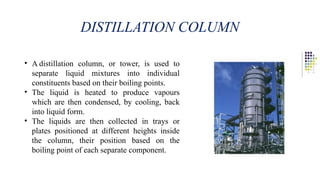
• A distillation column, or tower, is used to
separate liquid mixtures into individual
constituents based on their boiling points.
• The liquid is heated to produce vapours
which are then condensed, by cooling, back
into liquid form.
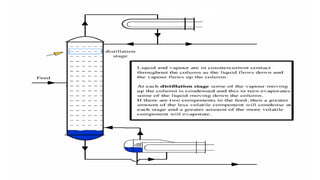
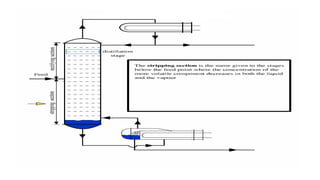
• The liquids are then collected in trays or
plates positioned at different heights inside
the column, their position based on the
boiling point of each separate component.
Batch Column
• In batch operation, the feed to the column is introduced batch-wise. That
is, the column is charged with a 'batch' and then the distillation process
is carried out.
• When the desired task is achieved, a next batch of feed is introduced.
Continuous Columns
• In contrast, continuous columns process a continuous feed stream. No
interruptions occur unless there is a problem with the column or
surrounding process units. They are capable of handling high
throughputs and are the most common of the two types
Main Components of Distillation Columns
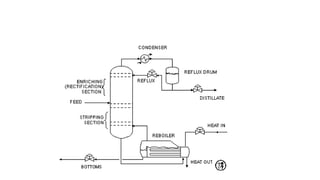
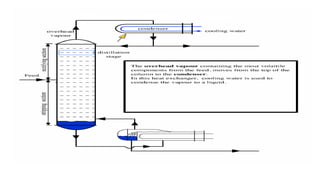
• a vertical shell where the separation of liquid components is carried
out
• column internals such as trays/plates and/or packings which are used
to enhance component separations
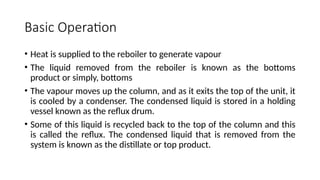
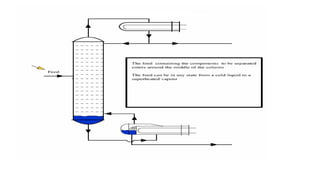
• a reboiler to provide the necessary vaporisation for the distillation
• a condenser to cool and condense the vapour leaving the top of the
column
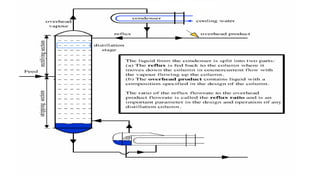
• a reflux drum to hold the condensed vapour from the top of the
column so that liquid (reflux) can be recycled back to the column
Basic Operation
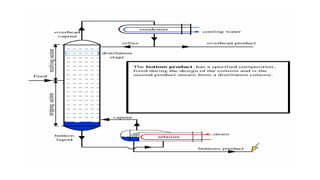
• Heat is supplied to the reboiler to generate vapour
• The liquid removed from the reboiler is known as the bottoms
product or simply, bottoms
• The vapour moves up the column, and as it exits the top of the unit, it
is cooled by a condenser. The condensed liquid is stored in a holding
vessel known as the reflux drum.
• Some of this liquid is recycled back to the top of the column and this
is called the reflux. The condensed liquid that is removed from the
system is known as the distillate or top product.
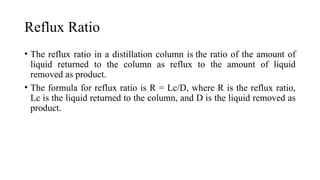
Reflux Ratio
• The reflux ratio in a distillation column is the ratio of the amount of
liquid returned to the column as reflux to the amount of liquid
removed as product.
• The formula for reflux ratio is R = Lc/D, where R is the reflux ratio,
Lc is the liquid returned to the column, and D is the liquid removed as
product.
Batch Columns
• In batch columns, the feed to the column is introduced batchwise and
the distillation is carried. When the desired quality is reached or when
the desired quantity is distilled out, the operation is stopped and next
batch of feed is introduced.
• Continuous ColumnsThese columns have a continuous feed stream and are capable of handling
Throughputs. These are further classified on the basis of,
The nature of the feed they are further processing
• Binary columns—Feed has only two components
• Multicomponent column—Feed has more than two components
The number of product streams they have
• Two product streams
• Multi product streams
The use of additional components in distillation
• Extractive distillation—use of solvent
• Azeotropic distillation—use of entrainer
The type of columns:
• Tray columns—use of sieve plate columns/Bubble cap trays/Valve
trays for better vapour–liquid contacting
• Packed towers—use of packings in columns for better vapour—liquid
contacting.
STEAM DISTILLATION
• Some systems have very high boiling points and some of these
substances are unstable at high temperatures. Especially when such
systems are completely insoluble with each other, steam distillation
can be a useful method of separating such mixtures.

distillation column - batch and continuous

  • 1.
    DISTILLATION COLUMN • Adistillation column, or tower, is used to separate liquid mixtures into individual constituents based on their boiling points. • The liquid is heated to produce vapours which are then condensed, by cooling, back into liquid form. • The liquids are then collected in trays or plates positioned at different heights inside the column, their position based on the boiling point of each separate component.
  • 2.
    Batch Column • Inbatch operation, the feed to the column is introduced batch-wise. That is, the column is charged with a 'batch' and then the distillation process is carried out. • When the desired task is achieved, a next batch of feed is introduced. Continuous Columns • In contrast, continuous columns process a continuous feed stream. No interruptions occur unless there is a problem with the column or surrounding process units. They are capable of handling high throughputs and are the most common of the two types
  • 3.
    Main Components ofDistillation Columns • a vertical shell where the separation of liquid components is carried out • column internals such as trays/plates and/or packings which are used to enhance component separations • a reboiler to provide the necessary vaporisation for the distillation • a condenser to cool and condense the vapour leaving the top of the column • a reflux drum to hold the condensed vapour from the top of the column so that liquid (reflux) can be recycled back to the column
  • 5.
    Basic Operation • Heatis supplied to the reboiler to generate vapour • The liquid removed from the reboiler is known as the bottoms product or simply, bottoms • The vapour moves up the column, and as it exits the top of the unit, it is cooled by a condenser. The condensed liquid is stored in a holding vessel known as the reflux drum. • Some of this liquid is recycled back to the top of the column and this is called the reflux. The condensed liquid that is removed from the system is known as the distillate or top product.
  • 12.
    Reflux Ratio • Thereflux ratio in a distillation column is the ratio of the amount of liquid returned to the column as reflux to the amount of liquid removed as product. • The formula for reflux ratio is R = Lc/D, where R is the reflux ratio, Lc is the liquid returned to the column, and D is the liquid removed as product.
  • 14.
    Batch Columns • Inbatch columns, the feed to the column is introduced batchwise and the distillation is carried. When the desired quality is reached or when the desired quantity is distilled out, the operation is stopped and next batch of feed is introduced.
  • 15.
    • Continuous ColumnsThesecolumns have a continuous feed stream and are capable of handling Throughputs. These are further classified on the basis of, The nature of the feed they are further processing • Binary columns—Feed has only two components • Multicomponent column—Feed has more than two components The number of product streams they have • Two product streams • Multi product streams The use of additional components in distillation • Extractive distillation—use of solvent • Azeotropic distillation—use of entrainer The type of columns: • Tray columns—use of sieve plate columns/Bubble cap trays/Valve trays for better vapour–liquid contacting • Packed towers—use of packings in columns for better vapour—liquid contacting.
  • 16.
    STEAM DISTILLATION • Somesystems have very high boiling points and some of these substances are unstable at high temperatures. Especially when such systems are completely insoluble with each other, steam distillation can be a useful method of separating such mixtures.