DRYING
Overview
• Drying-Introduction
• Applications of Drying
• Comparison between Drying vs Evaporation and other Unit
Operation
• Drying Equilibrium
• Moisture Content-Method of Expression
• Moisture Content-Types of expression
• Hysteresis
• Classification of Dryers
• Drying Calculation basis
• Theoretical Estimation of Drying Rate and Time
Introduction
• Drying
• It is a unit operation in which moisture is removed in small quantities from solids
or solid-like materials
• It’s a simultaneous heat and mass transfer process.
• It generally follows filtration, evaporation and crystallization etc. in process
Industries
• Other processes for moisture removal are
• Dehumidification - water is removed by condensation
• Adsorption - using Adsorbent
• Evaporation – boiling
• Other mechanical processes for moisture removal are
• Squeezing
• Pressing
• Centrifugation
• Decantation
• Filtration etc.
ApplicationsofDrying-Industries
• Table salt
• Coal
• Food products
• Paper
• Timber
• Pharmaceuticals
• Solid catalyst
• Soap
• Detergents
• Dyestuff
• Fertilizers
• Sugar
Whyitisimportant?
• Cost of transport reduction
• Making product for sale/further processing
• Maintaining specific moisture content for particular operation
• Maintaining specific property of a material like free flow , ease of
packaging etc
• To avoid corrosion imposed due to the moisture content present in
material
• To avoid microbiological reactions by micro organisms responsible
for food spoilage
• For preservation of nutritional values in food stuff
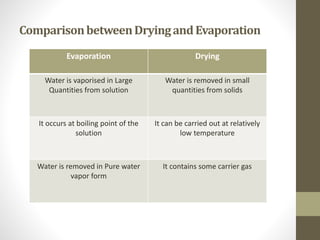
ComparisonbetweenDryingandEvaporation
Evaporation Drying
Water is vaporised in Large
Quantities from solution
Water is removed in small
quantities from solids
It occurs at boiling point of the
solution
It can be carried out at relatively
low temperature
Water is removed in Pure water
vapor form
It contains some carrier gas
Solidbehavior-Drying
• Crystalline
• Inorganic compounds
• Water/moisture in interstices or pores
• Drying is rapid
• Presence of liquid have no effect on nature of material
• Amorphous, fibrous or gel like materials
• Organic compound
• water//moisture present in dissolved state or trapped in fibers
• Surface layers dry more rapidly than the interior
• Some of the practical difficulties are Case Hardening
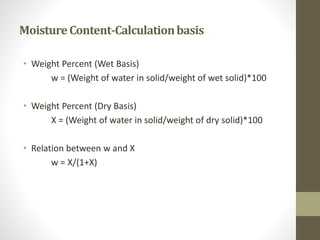
MoistureContent-Calculationbasis
• Weight Percent (Wet Basis)
w = (Weight of water in solid/weight of wet solid)*100
• Weight Percent (Dry Basis)
X = (Weight of water in solid/weight of dry solid)*100
• Relation between w and X
w = X/(1+X)
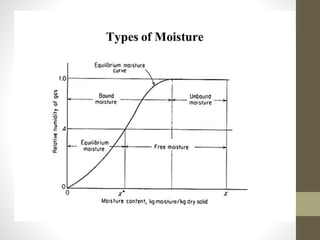
MoistureContent-ImportantTerms
• Equilibrium Moisture Content
• Bound and Unbound moisture content
• Critical moisture content
• Free moisture content
Classification of Dryers
• Mode of Heat Transfer
• Direct
• Indirect
• Radiative
• Dielectric
• Mode of Operation
• Batch
• Continuous
• Form of Feed and Product
• Various types of solid handling dryers
Mode of HeatTransfer
• Direct Driers
• Direct contact with gas and dusting is the main problem
• Easy to control the temperature of gas
• Gas is supplying heat required for drying and also used as carrier gas
• Overall thermal efficiency is low due to loss of heat with the exhaust
gas
• Indirect Driers
• Heating medium is contained in tubes and jackets.
• Heat is transferred through walls by conduction or by radiation from
hot surface
• They can be operated at reduced pressure and temperature to bring
down the temperature of evaporation
• A Sweep gas can be used for to remove the water vapor.
• Overall thermal efficiency is greater than the Direct Driers
• These are very expensive and chance of overheating cannot be
controlled.
Mode of HeatTransfer-Contd
• Radiation
• Infrared dryers depend on radiant energy to evaporate moisture
• It is supplied by infrared lamps, electric resistance elements etc
• These are not widely used in Industries
• Dielectric Dryers
• These are known as radio frequency dryers or microwave dryers
Mode of Operation
• Batch Dryers
• Operated intermittently or cyclically
• Operated under unsteady state conditions
• They are employed for valuable materials
• It can handle different types of materials
• Humidity can be altered during drying
• Comparatively little expensive operation
• Applicable for low through puts
• Used for pilot plants and process development
• Continuous Dryers
• Operated under steady state conditions
• Useful for high evaporation rates and for high throughputs
• Low cost of product
• Uniformity of the moisture content
• They can be counter current, co-current or cross current
FormofFeedandProduct
• Forms of feed
• Granular solids
• Filter cakes
• Pastes
• Slabs
• Films
• Sheets
• Slurries
• Solutions
• Types of flow patterns of the solids
• Cross-Circulation drying
• Through circulation drying
• Moving bed of solids
• Fluidized bed
BatchDryers
• Tray Dryers
• Vacuum Shelf Dryers
• Agitated Pan Dryers
• Rotating Batch Vacuum Dryers
• Freeze Dryers
ContinuousDryers
• Tunnel Dryers
• Band or Conveyor Dryers
• Turbo Dryers
• Direct Heat Rotary Dryers
• Roto - Louvre Dryers
• Indirect Heat Rotary Dryers
• Direct-Indirect Heat Rotary Dryers
• Fluidized Bed Dryers
• Spouted Bed Dryers
• Pneumatic Conveyor Dryers
• Spray Dryers
• Feed atomizers
• Thin film Dryers
• Drum Dryers

Lecture_Drying mass transfer operations.pptx

  • 1.
  • 2.
    Overview • Drying-Introduction • Applicationsof Drying • Comparison between Drying vs Evaporation and other Unit Operation • Drying Equilibrium • Moisture Content-Method of Expression • Moisture Content-Types of expression • Hysteresis • Classification of Dryers • Drying Calculation basis • Theoretical Estimation of Drying Rate and Time
  • 3.
    Introduction • Drying • Itis a unit operation in which moisture is removed in small quantities from solids or solid-like materials • It’s a simultaneous heat and mass transfer process. • It generally follows filtration, evaporation and crystallization etc. in process Industries • Other processes for moisture removal are • Dehumidification - water is removed by condensation • Adsorption - using Adsorbent • Evaporation – boiling • Other mechanical processes for moisture removal are • Squeezing • Pressing • Centrifugation • Decantation • Filtration etc.
  • 4.
    ApplicationsofDrying-Industries • Table salt •Coal • Food products • Paper • Timber • Pharmaceuticals • Solid catalyst • Soap • Detergents • Dyestuff • Fertilizers • Sugar
  • 5.
    Whyitisimportant? • Cost oftransport reduction • Making product for sale/further processing • Maintaining specific moisture content for particular operation • Maintaining specific property of a material like free flow , ease of packaging etc • To avoid corrosion imposed due to the moisture content present in material • To avoid microbiological reactions by micro organisms responsible for food spoilage • For preservation of nutritional values in food stuff
  • 6.
    ComparisonbetweenDryingandEvaporation Evaporation Drying Water isvaporised in Large Quantities from solution Water is removed in small quantities from solids It occurs at boiling point of the solution It can be carried out at relatively low temperature Water is removed in Pure water vapor form It contains some carrier gas
  • 7.
    Solidbehavior-Drying • Crystalline • Inorganiccompounds • Water/moisture in interstices or pores • Drying is rapid • Presence of liquid have no effect on nature of material • Amorphous, fibrous or gel like materials • Organic compound • water//moisture present in dissolved state or trapped in fibers • Surface layers dry more rapidly than the interior • Some of the practical difficulties are Case Hardening
  • 8.
    MoistureContent-Calculationbasis • Weight Percent(Wet Basis) w = (Weight of water in solid/weight of wet solid)*100 • Weight Percent (Dry Basis) X = (Weight of water in solid/weight of dry solid)*100 • Relation between w and X w = X/(1+X)
  • 9.
    MoistureContent-ImportantTerms • Equilibrium MoistureContent • Bound and Unbound moisture content • Critical moisture content • Free moisture content
  • 12.
    Classification of Dryers •Mode of Heat Transfer • Direct • Indirect • Radiative • Dielectric • Mode of Operation • Batch • Continuous • Form of Feed and Product • Various types of solid handling dryers
  • 13.
    Mode of HeatTransfer •Direct Driers • Direct contact with gas and dusting is the main problem • Easy to control the temperature of gas • Gas is supplying heat required for drying and also used as carrier gas • Overall thermal efficiency is low due to loss of heat with the exhaust gas • Indirect Driers • Heating medium is contained in tubes and jackets. • Heat is transferred through walls by conduction or by radiation from hot surface • They can be operated at reduced pressure and temperature to bring down the temperature of evaporation • A Sweep gas can be used for to remove the water vapor. • Overall thermal efficiency is greater than the Direct Driers • These are very expensive and chance of overheating cannot be controlled.
  • 14.
    Mode of HeatTransfer-Contd •Radiation • Infrared dryers depend on radiant energy to evaporate moisture • It is supplied by infrared lamps, electric resistance elements etc • These are not widely used in Industries • Dielectric Dryers • These are known as radio frequency dryers or microwave dryers
  • 15.
    Mode of Operation •Batch Dryers • Operated intermittently or cyclically • Operated under unsteady state conditions • They are employed for valuable materials • It can handle different types of materials • Humidity can be altered during drying • Comparatively little expensive operation • Applicable for low through puts • Used for pilot plants and process development • Continuous Dryers • Operated under steady state conditions • Useful for high evaporation rates and for high throughputs • Low cost of product • Uniformity of the moisture content • They can be counter current, co-current or cross current
  • 16.
    FormofFeedandProduct • Forms offeed • Granular solids • Filter cakes • Pastes • Slabs • Films • Sheets • Slurries • Solutions • Types of flow patterns of the solids • Cross-Circulation drying • Through circulation drying • Moving bed of solids • Fluidized bed
  • 17.
    BatchDryers • Tray Dryers •Vacuum Shelf Dryers • Agitated Pan Dryers • Rotating Batch Vacuum Dryers • Freeze Dryers
  • 18.
    ContinuousDryers • Tunnel Dryers •Band or Conveyor Dryers • Turbo Dryers • Direct Heat Rotary Dryers • Roto - Louvre Dryers • Indirect Heat Rotary Dryers • Direct-Indirect Heat Rotary Dryers • Fluidized Bed Dryers • Spouted Bed Dryers • Pneumatic Conveyor Dryers • Spray Dryers • Feed atomizers • Thin film Dryers • Drum Dryers