CELL STRUCTURES
CELL STRUCTURES
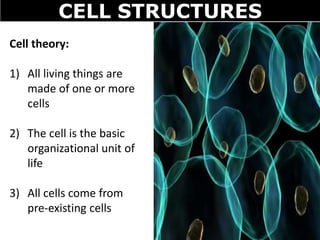
Cell theory:
1) All living things are
made of one or more
cells
2) The cell is the basic
organizational unit of
life
3) All cells come from
pre-existing cells
CELL STRUCTURES
CELL STRUCTURES
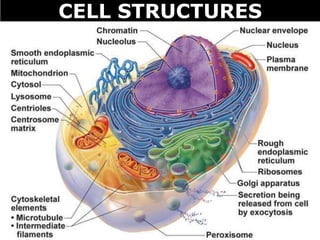
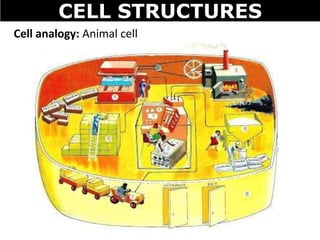
Cell analogy: Animal cell
CELL STRUCTURES
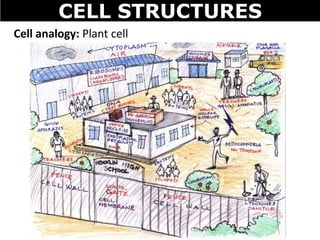
Cell analogy: Plant cell
CELL STRUCTURES
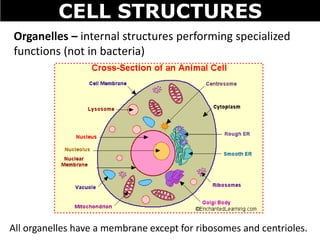
Organelles – internal structures performing specialized
functions (not in bacteria)
All organelles have a membrane except for ribosomes and centrioles.
CELL STRUCTURES
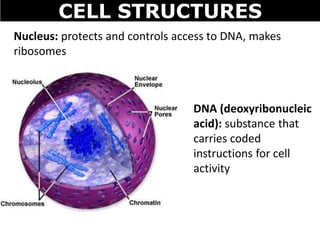
Nucleus: protects and controls access to DNA, makes
ribosomes
DNA (deoxyribonucleic
acid): substance that
carries coded
instructions for cell
activity
CELL STRUCTURES
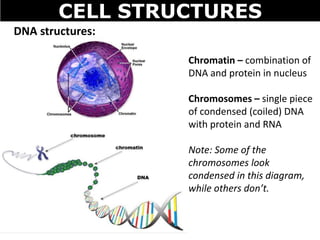
DNA structures:
Chromatin – combination of
DNA and protein in nucleus
Chromosomes – single piece
of condensed (coiled) DNA
with protein and RNA
Note: Some of the
chromosomes look
condensed in this diagram,
while others don’t.
CELL STRUCTURES
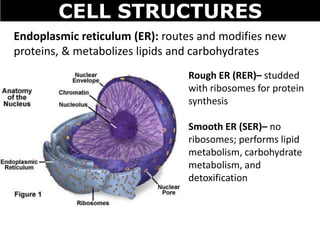
Endoplasmic reticulum (ER): routes and modifies new
proteins, & metabolizes lipids and carbohydrates
Rough ER (RER)– studded
with ribosomes for protein
synthesis
Smooth ER (SER)– no
ribosomes; performs lipid
metabolism, carbohydrate
metabolism, and
detoxification
CELL STRUCTURES
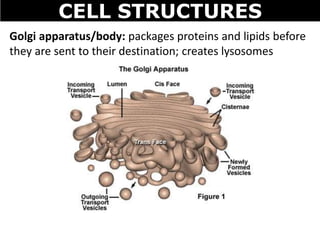
Golgi apparatus/body: packages proteins and lipids before
they are sent to their destination; creates lysosomes
CELL STRUCTURES
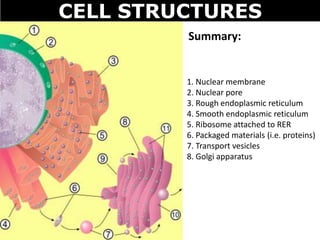
1. Nuclear membrane
2. Nuclear pore
3. Rough endoplasmic reticulum
4. Smooth endoplasmic reticulum
5. Ribosome attached to RER
6. Packaged materials (i.e. proteins)
7. Transport vesicles
8. Golgi apparatus
Summary:
CELL STRUCTURES
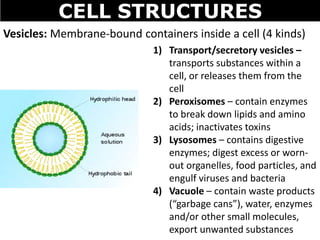
Vesicles: Membrane-bound containers inside a cell (4 kinds)
1) Transport/secretory vesicles –
transports substances within a
cell, or releases them from the
cell
2) Peroxisomes – contain enzymes
to break down lipids and amino
acids; inactivates toxins
3) Lysosomes – contains digestive
enzymes; digest excess or worn-
out organelles, food particles, and
engulf viruses and bacteria
4) Vacuole – contain waste products
(“garbage cans”), water, enzymes
and/or other small molecules,
export unwanted substances
CELL STRUCTURES
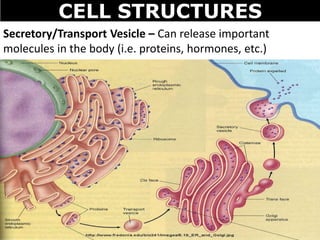
Secretory/Transport Vesicle – Can release important
molecules in the body (i.e. proteins, hormones, etc.)
CELL STRUCTURES
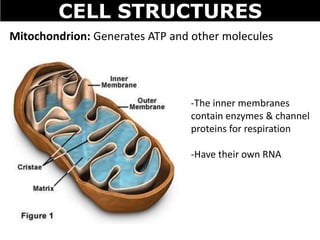
Mitochondrion: Generates ATP and other molecules
-The inner membranes
contain enzymes & channel
proteins for respiration
-Have their own RNA
CELL STRUCTURES
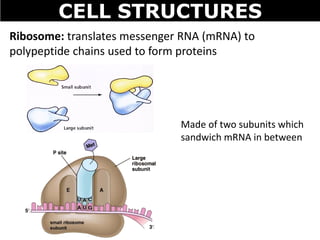
Ribosome: translates messenger RNA (mRNA) to
polypeptide chains used to form proteins
Made of two subunits which
sandwich mRNA in between
CELL STRUCTURES
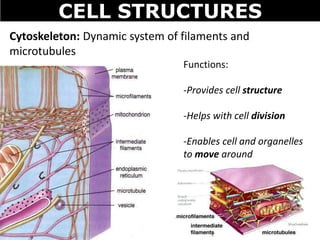
Cytoskeleton: Dynamic system of filaments and
microtubules
Functions:
-Provides cell structure
-Helps with cell division
-Enables cell and organelles
to move around
CELL STRUCTURES
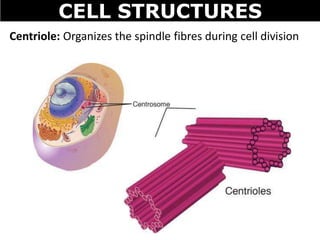
Centriole: Organizes the spindle fibres during cell division
CELL STRUCTURES
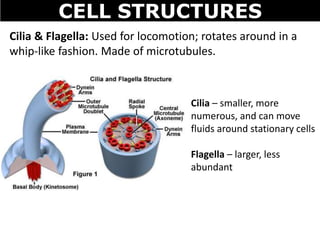
Cilia & Flagella: Used for locomotion; rotates around in a
whip-like fashion. Made of microtubules.
Cilia – smaller, more
numerous, and can move
fluids around stationary cells
Flagella – larger, less
abundant
CELL STRUCTURES
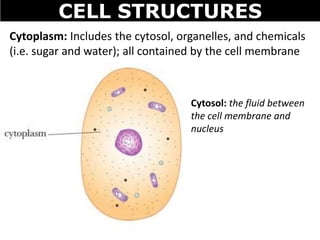
Cytoplasm: Includes the cytosol, organelles, and chemicals
(i.e. sugar and water); all contained by the cell membrane
Cytosol: the fluid between
the cell membrane and
nucleus
CELL STRUCTURES
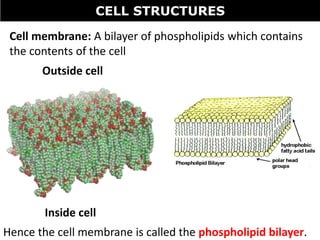
Outside cell
Inside cell
Hence the cell membrane is called the phospholipid bilayer.
Cell membrane: A bilayer of phospholipids which contains
the contents of the cell
CELL STRUCTURES
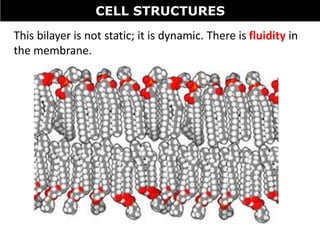
This bilayer is not static; it is dynamic. There is fluidity in
the membrane.
PLANT CELLS
PLANT CELLS
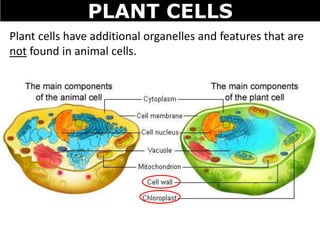
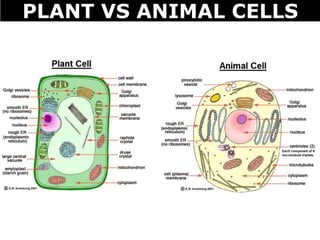
Plant cells have additional organelles and features that are
not found in animal cells.
PLANT CELLS
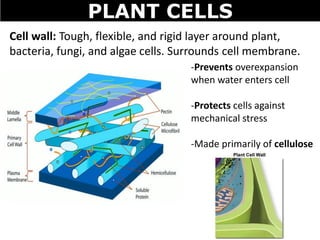
Cell wall: Tough, flexible, and rigid layer around plant,
bacteria, fungi, and algae cells. Surrounds cell membrane.
-Prevents overexpansion
when water enters cell
-Protects cells against
mechanical stress
-Made primarily of cellulose
PLANT CELLS
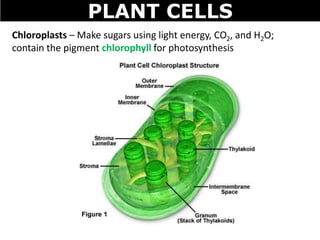
Chloroplasts – Make sugars using light energy, CO2, and H2O;
contain the pigment chlorophyll for photosynthesis
PLANT VS ANIMAL CELLS

01 cell structures

  • 1.
  • 2.
    CELL STRUCTURES Cell theory: 1)All living things are made of one or more cells 2) The cell is the basic organizational unit of life 3) All cells come from pre-existing cells
  • 3.
  • 4.
  • 5.
  • 6.
    CELL STRUCTURES Organelles –internal structures performing specialized functions (not in bacteria) All organelles have a membrane except for ribosomes and centrioles.
  • 7.
    CELL STRUCTURES Nucleus: protectsand controls access to DNA, makes ribosomes DNA (deoxyribonucleic acid): substance that carries coded instructions for cell activity
  • 8.
    CELL STRUCTURES DNA structures: Chromatin– combination of DNA and protein in nucleus Chromosomes – single piece of condensed (coiled) DNA with protein and RNA Note: Some of the chromosomes look condensed in this diagram, while others don’t.
  • 9.
    CELL STRUCTURES Endoplasmic reticulum(ER): routes and modifies new proteins, & metabolizes lipids and carbohydrates Rough ER (RER)– studded with ribosomes for protein synthesis Smooth ER (SER)– no ribosomes; performs lipid metabolism, carbohydrate metabolism, and detoxification
  • 10.
    CELL STRUCTURES Golgi apparatus/body:packages proteins and lipids before they are sent to their destination; creates lysosomes
  • 11.
    CELL STRUCTURES 1. Nuclearmembrane 2. Nuclear pore 3. Rough endoplasmic reticulum 4. Smooth endoplasmic reticulum 5. Ribosome attached to RER 6. Packaged materials (i.e. proteins) 7. Transport vesicles 8. Golgi apparatus Summary:
  • 12.
    CELL STRUCTURES Vesicles: Membrane-boundcontainers inside a cell (4 kinds) 1) Transport/secretory vesicles – transports substances within a cell, or releases them from the cell 2) Peroxisomes – contain enzymes to break down lipids and amino acids; inactivates toxins 3) Lysosomes – contains digestive enzymes; digest excess or worn- out organelles, food particles, and engulf viruses and bacteria 4) Vacuole – contain waste products (“garbage cans”), water, enzymes and/or other small molecules, export unwanted substances
  • 13.
    CELL STRUCTURES Secretory/Transport Vesicle– Can release important molecules in the body (i.e. proteins, hormones, etc.)
  • 14.
    CELL STRUCTURES Mitochondrion: GeneratesATP and other molecules -The inner membranes contain enzymes & channel proteins for respiration -Have their own RNA
  • 15.
    CELL STRUCTURES Ribosome: translatesmessenger RNA (mRNA) to polypeptide chains used to form proteins Made of two subunits which sandwich mRNA in between
  • 16.
    CELL STRUCTURES Cytoskeleton: Dynamicsystem of filaments and microtubules Functions: -Provides cell structure -Helps with cell division -Enables cell and organelles to move around
  • 17.
    CELL STRUCTURES Centriole: Organizesthe spindle fibres during cell division
  • 18.
    CELL STRUCTURES Cilia &Flagella: Used for locomotion; rotates around in a whip-like fashion. Made of microtubules. Cilia – smaller, more numerous, and can move fluids around stationary cells Flagella – larger, less abundant
  • 19.
    CELL STRUCTURES Cytoplasm: Includesthe cytosol, organelles, and chemicals (i.e. sugar and water); all contained by the cell membrane Cytosol: the fluid between the cell membrane and nucleus
  • 20.
    CELL STRUCTURES Outside cell Insidecell Hence the cell membrane is called the phospholipid bilayer. Cell membrane: A bilayer of phospholipids which contains the contents of the cell
  • 21.
    CELL STRUCTURES This bilayeris not static; it is dynamic. There is fluidity in the membrane.
  • 22.
  • 23.
    PLANT CELLS Plant cellshave additional organelles and features that are not found in animal cells.
  • 24.
    PLANT CELLS Cell wall:Tough, flexible, and rigid layer around plant, bacteria, fungi, and algae cells. Surrounds cell membrane. -Prevents overexpansion when water enters cell -Protects cells against mechanical stress -Made primarily of cellulose
  • 25.
    PLANT CELLS Chloroplasts –Make sugars using light energy, CO2, and H2O; contain the pigment chlorophyll for photosynthesis
  • 26.

Editor's Notes

  • #2 http://htwins.net/scale2/
  • #23 http://htwins.net/scale2/