CELL
STRUCTURE
AND
FUNCTION
Examine the tip of your finger, and you see the
ridges and valleys that make up your
fingerprints; a blade of grass, an insect. Using
powerful dissecting microscope you’ll see that
there is a common structure that makes up
every living things ---- the cell.
Cells come in many shapes and sizes. Although
typical cells range from 5 to 50 micrometers in
diameter. The tiniest bacteria are only 0.2
micrometers across. In contrast, the giant
amoeba, may reach 1000 micrometers in
diameter.
Early Discoveries Related to the Study of Cells
 In 1665, Robert Hooke examined a thin slice of cork. The piece of cork was
composed of many tiny compartments, named cells.
 In 1674, Anton Van Leeuwenhoek observed red blood cells, sperm cells,
bacteria, free living and parasitic protists
 In 1831, Robert Brown discovered the nucleus, discovered Brownian
Movement (1827) when he observed the movement of plant spores
floating in water.
 In 1835, Felix Dujardin found out that living cells contain an internal
substance (sarcode)
 Jan Evangelista Purkenji gave the name protoplasm
 In 1838, Mathias Schleiden stated that all plants are composed of cells
 In 1839, Theodor Schwann concluded that animals are composed of cells
 In 1858, Rudolf Virchow theorized that all living cells come from preexisting
living cells.
Components of the Cell Theory
a) All living things are composed of
one or more cells;
b) All living cells come from other living
cells by cell division;
c) Cells are the basic units of structure
and function in organisms.
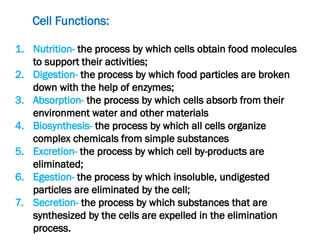
Cell Functions:
1. Nutrition- the process by which cells obtain food molecules
to support their activities;
2. Digestion- the process by which food particles are broken
down with the help of enzymes;
3. Absorption- the process by which cells absorb from their
environment water and other materials
4. Biosynthesis- the process by which all cells organize
complex chemicals from simple substances
5. Excretion- the process by which cell by-products are
eliminated;
6. Egestion- the process by which insoluble, undigested
particles are eliminated by the cell;
7. Secretion- the process by which substances that are
synthesized by the cells are expelled in the elimination
process.
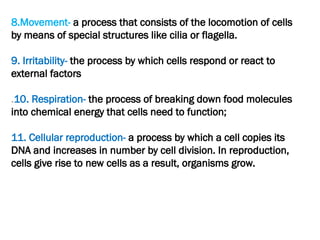
8.Movement- a process that consists of the locomotion of cells
by means of special structures like cilia or flagella.
9. Irritability- the process by which cells respond or react to
external factors
.10. Respiration- the process of breaking down food molecules
into chemical energy that cells need to function;
11. Cellular reproduction- a process by which a cell copies its
DNA and increases in number by cell division. In reproduction,
cells give rise to new cells as a result, organisms grow.
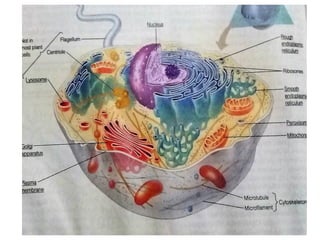
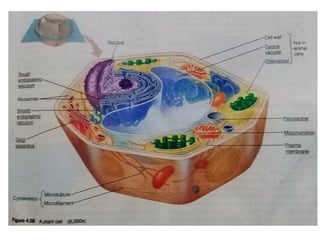
Basic cell Structures are:
 Cell membrane -- a thin, flexible barrier around the cell.
 Cell wall – strong layer around the membrane.
 Nucleus – a large structure that contains the cell’s genetic
material and controls the cell’ activities.
 Cytoplasm –material inside the cell membrane; but not including
the nucleus. It contains many important structures.
CELL STRUCTURES.
A. Cell wall – its main function is to provide support and protection for the cell.
Composition varies in different cell types and from one species to
another.
 about 60% of it is cellulose; other components include
hemicelluloses; pectins; lignins and proteins.
Young cells and cells in actively growing areas have primary cell
walls (25% cellulose – relatively thin and flexible).
Certain kinds of cells stop growing at maturity and form secondary
cell wall (25% lignin, which adds hardness and resists decay).
Cell walls of cork cells contain suberin that inhibit water loss
through bark (cork oak)
Cells that adjoin one another are probably held together by pectins.
Pectic layer between cells are called the middle lamella.
Pits and perforations in the cell walls are called plasmodesmata where
water & dissolved substances diffuse from one cell to another.
B. Nucleus – controls most cell processes.
 contains the hereditary information of DNA, occurs bound to
proteins (histones) in a threadlike chromatin. when cells divide
chromatin condenses to form chromosomes.
 surrounded by 2 membranes called nuclear envelope; outer
membrane is continuous w/ the membrane of the ER.
 inner & outer membranes are separated by a space except
where they fuse to form pores in the envelope.
B. chromosomes are not usually visible in a living cell except
during divisions.
 nucleoli – contain nucleic acids and proteins but function as
intermediate in protein synthesis.
C. Protoplasm – it is the structurally complex, constantly changing
aggregation of materials, w/c fills cells and is classically known as the
“living substance”.
 it is opalescent or transparent , & variously viscid.
 grayish, but may contain red, green, yellow, blue or black pigments
 Consists of a watery solution of salts and organic compounds.
 In most cells, the bulk of the protoplasm is the cytoplasm – outside the
nucleus.
D. Cytoskeleton --- helps support the cell. It is a network of protein filaments
that helps the cell maintain its shape. Also involved in many forms of cell
movement.
 Made up of microtubules and microfilaments.
 Microtubules are hollow tubes of protein. They maintain cell shape and
can serve as tracks along which organelles are moved. About 25
nanometers.
 Microfilaments are long thin fibers that function in the movement and
support of the cell. About 7 nanometers
 Cytoplasm – non-nuclear protoplasm; bounded by plasma
membrane
Organelles:
1. Ribosomes -- are the sites of protein synthesis.
 Proteins are assembled on ribosomes , small particles made
of RNA and protein.
 About 0.025 micrometers in diameter.
 Ribosomes produce proteins following coded instructions that
come from the nucleus.
 Usually occur in clusters called polysomes
 Either attached to membranes or free.
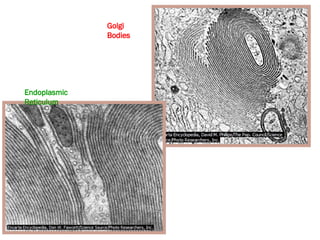
2. Endoplasmic Reticulum – is a system of flattened tubes and sacs
that is continuous between the plasma membrane and the outer
membrane of the nuclear envelope.
 Where components of the cell membrane are assembled &
some proteins are modified.
2 regions of ER:
a) Rough ER – region where many ribosomes attached to it;
involved in the synthesis of proteins.
b) Smooth ER – no ribosomes are attached; contains collections
of enzymes that perform specialized tasks such as the synthesis of
lipids.
 Both types of ER form vesicles that break away & fuse w/ other
membranes.
3. Golgi bodies or dictyosomes – are usually two-sided w/ one side
facing ER & one side facing the plasma membrane.
 Transport vesicles from the ER fuse w/ the inner face of the
dictyosome & release their contents into its interior. Enzymes
in the Golgi apparatus attach carbohydrates and lipids to
proteins.
 Named after the Italian biologist Camillo Golgi who
discovered it.
 Exocytosis – when contents are secreted to the exterior of the
cell.
 Aid specialized cells in secreting substances like nectar, oils, &
resinous chemicals.
 In dividing cells, they help build new primary walls after nuclei
have divided. Vesicles containing cell wall precursors fuse in
this region to form a cell plate.
4. Lysosomes are small organelles filled with enzymes.
Functions:
1. Break down lipids, carbohydrates, and proteins from food into particles
that can be used by the rest of the cell.
2. Help break down organelles that have outlived their usefulness.
3. Perform the vital function of removing debris that might otherwise
accumulate and clutter up the cell.
5. Vacuoles – constitute the bulk of most mature Plant cells.
 can swell, coalesce, about nine tenths of the volume of a ce
ll.
 Main water-storage centers of cells
 Contain mostly water with dissolved pigments, mineral salt
s, organic acids, proteins, crystals and various metabolic p
roducts.
 Their turgor keeps cells, tissues, and organs firm.
 The membrane of the central vacuole is known as tonoplast.
Endoplasmic
Reticulum
Golgi
Bodies
6. Plastids – peculiar to plants that contain photosynthetic pigments.
Membrane-bound; usually flattened, ellipsoid bodies.
 Chromoplasts – with yellow & red pigments
 Leucoplasts – colorless plastid
 Amyloplasts – store starch
 Elioplasts – store oils
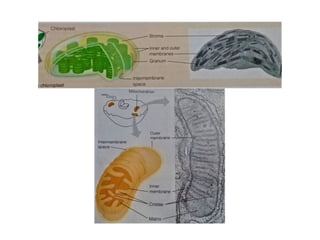
 Chloroplasts – green plastids; the fluid inside it is called stroma;
membranes occuring throughout the stroma are called thylakoids w/c
are aggregated into stacks called grana.
7. Mitochondria – function in the formation of energy-rich compounds,
especially ATP.
 Sausage-shaped, smaller than plastids, colorless, flexible & motile.
 Consist of smooth outer membranes & an inner membrane that is
folded into tubular or vesicle shaped cristae (mitochondrial crests)
 Involved in other metabolic activities, including synthesis of rubber
particles.
8. Microbodies
 Peroxisomes – occur primarily in leaves, they metabolize hydrogen
peroxide (H2 O2); contain enzymes catalase and oxidase
-- peroxide- detoxifying organelle, use H2 O2 to oxidize other toxins such
as ethanol & nitrites.
 Glyoxysomes – common in germinating oil-bearing seeds & the
young seedlings that grow from them; contain enzymes that
catalyze the breakdown of fatty acids & acetyl CoA.
E. Flagella and Cilia – threadlike cytoplasmic extensions w/c are the
locomotor organelles of swimming spores or sex cells.
 These two structures are similar to one another except that cilia are
short, proportional about like eyelashes and flagella are longer.
 They occur in many lower plants and in sperm of a few seed- plants.
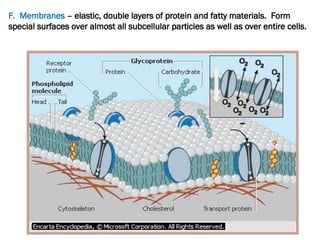
F. Membranes – elastic, double layers of protein and fatty materials. Form
special surfaces over almost all subcellular particles as well as over entire cells.
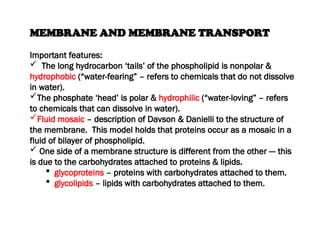
MEMBRANE AND MEMBRANE TRANSPORT
Important features:
 The long hydrocarbon ‘tails’ of the phospholipid is nonpolar &
hydrophobic (“water-fearing” – refers to chemicals that do not dissolve
in water).
The phosphate ‘head’ is polar & hydrophilic (“water-loving” – refers
to chemicals that can dissolve in water).
Fluid mosaic – description of Davson & Danielli to the structure of
the membrane. This model holds that proteins occur as a mosaic in a
fluid of bilayer of phospholipid.
 One side of a membrane structure is different from the other --- this
is due to the carbohydrates attached to proteins & lipids.
 glycoproteins – proteins with carbohydrates attached to them.
 glycolipids – lipids with carbohydrates attached to them.
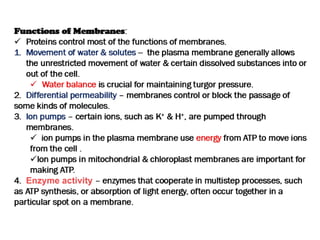
5. Cellular communication – proteins in the plasma membrane bind
molecules released from other cells. Once bound to an external
molecule, these proteins activate other proteins in the membrane that
cause metabolic changes in the cell.
 glycoproteins and glycolipids vary from species to species, from
one individual to another in the same species, and even from one
cell type to another in a single individual.
 cell identification tags - crucial to life - allow cells in an
embryo to sort themselves into tissues and organs.
 it also enables cells of the immune system to recognize and
reject foreign cells, such as infectious bacteria.
 Cholesterol in animal cell membranes, animal cells use it as starting
material for making some steroids, including the female and male sex
hormones.
Functions of membrane proteins include:
attaching the membrane to the cytoskleton and external fibers
providing identification tags
forming junction to adjacent cells
many membrane proteins are enzymes - catalytic teams for
molecular assembly lines
other proteins function as receptors for chemical messengers
from other cells - signal transduction.
MOVEMENT OF WATER & OTHER MOLECULES THROUGH
MEMBRANES
 Water is the most common molecules in cells
 Ions & other polar molecules (the solutes) are dissolved in water
(the solvent). The resulting mixture is a solution.
 The solutes include: protons (H+
), mineral ions (K+
& Mg2+
) and
organic compounds such as sugars & amino acids.
 Nonpolar molecules such as hydrocarbons & oxygen, small &
uncharged polar molecules such as water pass easily w/o
hindrance.
 Ions are almost entirely prevented.
MOVEMENT OF SOLUTES
All molecules display random thermal motion, or kinetic energy, a solute
molecule has a tendency to move around in a solution ---- results in the
diffusion of molecules outward from regions of high concentration to
regions of lower concentration.
 Diffusion – is the tendency for particles of any kind to spread out
spontaneously to regions where they are less concentrated.
 that is down a concentration gradient.
 The rate of diffusion depends on the ff:
a. Size of molecules – larger molecules move slower
b. Temperature of the solution – higher temperatures cause faster
movement.
 Anything that can fall, change, or flow from higher level to a lower one
has the potential to do work, w/c is called potential energy.
 When the solute is moving, it has energy of movement called Kinetic
energy.
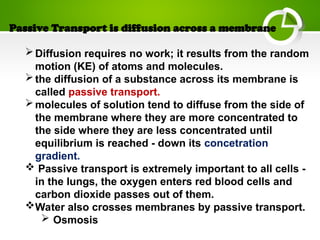
Passive Transport is diffusion across a membrane
Diffusion requires no work; it results from the random
motion (KE) of atoms and molecules.
the diffusion of a substance across its membrane is
called passive transport.
molecules of solution tend to diffuse from the side of
the membrane where they are more concentrated to
the side where they are less concentrated until
equilibrium is reached - down its concetration
gradient.
 Passive transport is extremely important to all cells -
in the lungs, the oxygen enters red blood cells and
carbon dioxide passes out of them.
Water also crosses membranes by passive transport.
 Osmosis
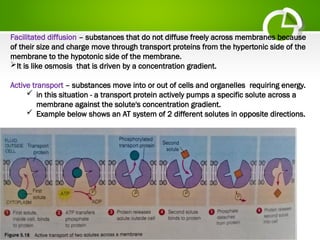
Facilitated diffusion – substances that do not diffuse freely across membranes because
of their size and charge move through transport proteins from the hypertonic side of the
membrane to the hypotonic side of the membrane.
It is like osmosis that is driven by a concentration gradient.
Active transport – substances move into or out of cells and organelles requiring energy.
 in this situation - a transport protein actively pumps a specific solute across a
membrane against the solute's concentration gradient.
 Example below shows an AT system of 2 different solutes in opposite directions.
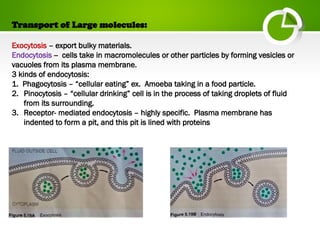
Transport of Large molecules:
Exocytosis – export bulky materials.
Endocytosis -- cells take in macromolecules or other particles by forming vesicles or
vacuoles from its plasma membrane.
3 kinds of endocytosis:
1. Phagocytosis – “cellular eating” ex. Amoeba taking in a food particle.
2. Pinocytosis – “cellular drinking” cell is in the process of taking droplets of fluid
from its surrounding.
3. Receptor- mediated endocytosis – highly specific. Plasma membrane has
indented to form a pit, and this pit is lined with proteins
WATER POTENTIAL
 like solutes, water also has potential energy to flow. Its potential energy is
called water potential.
 Water tends to move down a water-potential gradient, that is from a region of
high water potential to a region of low water potential.
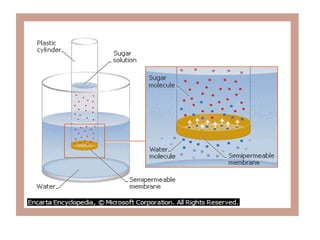
OSMOSIS – is the diffusion of water through a selectively permeable
membrane.
 It is influenced by different water potentials on either side of a
membrane.
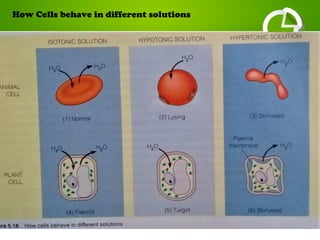
 Before osmosis begins, water on the side with hypotonic solution ( low
solute concentration) of the membrane has a higher water potential –
greater potential to move.
 Hypertonic solution – high solute concentration.
 Isotonic solution - equal solute concentration.
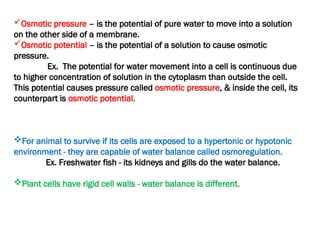
Osmotic pressure – is the potential of pure water to move into a solution
on the other side of a membrane.
Osmotic potential – is the potential of a solution to cause osmotic
pressure.
Ex. The potential for water movement into a cell is continuous due
to higher concentration of solution in the cytoplasm than outside the cell.
This potential causes pressure called osmotic pressure, & inside the cell, its
counterpart is osmotic potential.
For animal to survive if its cells are exposed to a hypertonic or hypotonic
environment - they are capable of water balance called osmoregulation.
Ex. Freshwater fish - its kidneys and gills do the water balance.
Plant cells have rigid cell walls - water balance is different.
How Cells behave in different solutions
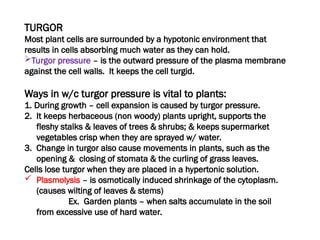
TURGOR
Most plant cells are surrounded by a hypotonic environment that
results in cells absorbing much water as they can hold.
Turgor pressure – is the outward pressure of the plasma membrane
against the cell walls. It keeps the cell turgid.
Ways in w/c turgor pressure is vital to plants:
1. During growth – cell expansion is caused by turgor pressure.
2. It keeps herbaceous (non woody) plants upright, supports the
fleshy stalks & leaves of trees & shrubs; & keeps supermarket
vegetables crisp when they are sprayed w/ water.
3. Change in turgor also cause movements in plants, such as the
opening & closing of stomata & the curling of grass leaves.
Cells lose turgor when they are placed in a hypertonic solution.
 Plasmolysis – is osmotically induced shrinkage of the cytoplasm.
(causes wilting of leaves & stems)
Ex. Garden plants – when salts accumulate in the soil
from excessive use of hard water.
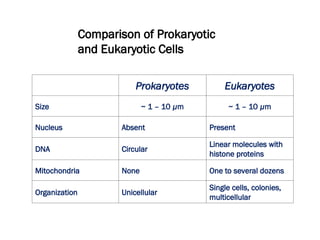
Comparison of Prokaryotic
and Eukaryotic Cells
Prokaryotes Eukaryotes
Size ~ 1 – 10 µm ~ 1 – 10 µm
Nucleus Absent Present
DNA Circular
Linear molecules with
histone proteins
Mitochondria None One to several dozens
Organization Unicellular
Single cells, colonies,
multicellular
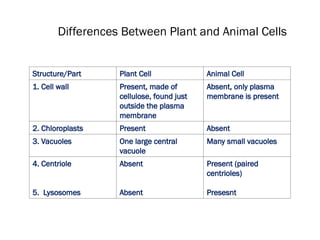
Differences Between Plant and Animal Cells
Structure/Part Plant Cell Animal Cell
1. Cell wall Present, made of
cellulose, found just
outside the plasma
membrane
Absent, only plasma
membrane is present
2. Chloroplasts Present Absent
3. Vacuoles One large central
vacuole
Many small vacuoles
4. Centriole
5. Lysosomes
Absent
Absent
Present (paired
centrioles)
Presesnt
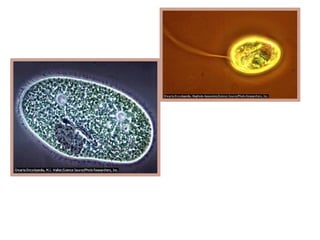
Unicellular Organisms
Cells are the basic living units of all organisms, but
sometimes a cell is the organism itself.
A single-celled organism is also called a unicellular
organism.
Unicellular organisms do everything that you would
expect a living thing to do – they grow, respond to the
environment, & reproduce.
Unicellular organisms include both prokaryotes and
eukaryotes.
Prokaryotes, especially bacteria are remarkably
adaptable -- live almost everywhere – in the soil, on
leaves, in the ocean, in the air, and even within human
body.
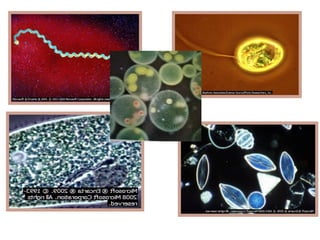
Many eukaryotes also spend their lives as single
cells. Some types of algae, which contain chloroplasts
and are found in oceans, lakes, and streams around
the world are single celled.
 Yeasts are unicellular fungi.
Some species of protists and algae are colonial.
Colonial organisms live in groups of individuals of the
same species that are attached to one another but
have few specialized structures
Multicellular Organisms
Organisms that are made up of many cells that work together
are called multicellular organisms.
The cells of multicellular organisms, such as human beings, do
not live on their own.
Cells in multicellular organisms are specialized to perform
particular functions within the organism. --- they have cell
specialization, or separate roles for each type of cell.
Example: pancreatic cells that are specialized to produce
protein enzymes that make it possible to digest food. To
perform this function, these cells contain enormous amounts of
the organelles involved in protein synthesis – rough
endoplasmic reticulum, Golgi apparatus, and clusters of
storage vacuoles loaded with protein.
Homeostasis in Unicellular and Multicellular
Organisms
 As an organism, you are an open thermodynamic
system; that is there is a constant flow of energy
and matter between you and the environment. It is
a flow that is dynamic equilibrium , often called a
steady state.
 A steady state occurs at all levels of organization-
from unicellular to colonial or to multicellular
organisms. It may also be from cell, to tissue, to
organ, to organ system, to organism.
Homeostasis- a regulating control, by which
a constant internal environment is
maintained despite external changes.
At the cellular level, a single cell has the
capacity for self regulation ( made possible
by the control of enzyme synthesis, product
formation, and uptake of matter from the
environment and release of energy)
Example: an amoeba
As an organism becomes more complex,
the more vital the process of
homeostasis becomes.
How do you adjust and maintain a steady
state in spite of temperature changes
outside?
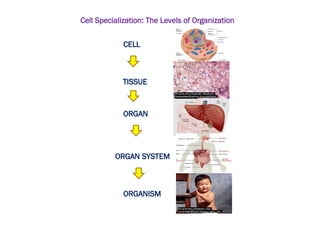
Cell Specialization: The Levels of Organization
CELL
TISSUE
ORGAN
ORGAN SYSTEM
ORGANISM
Energy and the cell
Energy is the capacity to perform work
2 Types of energy:
1. Kinetic energy – energy that is actually doing work. Heat, the
energy associated with the movement of molecules in body of
matter. Light is another kind of kinetic energy.
2. Potential energy – stored energy. This is the capacity to do
work that matter possesses as result of its location or
arrangement. In a teaspoon of sugar, unlit firecracker, a rock
atop of a hill. In organisms– stored in the chemical bonds such
as sugar.
Two laws that govern energy conversions
Thermodynamics – is the study of energy transformations that occur in a
collection of matter.
1. First Law of Thermodynamics – also known as the law of energy
conservation.
 It states that energy cannot be created or destroyed but only converted to
other forms
 The amount of energy in the universe is constant.
• Second Law of Thermodynamics – states that energy conversions reduce
the order of the universe. The amount of disorder in a system is called
entropy.
 Heat which is random molecular motion, is one form of disorder. The
more heat that is generated when one form of energy is converted to
another, the more entropy of the system increases.
 Tells us that the entropy of the universe as a whole is increasing.
Chemical Reactions Either Store or Release Energy
Chemical reactions are of two kinds:
1. Endergonic reaction – requires a net input of energy. Reactant molecules
contain relatively little potential energy; energy is absorbed from the
surroundings as the reaction occurs, so that products store more energy
than the reactants.
 Energy is stored in the covalent bonds of the product molecules.
 Example is photosynthesis.
2. Exergonic reaction – is a chemical reaction that releases energy.
 Example when wood burns (contains cellulose which is a carbohydrate )–
the potential energy is released as heat and light. CO2 and water are the
products of the reaction.
 Example is cellular respiration– the energy releasing chemical breakdown of
glucose molecules and the storage of energy in a form that the cell can use
to perform work.
Every working cell in every organism carries out thousands of
endergonic and exergonic reactions, the sum total of which is
known as cellular metabolism.
ATP powers nearly all forms of cellular work.
When a cell uses chemical energy to perform work, it couples an
exergonic reaction with an endergonic one. It first obtains
chemical energy from an exergonic reaction and then uses the
energy to drive endergonic reaction ---- energy coupling.
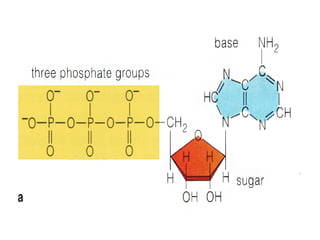
ATP (Adenosine triphosphate) has three parts, connected by
covalent bonds: 1) adenine, a nitrogenous base; 2) ribose, a five
carbon sugar; and 3) a chain of three phosphate groups (P)
The covalent bonds connecting the second and the third
phosphate are unstable – can readily be broken by hydrolysis .
Three things happen when the third bond breaks:
1. A phosphate is removed.
2. ATP becomes ADP (adenosine diphosphate).
3. Energy is released.
Chemical reaction:
ATP + H 2O ADP + Pi + energy
The transfer of a phosphate group to a molecule is called
phosphorylation, and most cellular work depends on ATP
energizing other molecules by phosphorylating them.
Substrate – substance that an enzyme acts on --- a reactant in a chemical
reaction. Each enzyme recognizes only one specific substrate or substrates of
the reaction it catalyzes.
Active site -- small part of an enzyme molecule that actually binds to
substrate.
The cellular environment affects enzyme activity.
 Temperature – affects molecular motion, and an enzyme’s optimal
temperature produces the highest rate of contact between reactant and the
enzyme’s active site.
 higher temperatures denature the enzyme.
 Most human enzymes have temperature optima of 35—40 degrees Celsius.
Salt concentration – salt ions interfere with some of the chemical bonds that
maintain protein structure.
pH – extra hydrogen ions present at very low pH also. Optimal pH for most
enzymes is in the range of 6—8.
Enzymes speed up the cell’s chemical reactions by
lowering energy barriers
An energy barrier is an amount of energy, called the energy of
activation (EA), that reactants must absorb to start a chemical
reaction.
In the case of ATP breakdown, EA is the amount of energy needed
to break the bond between the 2nd
and 3rd
phosphates.
Since most reactions require energy to get started, ATP and most
other vital molecules in our cells do not break spontaneously.
Most of the essential reactions of metabolism must occur quickly
and precisely for a cell to survive. If a chemical reactants of
metabolism are slow, a cell may die because it cannot make vital
products fast enough.
An enzyme is a protein molecule that serves as a biological
catalyst, increasing the rate of a reaction without itself being
changed into a different molecule.
It does not add energy to a cellular reaction; it speeds up a
reaction by lowering the EA barrier.
They are critical to life because they speed spontaneous reactions
to a biologically useful rate.
Example: Carbonic anhydrase
Enzymes are very selective in the reaction they catalyze, and their
selectivity determines which chemical processes occur in a cell at
any particular time.
Many enzymes will not work unless they are accompanied by
nonprotein helpers called cofactors. They may be inorganic
substances such as atoms of zinc, iron, or copper.
Coenzyme – cofactor that is an organic molecule. Most of them
are from vitamins or are vitamins themselves. For example,
vitamin B6 is a coenzyme required by enzymes involved in
converting one amino acid to another.
Coenzymes:
1. NAD+
-- Nicotinamide Adenine Dinucleotide
 It is similar to ATP in that it is made of adenine, ribose &
phosphate groups.
 The active site is a nitrogen-containing ring called nicotinamide,
which is a derivative of nicotinic acidn(niacin, or Vitamin B3 ,
added to products such as cornflake to make them “Vitamin
fortified”)
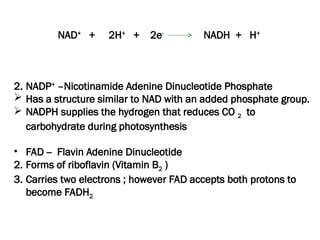
NAD+
+ 2H+
+ 2e-
NADH + H+
2. NADP+
–Nicotinamide Adenine Dinucleotide Phosphate
 Has a structure similar to NAD with an added phosphate group.
 NADPH supplies the hydrogen that reduces CO 2 to
carbohydrate during photosynthesis
• FAD -- Flavin Adenine Dinucleotide
2. Forms of riboflavin (Vitamin B2 )
3. Carries two electrons ; however FAD accepts both protons to
become FADH2
4. Cytochromes -- like chlorophyl & hemoglobin, cytochromes
are a group of metal containing molecules that participate in
metabolism by transferring electrons.
Regulating metabolism:
 Feedback inhibition – this means slowing a pathway when
its products are not needed.
Ex. Plants use a five-step pathway to make isoleucine from
threonine. When isoleucine accumulates, it inhibits the first
enzyme of the pathway, thereby decreasing production of
isoleucine until the current supply is used.
Enzyme inhibitors block enzyme action
1. Competitive inhibitors – many enzymes are inhibited by other molecules
compete for the enzyme’s active site. They mimic the substrate & can
overcome by increasing the substrate.
Ex. Sulfanilamide – a drug that competitively inhibit enzymes.
2. Noncompetitive inhibitors – other compounds inactivate enzymes by binding
to parts of the enzyme that are different from the active site.
Examples: insecticide malathion– inhibits a nervous system enzyme called
cholinesterase; this inhibition prevent nerve cells from transmitting signals &
kills the insect.
 Antibiotic Penicillin – inhibits an enzyme that bacteria use in making cell
walls; since humans lack this enzyme, we are not harmed by the drug.

Science Lecture 2024 C. Cell Structure.ppt

  • 1.
  • 2.
    Examine the tipof your finger, and you see the ridges and valleys that make up your fingerprints; a blade of grass, an insect. Using powerful dissecting microscope you’ll see that there is a common structure that makes up every living things ---- the cell. Cells come in many shapes and sizes. Although typical cells range from 5 to 50 micrometers in diameter. The tiniest bacteria are only 0.2 micrometers across. In contrast, the giant amoeba, may reach 1000 micrometers in diameter.
  • 3.
    Early Discoveries Relatedto the Study of Cells  In 1665, Robert Hooke examined a thin slice of cork. The piece of cork was composed of many tiny compartments, named cells.  In 1674, Anton Van Leeuwenhoek observed red blood cells, sperm cells, bacteria, free living and parasitic protists  In 1831, Robert Brown discovered the nucleus, discovered Brownian Movement (1827) when he observed the movement of plant spores floating in water.  In 1835, Felix Dujardin found out that living cells contain an internal substance (sarcode)  Jan Evangelista Purkenji gave the name protoplasm  In 1838, Mathias Schleiden stated that all plants are composed of cells  In 1839, Theodor Schwann concluded that animals are composed of cells  In 1858, Rudolf Virchow theorized that all living cells come from preexisting living cells.
  • 4.
    Components of theCell Theory a) All living things are composed of one or more cells; b) All living cells come from other living cells by cell division; c) Cells are the basic units of structure and function in organisms.
  • 5.
    Cell Functions: 1. Nutrition-the process by which cells obtain food molecules to support their activities; 2. Digestion- the process by which food particles are broken down with the help of enzymes; 3. Absorption- the process by which cells absorb from their environment water and other materials 4. Biosynthesis- the process by which all cells organize complex chemicals from simple substances 5. Excretion- the process by which cell by-products are eliminated; 6. Egestion- the process by which insoluble, undigested particles are eliminated by the cell; 7. Secretion- the process by which substances that are synthesized by the cells are expelled in the elimination process.
  • 6.
    8.Movement- a processthat consists of the locomotion of cells by means of special structures like cilia or flagella. 9. Irritability- the process by which cells respond or react to external factors .10. Respiration- the process of breaking down food molecules into chemical energy that cells need to function; 11. Cellular reproduction- a process by which a cell copies its DNA and increases in number by cell division. In reproduction, cells give rise to new cells as a result, organisms grow.
  • 9.
    Basic cell Structuresare:  Cell membrane -- a thin, flexible barrier around the cell.  Cell wall – strong layer around the membrane.  Nucleus – a large structure that contains the cell’s genetic material and controls the cell’ activities.  Cytoplasm –material inside the cell membrane; but not including the nucleus. It contains many important structures.
  • 10.
    CELL STRUCTURES. A. Cellwall – its main function is to provide support and protection for the cell. Composition varies in different cell types and from one species to another.  about 60% of it is cellulose; other components include hemicelluloses; pectins; lignins and proteins. Young cells and cells in actively growing areas have primary cell walls (25% cellulose – relatively thin and flexible). Certain kinds of cells stop growing at maturity and form secondary cell wall (25% lignin, which adds hardness and resists decay). Cell walls of cork cells contain suberin that inhibit water loss through bark (cork oak) Cells that adjoin one another are probably held together by pectins. Pectic layer between cells are called the middle lamella. Pits and perforations in the cell walls are called plasmodesmata where water & dissolved substances diffuse from one cell to another.
  • 11.
    B. Nucleus –controls most cell processes.  contains the hereditary information of DNA, occurs bound to proteins (histones) in a threadlike chromatin. when cells divide chromatin condenses to form chromosomes.  surrounded by 2 membranes called nuclear envelope; outer membrane is continuous w/ the membrane of the ER.  inner & outer membranes are separated by a space except where they fuse to form pores in the envelope. B. chromosomes are not usually visible in a living cell except during divisions.  nucleoli – contain nucleic acids and proteins but function as intermediate in protein synthesis.
  • 12.
    C. Protoplasm –it is the structurally complex, constantly changing aggregation of materials, w/c fills cells and is classically known as the “living substance”.  it is opalescent or transparent , & variously viscid.  grayish, but may contain red, green, yellow, blue or black pigments  Consists of a watery solution of salts and organic compounds.  In most cells, the bulk of the protoplasm is the cytoplasm – outside the nucleus. D. Cytoskeleton --- helps support the cell. It is a network of protein filaments that helps the cell maintain its shape. Also involved in many forms of cell movement.  Made up of microtubules and microfilaments.  Microtubules are hollow tubes of protein. They maintain cell shape and can serve as tracks along which organelles are moved. About 25 nanometers.  Microfilaments are long thin fibers that function in the movement and support of the cell. About 7 nanometers
  • 13.
     Cytoplasm –non-nuclear protoplasm; bounded by plasma membrane Organelles: 1. Ribosomes -- are the sites of protein synthesis.  Proteins are assembled on ribosomes , small particles made of RNA and protein.  About 0.025 micrometers in diameter.  Ribosomes produce proteins following coded instructions that come from the nucleus.  Usually occur in clusters called polysomes  Either attached to membranes or free.
  • 14.
    2. Endoplasmic Reticulum– is a system of flattened tubes and sacs that is continuous between the plasma membrane and the outer membrane of the nuclear envelope.  Where components of the cell membrane are assembled & some proteins are modified. 2 regions of ER: a) Rough ER – region where many ribosomes attached to it; involved in the synthesis of proteins. b) Smooth ER – no ribosomes are attached; contains collections of enzymes that perform specialized tasks such as the synthesis of lipids.  Both types of ER form vesicles that break away & fuse w/ other membranes.
  • 15.
    3. Golgi bodiesor dictyosomes – are usually two-sided w/ one side facing ER & one side facing the plasma membrane.  Transport vesicles from the ER fuse w/ the inner face of the dictyosome & release their contents into its interior. Enzymes in the Golgi apparatus attach carbohydrates and lipids to proteins.  Named after the Italian biologist Camillo Golgi who discovered it.  Exocytosis – when contents are secreted to the exterior of the cell.  Aid specialized cells in secreting substances like nectar, oils, & resinous chemicals.  In dividing cells, they help build new primary walls after nuclei have divided. Vesicles containing cell wall precursors fuse in this region to form a cell plate.
  • 16.
    4. Lysosomes aresmall organelles filled with enzymes. Functions: 1. Break down lipids, carbohydrates, and proteins from food into particles that can be used by the rest of the cell. 2. Help break down organelles that have outlived their usefulness. 3. Perform the vital function of removing debris that might otherwise accumulate and clutter up the cell. 5. Vacuoles – constitute the bulk of most mature Plant cells.  can swell, coalesce, about nine tenths of the volume of a ce ll.  Main water-storage centers of cells  Contain mostly water with dissolved pigments, mineral salt s, organic acids, proteins, crystals and various metabolic p roducts.  Their turgor keeps cells, tissues, and organs firm.  The membrane of the central vacuole is known as tonoplast.
  • 17.
  • 18.
    6. Plastids –peculiar to plants that contain photosynthetic pigments. Membrane-bound; usually flattened, ellipsoid bodies.  Chromoplasts – with yellow & red pigments  Leucoplasts – colorless plastid  Amyloplasts – store starch  Elioplasts – store oils  Chloroplasts – green plastids; the fluid inside it is called stroma; membranes occuring throughout the stroma are called thylakoids w/c are aggregated into stacks called grana. 7. Mitochondria – function in the formation of energy-rich compounds, especially ATP.  Sausage-shaped, smaller than plastids, colorless, flexible & motile.  Consist of smooth outer membranes & an inner membrane that is folded into tubular or vesicle shaped cristae (mitochondrial crests)  Involved in other metabolic activities, including synthesis of rubber particles.
  • 20.
    8. Microbodies  Peroxisomes– occur primarily in leaves, they metabolize hydrogen peroxide (H2 O2); contain enzymes catalase and oxidase -- peroxide- detoxifying organelle, use H2 O2 to oxidize other toxins such as ethanol & nitrites.  Glyoxysomes – common in germinating oil-bearing seeds & the young seedlings that grow from them; contain enzymes that catalyze the breakdown of fatty acids & acetyl CoA. E. Flagella and Cilia – threadlike cytoplasmic extensions w/c are the locomotor organelles of swimming spores or sex cells.  These two structures are similar to one another except that cilia are short, proportional about like eyelashes and flagella are longer.  They occur in many lower plants and in sperm of a few seed- plants.
  • 22.
    F. Membranes –elastic, double layers of protein and fatty materials. Form special surfaces over almost all subcellular particles as well as over entire cells.
  • 23.
    MEMBRANE AND MEMBRANETRANSPORT Important features:  The long hydrocarbon ‘tails’ of the phospholipid is nonpolar & hydrophobic (“water-fearing” – refers to chemicals that do not dissolve in water). The phosphate ‘head’ is polar & hydrophilic (“water-loving” – refers to chemicals that can dissolve in water). Fluid mosaic – description of Davson & Danielli to the structure of the membrane. This model holds that proteins occur as a mosaic in a fluid of bilayer of phospholipid.  One side of a membrane structure is different from the other --- this is due to the carbohydrates attached to proteins & lipids.  glycoproteins – proteins with carbohydrates attached to them.  glycolipids – lipids with carbohydrates attached to them.
  • 25.
    5. Cellular communication– proteins in the plasma membrane bind molecules released from other cells. Once bound to an external molecule, these proteins activate other proteins in the membrane that cause metabolic changes in the cell.  glycoproteins and glycolipids vary from species to species, from one individual to another in the same species, and even from one cell type to another in a single individual.  cell identification tags - crucial to life - allow cells in an embryo to sort themselves into tissues and organs.  it also enables cells of the immune system to recognize and reject foreign cells, such as infectious bacteria.  Cholesterol in animal cell membranes, animal cells use it as starting material for making some steroids, including the female and male sex hormones.
  • 26.
    Functions of membraneproteins include: attaching the membrane to the cytoskleton and external fibers providing identification tags forming junction to adjacent cells many membrane proteins are enzymes - catalytic teams for molecular assembly lines other proteins function as receptors for chemical messengers from other cells - signal transduction.
  • 27.
    MOVEMENT OF WATER& OTHER MOLECULES THROUGH MEMBRANES  Water is the most common molecules in cells  Ions & other polar molecules (the solutes) are dissolved in water (the solvent). The resulting mixture is a solution.  The solutes include: protons (H+ ), mineral ions (K+ & Mg2+ ) and organic compounds such as sugars & amino acids.  Nonpolar molecules such as hydrocarbons & oxygen, small & uncharged polar molecules such as water pass easily w/o hindrance.  Ions are almost entirely prevented.
  • 28.
    MOVEMENT OF SOLUTES Allmolecules display random thermal motion, or kinetic energy, a solute molecule has a tendency to move around in a solution ---- results in the diffusion of molecules outward from regions of high concentration to regions of lower concentration.  Diffusion – is the tendency for particles of any kind to spread out spontaneously to regions where they are less concentrated.  that is down a concentration gradient.  The rate of diffusion depends on the ff: a. Size of molecules – larger molecules move slower b. Temperature of the solution – higher temperatures cause faster movement.  Anything that can fall, change, or flow from higher level to a lower one has the potential to do work, w/c is called potential energy.  When the solute is moving, it has energy of movement called Kinetic energy.
  • 29.
    Passive Transport isdiffusion across a membrane Diffusion requires no work; it results from the random motion (KE) of atoms and molecules. the diffusion of a substance across its membrane is called passive transport. molecules of solution tend to diffuse from the side of the membrane where they are more concentrated to the side where they are less concentrated until equilibrium is reached - down its concetration gradient.  Passive transport is extremely important to all cells - in the lungs, the oxygen enters red blood cells and carbon dioxide passes out of them. Water also crosses membranes by passive transport.  Osmosis
  • 30.
    Facilitated diffusion –substances that do not diffuse freely across membranes because of their size and charge move through transport proteins from the hypertonic side of the membrane to the hypotonic side of the membrane. It is like osmosis that is driven by a concentration gradient. Active transport – substances move into or out of cells and organelles requiring energy.  in this situation - a transport protein actively pumps a specific solute across a membrane against the solute's concentration gradient.  Example below shows an AT system of 2 different solutes in opposite directions.
  • 31.
    Transport of Largemolecules: Exocytosis – export bulky materials. Endocytosis -- cells take in macromolecules or other particles by forming vesicles or vacuoles from its plasma membrane. 3 kinds of endocytosis: 1. Phagocytosis – “cellular eating” ex. Amoeba taking in a food particle. 2. Pinocytosis – “cellular drinking” cell is in the process of taking droplets of fluid from its surrounding. 3. Receptor- mediated endocytosis – highly specific. Plasma membrane has indented to form a pit, and this pit is lined with proteins
  • 32.
    WATER POTENTIAL  likesolutes, water also has potential energy to flow. Its potential energy is called water potential.  Water tends to move down a water-potential gradient, that is from a region of high water potential to a region of low water potential. OSMOSIS – is the diffusion of water through a selectively permeable membrane.  It is influenced by different water potentials on either side of a membrane.  Before osmosis begins, water on the side with hypotonic solution ( low solute concentration) of the membrane has a higher water potential – greater potential to move.  Hypertonic solution – high solute concentration.  Isotonic solution - equal solute concentration.
  • 34.
    Osmotic pressure –is the potential of pure water to move into a solution on the other side of a membrane. Osmotic potential – is the potential of a solution to cause osmotic pressure. Ex. The potential for water movement into a cell is continuous due to higher concentration of solution in the cytoplasm than outside the cell. This potential causes pressure called osmotic pressure, & inside the cell, its counterpart is osmotic potential. For animal to survive if its cells are exposed to a hypertonic or hypotonic environment - they are capable of water balance called osmoregulation. Ex. Freshwater fish - its kidneys and gills do the water balance. Plant cells have rigid cell walls - water balance is different.
  • 35.
    How Cells behavein different solutions
  • 36.
    TURGOR Most plant cellsare surrounded by a hypotonic environment that results in cells absorbing much water as they can hold. Turgor pressure – is the outward pressure of the plasma membrane against the cell walls. It keeps the cell turgid. Ways in w/c turgor pressure is vital to plants: 1. During growth – cell expansion is caused by turgor pressure. 2. It keeps herbaceous (non woody) plants upright, supports the fleshy stalks & leaves of trees & shrubs; & keeps supermarket vegetables crisp when they are sprayed w/ water. 3. Change in turgor also cause movements in plants, such as the opening & closing of stomata & the curling of grass leaves. Cells lose turgor when they are placed in a hypertonic solution.  Plasmolysis – is osmotically induced shrinkage of the cytoplasm. (causes wilting of leaves & stems) Ex. Garden plants – when salts accumulate in the soil from excessive use of hard water.
  • 37.
    Comparison of Prokaryotic andEukaryotic Cells Prokaryotes Eukaryotes Size ~ 1 – 10 µm ~ 1 – 10 µm Nucleus Absent Present DNA Circular Linear molecules with histone proteins Mitochondria None One to several dozens Organization Unicellular Single cells, colonies, multicellular
  • 38.
    Differences Between Plantand Animal Cells Structure/Part Plant Cell Animal Cell 1. Cell wall Present, made of cellulose, found just outside the plasma membrane Absent, only plasma membrane is present 2. Chloroplasts Present Absent 3. Vacuoles One large central vacuole Many small vacuoles 4. Centriole 5. Lysosomes Absent Absent Present (paired centrioles) Presesnt
  • 40.
    Unicellular Organisms Cells arethe basic living units of all organisms, but sometimes a cell is the organism itself. A single-celled organism is also called a unicellular organism. Unicellular organisms do everything that you would expect a living thing to do – they grow, respond to the environment, & reproduce. Unicellular organisms include both prokaryotes and eukaryotes. Prokaryotes, especially bacteria are remarkably adaptable -- live almost everywhere – in the soil, on leaves, in the ocean, in the air, and even within human body.
  • 41.
    Many eukaryotes alsospend their lives as single cells. Some types of algae, which contain chloroplasts and are found in oceans, lakes, and streams around the world are single celled.  Yeasts are unicellular fungi. Some species of protists and algae are colonial. Colonial organisms live in groups of individuals of the same species that are attached to one another but have few specialized structures
  • 43.
    Multicellular Organisms Organisms thatare made up of many cells that work together are called multicellular organisms. The cells of multicellular organisms, such as human beings, do not live on their own. Cells in multicellular organisms are specialized to perform particular functions within the organism. --- they have cell specialization, or separate roles for each type of cell. Example: pancreatic cells that are specialized to produce protein enzymes that make it possible to digest food. To perform this function, these cells contain enormous amounts of the organelles involved in protein synthesis – rough endoplasmic reticulum, Golgi apparatus, and clusters of storage vacuoles loaded with protein.
  • 45.
    Homeostasis in Unicellularand Multicellular Organisms  As an organism, you are an open thermodynamic system; that is there is a constant flow of energy and matter between you and the environment. It is a flow that is dynamic equilibrium , often called a steady state.  A steady state occurs at all levels of organization- from unicellular to colonial or to multicellular organisms. It may also be from cell, to tissue, to organ, to organ system, to organism.
  • 46.
    Homeostasis- a regulatingcontrol, by which a constant internal environment is maintained despite external changes. At the cellular level, a single cell has the capacity for self regulation ( made possible by the control of enzyme synthesis, product formation, and uptake of matter from the environment and release of energy) Example: an amoeba
  • 47.
    As an organismbecomes more complex, the more vital the process of homeostasis becomes. How do you adjust and maintain a steady state in spite of temperature changes outside?
  • 48.
    Cell Specialization: TheLevels of Organization CELL TISSUE ORGAN ORGAN SYSTEM ORGANISM
  • 51.
    Energy and thecell Energy is the capacity to perform work 2 Types of energy: 1. Kinetic energy – energy that is actually doing work. Heat, the energy associated with the movement of molecules in body of matter. Light is another kind of kinetic energy. 2. Potential energy – stored energy. This is the capacity to do work that matter possesses as result of its location or arrangement. In a teaspoon of sugar, unlit firecracker, a rock atop of a hill. In organisms– stored in the chemical bonds such as sugar.
  • 52.
    Two laws thatgovern energy conversions Thermodynamics – is the study of energy transformations that occur in a collection of matter. 1. First Law of Thermodynamics – also known as the law of energy conservation.  It states that energy cannot be created or destroyed but only converted to other forms  The amount of energy in the universe is constant. • Second Law of Thermodynamics – states that energy conversions reduce the order of the universe. The amount of disorder in a system is called entropy.  Heat which is random molecular motion, is one form of disorder. The more heat that is generated when one form of energy is converted to another, the more entropy of the system increases.  Tells us that the entropy of the universe as a whole is increasing.
  • 53.
    Chemical Reactions EitherStore or Release Energy Chemical reactions are of two kinds: 1. Endergonic reaction – requires a net input of energy. Reactant molecules contain relatively little potential energy; energy is absorbed from the surroundings as the reaction occurs, so that products store more energy than the reactants.  Energy is stored in the covalent bonds of the product molecules.  Example is photosynthesis. 2. Exergonic reaction – is a chemical reaction that releases energy.  Example when wood burns (contains cellulose which is a carbohydrate )– the potential energy is released as heat and light. CO2 and water are the products of the reaction.  Example is cellular respiration– the energy releasing chemical breakdown of glucose molecules and the storage of energy in a form that the cell can use to perform work.
  • 54.
    Every working cellin every organism carries out thousands of endergonic and exergonic reactions, the sum total of which is known as cellular metabolism. ATP powers nearly all forms of cellular work. When a cell uses chemical energy to perform work, it couples an exergonic reaction with an endergonic one. It first obtains chemical energy from an exergonic reaction and then uses the energy to drive endergonic reaction ---- energy coupling. ATP (Adenosine triphosphate) has three parts, connected by covalent bonds: 1) adenine, a nitrogenous base; 2) ribose, a five carbon sugar; and 3) a chain of three phosphate groups (P)
  • 56.
    The covalent bondsconnecting the second and the third phosphate are unstable – can readily be broken by hydrolysis . Three things happen when the third bond breaks: 1. A phosphate is removed. 2. ATP becomes ADP (adenosine diphosphate). 3. Energy is released. Chemical reaction: ATP + H 2O ADP + Pi + energy The transfer of a phosphate group to a molecule is called phosphorylation, and most cellular work depends on ATP energizing other molecules by phosphorylating them.
  • 57.
    Substrate – substancethat an enzyme acts on --- a reactant in a chemical reaction. Each enzyme recognizes only one specific substrate or substrates of the reaction it catalyzes. Active site -- small part of an enzyme molecule that actually binds to substrate. The cellular environment affects enzyme activity.  Temperature – affects molecular motion, and an enzyme’s optimal temperature produces the highest rate of contact between reactant and the enzyme’s active site.  higher temperatures denature the enzyme.  Most human enzymes have temperature optima of 35—40 degrees Celsius. Salt concentration – salt ions interfere with some of the chemical bonds that maintain protein structure. pH – extra hydrogen ions present at very low pH also. Optimal pH for most enzymes is in the range of 6—8.
  • 58.
    Enzymes speed upthe cell’s chemical reactions by lowering energy barriers An energy barrier is an amount of energy, called the energy of activation (EA), that reactants must absorb to start a chemical reaction. In the case of ATP breakdown, EA is the amount of energy needed to break the bond between the 2nd and 3rd phosphates. Since most reactions require energy to get started, ATP and most other vital molecules in our cells do not break spontaneously. Most of the essential reactions of metabolism must occur quickly and precisely for a cell to survive. If a chemical reactants of metabolism are slow, a cell may die because it cannot make vital products fast enough.
  • 59.
    An enzyme isa protein molecule that serves as a biological catalyst, increasing the rate of a reaction without itself being changed into a different molecule. It does not add energy to a cellular reaction; it speeds up a reaction by lowering the EA barrier. They are critical to life because they speed spontaneous reactions to a biologically useful rate. Example: Carbonic anhydrase Enzymes are very selective in the reaction they catalyze, and their selectivity determines which chemical processes occur in a cell at any particular time.
  • 60.
    Many enzymes willnot work unless they are accompanied by nonprotein helpers called cofactors. They may be inorganic substances such as atoms of zinc, iron, or copper. Coenzyme – cofactor that is an organic molecule. Most of them are from vitamins or are vitamins themselves. For example, vitamin B6 is a coenzyme required by enzymes involved in converting one amino acid to another. Coenzymes: 1. NAD+ -- Nicotinamide Adenine Dinucleotide  It is similar to ATP in that it is made of adenine, ribose & phosphate groups.  The active site is a nitrogen-containing ring called nicotinamide, which is a derivative of nicotinic acidn(niacin, or Vitamin B3 , added to products such as cornflake to make them “Vitamin fortified”)
  • 61.
    NAD+ + 2H+ + 2e- NADH+ H+ 2. NADP+ –Nicotinamide Adenine Dinucleotide Phosphate  Has a structure similar to NAD with an added phosphate group.  NADPH supplies the hydrogen that reduces CO 2 to carbohydrate during photosynthesis • FAD -- Flavin Adenine Dinucleotide 2. Forms of riboflavin (Vitamin B2 ) 3. Carries two electrons ; however FAD accepts both protons to become FADH2
  • 62.
    4. Cytochromes --like chlorophyl & hemoglobin, cytochromes are a group of metal containing molecules that participate in metabolism by transferring electrons. Regulating metabolism:  Feedback inhibition – this means slowing a pathway when its products are not needed. Ex. Plants use a five-step pathway to make isoleucine from threonine. When isoleucine accumulates, it inhibits the first enzyme of the pathway, thereby decreasing production of isoleucine until the current supply is used.
  • 63.
    Enzyme inhibitors blockenzyme action 1. Competitive inhibitors – many enzymes are inhibited by other molecules compete for the enzyme’s active site. They mimic the substrate & can overcome by increasing the substrate. Ex. Sulfanilamide – a drug that competitively inhibit enzymes. 2. Noncompetitive inhibitors – other compounds inactivate enzymes by binding to parts of the enzyme that are different from the active site. Examples: insecticide malathion– inhibits a nervous system enzyme called cholinesterase; this inhibition prevent nerve cells from transmitting signals & kills the insect.  Antibiotic Penicillin – inhibits an enzyme that bacteria use in making cell walls; since humans lack this enzyme, we are not harmed by the drug.