The Cell Theory
UNIT THREE, LESSON 3.3
BY MARGIELENE D. JUDAN
LESSON OUTLINE
Cells and Scientists
The Cell Theory
The Modern Cell Theory
The Modern Interpretation of the Cell Theory (Summary)
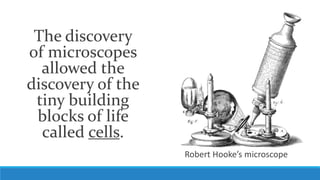
The discovery
of microscopes
allowed the
discovery of the
tiny building
blocks of life
called cells.
Robert Hooke’s microscope
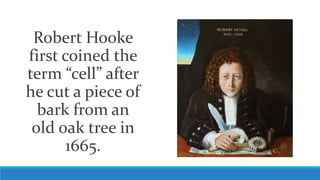
Robert Hooke
first coined the
term “cell” after
he cut a piece of
bark from an
old oak tree in
1665.
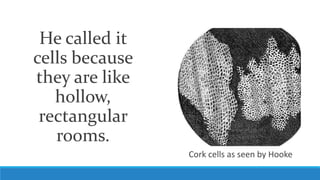
He called it
cells because
they are like
hollow,
rectangular
rooms.
Cork cells as seen by Hooke
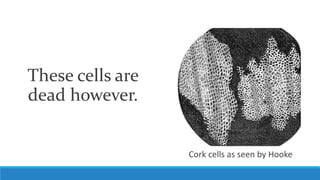
These cells are
dead however.
Cork cells as seen by Hooke
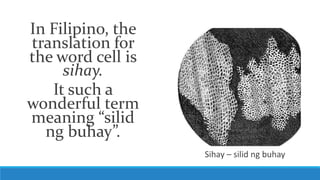
In Filipino, the
translation for
the word cell is
sihay.
It such a
wonderful term
meaning “silid
ng buhay”.
Sihay – silid ng buhay
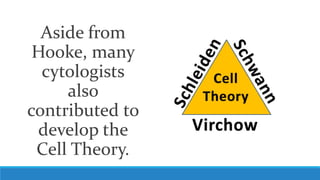
Aside from
Hooke, many
cytologists
also
contributed to
develop the
Cell Theory.
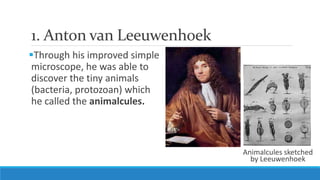
1. Anton van Leeuwenhoek
Through his improved simple
microscope, he was able to
discover the tiny animals
(bacteria, protozoan) which
he called the animalcules.
Animalcules sketched
by Leeuwenhoek
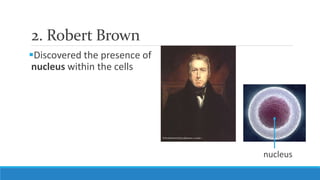
2. Robert Brown
Discovered the presence of
nucleus within the cells
nucleus
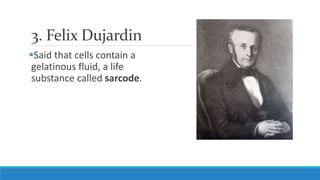
3. Felix Dujardin
Said that cells contain a
gelatinous fluid, a life
substance called sarcode.
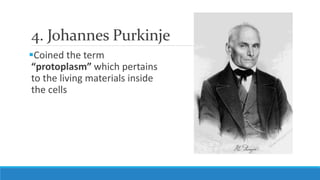
4. Johannes Purkinje
Coined the term
“protoplasm” which pertains
to the living materials inside
the cells
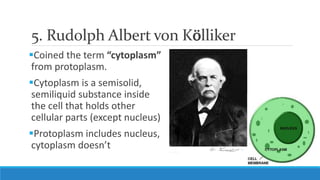
5. Rudolph Albert von Kölliker
Coined the term “cytoplasm”
from protoplasm.
Cytoplasm is a semisolid,
semiliquid substance inside
the cell that holds other
cellular parts (except nucleus)
Protoplasm includes nucleus,
cytoplasm doesn’t
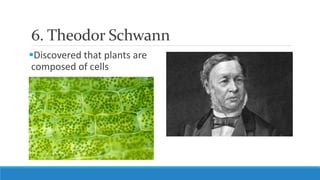
6. Theodor Schwann
Discovered that plants are
composed of cells
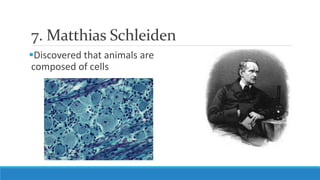
7. Matthias Schleiden
Discovered that animals are
composed of cells
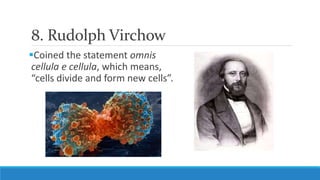
8. Rudolph Virchow
Coined the statement omnis
cellula e cellula, which means,
“cells divide and form new cells”.
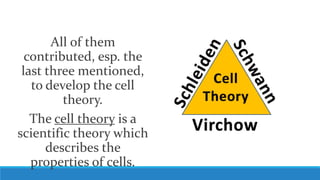
All of them
contributed, esp. the
last three mentioned,
to develop the cell
theory.
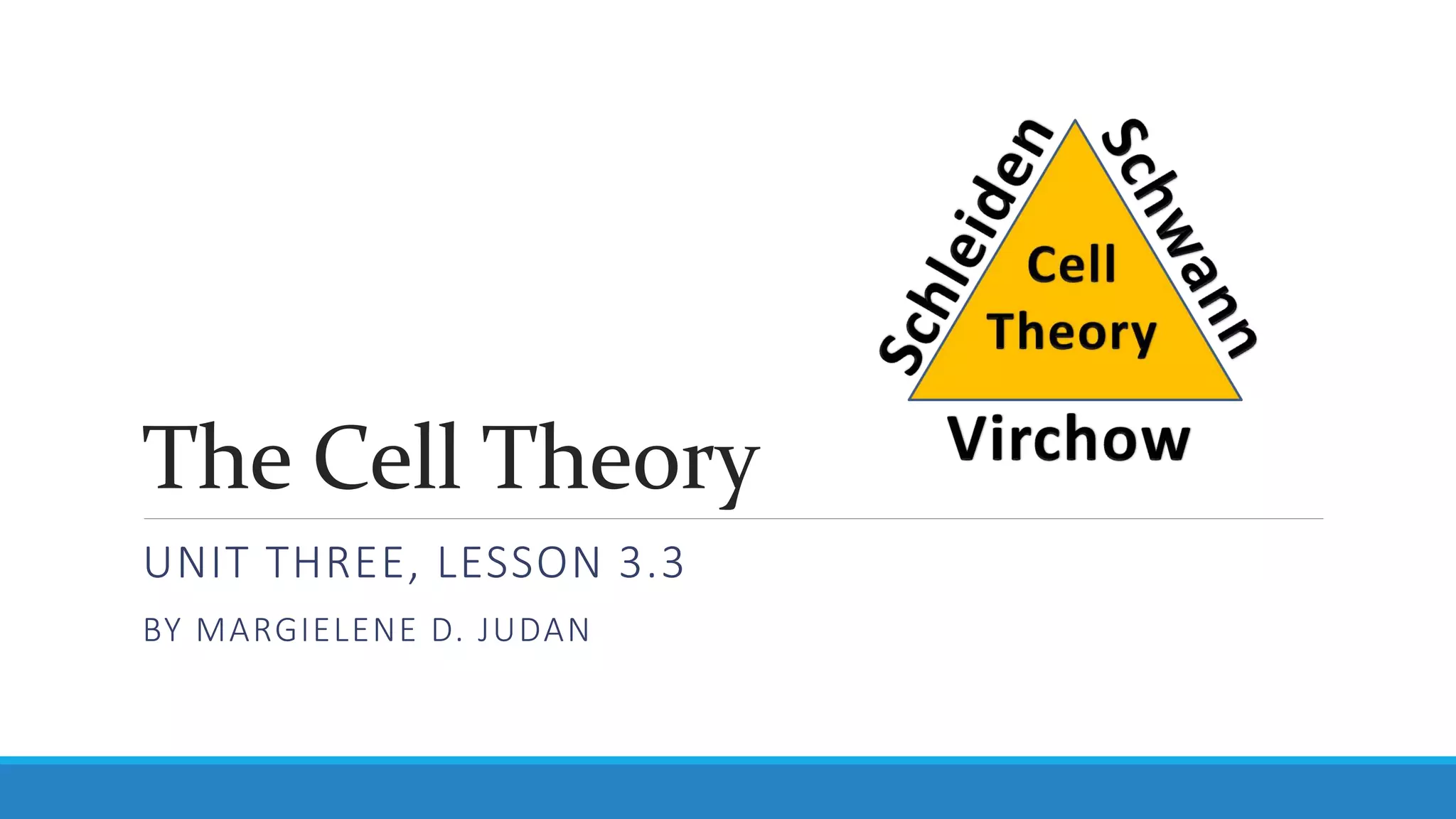
The cell theory is a
scientific theory which
describes the
properties of cells.
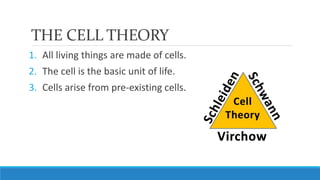
THE CELL THEORY
1. All living things are made of cells.
2. The cell is the basic unit of life.
3. Cells arise from pre-existing cells.
1. All living cells are made of cells.
Cells may be prokaryotic
(unicellular) or eukaryotic
(multicellular).
As mentioned earlier, Theodor
Schwann said that plants are made
up of cells, while Matthias
Schleiden said that animals are
also made up of cells.
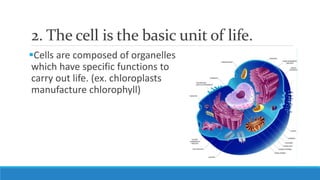
2. The cell is the basic unit of life.
Cells are composed of organelles
which have specific functions to
carry out life. (ex. chloroplasts
manufacture chlorophyll)
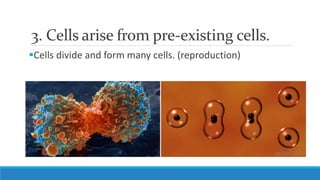
3. Cells arise from pre-existing cells.
Cells divide and form many cells. (reproduction)
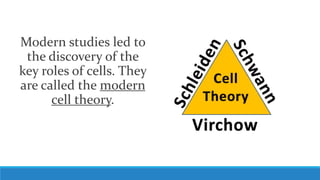
Modern studies led to
the discovery of the
key roles of cells. They
are called the modern
cell theory.
THE MODERN CELL THEORY
1. The energy of organisms is formed in the cells.
2. Hereditary information (DNA) is passed on from cell to
cell.
3. All cells have the basic chemical composition.
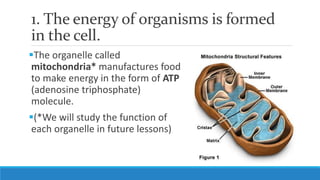
1. The energy of organisms is formed
in the cell.
The organelle called
mitochondria* manufactures food
to make energy in the form of ATP
(adenosine triphosphate)
molecule.
(*We will study the function of
each organelle in future lessons)
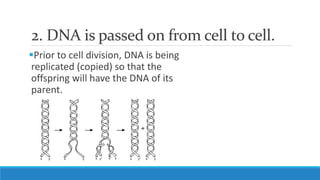
2. DNA is passed on from cell to cell.
Prior to cell division, DNA is being
replicated (copied) so that the
offspring will have the DNA of its
parent.
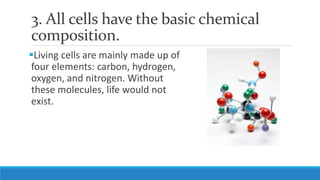
3. All cells have the basic chemical
composition.
Living cells are mainly made up of
four elements: carbon, hydrogen,
oxygen, and nitrogen. Without
these molecules, life would not
exist.
To sum up, these are the
general accepted parts of
modern cell theory:
THE MODERN INTERPRETATION
1. All known living things are made up of one or more cells.
2. All living cells arise from pre-existing cells by division.
3. The cell is the basic unit of life.
4. The activity of an organism depends on the activity of its
cells.
THE MODERN INTERPRETATION
5. The energy of organisms is formed in the cells.
6. Cells contain DNA (found in the chromosome) and
RNA (found in the nucleus and cytoplasm).
7. All cells are basically the same in chemical composition in
organisms of similar species.
The last slide is a video about
how DNA is replicated
(copied). Notice carefully the
complex and organized process
and you’ll realize how God
wonderfully made us according
to His likeness.
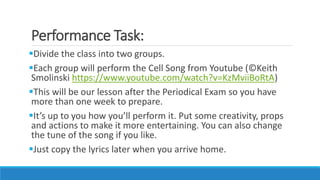
Performance Task:
Divide the class into two groups.
Each group will perform the Cell Song from Youtube (©Keith
Smolinski https://www.youtube.com/watch?v=KzMviiBoRtA)
This will be our lesson after the Periodical Exam so you have
more than one week to prepare.
It’s up to you how you’ll perform it. Put some creativity, props
and actions to make it more entertaining. You can also change
the tune of the song if you like.
Just copy the lyrics later when you arrive home.
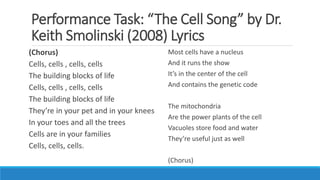
Performance Task: “The Cell Song” by Dr.
Keith Smolinski (2008) Lyrics
(Chorus)
Cells, cells , cells, cells
The building blocks of life
Cells, cells , cells, cells
The building blocks of life
They’re in your pet and in your knees
In your toes and all the trees
Cells are in your families
Cells, cells, cells.
Most cells have a nucleus
And it runs the show
It’s in the center of the cell
And contains the genetic code
The mitochondria
Are the power plants of the cell
Vacuoles store food and water
They’re useful just as well
(Chorus)
Performance Task: “The Cell Song” by Dr.
Keith Smolinski (2008) Lyrics
Ribosomes are working hard
Making proteins one by one
Golgi bodies pack them up
Ship them off for fun
The endoplasmic reticulum
Carries protein carefully
The lysosomes are janitors
Clean the cell for free
(Chorus)
Cytoplasm’s the gel-like stuff
That the cell parts are floating in
The cell membrane says what goes
out
And what comes back in
Plant cells have a thick cell wall
To protect the parts within
Chloroplasts make all the food
When photosynthesis begins
Performance Task: “The Cell Song” by Dr.
Keith Smolinski (2008) Lyrics
(Chorus)
Coda
Cells are in your families
Cells, cells, cells. ***
Assignment:
Answer letter C, p. 121.
Sources:
Science Links 7
http://biology.about.com/od/biologydictionary/g/celltheor
y.htm
http://classroom.synonym.com/major-chemical-elements-
found-cells-biology-21339.html
https://en.wikipedia.org/wiki/Cell_theory

Unit 3, Lesson 3.3 - The Cell Theory

  • 1.
    The Cell Theory UNITTHREE, LESSON 3.3 BY MARGIELENE D. JUDAN
  • 2.
    LESSON OUTLINE Cells andScientists The Cell Theory The Modern Cell Theory The Modern Interpretation of the Cell Theory (Summary)
  • 3.
    The discovery of microscopes allowedthe discovery of the tiny building blocks of life called cells. Robert Hooke’s microscope
  • 4.
    Robert Hooke first coinedthe term “cell” after he cut a piece of bark from an old oak tree in 1665.
  • 5.
    He called it cellsbecause they are like hollow, rectangular rooms. Cork cells as seen by Hooke
  • 6.
    These cells are deadhowever. Cork cells as seen by Hooke
  • 7.
    In Filipino, the translationfor the word cell is sihay. It such a wonderful term meaning “silid ng buhay”. Sihay – silid ng buhay
  • 8.
  • 9.
    1. Anton vanLeeuwenhoek Through his improved simple microscope, he was able to discover the tiny animals (bacteria, protozoan) which he called the animalcules. Animalcules sketched by Leeuwenhoek
  • 10.
    2. Robert Brown Discoveredthe presence of nucleus within the cells nucleus
  • 11.
    3. Felix Dujardin Saidthat cells contain a gelatinous fluid, a life substance called sarcode.
  • 12.
    4. Johannes Purkinje Coinedthe term “protoplasm” which pertains to the living materials inside the cells
  • 13.
    5. Rudolph Albertvon Kölliker Coined the term “cytoplasm” from protoplasm. Cytoplasm is a semisolid, semiliquid substance inside the cell that holds other cellular parts (except nucleus) Protoplasm includes nucleus, cytoplasm doesn’t
  • 14.
    6. Theodor Schwann Discoveredthat plants are composed of cells
  • 15.
    7. Matthias Schleiden Discoveredthat animals are composed of cells
  • 16.
    8. Rudolph Virchow Coinedthe statement omnis cellula e cellula, which means, “cells divide and form new cells”.
  • 17.
    All of them contributed,esp. the last three mentioned, to develop the cell theory. The cell theory is a scientific theory which describes the properties of cells.
  • 18.
    THE CELL THEORY 1.All living things are made of cells. 2. The cell is the basic unit of life. 3. Cells arise from pre-existing cells.
  • 19.
    1. All livingcells are made of cells. Cells may be prokaryotic (unicellular) or eukaryotic (multicellular). As mentioned earlier, Theodor Schwann said that plants are made up of cells, while Matthias Schleiden said that animals are also made up of cells.
  • 20.
    2. The cellis the basic unit of life. Cells are composed of organelles which have specific functions to carry out life. (ex. chloroplasts manufacture chlorophyll)
  • 21.
    3. Cells arisefrom pre-existing cells. Cells divide and form many cells. (reproduction)
  • 22.
    Modern studies ledto the discovery of the key roles of cells. They are called the modern cell theory.
  • 23.
    THE MODERN CELLTHEORY 1. The energy of organisms is formed in the cells. 2. Hereditary information (DNA) is passed on from cell to cell. 3. All cells have the basic chemical composition.
  • 24.
    1. The energyof organisms is formed in the cell. The organelle called mitochondria* manufactures food to make energy in the form of ATP (adenosine triphosphate) molecule. (*We will study the function of each organelle in future lessons)
  • 25.
    2. DNA ispassed on from cell to cell. Prior to cell division, DNA is being replicated (copied) so that the offspring will have the DNA of its parent.
  • 26.
    3. All cellshave the basic chemical composition. Living cells are mainly made up of four elements: carbon, hydrogen, oxygen, and nitrogen. Without these molecules, life would not exist.
  • 27.
    To sum up,these are the general accepted parts of modern cell theory:
  • 28.
    THE MODERN INTERPRETATION 1.All known living things are made up of one or more cells. 2. All living cells arise from pre-existing cells by division. 3. The cell is the basic unit of life. 4. The activity of an organism depends on the activity of its cells.
  • 29.
    THE MODERN INTERPRETATION 5.The energy of organisms is formed in the cells. 6. Cells contain DNA (found in the chromosome) and RNA (found in the nucleus and cytoplasm). 7. All cells are basically the same in chemical composition in organisms of similar species.
  • 30.
    The last slideis a video about how DNA is replicated (copied). Notice carefully the complex and organized process and you’ll realize how God wonderfully made us according to His likeness.
  • 32.
    Performance Task: Divide theclass into two groups. Each group will perform the Cell Song from Youtube (©Keith Smolinski https://www.youtube.com/watch?v=KzMviiBoRtA) This will be our lesson after the Periodical Exam so you have more than one week to prepare. It’s up to you how you’ll perform it. Put some creativity, props and actions to make it more entertaining. You can also change the tune of the song if you like. Just copy the lyrics later when you arrive home.
  • 34.
    Performance Task: “TheCell Song” by Dr. Keith Smolinski (2008) Lyrics (Chorus) Cells, cells , cells, cells The building blocks of life Cells, cells , cells, cells The building blocks of life They’re in your pet and in your knees In your toes and all the trees Cells are in your families Cells, cells, cells. Most cells have a nucleus And it runs the show It’s in the center of the cell And contains the genetic code The mitochondria Are the power plants of the cell Vacuoles store food and water They’re useful just as well (Chorus)
  • 35.
    Performance Task: “TheCell Song” by Dr. Keith Smolinski (2008) Lyrics Ribosomes are working hard Making proteins one by one Golgi bodies pack them up Ship them off for fun The endoplasmic reticulum Carries protein carefully The lysosomes are janitors Clean the cell for free (Chorus) Cytoplasm’s the gel-like stuff That the cell parts are floating in The cell membrane says what goes out And what comes back in Plant cells have a thick cell wall To protect the parts within Chloroplasts make all the food When photosynthesis begins
  • 36.
    Performance Task: “TheCell Song” by Dr. Keith Smolinski (2008) Lyrics (Chorus) Coda Cells are in your families Cells, cells, cells. ***
  • 37.
  • 38.