2.1Cell Theory
Scien
cebitz.
com
Scien
cebitz.
com
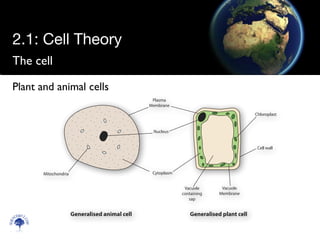
Plant and animal cells
The cell
2.1: Cell Theory
Scien
cebitz.
com
Nucleus
Plasma
Membrane
CytoplasmMitochondria
Vacuole
containing
sap
Vacuole
Membrane
Cell wall
Chloroplast
Generalised animal cell Generalised plant cell
2.1.1:	

Outline the cell theory.
Three basic Principles	

All living things are made of cells. 	

Cells are the smallest unit of life.	

Existing cells have come from other cells.
Scien
cebitz.
com
2.1: Cell Theory
2.1.2:	

Discuss the evidence for the cell theory.
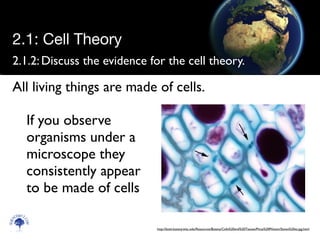
If you observe
organisms under a
microscope they
consistently appear
to be made of cells
Scien
cebitz.
com
2.1: Cell Theory
All living things are made of cells.
http://botit.botany.wisc.edu/Resources/Botany/Cells%20and%20Tissues/Pinus%20Phloem/Sieves%20xs.jpg.html
2.1.2:	

Discuss the evidence for the cell theory.
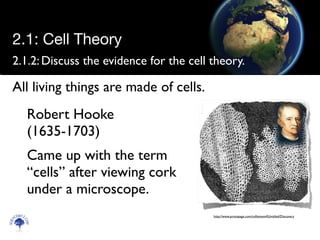
Robert Hooke
(1635-1703)	

Came up with the term
“cells” after viewing cork
under a microscope.
Scien
cebitz.
com
2.1: Cell Theory
All living things are made of cells.
http://www.protopage.com/cellzmann#Untitled/Discovery
2.1.2:	

Discuss the evidence for the cell theory.
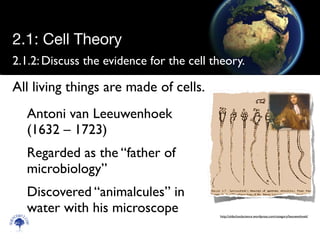
Antoni van Leeuwenhoek
(1632 – 1723)	

Regarded as the “father of
microbiology”	

Discovered “animalcules” in
water with his microscope
Scien
cebitz.
com
2.1: Cell Theory
All living things are made of cells.
http://oldschoolscience.wordpress.com/category/leeuwenhoek/
2.1.2:	

Discuss the evidence for the cell theory.
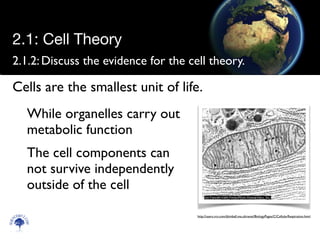
While organelles carry out
metabolic function	

The cell components can
not survive independently
outside of the cell
Scien
cebitz.
com
2.1: Cell Theory
Cells are the smallest unit of life.
http://users.rcn.com/jkimball.ma.ultranet/BiologyPages/C/CellularRespiration.html
2.1.2:	

Discuss the evidence for the cell theory.
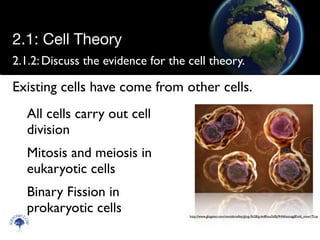
All cells carry out cell
division	

Mitosis and meiosis in
eukaryotic cells	

Binary Fission in
prokaryotic cells
Scien
cebitz.
com
2.1: Cell Theory
Existing cells have come from other cells.
http://www.glogster.com/reavisbradley/glog-5628/g-6n8hoa2d0jt9i4i6hetuqg8?old_view=True
2.1.2:	

Discuss the evidence for the cell theory.
Louis Pasteur proved
in 1864 that life could
not occur by
spontaneous
generation (e.g. that
rats could form from
sweaty grain)
Scien
cebitz.
com
2.1: Cell Theory
Existing cells have come from other cells.
Remak a Jewish
scientist discovered
“cell division” when
studying chicken
embryos
2.1.3	

State that unicellular organisms carry out
all the functions of life.
metabolism: chemical reactions inside the cell,
including cell respiration to release energy	

sensitivity: perceiving and responding to
changes in the environment	

homeostasis: keeping conditions inside the
organisms within tolerable limits
Scien
cebitz.
com
2.1: Cell Theory
Functions of life
2.1.3	

State that unicellular organisms carry out
all the functions of life.
growth: an irreversible increase in size	

reproduction: producing offspring either
sexually or asexually	

nutrition: obtaining food, to provide energy
and the materials needed for growth
Scien
cebitz.
com
2.1: Cell Theory
Functions of life
2.1.3	

State that unicellular organisms carry out
all the functions of life.
movement: via changes in size or appendages
such as flagella, following stimulus or changes
in turgor or full locomotion
Scien
cebitz.
com
2.1: Cell Theory
Functions of life

Topic 2 Cell theory

  • 1.
  • 2.
    Plant and animalcells The cell 2.1: Cell Theory Scien cebitz. com Nucleus Plasma Membrane CytoplasmMitochondria Vacuole containing sap Vacuole Membrane Cell wall Chloroplast Generalised animal cell Generalised plant cell
  • 3.
    2.1.1: Outline the celltheory. Three basic Principles All living things are made of cells. Cells are the smallest unit of life. Existing cells have come from other cells. Scien cebitz. com 2.1: Cell Theory
  • 4.
    2.1.2: Discuss the evidencefor the cell theory. If you observe organisms under a microscope they consistently appear to be made of cells Scien cebitz. com 2.1: Cell Theory All living things are made of cells. http://botit.botany.wisc.edu/Resources/Botany/Cells%20and%20Tissues/Pinus%20Phloem/Sieves%20xs.jpg.html
  • 5.
    2.1.2: Discuss the evidencefor the cell theory. Robert Hooke (1635-1703) Came up with the term “cells” after viewing cork under a microscope. Scien cebitz. com 2.1: Cell Theory All living things are made of cells. http://www.protopage.com/cellzmann#Untitled/Discovery
  • 6.
    2.1.2: Discuss the evidencefor the cell theory. Antoni van Leeuwenhoek (1632 – 1723) Regarded as the “father of microbiology” Discovered “animalcules” in water with his microscope Scien cebitz. com 2.1: Cell Theory All living things are made of cells. http://oldschoolscience.wordpress.com/category/leeuwenhoek/
  • 7.
    2.1.2: Discuss the evidencefor the cell theory. While organelles carry out metabolic function The cell components can not survive independently outside of the cell Scien cebitz. com 2.1: Cell Theory Cells are the smallest unit of life. http://users.rcn.com/jkimball.ma.ultranet/BiologyPages/C/CellularRespiration.html
  • 8.
    2.1.2: Discuss the evidencefor the cell theory. All cells carry out cell division Mitosis and meiosis in eukaryotic cells Binary Fission in prokaryotic cells Scien cebitz. com 2.1: Cell Theory Existing cells have come from other cells. http://www.glogster.com/reavisbradley/glog-5628/g-6n8hoa2d0jt9i4i6hetuqg8?old_view=True
  • 9.
    2.1.2: Discuss the evidencefor the cell theory. Louis Pasteur proved in 1864 that life could not occur by spontaneous generation (e.g. that rats could form from sweaty grain) Scien cebitz. com 2.1: Cell Theory Existing cells have come from other cells. Remak a Jewish scientist discovered “cell division” when studying chicken embryos
  • 10.
    2.1.3 State that unicellularorganisms carry out all the functions of life. metabolism: chemical reactions inside the cell, including cell respiration to release energy sensitivity: perceiving and responding to changes in the environment homeostasis: keeping conditions inside the organisms within tolerable limits Scien cebitz. com 2.1: Cell Theory Functions of life
  • 11.
    2.1.3 State that unicellularorganisms carry out all the functions of life. growth: an irreversible increase in size reproduction: producing offspring either sexually or asexually nutrition: obtaining food, to provide energy and the materials needed for growth Scien cebitz. com 2.1: Cell Theory Functions of life
  • 12.
    2.1.3 State that unicellularorganisms carry out all the functions of life. movement: via changes in size or appendages such as flagella, following stimulus or changes in turgor or full locomotion Scien cebitz. com 2.1: Cell Theory Functions of life