CELL STRUCTURE
AND FUNCTION
BY: MARIA SHEILA P. BERNALES
ELICIT
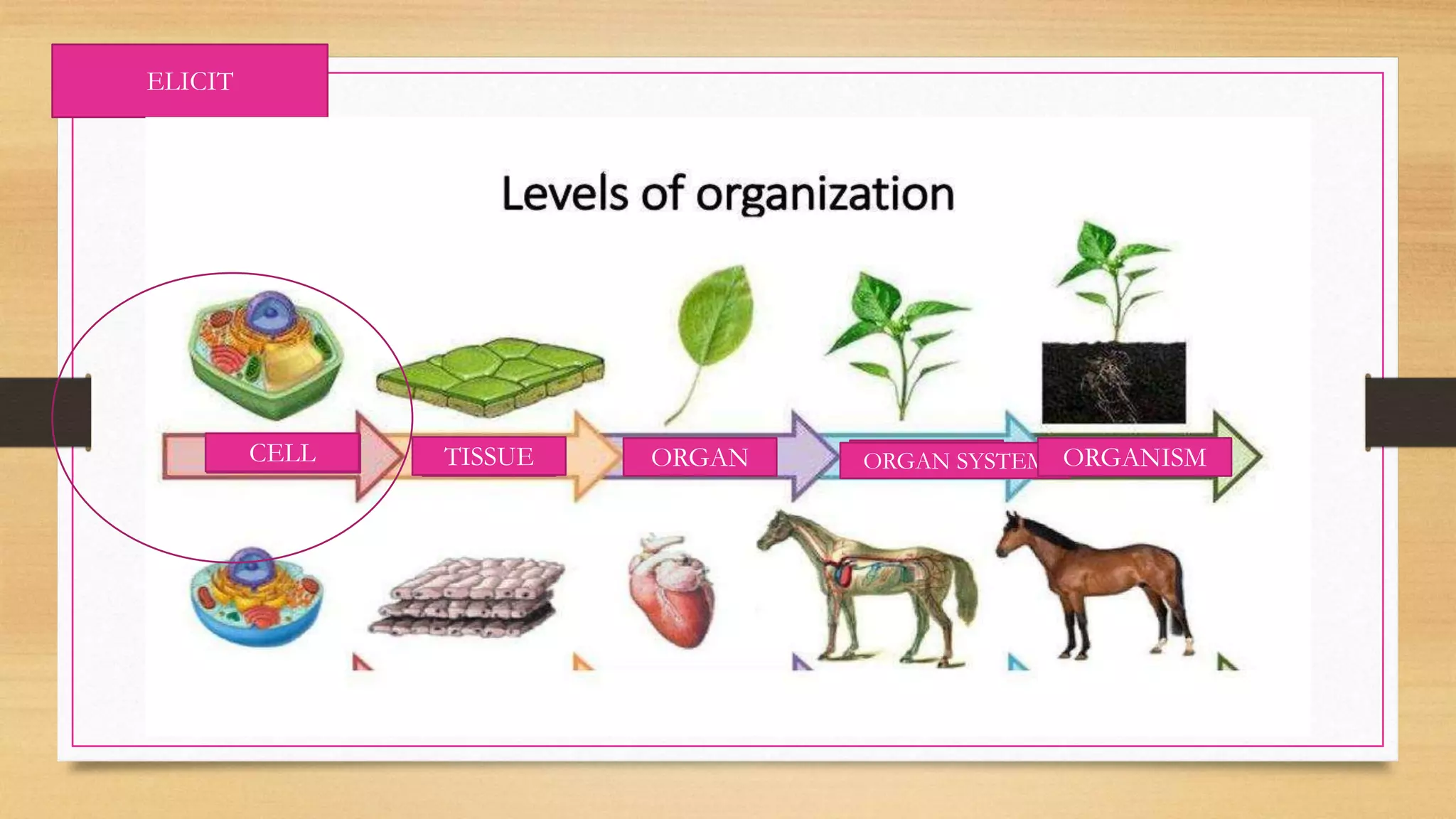
CELL TISSUE ORGAN ORGAN SYSTEM ORGANISM
LEARNING OBJECTIVES
Demonstrate your knowledge of the cell as a basic unit of
life by constructing a three dimensional model of a plant or
animal cell and identifying its components and functions.
Compare and contrast structures of plant and animal cells
Explore the role of different structures within a cell
MOTIVATION
• SHORT VIDEO CLIP
ENGAGE
• Ask the students how they understand the SHORT VIDEO.
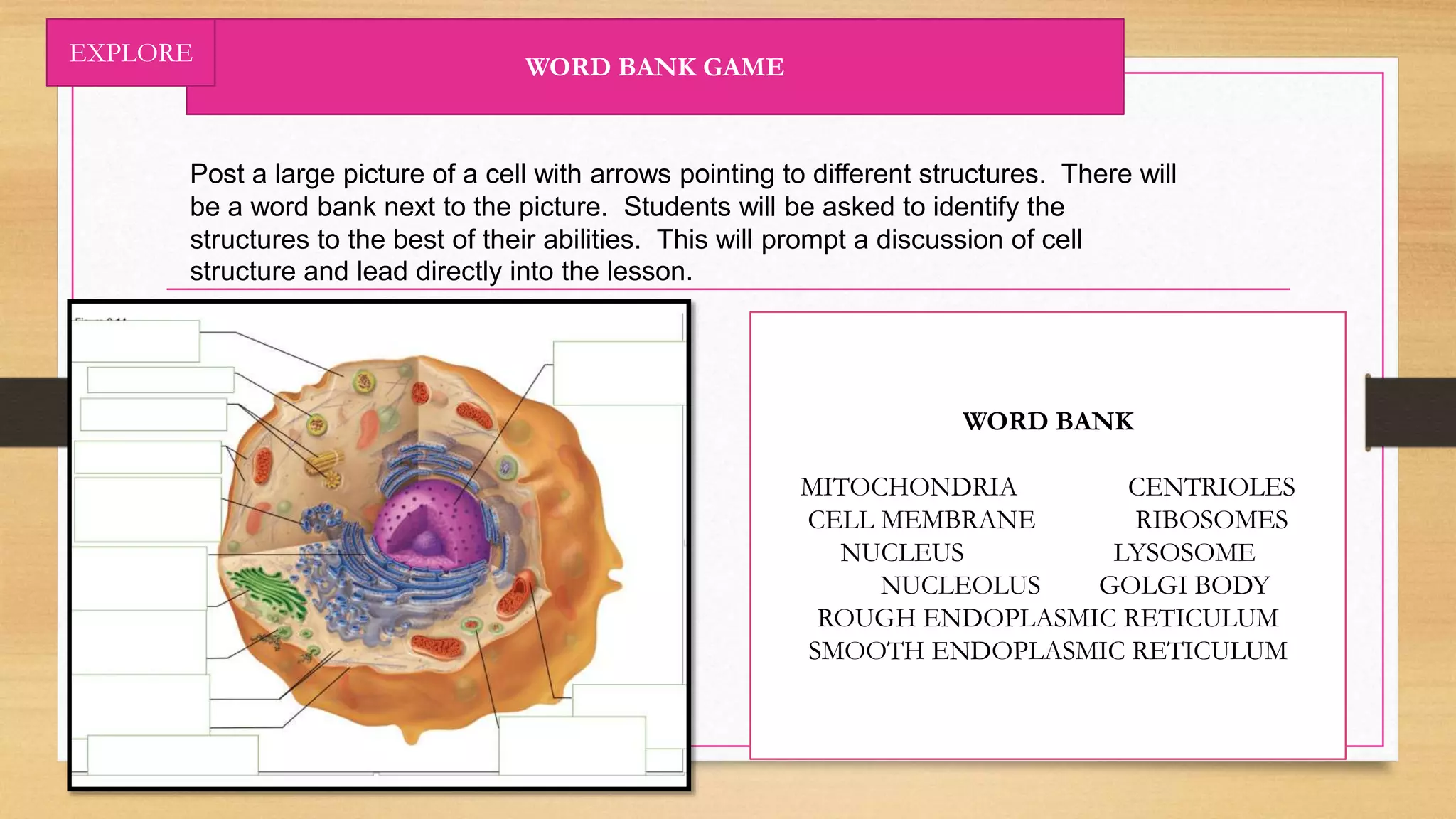
Post a large picture of a cell with arrows pointing to different structures. There will
be a word bank next to the picture. Students will be asked to identify the
structures to the best of their abilities. This will prompt a discussion of cell
structure and lead directly into the lesson.
WORD BANK GAME
WORD BANK
MITOCHONDRIA CENTRIOLES
CELL MEMBRANE RIBOSOMES
NUCLEUS LYSOSOME
NUCLEOLUS GOLGI BODY
ROUGH ENDOPLASMIC RETICULUM
SMOOTH ENDOPLASMIC RETICULUM
EXPLORE
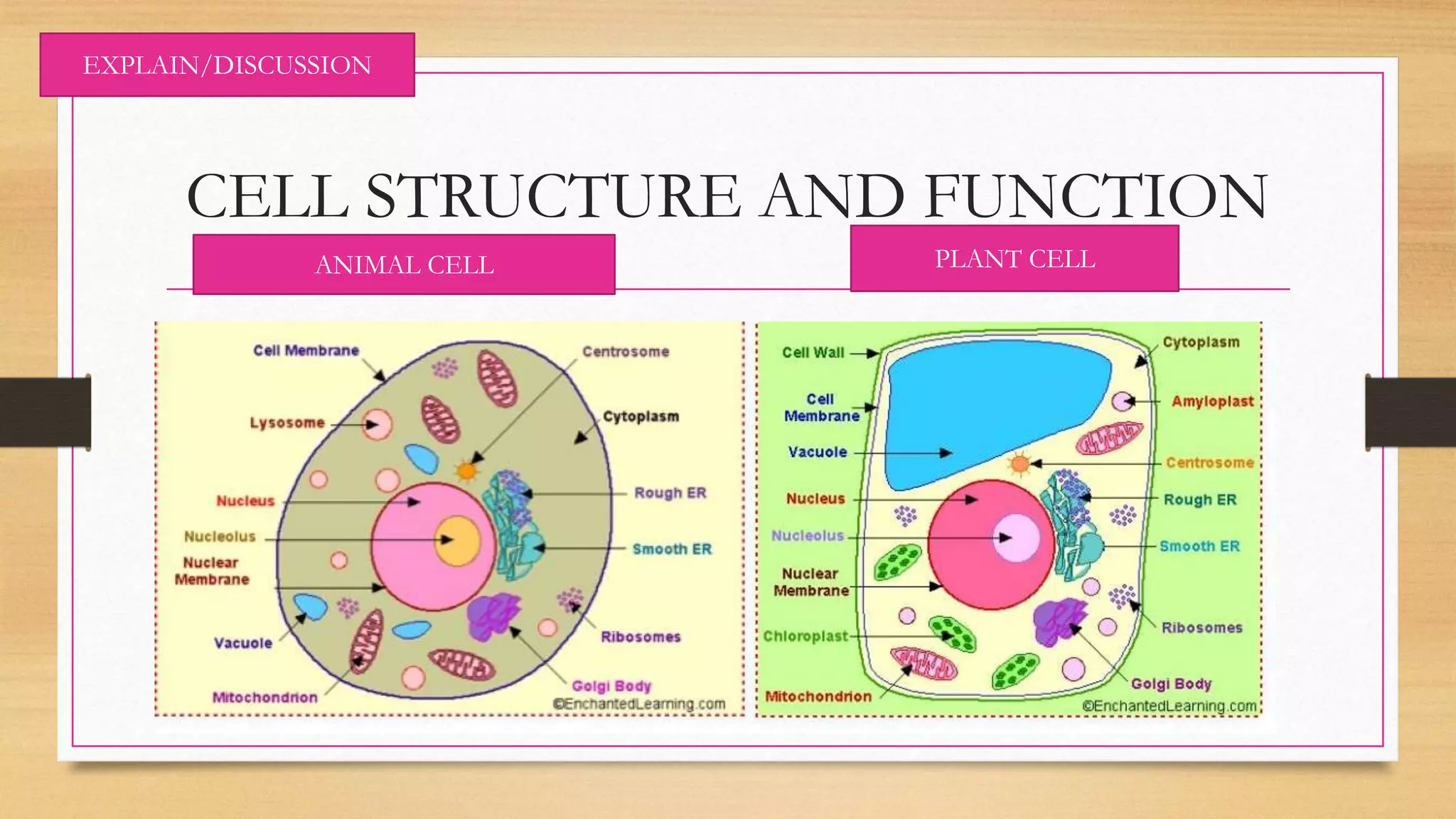
CELL STRUCTURE AND FUNCTION
EXPLAIN/DISCUSSION
ANIMAL CELL PLANT CELL
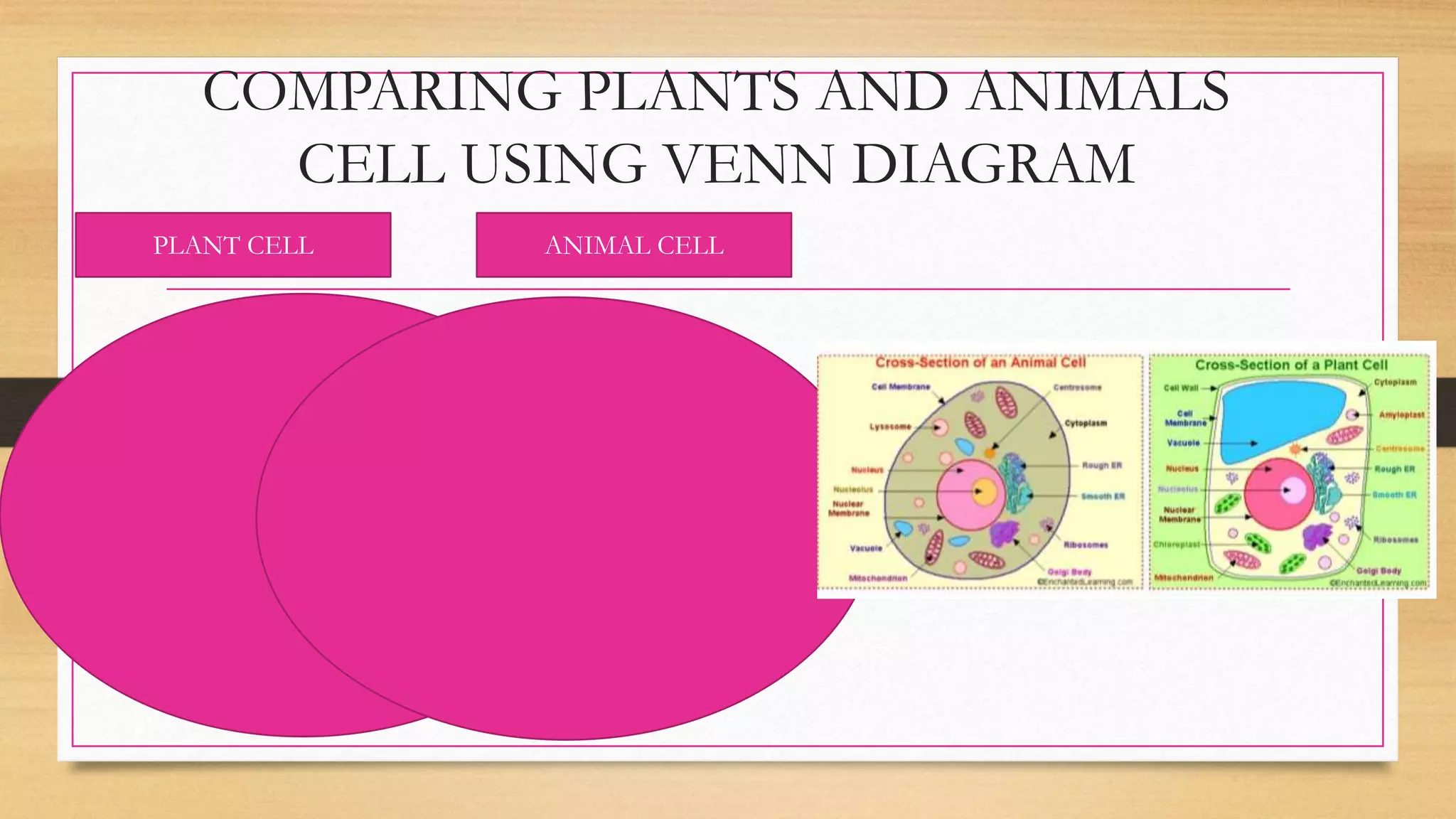
COMPARING PLANTS AND ANIMALS
CELL USING VENN DIAGRAM
PLANT CELL ANIMAL CELL
CELL
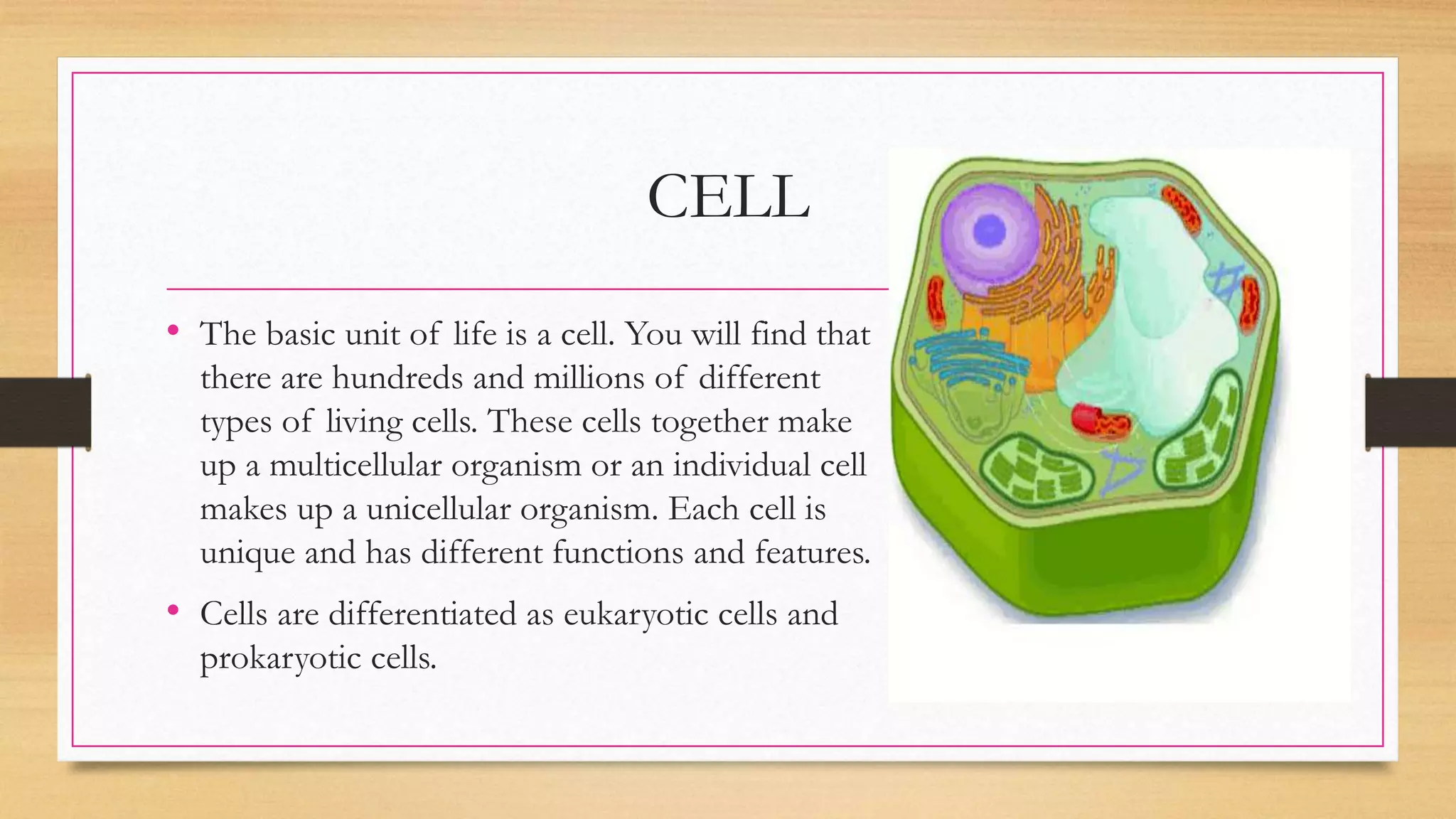
• The basic unit of life is a cell. You will find that
there are hundreds and millions of different
types of living cells. These cells together make
up a multicellular organism or an individual cell
makes up a unicellular organism. Each cell is
unique and has different functions and features.
• Cells are differentiated as eukaryotic cells and
prokaryotic cells.
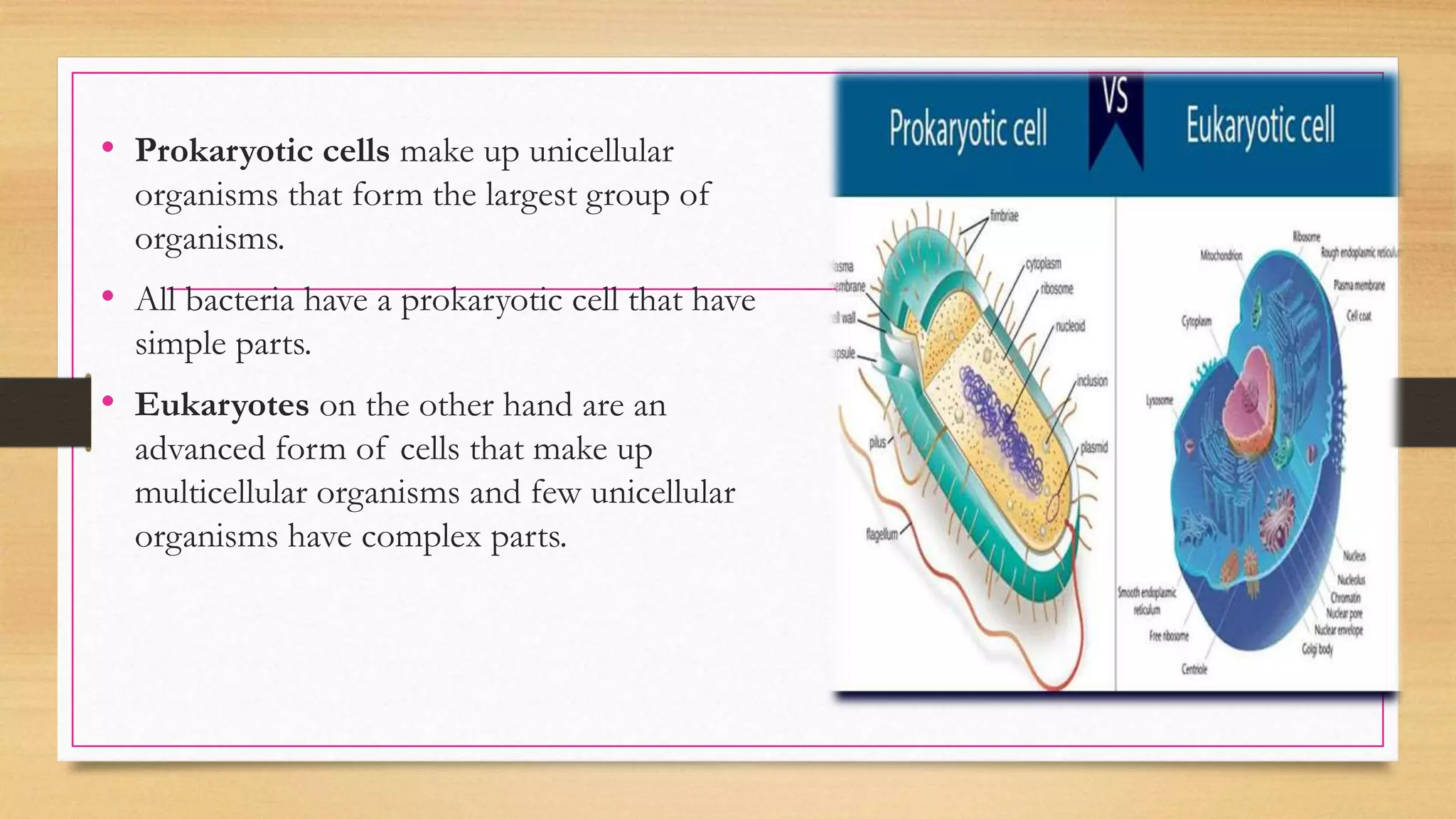
• Prokaryotic cells make up unicellular
organisms that form the largest group of
organisms.
• All bacteria have a prokaryotic cell that have
simple parts.
• Eukaryotes on the other hand are an
advanced form of cells that make up
multicellular organisms and few unicellular
organisms have complex parts.
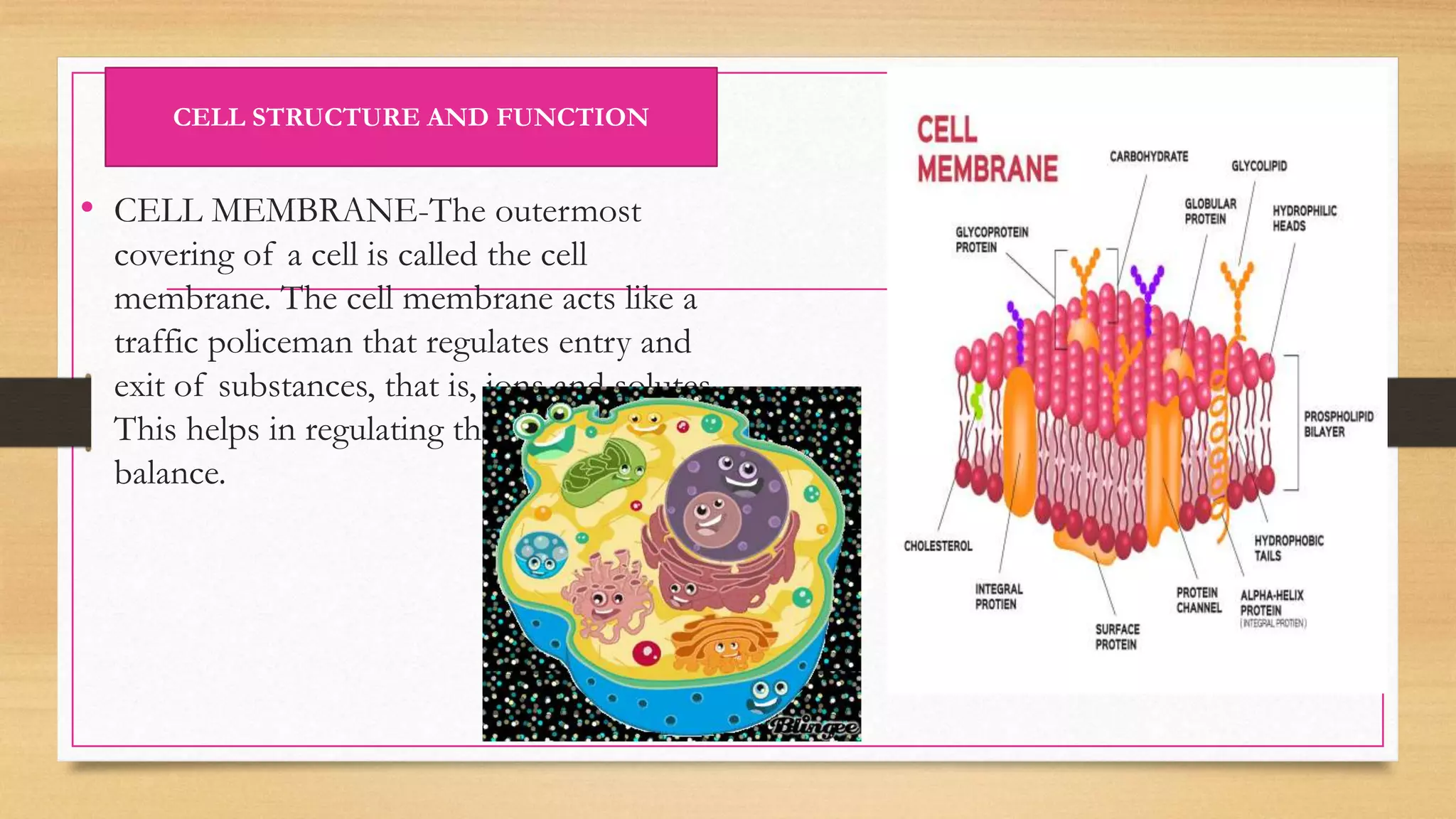
• CELL MEMBRANE-The outermost
covering of a cell is called the cell
membrane. The cell membrane acts like a
traffic policeman that regulates entry and
exit of substances, that is, ions and solutes.
This helps in regulating the internal cell
balance.
CELL STRUCTURE AND FUNCTION
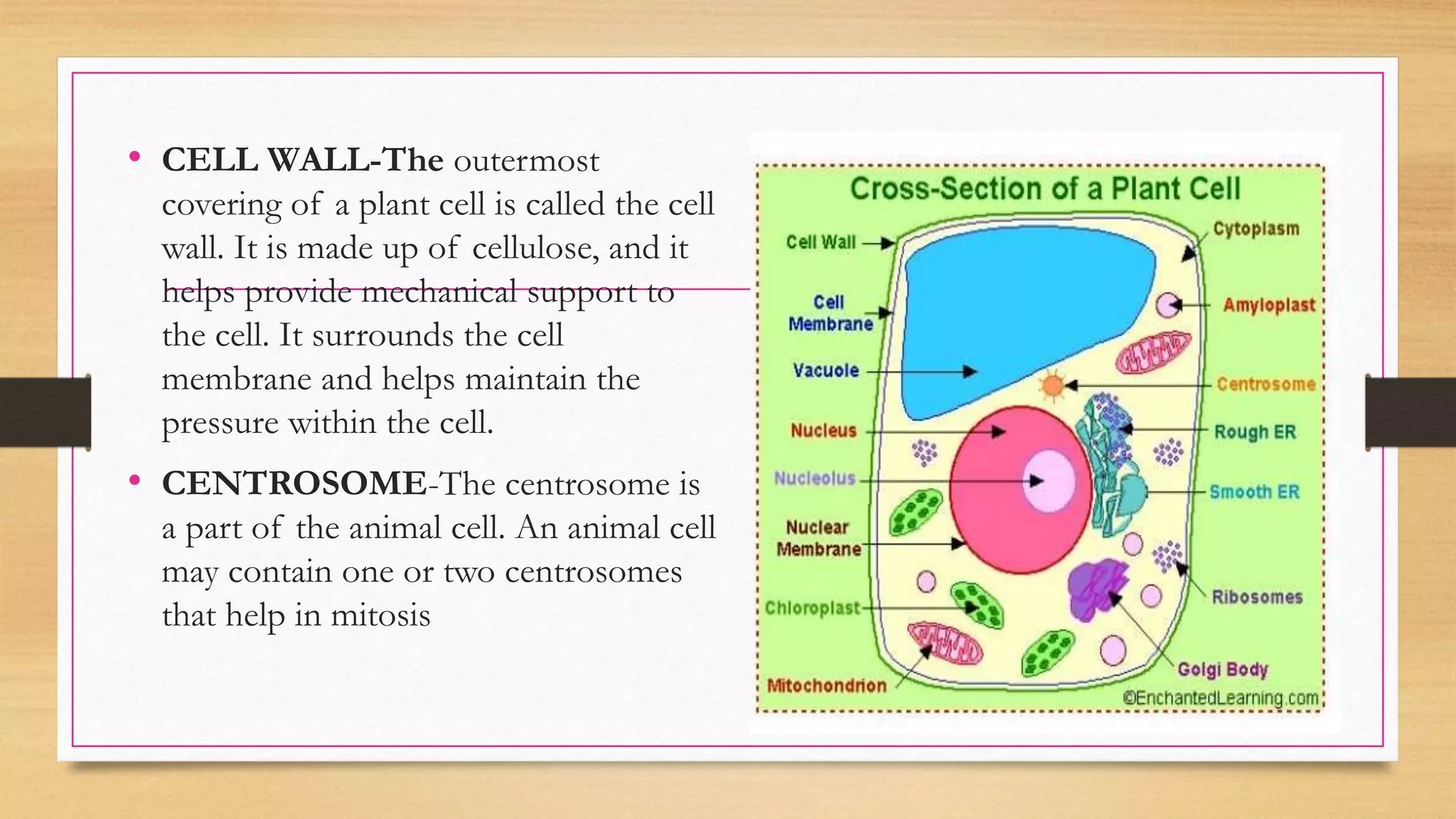
• CELL WALL-The outermost
covering of a plant cell is called the cell
wall. It is made up of cellulose, and it
helps provide mechanical support to
the cell. It surrounds the cell
membrane and helps maintain the
pressure within the cell.
• CENTROSOME-The centrosome is
a part of the animal cell. An animal cell
may contain one or two centrosomes
that help in mitosis
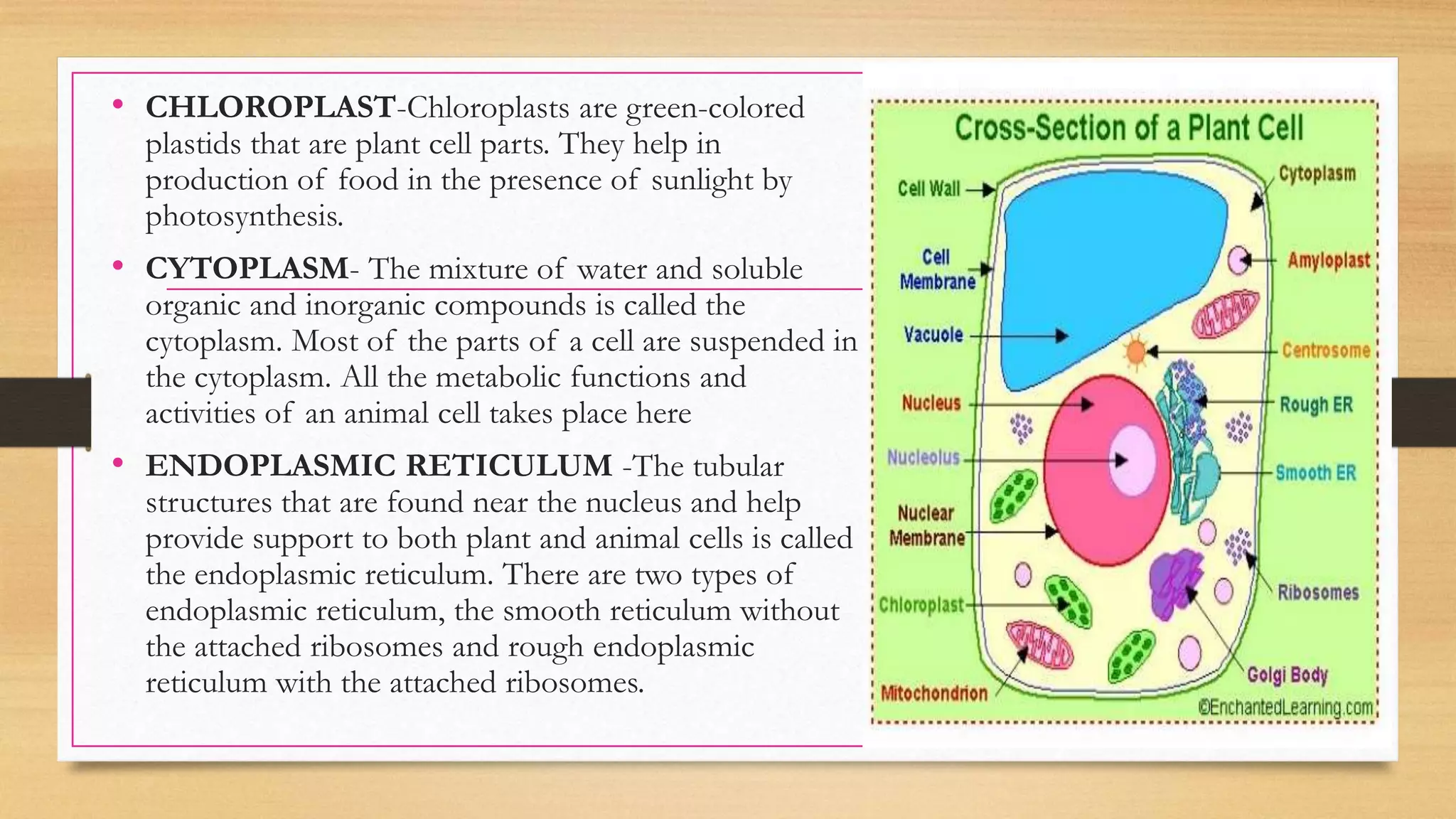
• CHLOROPLAST-Chloroplasts are green-colored
plastids that are plant cell parts. They help in
production of food in the presence of sunlight by
photosynthesis.
• CYTOPLASM- The mixture of water and soluble
organic and inorganic compounds is called the
cytoplasm. Most of the parts of a cell are suspended in
the cytoplasm. All the metabolic functions and
activities of an animal cell takes place here
• ENDOPLASMIC RETICULUM -The tubular
structures that are found near the nucleus and help
provide support to both plant and animal cells is called
the endoplasmic reticulum. There are two types of
endoplasmic reticulum, the smooth reticulum without
the attached ribosomes and rough endoplasmic
reticulum with the attached ribosomes.
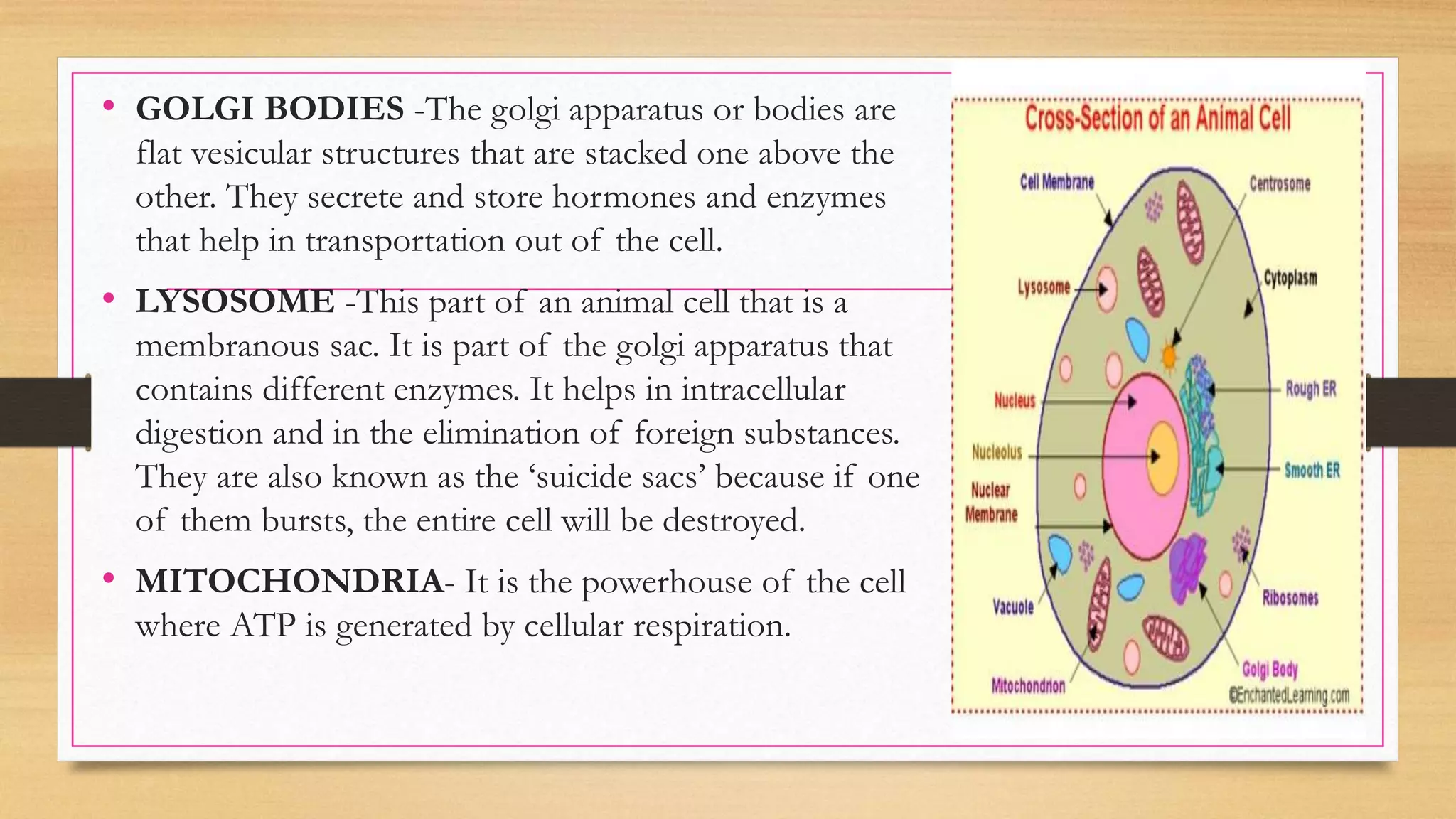
• GOLGI BODIES -The golgi apparatus or bodies are
flat vesicular structures that are stacked one above the
other. They secrete and store hormones and enzymes
that help in transportation out of the cell.
• LYSOSOME -This part of an animal cell that is a
membranous sac. It is part of the golgi apparatus that
contains different enzymes. It helps in intracellular
digestion and in the elimination of foreign substances.
They are also known as the ‘suicide sacs’ because if one
of them bursts, the entire cell will be destroyed.
• MITOCHONDRIA- It is the powerhouse of the cell
where ATP is generated by cellular respiration.
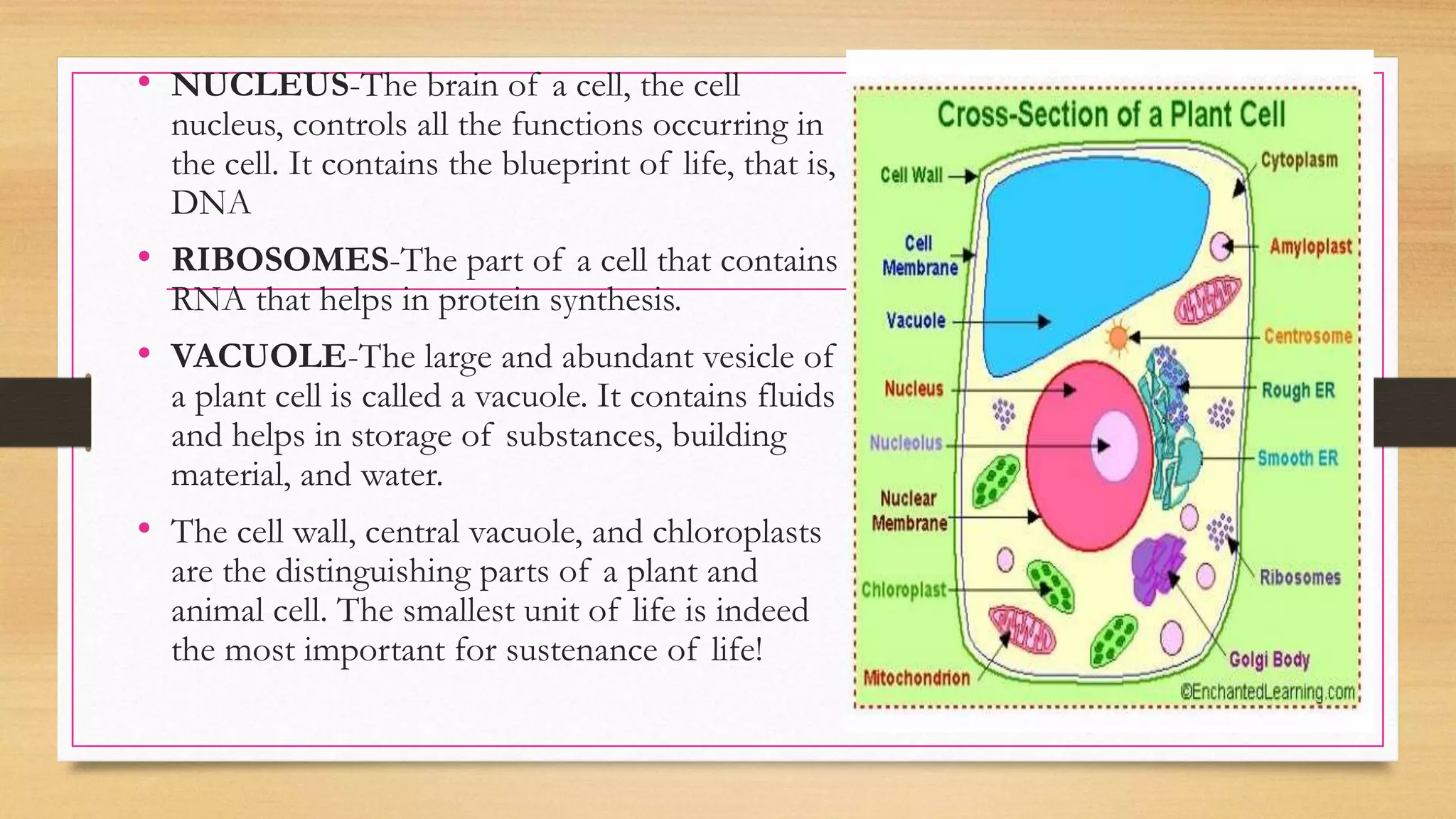
• NUCLEUS-The brain of a cell, the cell
nucleus, controls all the functions occurring in
the cell. It contains the blueprint of life, that is,
DNA
• RIBOSOMES-The part of a cell that contains
RNA that helps in protein synthesis.
• VACUOLE-The large and abundant vesicle of
a plant cell is called a vacuole. It contains fluids
and helps in storage of substances, building
material, and water.
• The cell wall, central vacuole, and chloroplasts
are the distinguishing parts of a plant and
animal cell. The smallest unit of life is indeed
the most important for sustenance of life!
Elaborate
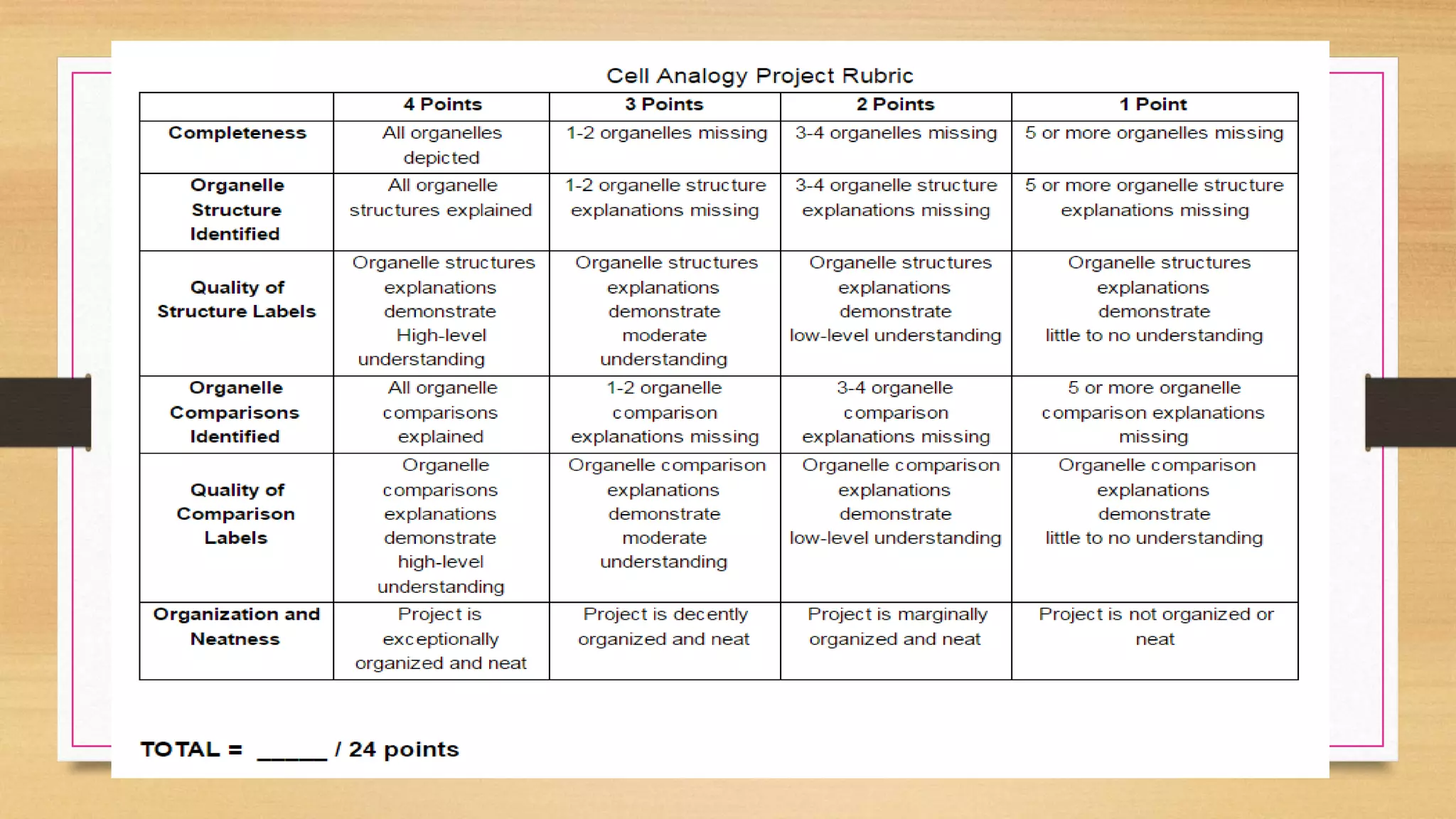
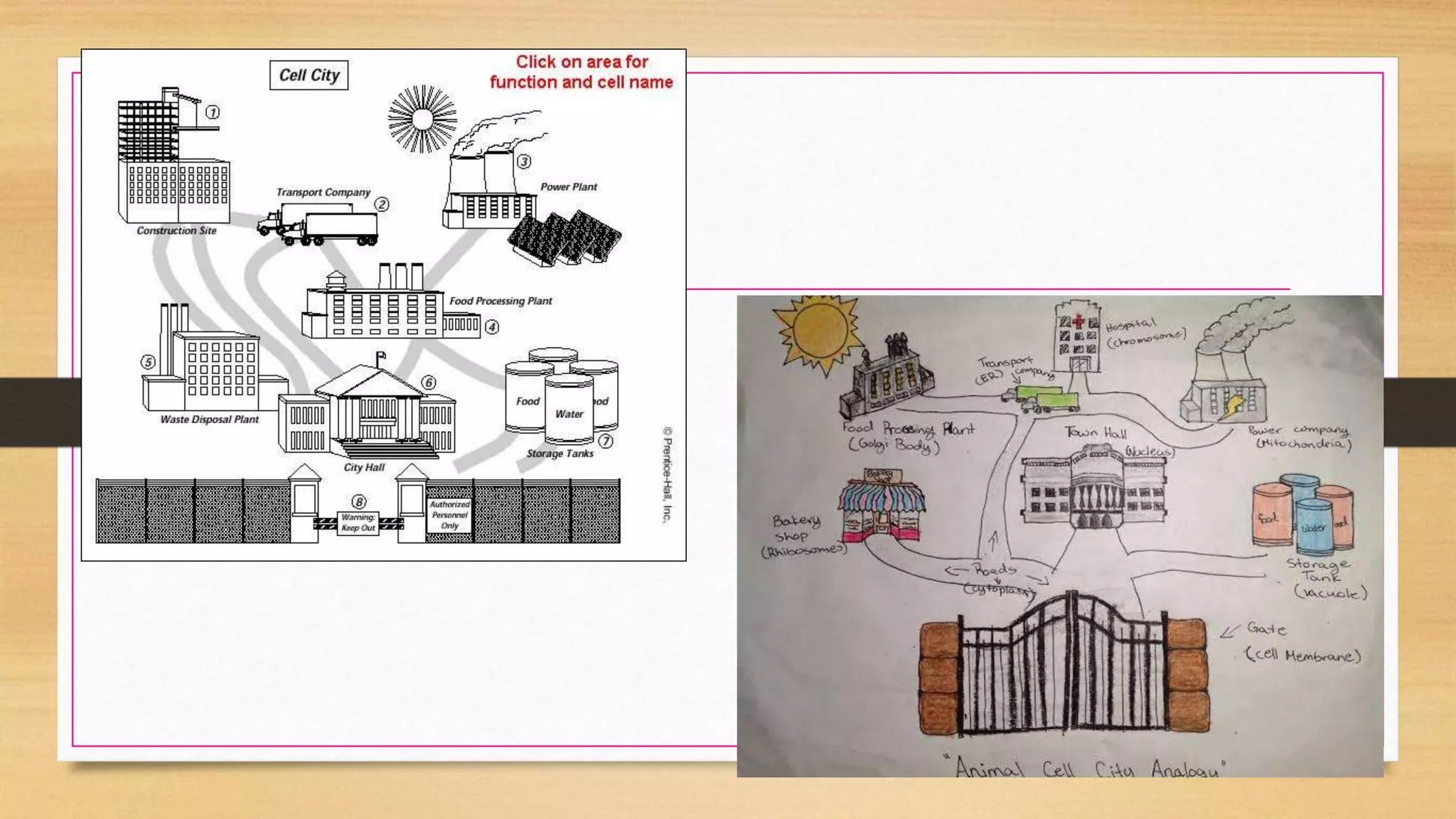
• CELL CITY PROJECT/CELL ANALOGY (10 MINS.)
• Group the students
• Instruct the students to make their own model city and label various buildings as cell
parts.
• Make the city on a large poster so everyone can add to the picture.
Example:
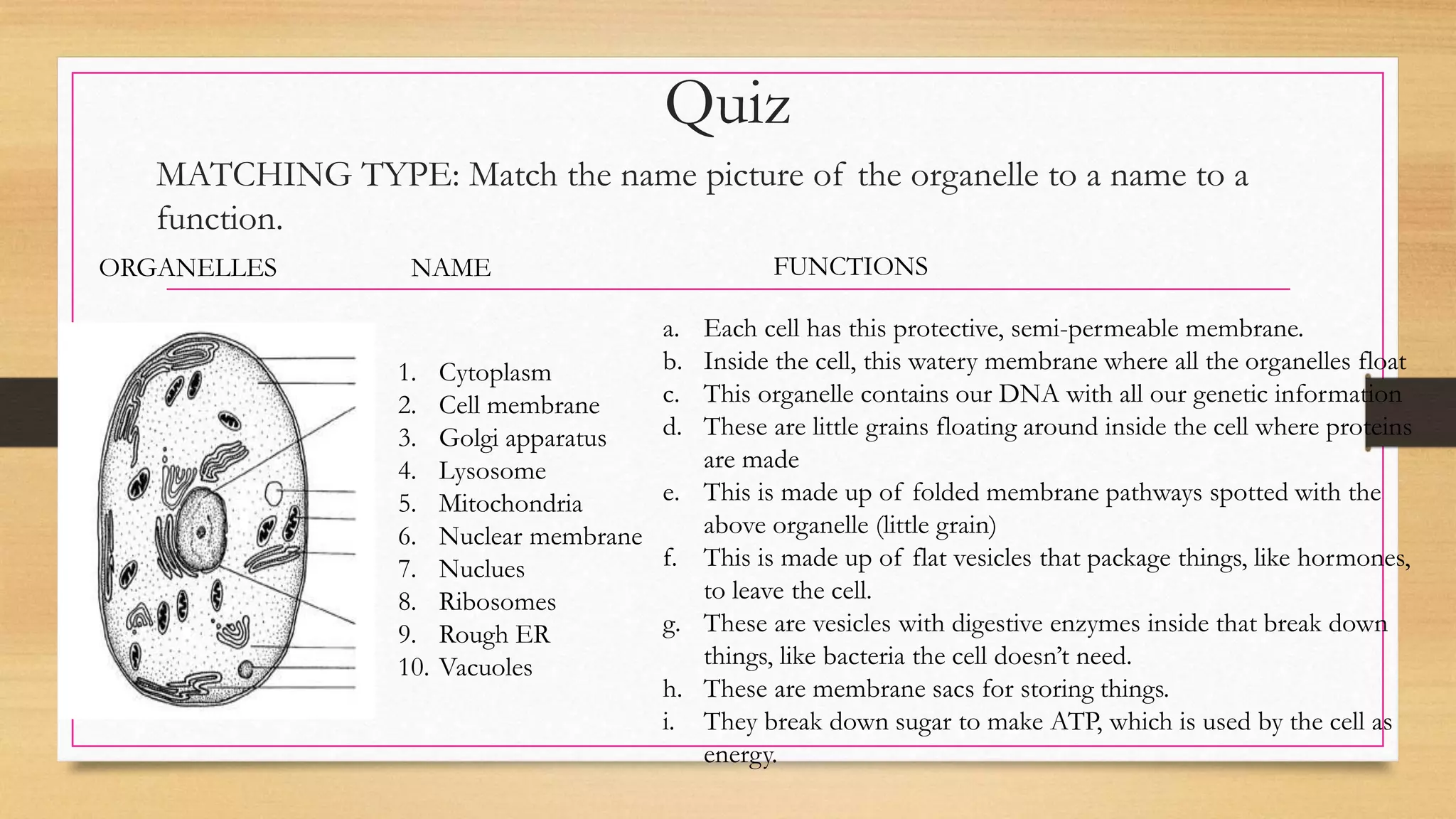
Quiz
MATCHING TYPE: Match the name picture of the organelle to a name to a
function.
1. Cytoplasm
2. Cell membrane
3. Golgi apparatus
4. Lysosome
5. Mitochondria
6. Nuclear membrane
7. Nuclues
8. Ribosomes
9. Rough ER
10. Vacuoles
a. Each cell has this protective, semi-permeable membrane.
b. Inside the cell, this watery membrane where all the organelles float
c. This organelle contains our DNA with all our genetic information
d. These are little grains floating around inside the cell where proteins
are made
e. This is made up of folded membrane pathways spotted with the
above organelle (little grain)
f. This is made up of flat vesicles that package things, like hormones,
to leave the cell.
g. These are vesicles with digestive enzymes inside that break down
things, like bacteria the cell doesn’t need.
h. These are membrane sacs for storing things.
i. They break down sugar to make ATP, which is used by the cell as
energy.
ORGANELLES NAME FUNCTIONS
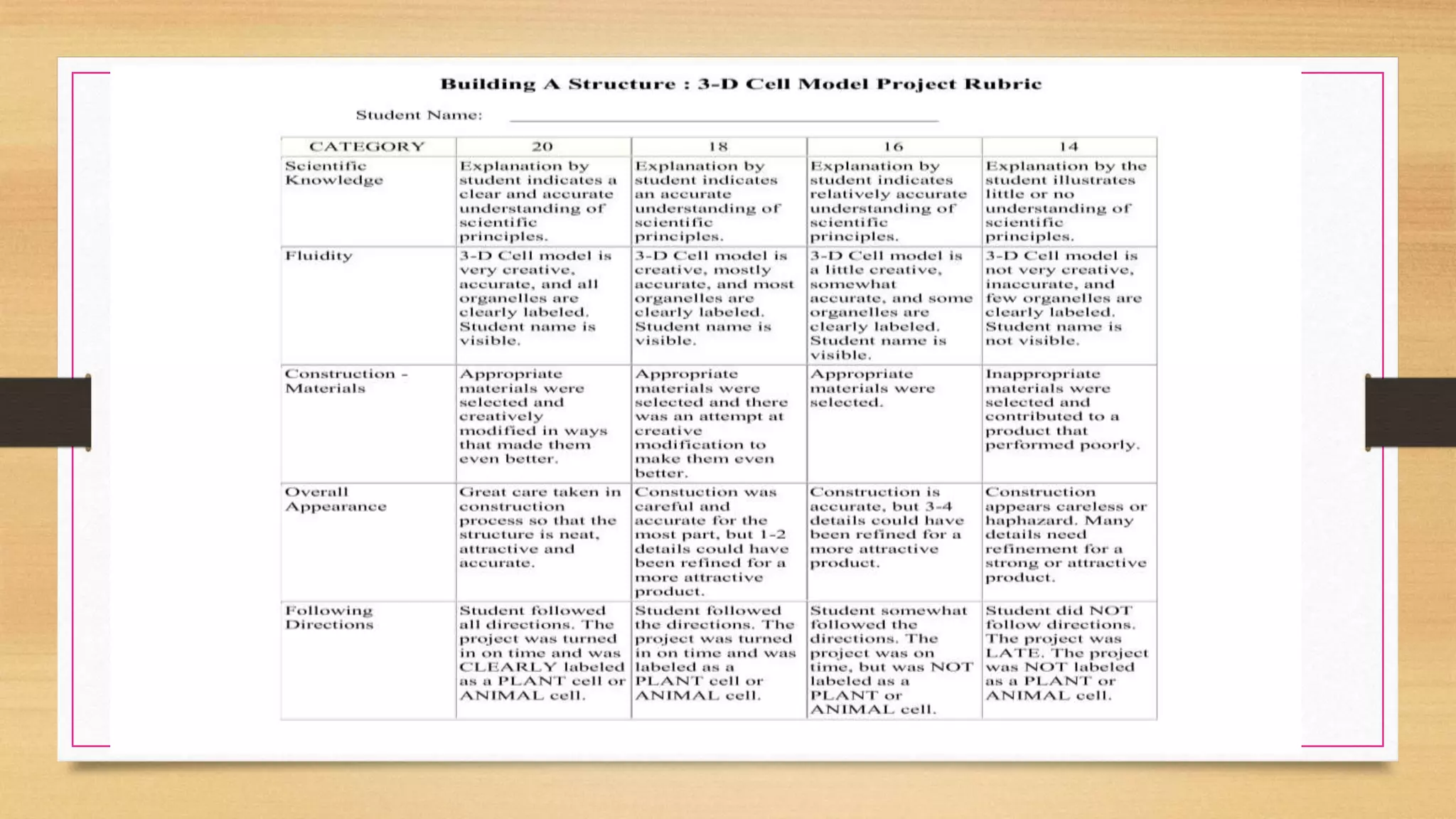
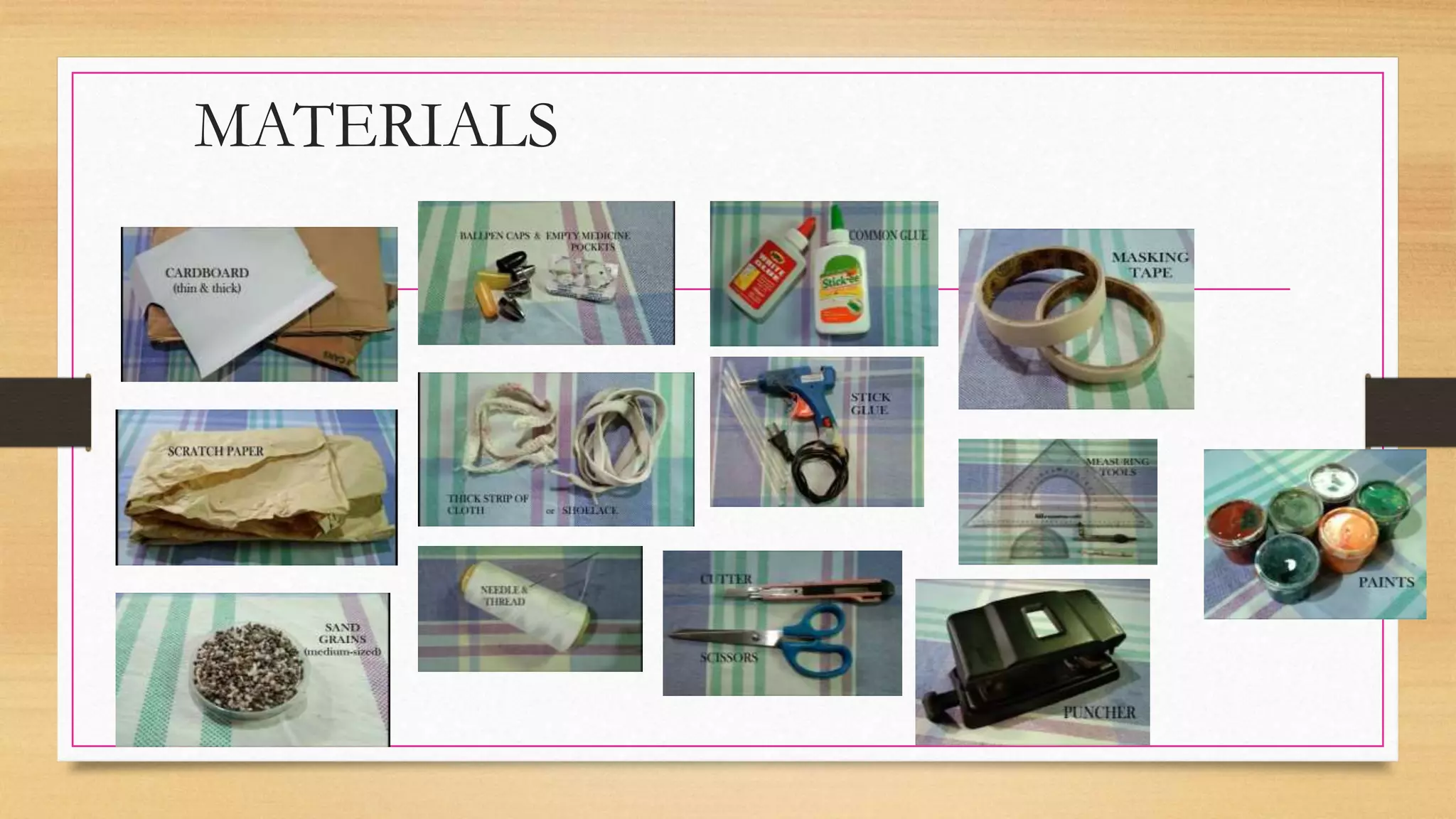
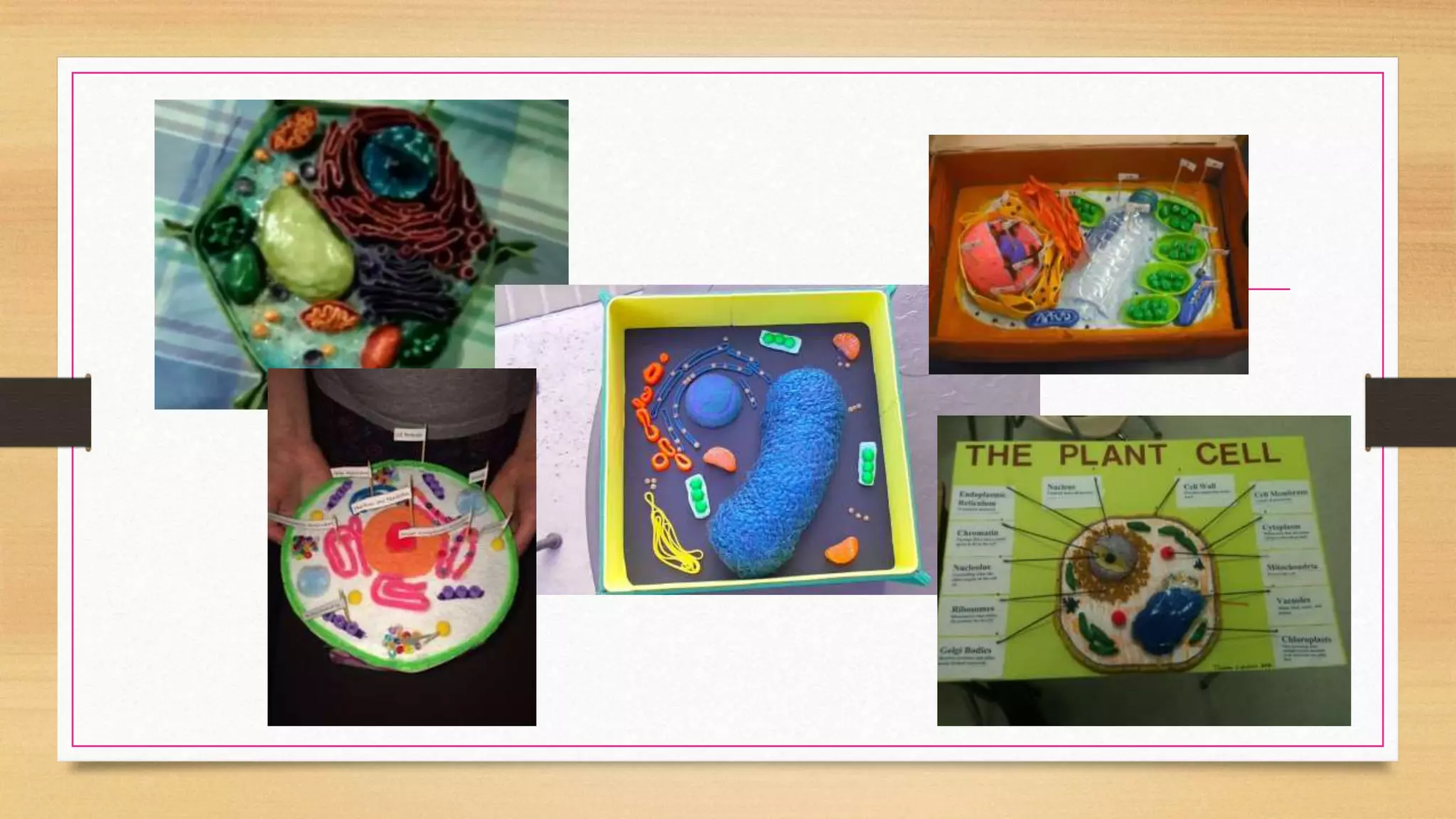
3-D CELL MODEL using recycled materials
(Student’s Activity)
Additional Activity
Tell the students to highlight, color and label the different organelles and cell parts and provide a written
explanation of the structure, location and function of each cell organelle
MATERIALS
STRUCTURE AND FUNC.pptx

STRUCTURE AND FUNC.pptx

  • 1.
    CELL STRUCTURE AND FUNCTION BY:MARIA SHEILA P. BERNALES
  • 2.
    ELICIT CELL TISSUE ORGANORGAN SYSTEM ORGANISM
  • 3.
    LEARNING OBJECTIVES Demonstrate yourknowledge of the cell as a basic unit of life by constructing a three dimensional model of a plant or animal cell and identifying its components and functions. Compare and contrast structures of plant and animal cells Explore the role of different structures within a cell
  • 4.
  • 5.
    • Ask thestudents how they understand the SHORT VIDEO.
  • 6.
    Post a largepicture of a cell with arrows pointing to different structures. There will be a word bank next to the picture. Students will be asked to identify the structures to the best of their abilities. This will prompt a discussion of cell structure and lead directly into the lesson. WORD BANK GAME WORD BANK MITOCHONDRIA CENTRIOLES CELL MEMBRANE RIBOSOMES NUCLEUS LYSOSOME NUCLEOLUS GOLGI BODY ROUGH ENDOPLASMIC RETICULUM SMOOTH ENDOPLASMIC RETICULUM EXPLORE
  • 7.
    CELL STRUCTURE ANDFUNCTION EXPLAIN/DISCUSSION ANIMAL CELL PLANT CELL
  • 8.
    COMPARING PLANTS ANDANIMALS CELL USING VENN DIAGRAM PLANT CELL ANIMAL CELL
  • 9.
    CELL • The basicunit of life is a cell. You will find that there are hundreds and millions of different types of living cells. These cells together make up a multicellular organism or an individual cell makes up a unicellular organism. Each cell is unique and has different functions and features. • Cells are differentiated as eukaryotic cells and prokaryotic cells.
  • 10.
    • Prokaryotic cellsmake up unicellular organisms that form the largest group of organisms. • All bacteria have a prokaryotic cell that have simple parts. • Eukaryotes on the other hand are an advanced form of cells that make up multicellular organisms and few unicellular organisms have complex parts.
  • 11.
    • CELL MEMBRANE-Theoutermost covering of a cell is called the cell membrane. The cell membrane acts like a traffic policeman that regulates entry and exit of substances, that is, ions and solutes. This helps in regulating the internal cell balance. CELL STRUCTURE AND FUNCTION
  • 12.
    • CELL WALL-Theoutermost covering of a plant cell is called the cell wall. It is made up of cellulose, and it helps provide mechanical support to the cell. It surrounds the cell membrane and helps maintain the pressure within the cell. • CENTROSOME-The centrosome is a part of the animal cell. An animal cell may contain one or two centrosomes that help in mitosis
  • 13.
    • CHLOROPLAST-Chloroplasts aregreen-colored plastids that are plant cell parts. They help in production of food in the presence of sunlight by photosynthesis. • CYTOPLASM- The mixture of water and soluble organic and inorganic compounds is called the cytoplasm. Most of the parts of a cell are suspended in the cytoplasm. All the metabolic functions and activities of an animal cell takes place here • ENDOPLASMIC RETICULUM -The tubular structures that are found near the nucleus and help provide support to both plant and animal cells is called the endoplasmic reticulum. There are two types of endoplasmic reticulum, the smooth reticulum without the attached ribosomes and rough endoplasmic reticulum with the attached ribosomes.
  • 14.
    • GOLGI BODIES-The golgi apparatus or bodies are flat vesicular structures that are stacked one above the other. They secrete and store hormones and enzymes that help in transportation out of the cell. • LYSOSOME -This part of an animal cell that is a membranous sac. It is part of the golgi apparatus that contains different enzymes. It helps in intracellular digestion and in the elimination of foreign substances. They are also known as the ‘suicide sacs’ because if one of them bursts, the entire cell will be destroyed. • MITOCHONDRIA- It is the powerhouse of the cell where ATP is generated by cellular respiration.
  • 15.
    • NUCLEUS-The brainof a cell, the cell nucleus, controls all the functions occurring in the cell. It contains the blueprint of life, that is, DNA • RIBOSOMES-The part of a cell that contains RNA that helps in protein synthesis. • VACUOLE-The large and abundant vesicle of a plant cell is called a vacuole. It contains fluids and helps in storage of substances, building material, and water. • The cell wall, central vacuole, and chloroplasts are the distinguishing parts of a plant and animal cell. The smallest unit of life is indeed the most important for sustenance of life!
  • 17.
    Elaborate • CELL CITYPROJECT/CELL ANALOGY (10 MINS.) • Group the students • Instruct the students to make their own model city and label various buildings as cell parts. • Make the city on a large poster so everyone can add to the picture. Example:
  • 20.
    Quiz MATCHING TYPE: Matchthe name picture of the organelle to a name to a function. 1. Cytoplasm 2. Cell membrane 3. Golgi apparatus 4. Lysosome 5. Mitochondria 6. Nuclear membrane 7. Nuclues 8. Ribosomes 9. Rough ER 10. Vacuoles a. Each cell has this protective, semi-permeable membrane. b. Inside the cell, this watery membrane where all the organelles float c. This organelle contains our DNA with all our genetic information d. These are little grains floating around inside the cell where proteins are made e. This is made up of folded membrane pathways spotted with the above organelle (little grain) f. This is made up of flat vesicles that package things, like hormones, to leave the cell. g. These are vesicles with digestive enzymes inside that break down things, like bacteria the cell doesn’t need. h. These are membrane sacs for storing things. i. They break down sugar to make ATP, which is used by the cell as energy. ORGANELLES NAME FUNCTIONS
  • 21.
    3-D CELL MODELusing recycled materials (Student’s Activity) Additional Activity Tell the students to highlight, color and label the different organelles and cell parts and provide a written explanation of the structure, location and function of each cell organelle
  • 23.