CELL STRUCTURE AND
FUNCTION
NITISH KUMAR
DATE : 10/04/2023
contents
1. History of cell study
2. Basic attributes of cells
3. Cell structures in plants and animals
4. Diseases associated with cell organelles
I. The history of cell study
A. Robert Hooke—1665—coined the word cell, looked at
cork cells
B. Antonie van Leeuwenhoek
• Created optics that could visualize single cells
• His technology “lost” for nearly 200 years
 C. Robert Brown—1831—discovered the "nucleus"
I. The history of cell study
 D. Theodor Schwann—1838—viewed animal cells in
cartilage
 1. Cells are the elementary particles of plants and
animals
 E. Mattias Schleiden—Cells are the fundamental basis
of life
 F. Virchow—1858—All cells come from cells
I. The history of cell study
 F. Cell theory
1. All living things are composed of one or more cells
• What about viruses?
 2. Cells are the basic unit of structure and function
 3. All cells come from preexisting cells
II. Attributes of cells
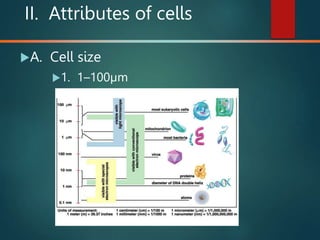
A. Cell size
1. 1–100µm
II. Attributes of cells
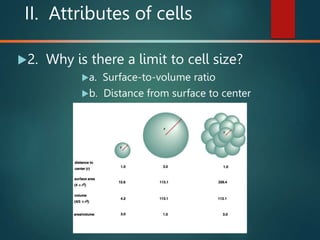
2. Why is there a limit to cell size?
a. Surface-to-volume ratio
b. Distance from surface to center
II. Attributes of cells
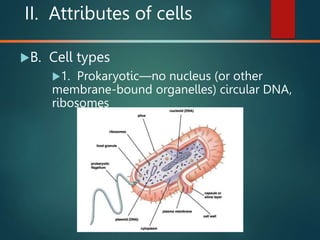
B. Cell types
1. Prokaryotic—no nucleus (or other
membrane-bound organelles) circular DNA,
ribosomes
II. Attributes of cells
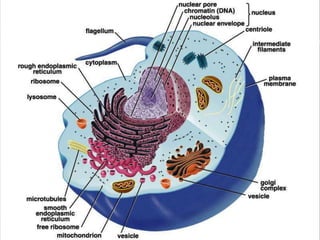
 B. Cell types
 2. Eukaryotic—larger, nucleus, linear chromosomes,
membranous organelles
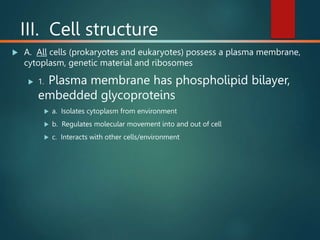
III. Cell structure
 A. All cells (prokaryotes and eukaryotes) possess a plasma membrane,
cytoplasm, genetic material and ribosomes
 1. Plasma membrane has phospholipid bilayer,
embedded glycoproteins
 a. Isolates cytoplasm from environment
 b. Regulates molecular movement into and out of cell
 c. Interacts with other cells/environment
III. Cell structure
 A. All cells possess a plasma membrane, cytoplasm,
genetic material and ribosomes (cont.)
2. Genetic material—DNA, found in the nucleus (of
eukaryotes)
• Within cytoplasm of prokaryotes
 3. Cytoplasm—water, salts, organic monomers and
polymers
 a. Contains organelles
III. Cell structure
 B. Organelles
 1. Ribosomes assemble amino acid monomers into
polypeptide chains
 a. Associated with the ER in eukaryotes
b. Composed of RNA and proteins
c. Both prokaryotes and eukaryotes have ribosomes
d. NOTE: Other organelles are present only in eukaryotes
III. Cell structure
B. Organelles (cont.)
 2. Endoplasmic reticulum consists of folded
membranes contiguous with outer nuclear
membrane
a. Rough ER: protein synthesis and secretion
b.Smooth ER: lipid synthesis and secretion
3. Golgi apparatus: membranous sacs associated
with the ER
a. Sorts proteins and lipids by destination
b.Modifies some molecules
c. Packages these materials, then transports them to
appropriate location
 4. Lysosomes are Golgi-derived vesicles
containing digestive enzymes
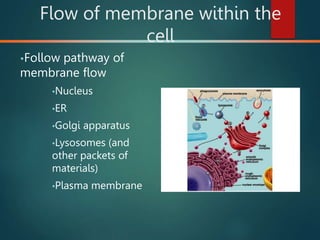
Flow of membrane within the
cell
•Follow pathway of
membrane flow
•Nucleus
•ER
•Golgi apparatus
•Lysosomes (and
other packets of
materials)
•Plasma membrane
III. Cell structure
 B. Organelles (cont.)
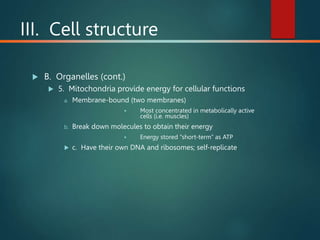
 5. Mitochondria provide energy for cellular functions
a. Membrane-bound (two membranes)
 Most concentrated in metabolically active
cells (i.e. muscles)
b. Break down molecules to obtain their energy
 Energy stored “short-term” as ATP
 c. Have their own DNA and ribosomes; self-replicate
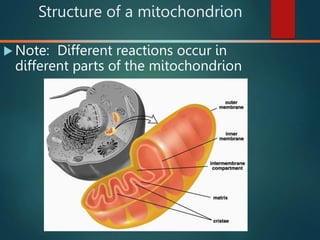
Structure of a mitochondrion
 Note: Different reactions occur in
different parts of the mitochondrion
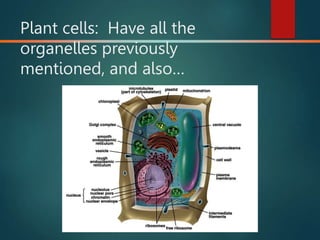
Plant cells: Have all the
organelles previously
mentioned, and also…
III. Cell structure
 B. Organelles (cont.)
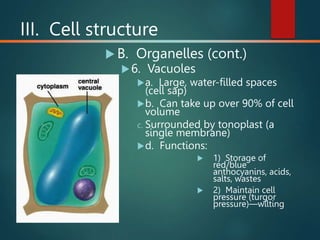
6. Vacuoles
a. Large, water-filled spaces
(cell sap)
b. Can take up over 90% of cell
volume
c. Surrounded by tonoplast (a
single membrane)
d. Functions:
 1) Storage of
red/blue
anthocyanins, acids,
salts, wastes
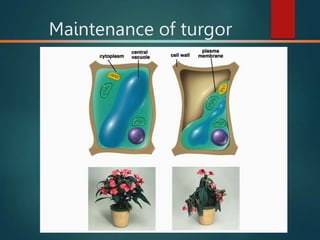
 2) Maintain cell
pressure (turgor
pressure)—wilting
Maintenance of turgor
pressure
III. Cell structure
 B. Organelles (cont.)
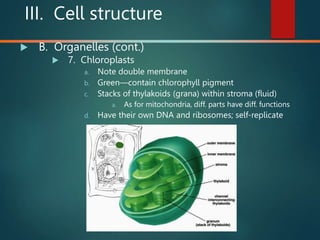
 7. Chloroplasts
a. Note double membrane
b. Green—contain chlorophyll pigment
c. Stacks of thylakoids (grana) within stroma (fluid)
a. As for mitochondria, diff. parts have diff. functions
d. Have their own DNA and ribosomes; self-replicate
III. Cell structure
 B. Organelles (cont.)
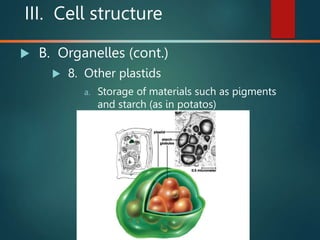
 8. Other plastids
a. Storage of materials such as pigments
and starch (as in potatos)
III. Cell structure
 B. Organelles (cont.)
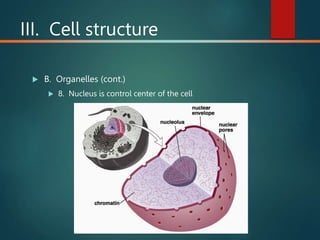
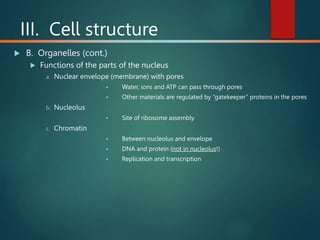
 8. Nucleus is control center of the cell
III. Cell structure
 B. Organelles (cont.)
 Functions of the parts of the nucleus
a. Nuclear envelope (membrane) with pores
 Water, ions and ATP can pass through pores
 Other materials are regulated by “gatekeeper” proteins in the pores
b. Nucleolus
 Site of ribosome assembly
c. Chromatin
 Between nucleolus and envelope
 DNA and protein (not in nucleolus!)
 Replication and transcription
III. Cell structure
 C. Cell walls in plant cells, prokaryotic cells, fungi
1. Plants
 Cell walls of cellulose (Ch. 3)
2. Fungi
 Cell walls of chitin (Ch. 3)
3. Function: support, protection
4. NOTE: Animal cells do not have cell walls!
III. Cell structure
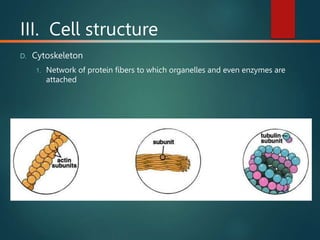
D. Cytoskeleton
1. Network of protein fibers to which organelles and even enzymes are
attached
 Microfilaments Intermed. Fil. Microtubules
III. Cell structure
 Cytoskeleton functions
1. Cell shape
2. Organization of cellular structures
3. Cell movement
 Caused by assembly, disassembly and sliding of
the filaments
4. Organelle movement
 Ex: Endocytosis
 Movement of membrane from ER to Golgi
apparatus, etc…
5. Cell division
III. Cell structure
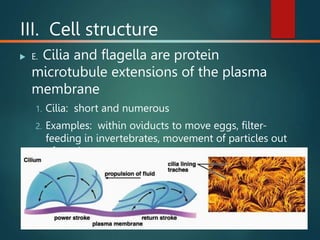
 E. Cilia and flagella are protein
microtubule extensions of the plasma
membrane
1. Cilia: short and numerous
2. Examples: within oviducts to move eggs, filter-
feeding in invertebrates, movement of particles out
of respiratory system
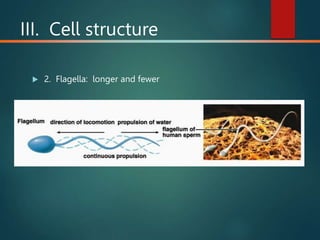
III. Cell structure
 2. Flagella: longer and fewer
Diseases associated with cell
organelles
 Cilia and Kartagener syndrome
It’s a variant of primary ciliary dyskinesia
consisting of bronchiectasis, situs inversus, and
chronic sinusitis. Kartagener syndrome is caused
by defects in the dynein arms of cilia, which make
them unable to beat appropriately. Because
embryonic cilia are also affected, body asymmetry
is randomized such that 50% of patients with
Kartagener syndrome will have situs inversus in
addition to respiratory and sinusitis symptoms.
The dilation of bronchial space leads to recurrent
infections and productive sputum. Bronchiectasis
develops over time; patients are not born with it.
 Golgi body and I-cell disease

Golgi disorders might result in malfunction of the
secretory pathways, which package and secrete proteins
synthesized in the rough endoplasmic reticulum, such as
I-cell disease, also referred to as mucolipidosis II.
 It is caused by a failure of the Golgi body to properly
phosphorylate and sort proteins, resulting in secretion of
some proteins that would otherwise be destined for
lysosomes. Patients with I-cell disease present with failure
to thrive, skeletal abnormalities, and coarse facial
features.
 Lysosomes and Pompe Disease

Lysosomes are membrane-bound organelles
containing hydrolytic enzymes that break
down cellular debris.
 ι1,4-Glucosidase deficiency, a lysosomal
storage disorder, is one of the causes of
Pompe disease. Patients with this condition
present with exercise intolerance and develop
infantile hypertrophic cardiomyopathy.
 Ribosomes and Treacher-Collins syndrome
Ribosomes are involved in protein synthesis,
which is fundamental to the survival of cells.
Ribosomal dysfunction leads to severe deficits.
 Treacher-Collins syndrome, a ribosomopathy,
presents with mandibular hypoplasia and facial
abnormalities such as cleft palate. Patients with
Diamond-Blackfan anemia, another
ribosomopathy, present with macrocytic anemia
and skeletal abnormalities.
 Mitochondria and MELAS syndrome
Because mitochondria are involved in adenosine

triphosphate (ATP) generation by cells,
mitochondrial disorders affect a cell’s ability to
produce ATP.
 An example is MELAS syndrome, which presents
with mitochondrial encephalopathy, lactic
acidosis, and stroke-like episodes (MELAS).
Mitochondrial myopathy is another example of a
mitochondrial disorder and often presents with
myopathy, lactic acidosis, and central nervous
system disease.
Summary
- Robert Hooke—1665—coined the word cell, looked at
cork cells
- All living things are composed of one or more cells as
their structural and functional units whuich arises from
pre existing cells.
- All cells (prokaryotes and eukaryotes) possess a
plasma membrane, cytoplasm, genetic material and
ribosomes
- Basic structure of cells in plants and animals with
organelles within.
- Disorders of different cell organelles
Thank you

Cell structure and function basics of cell biology

  • 1.
    CELL STRUCTURE AND FUNCTION NITISHKUMAR DATE : 10/04/2023
  • 2.
    contents 1. History ofcell study 2. Basic attributes of cells 3. Cell structures in plants and animals 4. Diseases associated with cell organelles
  • 3.
    I. The historyof cell study A. Robert Hooke—1665—coined the word cell, looked at cork cells B. Antonie van Leeuwenhoek • Created optics that could visualize single cells • His technology “lost” for nearly 200 years  C. Robert Brown—1831—discovered the "nucleus"
  • 4.
    I. The historyof cell study  D. Theodor Schwann—1838—viewed animal cells in cartilage  1. Cells are the elementary particles of plants and animals  E. Mattias Schleiden—Cells are the fundamental basis of life  F. Virchow—1858—All cells come from cells
  • 5.
    I. The historyof cell study  F. Cell theory 1. All living things are composed of one or more cells • What about viruses?  2. Cells are the basic unit of structure and function  3. All cells come from preexisting cells
  • 6.
    II. Attributes ofcells A. Cell size 1. 1–100µm
  • 7.
    II. Attributes ofcells 2. Why is there a limit to cell size? a. Surface-to-volume ratio b. Distance from surface to center
  • 8.
    II. Attributes ofcells B. Cell types 1. Prokaryotic—no nucleus (or other membrane-bound organelles) circular DNA, ribosomes
  • 9.
    II. Attributes ofcells  B. Cell types  2. Eukaryotic—larger, nucleus, linear chromosomes, membranous organelles
  • 11.
    III. Cell structure A. All cells (prokaryotes and eukaryotes) possess a plasma membrane, cytoplasm, genetic material and ribosomes  1. Plasma membrane has phospholipid bilayer, embedded glycoproteins  a. Isolates cytoplasm from environment  b. Regulates molecular movement into and out of cell  c. Interacts with other cells/environment
  • 12.
    III. Cell structure A. All cells possess a plasma membrane, cytoplasm, genetic material and ribosomes (cont.) 2. Genetic material—DNA, found in the nucleus (of eukaryotes) • Within cytoplasm of prokaryotes  3. Cytoplasm—water, salts, organic monomers and polymers  a. Contains organelles
  • 13.
    III. Cell structure B. Organelles  1. Ribosomes assemble amino acid monomers into polypeptide chains  a. Associated with the ER in eukaryotes b. Composed of RNA and proteins c. Both prokaryotes and eukaryotes have ribosomes d. NOTE: Other organelles are present only in eukaryotes
  • 14.
    III. Cell structure B.Organelles (cont.)  2. Endoplasmic reticulum consists of folded membranes contiguous with outer nuclear membrane a. Rough ER: protein synthesis and secretion b.Smooth ER: lipid synthesis and secretion 3. Golgi apparatus: membranous sacs associated with the ER a. Sorts proteins and lipids by destination b.Modifies some molecules c. Packages these materials, then transports them to appropriate location  4. Lysosomes are Golgi-derived vesicles containing digestive enzymes
  • 15.
    Flow of membranewithin the cell •Follow pathway of membrane flow •Nucleus •ER •Golgi apparatus •Lysosomes (and other packets of materials) •Plasma membrane
  • 16.
    III. Cell structure B. Organelles (cont.)  5. Mitochondria provide energy for cellular functions a. Membrane-bound (two membranes)  Most concentrated in metabolically active cells (i.e. muscles) b. Break down molecules to obtain their energy  Energy stored “short-term” as ATP  c. Have their own DNA and ribosomes; self-replicate
  • 17.
    Structure of amitochondrion  Note: Different reactions occur in different parts of the mitochondrion
  • 18.
    Plant cells: Haveall the organelles previously mentioned, and also…
  • 19.
    III. Cell structure B. Organelles (cont.) 6. Vacuoles a. Large, water-filled spaces (cell sap) b. Can take up over 90% of cell volume c. Surrounded by tonoplast (a single membrane) d. Functions:  1) Storage of red/blue anthocyanins, acids, salts, wastes  2) Maintain cell pressure (turgor pressure)—wilting
  • 20.
  • 21.
    III. Cell structure B. Organelles (cont.)  7. Chloroplasts a. Note double membrane b. Green—contain chlorophyll pigment c. Stacks of thylakoids (grana) within stroma (fluid) a. As for mitochondria, diff. parts have diff. functions d. Have their own DNA and ribosomes; self-replicate
  • 22.
    III. Cell structure B. Organelles (cont.)  8. Other plastids a. Storage of materials such as pigments and starch (as in potatos)
  • 23.
    III. Cell structure B. Organelles (cont.)  8. Nucleus is control center of the cell
  • 24.
    III. Cell structure B. Organelles (cont.)  Functions of the parts of the nucleus a. Nuclear envelope (membrane) with pores  Water, ions and ATP can pass through pores  Other materials are regulated by “gatekeeper” proteins in the pores b. Nucleolus  Site of ribosome assembly c. Chromatin  Between nucleolus and envelope  DNA and protein (not in nucleolus!)  Replication and transcription
  • 25.
    III. Cell structure C. Cell walls in plant cells, prokaryotic cells, fungi 1. Plants  Cell walls of cellulose (Ch. 3) 2. Fungi  Cell walls of chitin (Ch. 3) 3. Function: support, protection 4. NOTE: Animal cells do not have cell walls!
  • 26.
    III. Cell structure D.Cytoskeleton 1. Network of protein fibers to which organelles and even enzymes are attached  Microfilaments Intermed. Fil. Microtubules
  • 27.
    III. Cell structure Cytoskeleton functions 1. Cell shape 2. Organization of cellular structures 3. Cell movement  Caused by assembly, disassembly and sliding of the filaments 4. Organelle movement  Ex: Endocytosis  Movement of membrane from ER to Golgi apparatus, etc… 5. Cell division
  • 28.
    III. Cell structure E. Cilia and flagella are protein microtubule extensions of the plasma membrane 1. Cilia: short and numerous 2. Examples: within oviducts to move eggs, filter- feeding in invertebrates, movement of particles out of respiratory system
  • 29.
    III. Cell structure 2. Flagella: longer and fewer
  • 30.
    Diseases associated withcell organelles  Cilia and Kartagener syndrome It’s a variant of primary ciliary dyskinesia consisting of bronchiectasis, situs inversus, and chronic sinusitis. Kartagener syndrome is caused by defects in the dynein arms of cilia, which make them unable to beat appropriately. Because embryonic cilia are also affected, body asymmetry is randomized such that 50% of patients with Kartagener syndrome will have situs inversus in addition to respiratory and sinusitis symptoms. The dilation of bronchial space leads to recurrent infections and productive sputum. Bronchiectasis develops over time; patients are not born with it.
  • 31.
     Golgi bodyand I-cell disease  Golgi disorders might result in malfunction of the secretory pathways, which package and secrete proteins synthesized in the rough endoplasmic reticulum, such as I-cell disease, also referred to as mucolipidosis II.  It is caused by a failure of the Golgi body to properly phosphorylate and sort proteins, resulting in secretion of some proteins that would otherwise be destined for lysosomes. Patients with I-cell disease present with failure to thrive, skeletal abnormalities, and coarse facial features.
  • 32.
     Lysosomes andPompe Disease  Lysosomes are membrane-bound organelles containing hydrolytic enzymes that break down cellular debris.  ι1,4-Glucosidase deficiency, a lysosomal storage disorder, is one of the causes of Pompe disease. Patients with this condition present with exercise intolerance and develop infantile hypertrophic cardiomyopathy.
  • 33.
     Ribosomes andTreacher-Collins syndrome Ribosomes are involved in protein synthesis, which is fundamental to the survival of cells. Ribosomal dysfunction leads to severe deficits.  Treacher-Collins syndrome, a ribosomopathy, presents with mandibular hypoplasia and facial abnormalities such as cleft palate. Patients with Diamond-Blackfan anemia, another ribosomopathy, present with macrocytic anemia and skeletal abnormalities.
  • 34.
     Mitochondria andMELAS syndrome Because mitochondria are involved in adenosine triphosphate (ATP) generation by cells, mitochondrial disorders affect a cell’s ability to produce ATP.  An example is MELAS syndrome, which presents with mitochondrial encephalopathy, lactic acidosis, and stroke-like episodes (MELAS). Mitochondrial myopathy is another example of a mitochondrial disorder and often presents with myopathy, lactic acidosis, and central nervous system disease.
  • 35.
    Summary - Robert Hooke—1665—coinedthe word cell, looked at cork cells - All living things are composed of one or more cells as their structural and functional units whuich arises from pre existing cells. - All cells (prokaryotes and eukaryotes) possess a plasma membrane, cytoplasm, genetic material and ribosomes - Basic structure of cells in plants and animals with organelles within. - Disorders of different cell organelles
  • 36.

Editor's Notes