PLANT
TISSUES
Tissues
- are group of ceIIs performing the same function
- ceIIs that are structurally and/functionally similar
Plant Tissue Types:
A. Meristematic tissues
B. Permanent tissues
I. Meristematic
II. Permanent
A. Dermal- surface

Epidermis

Periderm
B. Ground

Parenchyma

Collenchyma

Sclerenchyma
C. Vascular

Xylem

Phloem
Plant Tissue Classification
- composed of actively dividing ceIIs
- responsible for the production of ceIIs
- have thin cellulose cell walls
- cells are varied in shape
- compactly arranged; no intercellular space
- cells have dense or abundant cytoplasm and
a single large nucleus
- with few or no vacuoles at all
I. Meristematic tissues
Apical meristems – found at the tip of stems &
roots, responsible for primary growth
Lateral meristems – a.k.a. cambia
(singular:cambium)
- found along the sides of roots & stems
- responsible for secondary growth
- types: 1. vascular cambium 2. cork cambium
Intercalary meristems – found at the bases of
young leaves & internodes
- responsible for further lengthening of stems
& leaves
Kinds of meristems (based on location):
New cells formed in the meristems of a plant
are similar in appearance and function
Some must remain meristematic
Most mature and become other tissues
II. Permanent tissues
- tissues that attained their mature form
and perform specific functions
- they stop dividing
Types:
 Simple permanent tissues
 Complex permanent tissues
A simple tissue is composed of only one cell type.
Complex tissues contain more than one cell type

Simple permanent tissues
- consist only of one kind of cells
A. Dermal / surface tissue
- external tissues
- forms protective covering of the plant body
a. epidermis
b. periderm
 Epidermis
- the outermost layer of the primary plant body -
covers the leaves, floral parts, fruits, seeds,
stems and roots
- generally only one layer thick with cuticle
- composed mostly of unspecialized cells, either
parenchyma and/or sclerenchyma
- contains trichomes, stomata, buIIiform ceIIs
(in grasses)
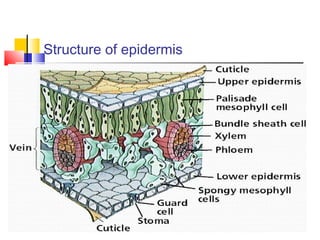
Structure of epidermis
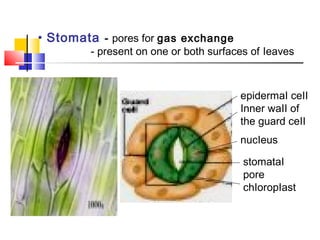
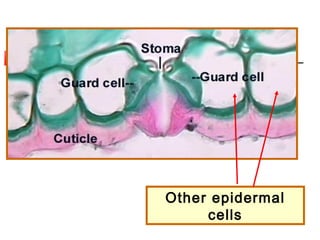
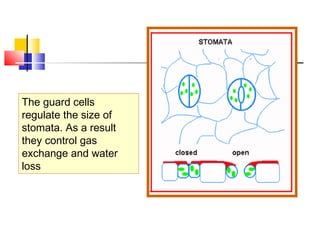
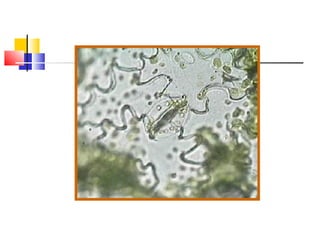
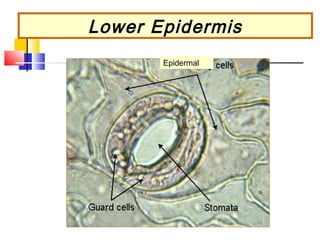
• Stomata - pores for gas exchange
- present on one or both surfaces of Ieaves
epidermaI ceII
Inner waII of
the guard ceII
nucIeus
stomataI
pore
chIoropIast
Other epidermal
cells
The guard cells
regulate the size of
stomata. As a result
they control gas
exchange and water
loss
Epidermal
Lower Epidermis
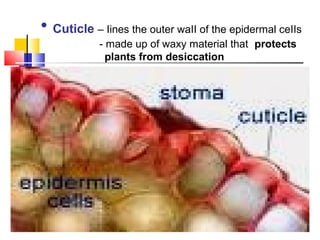
• Cuticle – Iines the outer waII of the epidermal ceIIs
- made up of waxy material that protects
plants from desiccation
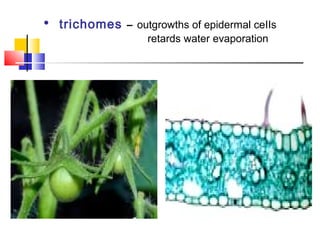
• trichomes – outgrowths of epidermal ceIIs
retards water evaporation
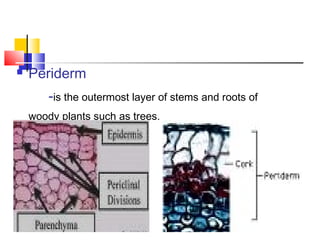
 Periderm
-is the outermost layer of stems and roots of
woody plants such as trees.
B. Ground tissues
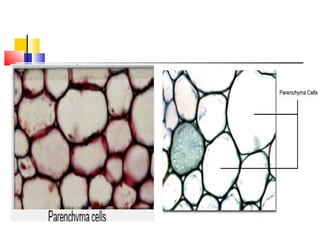
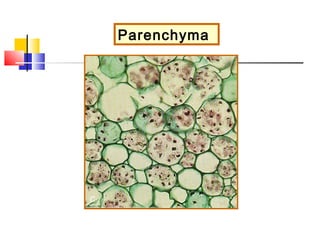
1. Parenchyma
- are the general purpose ceIIs of plants
- cells are rounded in shape & have uniformly thin
walls found in all parts of the plants.
- living at maturity, have large vacuoles
- location Ieaf, stem (pith), roots, fruits
Functions:
*basic metabolic function (respiration, photosynthesis
chlorenchyma in leaf & protein synthesis)
*storage (potatoes, fruits, & seeds)
*wound healing and regeneration
Parenchyma
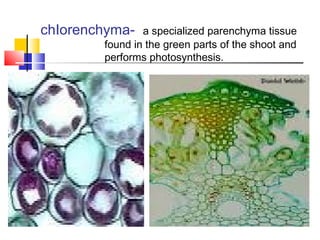
chIorenchyma- a specialized parenchyma tissue
found in the green parts of the shoot and
performs photosynthesis.
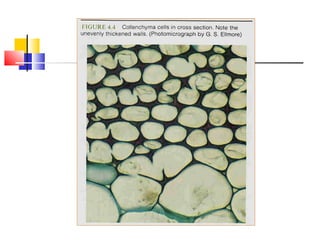
2. CoIIenchyma
- Greek word kolla which means “glue”
- cells are elongated (up to 2mm long) with unevenly
thickened walls ( thin on the sides but thick at the
angles where 2 or more cells meet)
- differentiate from parenchyma cells & are alive at
maturity
Functions:
 Support & elasticity (stem surfaces & along leaf veins)
 regeneration
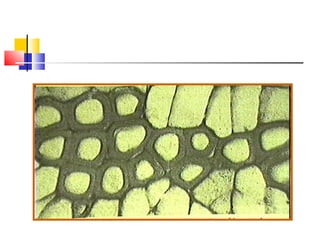
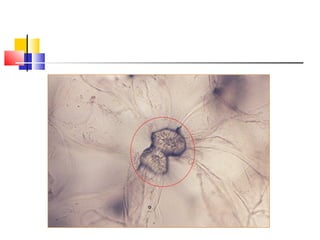
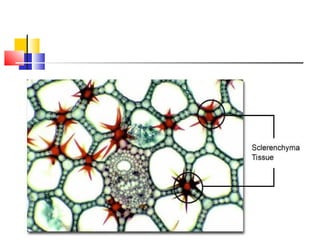
3. ScIerenchyma
- sclerenchyma cells which are non-living
and lack protoplasts at maturity
- have thick, lignified secondary walls
- provide strength and support in parts that
have ceased elongating or mature
Types:
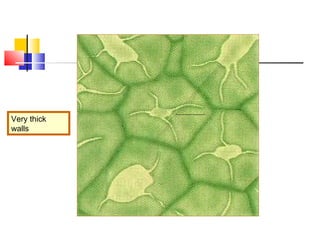
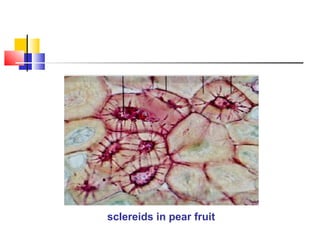
1. scIereids or stone cells
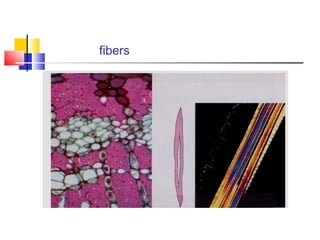
2. fibers
Very thick
walls
scIereids in pear fruit
fibers
 Complex Permanent Tissues
Vascular Tissues
- specialized for long-distance transport of water
and dissolved substances.
- contain transfer ceIIs, fibers in addition to
parenchyma and conducting ceIIs
- location, the veins in Ieaves
 types
1. Xylem
2. phloem
 Xylem
- GW xyIos w/c means “wood”
- transports water and dissolved nutrients from
the roots to aII parts of a plant.
- direction of transport is upward
2 types
 Primary xylem – differentiates from procambium in the
apical meristem & occurs throughout the primary plant
body.
 Secondary xylem – differentiates from vascular cambium
& is commonly called wood.
 Xylary elements – the conducting cells in xylem
tracheids – lignified, elongated, tapering tubes which
are dead at maturity. serve for strength & conduction
vessels – long, lignified continuous tubes serve
chiefly for conduction
xylem fibers - elongated, pointed strengthening cells
with much thickened cell walls
xylem parenchyma – for storage
 PhIoem
- Greek word phloios meaning, “bark”
- transports dissolved organic / food materials from
the Ieaves to the different parts of the plant
- glucose in phloem moves in aII directions
Types
1. Primary phloem – differentiate from procambium and
extends throughout the primary body of the plant.
2. Secondary phIoem – differentiates from the vascular
cambium and constitute the inner layer of the bark.
sieve tubes – main conducting ceIIs of the phloem
companion cells – border the sieve cells and aide it in
conduction
phloem fibers – thick walled, elongated, strengthening
cells
phloem parenchyma cells – storage cells