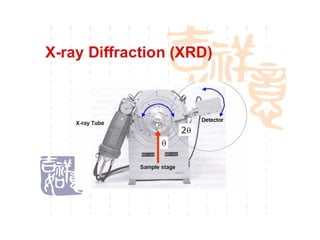
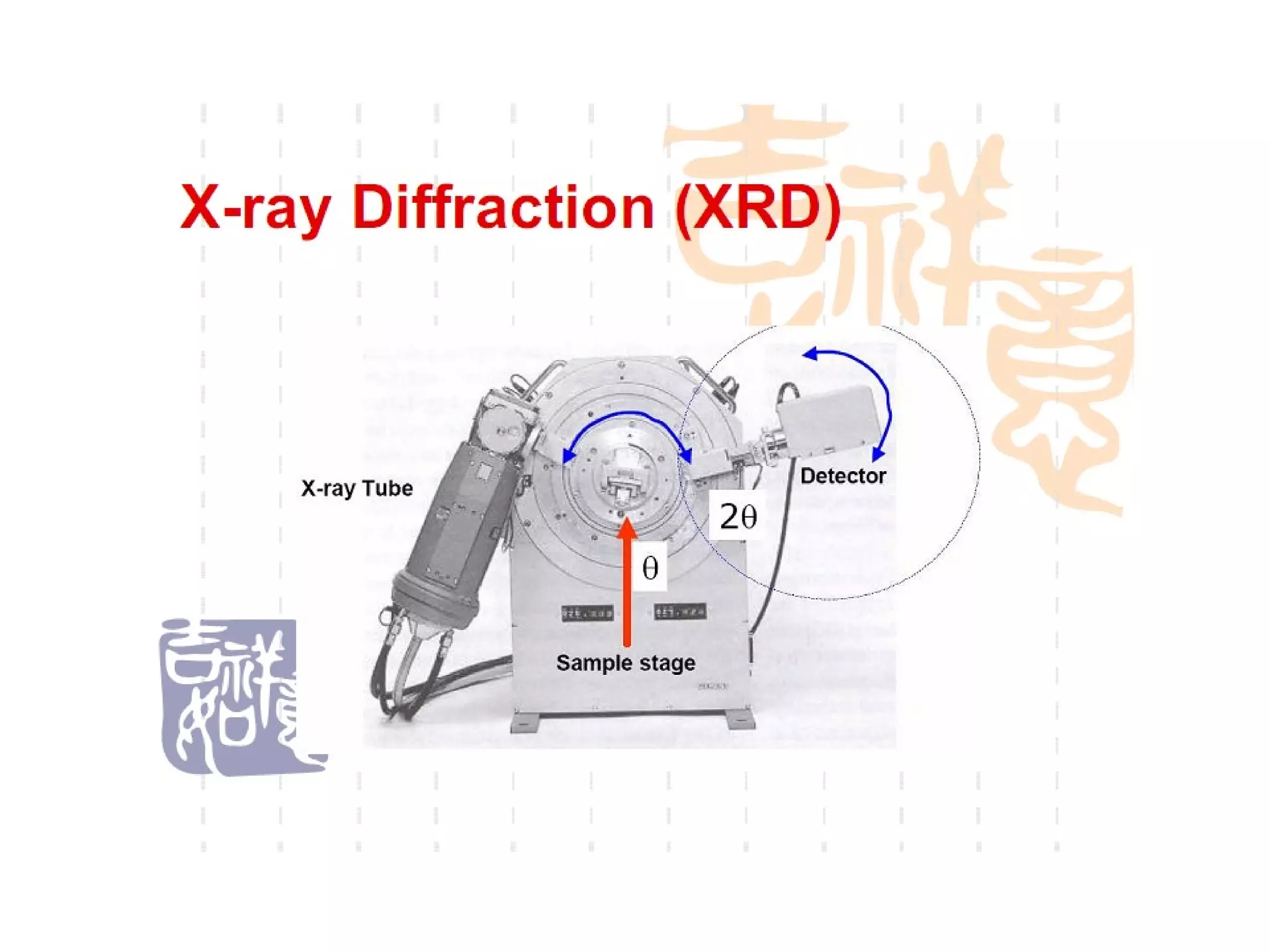
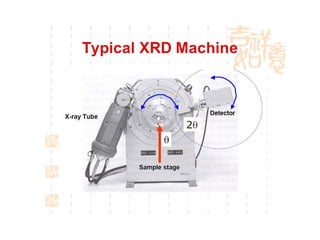
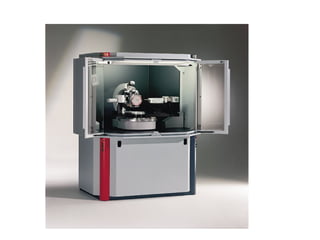
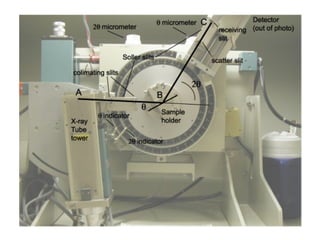
Essential Parts of the Diffractometer
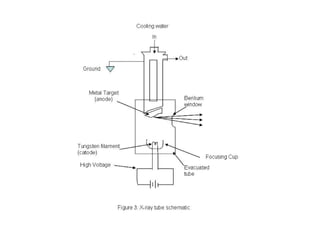
• X-ray Tube: the source of X Rays
• Incident-beam optics: condition the X-ray beam
  before it hits the sample
• The goniometer: the platform that holds and
  moves the sample, optics, detector, and/or tube
• The sample & sample holder
• Receiving-side optics: condition the X-ray beam
  after it has encountered the sample
• Detector: count the number of X Rays scattered
  by the sample
Instrumentation
• Production of X-Rays
• Collimator
• Monochromator
   Filter
   Crystal monochromator
• Detector
   Photographic methods
   Counter methods
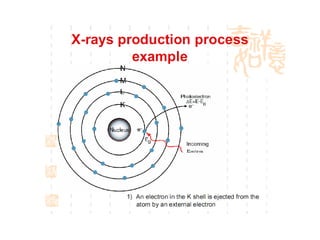
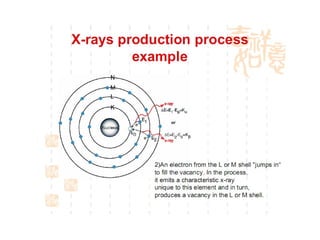
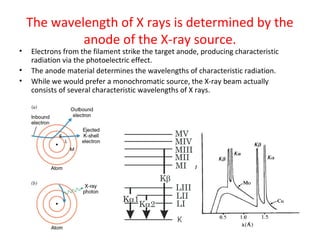
The wavelength of X rays is determined by the
             anode of the X-ray source.
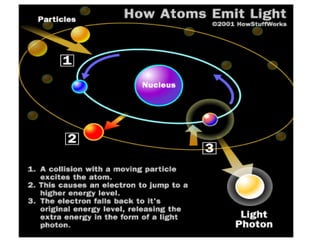
•   Electrons from the filament strike the target anode, producing characteristic
    radiation via the photoelectric effect.
•   The anode material determines the wavelengths of characteristic radiation.
•   While we would prefer a monochromatic source, the X-ray beam actually
    consists of several characteristic wavelengths of X rays.


            K
                L
                    M
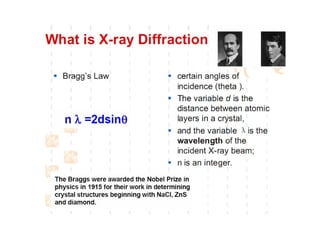
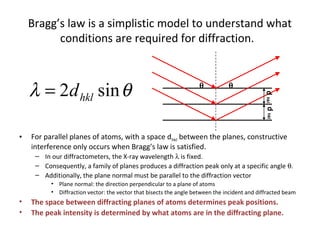
Bragg’s law is a simplistic model to understand what
          conditions are required for diffraction.


    λ = 2d hkl sin θ                                                θ          θ


                                                                                             d hkl d hkl
•   For parallel planes of atoms, with a space dhkl between the planes, constructive
    interference only occurs when Bragg’s law is satisfied.
     – In our diffractometers, the X-ray wavelength λ is fixed.
     – Consequently, a family of planes produces a diffraction peak only at a specific angle θ.
     – Additionally, the plane normal must be parallel to the diffraction vector
          • Plane normal: the direction perpendicular to a plane of atoms
          • Diffraction vector: the vector that bisects the angle between the incident and diffracted beam
•   The space between diffracting planes of atoms determines peak positions.
•   The peak intensity is determined by what atoms are in the diffracting plane.
XRD-Methods
•   Laue photographic method
•   Braggs X-Ray spectrometer
•   Rotating crystal method
•   Powder method
Laue photographic method
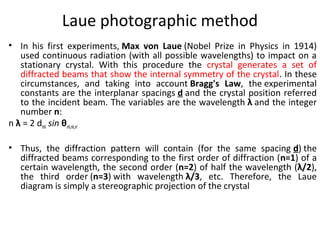
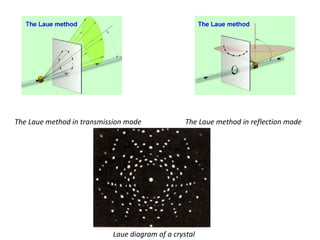
• In his first experiments, Max von Laue (Nobel Prize in Physics in 1914)
   used continuous radiation (with all possible wavelengths) to impact on a
   stationary crystal. With this procedure the crystal generates a set of
   diffracted beams that show the internal symmetry of the crystal. In these
   circumstances, and taking into account Bragg's Law, the experimental
   constants are the interplanar spacings d and the crystal position referred
   to the incident beam. The variables are the wavelength λ and the integer
   number n:
n λ = 2 dhkl sin θnh,nk,nl

• Thus, the diffraction pattern will contain (for the same spacing d) the
  diffracted beams corresponding to the first order of diffraction (n=1) of a
  certain wavelength, the second order (n=2) of half the wavelength (λ/2),
  the third order (n=3) with wavelength λ/3, etc. Therefore, the Laue
  diagram is simply a stereographic projection of the crystal
The Laue method in transmission mode             The Laue method in reflection mode


                           Laue diagram of a crystal
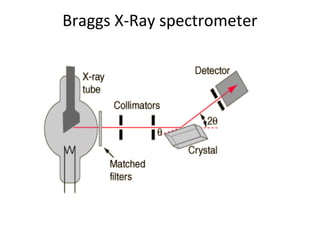
Braggs X-Ray spectrometer
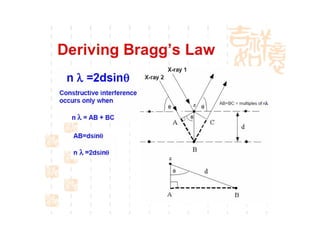
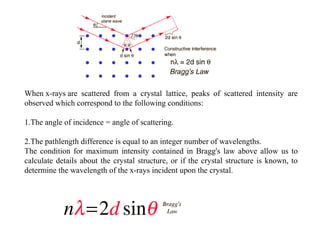
When x-rays are  scattered  from  a  crystal  lattice,  peaks  of  scattered  intensity  are 
observed which correspond to the following conditions:

1.The angle of incidence = angle of scattering.

2.The pathlength difference is equal to an integer number of wavelengths.
The  condition  for  maximum  intensity  contained  in  Bragg's  law  above  allow  us  to 
calculate  details  about  the  crystal  structure,  or  if  the  crystal  structure  is  known,  to 
determine the wavelength of the x-rays incident upon the crystal.
  
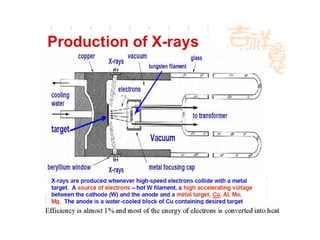
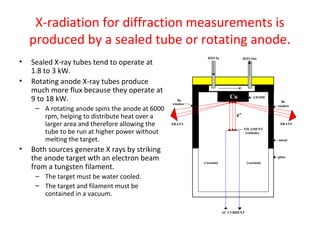
X-radiation for diffraction measurements is
    produced by a sealed tube or rotating anode.
                                                             H2O In              H2O Out
•   Sealed X-ray tubes tend to operate at
    1.8 to 3 kW.
•   Rotating anode X-ray tubes produce
    much more flux because they operate at
    9 to 18 kW.                                      Be
                                                                         Cu           ANODE
                                                                                                Be
                                                  window
     – A rotating anode spins the anode at 6000                                               window


       rpm, helping to distribute heat over a                               e-
       larger area and therefore allowing the     XRAYS                                        XRAYS

       tube to be run at higher power without                                    FILAMENT
                                                                                  (cathode)

       melting the target.                                                                    metal

•   Both sources generate X rays by striking
    the anode target wth an electron beam                  (vacuum)                (vacuum)
                                                                                              glass


    from a tungsten filament.
     – The target must be water cooled.
     – The target and filament must be
       contained in a vacuum.

                                                                      AC CURRENT
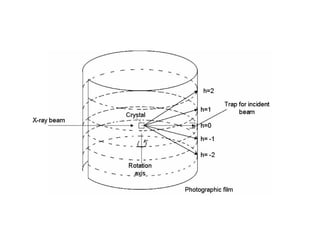
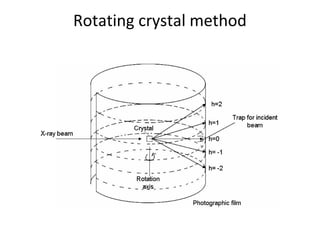
Rotating crystal method
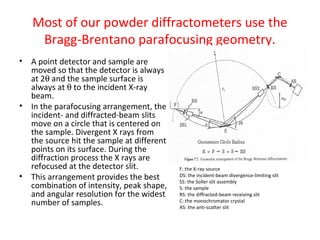
Most of our powder diffractometers use the
     Bragg-Brentano parafocusing geometry.
•   A point detector and sample are
    moved so that the detector is always
    at 2θ and the sample surface is
    always at θ to the incident X-ray
    beam.
•   In the parafocusing arrangement, the
    incident- and diffracted-beam slits
    move on a circle that is centered on
    the sample. Divergent X rays from
    the source hit the sample at different
    points on its surface. During the
    diffraction process the X rays are
    refocused at the detector slit.          F: the X-ray source
•   This arrangement provides the best       DS: the incident-beam divergence-limiting slit
                                             SS: the Soller slit assembly
    combination of intensity, peak shape,    S: the sample
    and angular resolution for the widest    RS: the diffracted-beam receiving slit
    number of samples.                       C: the monochromator crystal
                                             AS: the anti-scatter slit
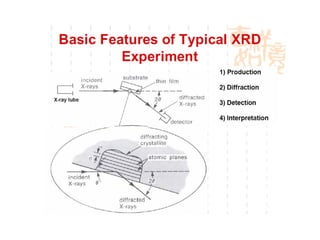
What is X-ray Powder Diffraction (XRD)
X-ray powder diffraction (XRD) is a rapid analytical
technique primarily used for phase identification of a
crystalline material and can provide information on unit
cell dimensions.

The analyzed material is finely ground, homogenized,
and average bulk composition is determined.
Fundamental Principles of X-ray Powder Diffraction (XRD)

 Max von Laue, in 1912, discovered that crystalline substances act
as three-dimensional diffraction gratings for X-ray wavelengths
similar to the spacing of planes in a crystal lattice.

 X-ray diffraction is now a common technique for the study of
crystal structures and atomic spacing.

 X-ray diffraction is based on constructive interference of
monochromatic X-rays and a crystalline sample.

 These X-rays are generated by a cathode ray tube, filtered to
produce monochromatic radiation, collimated to concentrate, and
directed toward the sample. The interaction of the incident rays
with the sample produces constructive interference (and a
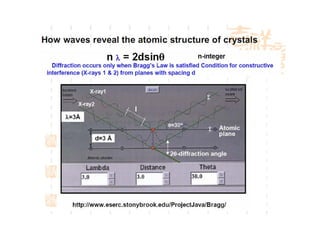
diffracted ray) when conditions satisfy Bragg's Law (nλ=2d sin θ).
 This law relates the wavelength of electromagnetic radiation to
the diffraction angle and the lattice spacing in a crystalline sample.

 These diffracted X-rays are then detected, processed and counted.

 By scanning the sample through a range of 2θangles, all possible
diffraction directions of the lattice should be attained due to the
random orientation of the powdered material.

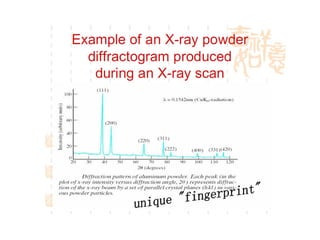
 Conversion of the diffraction peaks to d-spacings allows
identification of the mineral because each mineral has a set of
unique d-spacings. Typically, this is achieved by comparison of d-
spacings with standard reference patterns.
 All diffraction methods are based on generation of X-rays in an
X-ray tube. These X-rays are directed at the sample, and the
diffracted rays are collected.

 A key component of all diffraction is the angle between the
incident and diffracted rays. Powder and single crystal diffraction
vary in instrumentation beyond this.
Applications of XRD

•  XRD is a nondestructive technique
• To identify crystalline phases and orientation
• To determine structural properties:
• Lattice parameters (10-4Å), strain, grain size, expitaxy,
  phase composition, preferred orientation (Laue) order-
  disorder transformation, thermal expansion
• To measure thickness of thin films and multi-layers

• To determine atomic arrangement
• Detection limits: ~3% in a two phase mixture; can be
~0.1% with synchrotron radiation
Spatial resolution: normally none
Applications
•X-ray powder diffraction is most widely used for the identification
of unknown crystalline materials (e.g. minerals, inorganic
compounds). Determination of unknown solids is critical to studies
in geology, environmental science, material science, engineering
and biology. Other applications include

• characterization of crystalline materials

• identification of fine-grained minerals such as clays and mixed
layer clays that are difficult to determine optically

• determination of unit cell dimensions measurement of sample
purity
With specialized techniques, XRD can be used to:

• determine crystal structures using Rietveld refinement

• determine of modal amounts of minerals (quantitative analysis)

• make textural measurements, such as the orientation of grains, in a
polycrystalline sample

• characterize thin films samples by:
    determining lattice mismatch between film and substrate and to inferring
   stress and strain
    determining dislocation density and quality of the film by rocking curve
   measurements
    measuring superlattices in multilayered epitaxial structures
    determining the thickness, roughness and density of the film using glancing
   incidence X-ray reflectivity measurements
Strengths and Limitations of X-ray Powder Diffraction (XRD)?

Strengths

 Powerful and rapid (< 20 min) technique for identification of an
unknown mineral

 In most cases, it provides an unambiguous mineral determination
Minimal sample preparation is required

 XRD units are widely available

 Data interpretation is relatively straight forward
Limitations
 Homogeneous and single phase material is best for
identification of an unknown

 Must have access to a standard reference file of inorganic
compounds (d-spacings, hkls)

 Requires tenths of a gram of material which must be
ground into a powder

 For mixed materials, detection limit is ~ 2% of sample
For unit cell determinations, indexing of patterns for non-
isometric crystal systems is complicated

 Peak overlay may occur and worsens for high angle
'reflections'
SHIVA.PHARMACIST@GMAIL.COM


     THANK
              YOU

X ray diffraction

  • 11.
    Essential Parts ofthe Diffractometer • X-ray Tube: the source of X Rays • Incident-beam optics: condition the X-ray beam before it hits the sample • The goniometer: the platform that holds and moves the sample, optics, detector, and/or tube • The sample & sample holder • Receiving-side optics: condition the X-ray beam after it has encountered the sample • Detector: count the number of X Rays scattered by the sample
  • 12.
    Instrumentation • Production ofX-Rays • Collimator • Monochromator  Filter  Crystal monochromator • Detector  Photographic methods  Counter methods
  • 13.
    The wavelength ofX rays is determined by the anode of the X-ray source. • Electrons from the filament strike the target anode, producing characteristic radiation via the photoelectric effect. • The anode material determines the wavelengths of characteristic radiation. • While we would prefer a monochromatic source, the X-ray beam actually consists of several characteristic wavelengths of X rays. K L M
  • 18.
    Bragg’s law isa simplistic model to understand what conditions are required for diffraction. λ = 2d hkl sin θ θ θ d hkl d hkl • For parallel planes of atoms, with a space dhkl between the planes, constructive interference only occurs when Bragg’s law is satisfied. – In our diffractometers, the X-ray wavelength λ is fixed. – Consequently, a family of planes produces a diffraction peak only at a specific angle θ. – Additionally, the plane normal must be parallel to the diffraction vector • Plane normal: the direction perpendicular to a plane of atoms • Diffraction vector: the vector that bisects the angle between the incident and diffracted beam • The space between diffracting planes of atoms determines peak positions. • The peak intensity is determined by what atoms are in the diffracting plane.
  • 23.
    XRD-Methods • Laue photographic method • Braggs X-Ray spectrometer • Rotating crystal method • Powder method
  • 24.
    Laue photographic method •In his first experiments, Max von Laue (Nobel Prize in Physics in 1914) used continuous radiation (with all possible wavelengths) to impact on a stationary crystal. With this procedure the crystal generates a set of diffracted beams that show the internal symmetry of the crystal. In these circumstances, and taking into account Bragg's Law, the experimental constants are the interplanar spacings d and the crystal position referred to the incident beam. The variables are the wavelength λ and the integer number n: n λ = 2 dhkl sin θnh,nk,nl • Thus, the diffraction pattern will contain (for the same spacing d) the diffracted beams corresponding to the first order of diffraction (n=1) of a certain wavelength, the second order (n=2) of half the wavelength (λ/2), the third order (n=3) with wavelength λ/3, etc. Therefore, the Laue diagram is simply a stereographic projection of the crystal
  • 26.
    The Laue methodin transmission mode The Laue method in reflection mode Laue diagram of a crystal
  • 27.
  • 28.
    When x-rays are  scattered  from a  crystal  lattice,  peaks  of  scattered  intensity  are  observed which correspond to the following conditions: 1.The angle of incidence = angle of scattering. 2.The pathlength difference is equal to an integer number of wavelengths. The  condition  for  maximum  intensity  contained  in  Bragg's  law  above  allow  us  to  calculate  details  about  the  crystal  structure,  or  if  the  crystal  structure  is  known,  to  determine the wavelength of the x-rays incident upon the crystal.   
  • 29.
    X-radiation for diffractionmeasurements is produced by a sealed tube or rotating anode. H2O In H2O Out • Sealed X-ray tubes tend to operate at 1.8 to 3 kW. • Rotating anode X-ray tubes produce much more flux because they operate at 9 to 18 kW. Be Cu ANODE Be window – A rotating anode spins the anode at 6000 window rpm, helping to distribute heat over a e- larger area and therefore allowing the XRAYS XRAYS tube to be run at higher power without FILAMENT (cathode) melting the target. metal • Both sources generate X rays by striking the anode target wth an electron beam (vacuum) (vacuum) glass from a tungsten filament. – The target must be water cooled. – The target and filament must be contained in a vacuum. AC CURRENT
  • 30.
  • 31.
    Most of ourpowder diffractometers use the Bragg-Brentano parafocusing geometry. • A point detector and sample are moved so that the detector is always at 2θ and the sample surface is always at θ to the incident X-ray beam. • In the parafocusing arrangement, the incident- and diffracted-beam slits move on a circle that is centered on the sample. Divergent X rays from the source hit the sample at different points on its surface. During the diffraction process the X rays are refocused at the detector slit. F: the X-ray source • This arrangement provides the best DS: the incident-beam divergence-limiting slit SS: the Soller slit assembly combination of intensity, peak shape, S: the sample and angular resolution for the widest RS: the diffracted-beam receiving slit number of samples. C: the monochromator crystal AS: the anti-scatter slit
  • 33.
    What is X-rayPowder Diffraction (XRD) X-ray powder diffraction (XRD) is a rapid analytical technique primarily used for phase identification of a crystalline material and can provide information on unit cell dimensions. The analyzed material is finely ground, homogenized, and average bulk composition is determined.
  • 34.
    Fundamental Principles ofX-ray Powder Diffraction (XRD)  Max von Laue, in 1912, discovered that crystalline substances act as three-dimensional diffraction gratings for X-ray wavelengths similar to the spacing of planes in a crystal lattice.  X-ray diffraction is now a common technique for the study of crystal structures and atomic spacing.  X-ray diffraction is based on constructive interference of monochromatic X-rays and a crystalline sample.  These X-rays are generated by a cathode ray tube, filtered to produce monochromatic radiation, collimated to concentrate, and directed toward the sample. The interaction of the incident rays with the sample produces constructive interference (and a diffracted ray) when conditions satisfy Bragg's Law (nλ=2d sin θ).
  • 35.
     This lawrelates the wavelength of electromagnetic radiation to the diffraction angle and the lattice spacing in a crystalline sample.  These diffracted X-rays are then detected, processed and counted.  By scanning the sample through a range of 2θangles, all possible diffraction directions of the lattice should be attained due to the random orientation of the powdered material.  Conversion of the diffraction peaks to d-spacings allows identification of the mineral because each mineral has a set of unique d-spacings. Typically, this is achieved by comparison of d- spacings with standard reference patterns.
  • 36.
     All diffractionmethods are based on generation of X-rays in an X-ray tube. These X-rays are directed at the sample, and the diffracted rays are collected.  A key component of all diffraction is the angle between the incident and diffracted rays. Powder and single crystal diffraction vary in instrumentation beyond this.
  • 37.
    Applications of XRD • XRD is a nondestructive technique • To identify crystalline phases and orientation • To determine structural properties: • Lattice parameters (10-4Å), strain, grain size, expitaxy, phase composition, preferred orientation (Laue) order- disorder transformation, thermal expansion • To measure thickness of thin films and multi-layers • To determine atomic arrangement • Detection limits: ~3% in a two phase mixture; can be ~0.1% with synchrotron radiation Spatial resolution: normally none
  • 38.
    Applications •X-ray powder diffractionis most widely used for the identification of unknown crystalline materials (e.g. minerals, inorganic compounds). Determination of unknown solids is critical to studies in geology, environmental science, material science, engineering and biology. Other applications include • characterization of crystalline materials • identification of fine-grained minerals such as clays and mixed layer clays that are difficult to determine optically • determination of unit cell dimensions measurement of sample purity
  • 39.
    With specialized techniques,XRD can be used to: • determine crystal structures using Rietveld refinement • determine of modal amounts of minerals (quantitative analysis) • make textural measurements, such as the orientation of grains, in a polycrystalline sample • characterize thin films samples by:  determining lattice mismatch between film and substrate and to inferring stress and strain  determining dislocation density and quality of the film by rocking curve measurements  measuring superlattices in multilayered epitaxial structures  determining the thickness, roughness and density of the film using glancing incidence X-ray reflectivity measurements
  • 40.
    Strengths and Limitationsof X-ray Powder Diffraction (XRD)? Strengths  Powerful and rapid (< 20 min) technique for identification of an unknown mineral  In most cases, it provides an unambiguous mineral determination Minimal sample preparation is required  XRD units are widely available  Data interpretation is relatively straight forward
  • 41.
    Limitations  Homogeneous andsingle phase material is best for identification of an unknown  Must have access to a standard reference file of inorganic compounds (d-spacings, hkls)  Requires tenths of a gram of material which must be ground into a powder  For mixed materials, detection limit is ~ 2% of sample For unit cell determinations, indexing of patterns for non- isometric crystal systems is complicated  Peak overlay may occur and worsens for high angle 'reflections'
  • 42.