Electron Spin Resonance
spectroscopy
Mr.M.Ragu M.Sc,SET
Assistant Professor
Vivekananda College
Tiruvedakam west
Madurai-625234
Electron Paramagnetic Resonance spectroscopy
Electron Spin Resonance spectroscopy
ESR is discovered by soviet
physicist zavoisky in 1945.
ELECTRON SPIN RESONANCE
SPECTROSCOPY
DEFINITION:
ESR is a branch of absorption
spectroscopy in which radiation
having frequency in the microwave
region is absorbed by paramagnetic
substances to induce transition
between magnetic energy levels of
electrons with unpaired spins.
N S
Klystron
Microwave source
Detector
Cavity
cryostat
Circulator
Diagram of an ESR spectrometer
Spectrophotometer
Light source
Detector
• ESR spectra observed in microwave
region of the electromagnetic
radiation.
• ESR observed primarily in systems
containing unpaired electron.
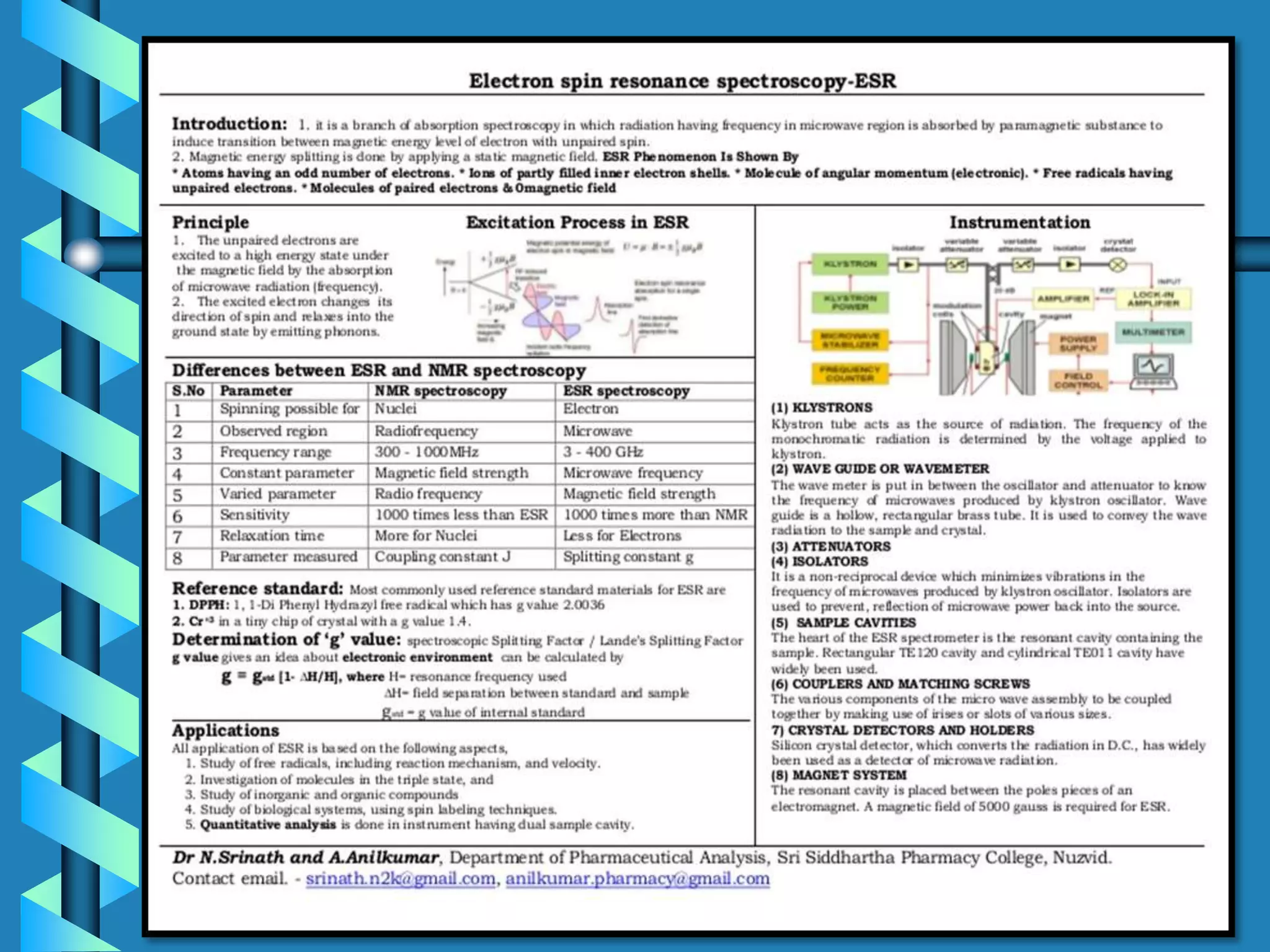
• COMPARISION BETWEEN NMR and
ESR
COMPARISION BETWEEN ESR and NMR
• Which molecules possessing
electrons with unpaired spins.
This phenomenon has been
designated by different names,
1. Electron paramagnetic
resonance(EPR)
2. Electron spin resonance(ESR)
3. Electron magnetic resonance(EMR)
• Now I discuss basic aspects of
ESR
i) Hyperfine splitting
ii) Applications
ESR theorem
• Electron spin s=1/2 spin angular
momentum quantum number
can have value of ms=±1/2.
• Presence of magnetic field this
degeneracy resolved, low
energy state ms=-1/2 in aligned
applied field high energy state
ms=+1/2 in opposed applied
field. E=h=gHo
How does EPR Work?
Like a proton, an electron has a spin, which gives it a
magnetic property known as a magnetic moment.
When an external magnetic field is supplied, the
paramagnetic electrons can either orient in a direction
parallel or antiparallel to the direction of the magnetic field
.
This creates two distinct energy levels for the unpaired
electrons and measurements are taken as they are driven
between the two levels.
The EPR experiment
• Put sample into
experimental magnetic
field (B)
• Irradiate (microwave
frequencies)
• Measure absorbance of
radiation as f(B)
Weil, Bolton, and Wertz, 1994, “Electron Paramagnetic Resonance”
Electron Spin Resonance Spectroscopy
or
It’s fun to flip electrons!
Principles of EMR spectroscopy
B 0
DE
h
Classical theory:
Electron spin moment interacts with
applied electromagnetic radiation
m s = —
1
2
m s = —
1
2
-
Energy
Quantum theory:
transitions between energy levels
induced by magnetic field
Resonance condition
h = gmBB0
The hyperfine effect
• The magnetic field experienced by the unpaired electron
is affected by nearby nuclei with non-zero nuclear spin
Weil, Bolton, and Wertz, 1994, “Electron Paramagnetic Resonance”, New York: Wiley Interscience.
Hyperfine splitting of EPR spectra
• The magnitude of the splitting and the number of lines
depend upon:
– The nuclear spin of the interacting nucleus
• # of lines = 2n(I + ½) so I = ½ gives 2 lines, etc.
– The nuclear gyromagnetic ratio
– The magnitude of the interaction between the
electronic spin and the nuclear spin
• Magnitude of the splitting typically decreases
greatly with increasing numbers of bonds between
the nucleus and unpaired electron
10 Gauss
No hyperfine
1H)
14N)
2 identical I=1/2 nuclei
1 I=5/2 nucleus (17O)
Hyperfine coupling
If the electron is surrounded by n spin-
active nuclei with a spin quantum
number of I, then a (2nI+1) line pattern
will be observed in a similar way to
NMR.
In the case of the hydrogen atom (I= ½),
this would be 2(1)(½) + 1 = 2 lines.
Some nuclei with spins
Element Isotope Nuclear No of %
spin lines abundance
Hydrogen 1H ½ 2 99.985
Nitrogen 14N 1 3 99.63
15N ½ 2 0.37
Vanadium 51V 7/2 8 99.76
Manganese 55Mn 5/2 6 100
Iron 57Fe ½ 2 2.19
Cobalt 59Co 7/2 8 100
Nickel 61Ni 3/2 4 1.134
Copper 63Cu 3/2 4 69.1
65Cu 3/2 4 30.9
Molybdenum 95Mo 5/2 6 15.7
97Mo 5/2 6 9.46
• Electron Paramagnetic Resonance of
Hydrogen Atom
It contains an unpaired electron with S = 1/2 and a
proton with nuclear spin I = 1/2 (ms = ±1/2 and mI =
±1/2). In the absence of magnetic field (B0 = 0), the
electron spin energy levels are degenerate, i.e., have
the same energy (F Application of B0 lifts the
degeneracy between them (the ms = −1/2 sublevel
going down and the ms = +1/2 sublevel going up).
Each of these electron sublevels further interacts with
the nucleus (I = 1/2) giving four sublevels designated
by the value of mI. This phenomenon is called
hyperfine splitting.
Hyperfine splittings multiply with
the number of nuclear spins
O
.
O-
H
H
H
H
Benzoquinone anion radical:
1 proton – splits into 2 lines 1:1
2 protons split into 3 lines 1:2:1
3 protons split into 4 lines 1:3:3:1
4 protons split into 5 lines 1:4:6:4:1
-60 C
20 C
At higher temperature:
faster motion - sharper lines
shorter lifetime - smaller signal
It contains an unpaired electron with S = 1/2 and
three equivalent protons. Each proton has a spin
I = 1/2. Therefore, the total nuclear spin is I = 3/2.
For each ms = ±1/2, the mI values
are +3/2, +1/2, −1/2, −3/2 as shown in Fig. The
interpretation of the ESR spectrum is similar to that
of H atom. The ESR spectrum shows four equally
spaced lines, (n + 1), i.e., a quartet in the intensity
ratio 1:3:3:1. The spacing between any two
successive lines represents the constant (A)
isotropic coupling
Methyl radical CH3 radical
APPLICATIONS
• The site of unpaired electrons.
• The no. of line compounds decide about
the no. and type of nuclei present in the
neighboured of the odd electron.
• The ESR spectrum the value of g can be
measured by comparing the position of
the line with that of a standard
substance of known g value. ex DPPH
powder.
• The electrical field is not spherical.
ESR SPECTROSCOPY

ESR SPECTROSCOPY

  • 1.
    Electron Spin Resonance spectroscopy Mr.M.RaguM.Sc,SET Assistant Professor Vivekananda College Tiruvedakam west Madurai-625234
  • 2.
    Electron Paramagnetic Resonancespectroscopy Electron Spin Resonance spectroscopy
  • 4.
    ESR is discoveredby soviet physicist zavoisky in 1945.
  • 5.
    ELECTRON SPIN RESONANCE SPECTROSCOPY DEFINITION: ESRis a branch of absorption spectroscopy in which radiation having frequency in the microwave region is absorbed by paramagnetic substances to induce transition between magnetic energy levels of electrons with unpaired spins.
  • 6.
    N S Klystron Microwave source Detector Cavity cryostat Circulator Diagramof an ESR spectrometer Spectrophotometer Light source Detector
  • 7.
    • ESR spectraobserved in microwave region of the electromagnetic radiation. • ESR observed primarily in systems containing unpaired electron. • COMPARISION BETWEEN NMR and ESR
  • 8.
  • 9.
    • Which moleculespossessing electrons with unpaired spins. This phenomenon has been designated by different names, 1. Electron paramagnetic resonance(EPR) 2. Electron spin resonance(ESR) 3. Electron magnetic resonance(EMR)
  • 10.
    • Now Idiscuss basic aspects of ESR i) Hyperfine splitting ii) Applications
  • 11.
    ESR theorem • Electronspin s=1/2 spin angular momentum quantum number can have value of ms=±1/2. • Presence of magnetic field this degeneracy resolved, low energy state ms=-1/2 in aligned applied field high energy state ms=+1/2 in opposed applied field. E=h=gHo
  • 12.
    How does EPRWork? Like a proton, an electron has a spin, which gives it a magnetic property known as a magnetic moment. When an external magnetic field is supplied, the paramagnetic electrons can either orient in a direction parallel or antiparallel to the direction of the magnetic field . This creates two distinct energy levels for the unpaired electrons and measurements are taken as they are driven between the two levels.
  • 13.
    The EPR experiment •Put sample into experimental magnetic field (B) • Irradiate (microwave frequencies) • Measure absorbance of radiation as f(B) Weil, Bolton, and Wertz, 1994, “Electron Paramagnetic Resonance”
  • 14.
    Electron Spin ResonanceSpectroscopy or It’s fun to flip electrons!
  • 16.
    Principles of EMRspectroscopy B 0 DE h Classical theory: Electron spin moment interacts with applied electromagnetic radiation m s = — 1 2 m s = — 1 2 - Energy Quantum theory: transitions between energy levels induced by magnetic field Resonance condition h = gmBB0
  • 17.
    The hyperfine effect •The magnetic field experienced by the unpaired electron is affected by nearby nuclei with non-zero nuclear spin Weil, Bolton, and Wertz, 1994, “Electron Paramagnetic Resonance”, New York: Wiley Interscience.
  • 18.
    Hyperfine splitting ofEPR spectra • The magnitude of the splitting and the number of lines depend upon: – The nuclear spin of the interacting nucleus • # of lines = 2n(I + ½) so I = ½ gives 2 lines, etc. – The nuclear gyromagnetic ratio – The magnitude of the interaction between the electronic spin and the nuclear spin • Magnitude of the splitting typically decreases greatly with increasing numbers of bonds between the nucleus and unpaired electron
  • 19.
    10 Gauss No hyperfine 1H) 14N) 2identical I=1/2 nuclei 1 I=5/2 nucleus (17O) Hyperfine coupling If the electron is surrounded by n spin- active nuclei with a spin quantum number of I, then a (2nI+1) line pattern will be observed in a similar way to NMR. In the case of the hydrogen atom (I= ½), this would be 2(1)(½) + 1 = 2 lines.
  • 20.
    Some nuclei withspins Element Isotope Nuclear No of % spin lines abundance Hydrogen 1H ½ 2 99.985 Nitrogen 14N 1 3 99.63 15N ½ 2 0.37 Vanadium 51V 7/2 8 99.76 Manganese 55Mn 5/2 6 100 Iron 57Fe ½ 2 2.19 Cobalt 59Co 7/2 8 100 Nickel 61Ni 3/2 4 1.134 Copper 63Cu 3/2 4 69.1 65Cu 3/2 4 30.9 Molybdenum 95Mo 5/2 6 15.7 97Mo 5/2 6 9.46
  • 21.
    • Electron ParamagneticResonance of Hydrogen Atom It contains an unpaired electron with S = 1/2 and a proton with nuclear spin I = 1/2 (ms = ±1/2 and mI = ±1/2). In the absence of magnetic field (B0 = 0), the electron spin energy levels are degenerate, i.e., have the same energy (F Application of B0 lifts the degeneracy between them (the ms = −1/2 sublevel going down and the ms = +1/2 sublevel going up). Each of these electron sublevels further interacts with the nucleus (I = 1/2) giving four sublevels designated by the value of mI. This phenomenon is called hyperfine splitting.
  • 22.
    Hyperfine splittings multiplywith the number of nuclear spins O . O- H H H H Benzoquinone anion radical: 1 proton – splits into 2 lines 1:1 2 protons split into 3 lines 1:2:1 3 protons split into 4 lines 1:3:3:1 4 protons split into 5 lines 1:4:6:4:1 -60 C 20 C At higher temperature: faster motion - sharper lines shorter lifetime - smaller signal
  • 24.
    It contains anunpaired electron with S = 1/2 and three equivalent protons. Each proton has a spin I = 1/2. Therefore, the total nuclear spin is I = 3/2. For each ms = ±1/2, the mI values are +3/2, +1/2, −1/2, −3/2 as shown in Fig. The interpretation of the ESR spectrum is similar to that of H atom. The ESR spectrum shows four equally spaced lines, (n + 1), i.e., a quartet in the intensity ratio 1:3:3:1. The spacing between any two successive lines represents the constant (A) isotropic coupling Methyl radical CH3 radical
  • 25.
    APPLICATIONS • The siteof unpaired electrons. • The no. of line compounds decide about the no. and type of nuclei present in the neighboured of the odd electron. • The ESR spectrum the value of g can be measured by comparing the position of the line with that of a standard substance of known g value. ex DPPH powder. • The electrical field is not spherical.