



    NUTRACEUTICALS


        T.Shivakumar

        B.PHARMACY

        shiva.pharmacist@gmail.com
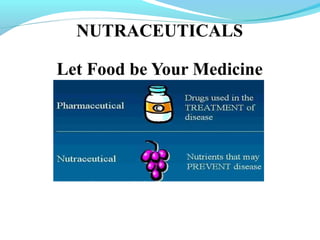
NUTRACEUTICALS

Let Food be Your Medicine
An Apple a Day Keeps the
      Doctor Away
 Greek Physician Hippocrates,
         Known as father of Medicine.
          (said several centuries ago)


            “Let Food be Your Medicine”

The Philosophy behind is:

               “Focus on Prevention”
Nutraceutical can be defined as
                     The term “Nutraceutical” was coined from
“Nutrition” & “Pharmaceutical” in 1989 by Stephen
DeFelice,MD, Founder and Chairman of the Foundation for
Innovation in Medicine (FIM).


 “A food or part of food or nutrient, that
provides health benefits, including the
prevention and treatment of a disease.”
“ A Diet supplement that delivers a
 concentrted form of a biologically active
 component of food in a non food matrix to
 enhance health”.
 “Health promoting compounds or products
 that have been isolated from food sources.”
Broadly can be defined as:

Nutrients: Substances which have established
 Nutritional functions e.g. Vitamins, Minerals, Amino
 Acids, Fatty acids, etc.

Herbals/ Phytochemicals: Herbs or Botanical products


Dietary Supplements: Probiotics, Prebiotics, Antioxidants,
 Enzymes, etc.
CLASSIFICATION:
I.Based on the beneficial ingredient:

• Anti oxidants,carotenoids
• Dairybased ingredients
• Minerals
• Probiotics and Prebiotics
• Proteins Peptides Aminoacids
• Soyabased ingredients
II. Based on Therapeutic Use:
  Nutraceuticals
• For bone &joint health- fish oils
• For Migrane risk reduction- tea
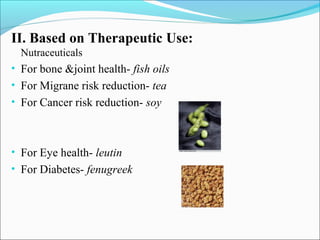
• For Cancer risk reduction- soy


• For Eye health- leutin
• For Diabetes- fenugreek
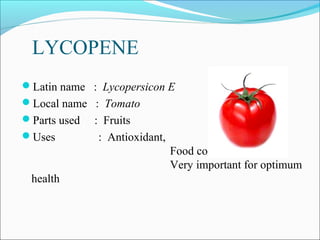
LYCOPENE
Latin name : Lycopersicon E
Local name : Tomato
Parts used   : Fruits
Uses          : Antioxidant,
                                Food colouring,
                                Very important for optimum
 health
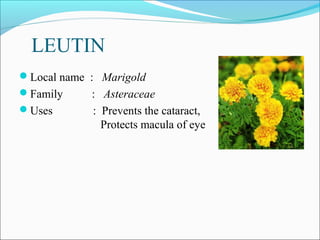
LEUTIN
Local name : Marigold
Family      : Asteraceae
Uses        : Prevents the cataract,
               Protects macula of eye
NUTRIENTS
Most common Nutrients used/ supplemented as Nutraceutical
 are:

     Minerals and Vitamins.

     or in combination

     or in combination with other antioxidants
Health Benefits of different common nutrients
                        Vitamins
Fat Soluble Vitamins

 Vitamin A: Acts as antioxidant, essential for growth and
    development, maintains healthy vision, skin and mucous
    membranes, may aid in the prevention and treatment of
    certain cancers and in the treatment of certain skin
    disorders.
Vitamin D: Essential for formation of bones and teeth, helps the
 body to absorb and use
 calcium

Vitamin E: Antioxidant, helps to form blood cells, boosts
  immune system

Vitamin K: Essential for blood clotting
Water Soluble Vitamins
Vitamin C: Antioxidant, necessary for healthy bones, gums,
 teeth and skin. Helps in wound healing, prevent from common
 cold

Vitamin B 1: Helps in carbohydrate metabolism, essential for
 neurological function.

Vitamin B 2: Energy metabolism, maintain healthy eye, skin and
 nerve function.
Vitamin B 3: Energy metabolism, brain function


Vitamin B 6: Helps to produce essential proteins, convert
  proteins to energy

Vitamin B 12: Help in producing genetic material, formation of
  RBC, maintenance of CNS, synthesis of amino acids, involved in
  metabolism of protein, fat and carbohydrate.
Herbals
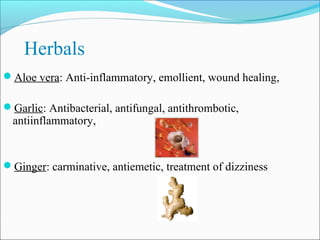
Aloe vera: Anti-inflammatory, emollient, wound healing,

Garlic: Antibacterial, antifungal, antithrombotic,
  antiinflammatory,


Ginger: carminative, antiemetic, treatment of dizziness
Green tea: Antioxidant, reduces risk of CVD, enhances humoral
  and cell mediated Immunity,

Vegetables, fruits, whole grain, herbs, nuts and various seeds
  contain an abundance of phenolic compounds, terpenoids,
  sulphur compounds, pigments etc. that has been associated with
  protection / treatment of certain disease conditions,
Phytochemicals
Phytochemicals could provide health benefits as;

•    Substrate for biochemical reactions
•    Cofactors of enzymatic reactions
•    Inhibitors of enzymatic reactions
•    Absorbents that bind to & eliminate undesirable constituent in the
     intestine
•    Scavengers of reactive or toxic chemicals
•   Enhance the absorption and / or stability of essential nutrients

•   Selective growth factor for beneficial bacteria

•   Fermentation substrate for beneficial bacteria

•   Selective inhibitors of deleterious intestinal bacteria
CONCLUSION
Nutraceuticals are present in most of the food ingredients with
 varying concentration
Concentration, time and duration of supply of nutraceuticals
 influence human health

Manipulating the foods, the concentration of active ingredients
 can be increased
Diet rich in nutraceuticals along with regular exercise, stress
 reduction and maintenance of healthy body weight will maximise
 health and reduce disease risk
Neutraceuticals

Neutraceuticals

  • 1.
      NUTRACEUTICALS T.Shivakumar B.PHARMACY shiva.pharmacist@gmail.com
  • 2.
  • 3.
    An Apple aDay Keeps the Doctor Away
  • 4.
     Greek PhysicianHippocrates, Known as father of Medicine. (said several centuries ago) “Let Food be Your Medicine” The Philosophy behind is: “Focus on Prevention”
  • 5.
    Nutraceutical can bedefined as The term “Nutraceutical” was coined from “Nutrition” & “Pharmaceutical” in 1989 by Stephen DeFelice,MD, Founder and Chairman of the Foundation for Innovation in Medicine (FIM). “A food or part of food or nutrient, that provides health benefits, including the prevention and treatment of a disease.”
  • 6.
    “ A Dietsupplement that delivers a concentrted form of a biologically active component of food in a non food matrix to enhance health”.  “Health promoting compounds or products that have been isolated from food sources.”
  • 7.
    Broadly can bedefined as: Nutrients: Substances which have established Nutritional functions e.g. Vitamins, Minerals, Amino Acids, Fatty acids, etc. Herbals/ Phytochemicals: Herbs or Botanical products Dietary Supplements: Probiotics, Prebiotics, Antioxidants, Enzymes, etc.
  • 8.
    CLASSIFICATION: I.Based on thebeneficial ingredient: • Anti oxidants,carotenoids • Dairybased ingredients • Minerals • Probiotics and Prebiotics • Proteins Peptides Aminoacids • Soyabased ingredients
  • 9.
    II. Based onTherapeutic Use: Nutraceuticals • For bone &joint health- fish oils • For Migrane risk reduction- tea • For Cancer risk reduction- soy • For Eye health- leutin • For Diabetes- fenugreek
  • 10.
    LYCOPENE Latin name :Lycopersicon E Local name : Tomato Parts used : Fruits Uses : Antioxidant, Food colouring, Very important for optimum health
  • 11.
    LEUTIN Local name :Marigold Family : Asteraceae Uses : Prevents the cataract, Protects macula of eye
  • 12.
    NUTRIENTS Most common Nutrientsused/ supplemented as Nutraceutical are: Minerals and Vitamins. or in combination or in combination with other antioxidants
  • 13.
    Health Benefits ofdifferent common nutrients Vitamins Fat Soluble Vitamins  Vitamin A: Acts as antioxidant, essential for growth and development, maintains healthy vision, skin and mucous membranes, may aid in the prevention and treatment of certain cancers and in the treatment of certain skin disorders.
  • 14.
    Vitamin D: Essentialfor formation of bones and teeth, helps the body to absorb and use calcium Vitamin E: Antioxidant, helps to form blood cells, boosts immune system Vitamin K: Essential for blood clotting
  • 15.
    Water Soluble Vitamins VitaminC: Antioxidant, necessary for healthy bones, gums, teeth and skin. Helps in wound healing, prevent from common cold Vitamin B 1: Helps in carbohydrate metabolism, essential for neurological function. Vitamin B 2: Energy metabolism, maintain healthy eye, skin and nerve function.
  • 16.
    Vitamin B 3:Energy metabolism, brain function Vitamin B 6: Helps to produce essential proteins, convert proteins to energy Vitamin B 12: Help in producing genetic material, formation of RBC, maintenance of CNS, synthesis of amino acids, involved in metabolism of protein, fat and carbohydrate.
  • 17.
    Herbals Aloe vera: Anti-inflammatory,emollient, wound healing, Garlic: Antibacterial, antifungal, antithrombotic, antiinflammatory, Ginger: carminative, antiemetic, treatment of dizziness
  • 18.
    Green tea: Antioxidant,reduces risk of CVD, enhances humoral and cell mediated Immunity, Vegetables, fruits, whole grain, herbs, nuts and various seeds contain an abundance of phenolic compounds, terpenoids, sulphur compounds, pigments etc. that has been associated with protection / treatment of certain disease conditions,
  • 19.
    Phytochemicals Phytochemicals could providehealth benefits as; • Substrate for biochemical reactions • Cofactors of enzymatic reactions • Inhibitors of enzymatic reactions • Absorbents that bind to & eliminate undesirable constituent in the intestine • Scavengers of reactive or toxic chemicals
  • 20.
    Enhance the absorption and / or stability of essential nutrients • Selective growth factor for beneficial bacteria • Fermentation substrate for beneficial bacteria • Selective inhibitors of deleterious intestinal bacteria
  • 21.
    CONCLUSION Nutraceuticals are presentin most of the food ingredients with varying concentration Concentration, time and duration of supply of nutraceuticals influence human health Manipulating the foods, the concentration of active ingredients can be increased Diet rich in nutraceuticals along with regular exercise, stress reduction and maintenance of healthy body weight will maximise health and reduce disease risk