X-ray Diffraction and Its
Applications in Science &
Engineering
CONVENTIONS OF LATTICE DESCRIPTION
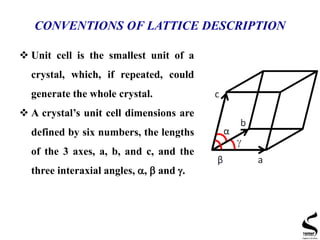
 Unit cell is the smallest unit of a
crystal, which, if repeated, could
generate the whole crystal.
 A crystal’s unit cell dimensions are
defined by six numbers, the lengths
of the 3 axes, a, b, and c, and the
three interaxial angles, ,  and .
CRYSTAL STRUCTURE
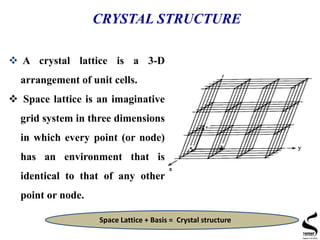
 A crystal lattice is a 3-D
arrangement of unit cells.
 Space lattice is an imaginative
grid system in three dimensions
in which every point (or node)
has an environment that is
identical to that of any other
point or node.
Space Lattice + Basis = Crystal structure
CRSYSTALLOGRAPHIC DIRECTIONS
A crystallographic direction is defined as the line between two vectors. The
following steps are utilized in the determination of the three dimensional
indices:
1. A vector of conventional length is positioned such that it passes through
the origin of the coordinate system.
2. The length of the vector projection on each of the three axes is
determined; these are measured in terms of the unit cell dimensions a,b
and c.
3. These three numbers are multiplied or divided by a common factor to
reduce them to the smallest integer values.
4. The three indices are enclosed in square brackets :
[uvw]. The u, v and w integers
correspond to the reduced projections along
the x, y and z axes, respectively
CRYSTALLOGRAPHIC PLANES
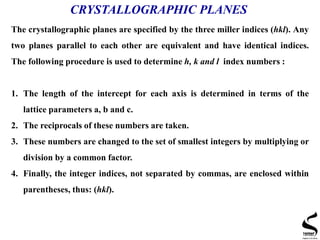
The crystallographic planes are specified by the three miller indices (hkl). Any
two planes parallel to each other are equivalent and have identical indices.
The following procedure is used to determine h, k and l index numbers :
1. The length of the intercept for each axis is determined in terms of the
lattice parameters a, b and c.
2. The reciprocals of these numbers are taken.
3. These numbers are changed to the set of smallest integers by multiplying or
division by a common factor.
4. Finally, the integer indices, not separated by commas, are enclosed within
parentheses, thus: (hkl).
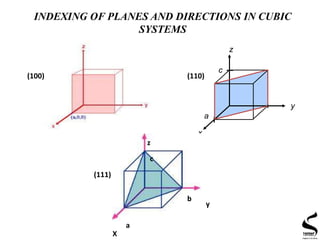
INDEXING OF PLANES AND DIRECTIONS IN CUBIC
SYSTEMS
z
x
y
a
b
c
X
y
z
a
b
c
(100) (110)
(111)
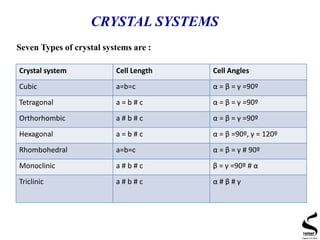
CRYSTAL SYSTEMS
Seven Types of crystal systems are :
Crystal system Cell Length Cell Angles
Cubic a=b=c α = β = γ =90º
Tetragonal a = b # c α = β = γ =90º
Orthorhombic a # b # c α = β = γ =90º
Hexagonal a = b # c α = β =90º, γ = 120º
Rhombohedral a=b=c α = β = γ # 90º
Monoclinic a # b # c β = γ =90º # α
Triclinic a # b # c α # β # γ
BASICS OF X-RAY DIFFRACTION
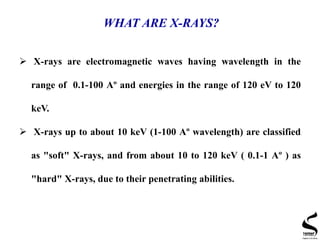
WHAT ARE X-RAYS?
 X-rays are electromagnetic waves having wavelength in the
range of 0.1-100 Aº and energies in the range of 120 eV to 120
keV.
 X-rays up to about 10 keV (1-100 Aº wavelength) are classified
as "soft" X-rays, and from about 10 to 120 keV ( 0.1-1 Aº ) as
"hard" X-rays, due to their penetrating abilities.
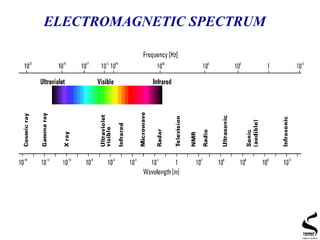
ELECTROMAGNETIC SPECTRUM
PRODUCTION OF X-RAYS
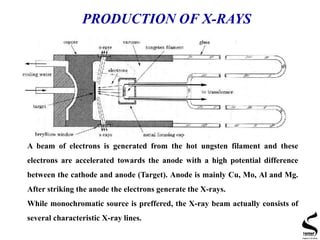
A beam of electrons is generated from the hot ungsten filament and these
electrons are accelerated towards the anode with a high potential difference
between the cathode and anode (Target). Anode is mainly Cu, Mo, Al and Mg.
After striking the anode the electrons generate the X-rays.
While monochromatic source is preffered, the X-ray beam actually consists of
several characteristic X-ray lines.
e-
e-
e-
e-
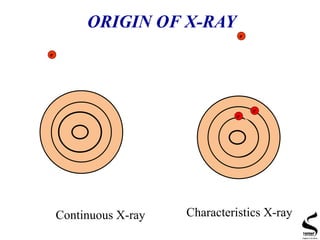
ORIGIN OF X-RAY
Continuous X-ray Characteristics X-ray
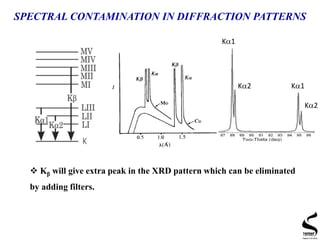
 Kβ will give extra peak in the XRD pattern which can be eliminated
by adding filters.
K1
K1K2
K2
SPECTRAL CONTAMINATION IN DIFFRACTION PATTERNS
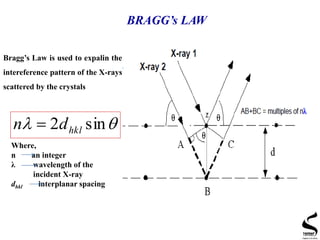
Bragg’s Law is used to expalin the
intereference pattern of the X-rays
scattered by the crystals
 sin2 hkldn 
Where,
n an integer
λ wavelength of the
incident X-ray
dhkl interplanar spacing
BRAGG’s LAW
WHAT IS X-RAY DIFFRACTION ?
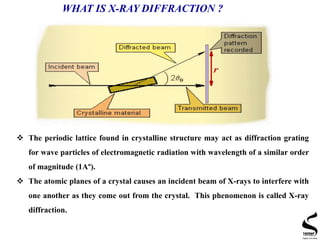
 The periodic lattice found in crystalline structure may act as diffraction grating
for wave particles of electromagnetic radiation with wavelength of a similar order
of magnitude (1Aº).
 The atomic planes of a crystal causes an incident beam of X-rays to interfere with
one another as they come out from the crystal. This phenomenon is called X-ray
diffraction.
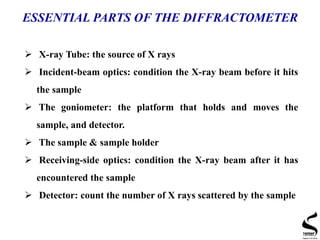
 X-ray Tube: the source of X rays
 Incident-beam optics: condition the X-ray beam before it hits
the sample
 The goniometer: the platform that holds and moves the
sample, and detector.
 The sample & sample holder
 Receiving-side optics: condition the X-ray beam after it has
encountered the sample
 Detector: count the number of X rays scattered by the sample
ESSENTIAL PARTS OF THE DIFFRACTOMETER
APPLICATIONS OF XRD
 XRD is a nondestructive technique
 To identify crystalline phases and orientation
 To determine structural properties: strain, grain size, epitaxy, phase
composition, preferred orientation, order-disorder transformation,
thermal expansion
 To measure thickness of thin films and multilayers
 To determine atomic arrangement
 Detection limits: ~ 3% in a two phase mixture; can be ~ 0.1 % with
synchrotron radiation
SAMPLE PREPARATION FOR XRD
 An ideal powder sample should have many crystallites in
random orientations
 If the crystallites in a sample are very large, there will not be a
smooth distribution of crystal orientations. You will not get a
powder average diffraction pattern.
 Crystallites should be <10 mm in size to get good powder
statistics
 Large crystallite sizes and non-random crystallite orientations
both lead to peak intensity variation.
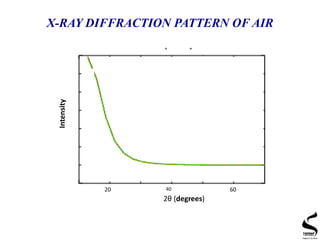
20 6040
2θ (degrees)
Intensity
X-RAY DIFFRACTION PATTERN OF AIR
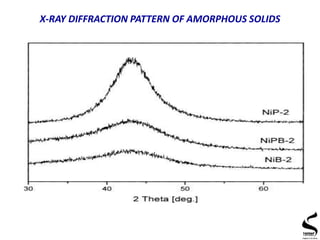
X-RAY DIFFRACTION PATTERN OF AMORPHOUS SOLIDS
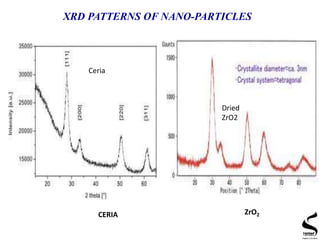
Dried
ZrO2
Ceria
CERIA ZrO2
XRD PATTERNS OF NANO-PARTICLES
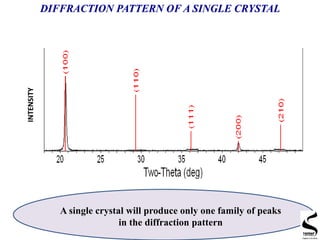
DIFFRACTION PATTERN OF A SINGLE CRYSTAL
A single crystal will produce only one family of peaks
in the diffraction pattern
INTENSITY
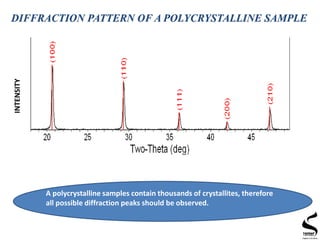
DIFFRACTION PATTERN OF A POLYCRYSTALLINE SAMPLEINTENSITY
A polycrystalline samples contain thousands of crystallites, therefore
all possible diffraction peaks should be observed.
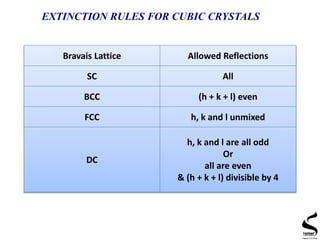
EXTINCTION RULES FOR CUBIC CRYSTALS
Bravais Lattice Allowed Reflections
SC All
BCC (h + k + l) even
FCC h, k and l unmixed
DC
h, k and l are all odd
Or
all are even
& (h + k + l) divisible by 4
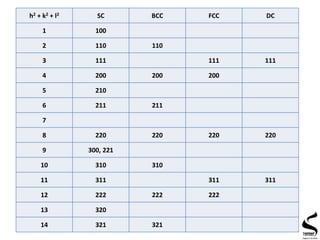
h2 + k2 + l2 SC BCC FCC DC
1 100
2 110 110
3 111 111 111
4 200 200 200
5 210
6 211 211
7
8 220 220 220 220
9 300, 221
10 310 310
11 311 311 311
12 222 222 222
13 320
14 321 321
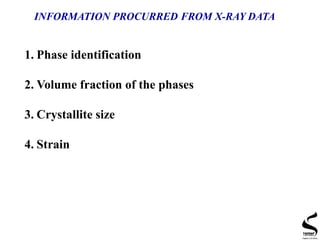
1. Phase identification
2. Volume fraction of the phases
3. Crystallite size
4. Strain
INFORMATION PROCURRED FROM X-RAY DATA
PHASE IDENTIFICATON
 The diffraction pattern for every phase is as unique as your
fingerprint
 Phases with the same chemical composition can have drastically
different diffraction patterns.
 Obtain XRD pattern
 Measure d-spacings
 Obtain integrated intensities
 Compare data with known standards in the JCPDS file, which
are for random orientations (there are more than 50,000 JCPDS
cards of inorganic materials).
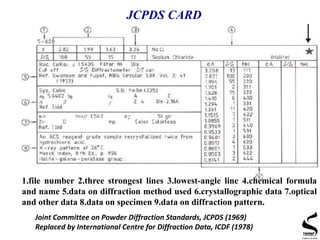
JCPDS CARD
1.file number 2.three strongest lines 3.lowest-angle line 4.chemical formula
and name 5.data on diffraction method used 6.crystallographic data 7.optical
and other data 8.data on specimen 9.data on diffraction pattern.
Joint Committee on Powder Diffraction Standards, JCPDS (1969)
Replaced by International Centre for Diffraction Data, ICDF (1978)
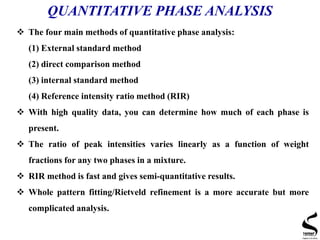
QUANTITATIVE PHASE ANALYSIS
 The four main methods of quantitative phase analysis:
(1) External standard method
(2) direct comparison method
(3) internal standard method
(4) Reference intensity ratio method (RIR)
 With high quality data, you can determine how much of each phase is
present.
 The ratio of peak intensities varies linearly as a function of weight
fractions for any two phases in a mixture.
 RIR method is fast and gives semi-quantitative results.
 Whole pattern fitting/Rietveld refinement is a more accurate but more
complicated analysis.
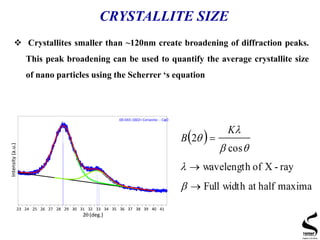
CRYSTALLITE SIZE
 Crystallites smaller than ~120nm create broadening of diffraction peaks.
This peak broadening can be used to quantify the average crystallite size
of nano particles using the Scherrer ‘s equation
23 24 25 26 27 28 29 30 31 32 33 34 35 36 37 38 39 40 41
2 (deg.)
Intensity(a.u.)
00-043-1002> Cerianite- - CeO2
 
maximahalfatwidthFull
ray-Xofwavelength
cos
2








K
B
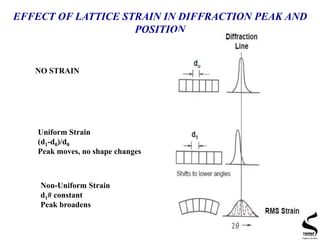
EFFECT OF LATTICE STRAIN IN DIFFRACTION PEAK AND
POSITION
NO STRAIN
Uniform Strain
(d1-d0)/d0
Peak moves, no shape changes
Non-Uniform Strain
d1# constant
Peak broadens
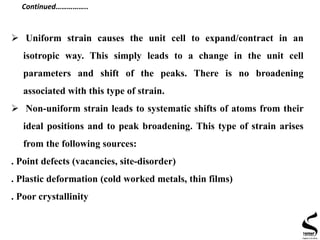
 Uniform strain causes the unit cell to expand/contract in an
isotropic way. This simply leads to a change in the unit cell
parameters and shift of the peaks. There is no broadening
associated with this type of strain.
 Non-uniform strain leads to systematic shifts of atoms from their
ideal positions and to peak broadening. This type of strain arises
from the following sources:
. Point defects (vacancies, site-disorder)
. Plastic deformation (cold worked metals, thin films)
. Poor crystallinity
Continued……………..
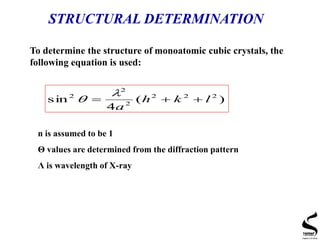
STRUCTURAL DETERMINATION
To determine the structure of monoatomic cubic crystals, the
following equation is used:
)(
4
sin 222
2
2
2
lkh
a



n is assumed to be 1
Θ values are determined from the diffraction pattern
Λ is wavelength of X-ray
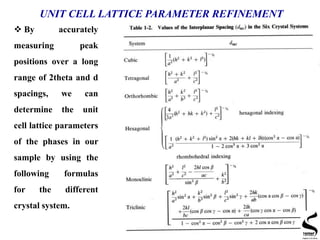
UNIT CELL LATTICE PARAMETER REFINEMENT
 By accurately
measuring peak
positions over a long
range of 2theta and d
spacings, we can
determine the unit
cell lattice parameters
of the phases in our
sample by using the
following formulas
for the different
crystal system.
INSTRUMENTAL SOURCES OF ERROR
Specimen displacement
 Instrument misalignment
 Error in zero 2θ position
 Peak distortion due to Kα2 and Kβ wavelengths
CONCLUSIONS
Non-destructive, fast, easy sample prep
High-accuracy for d-spacing calculations
Can be done in-situ
Single crystal, poly, and amorphous materials
Standards are available for thousands of material systems

XRD principle and application

  • 1.
    X-ray Diffraction andIts Applications in Science & Engineering
  • 2.
    CONVENTIONS OF LATTICEDESCRIPTION  Unit cell is the smallest unit of a crystal, which, if repeated, could generate the whole crystal.  A crystal’s unit cell dimensions are defined by six numbers, the lengths of the 3 axes, a, b, and c, and the three interaxial angles, ,  and .
  • 3.
    CRYSTAL STRUCTURE  Acrystal lattice is a 3-D arrangement of unit cells.  Space lattice is an imaginative grid system in three dimensions in which every point (or node) has an environment that is identical to that of any other point or node. Space Lattice + Basis = Crystal structure
  • 4.
    CRSYSTALLOGRAPHIC DIRECTIONS A crystallographicdirection is defined as the line between two vectors. The following steps are utilized in the determination of the three dimensional indices: 1. A vector of conventional length is positioned such that it passes through the origin of the coordinate system. 2. The length of the vector projection on each of the three axes is determined; these are measured in terms of the unit cell dimensions a,b and c. 3. These three numbers are multiplied or divided by a common factor to reduce them to the smallest integer values. 4. The three indices are enclosed in square brackets : [uvw]. The u, v and w integers correspond to the reduced projections along the x, y and z axes, respectively
  • 5.
    CRYSTALLOGRAPHIC PLANES The crystallographicplanes are specified by the three miller indices (hkl). Any two planes parallel to each other are equivalent and have identical indices. The following procedure is used to determine h, k and l index numbers : 1. The length of the intercept for each axis is determined in terms of the lattice parameters a, b and c. 2. The reciprocals of these numbers are taken. 3. These numbers are changed to the set of smallest integers by multiplying or division by a common factor. 4. Finally, the integer indices, not separated by commas, are enclosed within parentheses, thus: (hkl).
  • 6.
    INDEXING OF PLANESAND DIRECTIONS IN CUBIC SYSTEMS z x y a b c X y z a b c (100) (110) (111)
  • 7.
    CRYSTAL SYSTEMS Seven Typesof crystal systems are : Crystal system Cell Length Cell Angles Cubic a=b=c α = β = γ =90º Tetragonal a = b # c α = β = γ =90º Orthorhombic a # b # c α = β = γ =90º Hexagonal a = b # c α = β =90º, γ = 120º Rhombohedral a=b=c α = β = γ # 90º Monoclinic a # b # c β = γ =90º # α Triclinic a # b # c α # β # γ
  • 8.
    BASICS OF X-RAYDIFFRACTION
  • 9.
    WHAT ARE X-RAYS? X-rays are electromagnetic waves having wavelength in the range of 0.1-100 Aº and energies in the range of 120 eV to 120 keV.  X-rays up to about 10 keV (1-100 Aº wavelength) are classified as "soft" X-rays, and from about 10 to 120 keV ( 0.1-1 Aº ) as "hard" X-rays, due to their penetrating abilities.
  • 10.
  • 11.
    PRODUCTION OF X-RAYS Abeam of electrons is generated from the hot ungsten filament and these electrons are accelerated towards the anode with a high potential difference between the cathode and anode (Target). Anode is mainly Cu, Mo, Al and Mg. After striking the anode the electrons generate the X-rays. While monochromatic source is preffered, the X-ray beam actually consists of several characteristic X-ray lines.
  • 12.
    e- e- e- e- ORIGIN OF X-RAY ContinuousX-ray Characteristics X-ray
  • 13.
     Kβ willgive extra peak in the XRD pattern which can be eliminated by adding filters. K1 K1K2 K2 SPECTRAL CONTAMINATION IN DIFFRACTION PATTERNS
  • 14.
    Bragg’s Law isused to expalin the intereference pattern of the X-rays scattered by the crystals  sin2 hkldn  Where, n an integer λ wavelength of the incident X-ray dhkl interplanar spacing BRAGG’s LAW
  • 15.
    WHAT IS X-RAYDIFFRACTION ?  The periodic lattice found in crystalline structure may act as diffraction grating for wave particles of electromagnetic radiation with wavelength of a similar order of magnitude (1Aº).  The atomic planes of a crystal causes an incident beam of X-rays to interfere with one another as they come out from the crystal. This phenomenon is called X-ray diffraction.
  • 16.
     X-ray Tube:the source of X rays  Incident-beam optics: condition the X-ray beam before it hits the sample  The goniometer: the platform that holds and moves the sample, and detector.  The sample & sample holder  Receiving-side optics: condition the X-ray beam after it has encountered the sample  Detector: count the number of X rays scattered by the sample ESSENTIAL PARTS OF THE DIFFRACTOMETER
  • 17.
    APPLICATIONS OF XRD XRD is a nondestructive technique  To identify crystalline phases and orientation  To determine structural properties: strain, grain size, epitaxy, phase composition, preferred orientation, order-disorder transformation, thermal expansion  To measure thickness of thin films and multilayers  To determine atomic arrangement  Detection limits: ~ 3% in a two phase mixture; can be ~ 0.1 % with synchrotron radiation
  • 18.
    SAMPLE PREPARATION FORXRD  An ideal powder sample should have many crystallites in random orientations  If the crystallites in a sample are very large, there will not be a smooth distribution of crystal orientations. You will not get a powder average diffraction pattern.  Crystallites should be <10 mm in size to get good powder statistics  Large crystallite sizes and non-random crystallite orientations both lead to peak intensity variation.
  • 19.
    20 6040 2θ (degrees) Intensity X-RAYDIFFRACTION PATTERN OF AIR
  • 20.
    X-RAY DIFFRACTION PATTERNOF AMORPHOUS SOLIDS
  • 21.
  • 22.
    DIFFRACTION PATTERN OFA SINGLE CRYSTAL A single crystal will produce only one family of peaks in the diffraction pattern INTENSITY
  • 23.
    DIFFRACTION PATTERN OFA POLYCRYSTALLINE SAMPLEINTENSITY A polycrystalline samples contain thousands of crystallites, therefore all possible diffraction peaks should be observed.
  • 24.
    EXTINCTION RULES FORCUBIC CRYSTALS Bravais Lattice Allowed Reflections SC All BCC (h + k + l) even FCC h, k and l unmixed DC h, k and l are all odd Or all are even & (h + k + l) divisible by 4
  • 25.
    h2 + k2+ l2 SC BCC FCC DC 1 100 2 110 110 3 111 111 111 4 200 200 200 5 210 6 211 211 7 8 220 220 220 220 9 300, 221 10 310 310 11 311 311 311 12 222 222 222 13 320 14 321 321
  • 26.
    1. Phase identification 2.Volume fraction of the phases 3. Crystallite size 4. Strain INFORMATION PROCURRED FROM X-RAY DATA
  • 27.
    PHASE IDENTIFICATON  Thediffraction pattern for every phase is as unique as your fingerprint  Phases with the same chemical composition can have drastically different diffraction patterns.  Obtain XRD pattern  Measure d-spacings  Obtain integrated intensities  Compare data with known standards in the JCPDS file, which are for random orientations (there are more than 50,000 JCPDS cards of inorganic materials).
  • 28.
    JCPDS CARD 1.file number2.three strongest lines 3.lowest-angle line 4.chemical formula and name 5.data on diffraction method used 6.crystallographic data 7.optical and other data 8.data on specimen 9.data on diffraction pattern. Joint Committee on Powder Diffraction Standards, JCPDS (1969) Replaced by International Centre for Diffraction Data, ICDF (1978)
  • 29.
    QUANTITATIVE PHASE ANALYSIS The four main methods of quantitative phase analysis: (1) External standard method (2) direct comparison method (3) internal standard method (4) Reference intensity ratio method (RIR)  With high quality data, you can determine how much of each phase is present.  The ratio of peak intensities varies linearly as a function of weight fractions for any two phases in a mixture.  RIR method is fast and gives semi-quantitative results.  Whole pattern fitting/Rietveld refinement is a more accurate but more complicated analysis.
  • 30.
    CRYSTALLITE SIZE  Crystallitessmaller than ~120nm create broadening of diffraction peaks. This peak broadening can be used to quantify the average crystallite size of nano particles using the Scherrer ‘s equation 23 24 25 26 27 28 29 30 31 32 33 34 35 36 37 38 39 40 41 2 (deg.) Intensity(a.u.) 00-043-1002> Cerianite- - CeO2   maximahalfatwidthFull ray-Xofwavelength cos 2         K B
  • 31.
    EFFECT OF LATTICESTRAIN IN DIFFRACTION PEAK AND POSITION NO STRAIN Uniform Strain (d1-d0)/d0 Peak moves, no shape changes Non-Uniform Strain d1# constant Peak broadens
  • 32.
     Uniform straincauses the unit cell to expand/contract in an isotropic way. This simply leads to a change in the unit cell parameters and shift of the peaks. There is no broadening associated with this type of strain.  Non-uniform strain leads to systematic shifts of atoms from their ideal positions and to peak broadening. This type of strain arises from the following sources: . Point defects (vacancies, site-disorder) . Plastic deformation (cold worked metals, thin films) . Poor crystallinity Continued……………..
  • 33.
    STRUCTURAL DETERMINATION To determinethe structure of monoatomic cubic crystals, the following equation is used: )( 4 sin 222 2 2 2 lkh a    n is assumed to be 1 Θ values are determined from the diffraction pattern Λ is wavelength of X-ray
  • 34.
    UNIT CELL LATTICEPARAMETER REFINEMENT  By accurately measuring peak positions over a long range of 2theta and d spacings, we can determine the unit cell lattice parameters of the phases in our sample by using the following formulas for the different crystal system.
  • 35.
    INSTRUMENTAL SOURCES OFERROR Specimen displacement  Instrument misalignment  Error in zero 2θ position  Peak distortion due to Kα2 and Kβ wavelengths
  • 36.
    CONCLUSIONS Non-destructive, fast, easysample prep High-accuracy for d-spacing calculations Can be done in-situ Single crystal, poly, and amorphous materials Standards are available for thousands of material systems