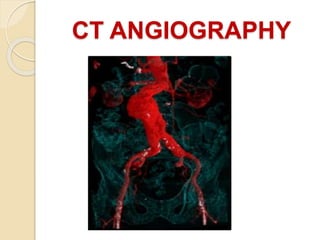
CT ANGIOGRAPHY
What is Angiography?
 Angiography or arteriography is a medical imaging
technique used to visualize the inside, or lumen, of blood
vessels and organs of the body, with particular interest in
the arteries, veins and the heart chambers.
 Angiography is performed using:
◦ x-rays with catheters
◦ computed tomography (CT)
◦ magnetic resonance imaging (MRI)
CT
 CT is based on the fundamental principle that the density
of the tissue passed by the X-ray beam can be measured
from the calculation of the attenuation coefficient.
What is CT Angiography?
 Produces detailed images of both blood vessels and
tissues in various parts of the body.
 Contrast agent: Iodine-rich dye.
 The scan is then performed while the contrast flows
through the blood vessels to the various organs of the
body.
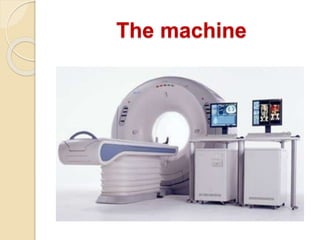
The machine
CT angiogram
Uses of CT angio
 CT angiography is used to examine blood vessels and
the organs supplied by them in various body parts,
including:
◦ brain
◦ neck
◦ heart
◦ chest
◦ abdomen (such as the kidneys and liver)
◦ pelvis
◦ legs and feet
◦ arms and hands
Uses
 Physicians use this test to diagnose and evaluate many
diseases of blood vessels and related conditions such
as:
◦ injury
◦ aneurysms
◦ blockages (including those from blood clots or plaques)
◦ disorganized blood vessels and blood supply to tumors
Procedure
 Prior to or on the day of the test, the patient is asked to
answer a questionnaire to ensure his/her safety.
 Intravenous catheter is inserted into the vein of the
patient usually in the arm.
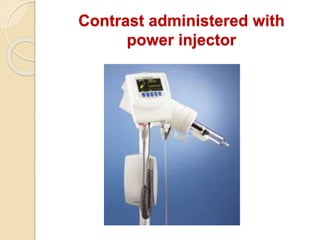
 An automatic injection pump connected to the IV will
give contrast material at a controlled rate.
 The scan of the desired area is performed.
Working
 Numerous x-ray beams and a set of electronic x-ray
detectors rotate around the patient, measuring the
amount of radiation being absorbed throughout the body.
 The examination table is moving through the scanner, so
that the x-ray beam follows a spiral path.
 When a contrast material is introduced to the
bloodstream during the procedure, it clearly defines the
blood vessels being examined by making them appear
bright white.
Contrast administered with
power injector
Precautions
 To prevent artifact:
◦ Patient may be asked to hold their breath during the scanning.
◦ Occasionally, sedation may be needed for children to keep them
still during scanning.
 Reducing exposure:
◦ Children are more sensitive to radiation than adults, the scan is
usually performed with an appropriate amount of radiation
delivered for the size of the child.
◦ For children and adults of reproductive age, radiation
protective shields are used for protection to reproductive
parts.
Advantages
 CT angiography may give more precise anatomical
detail than MRI, particularly in small blood vessels.
 Many patients can undergo CT angiography instead of
a conventional catheter angiography (catheterization)
to diagnose blood vessel problems.
 Lower cost examination compared to catheter
angiography.
Disadvantages
 There is always a slight chance of cancer from excessive
exposure to radiation. However, the benefit of an
accurate diagnosis far outweighs the risk.
 If a large amount of x-ray contrast material leaks out
from the vein being injected and spreads under the skin
where the IV is placed, it may damage the skin, blood
vessels and nerves.
 There might be a risk of serious allergic reaction to
contrast materials that contain iodine

CT angiography

  • 1.
  • 2.
    What is Angiography? Angiography or arteriography is a medical imaging technique used to visualize the inside, or lumen, of blood vessels and organs of the body, with particular interest in the arteries, veins and the heart chambers.  Angiography is performed using: ◦ x-rays with catheters ◦ computed tomography (CT) ◦ magnetic resonance imaging (MRI)
  • 3.
    CT  CT isbased on the fundamental principle that the density of the tissue passed by the X-ray beam can be measured from the calculation of the attenuation coefficient.
  • 4.
    What is CTAngiography?  Produces detailed images of both blood vessels and tissues in various parts of the body.  Contrast agent: Iodine-rich dye.  The scan is then performed while the contrast flows through the blood vessels to the various organs of the body.
  • 5.
  • 6.
  • 7.
    Uses of CTangio  CT angiography is used to examine blood vessels and the organs supplied by them in various body parts, including: ◦ brain ◦ neck ◦ heart ◦ chest ◦ abdomen (such as the kidneys and liver) ◦ pelvis ◦ legs and feet ◦ arms and hands
  • 8.
    Uses  Physicians usethis test to diagnose and evaluate many diseases of blood vessels and related conditions such as: ◦ injury ◦ aneurysms ◦ blockages (including those from blood clots or plaques) ◦ disorganized blood vessels and blood supply to tumors
  • 9.
    Procedure  Prior toor on the day of the test, the patient is asked to answer a questionnaire to ensure his/her safety.  Intravenous catheter is inserted into the vein of the patient usually in the arm.  An automatic injection pump connected to the IV will give contrast material at a controlled rate.  The scan of the desired area is performed.
  • 10.
    Working  Numerous x-raybeams and a set of electronic x-ray detectors rotate around the patient, measuring the amount of radiation being absorbed throughout the body.  The examination table is moving through the scanner, so that the x-ray beam follows a spiral path.  When a contrast material is introduced to the bloodstream during the procedure, it clearly defines the blood vessels being examined by making them appear bright white.
  • 12.
  • 13.
    Precautions  To preventartifact: ◦ Patient may be asked to hold their breath during the scanning. ◦ Occasionally, sedation may be needed for children to keep them still during scanning.  Reducing exposure: ◦ Children are more sensitive to radiation than adults, the scan is usually performed with an appropriate amount of radiation delivered for the size of the child. ◦ For children and adults of reproductive age, radiation protective shields are used for protection to reproductive parts.
  • 14.
    Advantages  CT angiographymay give more precise anatomical detail than MRI, particularly in small blood vessels.  Many patients can undergo CT angiography instead of a conventional catheter angiography (catheterization) to diagnose blood vessel problems.  Lower cost examination compared to catheter angiography.
  • 15.
    Disadvantages  There isalways a slight chance of cancer from excessive exposure to radiation. However, the benefit of an accurate diagnosis far outweighs the risk.  If a large amount of x-ray contrast material leaks out from the vein being injected and spreads under the skin where the IV is placed, it may damage the skin, blood vessels and nerves.  There might be a risk of serious allergic reaction to contrast materials that contain iodine