Pulmonary drug delivery System

       •            BY
       •          T.SHIVA
       • SHIVA.PHARMACIST@GMAIL.COM
INTRODUCTION.

ADVANTAGES.

DISADVANTAGES.

FACTORS AFFECTING PARTICLE DISTRIBUTION IN AIR.

FORMULATING AND DELEVERING THERAPEUTIC INHALATION
  AEROSOLS.

REFENCERENCE.
INTRODUCTION

     The human respiratory system is a complicated organ
system of very close structure–function relationships. The
system consisted of two regions: the conducting airway and
the respiratory region.

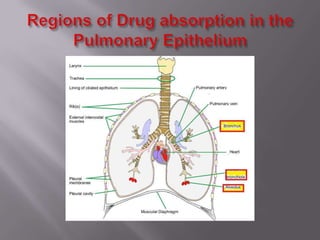
      The airway is further divided into many folds: nasal
cavity and the associated sinuses, and the nasopharynx,
oropharynx, larynx, trachea, bronchi, and bronchioles. The
respiratory region consists of respiratory bronchioles, alveolar
ducts, and alveolar sacs.
 Rapid absorption and fast onset of action due to relatively
  large absorption surface.

 Avoidance of the harsh environmental conditions in the
  gastrointestinal tract (chemical and enzymatic degradation of
  drugs).

 Avoidance of hepatic first pass metabolism and thus potential
  for dose reduction compared to oral delivery.

 Potential for direct delivery of drug to the central nervous
  system via the olfactory region, thus by-passing the blood
  brain barrier.

 Direct delivery of vaccine to lymphatic tissue and induction of
  a secretory immune response at distant mucosal site.
1.Difficulty in using aerosol devices.

2.Low reproducibility of devices which is unacceptable in cases of
  drugs with therapeutic index.

3.Absorption limited by the mucous layer.

4.Mucociliary clearance reduces the retention of drugs in the lungs
  [this is not good in poorly soluble or slow absorbed]
Factors effecting particle deposition in air


1.Physiological Factors.

2.Pharmaceutical Factors.
1)lung morphology.

2)Oral vs Nasal breathing.

3)Inspiratory flow rate(IFR)-of importance in devices (e.g.DPIs),
   energy of inspiration is used to generate the aerosol where
   increasing the IFR will lead to production of small particle size.

4)Co-ordination of aerosol generation with inspiration.

5)Tidal Volume.

6)Breath Holding.


Physiological factors
Pharmaceutical factors

1) Aerosol velocity:
 -DPIs, nebulizers depend on inspired air (IFR) i.e. Droplets
  carried by the effect of inspired only.
 -PMDI’s generate droplets with velocities >IFR
 :. greater tendency to impact on the or pharyngeal region.


2)Shape.


3)Density.


4)Size of particles.
   Drugs are delivered to the lungs by means of generating an
    aerosol.

   Aerosol: a colloidal, relatively stable two-phase system,
    consisting of solid or liquid particles dispersed in air or other
    gaseous phase having sufficiently small size to display
    considerable stability as a suspension.

   Atomization: process by which a liquid is converted into
    aerosolized particles which can be electrically, pneumatically
    or mechanically powered.
1.Pressurized Metered Dose Inhalers.

2.Dry Powder Inhalers.

3.Nebulisers.
   Metered-dose inhalers (MDIs), introduced in the mid 1950.

-   In MDIs, drug is either dissolved or suspended in a liquid
    propellant mixture together with other excipients, including
    surfactants, and presented in a pressurized canister fitted with a
    metering valve.

   - A Predetermined dose is release when up on actuation.
• Used for treatment of respiratory diseases such as
  asthma.

• They can be given in the form of suspension or solution.

• Particle size of less than 5 microns.

• Used to minimize the number of administrations errors.

• It can be deliver measure amount of medicament
  accurately.
Advantages of MDI
• It delivers specified amount of dose.
• Small size and convenience.
• Usually inexpensive as compare to dry powder inhalers
  and nebulizers.
• Quick to use.
• Multi dose capability more than 100 doses available.
Disadvantages of MDI
• Difficult to deliver high doses.
• There is no information about the number of doses left in
  the MDI.
• Accurate co-ordination between actuation of a dose and
  inhalation is essential.
Container:
  Tin-plated steel, plastic coated glass or aluminum canisters.
Propellants:
  1.Chloroflurocarbons.
  2.Hydroflouroalkanes.
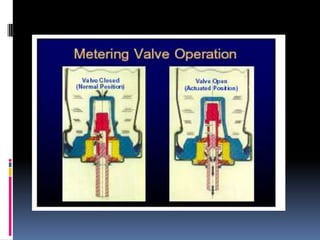
Metering Valve:
   It permits the reproducible delivery of small volumes. It is
  generally present in inverted position.

Formulation Metered Dose Inhalers:
 1.Solution system.
 2.Suspension system.

Filling Metered Dose Inhalers:
  1.Cold Filling.
  2.Pressure Filling.
In this drug is inhaled as cloud of fine particles. The drug is
  either preloaded in a inhalation device or into hard gelatin
  capsules or foil blister discs.They are propellant free and do
  not contain any excipient other than carrier like lactose.


Advantages:
    1. It is useful for young children.
    2.It delivers larger drug doses than MDIs.


Disavantages:
    1.Liberation of powders from the device.
    2.Less efficient.
1.Unit dose.
•   Spinhaler.
•   Rotahaler.

2.Multi dose.
•   Turbhaler.
•   Dischaler.
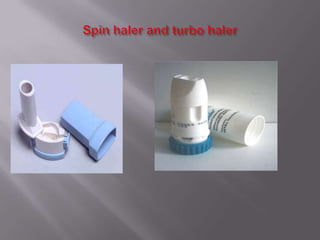
Spinhaler:The capsule is placed in a loose-fitting rotar is
   pierced through 2 needles.Inhaled air flow through the
   device causes rotation of rotar resulting in the powder being
   dispersed to the capsule walls and out through the
   perforations into the air.


Rota haler: The capsule is inserted into an orifice at rear of the
   device and when the two sections are rotated a fin on the
   inhaler barrel pulls the two halves of the capsule
   spins,dispersing its contents,which are inhaled through the
   mouthpiece.
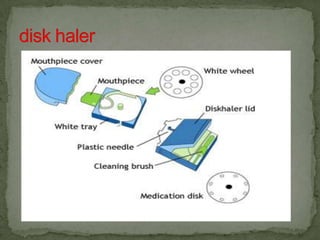
Diskhaler:Here aluminium foil blisters are placed in disc.Needle
  will pierce the blisters as air flows the blisters causes the
  powder to disperse as the patient will inhales through the
  mouthpiece.


Turbohaler:Here drug is present in reservoir from which it flows
  to disc.The disc is rotated by moving the turning grip back and
  forth thus drug is released which is inhaled by patient.
   Nebulizers deliver relatively large volumes of drug solutions
    and suspensions and are frequently used for drugs that
    cannot be conveniently formulated into MDIs or DPIs, or
    where the therapeutic dose is too large for delivery with
    these alternative systems.
    Nebulizers also have the advantage over metered-dose
    and dry powder systems in that drug may be inhaled during
    normal tidal breathing through a mouthpiece or face-mask,
    and thus they are useful for patients such as children, the
    elderly and patients with arthritis, who experience difficulties
    with MDIs.
   There are two categories of commercially available
    nebulizer: jet and ultrasonic
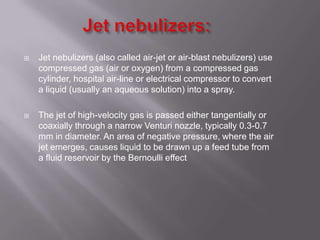
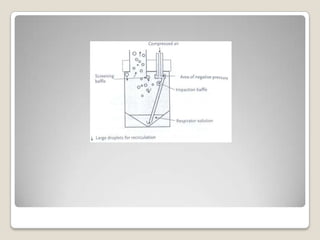
   Jet nebulizers (also called air-jet or air-blast nebulizers) use
    compressed gas (air or oxygen) from a compressed gas
    cylinder, hospital air-line or electrical compressor to convert
    a liquid (usually an aqueous solution) into a spray.

   The jet of high-velocity gas is passed either tangentially or
    coaxially through a narrow Venturi nozzle, typically 0.3-0.7
    mm in diameter. An area of negative pressure, where the air
    jet emerges, causes liquid to be drawn up a feed tube from
    a fluid reservoir by the Bernoulli effect
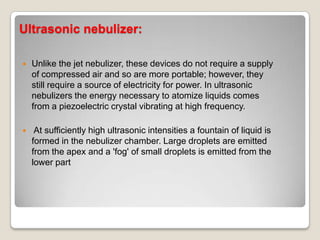
Ultrasonic nebulizer:

   Unlike the jet nebulizer, these devices do not require a supply
    of compressed air and so are more portable; however, they
    still require a source of electricity for power. In ultrasonic
    nebulizers the energy necessary to atomize liquids comes
    from a piezoelectric crystal vibrating at high frequency.

    At sufficiently high ultrasonic intensities a fountain of liquid is
    formed in the nebulizer chamber. Large droplets are emitted
    from the apex and a 'fog' of small droplets is emitted from the
    lower part
REFERENCES
Atkins,pj,barker. N.P.mathisen, D.(1992) The design and development of inhalation drug
    delivery systems in Hickey ASJ (ed). Pharmaceutical inhalation aerosal technology
    marcel dekker. New york.
Ben, J.H Hartly P.s,cox J.S.G(1971)Dry powder aerosals A new powder inhalation devices
   .Journal of pharmaceutical science,60, 1359-1564
Brindly,A.sumby,B.S smith,I.J.(1994) THE Charecteraisation of inhalation device by an
    inhalation simulator. The electronic lung .journal of aerosal medicine,7,197-200
Moren,F.(1981)Prenurised aerosal for oral inhalation International journal of
   pharmaceutics,8.1-10
Newman S.P(1989)Nebulisen therapy scintific and technical aspects, AB Draco,und
Pharmatics: biological barriers drug absortion ellis horwood chichester.
BIBLOGRAPHY
Campen L.V venthoye . G.(2002) inhalation, Dry powder in Swarbrick,J.boylan J.C
   (EDS)Encyclopedia of pharmaceutical technlogy , 2nd,edn marcel botter, New york.
Hickey A,S.T.(ED)(2003) Pharmaceutical inhalation Aerosol technology (2nd edn marce)
    Dekker ,New york
Munro,S.J.Mcripps, A.L(2002)Maternal dose inhalers in swarbrick,J. Boylan.
   J.C(EDS)Encyclopedia of pharmaceutical technology; 2nd edition Marcel Deker, New
   york. . ..
Pulmonary

Pulmonary

  • 1.
    Pulmonary drug deliverySystem • BY • T.SHIVA • SHIVA.PHARMACIST@GMAIL.COM
  • 2.
    INTRODUCTION. ADVANTAGES. DISADVANTAGES. FACTORS AFFECTING PARTICLEDISTRIBUTION IN AIR. FORMULATING AND DELEVERING THERAPEUTIC INHALATION AEROSOLS. REFENCERENCE.
  • 3.
    INTRODUCTION The human respiratory system is a complicated organ system of very close structure–function relationships. The system consisted of two regions: the conducting airway and the respiratory region. The airway is further divided into many folds: nasal cavity and the associated sinuses, and the nasopharynx, oropharynx, larynx, trachea, bronchi, and bronchioles. The respiratory region consists of respiratory bronchioles, alveolar ducts, and alveolar sacs.
  • 4.
     Rapid absorptionand fast onset of action due to relatively large absorption surface.  Avoidance of the harsh environmental conditions in the gastrointestinal tract (chemical and enzymatic degradation of drugs).  Avoidance of hepatic first pass metabolism and thus potential for dose reduction compared to oral delivery.  Potential for direct delivery of drug to the central nervous system via the olfactory region, thus by-passing the blood brain barrier.  Direct delivery of vaccine to lymphatic tissue and induction of a secretory immune response at distant mucosal site.
  • 5.
    1.Difficulty in usingaerosol devices. 2.Low reproducibility of devices which is unacceptable in cases of drugs with therapeutic index. 3.Absorption limited by the mucous layer. 4.Mucociliary clearance reduces the retention of drugs in the lungs [this is not good in poorly soluble or slow absorbed]
  • 7.
    Factors effecting particledeposition in air 1.Physiological Factors. 2.Pharmaceutical Factors.
  • 8.
    1)lung morphology. 2)Oral vsNasal breathing. 3)Inspiratory flow rate(IFR)-of importance in devices (e.g.DPIs), energy of inspiration is used to generate the aerosol where increasing the IFR will lead to production of small particle size. 4)Co-ordination of aerosol generation with inspiration. 5)Tidal Volume. 6)Breath Holding. Physiological factors
  • 9.
    Pharmaceutical factors 1) Aerosolvelocity:  -DPIs, nebulizers depend on inspired air (IFR) i.e. Droplets carried by the effect of inspired only.  -PMDI’s generate droplets with velocities >IFR :. greater tendency to impact on the or pharyngeal region. 2)Shape. 3)Density. 4)Size of particles.
  • 10.
    Drugs are delivered to the lungs by means of generating an aerosol.  Aerosol: a colloidal, relatively stable two-phase system, consisting of solid or liquid particles dispersed in air or other gaseous phase having sufficiently small size to display considerable stability as a suspension.  Atomization: process by which a liquid is converted into aerosolized particles which can be electrically, pneumatically or mechanically powered.
  • 11.
    1.Pressurized Metered DoseInhalers. 2.Dry Powder Inhalers. 3.Nebulisers.
  • 12.
    Metered-dose inhalers (MDIs), introduced in the mid 1950. - In MDIs, drug is either dissolved or suspended in a liquid propellant mixture together with other excipients, including surfactants, and presented in a pressurized canister fitted with a metering valve.  - A Predetermined dose is release when up on actuation.
  • 13.
    • Used fortreatment of respiratory diseases such as asthma. • They can be given in the form of suspension or solution. • Particle size of less than 5 microns. • Used to minimize the number of administrations errors. • It can be deliver measure amount of medicament accurately.
  • 14.
    Advantages of MDI •It delivers specified amount of dose. • Small size and convenience. • Usually inexpensive as compare to dry powder inhalers and nebulizers. • Quick to use. • Multi dose capability more than 100 doses available. Disadvantages of MDI • Difficult to deliver high doses. • There is no information about the number of doses left in the MDI. • Accurate co-ordination between actuation of a dose and inhalation is essential.
  • 15.
    Container: Tin-platedsteel, plastic coated glass or aluminum canisters. Propellants: 1.Chloroflurocarbons. 2.Hydroflouroalkanes. Metering Valve: It permits the reproducible delivery of small volumes. It is generally present in inverted position. Formulation Metered Dose Inhalers: 1.Solution system. 2.Suspension system. Filling Metered Dose Inhalers: 1.Cold Filling. 2.Pressure Filling.
  • 17.
    In this drugis inhaled as cloud of fine particles. The drug is either preloaded in a inhalation device or into hard gelatin capsules or foil blister discs.They are propellant free and do not contain any excipient other than carrier like lactose. Advantages: 1. It is useful for young children. 2.It delivers larger drug doses than MDIs. Disavantages: 1.Liberation of powders from the device. 2.Less efficient.
  • 18.
    1.Unit dose. • Spinhaler. • Rotahaler. 2.Multi dose. • Turbhaler. • Dischaler.
  • 19.
    Spinhaler:The capsule isplaced in a loose-fitting rotar is pierced through 2 needles.Inhaled air flow through the device causes rotation of rotar resulting in the powder being dispersed to the capsule walls and out through the perforations into the air. Rota haler: The capsule is inserted into an orifice at rear of the device and when the two sections are rotated a fin on the inhaler barrel pulls the two halves of the capsule spins,dispersing its contents,which are inhaled through the mouthpiece.
  • 20.
    Diskhaler:Here aluminium foilblisters are placed in disc.Needle will pierce the blisters as air flows the blisters causes the powder to disperse as the patient will inhales through the mouthpiece. Turbohaler:Here drug is present in reservoir from which it flows to disc.The disc is rotated by moving the turning grip back and forth thus drug is released which is inhaled by patient.
  • 23.
    Nebulizers deliver relatively large volumes of drug solutions and suspensions and are frequently used for drugs that cannot be conveniently formulated into MDIs or DPIs, or where the therapeutic dose is too large for delivery with these alternative systems.  Nebulizers also have the advantage over metered-dose and dry powder systems in that drug may be inhaled during normal tidal breathing through a mouthpiece or face-mask, and thus they are useful for patients such as children, the elderly and patients with arthritis, who experience difficulties with MDIs.  There are two categories of commercially available nebulizer: jet and ultrasonic
  • 24.
    Jet nebulizers (also called air-jet or air-blast nebulizers) use compressed gas (air or oxygen) from a compressed gas cylinder, hospital air-line or electrical compressor to convert a liquid (usually an aqueous solution) into a spray.  The jet of high-velocity gas is passed either tangentially or coaxially through a narrow Venturi nozzle, typically 0.3-0.7 mm in diameter. An area of negative pressure, where the air jet emerges, causes liquid to be drawn up a feed tube from a fluid reservoir by the Bernoulli effect
  • 26.
    Ultrasonic nebulizer:  Unlike the jet nebulizer, these devices do not require a supply of compressed air and so are more portable; however, they still require a source of electricity for power. In ultrasonic nebulizers the energy necessary to atomize liquids comes from a piezoelectric crystal vibrating at high frequency.  At sufficiently high ultrasonic intensities a fountain of liquid is formed in the nebulizer chamber. Large droplets are emitted from the apex and a 'fog' of small droplets is emitted from the lower part
  • 27.
    REFERENCES Atkins,pj,barker. N.P.mathisen, D.(1992)The design and development of inhalation drug delivery systems in Hickey ASJ (ed). Pharmaceutical inhalation aerosal technology marcel dekker. New york. Ben, J.H Hartly P.s,cox J.S.G(1971)Dry powder aerosals A new powder inhalation devices .Journal of pharmaceutical science,60, 1359-1564 Brindly,A.sumby,B.S smith,I.J.(1994) THE Charecteraisation of inhalation device by an inhalation simulator. The electronic lung .journal of aerosal medicine,7,197-200 Moren,F.(1981)Prenurised aerosal for oral inhalation International journal of pharmaceutics,8.1-10 Newman S.P(1989)Nebulisen therapy scintific and technical aspects, AB Draco,und Pharmatics: biological barriers drug absortion ellis horwood chichester.
  • 28.
    BIBLOGRAPHY Campen L.V venthoye. G.(2002) inhalation, Dry powder in Swarbrick,J.boylan J.C (EDS)Encyclopedia of pharmaceutical technlogy , 2nd,edn marcel botter, New york. Hickey A,S.T.(ED)(2003) Pharmaceutical inhalation Aerosol technology (2nd edn marce) Dekker ,New york Munro,S.J.Mcripps, A.L(2002)Maternal dose inhalers in swarbrick,J. Boylan. J.C(EDS)Encyclopedia of pharmaceutical technology; 2nd edition Marcel Deker, New york. . ..