Dr Jean-Michel Arnal Intensive Care Unit. Hôpital Font Pré Toulon France [email_address] Close loop ventilation in the ICU
Definition Conventional ventilation:  All the settings are done manually by the user Closed loop ventilation: Some settings are adjusted automatically according to parameters monitored
What parameter to close the loop? Non or little invasive Accurate in most condition Reproducible Technology integrated in a ventilator Not too expensive
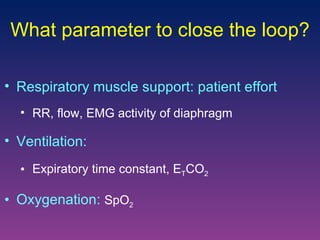
What parameter to close the loop? Respiratory muscle support: patient effort  RR, flow, EMG activity of diaphragm Ventilation:  Expiratory time constant, E T CO 2 Oxygenation:  SpO 2
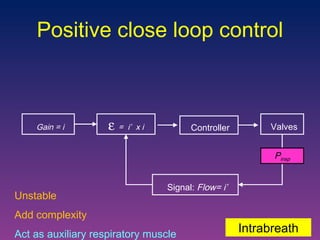
Positive close loop control C ontroller    =  i’  x i Valves Signal:  Flow=  i’ Gain = i P insp Unstable Add complexity Act as auxiliary respiratory muscle Intrabreath
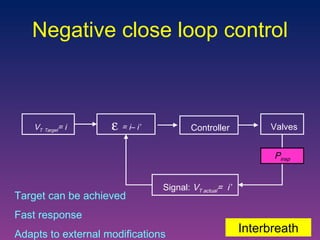
Negative close loop control C ontroller    = i– i’ Valves Signal:  V T actual =  i’ V T   Target = i P insp Target can be achieved Fast response Adapts to external modifications Interbreath
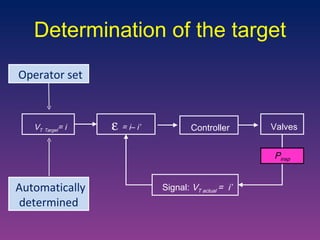
Determination of the target C ontroller    = i– i’ Valves Signal:  V T actual  =  i’ V T   Target = i P insp Operator  set Automatically determined
What is the target based on? Physiology:  Measurement of a physiologic parameter and algorithm that reproduces physiologic process Knowledge: Algorithm that reproduces expert clinical practice
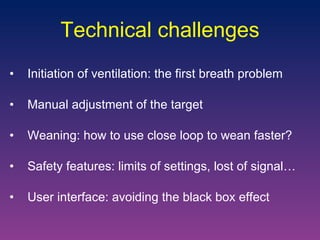
Technical challenges Initiation of ventilation: the first breath problem Manual adjustment of the target Weaning: how to use close loop to wean faster? Safety features: limits of settings, lost of signal… User interface: avoiding the black box effect
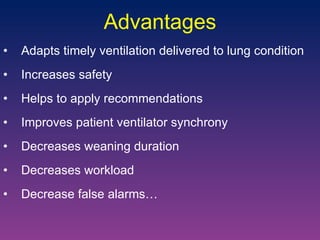
Advantages Adapts timely ventilation delivered to lung condition Increases safety Helps to apply recommendations Improves patient ventilator synchrony Decreases weaning duration Decreases workload Decrease false alarms…
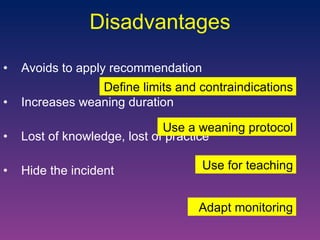
Disadvantages Avoids to apply recommendation Increases weaning duration Lost of knowledge, lost of practice Hide the incident Define limits and contraindications Use a weaning protocol Use for teaching Adapt monitoring
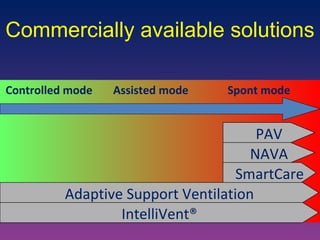
Commercially available solutions Controlled mode Assisted mode Spont mode PAV NAVA SmartCare Adaptive Support Ventilation IntelliVent®
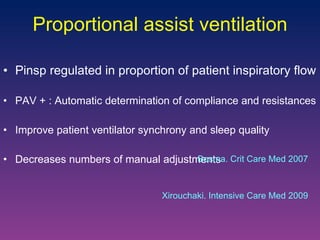
Pinsp regulated in proportion of patient inspiratory flow  PAV + : Automatic determination of compliance and resistances Improve patient ventilator synchrony and sleep quality Decreases numbers of manual adjustments Proportional assist ventilation Bosma. Crit Care Med 2007 Xirouchaki. Intensive Care Med 2009
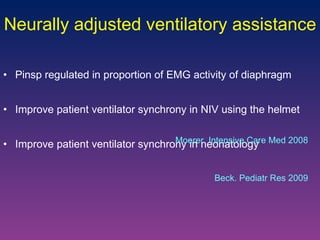
Pinsp regulated in proportion of EMG activity of diaphragm Improve patient ventilator synchrony in NIV using the helmet Improve patient ventilator synchrony in neonatology Neurally adjusted ventilatory assistance Moerer. Intensive Care Med 2008 Beck. Pediatr Res 2009
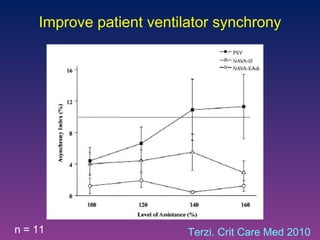
Improve patient ventilator synchrony Terzi. Crit Care Med 2010 n = 11
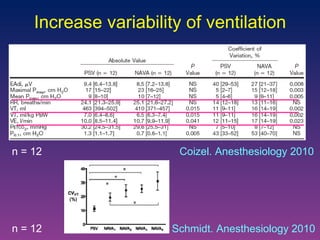
Increase variability of ventilation Coizel. Anesthesiology 2010  n = 12 n = 12 Schmidt. Anesthesiology 2010
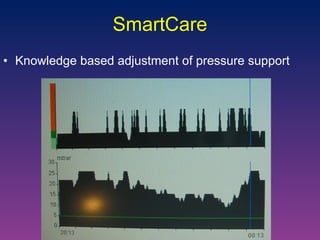
Knowledge based adjustment of pressure support SmartCare
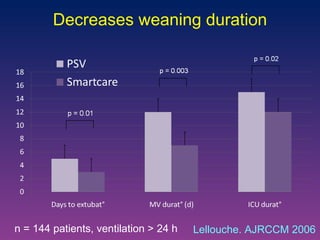
Decreases weaning duration Lellouche. AJRCCM 2006 n = 144 patients, ventilation > 24 h
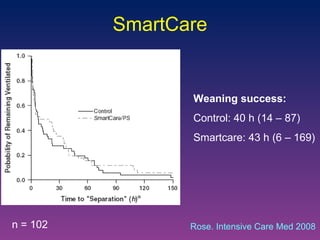
SmartCare n = 102 Rose. Intensive Care Med 2008 Weaning success: Control: 40 h (14 – 87) Smartcare: 43 h (6 – 169)
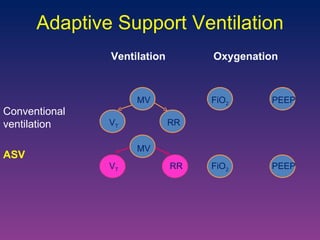
Adaptive Support Ventilation Ventilation Oxygenation Conventional ventilation ASV MV V T RR FiO 2 PEEP MV V T RR FiO 2 PEEP
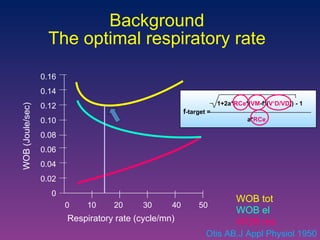
Background The optimal respiratory rate 0.16 0.14 0.12 0.10 0.08 0.06 0.04 0.02 0 0  10  20  30  40  50 WOB res WOB el WOB tot   1+2a* RCe *( VM -f*( V‘D/VD )) - 1 f -target = a* RCe Respiratory rate (cycle/mn) WOB (Joule/sec) Otis AB.J Appl Physiol 1950
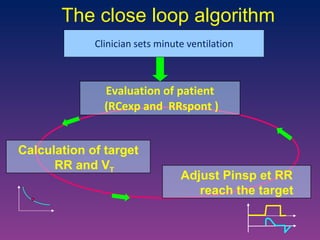
Evaluation of patient (RCexp and  RRspont ) Clinician sets minute ventilation Calculation of target RR and V T The close loop algorithm Adjust Pinsp et RR reach the target
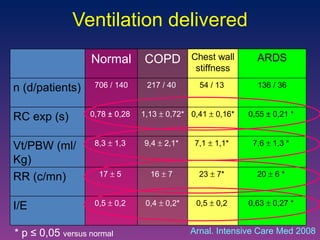
Ventilation delivered * p  ≤ 0,05  versus normal Arnal. Intensive Care Med 2008 Normal COPD Chest wall stiffness ARDS n (d/patients) 706 / 140 217 / 40  54 / 13  136 / 36 RC exp (s) 0,78 ± 0,28   1,13    0,72*  0,41    0,16*  0,55 ± 0,21 *  Vt/PBW (ml/Kg) 8,3    1,3   9,4    2,1*   7,1    1,1*  7,6    1,3 *  RR (c/mn) 17    5   16    7  23    7*  20    6 *  I/E 0,5    0,2   0,4    0,2* 0,5    0,2  0,63    0,27 *
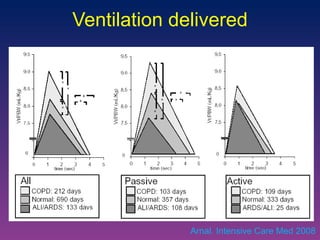
Ventilation delivered Arnal. Intensive Care Med 2008
ASV in ARDS patients Study on model reproducing 108 simulated scenario: ASV delivers around 6 mL/Kg PBW for most of cases Same plateau pressure than ARDSnet strategy Lower V T  for the most severe cases with lower Pplat Clinical study on 51 ARDS patients: V T  delivered are in line with recommendations Pplat was ≤ 28 cmH 2 O Sulemanji. Anesthesiology 2009 Arnal. AJRCCM 2007 [abstract]
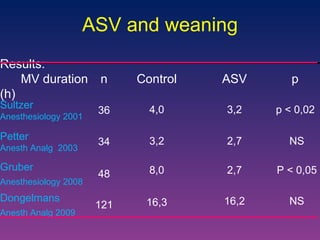
ASV and weaning Results:  MV duration (h) n Control ASV p  Sultzer  Anesthesiology 2001 36 4,0 3,2 p < 0,02  Petter  Anesth Analg  2003 34 3,2 2,7 NS Gruber  Anesthesiology 2008 48 8,0 2,7 P < 0,05 Dongelmans  Anesth Analg 2009 121 16,3 16,2 NS
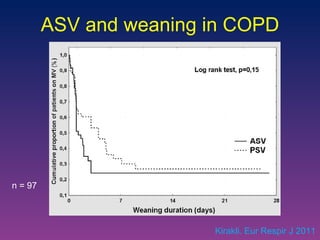
ASV and weaning in COPD Kirakli. Eur Respir J 2011 n = 97
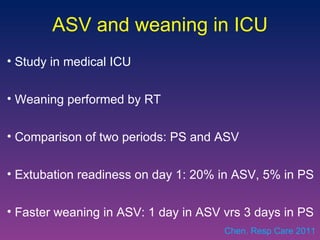
ASV and weaning in ICU Study in medical ICU  Weaning performed by RT Comparison of two periods: PS and ASV Extubation readiness on day 1: 20% in ASV, 5% in PS Faster weaning in ASV: 1 day in ASV vrs 3 days in PS Chen. Resp Care 2011
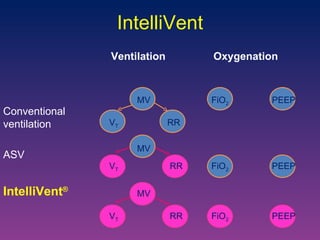
IntelliVent Ventilation Oxygenation Conventional ventilation ASV IntelliVent ® MV V T RR FiO 2 PEEP MV V T RR FiO 2 PEEP MV V T RR FiO 2 PEEP
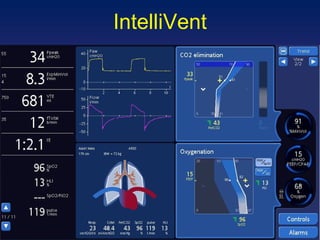
IntelliVent
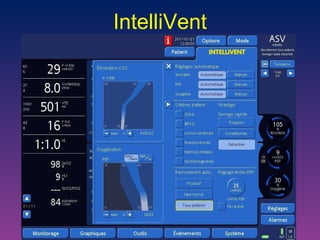
IntelliVent
Randomized control trial: Provide an automatic weaning in post cardiac surgery patients with less manipulations and more time spent in optimal ventilation zones than PS.  Randomized cross-over study: Safe in ICU patients with less inspiratory pressure and V T  than ASV with same gas exchanges.  IntelliVent Arnal. Intensive Care Med 2010 [abstract] Lellouche. Intensive Care Med 2010 [abstract]
Limitations Patient’s response to changes in ventilator setting is hardly predictable Different clinical situations:    Any algorithm won’t meet all the situations Different practice:   Any algorithm won’t meet all the expectations
In practice Available and usable For easy to ventilate patients or after the acute phase Advantages:  homogeneity in care, safety, less manipulation, improve organization… But: Learning curve: start with easy patients Must be associated with a weaning protocol
Which one to choose? Patient ventilator synchrony: PAV or NAVA Weaning duration: SmartCare ASV: Individualized breath pattern Automatic switch between control and assisted ventilation Reduction of weaning duration IntelliVent…
Conclusions Available, usable and safe Lot of potential interest: individual care, organization… Different solutions with increasing complexity Teaching and research tool Clinical evidences are needed before large implementation Thank you…  

Close loop Ventilation

  • 1.
    Dr Jean-Michel ArnalIntensive Care Unit. Hôpital Font Pré Toulon France [email_address] Close loop ventilation in the ICU
  • 2.
    Definition Conventional ventilation: All the settings are done manually by the user Closed loop ventilation: Some settings are adjusted automatically according to parameters monitored
  • 3.
    What parameter toclose the loop? Non or little invasive Accurate in most condition Reproducible Technology integrated in a ventilator Not too expensive
  • 4.
    What parameter toclose the loop? Respiratory muscle support: patient effort RR, flow, EMG activity of diaphragm Ventilation: Expiratory time constant, E T CO 2 Oxygenation: SpO 2
  • 5.
    Positive close loopcontrol C ontroller  = i’ x i Valves Signal: Flow= i’ Gain = i P insp Unstable Add complexity Act as auxiliary respiratory muscle Intrabreath
  • 6.
    Negative close loopcontrol C ontroller  = i– i’ Valves Signal: V T actual = i’ V T Target = i P insp Target can be achieved Fast response Adapts to external modifications Interbreath
  • 7.
    Determination of thetarget C ontroller  = i– i’ Valves Signal: V T actual = i’ V T Target = i P insp Operator set Automatically determined
  • 8.
    What is thetarget based on? Physiology: Measurement of a physiologic parameter and algorithm that reproduces physiologic process Knowledge: Algorithm that reproduces expert clinical practice
  • 9.
    Technical challenges Initiationof ventilation: the first breath problem Manual adjustment of the target Weaning: how to use close loop to wean faster? Safety features: limits of settings, lost of signal… User interface: avoiding the black box effect
  • 10.
    Advantages Adapts timelyventilation delivered to lung condition Increases safety Helps to apply recommendations Improves patient ventilator synchrony Decreases weaning duration Decreases workload Decrease false alarms…
  • 11.
    Disadvantages Avoids toapply recommendation Increases weaning duration Lost of knowledge, lost of practice Hide the incident Define limits and contraindications Use a weaning protocol Use for teaching Adapt monitoring
  • 12.
    Commercially available solutionsControlled mode Assisted mode Spont mode PAV NAVA SmartCare Adaptive Support Ventilation IntelliVent®
  • 13.
    Pinsp regulated inproportion of patient inspiratory flow PAV + : Automatic determination of compliance and resistances Improve patient ventilator synchrony and sleep quality Decreases numbers of manual adjustments Proportional assist ventilation Bosma. Crit Care Med 2007 Xirouchaki. Intensive Care Med 2009
  • 14.
    Pinsp regulated inproportion of EMG activity of diaphragm Improve patient ventilator synchrony in NIV using the helmet Improve patient ventilator synchrony in neonatology Neurally adjusted ventilatory assistance Moerer. Intensive Care Med 2008 Beck. Pediatr Res 2009
  • 15.
    Improve patient ventilatorsynchrony Terzi. Crit Care Med 2010 n = 11
  • 16.
    Increase variability ofventilation Coizel. Anesthesiology 2010 n = 12 n = 12 Schmidt. Anesthesiology 2010
  • 17.
    Knowledge based adjustmentof pressure support SmartCare
  • 18.
    Decreases weaning durationLellouche. AJRCCM 2006 n = 144 patients, ventilation > 24 h
  • 19.
    SmartCare n =102 Rose. Intensive Care Med 2008 Weaning success: Control: 40 h (14 – 87) Smartcare: 43 h (6 – 169)
  • 20.
    Adaptive Support VentilationVentilation Oxygenation Conventional ventilation ASV MV V T RR FiO 2 PEEP MV V T RR FiO 2 PEEP
  • 21.
    Background The optimalrespiratory rate 0.16 0.14 0.12 0.10 0.08 0.06 0.04 0.02 0 0 10 20 30 40 50 WOB res WOB el WOB tot 1+2a* RCe *( VM -f*( V‘D/VD )) - 1 f -target = a* RCe Respiratory rate (cycle/mn) WOB (Joule/sec) Otis AB.J Appl Physiol 1950
  • 22.
    Evaluation of patient(RCexp and RRspont ) Clinician sets minute ventilation Calculation of target RR and V T The close loop algorithm Adjust Pinsp et RR reach the target
  • 23.
    Ventilation delivered *p ≤ 0,05 versus normal Arnal. Intensive Care Med 2008 Normal COPD Chest wall stiffness ARDS n (d/patients) 706 / 140 217 / 40 54 / 13 136 / 36 RC exp (s) 0,78 ± 0,28 1,13  0,72* 0,41  0,16* 0,55 ± 0,21 * Vt/PBW (ml/Kg) 8,3  1,3 9,4  2,1* 7,1  1,1* 7,6  1,3 * RR (c/mn) 17  5 16  7 23  7* 20  6 * I/E 0,5  0,2 0,4  0,2* 0,5  0,2 0,63  0,27 *
  • 24.
    Ventilation delivered Arnal.Intensive Care Med 2008
  • 25.
    ASV in ARDSpatients Study on model reproducing 108 simulated scenario: ASV delivers around 6 mL/Kg PBW for most of cases Same plateau pressure than ARDSnet strategy Lower V T for the most severe cases with lower Pplat Clinical study on 51 ARDS patients: V T delivered are in line with recommendations Pplat was ≤ 28 cmH 2 O Sulemanji. Anesthesiology 2009 Arnal. AJRCCM 2007 [abstract]
  • 26.
    ASV and weaningResults: MV duration (h) n Control ASV p Sultzer Anesthesiology 2001 36 4,0 3,2 p < 0,02 Petter Anesth Analg 2003 34 3,2 2,7 NS Gruber Anesthesiology 2008 48 8,0 2,7 P < 0,05 Dongelmans Anesth Analg 2009 121 16,3 16,2 NS
  • 27.
    ASV and weaningin COPD Kirakli. Eur Respir J 2011 n = 97
  • 28.
    ASV and weaningin ICU Study in medical ICU Weaning performed by RT Comparison of two periods: PS and ASV Extubation readiness on day 1: 20% in ASV, 5% in PS Faster weaning in ASV: 1 day in ASV vrs 3 days in PS Chen. Resp Care 2011
  • 29.
    IntelliVent Ventilation OxygenationConventional ventilation ASV IntelliVent ® MV V T RR FiO 2 PEEP MV V T RR FiO 2 PEEP MV V T RR FiO 2 PEEP
  • 30.
  • 31.
  • 32.
    Randomized control trial:Provide an automatic weaning in post cardiac surgery patients with less manipulations and more time spent in optimal ventilation zones than PS. Randomized cross-over study: Safe in ICU patients with less inspiratory pressure and V T than ASV with same gas exchanges. IntelliVent Arnal. Intensive Care Med 2010 [abstract] Lellouche. Intensive Care Med 2010 [abstract]
  • 33.
    Limitations Patient’s responseto changes in ventilator setting is hardly predictable Different clinical situations: Any algorithm won’t meet all the situations Different practice: Any algorithm won’t meet all the expectations
  • 34.
    In practice Availableand usable For easy to ventilate patients or after the acute phase Advantages: homogeneity in care, safety, less manipulation, improve organization… But: Learning curve: start with easy patients Must be associated with a weaning protocol
  • 35.
    Which one tochoose? Patient ventilator synchrony: PAV or NAVA Weaning duration: SmartCare ASV: Individualized breath pattern Automatic switch between control and assisted ventilation Reduction of weaning duration IntelliVent…
  • 36.
    Conclusions Available, usableand safe Lot of potential interest: individual care, organization… Different solutions with increasing complexity Teaching and research tool Clinical evidences are needed before large implementation Thank you… 

Editor's Notes

  • #20 This study from Australia compared Smartcare with usual weaning in a single unit with a 1/1 nurse patient ratio, with very high qualified nurses. The result didn’t show any difference between control and Smartcare. At least, smartcare works as good as best practice in protocols.
  • #22 This physiologic figure is the background of ASV. It shows that for a given minute ventilation, there is an optimal respiratory rate that is associated with the minimal work or breathing. Otis showed in the fifty’s that this optimal respiratory rate depends on minute ventilation, dead space and expiratory time constant. Expiratory time constant resume the mechanical characteristics of the respiratory system because it is the product of resistances and compliance.