Lluís Blanch M.D., Ph.D. Consultant Critical Care Scientific Director Corporació Parc Taulí Universitat Autónoma de Barcelona Sabadell, Spain. Cairo 3 - 4 February 2010 Weaning: Tips & Tricks 10th Pulmonary Medicine Update Course
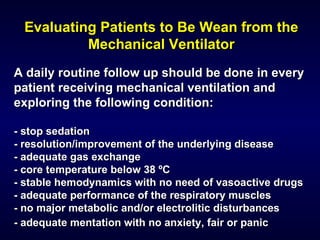
Evaluating Patients to Be Wean from the Mechanical Ventilator A daily routine follow up should be done in every patient receiving mechanical ventilation and exploring the following condition: - stop sedation - resolution/improvement of the underlying disease - adequate gas exchange - core temperature below 38 ºC - stable hemodynamics with no need of vasoactive drugs - adequate performance of the respiratory muscles - no major metabolic and/or electrolitic disturbances - adequate mentation with no anxiety, fair or panic
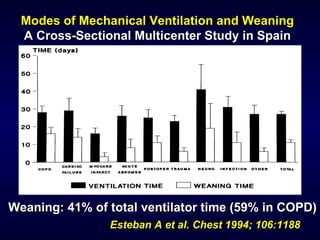
Esteban A et al. Chest 1994; 106:1188 Modes of Mechanical Ventilation and Weaning A Cross-Sectional Multicenter Study in Spain Weaning: 41% of total ventilator time (59% in COPD)
Weaning Techniques: T-Piece SIMV PSV Weaning Approach: Team Based Physician Based
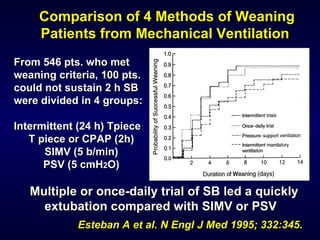
Esteban A et al. N Engl J Med 1995; 332:345. Comparison of 4 Methods of Weaning Patients from Mechanical Ventilation  From 546 pts. who met weaning criteria, 100 pts. could not sustain 2 h SB were divided in 4 groups: Intermittent (24 h) Tpiece T piece or CPAP (2h) SIMV (5 b/min) PSV (5 cmH 2 O) Multiple or once-daily trial of SB led a quickly extubation compared with SIMV or PSV
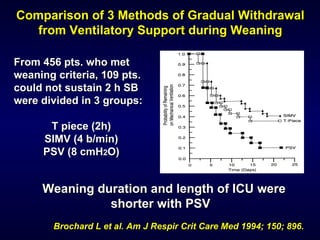
Brochard L et al. Am J Respir Crit Care Med 1994; 150; 896. Comparison of 3 Methods of Gradual Withdrawal from Ventilatory Support during Weaning From 456 pts. who met weaning criteria, 109 pts. could not sustain 2 h SB were divided in 3 groups: T piece (2h) SIMV (4 b/min) PSV (8 cmH 2 O) Weaning duration and length of ICU were shorter with PSV
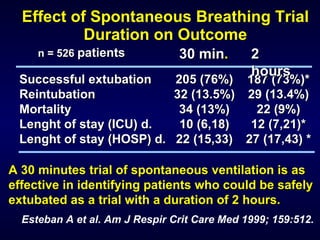
Effect of Spontaneous Breathing Trial Duration on Outcome A 30 minutes trial of spontaneous ventilation is as effective in identifying patients who could be safely extubated as a trial with a duration of 2 hours. Esteban A et al. Am J Respir Crit Care Med 1999; 159:512. n = 526  patients Successful extubation Reintubation Mortality Lenght of stay (ICU) d. Lenght of stay (HOSP) d. 205 (76%) 32 (13.5%) 34 (13%) 10 (6,18) 22 (15,33) 187 (73%)* 29 (13.4%) 22 (9%) 12 (7,21)* 27 (17,43) * 30   min . 2 hours
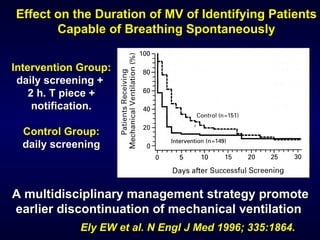
Ely EW et al. N Engl J Med 1996; 335:1864. Effect on the Duration of MV of Identifying Patients Capable of Breathing Spontaneously Intervention Group: daily screening +  2 h. T piece + notification. Control Group: daily screening A multidisciplinary management strategy promote earlier discontinuation of mechanical ventilation
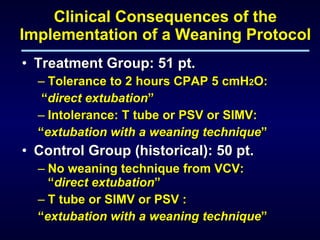
Clinical Consequences of the Implementation of a Weaning Protocol Treatment Group: 51 pt. Tolerance to 2 hours CPAP 5 cmH 2 O: “ direct extubation ” Intolerance: T tube or PSV or SIMV:  “ extubation with a weaning technique ”  Control Group (historical): 50 pt. No weaning technique from VCV:  “ direct extubation ” T tube or SIMV or PSV :  “ extubation with a weaning technique ”
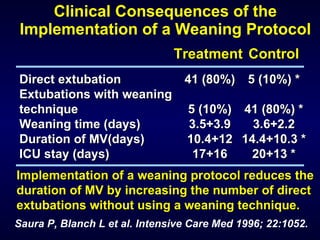
Clinical Consequences of the Implementation of a Weaning Protocol Implementation of a weaning protocol reduces the duration of MV by increasing the number of direct extubations without using a weaning technique.  Saura P, Blanch L et al. Intensive Care Med 1996; 22:1052. Direct extubation Extubations with weaning technique Weaning time (days) Duration of MV(days) ICU stay (days) 41 (80%) 5 (10%) 3.5+3.9 10.4+12 17+16 5 (10%) * 41 (80%) * 3.6+2.2 14.4+10.3 * 20+13 * Treatment Control
Weaning Techniques: T-Piece SIMV PSV Weaning Approach: Team Based Physician Based
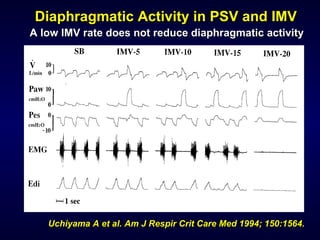
Uchiyama A et al. Am J Respir Crit Care Med 1994; 150:1564. Diaphragmatic Activity in PSV and IMV A low IMV rate does not reduce diaphragmatic activity
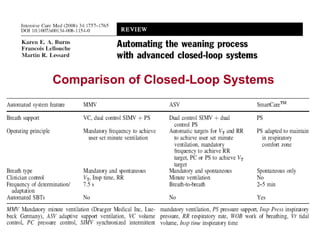
Comparison of Closed-Loop Systems
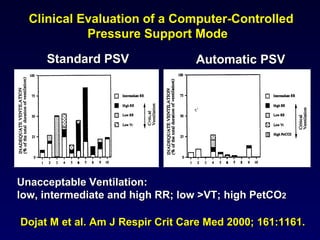
Clinical Evaluation of a Computer-Controlled Pressure Support Mode  Standard PSV Automatic PSV Unacceptable Ventilation:  low, intermediate and high RR; low >VT; high PetCO 2 Dojat M et al. Am J Respir Crit Care Med 2000; 161:1161.
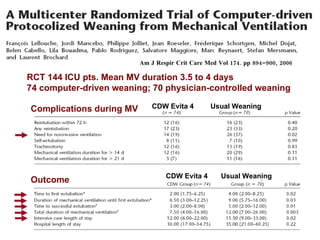
Am J Respir Crit Care Med Vol 174. pp 894–900, 2006 RCT 144 ICU pts. Mean MV duration 3.5 to 4 days  74 computer-driven weaning; 70 physician-controlled weaning CDW Evita 4 Usual Weaning CDW Evita 4 Usual Weaning Complications during MV Outcome
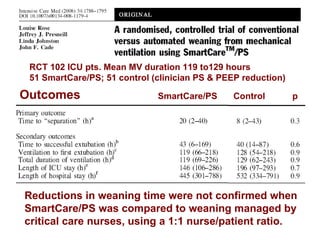
RCT 102 ICU pts. Mean MV duration 119 to129 hours  51 SmartCare/PS; 51 control (clinician PS & PEEP reduction) Reductions in weaning time were not confirmed when SmartCare/PS was compared to weaning managed by critical care nurses, using a 1:1 nurse/patient ratio. SmartCare/PS Control p Outcomes
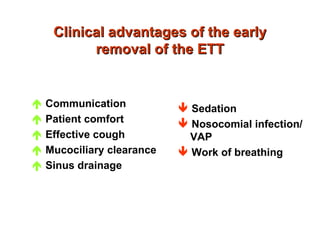
Clinical advantages of the early removal of the ETT    Communication    Patient comfort    Effective cough    Mucociliary clearance    Sinus drainage    Sedation     Nosocomial infection/VAP    Work of breathing
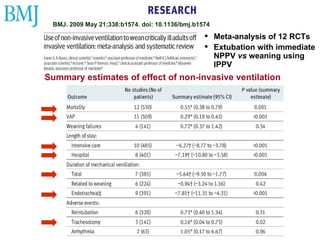
BMJ. 2009 May 21;338:b1574. doi: 10.1136/bmj.b1574  Meta-analysis of 12 RCTs Extubation with immediate NPPV  vs  weaning using IPPV Summary estimates of effect of non-invasive ventilation
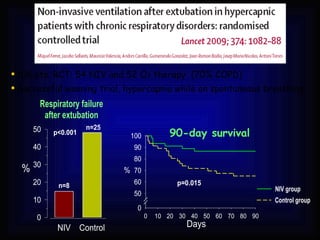
106 pts. RCT: 54 NIV and 52 O 2  therapy  (70% COPD) Successful weaning trial, hypercapnia while on spontaneous breathing 90-day survival
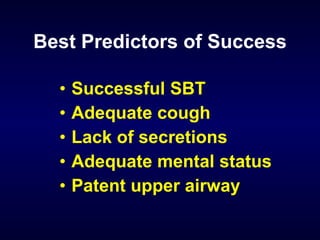
Best Predictors of Success Successful SBT Adequate cough Lack of secretions Adequate mental status Patent upper airway
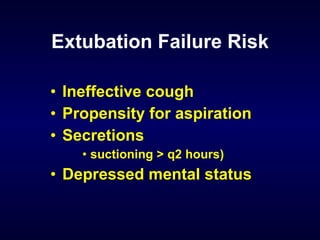
Extubation Failure Risk Ineffective cough Propensity for aspiration Secretions  suctioning > q2 hours) Depressed mental status
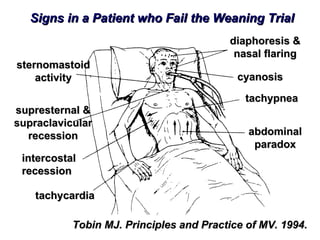
tachycardia intercostal recession supresternal & supraclavicular recession sternomastoid activity diaphoresis & nasal flaring cyanosis tachypnea abdominal paradox Tobin MJ. Principles and Practice of MV. 1994. Signs in a Patient who Fail the Weaning Trial
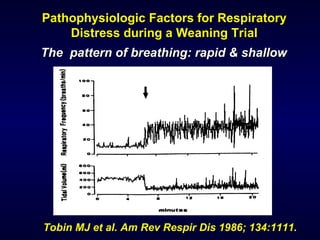
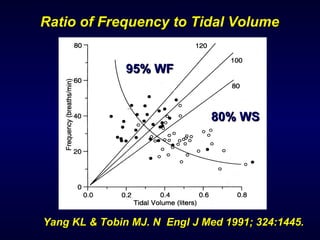
Tobin MJ et al. Am Rev Respir Dis 1986; 134:1111. Pathophysiologic Factors for Respiratory Distress during a Weaning Trial The  pattern of breathing: rapid & shallow
Yang KL & Tobin MJ. N  Engl J Med 1991; 324:1445. Ratio of Frequency to Tidal Volume 80% WS 95% WF
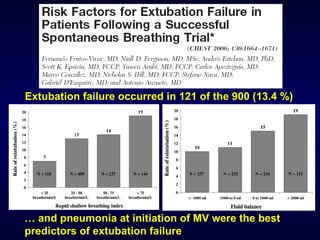
Extubation failure occurred in 121 of the 900 (13.4 %) …  and pneumonia at initiation of MV were the best predictors of extubation failure
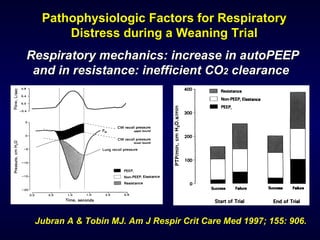
Jubran A & Tobin MJ. Am J Respir Crit Care Med 1997; 155: 906. Pathophysiologic Factors for Respiratory Distress during a Weaning Trial Respiratory mechanics: increase in autoPEEP and in resistance: inefficient CO 2  clearance
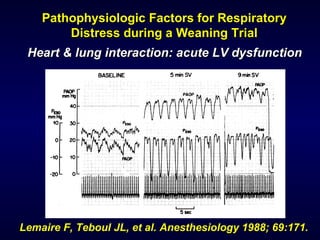
Lemaire F, Teboul JL, et al. Anesthesiology 1988; 69:171. Pathophysiologic Factors for Respiratory Distress during a Weaning Trial Heart & lung interaction: acute LV dysfunction
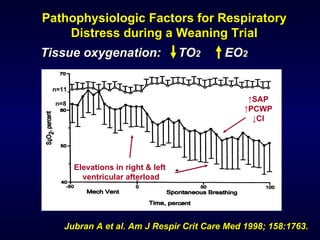
Jubran A et al. Am J Respir Crit Care Med 1998; 158:1763. Pathophysiologic Factors for Respiratory Distress during a Weaning Trial Tissue oxygenation:  TO 2   EO 2 Elevations in right & left  ventricular afterload n=11 n=8 ↑ SAP ↑ PCWP ↓ CI
Phychological Aspects of Weaning: 1-  MV patients know that their ability to breath depends on help from a machine 2-  ET tube makes hard to communicate 3-  Inability to talk: anxiety, helpness, anger, despair, hopeless,… 4-  Other stressors: dyspnea and sleep difficulties
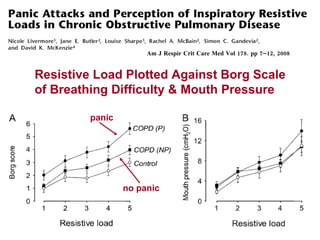
Resistive Load Plotted Against Borg Scale of Breathing Difficulty & Mouth Pressure panic no panic Am J Respir Crit Care Med Vol 178. pp 7–12, 2008
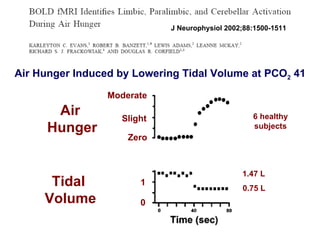
Air Hunger Induced by Lowering Tidal Volume at PCO 2  41 J Neurophysiol 2002;88:1500-1511 Air  Hunger Moderate Slight Zero 0 1 Tidal  Volume 1.47 L 0.75 L 6 healthy subjects
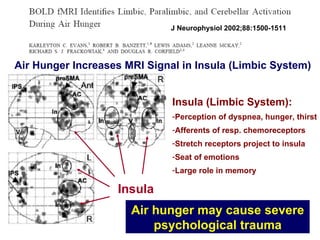
J Neurophysiol 2002;88:1500-1511 Insula (Limbic System): Perception of dyspnea, hunger, thirst Afferents of resp. chemoreceptors Stretch receptors project to insula Seat of emotions Large role in memory Air hunger may cause severe psychological trauma Air Hunger Increases MRI Signal in Insula (Limbic System) Insula
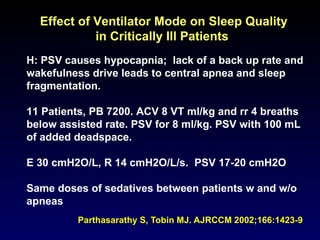
Parthasarathy S, Tobin MJ. AJRCCM 2002;166:1423-9 H: PSV causes hypocapnia;  lack of a back up rate and wakefulness drive leads to central apnea and sleep fragmentation. 11 Patients, PB 7200. ACV 8 VT ml/kg and rr 4 breaths below assisted rate. PSV for 8 ml/kg. PSV with 100 mL of added deadspace. E 30 cmH2O/L, R 14 cmH2O/L/s.  PSV 17-20 cmH2O Same doses of sedatives between patients w and w/o apneas Effect of Ventilator Mode on Sleep Quality in Critically Ill Patients
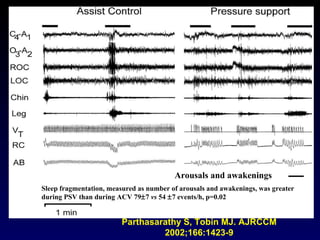
Parthasarathy S, Tobin MJ. AJRCCM 2002;166:1423-9 Arousals and awakenings Sleep fragmentation, measured as number of arousals and awakenings, was greater during PSV than during ACV 79  7  vs  54   7 events/h, p=0.02
In Conclusion:   1-  Successful weaning depends on skilled judgement, decision making, medical and nursing observation and intervention. 2-  Most patients do not require prolonged period of withdrawal of MV. 3-  Inadequate discontinuation of ventilatory support can precipitate, muscle fatigue, abnormal gas exchange and loss of airway protection.  4-  Have in mind: sleep quality, mental status, ICU-adquired weakness and cardiac function.  Weaning: Tips and Tricks

Weaning Tips & Tricks

  • 1.
    Lluís Blanch M.D.,Ph.D. Consultant Critical Care Scientific Director Corporació Parc Taulí Universitat Autónoma de Barcelona Sabadell, Spain. Cairo 3 - 4 February 2010 Weaning: Tips & Tricks 10th Pulmonary Medicine Update Course
  • 2.
    Evaluating Patients toBe Wean from the Mechanical Ventilator A daily routine follow up should be done in every patient receiving mechanical ventilation and exploring the following condition: - stop sedation - resolution/improvement of the underlying disease - adequate gas exchange - core temperature below 38 ºC - stable hemodynamics with no need of vasoactive drugs - adequate performance of the respiratory muscles - no major metabolic and/or electrolitic disturbances - adequate mentation with no anxiety, fair or panic
  • 3.
    Esteban A etal. Chest 1994; 106:1188 Modes of Mechanical Ventilation and Weaning A Cross-Sectional Multicenter Study in Spain Weaning: 41% of total ventilator time (59% in COPD)
  • 4.
    Weaning Techniques: T-PieceSIMV PSV Weaning Approach: Team Based Physician Based
  • 5.
    Esteban A etal. N Engl J Med 1995; 332:345. Comparison of 4 Methods of Weaning Patients from Mechanical Ventilation From 546 pts. who met weaning criteria, 100 pts. could not sustain 2 h SB were divided in 4 groups: Intermittent (24 h) Tpiece T piece or CPAP (2h) SIMV (5 b/min) PSV (5 cmH 2 O) Multiple or once-daily trial of SB led a quickly extubation compared with SIMV or PSV
  • 6.
    Brochard L etal. Am J Respir Crit Care Med 1994; 150; 896. Comparison of 3 Methods of Gradual Withdrawal from Ventilatory Support during Weaning From 456 pts. who met weaning criteria, 109 pts. could not sustain 2 h SB were divided in 3 groups: T piece (2h) SIMV (4 b/min) PSV (8 cmH 2 O) Weaning duration and length of ICU were shorter with PSV
  • 7.
    Effect of SpontaneousBreathing Trial Duration on Outcome A 30 minutes trial of spontaneous ventilation is as effective in identifying patients who could be safely extubated as a trial with a duration of 2 hours. Esteban A et al. Am J Respir Crit Care Med 1999; 159:512. n = 526 patients Successful extubation Reintubation Mortality Lenght of stay (ICU) d. Lenght of stay (HOSP) d. 205 (76%) 32 (13.5%) 34 (13%) 10 (6,18) 22 (15,33) 187 (73%)* 29 (13.4%) 22 (9%) 12 (7,21)* 27 (17,43) * 30 min . 2 hours
  • 8.
    Ely EW etal. N Engl J Med 1996; 335:1864. Effect on the Duration of MV of Identifying Patients Capable of Breathing Spontaneously Intervention Group: daily screening + 2 h. T piece + notification. Control Group: daily screening A multidisciplinary management strategy promote earlier discontinuation of mechanical ventilation
  • 9.
    Clinical Consequences ofthe Implementation of a Weaning Protocol Treatment Group: 51 pt. Tolerance to 2 hours CPAP 5 cmH 2 O: “ direct extubation ” Intolerance: T tube or PSV or SIMV: “ extubation with a weaning technique ” Control Group (historical): 50 pt. No weaning technique from VCV: “ direct extubation ” T tube or SIMV or PSV : “ extubation with a weaning technique ”
  • 10.
    Clinical Consequences ofthe Implementation of a Weaning Protocol Implementation of a weaning protocol reduces the duration of MV by increasing the number of direct extubations without using a weaning technique. Saura P, Blanch L et al. Intensive Care Med 1996; 22:1052. Direct extubation Extubations with weaning technique Weaning time (days) Duration of MV(days) ICU stay (days) 41 (80%) 5 (10%) 3.5+3.9 10.4+12 17+16 5 (10%) * 41 (80%) * 3.6+2.2 14.4+10.3 * 20+13 * Treatment Control
  • 11.
    Weaning Techniques: T-PieceSIMV PSV Weaning Approach: Team Based Physician Based
  • 12.
    Uchiyama A etal. Am J Respir Crit Care Med 1994; 150:1564. Diaphragmatic Activity in PSV and IMV A low IMV rate does not reduce diaphragmatic activity
  • 13.
  • 14.
    Clinical Evaluation ofa Computer-Controlled Pressure Support Mode Standard PSV Automatic PSV Unacceptable Ventilation: low, intermediate and high RR; low >VT; high PetCO 2 Dojat M et al. Am J Respir Crit Care Med 2000; 161:1161.
  • 15.
    Am J RespirCrit Care Med Vol 174. pp 894–900, 2006 RCT 144 ICU pts. Mean MV duration 3.5 to 4 days 74 computer-driven weaning; 70 physician-controlled weaning CDW Evita 4 Usual Weaning CDW Evita 4 Usual Weaning Complications during MV Outcome
  • 16.
    RCT 102 ICUpts. Mean MV duration 119 to129 hours 51 SmartCare/PS; 51 control (clinician PS & PEEP reduction) Reductions in weaning time were not confirmed when SmartCare/PS was compared to weaning managed by critical care nurses, using a 1:1 nurse/patient ratio. SmartCare/PS Control p Outcomes
  • 17.
    Clinical advantages ofthe early removal of the ETT  Communication  Patient comfort  Effective cough  Mucociliary clearance  Sinus drainage  Sedation  Nosocomial infection/VAP  Work of breathing
  • 18.
    BMJ. 2009 May21;338:b1574. doi: 10.1136/bmj.b1574 Meta-analysis of 12 RCTs Extubation with immediate NPPV vs weaning using IPPV Summary estimates of effect of non-invasive ventilation
  • 19.
    106 pts. RCT:54 NIV and 52 O 2 therapy (70% COPD) Successful weaning trial, hypercapnia while on spontaneous breathing 90-day survival
  • 20.
    Best Predictors ofSuccess Successful SBT Adequate cough Lack of secretions Adequate mental status Patent upper airway
  • 21.
    Extubation Failure RiskIneffective cough Propensity for aspiration Secretions suctioning > q2 hours) Depressed mental status
  • 22.
    tachycardia intercostal recessionsupresternal & supraclavicular recession sternomastoid activity diaphoresis & nasal flaring cyanosis tachypnea abdominal paradox Tobin MJ. Principles and Practice of MV. 1994. Signs in a Patient who Fail the Weaning Trial
  • 23.
    Tobin MJ etal. Am Rev Respir Dis 1986; 134:1111. Pathophysiologic Factors for Respiratory Distress during a Weaning Trial The pattern of breathing: rapid & shallow
  • 24.
    Yang KL &Tobin MJ. N Engl J Med 1991; 324:1445. Ratio of Frequency to Tidal Volume 80% WS 95% WF
  • 25.
    Extubation failure occurredin 121 of the 900 (13.4 %) … and pneumonia at initiation of MV were the best predictors of extubation failure
  • 26.
    Jubran A &Tobin MJ. Am J Respir Crit Care Med 1997; 155: 906. Pathophysiologic Factors for Respiratory Distress during a Weaning Trial Respiratory mechanics: increase in autoPEEP and in resistance: inefficient CO 2 clearance
  • 27.
    Lemaire F, TeboulJL, et al. Anesthesiology 1988; 69:171. Pathophysiologic Factors for Respiratory Distress during a Weaning Trial Heart & lung interaction: acute LV dysfunction
  • 28.
    Jubran A etal. Am J Respir Crit Care Med 1998; 158:1763. Pathophysiologic Factors for Respiratory Distress during a Weaning Trial Tissue oxygenation: TO 2 EO 2 Elevations in right & left ventricular afterload n=11 n=8 ↑ SAP ↑ PCWP ↓ CI
  • 29.
    Phychological Aspects ofWeaning: 1- MV patients know that their ability to breath depends on help from a machine 2- ET tube makes hard to communicate 3- Inability to talk: anxiety, helpness, anger, despair, hopeless,… 4- Other stressors: dyspnea and sleep difficulties
  • 30.
    Resistive Load PlottedAgainst Borg Scale of Breathing Difficulty & Mouth Pressure panic no panic Am J Respir Crit Care Med Vol 178. pp 7–12, 2008
  • 31.
    Air Hunger Inducedby Lowering Tidal Volume at PCO 2 41 J Neurophysiol 2002;88:1500-1511 Air Hunger Moderate Slight Zero 0 1 Tidal Volume 1.47 L 0.75 L 6 healthy subjects
  • 32.
    J Neurophysiol 2002;88:1500-1511Insula (Limbic System): Perception of dyspnea, hunger, thirst Afferents of resp. chemoreceptors Stretch receptors project to insula Seat of emotions Large role in memory Air hunger may cause severe psychological trauma Air Hunger Increases MRI Signal in Insula (Limbic System) Insula
  • 33.
    Parthasarathy S, TobinMJ. AJRCCM 2002;166:1423-9 H: PSV causes hypocapnia; lack of a back up rate and wakefulness drive leads to central apnea and sleep fragmentation. 11 Patients, PB 7200. ACV 8 VT ml/kg and rr 4 breaths below assisted rate. PSV for 8 ml/kg. PSV with 100 mL of added deadspace. E 30 cmH2O/L, R 14 cmH2O/L/s. PSV 17-20 cmH2O Same doses of sedatives between patients w and w/o apneas Effect of Ventilator Mode on Sleep Quality in Critically Ill Patients
  • 34.
    Parthasarathy S, TobinMJ. AJRCCM 2002;166:1423-9 Arousals and awakenings Sleep fragmentation, measured as number of arousals and awakenings, was greater during PSV than during ACV 79  7 vs 54  7 events/h, p=0.02
  • 35.
    In Conclusion: 1- Successful weaning depends on skilled judgement, decision making, medical and nursing observation and intervention. 2- Most patients do not require prolonged period of withdrawal of MV. 3- Inadequate discontinuation of ventilatory support can precipitate, muscle fatigue, abnormal gas exchange and loss of airway protection. 4- Have in mind: sleep quality, mental status, ICU-adquired weakness and cardiac function. Weaning: Tips and Tricks