ADAPTIVE SUPPORT
VENTILATION
Aziza Al-Amri
Mashail Al-Rayes
• Introduction
• Indication
• How does this mode work ?
• Initial setting
• Advantages and Disadvantages
• Weaning
Introduction
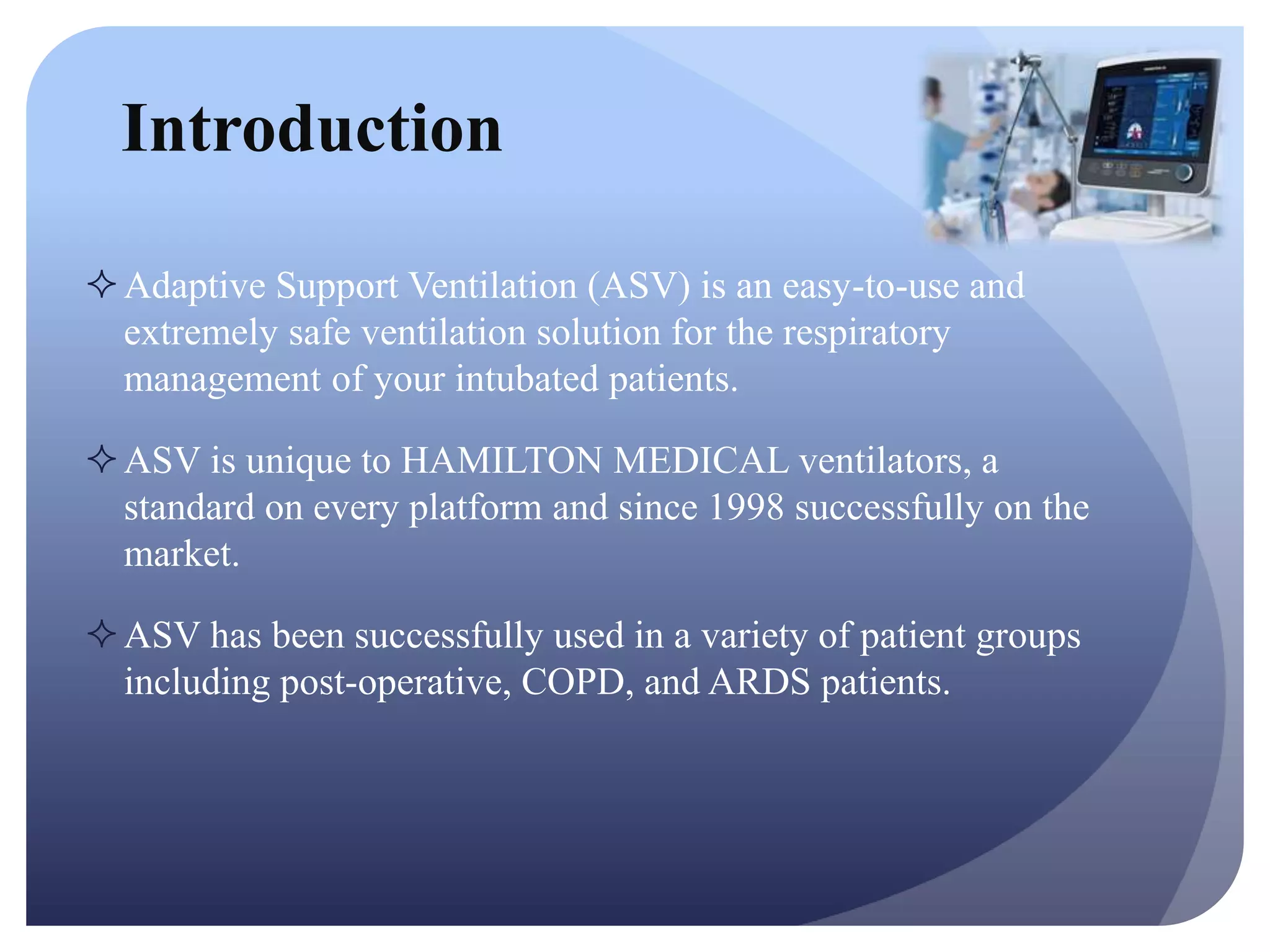
Adaptive Support Ventilation (ASV) is an easy-to-use and
extremely safe ventilation solution for the respiratory
management of your intubated patients.
ASV is unique to HAMILTON MEDICAL ventilators, a
standard on every platform and since 1998 successfully on the
market.
ASV has been successfully used in a variety of patient groups
including post-operative, COPD, and ARDS patients.
ASV mode
A dual control mode that uses both PC and PS to maintain a set
minimum VE using the least required setting for minimal WOB
depending on the patient’s condition and effort .
It could provides mandatory, assisted or spontaneous types of
breath .
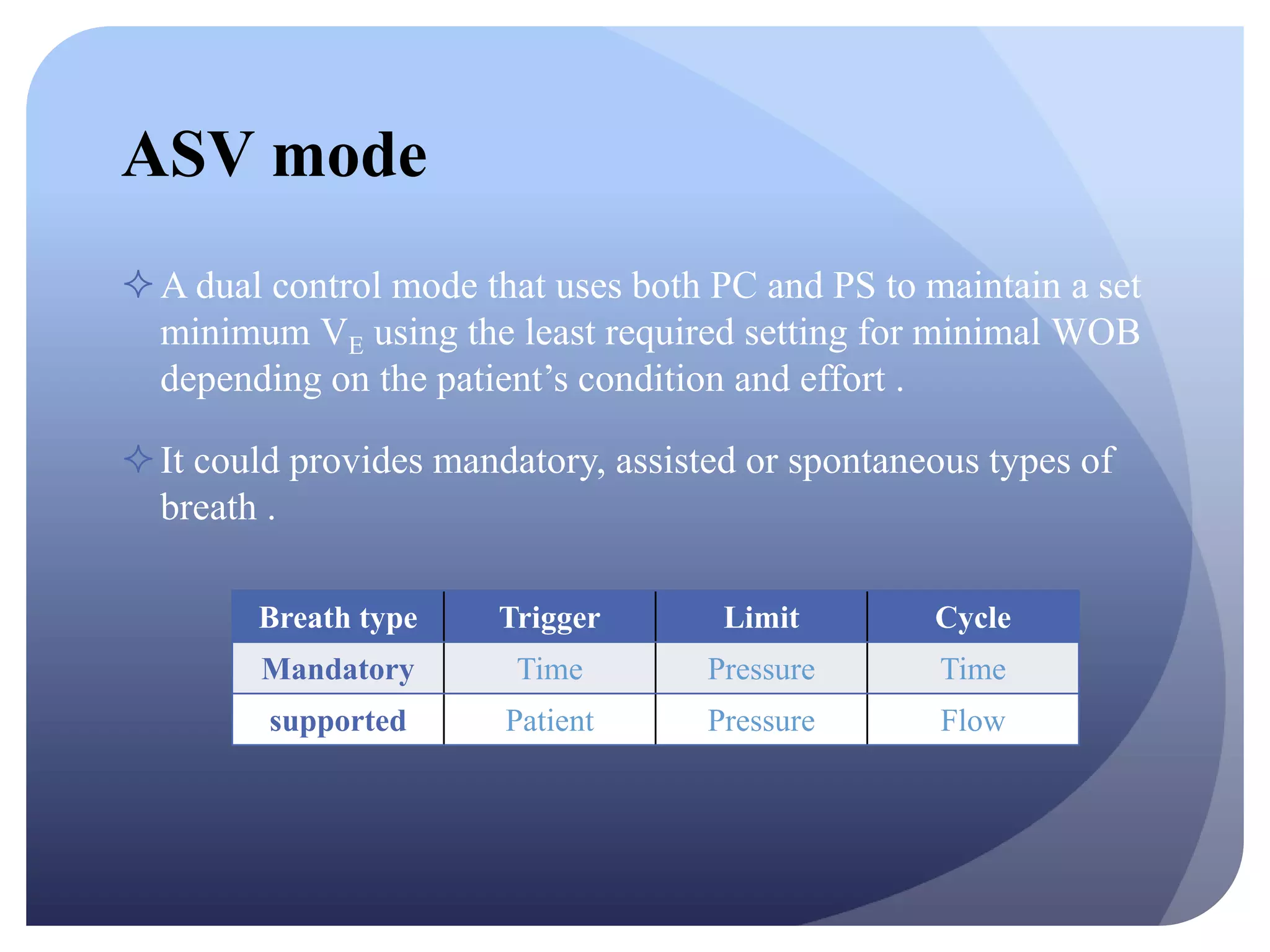
Breath type Trigger Limit Cycle
Mandatory Time Pressure Time
supported Patient Pressure Flow
Indications
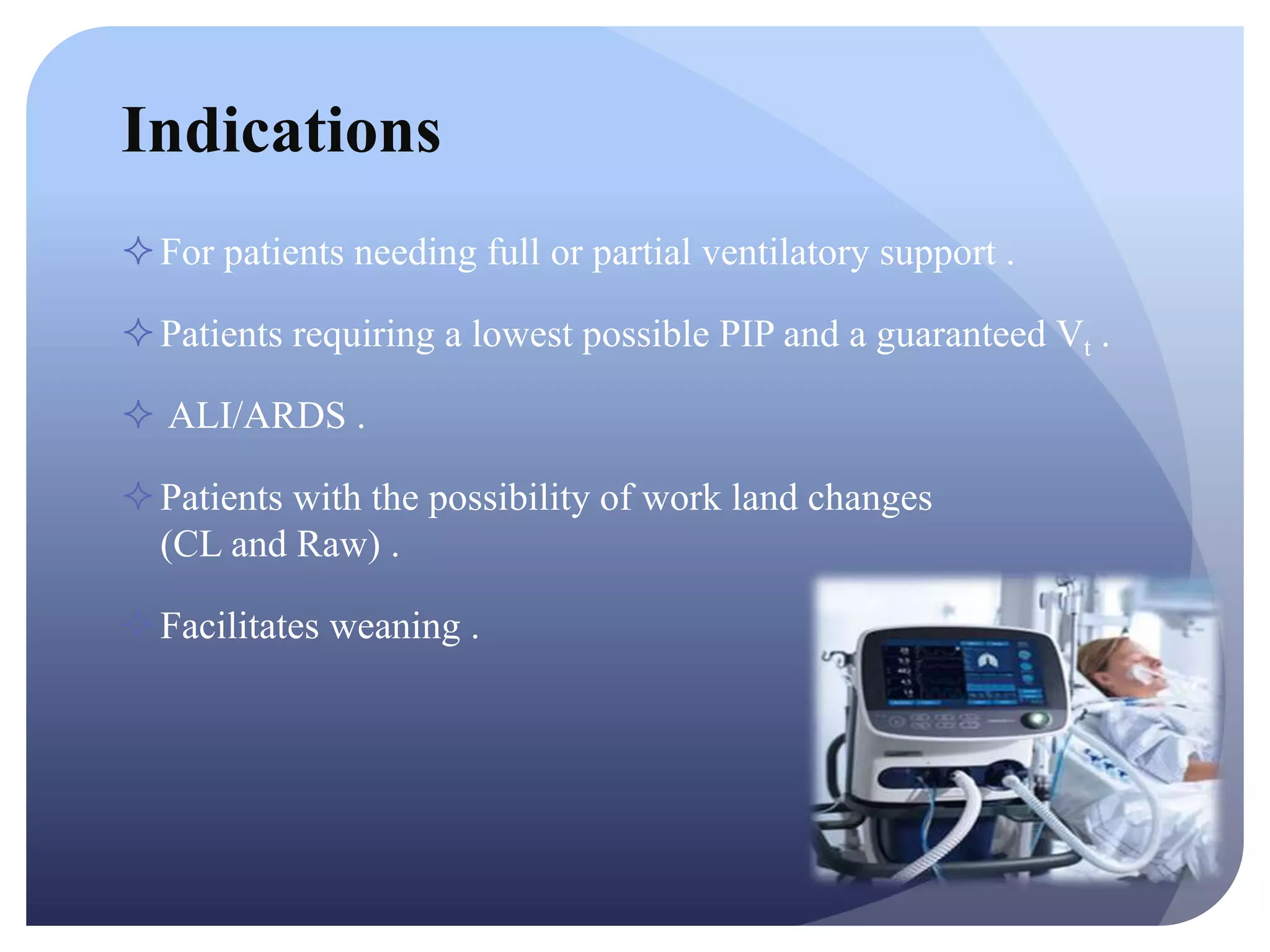
For patients needing full or partial ventilatory support .
Patients requiring a lowest possible PIP and a guaranteed Vt .
 ALI/ARDS .
Patients with the possibility of work land changes
(CL and Raw) .
Facilitates weaning .
How does it
work ?
Passive Vs. Active patient
ASV in passive patients :
ASV is a volume-targeted pressure controlled mode with
automatic adjustment of inspiratory pressure, respiratory rate, and
inspiratory/expiratory time ratio. Maximum tidal volume is
controlled by setting a maximum inspiratory pressure. Expiratory
time is determined according to the expiratory time constant in
order to prevent dynamic hyperinflation.
ASV in active patients ( spontaneously breathing
patients ) :
ASV is a volume-targeted pressure support mode with automatic
adjustment of pressure support according to the spontaneous
respiratory rate. The automatic decrease of pressure support when
the patient recovers their inspiratory strength is very useful for
weaning. ASV can also be used to perform a weaning trial before
extubation.
Passive Vs. Active patient
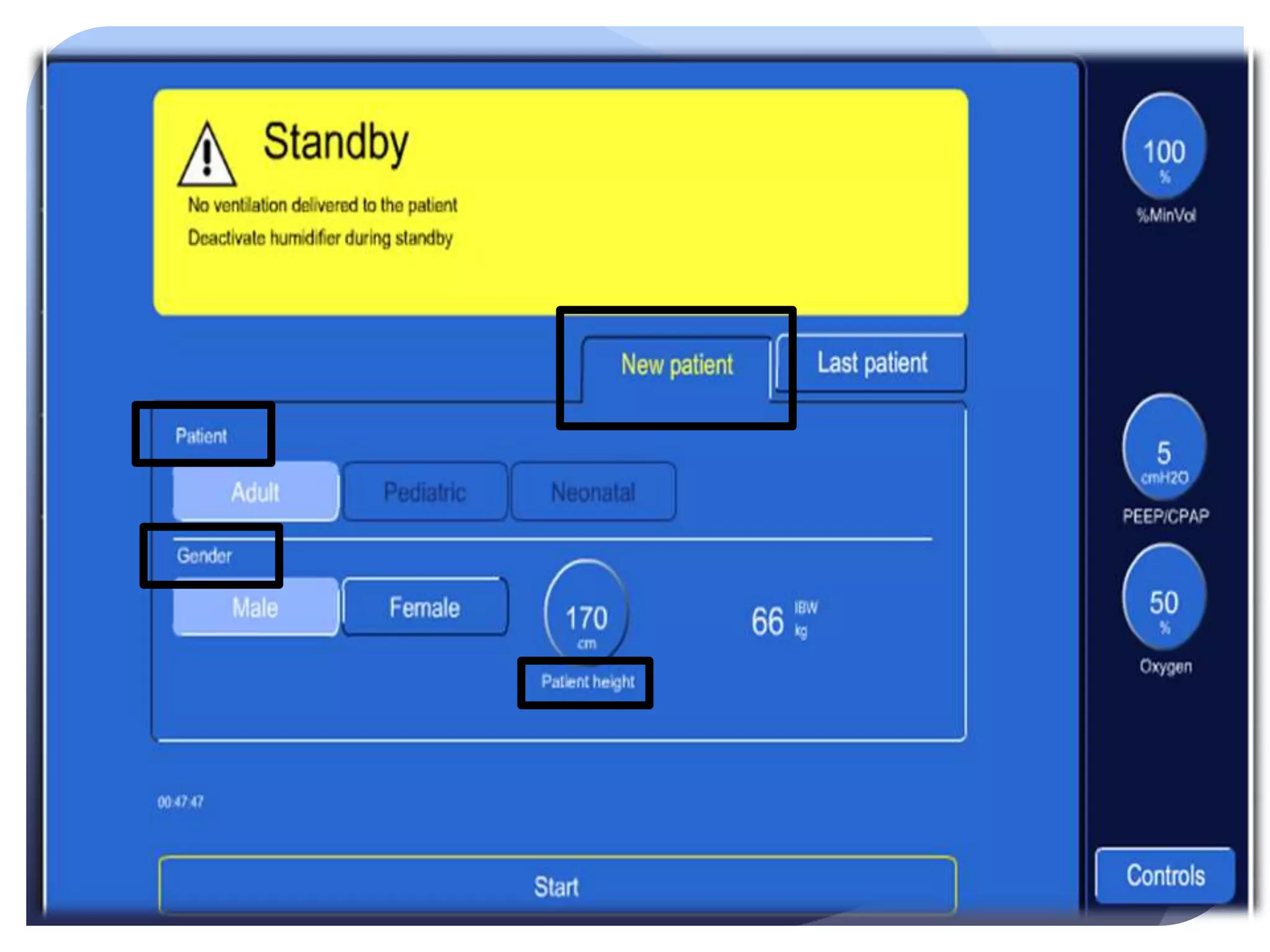
 Enters the patient’s IBW  VE % ( VT , RR ) .
 A series of test breaths measures the system C,
resistance and auto-PEEP .
 Expiratory time constant .
 If no spontaneous effort occur, the ventilator
determines the the appropriate F , VT .
 I:E ratio and Ti of the mandatory breaths are
continually being “optimized” by the ventilator to
prevent auto-PEEP .
1 number
How does it work ?
 If the patient starts having inspiratory effort, the
number of mandatory breaths and the ventilator
switches to PS .
 Pressure limits for both mandatory and spontaneous
breaths is always being automatically adjusted .
 The more the spontaneous (PS) breathing, the less
the mandatory (PC) breaths .
How does it work ?
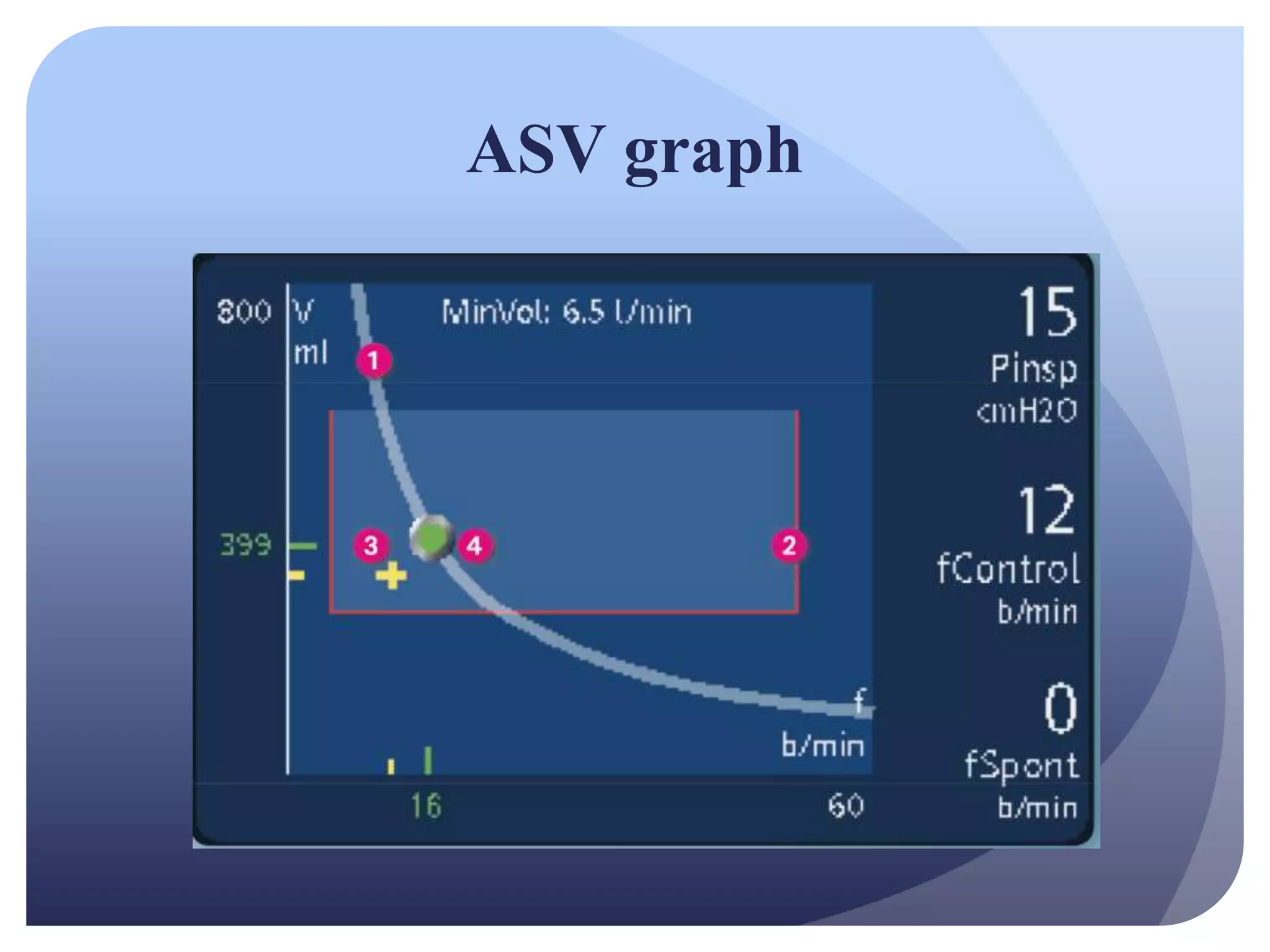
ASV graph
Dynamic Lung
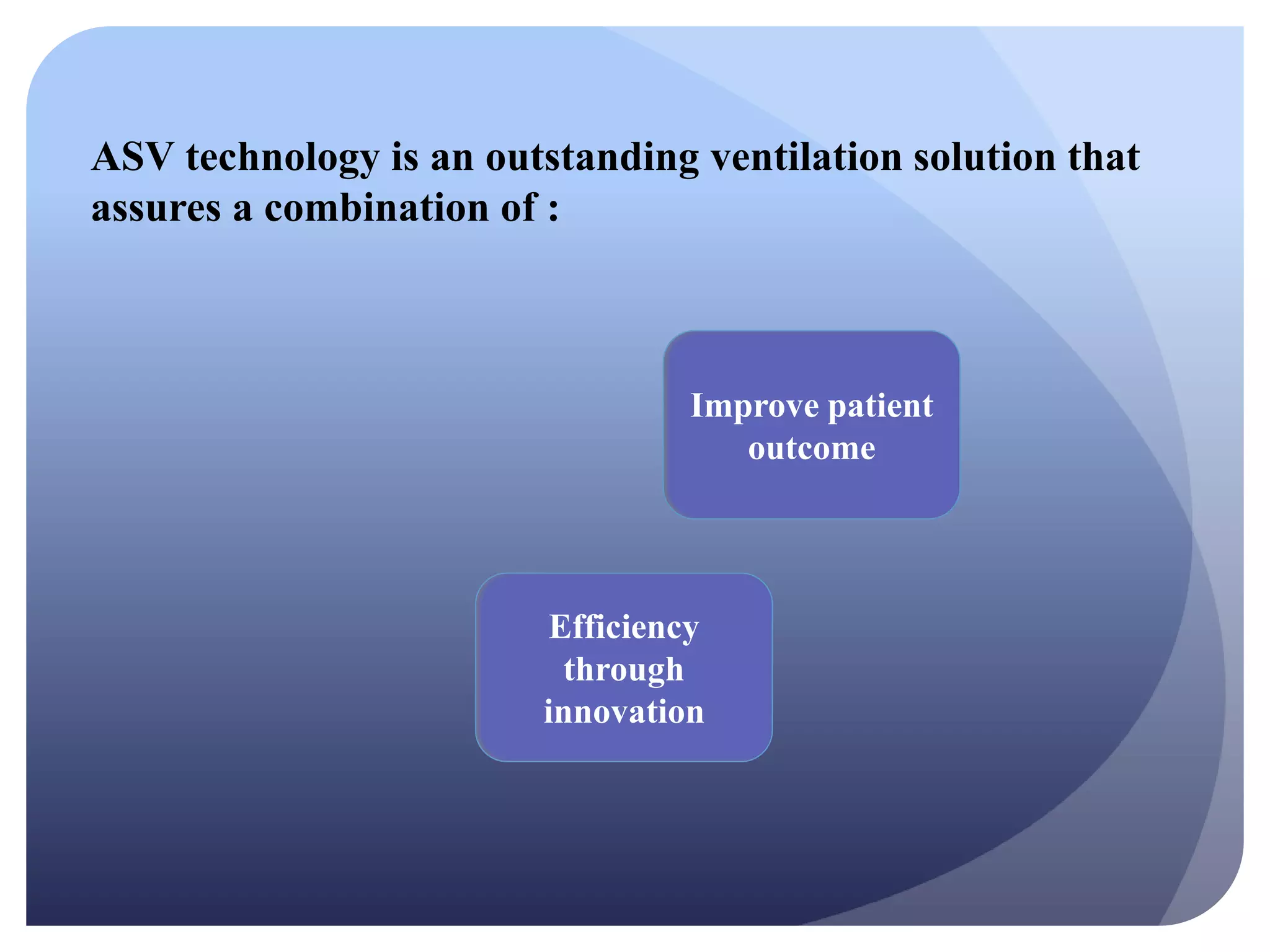
ASV technology is an outstanding ventilation solution that
assures a combination of :
Ease of use
Efficiency
through
innovation
Improve patient
outcome
Ease of use
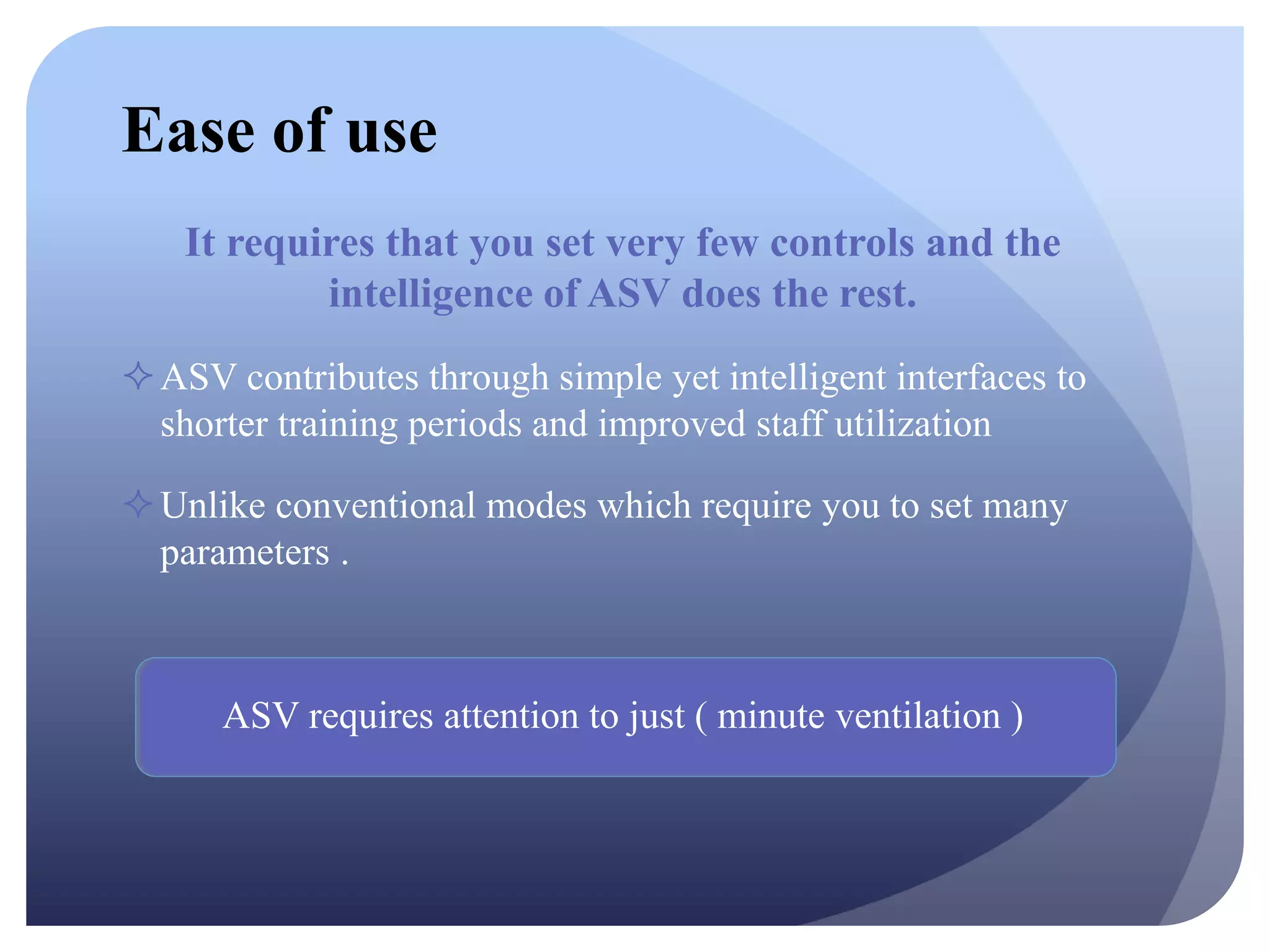
It requires that you set very few controls and the
intelligence of ASV does the rest.
ASV contributes through simple yet intelligent interfaces to
shorter training periods and improved staff utilization
Unlike conventional modes which require you to set many
parameters .
ASV requires attention to just ( minute ventilation )
Adaptive technology for everyday use
Patients’ lung mechanics change constantly during ventilation.
Clinicians however, don’t always have the time to monitor and
adjust settings for each patient minute by minute and hour by
hour. ASV helps by adapting to the changing conditions and
needs of each patient .
ASV delivers the optimal tidal volume safely at the lowest
pressure possible, combining the benefits of pressure-
controlled ventilation with a volume guarantee .
ASV technology is an outstanding ventilation solution that
assures a combination of :
Ease of use
Efficiency
through
innovation
Improve patient
outcome
Improved patient outcome
 Intelligent Ventilation with ASV means fewer days on the ventilator .
 Clinicians can spend more time with the patient and ensure shorter
stays in the ICU.
 ASV employs lung protective strategies to minimize complications
from Auto-PEEP and volutrauma/barotrauma. ASV also prevents
apnea, tachypnea, excessive dead space ventilation and excessively
large breaths.
IS IT SAFE ???
Yes , It is ..
ASV is an extremely safe ventilation solution for the
respiratory management of your intubated patients. It employs
lung-protective rules and adjusts the ventilatory pattern based
on the patient’s pulmonary mechanics and spontaneous
respiratory activity to maintain preset minute ventilation .
ASV guides the patient in a favorable breathing pattern from
fully supported ventilation to extubation.
ASV technology is an outstanding ventilation solution that
assures a combination of :
Efficiency
through
innovation
Improve patient
outcome
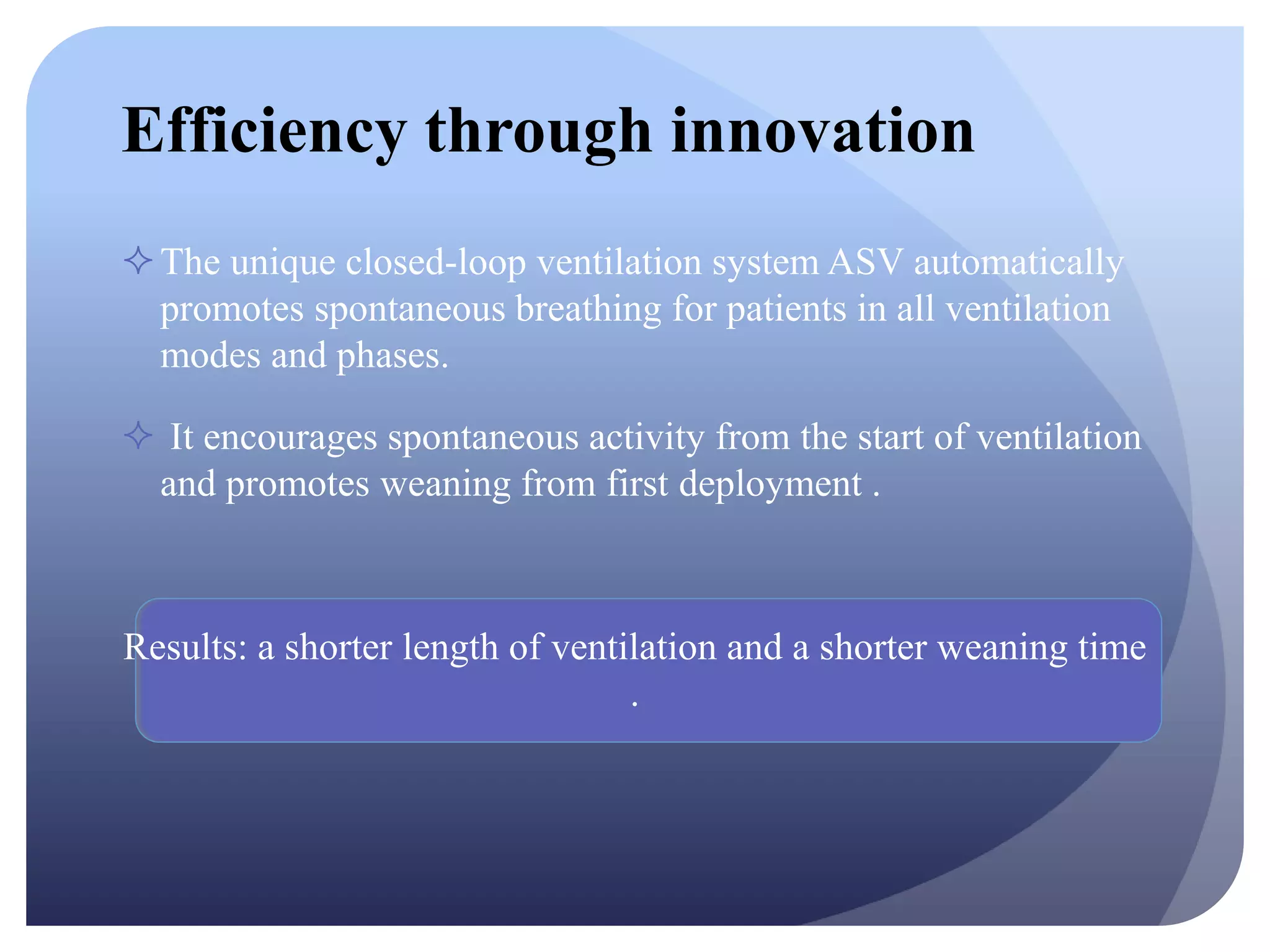
Efficiency through innovation
The unique closed-loop ventilation system ASV automatically
promotes spontaneous breathing for patients in all ventilation
modes and phases.
 It encourages spontaneous activity from the start of ventilation
and promotes weaning from first deployment .
Results: a shorter length of ventilation and a shorter weaning time
.
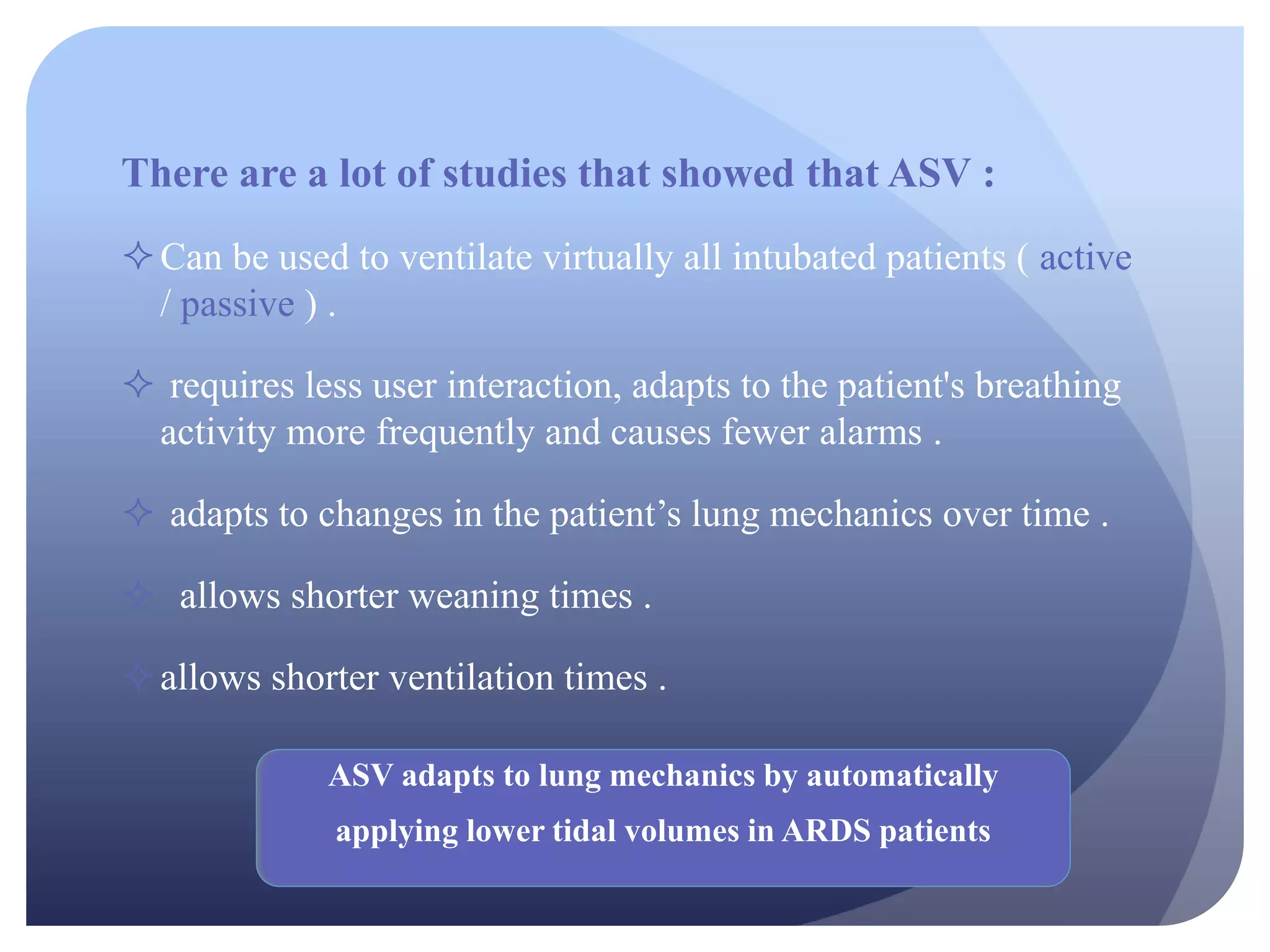
There are a lot of studies that showed that ASV :
Can be used to ventilate virtually all intubated patients ( active
/ passive ) .
 requires less user interaction, adapts to the patient's breathing
activity more frequently and causes fewer alarms .
 adapts to changes in the patient’s lung mechanics over time .
 allows shorter weaning times .
allows shorter ventilation times .
ASV adapts to lung mechanics by automatically
applying lower tidal volumes in ARDS patients
Advantages Disadvantages and Risks
Guaranteed VT and VE Inability to recognize and adjust to Δ
in alveolar VD
Minimal patient WOB Possible respiratory atrophy
Breath by breath analysis A sudden ↑ in RR and demand may
result in a ↓ in ventilator support
Ventilator adapts to the patient Varying mean Paw
Weaning is done automatically and
continuously
In patients with COPD, a longer TE
may be required
Decelerating flow waveform for
improved gas distribution
Weaning
1. Check the PS level used with the patient with the set VE
( PS = PIP – PEEP )
2. Start to wean by decreasing VE by 20% , PS will decrease.
3. Decrease FiO2 to 40% or less.
4. When the PS < 16 , start spontaneous breathing trial.
Spontaneous breathing trial
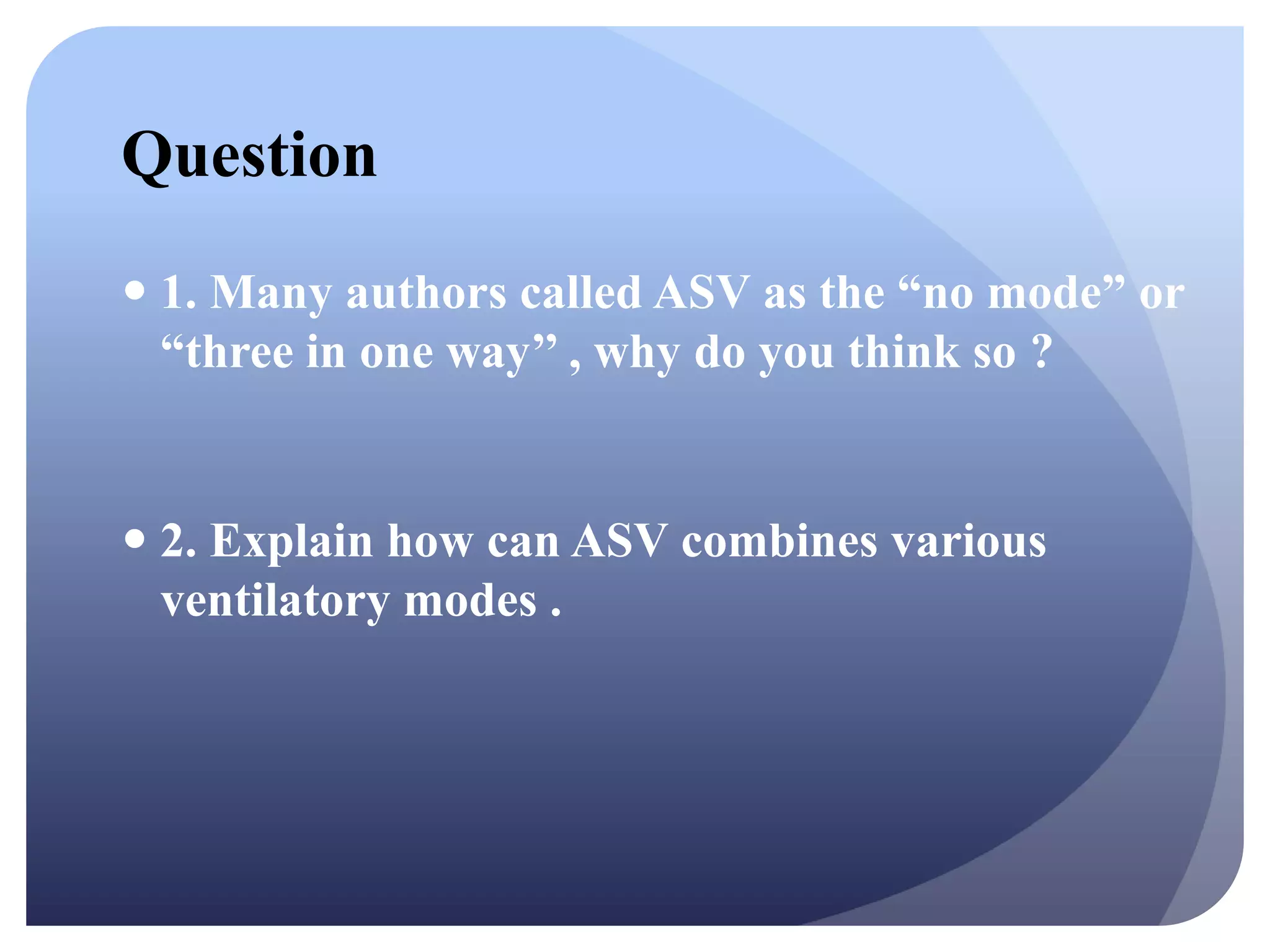
1. Decrease the VE to the minimum percentage (25%).
2. Decrease the PEEP to 5 .
3. Monitor the patient (30 min – 2 H)
4. If the patient is fine and stable (no signs of distress).
5. Extubate.
Question
 1. Many authors called ASV as the “no mode” or
“three in one way’’ , why do you think so ?
 2. Explain how can ASV combines various
ventilatory modes .
References
Ventilator management ( Dana Oakes ) .
Hamilton : https://www.hamilton-
medical.com/Solutions/Adaptive-Support-Ventilation-ASV.html
ASV for faster weaning in COPD:
http://www.ncbi.nlm.nih.gov/pubmed/21406514
Http://www.ardsnet.org/
Thank you

ASV

  • 1.
  • 2.
    • Introduction • Indication •How does this mode work ? • Initial setting • Advantages and Disadvantages • Weaning
  • 3.
    Introduction Adaptive Support Ventilation(ASV) is an easy-to-use and extremely safe ventilation solution for the respiratory management of your intubated patients. ASV is unique to HAMILTON MEDICAL ventilators, a standard on every platform and since 1998 successfully on the market. ASV has been successfully used in a variety of patient groups including post-operative, COPD, and ARDS patients.
  • 4.
    ASV mode A dualcontrol mode that uses both PC and PS to maintain a set minimum VE using the least required setting for minimal WOB depending on the patient’s condition and effort . It could provides mandatory, assisted or spontaneous types of breath . Breath type Trigger Limit Cycle Mandatory Time Pressure Time supported Patient Pressure Flow
  • 5.
    Indications For patients needingfull or partial ventilatory support . Patients requiring a lowest possible PIP and a guaranteed Vt .  ALI/ARDS . Patients with the possibility of work land changes (CL and Raw) . Facilitates weaning .
  • 6.
  • 7.
    Passive Vs. Activepatient ASV in passive patients : ASV is a volume-targeted pressure controlled mode with automatic adjustment of inspiratory pressure, respiratory rate, and inspiratory/expiratory time ratio. Maximum tidal volume is controlled by setting a maximum inspiratory pressure. Expiratory time is determined according to the expiratory time constant in order to prevent dynamic hyperinflation.
  • 8.
    ASV in activepatients ( spontaneously breathing patients ) : ASV is a volume-targeted pressure support mode with automatic adjustment of pressure support according to the spontaneous respiratory rate. The automatic decrease of pressure support when the patient recovers their inspiratory strength is very useful for weaning. ASV can also be used to perform a weaning trial before extubation. Passive Vs. Active patient
  • 9.
     Enters thepatient’s IBW  VE % ( VT , RR ) .  A series of test breaths measures the system C, resistance and auto-PEEP .  Expiratory time constant .  If no spontaneous effort occur, the ventilator determines the the appropriate F , VT .  I:E ratio and Ti of the mandatory breaths are continually being “optimized” by the ventilator to prevent auto-PEEP . 1 number How does it work ?
  • 10.
     If thepatient starts having inspiratory effort, the number of mandatory breaths and the ventilator switches to PS .  Pressure limits for both mandatory and spontaneous breaths is always being automatically adjusted .  The more the spontaneous (PS) breathing, the less the mandatory (PC) breaths . How does it work ?
  • 18.
  • 19.
  • 20.
    ASV technology isan outstanding ventilation solution that assures a combination of : Ease of use Efficiency through innovation Improve patient outcome
  • 21.
    Ease of use Itrequires that you set very few controls and the intelligence of ASV does the rest. ASV contributes through simple yet intelligent interfaces to shorter training periods and improved staff utilization Unlike conventional modes which require you to set many parameters . ASV requires attention to just ( minute ventilation )
  • 22.
    Adaptive technology foreveryday use Patients’ lung mechanics change constantly during ventilation. Clinicians however, don’t always have the time to monitor and adjust settings for each patient minute by minute and hour by hour. ASV helps by adapting to the changing conditions and needs of each patient . ASV delivers the optimal tidal volume safely at the lowest pressure possible, combining the benefits of pressure- controlled ventilation with a volume guarantee .
  • 23.
    ASV technology isan outstanding ventilation solution that assures a combination of : Ease of use Efficiency through innovation Improve patient outcome
  • 24.
    Improved patient outcome Intelligent Ventilation with ASV means fewer days on the ventilator .  Clinicians can spend more time with the patient and ensure shorter stays in the ICU.  ASV employs lung protective strategies to minimize complications from Auto-PEEP and volutrauma/barotrauma. ASV also prevents apnea, tachypnea, excessive dead space ventilation and excessively large breaths.
  • 25.
  • 26.
    Yes , Itis .. ASV is an extremely safe ventilation solution for the respiratory management of your intubated patients. It employs lung-protective rules and adjusts the ventilatory pattern based on the patient’s pulmonary mechanics and spontaneous respiratory activity to maintain preset minute ventilation . ASV guides the patient in a favorable breathing pattern from fully supported ventilation to extubation.
  • 27.
    ASV technology isan outstanding ventilation solution that assures a combination of : Efficiency through innovation Improve patient outcome
  • 28.
    Efficiency through innovation Theunique closed-loop ventilation system ASV automatically promotes spontaneous breathing for patients in all ventilation modes and phases.  It encourages spontaneous activity from the start of ventilation and promotes weaning from first deployment . Results: a shorter length of ventilation and a shorter weaning time .
  • 29.
    There are alot of studies that showed that ASV : Can be used to ventilate virtually all intubated patients ( active / passive ) .  requires less user interaction, adapts to the patient's breathing activity more frequently and causes fewer alarms .  adapts to changes in the patient’s lung mechanics over time .  allows shorter weaning times . allows shorter ventilation times . ASV adapts to lung mechanics by automatically applying lower tidal volumes in ARDS patients
  • 30.
    Advantages Disadvantages andRisks Guaranteed VT and VE Inability to recognize and adjust to Δ in alveolar VD Minimal patient WOB Possible respiratory atrophy Breath by breath analysis A sudden ↑ in RR and demand may result in a ↓ in ventilator support Ventilator adapts to the patient Varying mean Paw Weaning is done automatically and continuously In patients with COPD, a longer TE may be required Decelerating flow waveform for improved gas distribution
  • 31.
    Weaning 1. Check thePS level used with the patient with the set VE ( PS = PIP – PEEP ) 2. Start to wean by decreasing VE by 20% , PS will decrease. 3. Decrease FiO2 to 40% or less. 4. When the PS < 16 , start spontaneous breathing trial.
  • 32.
    Spontaneous breathing trial 1.Decrease the VE to the minimum percentage (25%). 2. Decrease the PEEP to 5 . 3. Monitor the patient (30 min – 2 H) 4. If the patient is fine and stable (no signs of distress). 5. Extubate.
  • 33.
    Question  1. Manyauthors called ASV as the “no mode” or “three in one way’’ , why do you think so ?  2. Explain how can ASV combines various ventilatory modes .
  • 34.
    References Ventilator management (Dana Oakes ) . Hamilton : https://www.hamilton- medical.com/Solutions/Adaptive-Support-Ventilation-ASV.html ASV for faster weaning in COPD: http://www.ncbi.nlm.nih.gov/pubmed/21406514 Http://www.ardsnet.org/
  • 35.

Editor's Notes

  • #10 A series of test breaths measures the system C, resistance and auto-PEEP . ------------ measured resp. mechanics ( flow sensor )
  • #14 1.Mv from (25-350%) Normal 100%------ asthma 90------- (ARDS) 120%------ others 110%----- Add 20% if T body >38.5°C ------add 5% for every 500 m above sea level In RESPIRATORY FAILURE , MV% of 165 ----- decrease WOB 2- diseased lung ----- higher % ------ to give us normal PaCo2 . 3- set peep + fio2 for the oxygenation manually . PEEP (5-8) -----FiO2 ( 100%)
  • #15 High pressure alarm : Rule 10 cm h2o above the limit
  • #16 Flow trigger of 2 l/min Expiratory trigger sensitivity: Start with 25% and 40% in COPD
  • #19 1 Minute volume curve showing target volume 2 Safety frame showing limits for lung protective ventilation 3 Current tidal volume/respiratory frequency 4 The optimal combination of tidal volume/respiratory frequency with which the patient will be ventilated
  • #25 3. This ASVdetects the patient's normal breathing pattern and stores it in a built-in computer. When the patient falls asleep, the machine uses the stored information to regulate the patient's breathing pattern and prevent sleep apnea.
  • #32 4. We can use PS or ASV. Many studies have proven that ASV can make weaning faster than PS and lessen the ventilation length
  • #34 2.PSV, if the patient's (RR) is higher than the target PC , if there is no spontaneous breathing SIMV , when patient's RR is lower than target.