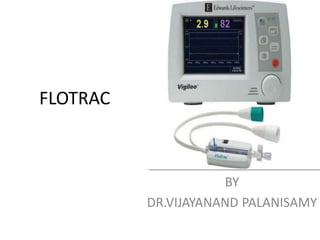
FLOTRAC
BY
DR.VIJAYANAND PALANISAMY
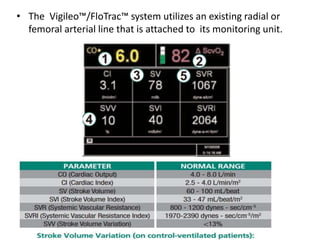
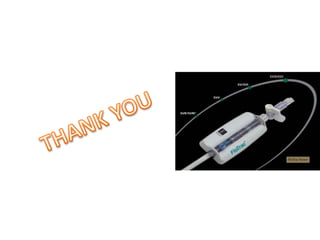
• The Vigileo™/FloTrac™ system utilizes an existing radial or
femoral arterial line that is attached to its monitoring unit.
• The key findings that emerged from many
literature reviews indicated that the
Vigileo™/FloTrac™ system's specific values for CO
and CI may not correlate exactly with PAC with
100% accuracy. However, the trends of these
Vigileo™/FloTrac™ system derived values are
useful to estimate hemodynamic status.
Additionally, the SVV values are reliable for
gauging vascular fluid status and the adequacy of
need for additional intravascular fluid volume.
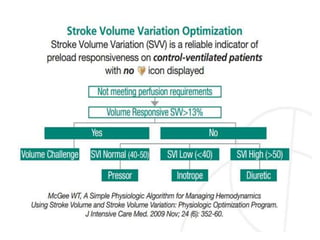
How to asses volume responsiveness?
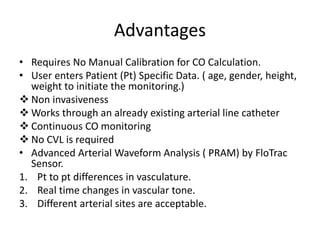
Advantages
• Requires No Manual Calibration for CO Calculation.
• User enters Patient (Pt) Specific Data. ( age, gender, height,
weight to initiate the monitoring.)
 Non invasiveness
 Works through an already existing arterial line catheter
 Continuous CO monitoring
 No CVL is required
• Advanced Arterial Waveform Analysis ( PRAM) by FloTrac
Sensor.
1. Pt to pt differences in vasculature.
2. Real time changes in vascular tone.
3. Different arterial sites are acceptable.
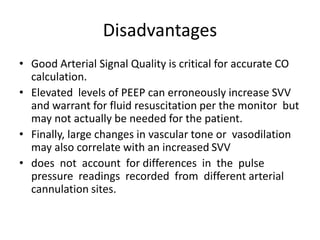
Disadvantages
• Good Arterial Signal Quality is critical for accurate CO
calculation.
• Elevated levels of PEEP can erroneously increase SVV
and warrant for fluid resuscitation per the monitor but
may not actually be needed for the patient.
• Finally, large changes in vascular tone or vasodilation
may also correlate with an increased SVV
• does not account for differences in the pulse
pressure readings recorded from different arterial
cannulation sites.
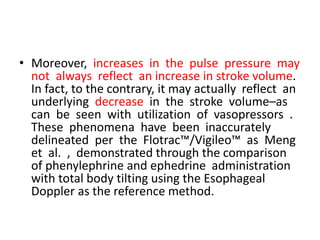
• Moreover, increases in the pulse pressure may
not always reflect an increase in stroke volume.
In fact, to the contrary, it may actually reflect an
underlying decrease in the stroke volume–as
can be seen with utilization of vasopressors .
These phenomena have been inaccurately
delineated per the Flotrac™/Vigileo™ as Meng
et al. , demonstrated through the comparison
of phenylephrine and ephedrine administration
with total body tilting using the Esophageal
Doppler as the reference method.
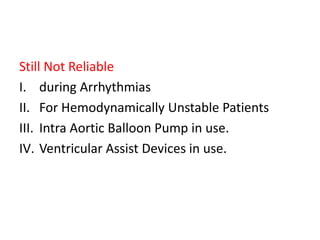
Still Not Reliable
I. during Arrhythmias
II. For Hemodynamically Unstable Patients
III. Intra Aortic Balloon Pump in use.
IV. Ventricular Assist Devices in use.
contraindications
• No absolute contraindications but has
limitations that must be taken into account.
• Currently, the monitoring system is only
recommended for patients that are 100%
mechanically ventilated and not
spontaneously breathing
• Cost effectiveness should be a consideration
when determining which hemodynamic
system to use
• However, clinical judgment cannot be
substituted for data obtained from the system.
Flotrac

Flotrac

  • 1.
  • 2.
    • The Vigileo™/FloTrac™system utilizes an existing radial or femoral arterial line that is attached to its monitoring unit.
  • 3.
    • The keyfindings that emerged from many literature reviews indicated that the Vigileo™/FloTrac™ system's specific values for CO and CI may not correlate exactly with PAC with 100% accuracy. However, the trends of these Vigileo™/FloTrac™ system derived values are useful to estimate hemodynamic status. Additionally, the SVV values are reliable for gauging vascular fluid status and the adequacy of need for additional intravascular fluid volume.
  • 4.
    How to assesvolume responsiveness?
  • 6.
    Advantages • Requires NoManual Calibration for CO Calculation. • User enters Patient (Pt) Specific Data. ( age, gender, height, weight to initiate the monitoring.)  Non invasiveness  Works through an already existing arterial line catheter  Continuous CO monitoring  No CVL is required • Advanced Arterial Waveform Analysis ( PRAM) by FloTrac Sensor. 1. Pt to pt differences in vasculature. 2. Real time changes in vascular tone. 3. Different arterial sites are acceptable.
  • 7.
    Disadvantages • Good ArterialSignal Quality is critical for accurate CO calculation. • Elevated levels of PEEP can erroneously increase SVV and warrant for fluid resuscitation per the monitor but may not actually be needed for the patient. • Finally, large changes in vascular tone or vasodilation may also correlate with an increased SVV • does not account for differences in the pulse pressure readings recorded from different arterial cannulation sites.
  • 8.
    • Moreover, increasesin the pulse pressure may not always reflect an increase in stroke volume. In fact, to the contrary, it may actually reflect an underlying decrease in the stroke volume–as can be seen with utilization of vasopressors . These phenomena have been inaccurately delineated per the Flotrac™/Vigileo™ as Meng et al. , demonstrated through the comparison of phenylephrine and ephedrine administration with total body tilting using the Esophageal Doppler as the reference method.
  • 9.
    Still Not Reliable I.during Arrhythmias II. For Hemodynamically Unstable Patients III. Intra Aortic Balloon Pump in use. IV. Ventricular Assist Devices in use.
  • 10.
    contraindications • No absolutecontraindications but has limitations that must be taken into account. • Currently, the monitoring system is only recommended for patients that are 100% mechanically ventilated and not spontaneously breathing
  • 12.
    • Cost effectivenessshould be a consideration when determining which hemodynamic system to use • However, clinical judgment cannot be substituted for data obtained from the system.