
Dr. Lluís Blanch
Senior Critical Care
Director of Research and Innovation
Corporació Sanitària Parc Taulí
Cairo, 12th of January 2015
New directions
in Mechanical
Ventilation
D
r.Lluís
Blanch
L.Blanch is inventor of one Corporació Sanitaria Parc
Taulí owned US patent: “Method and system for
managed related patient parameters provided by a
monitoring device,” US Patent No. 12/538,940.
L.Blanch owns 10% of BetterCare S.L. which is a
research and development company, spin off of
Corporació Sanitària Parc Taulí.
Financial Disclosures
Lluis Blanch MD, PhDD
r.Lluís
Blanch
Objectives MV
• Safety
• Efficacy
– Oxygenation
– Ventilation
– Work of Breathing
• Comfort / Synchrony
– Surveillance of Flow & Pressure
D
r.Lluís
Blanch
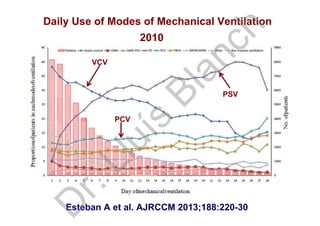
Daily Use of Modes of Mechanical Ventilation
2010
Esteban A et al. AJRCCM 2013;188:220-30
VCV
PSV
PCV
D
r.Lluís
Blanch
Paw & TV & PEEP
D
r.Lluís
Blanch
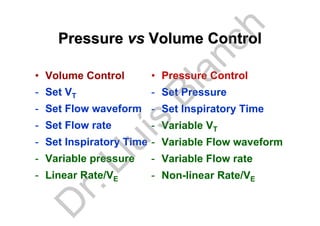
• Volume Control
- Set VT
- Set Flow waveform
- Set Flow rate
- Set Inspiratory Time
- Variable pressure
- Linear Rate/VE
• Pressure Control
- Set Pressure
- Set Inspiratory Time
- Variable VT
- Variable Flow waveform
- Variable Flow rate
- Non-linear Rate/VE
Pressure vs Volume ControlPressure vs Volume Control
D
r.Lluís
Blanch
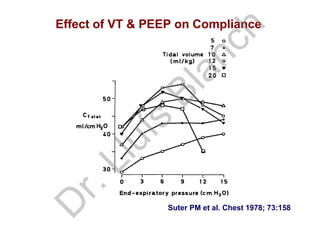
Effect of VT & PEEP on Compliance
Suter PM et al. Chest 1978; 73:158
D
r.Lluís
Blanch
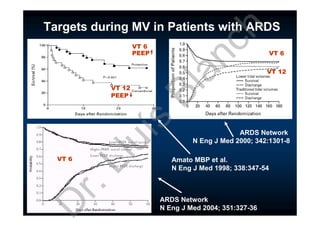
Amato MBP et al.
N Eng J Med 1998; 338:347-54
Targets during MV in Patients with ARDS
VT 12
PEEP
VT 6
PEEP VT 6
VT 12
ARDS Network
N Eng J Med 2000; 342:1301-8
ARDS Network
N Eng J Med 2004; 351:327-36
VT 6
D
r.Lluís
Blanch
Protective ventilation strategy during general
anesthesia for abdominal surgery improves post-
operative pulmonary function: a randomized trial
N Engl J Med 2013;369:428-37.
D
r.Lluís
Blanch
A Trial of Intraoperative Lung Protective
Ventilation in Abdominal Surgery
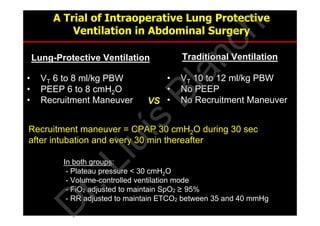
• VT 6 to 8 ml/kg PBW
• PEEP 6 to 8 cmH2O
• Recruitment Maneuver
• VT 10 to 12 ml/kg PBW
• No PEEP
• No Recruitment Maneuver
Recruitment maneuver = CPAP 30 cmH2O during 30 sec
after intubation and every 30 min thereafter
VS.
Lung-Protective Ventilation Traditional Ventilation
In both groups:
- Plateau pressure < 30 cmH2O
- Volume-controlled ventilation mode
- FiO2 adjusted to maintain SpO2 ≥ 95%
- RR adjusted to maintain ETCO2 between 35 and 40 mmHg
D
r.Lluís
Blanch
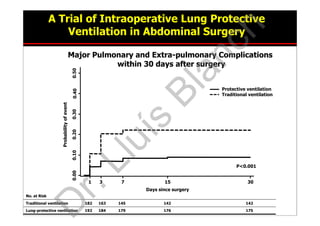
0.000.100.200.300.50
Days since surgery
Probabilityofevent
1 3 7 15 30
0.40
Protective ventilation
Traditional ventilation
No. at Risk
Traditional ventilation 182 163 145 142 142
Lung-protective ventilation 192 184 179 176 175
P<0.001
Major Pulmonary and Extra-pulmonary Complications
within 30 days after surgery
A Trial of Intraoperative Lung Protective
Ventilation in Abdominal Surgery
D
r.Lluís
Blanch
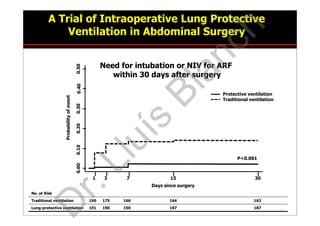
Need for intubation or NIV for ARF
within 30 days after surgery
No. at Risk
Traditional ventilation 190 175 166 164 163
Lung-protective ventilation 191 190 190 187 187
1 3 7 15 30
0.000.100.200.300.500.40
Probabilityofevent
Days since surgery
Protective ventilation
Traditional ventilation
P<0.001
A Trial of Intraoperative Lung Protective
Ventilation in Abdominal Surgery
D
r.Lluís
Blanch
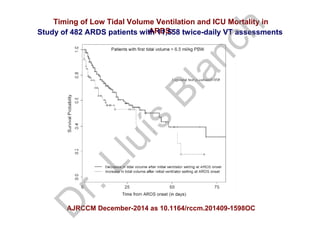
AJRCCM December-2014 as 10.1164/rccm.201409-1598OC
Timing of Low Tidal Volume Ventilation and ICU Mortality in
ARDS:Study of 482 ARDS patients with 11,558 twice-daily VT assessments
D
r.Lluís
Blanch
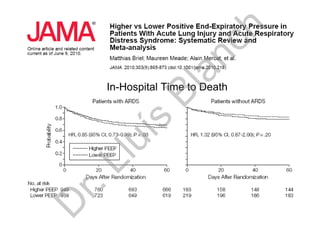
In-Hospital Time to Death
D
r.Lluís
Blanch
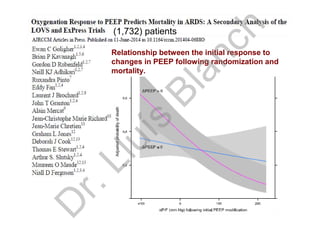
Relationship between the initial response to
changes in PEEP following randomization and
mortality.
(1,732) patients
D
r.Lluís
Blanch
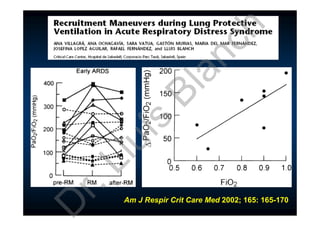
Am J Respir Crit Care Med 2002; 165: 165-170
D
r.Lluís
Blanch
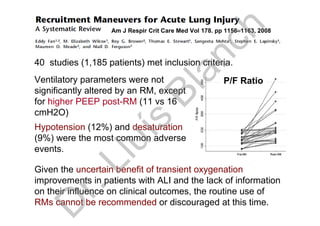
40 studies (1,185 patients) met inclusion criteria.
Ventilatory parameters were not
significantly altered by an RM, except
for higher PEEP post-RM (11 vs 16
cmH2O)
Hypotension (12%) and desaturation
(9%) were the most common adverse
events.
Given the uncertain benefit of transient oxygenation
improvements in patients with ALI and the lack of information
on their influence on clinical outcomes, the routine use of
RMs cannot be recommended or discouraged at this time.
Am J Respir Crit Care Med Vol 178. pp 1156–1163, 2008
P/F Ratio
D
r.Lluís
Blanch
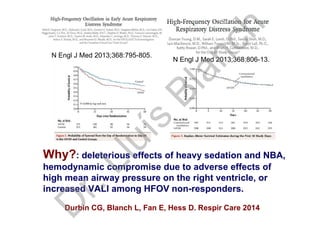
N Engl J Med 2013;368:806-13.
N Engl J Med 2013;368:795-805.
Why?: deleterious effects of heavy sedation and NBA,
hemodynamic compromise due to adverse effects of
high mean airway pressure on the right ventricle, or
increased VALI among HFOV non-responders.
Durbin CG, Blanch L, Fan E, Hess D. Respir Care 2014
D
r.Lluís
Blanch
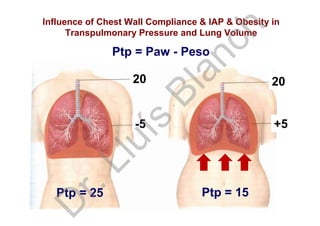
20
+5
20
-5
Influence of Chest Wall Compliance & IAP & Obesity in
Transpulmonary Pressure and Lung Volume
Ptp = 25 Ptp = 15
Ptp = Paw - Peso
D
r.Lluís
Blanch
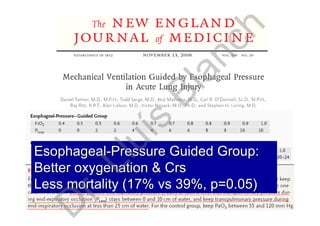
EsophagealEsophageal--Pressure Guided Group:Pressure Guided Group:
Better oxygenation & CrsBetter oxygenation & Crs
Less mortality (17% vs 39%, p=0.05)Less mortality (17% vs 39%, p=0.05)
D
r.Lluís
Blanch
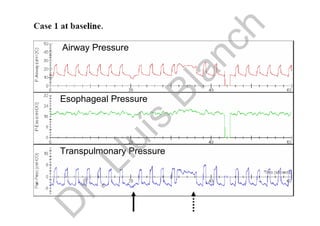
Airway Pressure
Esophageal Pressure
Transpulmonary Pressure
D
r.Lluís
Blanch
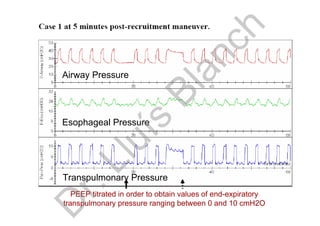
PEEP titrated in order to obtain values of end-expiratory
transpulmonary pressure ranging between 0 and 10 cmH2O
Airway Pressure
Esophageal Pressure
Transpulmonary Pressure
D
r.Lluís
Blanch
Neuromuscular Blockers
D
r.Lluís
Blanch
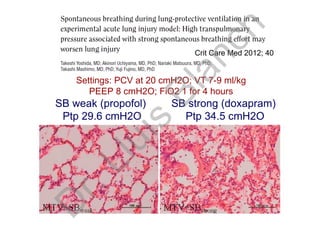
Settings: PCV at 20 cmH2O; VT 7-9 ml/kg
PEEP 8 cmH2O; FiO2 1 for 4 hours
SB weak (propofol)
Ptp 29.6 cmH2O
SB strong (doxapram)
Ptp 34.5 cmH2O
Crit Care Med 2012; 40
D
r.Lluís
Blanch
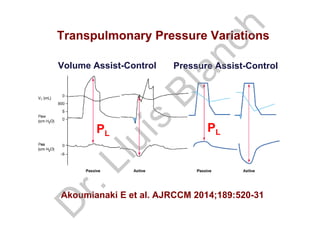
Transpulmonary Pressure Variations
Volume Assist-Control Pressure Assist-Control
PLPL
Akoumianaki E et al. AJRCCM 2014;189:520-31
D
r.Lluís
Blanch
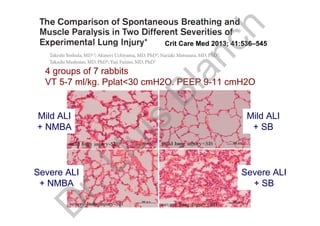
Crit Care Med 2013; 41:536–545
4 groups of 7 rabbits
VT 5-7 ml/kg. Pplat<30 cmH2O. PEEP 9-11 cmH2O
Mild ALI
+ NMBA
Mild ALI
+ SB
Severe ALI
+ NMBA
Severe ALI
+ SB
D
r.Lluís
Blanch
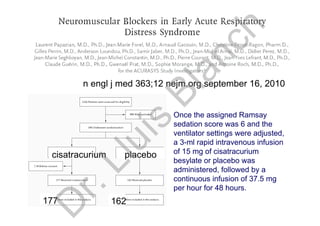
n engl j med 363;12 nejm.org september 16, 2010
Once the assigned Ramsay
sedation score was 6 and the
ventilator settings were adjusted,
a 3-ml rapid intravenous infusion
of 15 mg of cisatracurium
besylate or placebo was
administered, followed by a
continuous infusion of 37.5 mg
per hour for 48 hours.
177 162
cisatracurium placebo
D
r.Lluís
Blanch
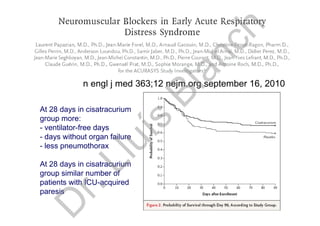
n engl j med 363;12 nejm.org september 16, 2010
At 28 days in cisatracurium
group more:
- ventilator-free days
- days without organ failure
- less pneumothorax
At 28 days in cisatracurium
group similar number of
patients with ICU-acquired
paresis
D
r.Lluís
Blanch
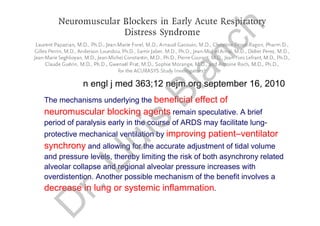
The mechanisms underlying the beneficial effect of
neuromuscular blocking agents remain speculative. A brief
period of paralysis early in the course of ARDS may facilitate lung-
protective mechanical ventilation by improving patient–ventilator
synchrony and allowing for the accurate adjustment of tidal volume
and pressure levels, thereby limiting the risk of both asynchrony related
alveolar collapse and regional alveolar pressure increases with
overdistention. Another possible mechanism of the benefit involves a
decrease in lung or systemic inflammation.
n engl j med 363;12 nejm.org september 16, 2010
D
r.Lluís
Blanch
Patient Ventilator
Interaction & Comfort
D
r.Lluís
Blanch
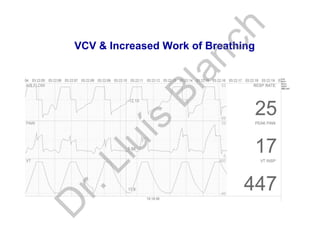
VCV & Increased Work of Breathing
D
r.Lluís
Blanch
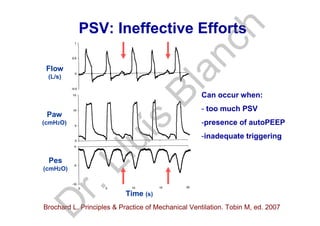
PSV: Ineffective Efforts
Paw
(cmH2O)
Pes
(cmH2O)
Flow
(L/s)
Time (s)
Brochard L. Principles & Practice of Mechanical Ventilation. Tobin M, ed. 2007
Can occur when:
- too much PSV
-presence of autoPEEP
-inadequate triggering
D
r.Lluís
Blanch
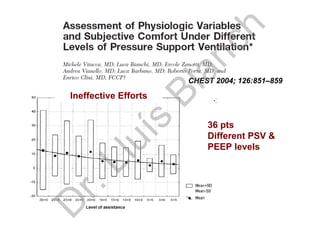
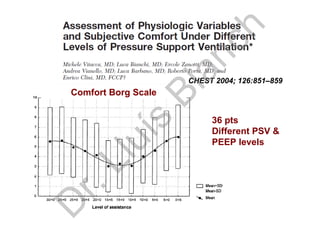
CHEST 2004; 126:851–859
36 pts
Different PSV &
PEEP levels
Ineffective Efforts
D
r.Lluís
Blanch
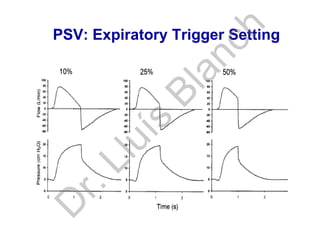
PSV: Expiratory Trigger Setting
D
r.Lluís
Blanch
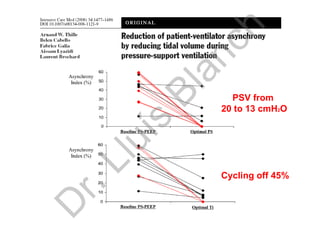
PSV from
20 to 13 cmH2O
Cycling off 45%
D
r.Lluís
Blanch
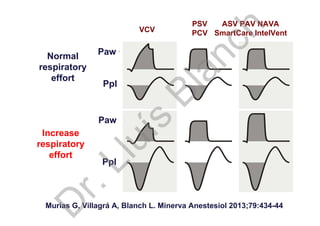
Murias G, Villagrá A, Blanch L. Minerva Anestesiol 2013;79:434-44
Ppl
Ppl
Paw
Paw
Increase
respiratory
effort
ASV PAV NAVA
SmartCare IntelVentVCV
PSV
PCV
Normal
respiratory
effort
D
r.Lluís
Blanch
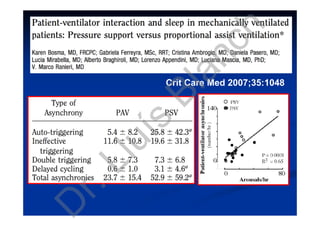
Crit Care Med 2007;35:1048
D
r.Lluís
Blanch
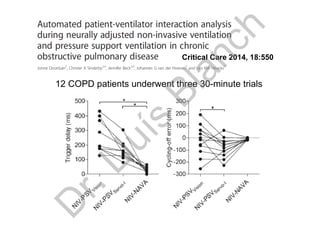
Critical Care 2014, 18:550
12 COPD patients underwent three 30-minute trials
D
r.Lluís
Blanch
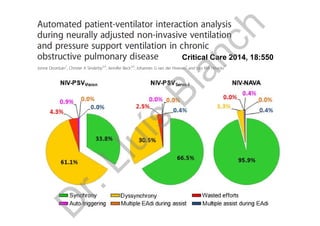
Critical Care 2014, 18:550
D
r.Lluís
Blanch
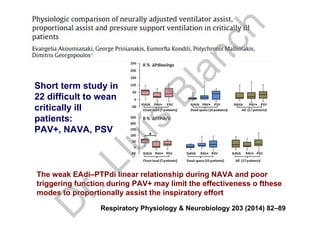
Respiratory Physiology & Neurobiology 203 (2014) 82–89
The weak EAdi–PTPdi linear relationship during NAVA and poor
triggering function during PAV+ may limit the effectiveness o fthese
modes to proportionally assist the inspiratory effort
Short term study in
22 difficult to wean
critically ill
patients:
PAV+, NAVA, PSV
D
r.Lluís
Blanch
CHEST 2004; 126:851–859
36 pts
Different PSV &
PEEP levels
Comfort Borg Scale
D
r.Lluís
Blanch
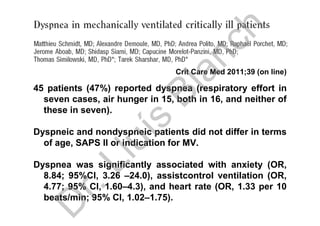
Crit Care Med 2011;39 (on line)
45 patients (47%) reported dyspnea (respiratory effort in
seven cases, air hunger in 15, both in 16, and neither of
these in seven).
Dyspneic and nondyspneic patients did not differ in terms
of age, SAPS II or indication for MV.
Dyspnea was significantly associated with anxiety (OR,
8.84; 95%CI, 3.26 –24.0), assistcontrol ventilation (OR,
4.77; 95% CI, 1.60–4.3), and heart rate (OR, 1.33 per 10
beats/min; 95% CI, 1.02–1.75).
D
r.Lluís
Blanch
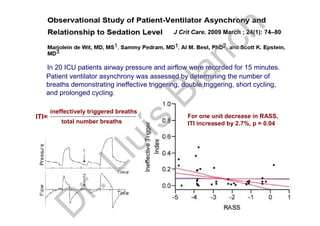
J Crit Care. 2009 March ; 24(1): 74–80
Patient ventilator asynchrony was assessed by determining the number of
breaths demonstrating ineffective triggering, double triggering, short cycling,
and prolonged cycling.
In 20 ICU patients airway pressure and airflow were recorded for 15 minutes.
For one unit decrease in RASS,
ITI increased by 2.7%, p = 0.04
ITI=
ineffectively triggered breaths
total number breaths
D
r.Lluís
Blanch
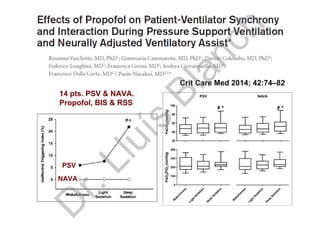
Crit Care Med 2014; 42:74–82
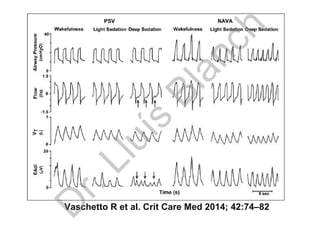
14 pts. PSV & NAVA.
Propofol, BIS & RSS
PSV
NAVA
D
r.Lluís
Blanch
Vaschetto R et al. Crit Care Med 2014; 42:74–82
D
r.Lluís
Blanch
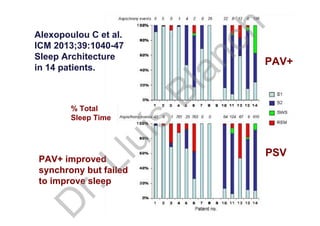
Alexopoulou C et al.
ICM 2013;39:1040-47
Sleep Architecture
in 14 patients.
PAV+
PSV
% Total
Sleep Time
PAV+ improved
synchrony but failed
to improve sleep
D
r.Lluís
Blanch
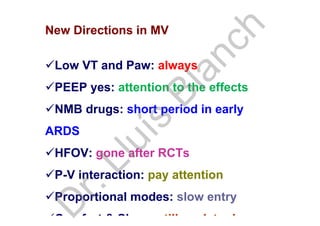
New Directions in MV
Low VT and Paw: always
PEEP yes: attention to the effects
NMB drugs: short period in early
ARDS
HFOV: gone after RCTs
P-V interaction: pay attention
Proportional modes: slow entry
Comfort & Sleep: still work to do
D
r.Lluís
Blanch

New Directions in Mechanical Ventilation

  • 1.
    Dr. Lluís Blanch SeniorCritical Care Director of Research and Innovation Corporació Sanitària Parc Taulí Cairo, 12th of January 2015 New directions in Mechanical Ventilation D r.Lluís Blanch
  • 2.
    L.Blanch is inventorof one Corporació Sanitaria Parc Taulí owned US patent: “Method and system for managed related patient parameters provided by a monitoring device,” US Patent No. 12/538,940. L.Blanch owns 10% of BetterCare S.L. which is a research and development company, spin off of Corporació Sanitària Parc Taulí. Financial Disclosures Lluis Blanch MD, PhDD r.Lluís Blanch
  • 3.
    Objectives MV • Safety •Efficacy – Oxygenation – Ventilation – Work of Breathing • Comfort / Synchrony – Surveillance of Flow & Pressure D r.Lluís Blanch
  • 4.
    Daily Use ofModes of Mechanical Ventilation 2010 Esteban A et al. AJRCCM 2013;188:220-30 VCV PSV PCV D r.Lluís Blanch
  • 5.
    Paw & TV& PEEP D r.Lluís Blanch
  • 6.
    • Volume Control -Set VT - Set Flow waveform - Set Flow rate - Set Inspiratory Time - Variable pressure - Linear Rate/VE • Pressure Control - Set Pressure - Set Inspiratory Time - Variable VT - Variable Flow waveform - Variable Flow rate - Non-linear Rate/VE Pressure vs Volume ControlPressure vs Volume Control D r.Lluís Blanch
  • 7.
    Effect of VT& PEEP on Compliance Suter PM et al. Chest 1978; 73:158 D r.Lluís Blanch
  • 8.
    Amato MBP etal. N Eng J Med 1998; 338:347-54 Targets during MV in Patients with ARDS VT 12 PEEP VT 6 PEEP VT 6 VT 12 ARDS Network N Eng J Med 2000; 342:1301-8 ARDS Network N Eng J Med 2004; 351:327-36 VT 6 D r.Lluís Blanch
  • 9.
    Protective ventilation strategyduring general anesthesia for abdominal surgery improves post- operative pulmonary function: a randomized trial N Engl J Med 2013;369:428-37. D r.Lluís Blanch
  • 10.
    A Trial ofIntraoperative Lung Protective Ventilation in Abdominal Surgery • VT 6 to 8 ml/kg PBW • PEEP 6 to 8 cmH2O • Recruitment Maneuver • VT 10 to 12 ml/kg PBW • No PEEP • No Recruitment Maneuver Recruitment maneuver = CPAP 30 cmH2O during 30 sec after intubation and every 30 min thereafter VS. Lung-Protective Ventilation Traditional Ventilation In both groups: - Plateau pressure < 30 cmH2O - Volume-controlled ventilation mode - FiO2 adjusted to maintain SpO2 ≥ 95% - RR adjusted to maintain ETCO2 between 35 and 40 mmHg D r.Lluís Blanch
  • 11.
    0.000.100.200.300.50 Days since surgery Probabilityofevent 13 7 15 30 0.40 Protective ventilation Traditional ventilation No. at Risk Traditional ventilation 182 163 145 142 142 Lung-protective ventilation 192 184 179 176 175 P<0.001 Major Pulmonary and Extra-pulmonary Complications within 30 days after surgery A Trial of Intraoperative Lung Protective Ventilation in Abdominal Surgery D r.Lluís Blanch
  • 12.
    Need for intubationor NIV for ARF within 30 days after surgery No. at Risk Traditional ventilation 190 175 166 164 163 Lung-protective ventilation 191 190 190 187 187 1 3 7 15 30 0.000.100.200.300.500.40 Probabilityofevent Days since surgery Protective ventilation Traditional ventilation P<0.001 A Trial of Intraoperative Lung Protective Ventilation in Abdominal Surgery D r.Lluís Blanch
  • 13.
    AJRCCM December-2014 as10.1164/rccm.201409-1598OC Timing of Low Tidal Volume Ventilation and ICU Mortality in ARDS:Study of 482 ARDS patients with 11,558 twice-daily VT assessments D r.Lluís Blanch
  • 14.
    In-Hospital Time toDeath D r.Lluís Blanch
  • 15.
    Relationship between theinitial response to changes in PEEP following randomization and mortality. (1,732) patients D r.Lluís Blanch
  • 16.
    Am J RespirCrit Care Med 2002; 165: 165-170 D r.Lluís Blanch
  • 17.
    40 studies (1,185patients) met inclusion criteria. Ventilatory parameters were not significantly altered by an RM, except for higher PEEP post-RM (11 vs 16 cmH2O) Hypotension (12%) and desaturation (9%) were the most common adverse events. Given the uncertain benefit of transient oxygenation improvements in patients with ALI and the lack of information on their influence on clinical outcomes, the routine use of RMs cannot be recommended or discouraged at this time. Am J Respir Crit Care Med Vol 178. pp 1156–1163, 2008 P/F Ratio D r.Lluís Blanch
  • 18.
    N Engl JMed 2013;368:806-13. N Engl J Med 2013;368:795-805. Why?: deleterious effects of heavy sedation and NBA, hemodynamic compromise due to adverse effects of high mean airway pressure on the right ventricle, or increased VALI among HFOV non-responders. Durbin CG, Blanch L, Fan E, Hess D. Respir Care 2014 D r.Lluís Blanch
  • 19.
    20 +5 20 -5 Influence of ChestWall Compliance & IAP & Obesity in Transpulmonary Pressure and Lung Volume Ptp = 25 Ptp = 15 Ptp = Paw - Peso D r.Lluís Blanch
  • 20.
    EsophagealEsophageal--Pressure Guided Group:PressureGuided Group: Better oxygenation & CrsBetter oxygenation & Crs Less mortality (17% vs 39%, p=0.05)Less mortality (17% vs 39%, p=0.05) D r.Lluís Blanch
  • 21.
  • 22.
    PEEP titrated inorder to obtain values of end-expiratory transpulmonary pressure ranging between 0 and 10 cmH2O Airway Pressure Esophageal Pressure Transpulmonary Pressure D r.Lluís Blanch
  • 23.
  • 24.
    Settings: PCV at20 cmH2O; VT 7-9 ml/kg PEEP 8 cmH2O; FiO2 1 for 4 hours SB weak (propofol) Ptp 29.6 cmH2O SB strong (doxapram) Ptp 34.5 cmH2O Crit Care Med 2012; 40 D r.Lluís Blanch
  • 25.
    Transpulmonary Pressure Variations VolumeAssist-Control Pressure Assist-Control PLPL Akoumianaki E et al. AJRCCM 2014;189:520-31 D r.Lluís Blanch
  • 26.
    Crit Care Med2013; 41:536–545 4 groups of 7 rabbits VT 5-7 ml/kg. Pplat<30 cmH2O. PEEP 9-11 cmH2O Mild ALI + NMBA Mild ALI + SB Severe ALI + NMBA Severe ALI + SB D r.Lluís Blanch
  • 27.
    n engl jmed 363;12 nejm.org september 16, 2010 Once the assigned Ramsay sedation score was 6 and the ventilator settings were adjusted, a 3-ml rapid intravenous infusion of 15 mg of cisatracurium besylate or placebo was administered, followed by a continuous infusion of 37.5 mg per hour for 48 hours. 177 162 cisatracurium placebo D r.Lluís Blanch
  • 28.
    n engl jmed 363;12 nejm.org september 16, 2010 At 28 days in cisatracurium group more: - ventilator-free days - days without organ failure - less pneumothorax At 28 days in cisatracurium group similar number of patients with ICU-acquired paresis D r.Lluís Blanch
  • 29.
    The mechanisms underlyingthe beneficial effect of neuromuscular blocking agents remain speculative. A brief period of paralysis early in the course of ARDS may facilitate lung- protective mechanical ventilation by improving patient–ventilator synchrony and allowing for the accurate adjustment of tidal volume and pressure levels, thereby limiting the risk of both asynchrony related alveolar collapse and regional alveolar pressure increases with overdistention. Another possible mechanism of the benefit involves a decrease in lung or systemic inflammation. n engl j med 363;12 nejm.org september 16, 2010 D r.Lluís Blanch
  • 30.
    Patient Ventilator Interaction &Comfort D r.Lluís Blanch
  • 31.
    VCV & IncreasedWork of Breathing D r.Lluís Blanch
  • 32.
    PSV: Ineffective Efforts Paw (cmH2O) Pes (cmH2O) Flow (L/s) Time(s) Brochard L. Principles & Practice of Mechanical Ventilation. Tobin M, ed. 2007 Can occur when: - too much PSV -presence of autoPEEP -inadequate triggering D r.Lluís Blanch
  • 33.
    CHEST 2004; 126:851–859 36pts Different PSV & PEEP levels Ineffective Efforts D r.Lluís Blanch
  • 34.
    PSV: Expiratory TriggerSetting D r.Lluís Blanch
  • 35.
    PSV from 20 to13 cmH2O Cycling off 45% D r.Lluís Blanch
  • 36.
    Murias G, VillagráA, Blanch L. Minerva Anestesiol 2013;79:434-44 Ppl Ppl Paw Paw Increase respiratory effort ASV PAV NAVA SmartCare IntelVentVCV PSV PCV Normal respiratory effort D r.Lluís Blanch
  • 37.
    Crit Care Med2007;35:1048 D r.Lluís Blanch
  • 38.
    Critical Care 2014,18:550 12 COPD patients underwent three 30-minute trials D r.Lluís Blanch
  • 39.
    Critical Care 2014,18:550 D r.Lluís Blanch
  • 40.
    Respiratory Physiology &Neurobiology 203 (2014) 82–89 The weak EAdi–PTPdi linear relationship during NAVA and poor triggering function during PAV+ may limit the effectiveness o fthese modes to proportionally assist the inspiratory effort Short term study in 22 difficult to wean critically ill patients: PAV+, NAVA, PSV D r.Lluís Blanch
  • 41.
    CHEST 2004; 126:851–859 36pts Different PSV & PEEP levels Comfort Borg Scale D r.Lluís Blanch
  • 42.
    Crit Care Med2011;39 (on line) 45 patients (47%) reported dyspnea (respiratory effort in seven cases, air hunger in 15, both in 16, and neither of these in seven). Dyspneic and nondyspneic patients did not differ in terms of age, SAPS II or indication for MV. Dyspnea was significantly associated with anxiety (OR, 8.84; 95%CI, 3.26 –24.0), assistcontrol ventilation (OR, 4.77; 95% CI, 1.60–4.3), and heart rate (OR, 1.33 per 10 beats/min; 95% CI, 1.02–1.75). D r.Lluís Blanch
  • 43.
    J Crit Care.2009 March ; 24(1): 74–80 Patient ventilator asynchrony was assessed by determining the number of breaths demonstrating ineffective triggering, double triggering, short cycling, and prolonged cycling. In 20 ICU patients airway pressure and airflow were recorded for 15 minutes. For one unit decrease in RASS, ITI increased by 2.7%, p = 0.04 ITI= ineffectively triggered breaths total number breaths D r.Lluís Blanch
  • 44.
    Crit Care Med2014; 42:74–82 14 pts. PSV & NAVA. Propofol, BIS & RSS PSV NAVA D r.Lluís Blanch
  • 45.
    Vaschetto R etal. Crit Care Med 2014; 42:74–82 D r.Lluís Blanch
  • 46.
    Alexopoulou C etal. ICM 2013;39:1040-47 Sleep Architecture in 14 patients. PAV+ PSV % Total Sleep Time PAV+ improved synchrony but failed to improve sleep D r.Lluís Blanch
  • 47.
    New Directions inMV Low VT and Paw: always PEEP yes: attention to the effects NMB drugs: short period in early ARDS HFOV: gone after RCTs P-V interaction: pay attention Proportional modes: slow entry Comfort & Sleep: still work to do D r.Lluís Blanch