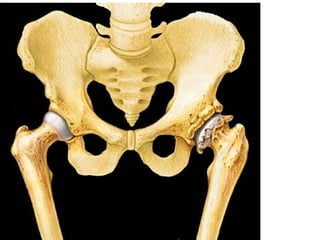
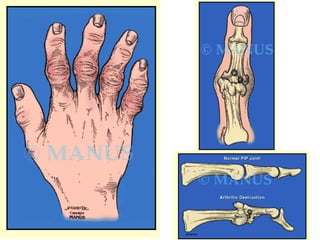
Osteoarthritis

            (Degenerative
arthritis/osteoarthrosis/hypertrophic
               arthritis)
Osteoarthritis

   Osteoarthritis is a non-inflammatory,
    degenerative condition of joints
    Characterized by degeneration of articular
    cartilage and formation of new bone i.e.
    osteophytes.
   Common in weight-bearing joints such as
    hip and knee.
   Also seen in spine and hands.
   Both male and females are affected.
   But more common in older women i.e.
    above 50 yrs,particularly in
    postmenopausal age.
Risk factors
 Obesity   esp OA knee

 Abnormal mechanical loading
eg.meniscectomy, instability

 Inherited type II collagen defects in
premature polyarticular OA

 Inheritance in nodal OA

 Occupation eg farmers

 Infection:Non-gonococcal septic arthritis

Hereditary
Ageing process in joint cartilage

Defective lubricating mechanism

Incompletely treated congenital
dislocation of hip
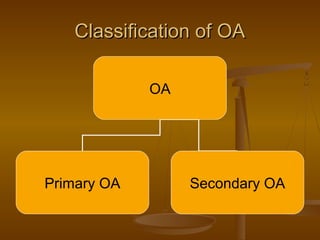
Classification of OA

             OA


Primary OA        Secondary OA
Primary OA
   More common than secondary OA
   Cause –Unknown
   Common-in elders where there is no
    previous pathology.
   Its mainly due to wear and tear changes
    occuring in old ages mainly in weight
    bearing joints.
Secondary OA
 Due to a predisposing cause such as:
1.Injury to the joint
2.Previous infection
3.RA
4.CDH
5.Deformity
6.Obesity
7.hyperthyriodism
Types of OA
   Nodal Generalised OA
   • Crystal Associated OA
   • OA of Premature Onset
Nodal Generalised OA
•   • Heberden’s nodes
•   • Bouchard’s nodes
•   • CMC of thumb
•   • Hallux
•   valgus/rigidus
•   • Knees & hips
•   • Apophyseal joints
Crystal Associated OA
•   Calcium pyrophosphate
•   dihydrate occurs
•   mainly in elderly
•   women, and principally
•   affects the knee
OA of Premature Onset
• • Previous meniscectomy
• • Haemochromatosis
Pathology

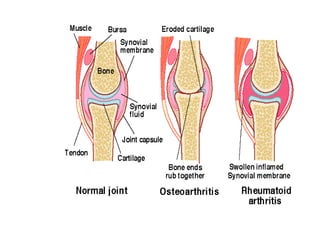
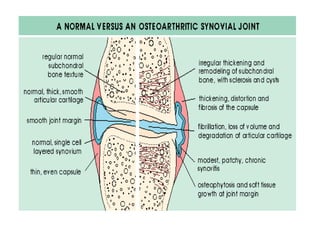
 OA is a degenerative condition primarily
  affecting the articular cartilage.
1.articular cartilage
2.Bone
3.Synovial membrane
4.capsule
5.Ligament
6.muscle
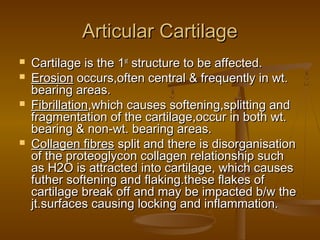
Articular Cartilage
   Cartilage is the 1st structure to be affected.
   Erosion occurs,often central & frequently in wt.
    bearing areas.
   Fibrillation,which causes softening,splitting and
    fragmentation of the cartilage,occur in both wt.
    bearing & non-wt. bearing areas.
   Collagen fibres split and there is disorganisation
    of the proteoglycon collagen relationship such
    as H2O is attracted into cartilage, which causes
    futher softening and flaking.these flakes of
    cartilage break off and may be impacted b/w the
    jt.surfaces causing locking and inflammation.
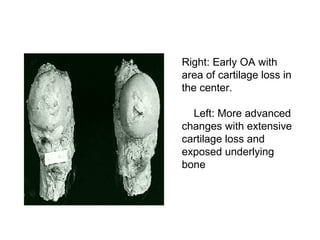
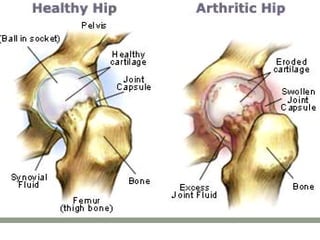
Right: Early OA with
area of cartilage loss in
the center.

  Left: More advanced
changes with extensive
cartilage loss and
exposed underlying
bone
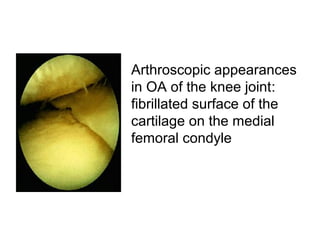
Arthroscopic appearances
in OA of the knee joint:
fibrillated surface of the
cartilage on the medial
femoral condyle
Bone(Eburnation)
   Bone surface become hard & polished as
    there is loss of protection from the
    cartilage.
   Cystic cavities form in the subchondral
    bone because eburnated bone is brittle
    and microfractures occur.
   Venous congestion in the subchondral
    bone.
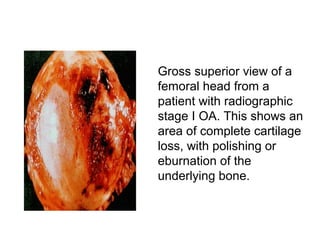
Gross superior view of a
femoral head from a
patient with radiographic
stage I OA. This shows an
area of complete cartilage
loss, with polishing or
eburnation of the
underlying bone.
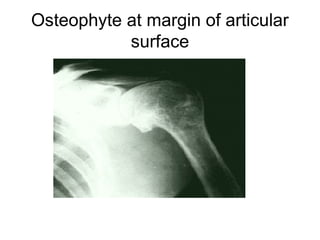
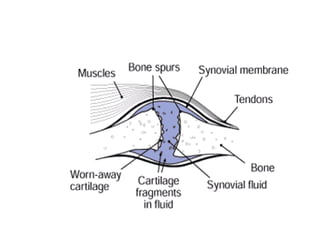
   Osteophytes form at the margin of the
    articular surface,which may get projected
    into the jt. Or into capsule & ligament,bone
    of the wt.-bearing jt.
   There is alteration in the shape of the
    femoral head which becomes flat and
    mushroom shaped.
   Tibial condyles become flatened.
Osteophyte at margin of articular
           surface
Synovial Membrane
   Synovial membrane undergo hypertrophy and
    become oedematous (which can lead to ‘cold’
    effusions).
   Reduction of synovial fluid secretion results in
    loss of nutrition and lubricating action of articular
    cartilage.
               Capsule
It undergoes fibrous degeneration and there are
   low-grade chronic inflammatory changes
Ligament
   Undergoes fibrous degernation
   There is low grade chronic inflammatory
    changes and acc.to the aspect joint
    become contracted or elongated.
                Muscles
Undergoes atrophy,as pt. is not able to use
 the jt. Because of pain which further limits
 movts. and function.
Clinical features of OA
  Pain
 Stiffness

 Muscle spasm

 Restricted movement

 Deformity

 Muscle weakness or wasting

 Joint enlargement and instability

 Crepitus

 • Joint Effusion
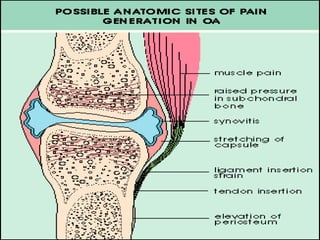
Clinical features 1
• Pain and tenderness
  – Usually slow onset of discomfort, with
    gradual and intermittent increase
  – Pain is more on wt. bearing due to stress
    on the synovial membrane & later on due
    to bone surface,which r rich in nerve
    endings coming in contact.
  -initially relieved by rest but later on disturb
    sleep.
  -Diffuse/ sharp and stabbing local pain
Clinical features
• Pain and tenderness (cont)

  – Types of pain

    • Mechanical: increases with use of the joint

    • Inflammatory phases

    • Rest pain later on in 50%

    • Night pain in 30% later on
Clinical features 2
• Movement abnormalities
  – ‘Gelling’: stiffness after periods of inactivity,
    passes over within minutes (approx
    15min.) of using joint again
  – Coarse crepitus: palpate/hear (due to
    flaked cartilage & eburnated bone ends)

  – Reduced ROM: capsular thickening and
    bony changes in joint,ms. Spasm or soft
    tissue contracture.
Clinical features 3
• Deformities
  – Soft tissue swelling:
     • mild synovitis
     • small effusions
  – Osteophytes
  – Joint laxity
  – Asymmetrical joint destruction leading to
    angulation
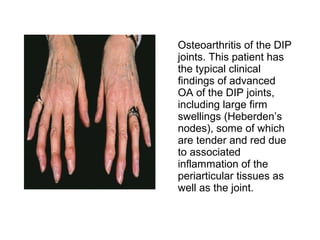
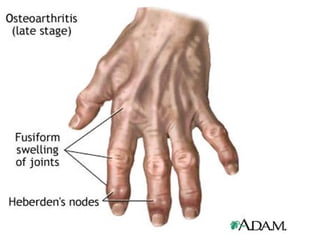
Osteoarthritis of the DIP
joints. This patient has
the typical clinical
findings of advanced
OA of the DIP joints,
including large firm
swellings (Heberden’s
nodes), some of which
are tender and red due
to associated
inflammation of the
periarticular tissues as
well as the joint.
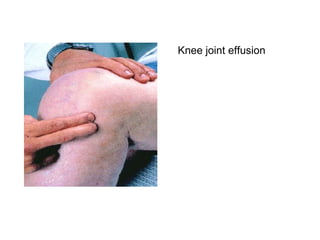
Knee joint effusion
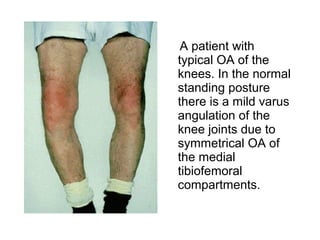
A patient with
typical OA of the
knees. In the normal
standing posture
there is a mild varus
angulation of the
knee joints due to
symmetrical OA of
the medial
tibiofemoral
compartments.
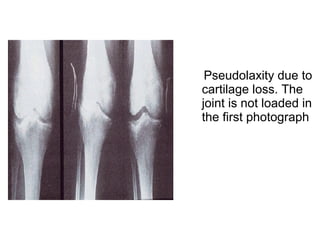
Pseudolaxity due to
cartilage loss. The
joint is not loaded in
the first photograph
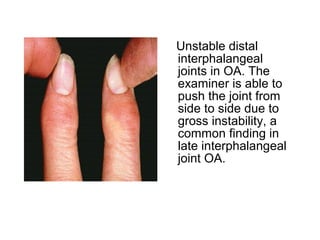
Unstable distal
interphalangeal
joints in OA. The
examiner is able to
push the joint from
side to side due to
gross instability, a
common finding in
late interphalangeal
joint OA.
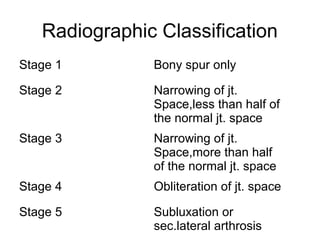
Radiographic Classification
Stage 1        Bony spur only

Stage 2        Narrowing of jt.
               Space,less than half of
               the normal jt. space
Stage 3        Narrowing of jt.
               Space,more than half
               of the normal jt. space
Stage 4        Obliteration of jt. space

Stage 5        Subluxation or
               sec.lateral arthrosis
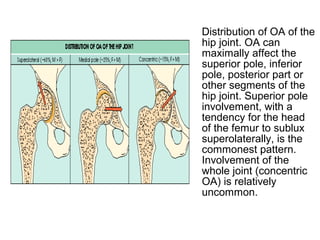
Distribution of OA of the
hip joint. OA can
maximally affect the
superior pole, inferior
pole, posterior part or
other segments of the
hip joint. Superior pole
involvement, with a
tendency for the head
of the femur to sublux
superolaterally, is the
commonest pattern.
Involvement of the
whole joint (concentric
OA) is relatively
uncommon.
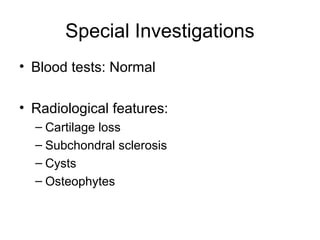
Special Investigations
• Blood tests: Normal

• Radiological features:
  – Cartilage loss
  – Subchondral sclerosis
  – Cysts
  – Osteophytes
Management
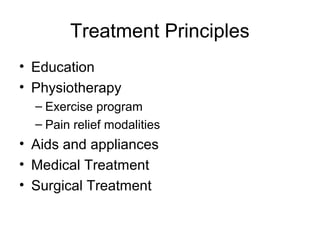
Treatment Principles
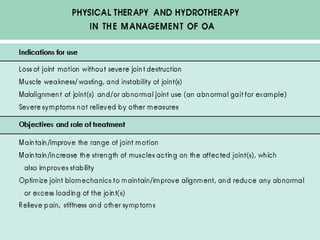
• Education
• Physiotherapy
  – Exercise program
  – Pain relief modalities
• Aids and appliances
• Medical Treatment
• Surgical Treatment
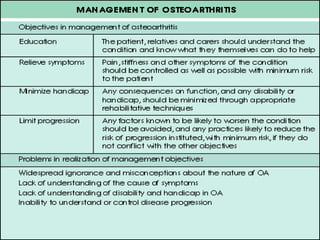
Education
• Nonsystemic nature of disease
• Prevent overloading of joint. Obesity!!
• Appropriate use of treatment modalities
  – Importance of exercise program
  – Aids, apliances, braces
  – Medial treatments
  – Surgical treatments
Exercise
• Will not ‘wear the joint out’

• Important for cartilage nutrition

• Some evidence that lack of exercise leads
  to progression of OA
Exercise
• Encourage full range low impact
  movements eg swimming, cycling
• Avoid
  – Prolonged loading
  – Activities that cause pain
  – Contact sports
  – High impact sports eg running
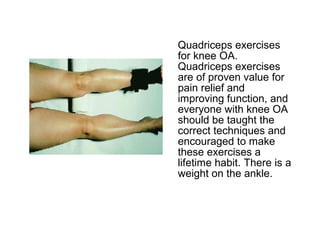
Quadriceps exercises
for knee OA.
Quadriceps exercises
are of proven value for
pain relief and
improving function, and
everyone with knee OA
should be taught the
correct techniques and
encouraged to make
these exercises a
lifetime habit. There is a
weight on the ankle.
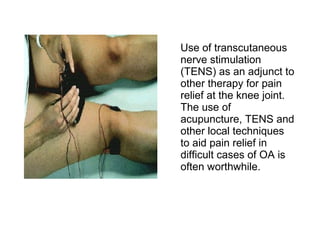
Use of transcutaneous
nerve stimulation
(TENS) as an adjunct to
other therapy for pain
relief at the knee joint.
The use of
acupuncture, TENS and
other local techniques
to aid pain relief in
difficult cases of OA is
often worthwhile.
Aids and appliances
• Braces / splints
• Special shoes/insoles
• Mobility aids
• Aids: dressing, reaching, tap openers,
  kitchen aids
• Taping of patella in patello femoral OA
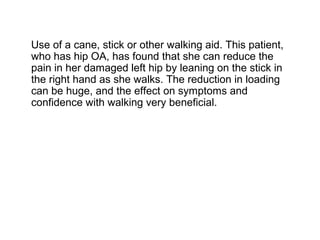
Use of a cane, stick or other walking aid. This patient,
who has hip OA, has found that she can reduce the
pain in her damaged left hip by leaning on the stick in
the right hand as she walks. The reduction in loading
can be huge, and the effect on symptoms and
confidence with walking very beneficial.
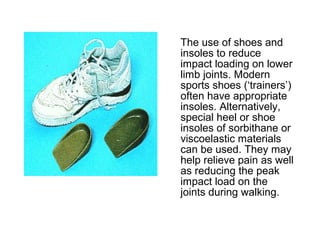
The use of shoes and
insoles to reduce
impact loading on lower
limb joints. Modern
sports shoes (‘trainers’)
often have appropriate
insoles. Alternatively,
special heel or shoe
insoles of sorbithane or
viscoelastic materials
can be used. They may
help relieve pain as well
as reducing the peak
impact load on the
joints during walking.
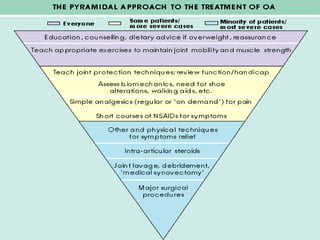
Medical Treatment
• Simple analgesics: paracetamol, low dose
  ibuprofen
• NSAID’s/Coxibs PRN regular
• Intra-articular corticosteroids
• Topical treatment eg NSAID creams,
  capsaicin
• ‘Chondroprotective agents’
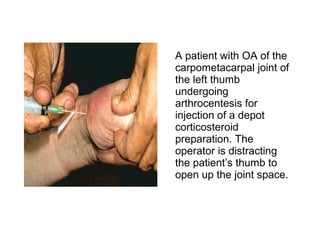
A patient with OA of the
carpometacarpal joint of
the left thumb
undergoing
arthrocentesis for
injection of a depot
corticosteroid
preparation. The
operator is distracting
the patient’s thumb to
open up the joint space.
Joint replacement surgery
• Indications: pain affecting work, sleep,
  walking and leisure activities

• Complications
  – sepsis
  – loosening
  – lifespan of materials (mechanical failure)
Osteoarthritis ppt
Osteoarthritis ppt
Osteoarthritis ppt
Osteoarthritis ppt
Osteoarthritis ppt

Osteoarthritis ppt

  • 1.
    Osteoarthritis (Degenerative arthritis/osteoarthrosis/hypertrophic arthritis)
  • 2.
    Osteoarthritis  Osteoarthritis is a non-inflammatory, degenerative condition of joints Characterized by degeneration of articular cartilage and formation of new bone i.e. osteophytes.
  • 4.
    Common in weight-bearing joints such as hip and knee.  Also seen in spine and hands.  Both male and females are affected.  But more common in older women i.e. above 50 yrs,particularly in postmenopausal age.
  • 5.
    Risk factors  Obesity esp OA knee  Abnormal mechanical loading eg.meniscectomy, instability  Inherited type II collagen defects in premature polyarticular OA  Inheritance in nodal OA  Occupation eg farmers  Infection:Non-gonococcal septic arthritis Hereditary
  • 6.
    Ageing process injoint cartilage Defective lubricating mechanism Incompletely treated congenital dislocation of hip
  • 7.
    Classification of OA OA Primary OA Secondary OA
  • 8.
    Primary OA  More common than secondary OA  Cause –Unknown  Common-in elders where there is no previous pathology.  Its mainly due to wear and tear changes occuring in old ages mainly in weight bearing joints.
  • 9.
    Secondary OA  Dueto a predisposing cause such as: 1.Injury to the joint 2.Previous infection 3.RA 4.CDH 5.Deformity 6.Obesity 7.hyperthyriodism
  • 10.
    Types of OA  Nodal Generalised OA  • Crystal Associated OA  • OA of Premature Onset
  • 11.
    Nodal Generalised OA • • Heberden’s nodes • • Bouchard’s nodes • • CMC of thumb • • Hallux • valgus/rigidus • • Knees & hips • • Apophyseal joints
  • 12.
    Crystal Associated OA • Calcium pyrophosphate • dihydrate occurs • mainly in elderly • women, and principally • affects the knee
  • 13.
    OA of PrematureOnset • • Previous meniscectomy • • Haemochromatosis
  • 15.
    Pathology  OA isa degenerative condition primarily affecting the articular cartilage. 1.articular cartilage 2.Bone 3.Synovial membrane 4.capsule 5.Ligament 6.muscle
  • 16.
    Articular Cartilage  Cartilage is the 1st structure to be affected.  Erosion occurs,often central & frequently in wt. bearing areas.  Fibrillation,which causes softening,splitting and fragmentation of the cartilage,occur in both wt. bearing & non-wt. bearing areas.  Collagen fibres split and there is disorganisation of the proteoglycon collagen relationship such as H2O is attracted into cartilage, which causes futher softening and flaking.these flakes of cartilage break off and may be impacted b/w the jt.surfaces causing locking and inflammation.
  • 17.
    Right: Early OAwith area of cartilage loss in the center. Left: More advanced changes with extensive cartilage loss and exposed underlying bone
  • 18.
    Arthroscopic appearances in OAof the knee joint: fibrillated surface of the cartilage on the medial femoral condyle
  • 19.
    Bone(Eburnation)  Bone surface become hard & polished as there is loss of protection from the cartilage.  Cystic cavities form in the subchondral bone because eburnated bone is brittle and microfractures occur.  Venous congestion in the subchondral bone.
  • 20.
    Gross superior viewof a femoral head from a patient with radiographic stage I OA. This shows an area of complete cartilage loss, with polishing or eburnation of the underlying bone.
  • 21.
    Osteophytes form at the margin of the articular surface,which may get projected into the jt. Or into capsule & ligament,bone of the wt.-bearing jt.  There is alteration in the shape of the femoral head which becomes flat and mushroom shaped.  Tibial condyles become flatened.
  • 22.
    Osteophyte at marginof articular surface
  • 23.
    Synovial Membrane  Synovial membrane undergo hypertrophy and become oedematous (which can lead to ‘cold’ effusions).  Reduction of synovial fluid secretion results in loss of nutrition and lubricating action of articular cartilage. Capsule It undergoes fibrous degeneration and there are low-grade chronic inflammatory changes
  • 25.
    Ligament  Undergoes fibrous degernation  There is low grade chronic inflammatory changes and acc.to the aspect joint become contracted or elongated. Muscles Undergoes atrophy,as pt. is not able to use the jt. Because of pain which further limits movts. and function.
  • 28.
    Clinical features ofOA  Pain  Stiffness  Muscle spasm  Restricted movement  Deformity  Muscle weakness or wasting  Joint enlargement and instability  Crepitus • Joint Effusion
  • 29.
    Clinical features 1 •Pain and tenderness – Usually slow onset of discomfort, with gradual and intermittent increase – Pain is more on wt. bearing due to stress on the synovial membrane & later on due to bone surface,which r rich in nerve endings coming in contact. -initially relieved by rest but later on disturb sleep. -Diffuse/ sharp and stabbing local pain
  • 31.
    Clinical features • Painand tenderness (cont) – Types of pain • Mechanical: increases with use of the joint • Inflammatory phases • Rest pain later on in 50% • Night pain in 30% later on
  • 32.
    Clinical features 2 •Movement abnormalities – ‘Gelling’: stiffness after periods of inactivity, passes over within minutes (approx 15min.) of using joint again – Coarse crepitus: palpate/hear (due to flaked cartilage & eburnated bone ends) – Reduced ROM: capsular thickening and bony changes in joint,ms. Spasm or soft tissue contracture.
  • 33.
    Clinical features 3 •Deformities – Soft tissue swelling: • mild synovitis • small effusions – Osteophytes – Joint laxity – Asymmetrical joint destruction leading to angulation
  • 34.
    Osteoarthritis of theDIP joints. This patient has the typical clinical findings of advanced OA of the DIP joints, including large firm swellings (Heberden’s nodes), some of which are tender and red due to associated inflammation of the periarticular tissues as well as the joint.
  • 35.
  • 36.
    A patient with typicalOA of the knees. In the normal standing posture there is a mild varus angulation of the knee joints due to symmetrical OA of the medial tibiofemoral compartments.
  • 37.
    Pseudolaxity due to cartilageloss. The joint is not loaded in the first photograph
  • 38.
    Unstable distal interphalangeal joints inOA. The examiner is able to push the joint from side to side due to gross instability, a common finding in late interphalangeal joint OA.
  • 39.
    Radiographic Classification Stage 1 Bony spur only Stage 2 Narrowing of jt. Space,less than half of the normal jt. space Stage 3 Narrowing of jt. Space,more than half of the normal jt. space Stage 4 Obliteration of jt. space Stage 5 Subluxation or sec.lateral arthrosis
  • 40.
    Distribution of OAof the hip joint. OA can maximally affect the superior pole, inferior pole, posterior part or other segments of the hip joint. Superior pole involvement, with a tendency for the head of the femur to sublux superolaterally, is the commonest pattern. Involvement of the whole joint (concentric OA) is relatively uncommon.
  • 42.
    Special Investigations • Bloodtests: Normal • Radiological features: – Cartilage loss – Subchondral sclerosis – Cysts – Osteophytes
  • 44.
  • 46.
    Treatment Principles • Education •Physiotherapy – Exercise program – Pain relief modalities • Aids and appliances • Medical Treatment • Surgical Treatment
  • 47.
    Education • Nonsystemic natureof disease • Prevent overloading of joint. Obesity!! • Appropriate use of treatment modalities – Importance of exercise program – Aids, apliances, braces – Medial treatments – Surgical treatments
  • 49.
    Exercise • Will not‘wear the joint out’ • Important for cartilage nutrition • Some evidence that lack of exercise leads to progression of OA
  • 50.
    Exercise • Encourage fullrange low impact movements eg swimming, cycling • Avoid – Prolonged loading – Activities that cause pain – Contact sports – High impact sports eg running
  • 51.
    Quadriceps exercises for kneeOA. Quadriceps exercises are of proven value for pain relief and improving function, and everyone with knee OA should be taught the correct techniques and encouraged to make these exercises a lifetime habit. There is a weight on the ankle.
  • 52.
    Use of transcutaneous nervestimulation (TENS) as an adjunct to other therapy for pain relief at the knee joint. The use of acupuncture, TENS and other local techniques to aid pain relief in difficult cases of OA is often worthwhile.
  • 53.
    Aids and appliances •Braces / splints • Special shoes/insoles • Mobility aids • Aids: dressing, reaching, tap openers, kitchen aids • Taping of patella in patello femoral OA
  • 54.
    Use of acane, stick or other walking aid. This patient, who has hip OA, has found that she can reduce the pain in her damaged left hip by leaning on the stick in the right hand as she walks. The reduction in loading can be huge, and the effect on symptoms and confidence with walking very beneficial.
  • 55.
    The use ofshoes and insoles to reduce impact loading on lower limb joints. Modern sports shoes (‘trainers’) often have appropriate insoles. Alternatively, special heel or shoe insoles of sorbithane or viscoelastic materials can be used. They may help relieve pain as well as reducing the peak impact load on the joints during walking.
  • 56.
    Medical Treatment • Simpleanalgesics: paracetamol, low dose ibuprofen • NSAID’s/Coxibs PRN regular • Intra-articular corticosteroids • Topical treatment eg NSAID creams, capsaicin • ‘Chondroprotective agents’
  • 57.
    A patient withOA of the carpometacarpal joint of the left thumb undergoing arthrocentesis for injection of a depot corticosteroid preparation. The operator is distracting the patient’s thumb to open up the joint space.
  • 59.
    Joint replacement surgery •Indications: pain affecting work, sleep, walking and leisure activities • Complications – sepsis – loosening – lifespan of materials (mechanical failure)