Huntington’s Disease By: Sara Lincoln
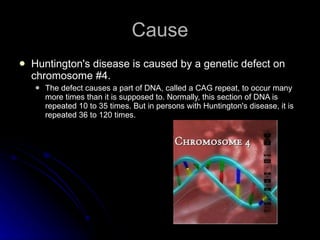
Cause Huntington's disease is caused by a genetic defect on chromosome #4.  The defect causes a part of DNA, called a CAG repeat, to occur many more times than it is supposed to. Normally, this section of DNA is repeated 10 to 35 times. But in persons with Huntington's disease, it is repeated 36 to 120 times.
How it’s transmitted… It is passed down from one of your parents As the disease is passed along in families, it becomes evident at younger and younger ages.
Who gets it… If one of your parents has Huntington's disease, you have a 50% chance of getting the gene for the disease.  No particular groups get its it can affect anyone There are two forms of Huntington's disease.  The most common is adult-onset Huntington's disease. Persons with this form usually develop symptoms in their mid 30s and 40s.  An early-onset form of Huntington's disease accounts for a small number of cases and begins in childhood or adolescence
Etiology… Huntington’s can either affect you in childhood to adolescent or in can happen in your 30’s to 40’s
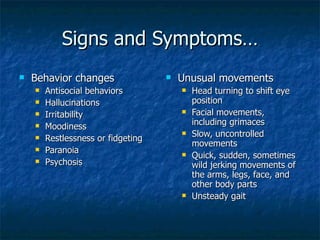
Signs and Symptoms… Behavior changes  Antisocial behaviors  Hallucinations  Irritability  Moodiness  Restlessness or fidgeting  Paranoia Psychosis Unusual movements  Head turning to shift eye position  Facial movements, including grimaces  Slow, uncontrolled movements  Quick, sudden, sometimes wild jerking movements of the arms, legs, face, and other body parts  Unsteady gait
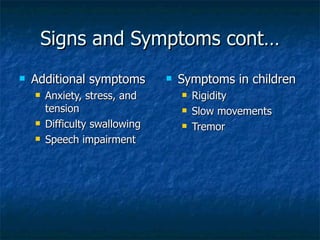
Signs and Symptoms cont… Additional symptoms  Anxiety, stress, and tension  Difficulty swallowing  Speech impairment  Symptoms in children  Rigidity  Slow movements  Tremor
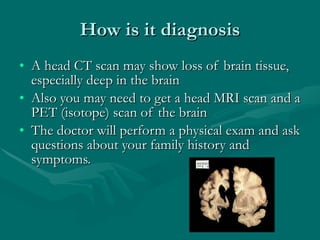
How is it diagnosis A head CT scan may show loss of brain tissue, especially deep in the brain  Also you may need to get a head MRI scan and a PET (isotope) scan of the brain  The doctor will perform a physical exam and ask questions about your family history and symptoms.
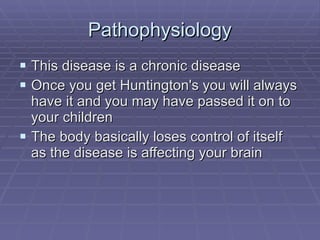
Pathophysiology This disease is a chronic disease Once you get Huntington's you will always have it and you may have passed it on to your children The body basically loses control of itself  as the disease is affecting your brain
Prognosis and Treatment This disease can not be prevent if you have the defect you will die form it eventually  and if you have children you have a 50% chance of passing it on to them. There really is no treatment, but there is medacations that can slow down the disease but it has a different affect on different people
Huntington’s Disease

Huntington’S Disease

  • 1.
  • 2.
    Cause Huntington's diseaseis caused by a genetic defect on chromosome #4. The defect causes a part of DNA, called a CAG repeat, to occur many more times than it is supposed to. Normally, this section of DNA is repeated 10 to 35 times. But in persons with Huntington's disease, it is repeated 36 to 120 times.
  • 3.
    How it’s transmitted…It is passed down from one of your parents As the disease is passed along in families, it becomes evident at younger and younger ages.
  • 4.
    Who gets it…If one of your parents has Huntington's disease, you have a 50% chance of getting the gene for the disease. No particular groups get its it can affect anyone There are two forms of Huntington's disease. The most common is adult-onset Huntington's disease. Persons with this form usually develop symptoms in their mid 30s and 40s. An early-onset form of Huntington's disease accounts for a small number of cases and begins in childhood or adolescence
  • 5.
    Etiology… Huntington’s caneither affect you in childhood to adolescent or in can happen in your 30’s to 40’s
  • 6.
    Signs and Symptoms…Behavior changes Antisocial behaviors Hallucinations Irritability Moodiness Restlessness or fidgeting Paranoia Psychosis Unusual movements Head turning to shift eye position Facial movements, including grimaces Slow, uncontrolled movements Quick, sudden, sometimes wild jerking movements of the arms, legs, face, and other body parts Unsteady gait
  • 7.
    Signs and Symptomscont… Additional symptoms Anxiety, stress, and tension Difficulty swallowing Speech impairment Symptoms in children Rigidity Slow movements Tremor
  • 8.
    How is itdiagnosis A head CT scan may show loss of brain tissue, especially deep in the brain Also you may need to get a head MRI scan and a PET (isotope) scan of the brain The doctor will perform a physical exam and ask questions about your family history and symptoms.
  • 9.
    Pathophysiology This diseaseis a chronic disease Once you get Huntington's you will always have it and you may have passed it on to your children The body basically loses control of itself as the disease is affecting your brain
  • 10.
    Prognosis and TreatmentThis disease can not be prevent if you have the defect you will die form it eventually and if you have children you have a 50% chance of passing it on to them. There really is no treatment, but there is medacations that can slow down the disease but it has a different affect on different people
  • 11.