1
2
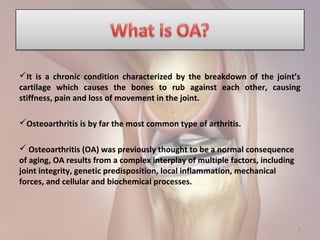
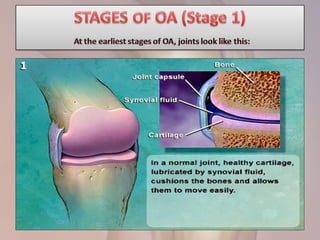
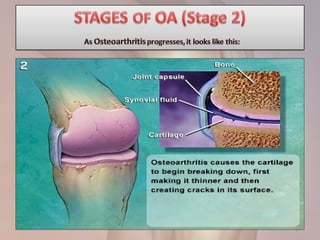
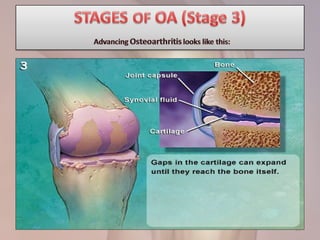
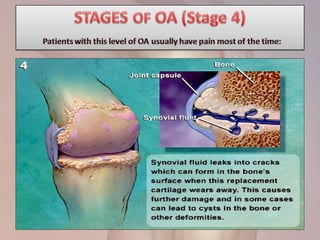
It is a chronic condition characterized by the breakdown of the joint’s
cartilage which causes the bones to rub against each other, causing
stiffness, pain and loss of movement in the joint.
Osteoarthritis is by far the most common type of arthritis.
 Osteoarthritis (OA) was previously thought to be a normal consequence
of aging, OA results from a complex interplay of multiple factors, including
joint integrity, genetic predisposition, local inflammation, mechanical
forces, and cellular and biochemical processes.
3
 It is thought that OA dates back to ancient humans. Evidence of OA has
been found in ice-aged skeletons.
 Individuals younger than 60 years have 27% to have OA, > 70 have 44%
 The symptoms of OA usually appear in middle age and almost everyone
has them by age 70. Before age 55, the condition occurs equally in both
sexes. However, after 55 it is more common in women.
4
5
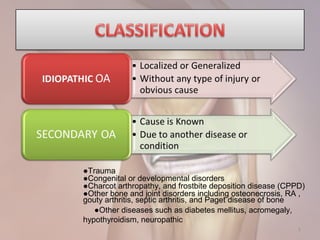
●Trauma
●Congenital or developmental disorders
●Charcot arthropathy, and frostbite deposition disease (CPPD)
●Other bone and joint disorders including osteonecrosis, RA ,
gouty arthritis, septic arthritis, and Paget disease of bone
●Other diseases such as diabetes mellitus, acromegaly,
hypothyroidism, neuropathic
6
7
8
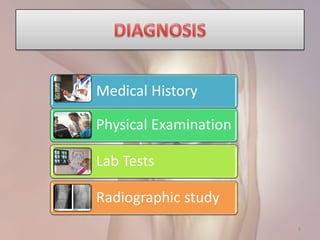
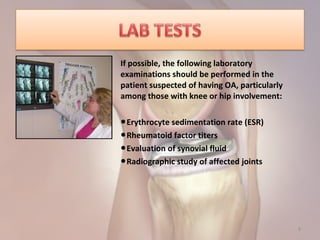
If possible, the following laboratory
examinations should be performed in the
patient suspected of having OA, particularly
among those with knee or hip involvement:
●Erythrocyte sedimentation rate (ESR)
●Rheumatoid factor titers
●Evaluation of synovial fluid
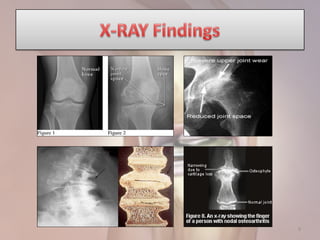
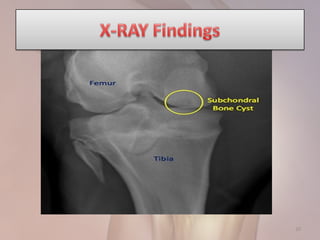
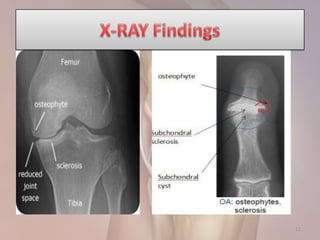
●Radiographic study of affected joints
9
10
11
12
 OA is primarily a disease of cartilage.
 The exact initiating factor in Primary Osteoarthritis is not known.
 Interleukin-1 (IL-1) is a potent pro-inflammatory cytokine that, in vitro, is
capable of inducing chondrocytes and synovial cells to synthesize MMPs.
 These MMPs (Matrix Metallo Proteinases) are the primary enzymes
responsible for the degradation of articular cartilage.
 In addition, IL-1 suppresses the synthesis of type II collagen and
proteoglycans, and inhibits the transforming growth factor-ß stimulated
chondrocyte proliferation.

 This ultimately leads to the degeneration of articular cartilage and thus OA.
13
14
15
16
17
18
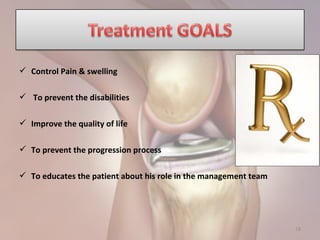
 Control Pain & swelling
 To prevent the disabilities
 Improve the quality of life
 To prevent the progression process
 To educates the patient about his role in the management team
19
 THE IMPROTANT 1ST
STEP in management is to be confident
that the is most likely due to OA.
The generalized therapeutic approach
 Both inflammatory and noninflammatory OA can be
polyarticular, oligoarticular, or monoarticular.
20
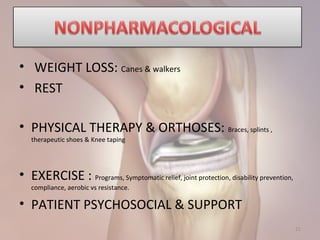
• WEIGHT LOSS: Canes & walkers
• REST
• PHYSICAL THERAPY & ORTHOSES: Braces, splints ,
therapeutic shoes & Knee taping
• EXERCISE : Programs, Symptomatic relief, joint protection, disability prevention,
compliance, aerobic vs resistance.
• PATIENT PSYCHOSOCIAL & SUPPORT
21
22
 All patients with arthritis should see their doctor for a careful history
and physical examination before beginning an exercise program.
 A Comprehensive Evaluation is the initial step in designing a physical
activity program individualized for the patient with OA.
 Assessment Objectives can be divided into 2 broad categories:
1) Arthritis-related Factors (Current Medications, Joint Pain, Inflammation,
Stability, and ROM)
2) Impairments associated with Inactivity (Altered Body Composition,
Muscle Weakness, and Poor Cardio-Vascular Fitness)
• Used only if not responded to the nonpharmacotherapy
• Not required during periods when symptoms are absent or
too minimal
• The major medications include analgesics, such as
Acetaminophen, NSAIDs & intraarticular glucocorticoids.
23
24
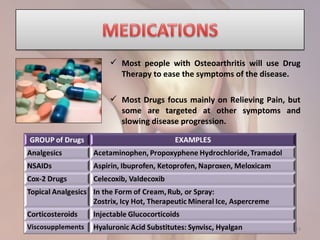
 Most people with Osteoarthritis will use Drug
Therapy to ease the symptoms of the disease.
 Most Drugs focus mainly on Relieving Pain, but
some are targeted at other symptoms and
slowing disease progression.
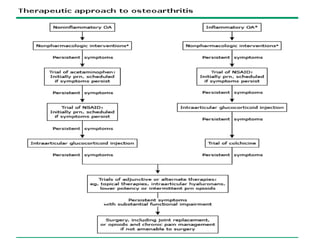
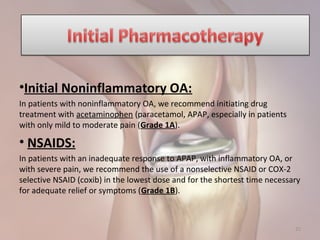
•Initial Noninflammatory OA:
In patients with noninflammatory OA, we recommend initiating drug
treatment with acetaminophen (paracetamol, APAP, especially in patients
with only mild to moderate pain (Grade 1A).
• NSAIDS:
In patients with an inadequate response to APAP, with inflammatory OA, or
with severe pain, we recommend the use of a nonselective NSAID or COX-2
selective NSAID (coxib) in the lowest dose and for the shortest time necessary
for adequate relief or symptoms (Grade 1B).
25
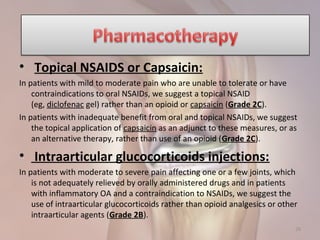
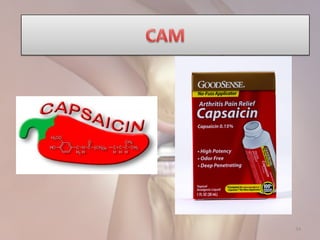
• Topical NSAIDS or Capsaicin:
In patients with mild to moderate pain who are unable to tolerate or have
contraindications to oral NSAIDs, we suggest a topical NSAID
(eg, diclofenac gel) rather than an opioid or capsaicin (Grade 2C).
In patients with inadequate benefit from oral and topical NSAIDs, we suggest
the topical application of capsaicin as an adjunct to these measures, or as
an alternative therapy, rather than use of an opioid (Grade 2C).
• Intraarticular glucocorticoids injections:
In patients with moderate to severe pain affecting one or a few joints, which
is not adequately relieved by orally administered drugs and in patients
with inflammatory OA and a contraindication to NSAIDs, we suggest the
use of intraarticular glucocorticoids rather than opioid analgesics or other
intraarticular agents (Grade 2B).
26
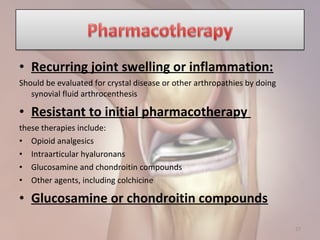
• Recurring joint swelling or inflammation:
Should be evaluated for crystal disease or other arthropathies by doing
synovial fluid arthrocenthesis
• Resistant to initial pharmacotherapy
these therapies include:
• Opioid analgesics
• Intraarticular hyaluronans
• Glucosamine and chondroitin compounds
• Other agents, including colchicine
• Glucosamine or chondroitin compounds
27
28
29
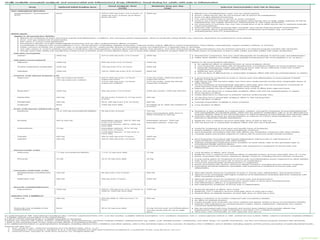
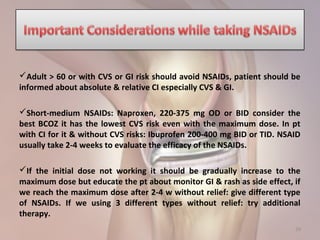
Adult > 60 or with CVS or GI risk should avoid NSAIDs, patient should be
informed about absolute & relative CI especially CVS & GI.
Short-medium NSAIDs: Naproxen, 220-375 mg OD or BID consider the
best BCOZ it has the lowest CVS risk even with the maximum dose. In pt
with CI for it & without CVS risks: Ibuprofen 200-400 mg BID or TID. NSAID
usually take 2-4 weeks to evaluate the efficacy of the NSAIDs.
If the initial dose not working it should be gradually increase to the
maximum dose but educate the pt about monitor GI & rash as side effect, if
we reach the maximum dose after 2-4 w without relief: give different type
of NSAIDs. If we using 3 different types without relief: try additional
therapy.
• Peptic ulcer or high risk for GI disease
• Using ASA for CV prevention
• Warfarin or anticoagulation therapy
• Patient with increased risk for CV disease
• Risk for renal insufficiency
• ASA sensitivity syndrome
30
• Uncertain diagnosis
• Needle aspiration or injection
• Narcotic anlgesics
• Alternative therapy
• Patients with severe OA unrelieved by oral,
topical, and intraarticular medications
31
32
33
34
• 2016
35
36
Thank You…………..

Osteoarthritis pathophysiology & updated management

  • 1.
  • 2.
    2 It is achronic condition characterized by the breakdown of the joint’s cartilage which causes the bones to rub against each other, causing stiffness, pain and loss of movement in the joint. Osteoarthritis is by far the most common type of arthritis.  Osteoarthritis (OA) was previously thought to be a normal consequence of aging, OA results from a complex interplay of multiple factors, including joint integrity, genetic predisposition, local inflammation, mechanical forces, and cellular and biochemical processes.
  • 3.
    3  It isthought that OA dates back to ancient humans. Evidence of OA has been found in ice-aged skeletons.  Individuals younger than 60 years have 27% to have OA, > 70 have 44%  The symptoms of OA usually appear in middle age and almost everyone has them by age 70. Before age 55, the condition occurs equally in both sexes. However, after 55 it is more common in women.
  • 4.
  • 5.
    5 ●Trauma ●Congenital or developmentaldisorders ●Charcot arthropathy, and frostbite deposition disease (CPPD) ●Other bone and joint disorders including osteonecrosis, RA , gouty arthritis, septic arthritis, and Paget disease of bone ●Other diseases such as diabetes mellitus, acromegaly, hypothyroidism, neuropathic
  • 6.
  • 7.
  • 8.
    8 If possible, thefollowing laboratory examinations should be performed in the patient suspected of having OA, particularly among those with knee or hip involvement: ●Erythrocyte sedimentation rate (ESR) ●Rheumatoid factor titers ●Evaluation of synovial fluid ●Radiographic study of affected joints
  • 9.
  • 10.
  • 11.
  • 12.
    12  OA isprimarily a disease of cartilage.  The exact initiating factor in Primary Osteoarthritis is not known.  Interleukin-1 (IL-1) is a potent pro-inflammatory cytokine that, in vitro, is capable of inducing chondrocytes and synovial cells to synthesize MMPs.  These MMPs (Matrix Metallo Proteinases) are the primary enzymes responsible for the degradation of articular cartilage.  In addition, IL-1 suppresses the synthesis of type II collagen and proteoglycans, and inhibits the transforming growth factor-ß stimulated chondrocyte proliferation.  This ultimately leads to the degeneration of articular cartilage and thus OA.
  • 13.
  • 14.
  • 15.
  • 16.
  • 17.
  • 18.
    18  Control Pain& swelling  To prevent the disabilities  Improve the quality of life  To prevent the progression process  To educates the patient about his role in the management team
  • 19.
    19  THE IMPROTANT1ST STEP in management is to be confident that the is most likely due to OA. The generalized therapeutic approach  Both inflammatory and noninflammatory OA can be polyarticular, oligoarticular, or monoarticular.
  • 20.
  • 21.
    • WEIGHT LOSS:Canes & walkers • REST • PHYSICAL THERAPY & ORTHOSES: Braces, splints , therapeutic shoes & Knee taping • EXERCISE : Programs, Symptomatic relief, joint protection, disability prevention, compliance, aerobic vs resistance. • PATIENT PSYCHOSOCIAL & SUPPORT 21
  • 22.
    22  All patientswith arthritis should see their doctor for a careful history and physical examination before beginning an exercise program.  A Comprehensive Evaluation is the initial step in designing a physical activity program individualized for the patient with OA.  Assessment Objectives can be divided into 2 broad categories: 1) Arthritis-related Factors (Current Medications, Joint Pain, Inflammation, Stability, and ROM) 2) Impairments associated with Inactivity (Altered Body Composition, Muscle Weakness, and Poor Cardio-Vascular Fitness)
  • 23.
    • Used onlyif not responded to the nonpharmacotherapy • Not required during periods when symptoms are absent or too minimal • The major medications include analgesics, such as Acetaminophen, NSAIDs & intraarticular glucocorticoids. 23
  • 24.
    24  Most peoplewith Osteoarthritis will use Drug Therapy to ease the symptoms of the disease.  Most Drugs focus mainly on Relieving Pain, but some are targeted at other symptoms and slowing disease progression.
  • 25.
    •Initial Noninflammatory OA: Inpatients with noninflammatory OA, we recommend initiating drug treatment with acetaminophen (paracetamol, APAP, especially in patients with only mild to moderate pain (Grade 1A). • NSAIDS: In patients with an inadequate response to APAP, with inflammatory OA, or with severe pain, we recommend the use of a nonselective NSAID or COX-2 selective NSAID (coxib) in the lowest dose and for the shortest time necessary for adequate relief or symptoms (Grade 1B). 25
  • 26.
    • Topical NSAIDSor Capsaicin: In patients with mild to moderate pain who are unable to tolerate or have contraindications to oral NSAIDs, we suggest a topical NSAID (eg, diclofenac gel) rather than an opioid or capsaicin (Grade 2C). In patients with inadequate benefit from oral and topical NSAIDs, we suggest the topical application of capsaicin as an adjunct to these measures, or as an alternative therapy, rather than use of an opioid (Grade 2C). • Intraarticular glucocorticoids injections: In patients with moderate to severe pain affecting one or a few joints, which is not adequately relieved by orally administered drugs and in patients with inflammatory OA and a contraindication to NSAIDs, we suggest the use of intraarticular glucocorticoids rather than opioid analgesics or other intraarticular agents (Grade 2B). 26
  • 27.
    • Recurring jointswelling or inflammation: Should be evaluated for crystal disease or other arthropathies by doing synovial fluid arthrocenthesis • Resistant to initial pharmacotherapy these therapies include: • Opioid analgesics • Intraarticular hyaluronans • Glucosamine and chondroitin compounds • Other agents, including colchicine • Glucosamine or chondroitin compounds 27
  • 28.
  • 29.
    29 Adult > 60or with CVS or GI risk should avoid NSAIDs, patient should be informed about absolute & relative CI especially CVS & GI. Short-medium NSAIDs: Naproxen, 220-375 mg OD or BID consider the best BCOZ it has the lowest CVS risk even with the maximum dose. In pt with CI for it & without CVS risks: Ibuprofen 200-400 mg BID or TID. NSAID usually take 2-4 weeks to evaluate the efficacy of the NSAIDs. If the initial dose not working it should be gradually increase to the maximum dose but educate the pt about monitor GI & rash as side effect, if we reach the maximum dose after 2-4 w without relief: give different type of NSAIDs. If we using 3 different types without relief: try additional therapy.
  • 30.
    • Peptic ulceror high risk for GI disease • Using ASA for CV prevention • Warfarin or anticoagulation therapy • Patient with increased risk for CV disease • Risk for renal insufficiency • ASA sensitivity syndrome 30
  • 31.
    • Uncertain diagnosis •Needle aspiration or injection • Narcotic anlgesics • Alternative therapy • Patients with severe OA unrelieved by oral, topical, and intraarticular medications 31
  • 32.
  • 33.
  • 34.
  • 35.
  • 36.