V.Lokeesan, BSN
T.Assistant lecturer
FHCS,EUSL.
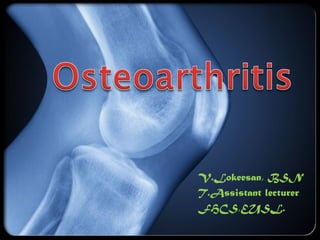
Osteoarthritis (OA)
• OA is the most common form of
arthritis and the most common
joint disease
• Known as degenerative joint
disease or osteoarthrosis
• Most of the people who have OA
are older than age 45, and
women are more commonly
affected than men.
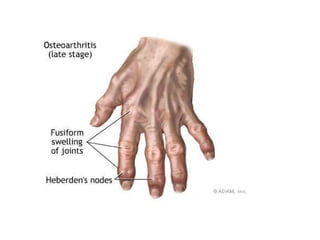
• OA most often occurs at the
ends of the fingers, thumbs,
neck, lower back, knees, and
hips.
OA has been classified as….
• Primary (idiopathic)
– No prior event or disease related to the OA
• Secondary
– Resulting from previous joint injury or
inflammatory disease
• Distinction between primary and secondary
OA is not always clear
OA
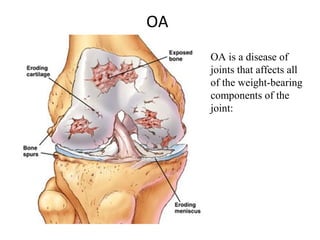
OA is a disease of
joints that affects all
of the weight-bearing
components of the
joint:
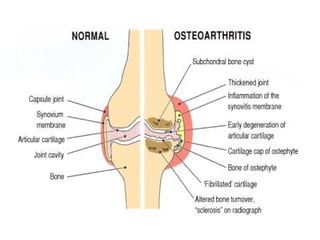
Osteoarthritis (OA) - Definition
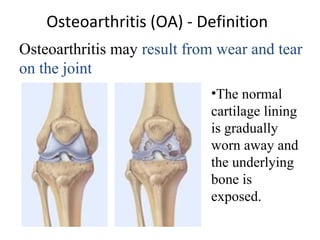
Osteoarthritis may result from wear and tear
on the joint
•The normal
cartilage lining
is gradually
worn away and
the underlying
bone is
exposed.
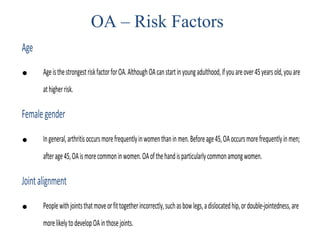
Age
• AgeisthestrongestriskfactorforOA.AlthoughOAcanstartinyoungadulthood,ifyouareover45yearsold,youare
athigherrisk.
Femalegender
• Ingeneral,arthritisoccursmorefrequentlyinwomenthaninmen.Beforeage45,OAoccursmorefrequentlyinmen;
afterage45,OAismorecommoninwomen.OAofthehandisparticularlycommonamongwomen.
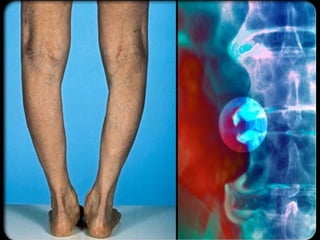
Jointalignment
• Peoplewithjointsthatmoveorfittogetherincorrectly,suchasbowlegs,adislocatedhip,ordouble-jointedness,are
morelikelytodevelopOAinthosejoints.
OA – Risk Factors
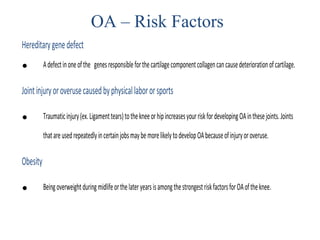
Hereditarygenedefect
• Adefectinoneofthe genesresponsibleforthecartilagecomponentcollagencancausedeteriorationofcartilage.
Jointinjuryoroverusecausedbyphysicallabororsports
• Traumaticinjury(ex.Ligamenttears)tothekneeorhipincreasesyourriskfordevelopingOAinthesejoints.Joints
thatareusedrepeatedlyincertainjobsmaybemorelikelytodevelopOAbecauseofinjuryoroveruse.
Obesity
• BeingoverweightduringmidlifeorthelateryearsisamongthestrongestriskfactorsforOAoftheknee.
OA – Risk Factors
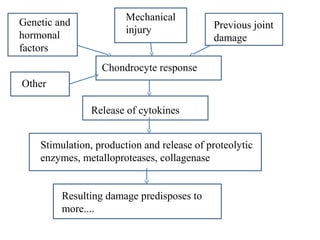
Genetic and
hormonal
factors
Other
Mechanical
injury
Chondrocyte response
Release of cytokines
Stimulation, production and release of proteolytic
enzymes, metalloproteases, collagenase
Resulting damage predisposes to
more....
Previous joint
damage
OA – Articular Cartilage
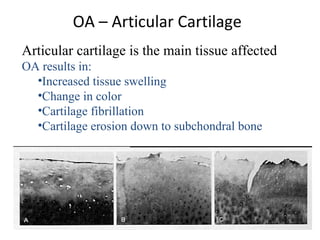
Articular cartilage is the main tissue affected
OA results in:
•Increased tissue swelling
•Change in color
•Cartilage fibrillation
•Cartilage erosion down to subchondral bone
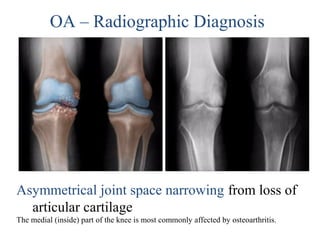
Asymmetrical joint space narrowing from loss of
articular cartilage
The medial (inside) part of the knee is most commonly affected by osteoarthritis.
OA – Radiographic Diagnosis
OA – Symptoms
• OA usually occurs slowly - It may be many years
before the damage to the joint becomes
noticeable
• Only a third of people whose X-rays show OA
report pain or other symptoms:
– Steady or intermittent pain in a joint
– Stiffness that tends to follow periods of inactivity, such as sleep
or sitting
– Swelling or tenderness in one or more joints [not necessarily
occurring on both sides of the body at the same time]
– Crunching feeling or sound of bone rubbing on bone (called
crepitus) when the joint is used
Diagnostic Findings
• You'll need to describe your symptoms in
detail, including the location and frequency of
any pain
• Examination of the affected joints
• X-rays or other imaging studies
• blood tests are used to rule out other forms of
arthritis
Medical Management
• No treatment halts the degenerative process
• preventive measures can slow the progress
– weight reduction
– prevention of injuries
– perinatal screening for congenital hip disease, and
occupational modifications.
• Conservative treatment measures
– use of heat
– weight reduction, joint rest and avoidance of joint
overuse
– orthotic devices to support inflamed joints
(splints, braces)
– postural exercises and aerobic exercise
PHARMACOLOGIC THERAPY
• Pharmacologic management of OA is directed
toward symptom management and pain
control
• Initial analgesic therapy is acetaminophen
• Nonselective NSAIDs
• Opioids and intra-articular corticosteroids
• glucosamine and chondroitin - which are
thought to improve tissue function and retard
breakdown of cartilage
Surgical management
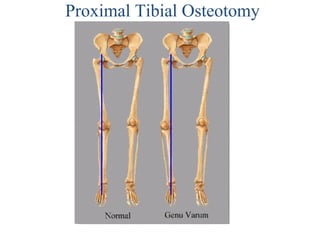
• Osteotomy (to alter the force distribution in
the joint)
• Arthroplasty
• viscosupplementation (the reconstitution of
synovial fluid viscosity)- Hyaluronic acid
• Tidal irrigation (lavage)- of the knee involves
the introduction and then removal of a large
volume of saline into the joint through
cannulas.
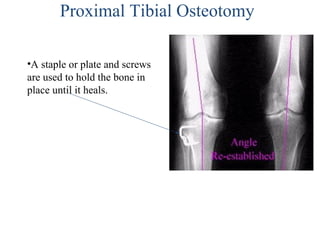
Proximal Tibial Osteotomy
•A staple or plate and screws
are used to hold the bone in
place until it heals.
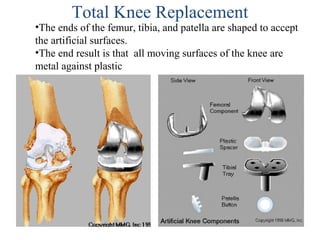
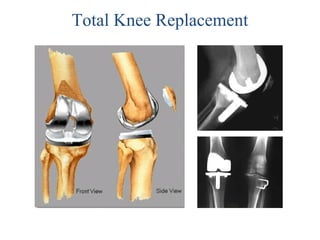
•The ends of the femur, tibia, and patella are shaped to accept
the artificial surfaces.
•The end result is that all moving surfaces of the knee are
metal against plastic
Total Knee Replacement
•OA is a condition which progresses slowly over a
period of many years and cannot be cured
•Treatment is directed at decreasing the symptoms of
the condition, and slowing the progress of the
condition
•Functional treatment goals:
•Limit pain
•Increase range of motion
•Increase muscle strength
OA – Disease Management
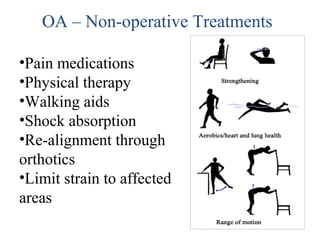
OA – Non-operative Treatments
•Pain medications
•Physical therapy
•Walking aids
•Shock absorption
•Re-alignment through
orthotics
•Limit strain to affected
areas
Nursing Management
Nursing Assessment for Osteoarthritis
• Activity / Rest
– Joint pain due to movement, tenderness
worsened by stress on the joints, stiffness in the
morning, usually occurs bilaterally and
symmetrically functional limitations that affect
lifestyle, leisure, work, fatigue, malaise.
– Limitation of movement, muscle atrophy, skin:
contractor / abnormalities in the joints and
muscles.
• Cardiovascular
– Raynaud's phenomenon of the hand (eg litermiten
pale, cyanosis and redness on the fingers before
the color returned to normal.
• Ego Integrity
– Stress factors of acute / chronic (eg, financial jobs,
disability, relationship factors.
– Hopelessness and helplessness (inability
situation).
– Threats to the self-concept, body image, personal
identity, for example dependence on others.
• Food / Fluids
– The inability to produce or consume food or
liquids adequately nausea, anorexia.
– Difficulty chewing, weight loss, dryness of mucous
membranes.
• Hygiene
– The difficulties to implement self-care activities,
dependence on others.
• Neurosensory
– Tingling in hands and feet, swollen joints
• Pain / comfort
– The acute phase of pain (probably not
accompanied by soft tissue
– swelling in the joints. chronic pain and stiffness
(especially in the morning).
• Social Interaction
– Damage interaction with family or others, the
changing role: isolation.
• Counseling / Learning
– Family history of rheumatic
– The use of health foods, vitamins, cure disease
without testing
– History pericarditis, valve lesion edge. Pulmonary
fibrosis, pleuritis.
Nursing Diagnosis
• Acute / Chronic pain related to distention of
tissue by the accumulation of fluid /
inflammatory process, synovial joints.
• Assess pain; note the location and intensity of
pain (scale 0-10).
• Write down the factors that accelerate and
signs of non-verbal pain.
• Give the hard mattress, small pillow. Elevate
bed when a client needs to rest / sleep.
• Help the client take a comfortable position
when sleeping or sitting in a chair.
• Monitor the use of a pillow.
• Help clients to frequently change positions.
• Help the client to a warm bath at the time of
waking.
• Help the client to a warm compress on the
sore joints several times a day.
• Monitor temperature compress.
– Encourage the use of stress management
techniques such as progressive relaxation
therapeutic touch, visualization, self hypnosis
guidelines imagination, and breath control.
Engage in activities of entertainment that is
suitable for individual situations.
• Give the drug before activity / exercise that is
planned as directed.
• Assist clients with physical therapy.
• Impaired Physical Mobility related to skeletal
deformities, pain, discomfort, decreased
muscle strength.
• Monitor the level of inflammation / pain in
joints
• Maintain bed rest / sit if necessary
• Schedule of activities to provide a rest period
of continuous and uninterrupted night time
sleep.
• Assist clients with range of motion active /
passive and resistive exercise and isometric if
possible.
• Slide to maintain an upright position and
sitting height, standing, and walking.
• Provide a safe environment, for example,
raise the chair / toilet, use a high grip and tub
and toilet, the use of mobility aids /
wheelchairs rescue.
• Collaboration physical therapist / occupational
specialist.
• Anxiety related to operative procedures
• Risk for infection related to long term use of
corticosteroids
• Risk for injury related to mobility changes
secondary to osteoarthritis
• Knowledge deficit about condition, prognosis
and treatment needs related to lack of
information.
Thank you

Osteoarthritis

  • 1.
  • 2.
    Osteoarthritis (OA) • OAis the most common form of arthritis and the most common joint disease • Known as degenerative joint disease or osteoarthrosis • Most of the people who have OA are older than age 45, and women are more commonly affected than men. • OA most often occurs at the ends of the fingers, thumbs, neck, lower back, knees, and hips.
  • 3.
    OA has beenclassified as…. • Primary (idiopathic) – No prior event or disease related to the OA • Secondary – Resulting from previous joint injury or inflammatory disease • Distinction between primary and secondary OA is not always clear
  • 4.
    OA OA is adisease of joints that affects all of the weight-bearing components of the joint:
  • 5.
    Osteoarthritis (OA) -Definition Osteoarthritis may result from wear and tear on the joint •The normal cartilage lining is gradually worn away and the underlying bone is exposed.
  • 6.
  • 7.
    Hereditarygenedefect • Adefectinoneofthe genesresponsibleforthecartilagecomponentcollagencancausedeteriorationofcartilage. Jointinjuryoroverusecausedbyphysicallabororsports •Traumaticinjury(ex.Ligamenttears)tothekneeorhipincreasesyourriskfordevelopingOAinthesejoints.Joints thatareusedrepeatedlyincertainjobsmaybemorelikelytodevelopOAbecauseofinjuryoroveruse. Obesity • BeingoverweightduringmidlifeorthelateryearsisamongthestrongestriskfactorsforOAoftheknee. OA – Risk Factors
  • 8.
    Genetic and hormonal factors Other Mechanical injury Chondrocyte response Releaseof cytokines Stimulation, production and release of proteolytic enzymes, metalloproteases, collagenase Resulting damage predisposes to more.... Previous joint damage
  • 9.
    OA – ArticularCartilage Articular cartilage is the main tissue affected OA results in: •Increased tissue swelling •Change in color •Cartilage fibrillation •Cartilage erosion down to subchondral bone
  • 11.
    Asymmetrical joint spacenarrowing from loss of articular cartilage The medial (inside) part of the knee is most commonly affected by osteoarthritis. OA – Radiographic Diagnosis
  • 12.
    OA – Symptoms •OA usually occurs slowly - It may be many years before the damage to the joint becomes noticeable • Only a third of people whose X-rays show OA report pain or other symptoms: – Steady or intermittent pain in a joint – Stiffness that tends to follow periods of inactivity, such as sleep or sitting – Swelling or tenderness in one or more joints [not necessarily occurring on both sides of the body at the same time] – Crunching feeling or sound of bone rubbing on bone (called crepitus) when the joint is used
  • 13.
    Diagnostic Findings • You'llneed to describe your symptoms in detail, including the location and frequency of any pain • Examination of the affected joints • X-rays or other imaging studies • blood tests are used to rule out other forms of arthritis
  • 16.
    Medical Management • Notreatment halts the degenerative process • preventive measures can slow the progress – weight reduction – prevention of injuries – perinatal screening for congenital hip disease, and occupational modifications.
  • 17.
    • Conservative treatmentmeasures – use of heat – weight reduction, joint rest and avoidance of joint overuse – orthotic devices to support inflamed joints (splints, braces) – postural exercises and aerobic exercise
  • 18.
    PHARMACOLOGIC THERAPY • Pharmacologicmanagement of OA is directed toward symptom management and pain control • Initial analgesic therapy is acetaminophen • Nonselective NSAIDs • Opioids and intra-articular corticosteroids • glucosamine and chondroitin - which are thought to improve tissue function and retard breakdown of cartilage
  • 19.
    Surgical management • Osteotomy(to alter the force distribution in the joint) • Arthroplasty • viscosupplementation (the reconstitution of synovial fluid viscosity)- Hyaluronic acid • Tidal irrigation (lavage)- of the knee involves the introduction and then removal of a large volume of saline into the joint through cannulas.
  • 20.
  • 21.
    Proximal Tibial Osteotomy •Astaple or plate and screws are used to hold the bone in place until it heals.
  • 22.
    •The ends ofthe femur, tibia, and patella are shaped to accept the artificial surfaces. •The end result is that all moving surfaces of the knee are metal against plastic Total Knee Replacement
  • 23.
  • 24.
    •OA is acondition which progresses slowly over a period of many years and cannot be cured •Treatment is directed at decreasing the symptoms of the condition, and slowing the progress of the condition •Functional treatment goals: •Limit pain •Increase range of motion •Increase muscle strength OA – Disease Management
  • 25.
    OA – Non-operativeTreatments •Pain medications •Physical therapy •Walking aids •Shock absorption •Re-alignment through orthotics •Limit strain to affected areas
  • 26.
    Nursing Management Nursing Assessmentfor Osteoarthritis • Activity / Rest – Joint pain due to movement, tenderness worsened by stress on the joints, stiffness in the morning, usually occurs bilaterally and symmetrically functional limitations that affect lifestyle, leisure, work, fatigue, malaise. – Limitation of movement, muscle atrophy, skin: contractor / abnormalities in the joints and muscles.
  • 27.
    • Cardiovascular – Raynaud'sphenomenon of the hand (eg litermiten pale, cyanosis and redness on the fingers before the color returned to normal. • Ego Integrity – Stress factors of acute / chronic (eg, financial jobs, disability, relationship factors. – Hopelessness and helplessness (inability situation). – Threats to the self-concept, body image, personal identity, for example dependence on others.
  • 28.
    • Food /Fluids – The inability to produce or consume food or liquids adequately nausea, anorexia. – Difficulty chewing, weight loss, dryness of mucous membranes. • Hygiene – The difficulties to implement self-care activities, dependence on others.
  • 29.
    • Neurosensory – Tinglingin hands and feet, swollen joints • Pain / comfort – The acute phase of pain (probably not accompanied by soft tissue – swelling in the joints. chronic pain and stiffness (especially in the morning).
  • 30.
    • Social Interaction –Damage interaction with family or others, the changing role: isolation. • Counseling / Learning – Family history of rheumatic – The use of health foods, vitamins, cure disease without testing – History pericarditis, valve lesion edge. Pulmonary fibrosis, pleuritis.
  • 31.
    Nursing Diagnosis • Acute/ Chronic pain related to distention of tissue by the accumulation of fluid / inflammatory process, synovial joints.
  • 32.
    • Assess pain;note the location and intensity of pain (scale 0-10). • Write down the factors that accelerate and signs of non-verbal pain. • Give the hard mattress, small pillow. Elevate bed when a client needs to rest / sleep. • Help the client take a comfortable position when sleeping or sitting in a chair.
  • 33.
    • Monitor theuse of a pillow. • Help clients to frequently change positions. • Help the client to a warm bath at the time of waking. • Help the client to a warm compress on the sore joints several times a day.
  • 34.
    • Monitor temperaturecompress. – Encourage the use of stress management techniques such as progressive relaxation therapeutic touch, visualization, self hypnosis guidelines imagination, and breath control. Engage in activities of entertainment that is suitable for individual situations. • Give the drug before activity / exercise that is planned as directed. • Assist clients with physical therapy.
  • 35.
    • Impaired PhysicalMobility related to skeletal deformities, pain, discomfort, decreased muscle strength.
  • 36.
    • Monitor thelevel of inflammation / pain in joints • Maintain bed rest / sit if necessary • Schedule of activities to provide a rest period of continuous and uninterrupted night time sleep. • Assist clients with range of motion active / passive and resistive exercise and isometric if possible.
  • 37.
    • Slide tomaintain an upright position and sitting height, standing, and walking. • Provide a safe environment, for example, raise the chair / toilet, use a high grip and tub and toilet, the use of mobility aids / wheelchairs rescue. • Collaboration physical therapist / occupational specialist.
  • 38.
    • Anxiety relatedto operative procedures • Risk for infection related to long term use of corticosteroids • Risk for injury related to mobility changes secondary to osteoarthritis • Knowledge deficit about condition, prognosis and treatment needs related to lack of information.
  • 39.