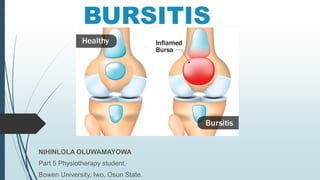
BURSITIS
NIHINLOLA OLUWAMAYOWA
Part 5 Physiotherapy student,
Bowen University, Iwo, Osun State.
OUTLINE
 INTRODUCTION TO BURSA AND
FUNCTIONS
 TYPES OF BURSA
 BURSITIS DEFINITION
 CAUSES
 RISK FACTORS
 COMMON SITES
 CLINICAL FEATURES
 DIAGNOSIS
 DIFFERENTIAL DIAGNOSIS
 PREVENTION
 TREATMENT
• TREATMENTIN BURSITIS DUE
TO FRICTION
• IN INFECTIVE BURSITIS
 REFERENCES
INTRODUCTION TO BURSA AND
FUNCTIONS
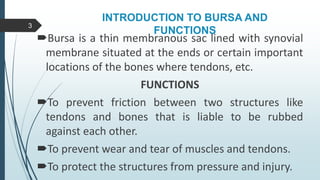
Bursa is a thin membranous sac lined with synovial
membrane situated at the ends or certain important
locations of the bones where tendons, etc.
FUNCTIONS
To prevent friction between two structures like
tendons and bones that is liable to be rubbed
against each other.
To prevent wear and tear of muscles and tendons.
To protect the structures from pressure and injury.
3
4
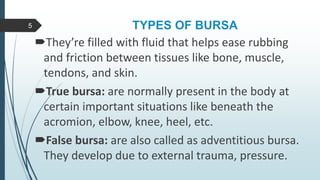
Elbow Bursae
TYPES OF BURSA
They’re filled with fluid that helps ease rubbing
and friction between tissues like bone, muscle,
tendons, and skin.
True bursa: are normally present in the body at
certain important situations like beneath the
acromion, elbow, knee, heel, etc.
False bursa: are also called as adventitious bursa.
They develop due to external trauma, pressure.
5
BURSITIS DEFINITION
Is the inflammation of bursae. This occurs
because of bacterial infection or mechanical
irritation. Because of which the bursitis may
be infective or irritative caused by excessive
pressure or friction. Also sometimes due to
gouty deposit.
It can affect any joint, but is most common
in the shoulders, hips, elbows or knees.
6
CAUSES
• Trauma may be due to a single blow or repetitive trauma.
• Infection (acute or chronic) e.g. tuberculosis.
• Metabolic disorders, For example gout.
•Abnormal external pressures, For example, hip ischial-
tuberosity in prolong sitting.
• Inflammatory disorders, such as rheumatoid arthritis.
• Unaccustomed activity, exercise or ill-fitting shoes etc.
•Due to excessive pressure, friction.
7
RISK FACTORS
Age: Bursitis becomes more common with aging.
Occupations or hobbies: risk of developing bursitis
increases in work or hobby that requires repetitive motion
or pressure on particular bursae. Examples include carpet
laying, gardening and playing a musical instrument etc.
History of other medical conditions: certain systemic
diseases and conditions (rheumatoid arthritis, gout and
diabetes).
Overweight can increase the risk of developing hip and knee
bursitis.
8
COMMON SITES
Upper Limbs
— Sub-acromion — Olecranon
Lower Limbs
— Pre-patellar
— Tendo-Achilles
— Medial side of the great toe
— Lateral side of the little toe.
9
CLINICAL
FEATURES
Pain,
swelling,
redness,
tenderness,
painful and reduced joint range of motion,
limping is seen in gluteal bursitis, etc.
10
DIAGNOSIS
Physical Test: involves taking symptoms history and do a
physical exam to see if the joint is swollen. You might also
have
Imaging tests: X-rays can rule out other problems that
might be causing pain. MRI and ultrasound give an image
of your joint.
Plain X-ray helps to detect the calcaneal and the retro-
calcaneal spurs.
Lab tests: involves the use of a needle to take a bit of fluid
from the bursa and test it for signs of infection.
11
DIFFERENTIAL DIAGNOSIS
Tendonitis
Cellulitis
Osteoarthritis
Rheumatoid arthritis
Septic arthritis
Fracture
Ligamentous injury
12
PREVENTION
You can’t always prevent bursitis, but some steps can lower
your risk.
Use cushions or pads when you’re resting a joint on a hard
surface, like if you’re kneeling or sitting.
If you play sports, mix things up so you don’t make the
same motions all the time.
Warm up and stretch before you play, and always use
proper form.
clean any cuts on elbows and knees to prevent infections
13
PREVENTION
Warming up and stretching before strenuous activities to
protect your joints from injury.
Take breaks often when you’re making the same motions
over and over again.
Use good posture all day.
Keep a healthy body weight.
If something hurts, stop doing it and check with your
doctor.
Exercising: strengthening your muscles can help protect
your affected joint.
14
TREATMENT IN BURSITIS DUE TO
FRICTION
• Rest to the part.
• Thermotherapy: Ultrasound, TENS therapies, etc.
• Cryotherapy in initial stages.
• Restricted weight bearing.
• Isometric exercises to the affected part.
• Muscle strengthening exercises.
• Joint mobilization if there is restriction.
• Injection of hydrocortisone in intractable cases.
• Excision of the bursa, if chronic and troublesome.
15
TREATMENT IN INFECTIVE BURSITIS
• Appropriate antibiotics
Cryotherapy
• Rest of the measures is same as above.
• Appropriate supports like felt pad, footwear modifications
etc.
• Avoiding repeated frictional movements.
Deep friction massage.
16
TREATMENT IN INFECTIVE BURSITIS
For example—shoulder abduction in sub deltoid bursa.
• Relaxed passive movements to avoid friction.
• Active limited ROM exercises with strong isometrics.
• Progressive resistive exercises.
• Deep heating like Ultrasound , Short Wave
Diarthermy, TENS, etc.
• Active exercises to the unaffected joints.
• Isometrics with limb in elevation helps considerably.
17
REFERENCES
Gitesh Amrohit (2012)The Pocketbook for Physiotherapists. 2nd
ed. Pg. 317 Jaypee Brothers Medical Publishers (P) Ltd: India
John Ebnezar(2011) Essentials of Orthopedics for
Physiotherapists. 2nd ed. Pg. 34 Jaypee Brothers Medical
Publishers (P) Ltd: India
Fauci, Anthony S., and Carol Langford. Harrisons’s rheumatology.
McGraw Hill Professional, 2010.
Aaron, Daniel L., et al. “Four common types of bursitis: diagnosis
and management.” Journal of the American Academy of
Orthopaedic Surgeons 19.6 (2011): 359-367.
18
REFERENCES
www.nhs.uk/conditions/bursitis/
www.mayoclinic.org/diseases-conditions/bursitis/symptoms-
causes/syc-20353242
www.chrisbaileyorthopaedics.com
www.webmd.com/pain-management/arthritis-bursitis
www.msdmanuals.com
www.wikidoc.org/index.php/Bursitis_differential_diagnosis
19
20

Bursitis

  • 1.
    BURSITIS NIHINLOLA OLUWAMAYOWA Part 5Physiotherapy student, Bowen University, Iwo, Osun State.
  • 2.
    OUTLINE  INTRODUCTION TOBURSA AND FUNCTIONS  TYPES OF BURSA  BURSITIS DEFINITION  CAUSES  RISK FACTORS  COMMON SITES  CLINICAL FEATURES  DIAGNOSIS  DIFFERENTIAL DIAGNOSIS  PREVENTION  TREATMENT • TREATMENTIN BURSITIS DUE TO FRICTION • IN INFECTIVE BURSITIS  REFERENCES
  • 3.
    INTRODUCTION TO BURSAAND FUNCTIONS Bursa is a thin membranous sac lined with synovial membrane situated at the ends or certain important locations of the bones where tendons, etc. FUNCTIONS To prevent friction between two structures like tendons and bones that is liable to be rubbed against each other. To prevent wear and tear of muscles and tendons. To protect the structures from pressure and injury. 3
  • 4.
  • 5.
    TYPES OF BURSA They’refilled with fluid that helps ease rubbing and friction between tissues like bone, muscle, tendons, and skin. True bursa: are normally present in the body at certain important situations like beneath the acromion, elbow, knee, heel, etc. False bursa: are also called as adventitious bursa. They develop due to external trauma, pressure. 5
  • 6.
    BURSITIS DEFINITION Is theinflammation of bursae. This occurs because of bacterial infection or mechanical irritation. Because of which the bursitis may be infective or irritative caused by excessive pressure or friction. Also sometimes due to gouty deposit. It can affect any joint, but is most common in the shoulders, hips, elbows or knees. 6
  • 7.
    CAUSES • Trauma maybe due to a single blow or repetitive trauma. • Infection (acute or chronic) e.g. tuberculosis. • Metabolic disorders, For example gout. •Abnormal external pressures, For example, hip ischial- tuberosity in prolong sitting. • Inflammatory disorders, such as rheumatoid arthritis. • Unaccustomed activity, exercise or ill-fitting shoes etc. •Due to excessive pressure, friction. 7
  • 8.
    RISK FACTORS Age: Bursitisbecomes more common with aging. Occupations or hobbies: risk of developing bursitis increases in work or hobby that requires repetitive motion or pressure on particular bursae. Examples include carpet laying, gardening and playing a musical instrument etc. History of other medical conditions: certain systemic diseases and conditions (rheumatoid arthritis, gout and diabetes). Overweight can increase the risk of developing hip and knee bursitis. 8
  • 9.
    COMMON SITES Upper Limbs —Sub-acromion — Olecranon Lower Limbs — Pre-patellar — Tendo-Achilles — Medial side of the great toe — Lateral side of the little toe. 9
  • 10.
    CLINICAL FEATURES Pain, swelling, redness, tenderness, painful and reducedjoint range of motion, limping is seen in gluteal bursitis, etc. 10
  • 11.
    DIAGNOSIS Physical Test: involvestaking symptoms history and do a physical exam to see if the joint is swollen. You might also have Imaging tests: X-rays can rule out other problems that might be causing pain. MRI and ultrasound give an image of your joint. Plain X-ray helps to detect the calcaneal and the retro- calcaneal spurs. Lab tests: involves the use of a needle to take a bit of fluid from the bursa and test it for signs of infection. 11
  • 12.
  • 13.
    PREVENTION You can’t alwaysprevent bursitis, but some steps can lower your risk. Use cushions or pads when you’re resting a joint on a hard surface, like if you’re kneeling or sitting. If you play sports, mix things up so you don’t make the same motions all the time. Warm up and stretch before you play, and always use proper form. clean any cuts on elbows and knees to prevent infections 13
  • 14.
    PREVENTION Warming up andstretching before strenuous activities to protect your joints from injury. Take breaks often when you’re making the same motions over and over again. Use good posture all day. Keep a healthy body weight. If something hurts, stop doing it and check with your doctor. Exercising: strengthening your muscles can help protect your affected joint. 14
  • 15.
    TREATMENT IN BURSITISDUE TO FRICTION • Rest to the part. • Thermotherapy: Ultrasound, TENS therapies, etc. • Cryotherapy in initial stages. • Restricted weight bearing. • Isometric exercises to the affected part. • Muscle strengthening exercises. • Joint mobilization if there is restriction. • Injection of hydrocortisone in intractable cases. • Excision of the bursa, if chronic and troublesome. 15
  • 16.
    TREATMENT IN INFECTIVEBURSITIS • Appropriate antibiotics Cryotherapy • Rest of the measures is same as above. • Appropriate supports like felt pad, footwear modifications etc. • Avoiding repeated frictional movements. Deep friction massage. 16
  • 17.
    TREATMENT IN INFECTIVEBURSITIS For example—shoulder abduction in sub deltoid bursa. • Relaxed passive movements to avoid friction. • Active limited ROM exercises with strong isometrics. • Progressive resistive exercises. • Deep heating like Ultrasound , Short Wave Diarthermy, TENS, etc. • Active exercises to the unaffected joints. • Isometrics with limb in elevation helps considerably. 17
  • 18.
    REFERENCES Gitesh Amrohit (2012)ThePocketbook for Physiotherapists. 2nd ed. Pg. 317 Jaypee Brothers Medical Publishers (P) Ltd: India John Ebnezar(2011) Essentials of Orthopedics for Physiotherapists. 2nd ed. Pg. 34 Jaypee Brothers Medical Publishers (P) Ltd: India Fauci, Anthony S., and Carol Langford. Harrisons’s rheumatology. McGraw Hill Professional, 2010. Aaron, Daniel L., et al. “Four common types of bursitis: diagnosis and management.” Journal of the American Academy of Orthopaedic Surgeons 19.6 (2011): 359-367. 18
  • 19.
  • 20.