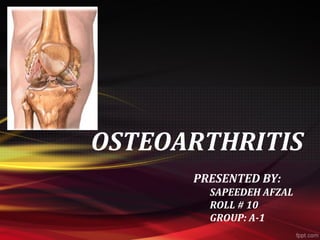
OSTEOARTHRITIS
PRESENTED BY:
SAPEEDEH AFZAL
ROLL # 10
GROUP: A-1
ROAD MAP
• PROTECTIVE MECHANISM OF SYNOVIAL JOINTS
• WHAT IS OA
• EPIDEMIOLOGY
• DISTRIBUTION OF DISEASE.
• AETIOLOGY & RISK FACTORS
• PATHOGENESIS
• CLINICAL FEATURES
• DIFFERENTIAL DIAGNOSIS
• INVESTIGATIONS
• MANAGEMENT
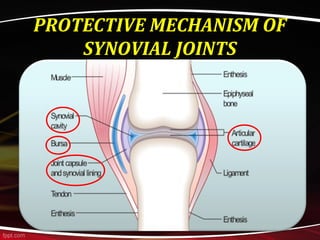
PROTECTIVE MECHANISM OF
SYNOVIAL JOINTS
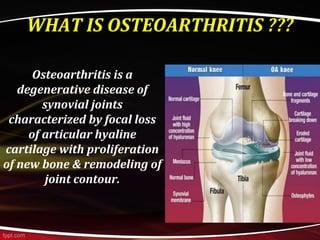
WHAT IS OSTEOARTHRITIS ???
Osteoarthritis is a
degenerative disease of
synovial joints
characterized by focal loss
of articular hyaline
cartilage with proliferation
of new bone & remodeling of
joint contour.
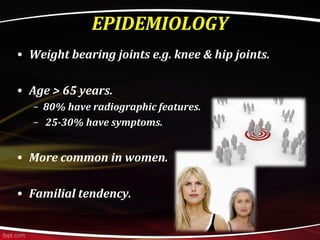
EPIDEMIOLOGY
• Weight bearing joints e.g. knee & hip joints.
• Age > 65 years.
– 80% have radiographic features.
– 25-30% have symptoms.
• More common in women.
• Familial tendency.
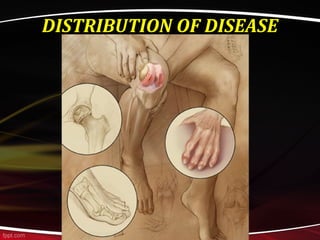
DISTRIBUTION OF DISEASE
ETIOLOGY
• PRIMARY / IDIOPATHIC:
When there is no obvious predisposing
factor. Common form of OA.
• SECONDARY:
When degenerative joint changes occur in
response to a recognizable local or systemic
factor.
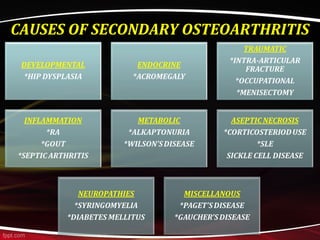
CAUSES OF SECONDARY OSTEOARTHRITIS
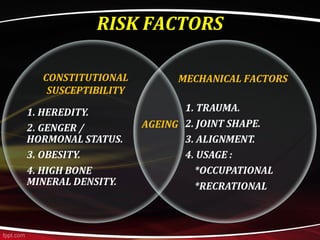
RISK FACTORS
AGEING
CONSTITUTIONAL
SUSCEPTIBILITY
MECHANICAL FACTORS
PATHOGENESIS
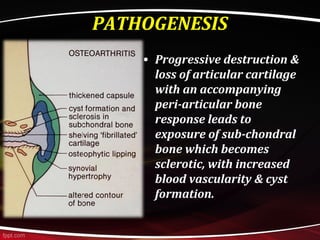
• Progressive destruction &
loss of articular cartilage
with an accompanying
peri-articular bone
response leads to
exposure of sub-chondral
bone which becomes
sclerotic, with increased
blood vascularity & cyst
formation.
CLINICAL FEATURES
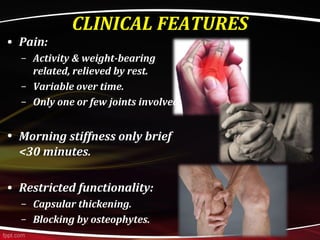
• Pain:
– Activity & weight-bearing
related, relieved by rest.
– Variable over time.
– Only one or few joints involved.
• Morning stiffness only brief
<30 minutes.
• Restricted functionality:
– Capsular thickening.
– Blocking by osteophytes.
CLINICAL FINDINGS IN NODAL
GENERALIZED OA
• Presentation typically in women. (40 & 50 years)
• Pain.
• Stiffness.
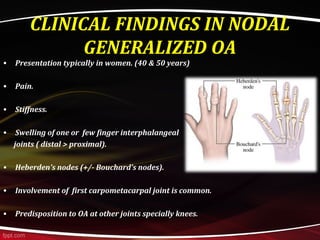
• Swelling of one or few finger interphalangeal
joints ( distal > proximal).
• Heberden’s nodes (+/- Bouchard’s nodes).
• Involvement of first carpometacarpal joint is common.
• Predisposition to OA at other joints specially knees.
CLINICAL FINDINGS IN KNEE OA
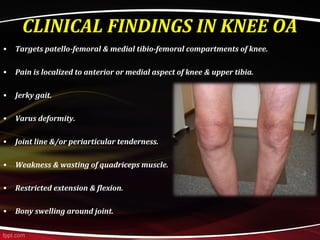
• Targets patello-femoral & medial tibio-femoral compartments of knee.
• Pain is localized to anterior or medial aspect of knee & upper tibia.
• Jerky gait.
• Varus deformity.
• Joint line &/or periarticular tenderness.
• Weakness & wasting of quadriceps muscle.
• Restricted extension & flexion.
• Bony swelling around joint.
CLINICAL FINDINGS IN HIP OA
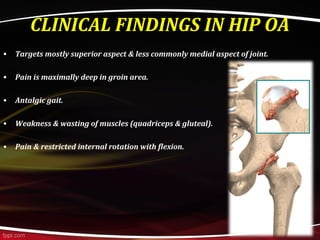
• Targets mostly superior aspect & less commonly medial aspect of joint.
• Pain is maximally deep in groin area.
• Antalgic gait.
• Weakness & wasting of muscles (quadriceps & gluteal).
• Pain & restricted internal rotation with flexion.
CLINICAL FINDINGS IN EARLY-
ONSET OA
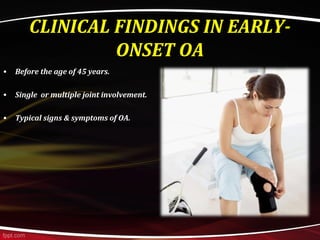
• Before the age of 45 years.
• Single or multiple joint involvement.
• Typical signs & symptoms of OA.
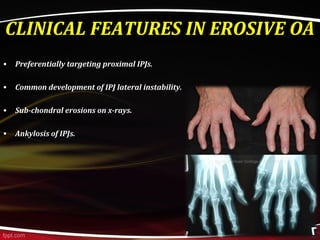
CLINICAL FEATURES IN EROSIVE OA
• Preferentially targeting proximal IPJs.
• Common development of IPJ lateral instability.
• Sub-chondral erosions on x-rays.
• Ankylosis of IPJs.
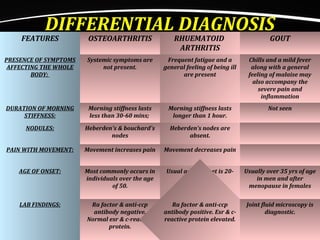
DIFFERENTIAL DIAGNOSIS
FEATURES OSTEOARTHRITIS RHUEMATOID
ARTHRITIS
GOUT
PRESENCE OF SYMPTOMS
AFFECTING THE WHOLE
BODY:
Systemic symptoms are
not present.
Frequent fatigue and a
general feeling of being ill
are present
Chills and a mild fever
along with a general
feeling of malaise may
also accompany the
severe pain and
inflammation
DURATION OF MORNING
STIFFNESS:
Morning stiffness lasts
less than 30-60 mins;
Morning stiffness lasts
longer than 1 hour.
Not seen
NODULES: Heberden's & bouchard's
nodes
Heberden’s nodes are
absent.
PAIN WITH MOVEMENT: Movement increases pain Movement decreases pain
AGE OF ONSET: Most commonly occurs in
individuals over the age
of 50.
Usual age of onset is 20-
40 years.
Usually over 35 yrs of age
in men and after
menopause in females
LAB FINDINGS: Ra factor & anti-ccp
antibody negative.
Normal esr & c-reactive
protein.
Ra factor & anti-ccp
antibody positive. Esr & c-
reactive protein elevated.
Joint fluid microscopy is
diagnostic.
INVESTIGATIONS
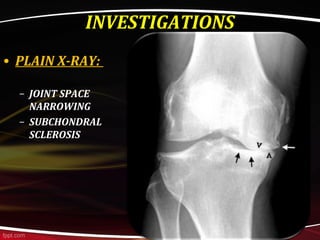
• PLAIN X-RAY:
– JOINT SPACE
NARROWING
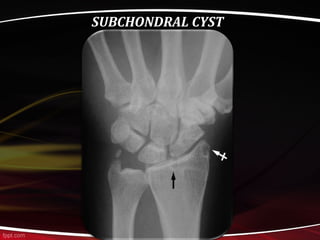
– SUBCHONDRAL
SCLEROSIS
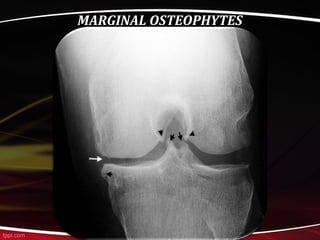
MARGINAL OSTEOPHYTES
SUBCHONDRAL CYST
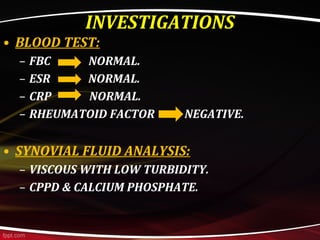
• BLOOD TEST:
– FBC NORMAL.
– ESR NORMAL.
– CRP NORMAL.
– RHEUMATOID FACTOR NEGATIVE.
• SYNOVIAL FLUID ANALYSIS:
– VISCOUS WITH LOW TURBIDITY.
– CPPD & CALCIUM PHOSPHATE.
INVESTIGATIONS
MANAGEMENT
NON-PHARMACOTHERAPY
– Full explanation of the condition via patient education:
• Properly position and support your neck and back while sitting or sleeping.
• Adjust furniture, such as raising a chair or toilet seat.
• Avoid repeated motions of the joint, especially frequent bending.
• Lose weight if you are overweight or obese,
which can reduce pain and slow progression
of OA.
• Exercise each day.
• Build confidence.
NON-PHARMACOTHERAPY
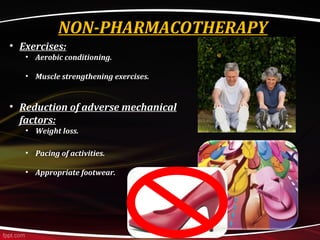
• Exercises:
• Aerobic conditioning.
• Muscle strengthening exercises.
• Reduction of adverse mechanical
factors:
• Weight loss.
• Pacing of activities.
• Appropriate footwear.
PHARMACOTHERAPY
PARACETAMOL
•Initial drug of choice
•Orally 1 gm 6-8 hourly
NSAIDs
•Indicated as needed.
•Oral e.g: ibuprofen & coxibs
•Topically e.g: capsaicin
0.025% cream
WEAK OPIOIDS
•Occasionally required.
•e.g: dihydrocodeine
INTRA-ARTICULAR
CORTICOSTEROIDS
INJECTIONS
•3-5 weekly.
HYALURONIC INJECTIONSHYALURONIC INJECTIONS
•Injections for 3-5 weeks.Injections for 3-5 weeks.
•Pain relief for several months.
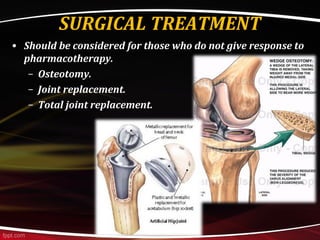
SURGICAL TREATMENT
• Should be considered for those who do not give response to
pharmacotherapy.
– Osteotomy.
– Joint replacement.
– Total joint replacement.
Osteoarthritis
Osteoarthritis

Osteoarthritis

  • 2.
  • 3.
    ROAD MAP • PROTECTIVEMECHANISM OF SYNOVIAL JOINTS • WHAT IS OA • EPIDEMIOLOGY • DISTRIBUTION OF DISEASE. • AETIOLOGY & RISK FACTORS • PATHOGENESIS • CLINICAL FEATURES • DIFFERENTIAL DIAGNOSIS • INVESTIGATIONS • MANAGEMENT
  • 4.
  • 5.
    WHAT IS OSTEOARTHRITIS??? Osteoarthritis is a degenerative disease of synovial joints characterized by focal loss of articular hyaline cartilage with proliferation of new bone & remodeling of joint contour.
  • 6.
    EPIDEMIOLOGY • Weight bearingjoints e.g. knee & hip joints. • Age > 65 years. – 80% have radiographic features. – 25-30% have symptoms. • More common in women. • Familial tendency.
  • 7.
  • 8.
    ETIOLOGY • PRIMARY /IDIOPATHIC: When there is no obvious predisposing factor. Common form of OA. • SECONDARY: When degenerative joint changes occur in response to a recognizable local or systemic factor.
  • 9.
    CAUSES OF SECONDARYOSTEOARTHRITIS
  • 10.
  • 11.
    PATHOGENESIS • Progressive destruction& loss of articular cartilage with an accompanying peri-articular bone response leads to exposure of sub-chondral bone which becomes sclerotic, with increased blood vascularity & cyst formation.
  • 12.
    CLINICAL FEATURES • Pain: –Activity & weight-bearing related, relieved by rest. – Variable over time. – Only one or few joints involved. • Morning stiffness only brief <30 minutes. • Restricted functionality: – Capsular thickening. – Blocking by osteophytes.
  • 13.
    CLINICAL FINDINGS INNODAL GENERALIZED OA • Presentation typically in women. (40 & 50 years) • Pain. • Stiffness. • Swelling of one or few finger interphalangeal joints ( distal > proximal). • Heberden’s nodes (+/- Bouchard’s nodes). • Involvement of first carpometacarpal joint is common. • Predisposition to OA at other joints specially knees.
  • 14.
    CLINICAL FINDINGS INKNEE OA • Targets patello-femoral & medial tibio-femoral compartments of knee. • Pain is localized to anterior or medial aspect of knee & upper tibia. • Jerky gait. • Varus deformity. • Joint line &/or periarticular tenderness. • Weakness & wasting of quadriceps muscle. • Restricted extension & flexion. • Bony swelling around joint.
  • 15.
    CLINICAL FINDINGS INHIP OA • Targets mostly superior aspect & less commonly medial aspect of joint. • Pain is maximally deep in groin area. • Antalgic gait. • Weakness & wasting of muscles (quadriceps & gluteal). • Pain & restricted internal rotation with flexion.
  • 16.
    CLINICAL FINDINGS INEARLY- ONSET OA • Before the age of 45 years. • Single or multiple joint involvement. • Typical signs & symptoms of OA.
  • 17.
    CLINICAL FEATURES INEROSIVE OA • Preferentially targeting proximal IPJs. • Common development of IPJ lateral instability. • Sub-chondral erosions on x-rays. • Ankylosis of IPJs.
  • 18.
    DIFFERENTIAL DIAGNOSIS FEATURES OSTEOARTHRITISRHUEMATOID ARTHRITIS GOUT PRESENCE OF SYMPTOMS AFFECTING THE WHOLE BODY: Systemic symptoms are not present. Frequent fatigue and a general feeling of being ill are present Chills and a mild fever along with a general feeling of malaise may also accompany the severe pain and inflammation DURATION OF MORNING STIFFNESS: Morning stiffness lasts less than 30-60 mins; Morning stiffness lasts longer than 1 hour. Not seen NODULES: Heberden's & bouchard's nodes Heberden’s nodes are absent. PAIN WITH MOVEMENT: Movement increases pain Movement decreases pain AGE OF ONSET: Most commonly occurs in individuals over the age of 50. Usual age of onset is 20- 40 years. Usually over 35 yrs of age in men and after menopause in females LAB FINDINGS: Ra factor & anti-ccp antibody negative. Normal esr & c-reactive protein. Ra factor & anti-ccp antibody positive. Esr & c- reactive protein elevated. Joint fluid microscopy is diagnostic.
  • 19.
    INVESTIGATIONS • PLAIN X-RAY: –JOINT SPACE NARROWING – SUBCHONDRAL SCLEROSIS
  • 20.
  • 21.
  • 22.
    • BLOOD TEST: –FBC NORMAL. – ESR NORMAL. – CRP NORMAL. – RHEUMATOID FACTOR NEGATIVE. • SYNOVIAL FLUID ANALYSIS: – VISCOUS WITH LOW TURBIDITY. – CPPD & CALCIUM PHOSPHATE. INVESTIGATIONS
  • 23.
  • 24.
    NON-PHARMACOTHERAPY – Full explanationof the condition via patient education: • Properly position and support your neck and back while sitting or sleeping. • Adjust furniture, such as raising a chair or toilet seat. • Avoid repeated motions of the joint, especially frequent bending. • Lose weight if you are overweight or obese, which can reduce pain and slow progression of OA. • Exercise each day. • Build confidence.
  • 25.
    NON-PHARMACOTHERAPY • Exercises: • Aerobicconditioning. • Muscle strengthening exercises. • Reduction of adverse mechanical factors: • Weight loss. • Pacing of activities. • Appropriate footwear.
  • 26.
    PHARMACOTHERAPY PARACETAMOL •Initial drug ofchoice •Orally 1 gm 6-8 hourly NSAIDs •Indicated as needed. •Oral e.g: ibuprofen & coxibs •Topically e.g: capsaicin 0.025% cream WEAK OPIOIDS •Occasionally required. •e.g: dihydrocodeine INTRA-ARTICULAR CORTICOSTEROIDS INJECTIONS •3-5 weekly. HYALURONIC INJECTIONSHYALURONIC INJECTIONS •Injections for 3-5 weeks.Injections for 3-5 weeks. •Pain relief for several months.
  • 27.
    SURGICAL TREATMENT • Shouldbe considered for those who do not give response to pharmacotherapy. – Osteotomy. – Joint replacement. – Total joint replacement.