27-Jul-13 Dr.PR Khuman,MPT(Ortho & Sport) 2
History
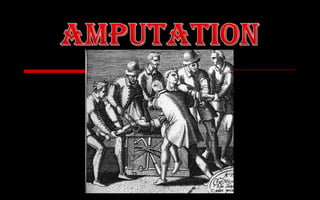
 Amputatio – Latin noun from verb Amputare
 Amputare– to cut off or cut away, derived from
 Amb, about and
 Putare, to prune or to lop
 The verb “Amputare” was employed to cutting
off the hands of criminals.
27-Jul-13 Dr.PR Khuman,MPT(Ortho & Sport) 3
History cont…
 Early 15th centurThe Cyrurgie of Guy de Chauliac
has a paragraph headed “The rewle in kyttyng of a
dede membre” (The rule in cutting off of a dead member)
 Ambroise Pare,1564, Father of French surgery,
Improved ligation of larger vessels during surgery,
gangrene
 Lowe, 1612, English, extirpation
27-Jul-13 Dr.PR Khuman,MPT(Ortho & Sport) 4
History cont…
 Woodall, 1617, Dismembering or Amputation
 Woodall, 1639, Employed both amputation &
dismembering, the former as often.
 Dionis, 1750, suggested employing the
Greek word Acrotiriasmos – cutting off the
extremities of the body.
 17th century British authors Cooke &
Wiseman employed “Amputation”
27-Jul-13 Dr.PR Khuman,MPT(Ortho & Sport) 5
Definition
 Amputation is the removal of limb, part or
total from the body.
 Disarticulation is removing the limb through
a joint.
 Generally the amputation of Lower Limb are
more common than those of upper limb.
27-Jul-13 Dr.PR Khuman,MPT(Ortho & Sport) 6
Incidence
 Age –
 Common in 50 – 70 year
 Gender –
 Male – 75%
 Female – 25%
 Limbs –
 Lower limbs 85%
 Upper limbs – 15%
27-Jul-13 Dr.PR Khuman,MPT(Ortho & Sport) 7
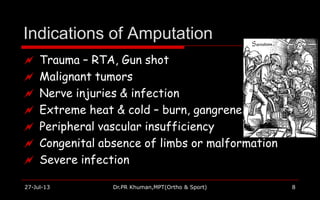
Indications of Amputation
 Trauma – RTA, Gun shot
 Malignant tumors
 Nerve injuries & infection
 Extreme heat & cold – burn, gangrene
 Peripheral vascular insufficiency
 Congenital absence of limbs or malformation
 Severe infection
27-Jul-13 Dr.PR Khuman,MPT(Ortho & Sport) 8
Causes of Amputation
 Natural causes
 Accidental causes
 Ritual, Punitive & Legal Amputations
 Cold steel & Gunshot causes
27-Jul-13 Dr.PR Khuman,MPT(Ortho & Sport) 9
Natural causes of limb loss
 Congenital absence
 Arterial disease
 Frostbite
 Ergot and other toxins
 Wound infections
 Diabetes mellitus
 Dietary deficiencies
 Tumors
27-Jul-13 Dr.PR Khuman,MPT(Ortho & Sport) 10
Accidents causes
 Falls when running or from heights
 Crushing by trees
 Savaging by crocodiles and sharks
 Effects of earthquakes, tsunamis and
Violent storms
27-Jul-13 Dr.PR Khuman,MPT(Ortho & Sport) 11
Ritual, Punitive & Legal Amputations
 Curing local pain
 In removing deformity
 Infection or gangrene
 In saving lives
27-Jul-13 Dr.PR Khuman,MPT(Ortho & Sport) 12
Cold steel & Gunshot causes
 Iron & steel weapons evolved fingers & hands
 Destructive gunshot wounding, associated with
mortal sepsis
 Boiling oil
27-Jul-13 Dr.PR Khuman,MPT(Ortho & Sport) 13
27-Jul-13 Dr.PR Khuman,MPT(Ortho & Sport) 14
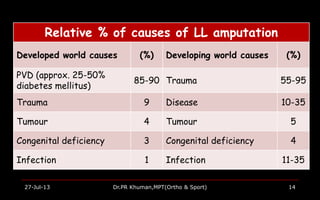
Relative % of causes of LL amputation
Developed world causes (%) Developing world causes (%)
PVD (approx. 25-50%
diabetes mellitus)
85-90 Trauma 55-95
Trauma 9 Disease 10-35
Tumour 4 Tumour 5
Congenital deficiency 3 Congenital deficiency 4
Infection 1 Infection 11-35
27-Jul-13 Dr.PR Khuman,MPT(Ortho & Sport) 15
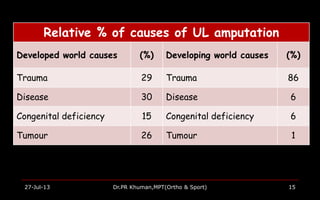
Relative % of causes of UL amputation
Developed world causes (%) Developing world causes (%)
Trauma 29 Trauma 86
Disease 30 Disease 6
Congenital deficiency 15 Congenital deficiency 6
Tumour 26 Tumour 1
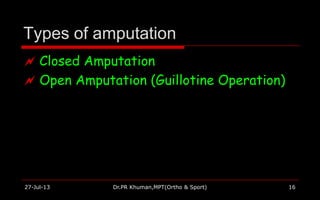
Types of amputation
 Closed Amputation
 Open Amputation (Guillotine Operation)
27-Jul-13 Dr.PR Khuman,MPT(Ortho & Sport) 16
Closed Amputation
 It is done as an elective procedure.
 After amputations, the soft tissues are
closed primarily over the bony stump.
 E.g., above knee, below knee etc.
27-Jul-13 Dr.PR Khuman,MPT(Ortho & Sport) 17
Open Amputation (Guillotine Operation)
 It is done as an emergency procedure.
 E.g. life threatening infections
 After amputations, the wound is left
open & not closed.
 2 types depending upon the skin flaps:
 Open amputation with inverted skin flap
 Circular open amputation
27-Jul-13 Dr.PR Khuman,MPT(Ortho & Sport) 18
Principles of Close Amputation
 Tourniquets: desirable except in ischemic
limbs.
 Level of amputation: it is very important to
fit the prosthesis.
 Skin flaps: good skin coverage is important.
Skin should be mobile & sensitive.
 Muscle: is divided at least 5cm distal to the
level of intended bone section & sutured.
27-Jul-13 Dr.PR Khuman,MPT(Ortho & Sport) 19
Principles of Close Amputation cont…
 Methods of Muscle Suture
 Myodesis – muscle is suture to bone
 Myoplasty – muscle is sutured to opposite
muscle group under appropriate tension.
27-Jul-13 Dr.PR Khuman,MPT(Ortho & Sport) 20
Principles of Close Amputation cont…
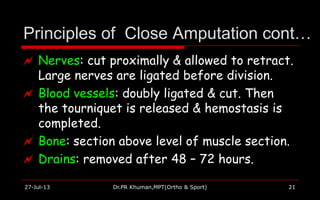
 Nerves: cut proximally & allowed to retract.
Large nerves are ligated before division.
 Blood vessels: doubly ligated & cut. Then
the tourniquet is released & hemostasis is
completed.
 Bone: section above level of muscle section.
 Drains: removed after 48 – 72 hours.
27-Jul-13 Dr.PR Khuman,MPT(Ortho & Sport) 21
Principles of Close Amputation cont…
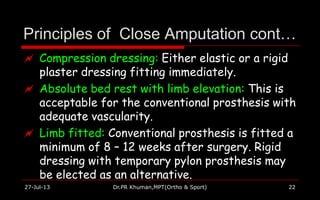
 Compression dressing: Either elastic or a rigid
plaster dressing fitting immediately.
 Absolute bed rest with limb elevation: This is
acceptable for the conventional prosthesis with
adequate vascularity.
 Limb fitted: Conventional prosthesis is fitted a
minimum of 8 – 12 weeks after surgery. Rigid
dressing with temporary pylon prosthesis may
be elected as an alternative.
27-Jul-13 Dr.PR Khuman,MPT(Ortho & Sport) 22
Principle of open amputation
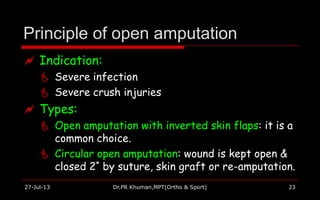
 Indication:
 Severe infection
 Severe crush injuries
 Types:
 Open amputation with inverted skin flaps: it is a
common choice.
 Circular open amputation: wound is kept open &
closed 2* by suture, skin graft or re-amputation.
27-Jul-13 Dr.PR Khuman,MPT(Ortho & Sport) 23
Principle of open amputation cont…
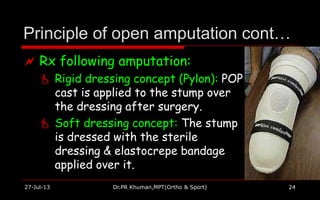
 Rx following amputation:
 Rigid dressing concept (Pylon): POP
cast is applied to the stump over
the dressing after surgery.
 Soft dressing concept: The stump
is dressed with the sterile
dressing & elastocrepe bandage
applied over it.
27-Jul-13 Dr.PR Khuman,MPT(Ortho & Sport) 24
Complication of amputation
 Haematomas
 Infections
 Necrosis
 Contractures
 Neuromas
 Stump pain
 Phantom sensation
 Hyperesthesia of
stump
 Stump edema
 Bone overgrowth
 Causalgia
27-Jul-13 Dr.PR Khuman,MPT(Ortho & Sport) 25
Amputation - Complications
 Phantom Limbs –
 Some amputees experience the phenomenon of
Phantom Limbs; they feel body parts that are no
longer there.
 Limbs can itch, ache, & feel as if they are moving.
 Scientists believe it has to do with neural map
that sends information to the brain about limbs
regardless of their existence.
27-Jul-13 Dr.PR Khuman,MPT(Ortho & Sport) 26
Amputation – Complications cont…
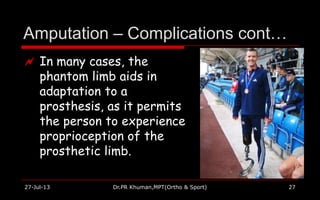
 In many cases, the
phantom limb aids in
adaptation to a
prosthesis, as it permits
the person to experience
proprioception of the
prosthetic limb.
27-Jul-13 Dr.PR Khuman,MPT(Ortho & Sport) 27
Amputation – Complications cont…
 Painful adhesive scar formation
 An adherent painful scar over the surgical
incision poses a problem in process of rehab.
 It may obstacle in fitting prosthesis.
 Early mobilization of the painful scar is
recommended with other therapeutic
modalities.
27-Jul-13 Dr.PR Khuman,MPT(Ortho & Sport) 28
Amputation – Complications cont…
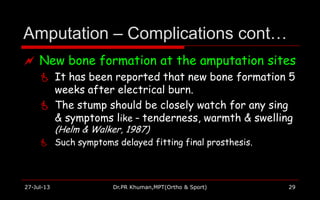
 New bone formation at the amputation sites
 It has been reported that new bone formation 5
weeks after electrical burn.
 The stump should be closely watch for any sing
& symptoms like – tenderness, warmth & swelling
(Helm & Walker, 1987)
 Such symptoms delayed fitting final prosthesis.
27-Jul-13 Dr.PR Khuman,MPT(Ortho & Sport) 29
Amputation – Complications cont…
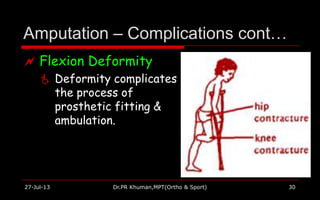
 Flexion Deformity
 Deformity complicates
the process of
prosthetic fitting &
ambulation.
27-Jul-13 Dr.PR Khuman,MPT(Ortho & Sport) 30
Amputation – Complications cont…
 Hyperesthesia of the stump:
 This is another annoying symptom that is
difficult to control.
 Re-amputation results only in reproducing
the symptom at a higher level.
27-Jul-13 Dr.PR Khuman,MPT(Ortho & Sport) 31
Reasons for amputation
 Circulatory disorders
 Diabetic foot infection or gangrene (the
most common reason for non-traumatic
amputation)
 Sepsis with peripheral necrosis
27-Jul-13 Dr.PR Khuman,MPT(Ortho & Sport) 32
Reasons for amputation cont…
 Neoplasm
 Cancerous bone or soft tissue tumors
 e.g. osteosarcoma, osteochondroma,
fibrosarcoma, epithelioid sarcoma, ewing's
sarcoma, synovial sarcoma, sacrococcygeal
teratoma
 Melanoma
27-Jul-13 Dr.PR Khuman,MPT(Ortho & Sport) 33
Reasons for amputation cont…
 Trauma
 Severe limb injuries in which the limb cannot be
spared or attempts to spare the limb have
failed
 Traumatic amputation (Amputation occurs
usually at scene of accident, where the limb is
partially or wholly severed).
 Amputation in utero (Amniotic band)
27-Jul-13 Dr.PR Khuman,MPT(Ortho & Sport) 34
Reasons for amputation cont…
 Infection
 Bone infection (osteomyelitis)
27-Jul-13 Dr.PR Khuman,MPT(Ortho & Sport) 35
Reasons for amputation cont…
 As a punishment in Islam
 According to Islamic Sharia Law, the
punishment for stealing is the amputation of
the hand & after repeated offense, the foot
(Quran 5:38)
 This controversial practice is still in
practice today in countries like Iran, Saudi
Arabia & Northern Nigeria.
27-Jul-13 Dr.PR Khuman,MPT(Ortho & Sport) 36
Reasons for amputation cont…
 Other
 Sometimes professional athletes may choose to
have digit amputated to relieve chronic pain &
impaired performance.
 Australian footballer Daniel Chick elected to
have his left ring finger amputated as chronic
pain & injury was limiting his performance.
 Rugby player Jone Tawake also had a finger
removed.
27-Jul-13 Dr.PR Khuman,MPT(Ortho & Sport) 37
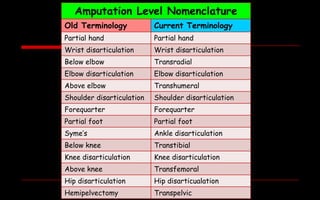
Amputation Level Nomenclature
Old Terminology Current Terminology
Partial hand Partial hand
Wrist disarticulation Wrist disarticulation
Below elbow Transradial
Elbow disarticulation Elbow disarticulation
Above elbow Transhumeral
Shoulder disarticulation Shoulder disarticulation
Forequarter Forequarter
Partial foot Partial foot
Syme’s Ankle disarticulation
Below knee Transtibial
Knee disarticulation Knee disarticulation
Above knee Transfemoral
Hip disarticulation Hip disarticualation
Hemipelvectomy Transpelvic
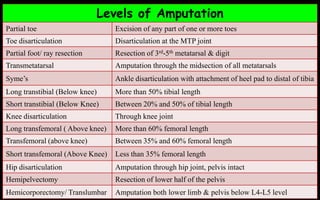
Levels of Amputation
Partial toe Excision of any part of one or more toes
Toe disarticulation Disarticulation at the MTP joint
Partial foot/ ray resection Resection of 3rd-5th metatarsal & digit
Transmetatarsal Amputation through the midsection of all metatarsals
Syme’s Ankle disarticulation with attachment of heel pad to distal of tibia
Long transtibial (Below knee) More than 50% tibial length
Short transtibial (Below Knee) Between 20% and 50% of tibial length
Knee disarticulation Through knee joint
Long transfemoral ( Above knee) More than 60% femoral length
Transfemoral (above knee) Between 35% and 60% femoral length
Short transfemoral (Above Knee) Less than 35% femoral length
Hip disarticulation Amputation through hip joint, pelvis intact
Hemipelvectomy Resection of lower half of the pelvis
Hemicorporectomy/ Translumbar Amputation both lower limb & pelvis below L4-L5 level
27-Jul-13 Dr.PR Khuman,MPT(Ortho & Sport) 40
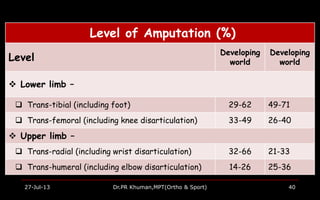
Level of Amputation (%)
Level
Developing
world
Developing
world
 Lower limb –
 Trans-tibial (including foot) 29-62 49-71
 Trans-femoral (including knee disarticulation) 33-49 26-40
 Upper limb –
 Trans-radial (including wrist disarticulation) 32-66 21-33
 Trans-humeral (including elbow disarticulation) 14-26 25-36
Principle consideration to amputate
 Preservation of life
 Improvement of general health
 Restoration of function
 Reduction of pain
27-Jul-13 Dr.PR Khuman,MPT(Ortho & Sport) 41
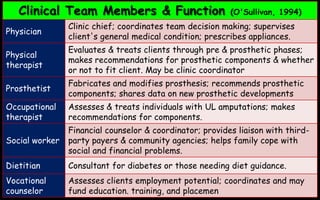
Clinical Team Members & Function (O'Sullivan, 1994)
Physician
Clinic chief; coordinates team decision making; supervises
client's general medical condition; prescribes appliances.
Physical
therapist
Evaluates & treats clients through pre & prosthetic phases;
makes recommendations for prosthetic components & whether
or not to fit client. May be clinic coordinator
Prosthetist
Fabricates and modifies prosthesis; recommends prosthetic
components; shares data on new prosthetic developments
Occupational
therapist
Assesses & treats individuals with UL amputations; makes
recommendations for components.
Social worker
Financial counselor & coordinator; provides liaison with third-
party payers & community agencies; helps family cope with
social and financial problems.
Dietitian Consultant for diabetes or those needing diet guidance.
Vocational
counselor
Assesses clients employment potential; coordinates and may
fund education. training, and placemen
Rehabilitation of LL Amputation
 Pre operative period
 Post operative period
 Pre-prosthetic stage
 Prosthetic stage
27-Jul-13 Dr.PR Khuman,MPT(Ortho & Sport) 43
Pre - Operative period
27-Jul-13 Dr.PR Khuman,MPT(Ortho & Sport) 44
Pre Operative period
 Assessment
 Physical
 Social
 Psychological
 Training
 Re-assurance
27-Jul-13 Dr.PR Khuman,MPT(Ortho & Sport) 45
Pre Operative Assessment
 Assessment of –
 The affected limb
 The unaffected limb &
 The patient as a whole is conducted thoroughly.
 Assessment of physical, social &
psychological status of the patient should
be made.
27-Jul-13 Dr.PR Khuman,MPT(Ortho & Sport) 46
Physical Assessment
 Muscle strength of UL, trunk & LL apart from
the affected limb before level of amputation.
 Joint mobility, particularly proximal to the
amputation level.
 Respiratory function
 Balance reaction in sitting & standing
 Functional ability
 Vision & hearing status
27-Jul-13 Dr.PR Khuman,MPT(Ortho & Sport) 47
Social assessment includes
 Family & friends supports
 Living accommodation –
 Stairs, ramps, rails, width of door, wheelchair
accessibility
 Proximity of shops
27-Jul-13 Dr.PR Khuman,MPT(Ortho & Sport) 48
Psychological Assessment
 Patients psychological approach to amputation.
 Motivation to walk.
 Other psychological problems.
27-Jul-13 Dr.PR Khuman,MPT(Ortho & Sport) 49
Pre Operative Training
27-Jul-13 Dr.PR Khuman,MPT(Ortho & Sport) 50
Basic aims
 To prevent post operative complication
 To reduce the cost of rehabilitation
 To reduce the period of rehabilitation
27-Jul-13 Dr.PR Khuman,MPT(Ortho & Sport) 51
Training program includes
 To prevention of thrombosis:
 Maintaining circulation through movt of the
other good limb.
 To prevent the chest complication:
 Deep breathing, coughing & postural drainage
 To relieve pressure:
 Pressure mobility of all the joints
 More emphasis is given to susceptible joints.
27-Jul-13 Dr.PR Khuman,MPT(Ortho & Sport) 52
Training program cont…
 To improve mobility:
 Mobility ex for trunk, pelvic or shoulder girdle
 Mobility ex to compensate for the deficiencies
& restriction due to prosthesis.
 Teach the technique to be adapted for mobility
& limb positioning in bed.
27-Jul-13 Dr.PR Khuman,MPT(Ortho & Sport) 53
Training program cont…
 To educate the patient:
 Educate the techniques of transfers, monitoring
wheelchair, single limb standing & balancing.
 Explain important aspect of balance, equilibrium,
standing & walking techniques.
 Educate to detect the possible complications
like – soft tissue tightness, pressure point,
expected degree of pain & phantom pain.
27-Jul-13 Dr.PR Khuman,MPT(Ortho & Sport) 54
Reassurance
 Psychological reassurance play an important
roll in recovery
 Reassurance with all possible encouragement
 Practical demonstration by who has
undergone similar surgery.
27-Jul-13 Dr.PR Khuman,MPT(Ortho & Sport) 55
Post Operative Period
(pre prosthetic stage)
27-Jul-13 Dr.PR Khuman,MPT(Ortho & Sport) 56
Aims of Rx
 To prevent post operative complication
 To prevent deformities
 To control stump edema
 To maintain strength of whole body & increase strength of
muscle controlling the stump
 To maintain general mobility
 To improve balance & transfer
 To re-educate walking
 To restore functional independence
 To treat phantom pain
27-Jul-13 Dr.PR Khuman,MPT(Ortho & Sport) 57
Prevention of post operative complication
 Breathing ex to prevent respiratory
complications.
 Brisk ankle & foot ex for unaffected leg to
prevent circulatory complications.
 This exs are given form 1st day onward until
patient ambulate.
27-Jul-13 Dr.PR Khuman,MPT(Ortho & Sport) 58
Prevention of deformities
 Positioning in bed:
 Stump should be parallel to the unaffected leg
without resting on pillow.
 Patient should lie as flat as possible & progress
to prone lying when drains are out.
 Pt with cardiac & respiratory problems may
discomfort in prone lying, brought to supine.
 Prolong sitting on soft mattress can predispose
to development of hip flexion deformity.
27-Jul-13 Dr.PR Khuman,MPT(Ortho & Sport) 59
Prevention of deformities cont…
 Exercise to counteract the deformity:
 Strong isometric quadriceps ex – BKA
 Hip extensor & add isometric ex – high AKA
 Hip extensor & abd isometric ex – low AKA
 Progression is made to free active & resisted stump
ex.
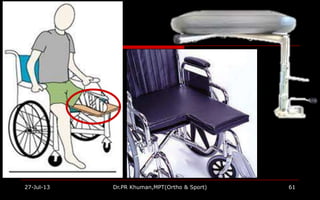
 Stump board – in BKA – stump should be rest on
board when sitting in wheelchair.
 Prolong sitting with knee flex should be avoided.
27-Jul-13 Dr.PR Khuman,MPT(Ortho & Sport) 60
27-Jul-13 Dr.PR Khuman,MPT(Ortho & Sport) 61
To control the stump edema
 Control environment treatment (CET):
 Here, the dressing free stump place over a clear
& sealed plastic sleeve which is attached to a
pressure cycle machine blowing sterile warmed
air over the wound.
 The temp, pressure & humidity are set with
ideal environment for healing of stump.
27-Jul-13 Dr.PR Khuman,MPT(Ortho & Sport) 62
To control the stump edema cont…
 Pressure environment treatment (PET):
 This is simpler version of CET
 Here, the air is not sterilized, no temp control &
limited pressure control.
27-Jul-13 Dr.PR Khuman,MPT(Ortho & Sport) 63
To control the stump edema cont…
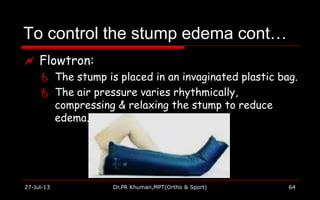
 Flowtron:
 The stump is placed in an invaginated plastic bag.
 The air pressure varies rhythmically,
compressing & relaxing the stump to reduce
edema.
27-Jul-13 Dr.PR Khuman,MPT(Ortho & Sport) 64
To control the stump edema cont…
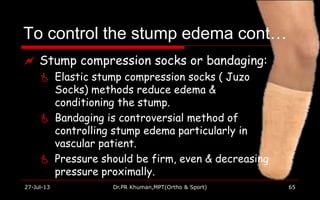
 Stump compression socks or bandaging:
 Elastic stump compression socks ( Juzo
Socks) methods reduce edema &
conditioning the stump.
 Bandaging is controversial method of
controlling stump edema particularly in
vascular patient.
 Pressure should be firm, even & decreasing
pressure proximally.
27-Jul-13 Dr.PR Khuman,MPT(Ortho & Sport) 65
To control the stump edema cont…
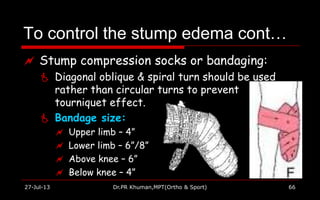
 Stump compression socks or bandaging:
 Diagonal oblique & spiral turn should be used
rather than circular turns to prevent
tourniquet effect.
 Bandage size:
 Upper limb – 4”
 Lower limb – 6”/8”
 Above knee – 6”
 Below knee – 4”
27-Jul-13 Dr.PR Khuman,MPT(Ortho & Sport) 66
Stump compression socks or bandaging:
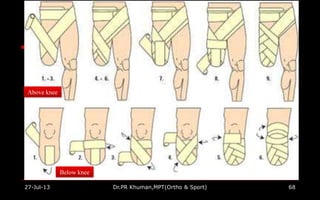
 Above knee (AK) bandaging:
 It should extend up to groin to prevent follicle
infection due to friction with socket of
prosthesis.
 It should bandage with hip in extension &
adduction.
 Below knee (BK) bandaging:
 Stump should bandage with knee in slight flexion.
27-Jul-13 Dr.PR Khuman,MPT(Ortho & Sport) 67
27-Jul-13 Dr.PR Khuman,MPT(Ortho & Sport) 68
Above knee
Below knee
Maintain body strength & strengthen
muscle controlling stump
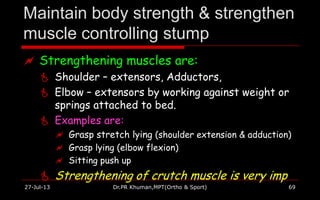
 Strengthening muscles are:
 Shoulder – extensors, Adductors,
 Elbow – extensors by working against weight or
springs attached to bed.
 Examples are:
 Grasp stretch lying (shoulder extension & adduction)
 Grasp lying (elbow flexion)
 Sitting push up
 Strengthening of crutch muscle is very imp
27-Jul-13 Dr.PR Khuman,MPT(Ortho & Sport) 69
Exercise for unaffected side
 Lying:
 Static quadriceps
 Static gluteal
 Straight leg raising (SLR)
 Alternate hip & knee bending & stretching
27-Jul-13 Dr.PR Khuman,MPT(Ortho & Sport) 70
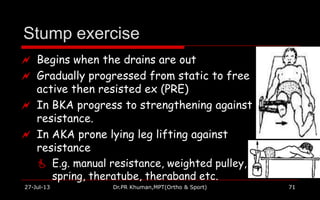
Stump exercise
 Begins when the drains are out
 Gradually progressed from static to free
active then resisted ex (PRE)
 In BKA progress to strengthening against
resistance.
 In AKA prone lying leg lifting against
resistance
 E.g. manual resistance, weighted pulley,
spring, theratube, theraband etc.
27-Jul-13 Dr.PR Khuman,MPT(Ortho & Sport) 71
Maintain good mobility
 Exercise which moves the shoulder in all
direction will maintain shoulder mobility
 Trunk movts in lying & sitting will improve
trunk mobility
27-Jul-13 Dr.PR Khuman,MPT(Ortho & Sport) 72
Improve balance & transfers
 Balance training
 In sitting position by encouraging balance
reaction, tapping, perturbation & trunk
stabilization
 Training of transfer techniques
 Wheelchair to bed
 Bed to wheelchair
 Wheelchair to toilet etc
27-Jul-13 Dr.PR Khuman,MPT(Ortho & Sport) 73
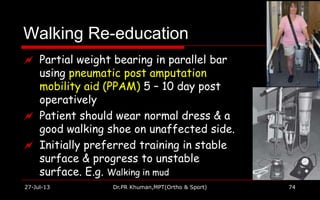
Walking Re-education
 Partial weight bearing in parallel bar
using pneumatic post amputation
mobility aid (PPAM) 5 – 10 day post
operatively
 Patient should wear normal dress & a
good walking shoe on unaffected side.
 Initially preferred training in stable
surface & progress to unstable
surface. E.g. Walking in mud
27-Jul-13 Dr.PR Khuman,MPT(Ortho & Sport) 74
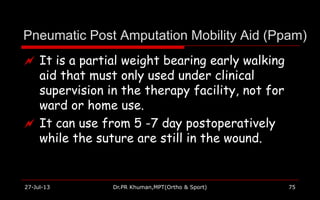
Pneumatic Post Amputation Mobility Aid (Ppam)
 It is a partial weight bearing early walking
aid that must only used under clinical
supervision in the therapy facility, not for
ward or home use.
 It can use from 5 -7 day postoperatively
while the suture are still in the wound.
27-Jul-13 Dr.PR Khuman,MPT(Ortho & Sport) 75
Ppam Aid Advantages
 Great psychological boost gained by walking soon
after amputation.
 Reduction of oedema by pressure in bag.
 Postural reaction are re-educated by encouraging
partial weight bearing.
 Preparation of the residual limb for hard socket of
a prosthesis.
 This may help in reducing phantom sensation.
27-Jul-13 Dr.PR Khuman,MPT(Ortho & Sport) 76
Ppam Aid Disadvantages
 If a fixed flexion contracture is present, the
residual limb is more liable to break down.
 If the amputee is very heavy or heavy footed gait,
excessive pistoning may occur & there will be
insufficient support.
 Amputees used a stiff knee gait pattern, which is
unnatural for those with the trans-tibial level.
 The inflation pressure may greater than the
arterial pressure in the residual limb.
27-Jul-13 Dr.PR Khuman,MPT(Ortho & Sport) 77
Walking without a prosthesis
 Using firm compression socks or bandage the
gait training can be done in parallel bar
 Progress to – a frame or crutch depending on
stability.
 Crutch user found less adaptation time to use a
prosthesis
 Normal alignment of pelvis & reciprocal movt of
stump should maintain.
27-Jul-13 Dr.PR Khuman,MPT(Ortho & Sport) 78
Principle of Bandaging of Stump
 Pressure of bandage should be
 Moderately firm
 Evenly distributed
 Decreasing proximally
 Extra pressure over the corners – conical shape
 Pattern of bandage:
 Diagonal, oblique or spiral
 Not circular
27-Jul-13 Dr.PR Khuman,MPT(Ortho & Sport) 79
27-Jul-13 Dr.PR Khuman,MPT(Ortho & Sport) 80
Main Aim at this Stage:
 To understand the components of prosthesis
 To independently fitting & removing of
prosthesis & checking its fit
 To care of prosthesis
 To independent mobility – with or without walker
 To enable functional task with prosthesis
 To enable occupational & leisure activities
 To enable to cope with falls
27-Jul-13 Dr.PR Khuman,MPT(Ortho & Sport) 81
Type of Prosthesis
 Temporary prosthesis
 It takes approx 2 week manufacture
 Quick & easy to manufacture
 Cheaper, lighter & relatively simple to apply
 Allow time for stump shrinkage to take place
 Final/ definitive prosthesis
 It takes 2 – 3 month to manufacture
 Measurement taken after shrinkage completed
27-Jul-13 Dr.PR Khuman,MPT(Ortho & Sport) 82
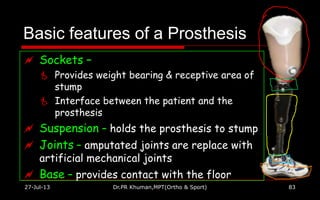
Basic features of a Prosthesis
 Sockets –
 Provides weight bearing & receptive area of
stump
 Interface between the patient and the
prosthesis
 Suspension – holds the prosthesis to stump
 Joints – amputated joints are replace with
artificial mechanical joints
 Base – provides contact with the floor
27-Jul-13 Dr.PR Khuman,MPT(Ortho & Sport) 83
Material used for prosthesis
 Metal –
 Steel & other alloys – for hip & knee mechanism
 Duraluminium – for the socket & outer shell
 Leather –
 Soft leather for straps
 Hardened leather for thigh corsets
 Plastics –
 Thermoplastic materials like polypropylene – for sockets
 Plastic foam – to support distal tissue of stump
 Wood –
 Preferred as a socket material & prosthetic feet in topical climate
27-Jul-13 Dr.PR Khuman,MPT(Ortho & Sport) 84
Factors To Be Consider Before
Prescribing Prosthesis
 Age
 General physique of the patient
 Mental conditions
 Length of the stump
 Status of stump circulation
 Level of amputation
 Strength, ROM & mobility related body segment
 Requirement of job & daily living
27-Jul-13 Dr.PR Khuman,MPT(Ortho & Sport) 85
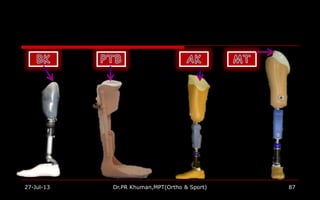
Prosthesis for Lower Limb Amputation
 Depending on the level of amputation
 Transmetatarsal
 Below knee
 Patella Tendon Bearing (PTB)
 Above knee – Below knee (AKBK)
 Mid thigh
27-Jul-13 Dr.PR Khuman,MPT(Ortho & Sport) 86
27-Jul-13 Dr.PR Khuman,MPT(Ortho & Sport) 87
Re-education with Prosthesis
 After satisfactory fitting of prosthesis the
process of training & re-education begins.
 It include the following:
 Correct methods of applying & removing of
prosthesis
 Early detection of any complication due to
prosthesis
 Functions of various component of prosthesis
 Limitation of activities with prosthetic limb
27-Jul-13 Dr.PR Khuman,MPT(Ortho & Sport) 88
Restore functional independence
 Taught to move up & down, side to side on
the bed by pressing on the sole of stump
 Sitting up form lying by pushing down with
the arm – begin when the drip are removed
 Good trunk rotation will make all reaching
function easier
27-Jul-13 Dr.PR Khuman,MPT(Ortho & Sport) 89
Restore functional independence cont…
 Functional training should start as soon as
patient is able
 The exercise program should consist of
 Resisted pulley work
 Mat exercise
 Slow reversal or repeated contraction
 The patient must be encourage to be as
independent as possible
27-Jul-13 Dr.PR Khuman,MPT(Ortho & Sport) 90
Treatment of Phantom Pain
 Pharmacological Rx
 Injection with steroid or local anesthetic has
reduced the pain temporarily
 Intrathecal or epidural anesthetic with opioids
used successfully
 Non invasive Rx
 Such as – US, Icing, Icing, TENS or massage
have been used
27-Jul-13 Dr.PR Khuman,MPT(Ortho & Sport) 91
Treatment of Phantom Pain cont…
 Other methods –
 Mild non narcotic analgesics,
 Biofeedback,
 Psychotherapy,
 Nerve block & dorsal rhyzotomies have been used
with inconsistent result.
27-Jul-13 Dr.PR Khuman,MPT(Ortho & Sport) 92
27-Jul-13 Dr.PR Khuman,MPT(Ortho & Sport) 93
COMMON ABNORMALITIES
INWALKING WITH A PROSTHESIS
 The common problems encountered in
walking with a prosthesis can also be
divided into
 Stance phase problem or
 Swing phase problem.
27-Jul-13 Dr.PR Khuman,MPT(Ortho & Sport) 94
Stance Phase Problems with a BK
Prosthesis
 Problems commonly encountered in the
stance phase of walking with a
prosthesis include
 “Buckling” of the knee,
 “Snapping back” of the knee,
 “Foot slapping,” and
 “Vaulting.”
27-Jul-13 Dr.PR Khuman,MPT(Ortho & Sport) 95
Reasons for knee buckling
 Weak quadriceps:
 Can’t straighten the knee when heel strikes the
ground. This can be corrected by a muscle
strengthening program.
 Pain from an ill-fitting socket:
 Changing the socket might solve this problem.
 A poorly-aligned prosthetic foot, or one with a
heel that is too hard: These also can be
corrected.
27-Jul-13 Dr.PR Khuman,MPT(Ortho & Sport) 96
Causes of snapping back
 Weak thigh muscles or poor alignment of the
socket and the foot.
 Fear of knee buckling is offset by keeping the
knee as straight as possible when heel strikes in
early stance phase.
 One way of keeping it straight is to “snap” the
knee back.
 Over time, this can cause pain & deformity in
knee.
27-Jul-13 Dr.PR Khuman,MPT(Ortho & Sport) 97
 The knee may snap backwards because of a soft
heel or a foot that points downward more than it
should.
 A good muscle strengthening program for the
thigh muscles is important to overcome this
problem.
 Additionally, your prosthetist can check the
socket to ensure that there is a good fit and
alignment.
27-Jul-13 Dr.PR Khuman,MPT(Ortho & Sport) 98
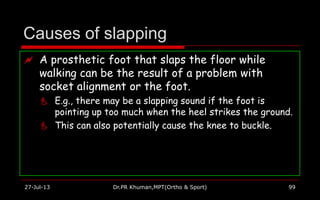
Causes of slapping
 A prosthetic foot that slaps the floor while
walking can be the result of a problem with
socket alignment or the foot.
 E.g., there may be a slapping sound if the foot is
pointing up too much when the heel strikes the ground.
 This can also potentially cause the knee to buckle.
27-Jul-13 Dr.PR Khuman,MPT(Ortho & Sport) 99
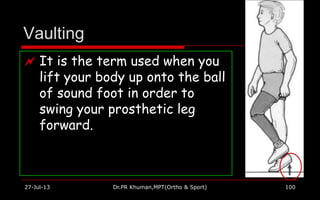
Vaulting
 It is the term used when you
lift your body up onto the ball
of sound foot in order to
swing your prosthetic leg
forward.
27-Jul-13 Dr.PR Khuman,MPT(Ortho & Sport) 100