Mechanical Properties of
Bone
Human knowledge and human power meet
in one; for where the cause is not known
the effect cannot be produced.
~ Sir Francis
Bacon
BIOE 3200 - Fall 2014
Nova special, “Making Stuff Stronger”:
https://www.youtube.com/watch?v=KE-
Y45WjiP0&list=PL9OMJke2jE_CuZgiOUJ0frfw3TRLKQByw&index=1
Learning Objectives
 Conduct stress analysis on bone
sample
◦ Identify the source of anisotropic material
properties
◦ Analyze how changes in bone
composition affect stress and strain within
bone
BIOE 3200 - Fall 2014
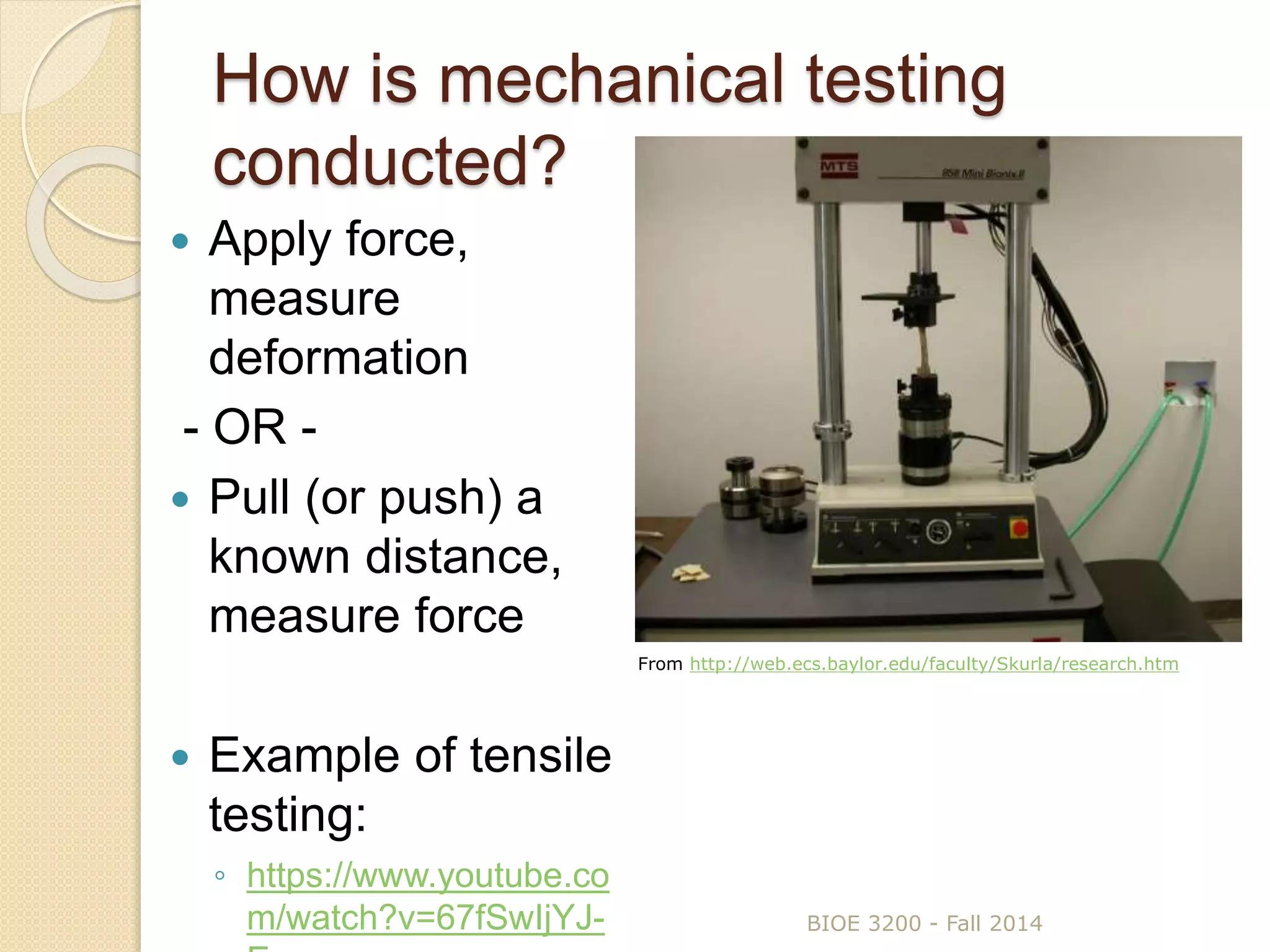
How is mechanical testing
conducted?
 Apply force,
measure
deformation
- OR -
 Pull (or push) a
known distance,
measure force
 Example of tensile
testing:
◦ https://www.youtube.co
m/watch?v=67fSwIjYJ- BIOE 3200 - Fall 2014
From http://web.ecs.baylor.edu/faculty/Skurla/research.htm
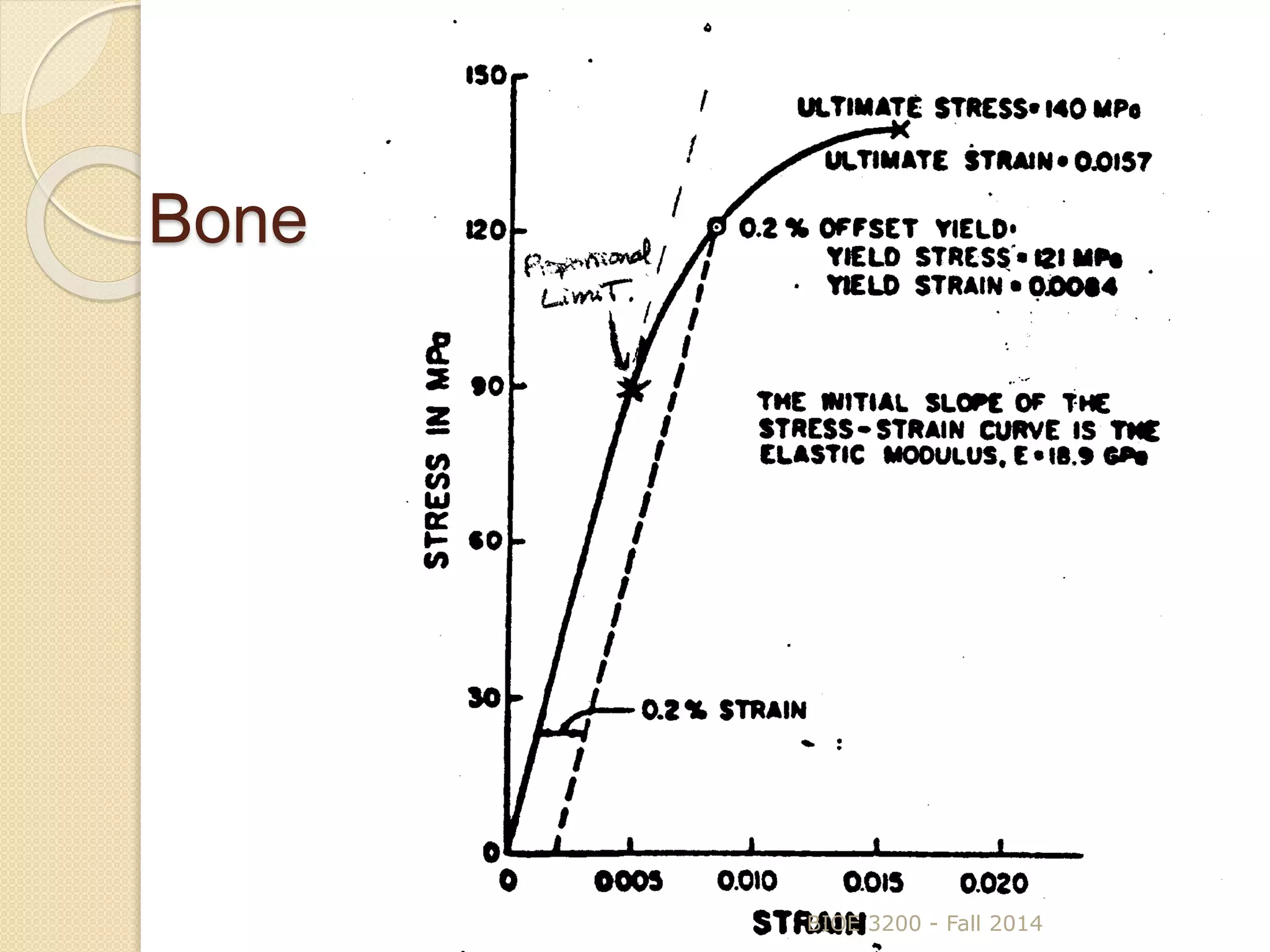
Bone
BIOE 3200 - Fall 2014
Bone is anisotropic: material
properties are different in different
directions.
 Bone is a composite of mainly
collagen and minerals (hydroxyapatite,
or calcium)
◦ Collagen has a low E, high tensile
strength, low compressive strength
◦ Hydroxyapatite is stiff, brittle, high
compressive strength
 Anisotropic material that can resist
different types of forces
 Strongest in compression, weakest in
shear, intermediate in tension
BIOE 3200 - Fall 2014
What gives bone its anisotropic
properties?
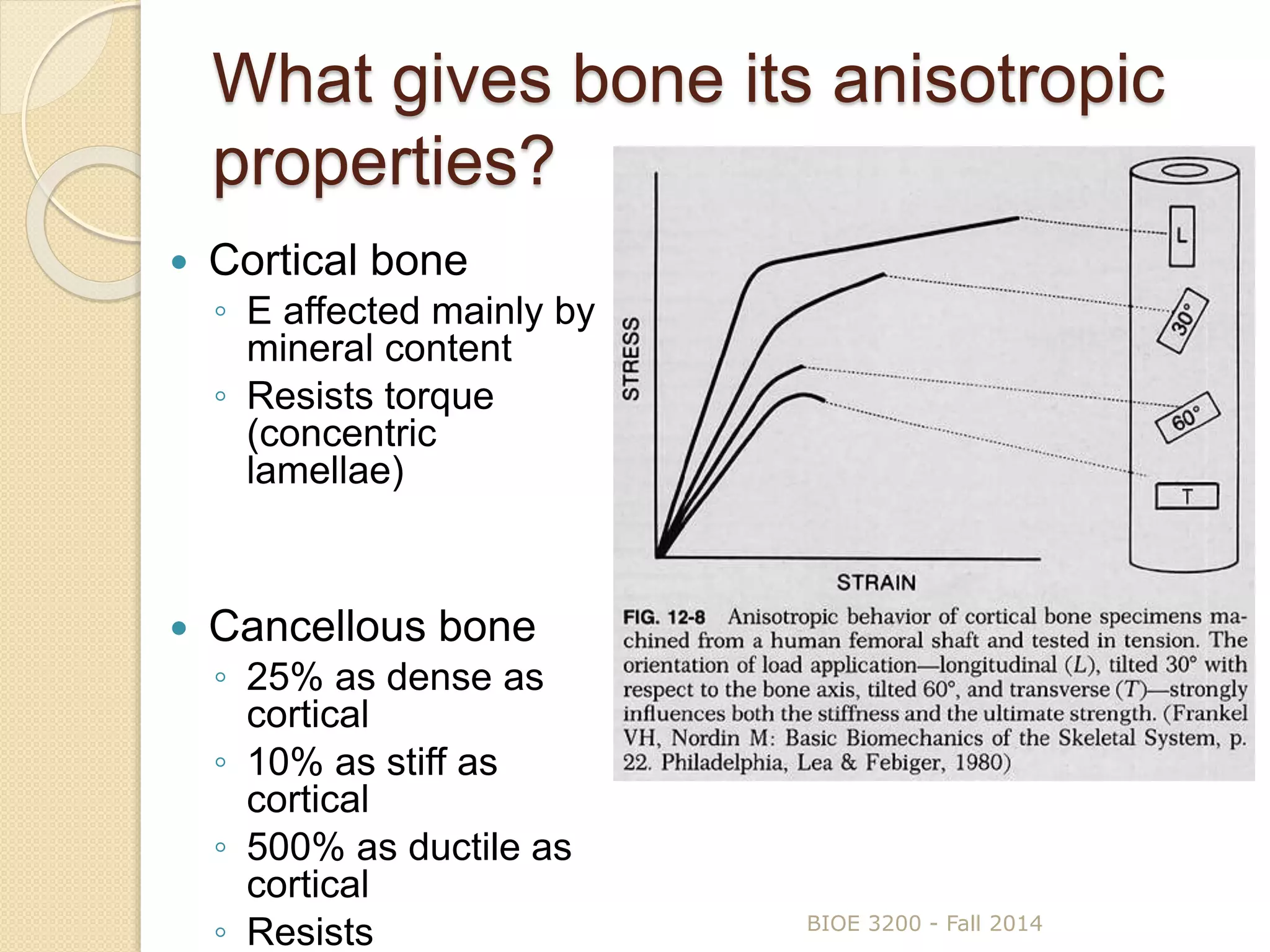
 Cortical bone
◦ E affected mainly by
mineral content
◦ Resists torque
(concentric
lamellae)
 Cancellous bone
◦ 25% as dense as
cortical
◦ 10% as stiff as
cortical
◦ 500% as ductile as
cortical
◦ Resists BIOE 3200 - Fall 2014
Bone is a dynamic material
 Self-repairs (osteoclasts, osteoblasts)
 Changes with aging: becomes stiffer
and less ductile
 Changes with lack of weight-bearing:
becomes weaker
BIOE 3200 - Fall 2014

2 mechanical properties of bone

  • 1.
    Mechanical Properties of Bone Humanknowledge and human power meet in one; for where the cause is not known the effect cannot be produced. ~ Sir Francis Bacon BIOE 3200 - Fall 2014 Nova special, “Making Stuff Stronger”: https://www.youtube.com/watch?v=KE- Y45WjiP0&list=PL9OMJke2jE_CuZgiOUJ0frfw3TRLKQByw&index=1
  • 2.
    Learning Objectives  Conductstress analysis on bone sample ◦ Identify the source of anisotropic material properties ◦ Analyze how changes in bone composition affect stress and strain within bone BIOE 3200 - Fall 2014
  • 3.
    How is mechanicaltesting conducted?  Apply force, measure deformation - OR -  Pull (or push) a known distance, measure force  Example of tensile testing: ◦ https://www.youtube.co m/watch?v=67fSwIjYJ- BIOE 3200 - Fall 2014 From http://web.ecs.baylor.edu/faculty/Skurla/research.htm
  • 4.
  • 5.
    BIOE 3200 -Fall 2014
  • 6.
    BIOE 3200 -Fall 2014
  • 7.
    Bone is anisotropic:material properties are different in different directions.  Bone is a composite of mainly collagen and minerals (hydroxyapatite, or calcium) ◦ Collagen has a low E, high tensile strength, low compressive strength ◦ Hydroxyapatite is stiff, brittle, high compressive strength  Anisotropic material that can resist different types of forces  Strongest in compression, weakest in shear, intermediate in tension BIOE 3200 - Fall 2014
  • 8.
    What gives boneits anisotropic properties?  Cortical bone ◦ E affected mainly by mineral content ◦ Resists torque (concentric lamellae)  Cancellous bone ◦ 25% as dense as cortical ◦ 10% as stiff as cortical ◦ 500% as ductile as cortical ◦ Resists BIOE 3200 - Fall 2014
  • 9.
    Bone is adynamic material  Self-repairs (osteoclasts, osteoblasts)  Changes with aging: becomes stiffer and less ductile  Changes with lack of weight-bearing: becomes weaker BIOE 3200 - Fall 2014

Editor's Notes

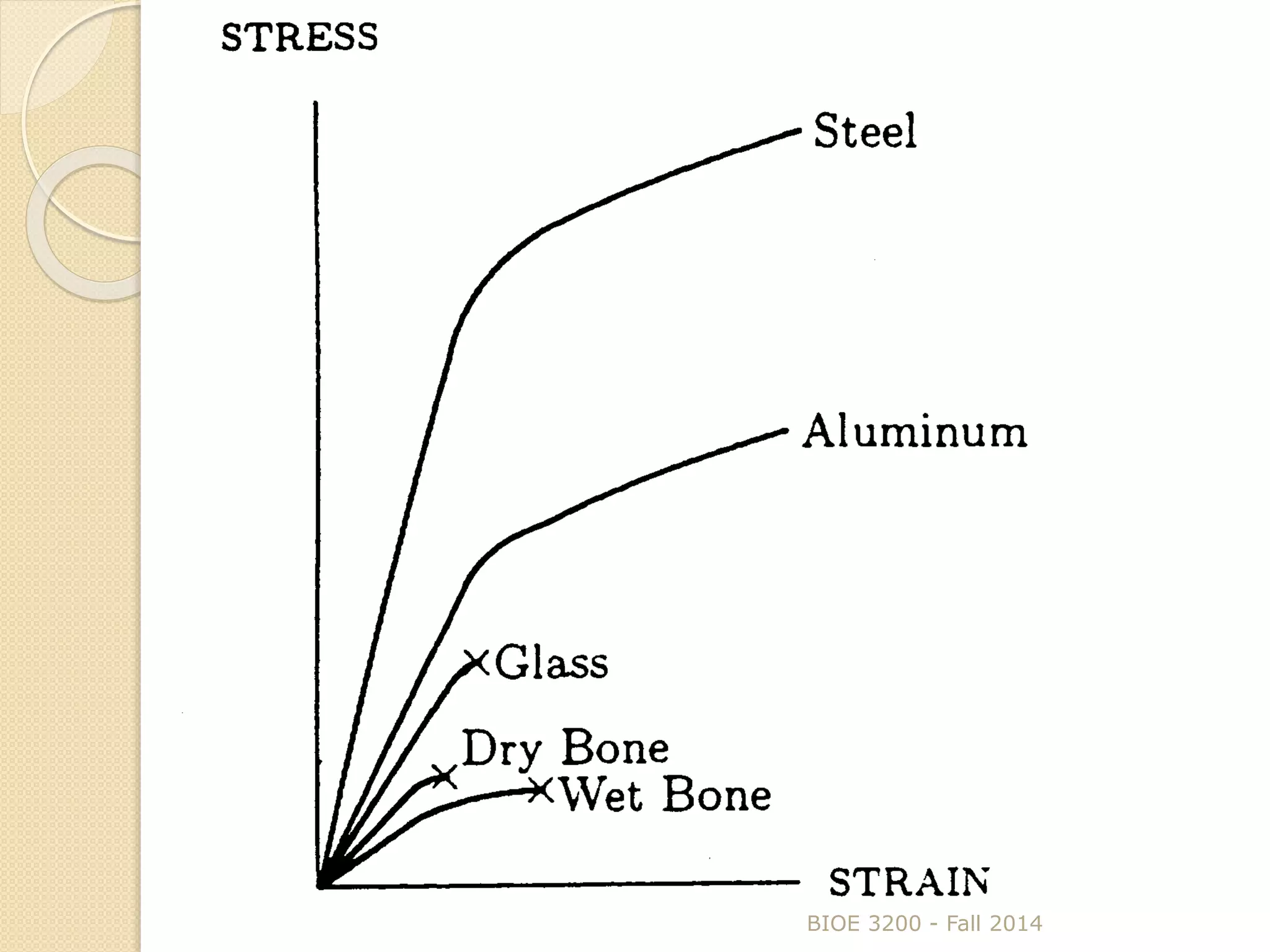
  • #5 Stress/strain graphs – elastic region, E = slope (stiffness); Hooke’s Law (elastic materials like springs); beyond yield point, plastic deformation, elastic strain + plastic strain = total ε “2% Yield” – the point at which if the load is removed, all but 2% of the deformation is recovered Define LEHI material: Linear stress-strain behavior; Elastic (no dissipation of energy; load/unload curve are the same); Homogeneous (same material behavior throughout body; Isotropic (same material properties in all directions)
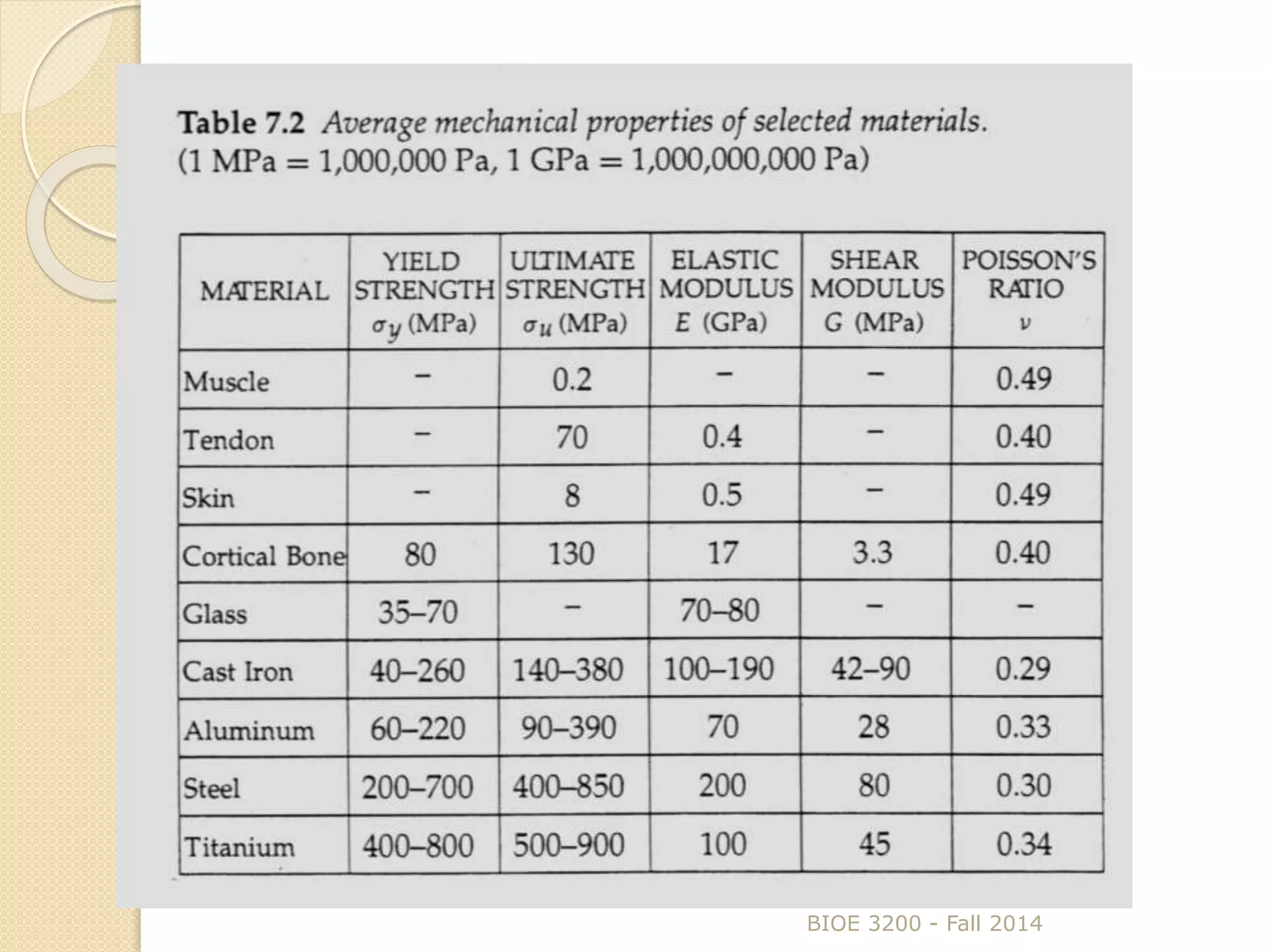
  • #6 Trabecular bone E = 15 GPa; Cortical bone E = 20 GPa; Esteel = 200 GPa; polymers, E < 1
  • #7 Polyethylene (HDPE) – common implant material: E = about 0.8
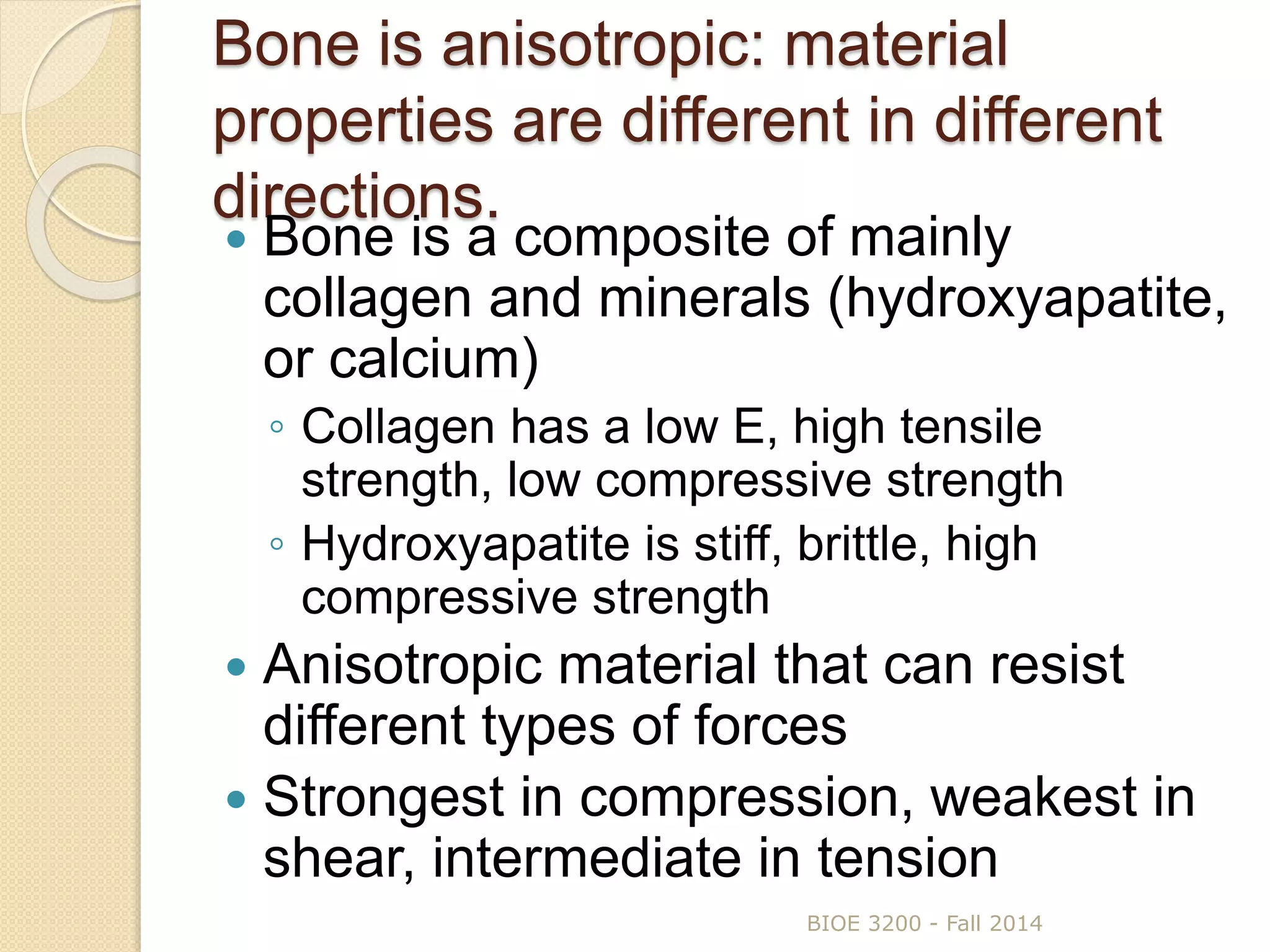
  • #8 Discuss factors contributing to anisotropic properties of bone; if stress is the same, why would strain be different in different orientations?
  • #9 Be careful when citing material properties for bone; Only valid for bone with the same microstructure and in the same environment as the test specimen