AMPUTATION
Dr. DINRAJ T V
JR 1, GENERAL SURGERY
AIMS
•AMPUTATION IS THE COMPLETE
REMOVAL OF AN INJURED OR
DEFORMED BODY PART
INDICATIONS
• PERIPHERAL VASCULAR DISEASE
 GANGRENE DUE TO ATHEROSCLEROSIS,
EMBOLISM, TAO
• DIABETIC LIMB DISEASE/ GANGRENE
• DEAD, DYING DEVITALISED TISSUE
• TRAUMA : LIFE SAVING IN CRUSH INJURIES
• INFECTION AND GANGRENE – TO SEPSIS
• MALIGNANCY
• DEVERE DEFORMITY : CONGENITAL/ ACQUIRED
AIM OF AMPUTATION
• RETURN PATIENT TO MAXIMUM LEVEL OF
INDEPENDENT FUNCTION
• ABLATION OF DISEASED TISSUE (TUMOR OR
INFECTION)
• REDUCE MORBIDITY & MORTALITY (TUMOR
OR INFECTION)
• PRODUCE A PHYSIOLOGICAL END ORGAN .
IDEAL STUMP
• PROPER HEALING
• ROUND, GENTLE CONTOUR WITH MUSCLE PADDING
• ADEQUATE BLOOD SUPPLY
• PROVISION FOR PROSTESIS
• THIN SCAR, SHOULD AFFECT PROSTESIS FUNCTION
• ADEQUATE ADJACENT JOINT MOVEMENT
DETERMINATION OF LEVEL
• Zone of Injury (trauma)
• Adequate margins (tumor)
• Adequate circulation (vascular disease)
• Soft tissue envelope
• Bone and joint condition
• Control of infection
• Nutritional status
Preoperative evaluation
Hb, PCV
Correct anaemia
Control of infection : with antibiotics
Diabetic control
Level of amputation :
Arterial DOPPLER
R/o other cardiac conditions
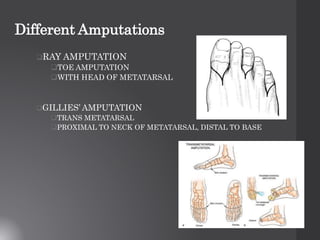
Different Amputations
RAY AMPUTATION
TOE AMPUTATION
WITH HEAD OF METATARSAL
GILLIES’ AMPUTATION
TRANS METATARSAL
PROXIMAL TO NECK OF METATARSAL, DISTAL TO BASE
LISFRANC’S
TARSO METATARSAL AMPUTATION
DISARTICULATION
LONG VOLAR FLAP
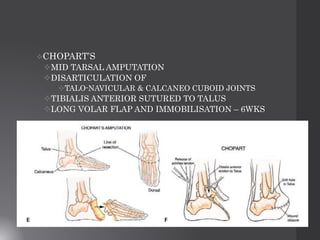
CHOPART’S
MID TARSAL AMPUTATION
DISARTICULATION OF
TALO-NAVICULAR & CALCANEO CUBOID JOINTS
TIBIALIS ANTERIOR SUTURED TO TALUS
LONG VOLAR FLAP AND IMMOBILISATION – 6WKS
SYME’S AMPUTATION
REMOVAL OF FOOT WITH CALCANEUM
RETAINING HEEL FLAP
BONE AT TIBIA & FIBULA JUST ABOVE ANKLE JOINT
ELEPHANT BOOT
Pirogoff's amputation
Amputation of the foot at the ankle, part of the
calcaneus being left in the stump
The Boyd procedure
Provides a broad weight-bearing surface of the heel by
creating an arthrodesis between the distal tibia and
the tuber of the calcaneus
Compared to a Syme's amputation, it provides more
length and better preserves the weight-bearing function
of the heel pad.
Its increased complexity and morbidity have made it
less used now than the Syme's amputation.
BELOW KNEE AMPUTATION
(BURGESS’ )
MIN. STUMP LENGTH :
8 CM FROM TIBIAL TUBEROSITY
(14-17 CM IS GOOD)
LONG POSTERIOR FLAP
SCAR ANTERIORLY
FIBULA TO BE DIVIDED BEFORE TIBIA AT A HIGHER LEVEL
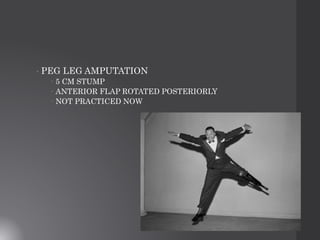
• PEG LEG AMPUTATION
 5 CM STUMP
 ANTERIOR FLAP ROTATED POSTERIORLY
 NOT PRACTICED NOW
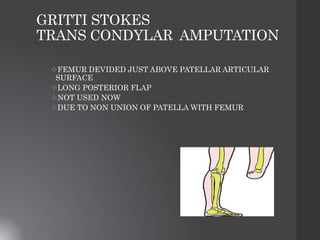
GRITTI STOKES
TRANS CONDYLAR AMPUTATION
FEMUR DEVIDED JUST ABOVE PATELLAR ARTICULAR
SURFACE
LONG POSTERIOR FLAP
NOT USED NOW
DUE TO NON UNION OF PATELLA WITH FEMUR
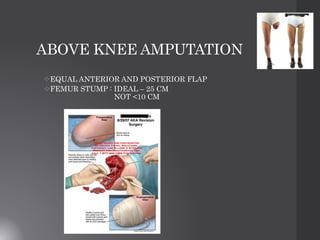
ABOVE KNEE AMPUTATION
EQUAL ANTERIOR AND POSTERIOR FLAP
FEMUR STUMP : IDEAL – 25 CM
NOT <10 CM
HIP DISARTICULATION
WHEN STUMP >10CM IS NOT POSSIBLE
SOLCUM’S APPROACH : SINGLE POSTERIOR FLAP
BOYD’S APPROACH : ANTERIOR RAACQUET INCISION
HIND QUARTER AMPUTATION
SIR GORDON TAYLOR’S AMPUTATION
HEMI PELVECTOMY
REMOVAL OF
 ONE SIDE PELVIS
 INNOMINATE BONE
 PUBIS
 MUSCLES AND VESSELS
RETAIN PART OF PUBIS, ILIUM
POSTERIOR FLAP : BY SUPERIOR GLUTEAL ARTERY
UPPER LIMB AMPUTATION
KRUKENBERG’S AMPUTATION
DONE IN TRAUMA
FOREARM AMPUTATION
GAP B/W RADIUS AND ULNA LIKE A CLAW
• UPPER LIMB AMPUTATION
 20 CM STUMP IS ADVICED IN BOTH ABOVE AND
BELOW ELBOW AMPUTATION
• FOREQUARTER AMPUTATION
 INTER SCAPULO THORACIC AMPUTATION
 UPPER LIMB WITH SCAPULA, LATERAL 2/3 OF
CLAVICLE,
TYPES OF AMPUTATION
• WEIGHT BEARING
• NON WEIGHT BEARING
• END BEARING/ CONE BEARING
• NON END BEARING/ SIDE BEARING
• FLAP CAN BE
 UNEQUAL/ EQUAL FLAPS
PRINCIPLES OF AMPUTATION
• Adequate blood supply
• No tourniquet during surgery
• Proper making of skin
• Proximal part of flap contain muscle and distal part only
skin
• Nerve to be buried deep
• Proper dressings after surgery
Incisions
• Circular incision amputation
• Elliptical/ oval incision
• Racquet incision
•SKIN FLAPS
 The apex of the fish mouth at the level of the bony resection
 Total length of flap anterior + posterior = 1.5 times diameter
 Flap should be semi circular for conical stump
 Use any available flaps in trauma to preserve length
 Tailor flaps at least as long as the diameter of the stump
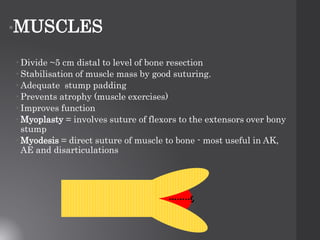
•MUSCLES
 Divide ~5 cm distal to level of bone resection
 Stabilisation of muscle mass by good suturing.
 Adequate stump padding
 Prevents atrophy (muscle exercises)
 Improves function
 Myoplasty = involves suture of flexors to the extensors over bony
stump
 Myodesis = direct suture of muscle to bone - most useful in AK,
AE and disarticulations
Nerves
Divide cleanly under gentle tension proximal to bone ends -
allow to retract
Large nerves eg sciatic, median - ligate due to large contained
vessels
Blood vessels
Large arteries & veins should be doubly ligated and
haemostasis achieved prior to closure
Bone
Avoid excessive periosteal stripping (prevent spur formation)
Bevel & smooth the bone end
• Closure
 Do not close under tension
 Interrupted sutures preferably
• Drains are necessary
Goals of Postoperative Management
Prompt, uncomplicated wound healing
Control of edema
Control of Postoperative pain
Prevention of joint contractures
Rapid rehabilitation
WOUND CARE
ABSORBENT, NON-ADHERENT AND OCCLUSIVE
VACCUM DRAIN
PROPER PADDING FOR COMFORT AND PROTECTION
BANDAGING SHOULD BE FIRM BUT
NOT RESTRICTIVE
• PREVENT CONTRACTURE
 USE OF BRACE OR OTHER IMMOBILISER
 PHYSIOTHERAPY
 EARLY MOBILISATION OF PATIENT
 Sitting out of bed within 48 hrs
 Wheelchair used to assist mobility
 Practice in transferring, standing and early walking with
crutches supervised with physio.
Complications
 Early
 Haemorrhage & Haematoma
 Infection
 Late
 Necrosis of stump end.
 Ring sequestrum formation
 Contractures (due to muscle imbalance)
 Neuroma at the cut nerve ending
 Phantom pain
 Terminal overgrowth (children)
• Phantom limb sensation is the sensation that the
amputated limb is still present.
• Phantom limb pain usually is like a burning,
stinging, electric pain, and it can be increased with
anxiety and stress.
• Telescoping is the sensation that the distal part of
the amputated extremity has moved proximally up
the arm
“Stump Edema Syndrome” : associated with the use
of suction prosthesis.
-Proximal constriction
-Blood in skin ,pain, Pigmentation
-Elevation
COMPLICATIONS
1. Failure of wound to heal : gap if wider than 1cm needs revision
2. Infection : open – flaps retract / edematous
results in shortening the bone
Rx : close only central 1/3 for coverage of bone.
3. Phantom sensation : diminishes over time, telescoping
4. Pain and phantom pain : massage , cold packs, exercise and
neuromuscular stimulation
TENS ( trans cutaneous electric nerve stimulation) :
incorporated in a prosthesis
-carbamazipine,Phenytoin,gabapentin,Amitriptylin &Mexiletine
Follow up
2 weeks after surgery
Start muscle contraction exercises and physiotherapy
Desensitization is started with a towel for distal
residual extremity pressure
Prosthetic management to be started by 6weeks
Depending on the condition of the extremity and
wound
Some patients are not candidates for prosthesis
Thank you….

Amputations

  • 1.
    AMPUTATION Dr. DINRAJ TV JR 1, GENERAL SURGERY AIMS
  • 2.
    •AMPUTATION IS THECOMPLETE REMOVAL OF AN INJURED OR DEFORMED BODY PART
  • 3.
    INDICATIONS • PERIPHERAL VASCULARDISEASE  GANGRENE DUE TO ATHEROSCLEROSIS, EMBOLISM, TAO • DIABETIC LIMB DISEASE/ GANGRENE • DEAD, DYING DEVITALISED TISSUE • TRAUMA : LIFE SAVING IN CRUSH INJURIES • INFECTION AND GANGRENE – TO SEPSIS • MALIGNANCY • DEVERE DEFORMITY : CONGENITAL/ ACQUIRED
  • 4.
    AIM OF AMPUTATION •RETURN PATIENT TO MAXIMUM LEVEL OF INDEPENDENT FUNCTION • ABLATION OF DISEASED TISSUE (TUMOR OR INFECTION) • REDUCE MORBIDITY & MORTALITY (TUMOR OR INFECTION) • PRODUCE A PHYSIOLOGICAL END ORGAN .
  • 5.
    IDEAL STUMP • PROPERHEALING • ROUND, GENTLE CONTOUR WITH MUSCLE PADDING • ADEQUATE BLOOD SUPPLY • PROVISION FOR PROSTESIS • THIN SCAR, SHOULD AFFECT PROSTESIS FUNCTION • ADEQUATE ADJACENT JOINT MOVEMENT
  • 8.
    DETERMINATION OF LEVEL •Zone of Injury (trauma) • Adequate margins (tumor) • Adequate circulation (vascular disease) • Soft tissue envelope • Bone and joint condition • Control of infection • Nutritional status
  • 9.
    Preoperative evaluation Hb, PCV Correctanaemia Control of infection : with antibiotics Diabetic control Level of amputation : Arterial DOPPLER R/o other cardiac conditions
  • 10.
    Different Amputations RAY AMPUTATION TOEAMPUTATION WITH HEAD OF METATARSAL GILLIES’ AMPUTATION TRANS METATARSAL PROXIMAL TO NECK OF METATARSAL, DISTAL TO BASE
  • 11.
  • 12.
    CHOPART’S MID TARSAL AMPUTATION DISARTICULATIONOF TALO-NAVICULAR & CALCANEO CUBOID JOINTS TIBIALIS ANTERIOR SUTURED TO TALUS LONG VOLAR FLAP AND IMMOBILISATION – 6WKS
  • 13.
    SYME’S AMPUTATION REMOVAL OFFOOT WITH CALCANEUM RETAINING HEEL FLAP BONE AT TIBIA & FIBULA JUST ABOVE ANKLE JOINT ELEPHANT BOOT
  • 14.
    Pirogoff's amputation Amputation ofthe foot at the ankle, part of the calcaneus being left in the stump The Boyd procedure Provides a broad weight-bearing surface of the heel by creating an arthrodesis between the distal tibia and the tuber of the calcaneus Compared to a Syme's amputation, it provides more length and better preserves the weight-bearing function of the heel pad. Its increased complexity and morbidity have made it less used now than the Syme's amputation.
  • 15.
    BELOW KNEE AMPUTATION (BURGESS’) MIN. STUMP LENGTH : 8 CM FROM TIBIAL TUBEROSITY (14-17 CM IS GOOD) LONG POSTERIOR FLAP SCAR ANTERIORLY FIBULA TO BE DIVIDED BEFORE TIBIA AT A HIGHER LEVEL
  • 16.
    • PEG LEGAMPUTATION  5 CM STUMP  ANTERIOR FLAP ROTATED POSTERIORLY  NOT PRACTICED NOW
  • 17.
    GRITTI STOKES TRANS CONDYLARAMPUTATION FEMUR DEVIDED JUST ABOVE PATELLAR ARTICULAR SURFACE LONG POSTERIOR FLAP NOT USED NOW DUE TO NON UNION OF PATELLA WITH FEMUR
  • 18.
    ABOVE KNEE AMPUTATION EQUALANTERIOR AND POSTERIOR FLAP FEMUR STUMP : IDEAL – 25 CM NOT <10 CM
  • 19.
    HIP DISARTICULATION WHEN STUMP>10CM IS NOT POSSIBLE SOLCUM’S APPROACH : SINGLE POSTERIOR FLAP BOYD’S APPROACH : ANTERIOR RAACQUET INCISION
  • 20.
    HIND QUARTER AMPUTATION SIRGORDON TAYLOR’S AMPUTATION HEMI PELVECTOMY REMOVAL OF  ONE SIDE PELVIS  INNOMINATE BONE  PUBIS  MUSCLES AND VESSELS RETAIN PART OF PUBIS, ILIUM POSTERIOR FLAP : BY SUPERIOR GLUTEAL ARTERY
  • 21.
    UPPER LIMB AMPUTATION KRUKENBERG’SAMPUTATION DONE IN TRAUMA FOREARM AMPUTATION GAP B/W RADIUS AND ULNA LIKE A CLAW
  • 22.
    • UPPER LIMBAMPUTATION  20 CM STUMP IS ADVICED IN BOTH ABOVE AND BELOW ELBOW AMPUTATION • FOREQUARTER AMPUTATION  INTER SCAPULO THORACIC AMPUTATION  UPPER LIMB WITH SCAPULA, LATERAL 2/3 OF CLAVICLE,
  • 23.
    TYPES OF AMPUTATION •WEIGHT BEARING • NON WEIGHT BEARING • END BEARING/ CONE BEARING • NON END BEARING/ SIDE BEARING • FLAP CAN BE  UNEQUAL/ EQUAL FLAPS
  • 24.
    PRINCIPLES OF AMPUTATION •Adequate blood supply • No tourniquet during surgery • Proper making of skin • Proximal part of flap contain muscle and distal part only skin • Nerve to be buried deep • Proper dressings after surgery
  • 25.
    Incisions • Circular incisionamputation • Elliptical/ oval incision • Racquet incision
  • 26.
    •SKIN FLAPS  Theapex of the fish mouth at the level of the bony resection  Total length of flap anterior + posterior = 1.5 times diameter  Flap should be semi circular for conical stump  Use any available flaps in trauma to preserve length  Tailor flaps at least as long as the diameter of the stump
  • 27.
    •MUSCLES  Divide ~5cm distal to level of bone resection  Stabilisation of muscle mass by good suturing.  Adequate stump padding  Prevents atrophy (muscle exercises)  Improves function  Myoplasty = involves suture of flexors to the extensors over bony stump  Myodesis = direct suture of muscle to bone - most useful in AK, AE and disarticulations
  • 28.
    Nerves Divide cleanly undergentle tension proximal to bone ends - allow to retract Large nerves eg sciatic, median - ligate due to large contained vessels Blood vessels Large arteries & veins should be doubly ligated and haemostasis achieved prior to closure Bone Avoid excessive periosteal stripping (prevent spur formation) Bevel & smooth the bone end
  • 29.
    • Closure  Donot close under tension  Interrupted sutures preferably • Drains are necessary
  • 30.
    Goals of PostoperativeManagement Prompt, uncomplicated wound healing Control of edema Control of Postoperative pain Prevention of joint contractures Rapid rehabilitation
  • 31.
    WOUND CARE ABSORBENT, NON-ADHERENTAND OCCLUSIVE VACCUM DRAIN PROPER PADDING FOR COMFORT AND PROTECTION BANDAGING SHOULD BE FIRM BUT NOT RESTRICTIVE
  • 32.
    • PREVENT CONTRACTURE USE OF BRACE OR OTHER IMMOBILISER  PHYSIOTHERAPY  EARLY MOBILISATION OF PATIENT  Sitting out of bed within 48 hrs  Wheelchair used to assist mobility  Practice in transferring, standing and early walking with crutches supervised with physio.
  • 33.
    Complications  Early  Haemorrhage& Haematoma  Infection  Late  Necrosis of stump end.  Ring sequestrum formation  Contractures (due to muscle imbalance)  Neuroma at the cut nerve ending  Phantom pain  Terminal overgrowth (children)
  • 34.
    • Phantom limbsensation is the sensation that the amputated limb is still present. • Phantom limb pain usually is like a burning, stinging, electric pain, and it can be increased with anxiety and stress. • Telescoping is the sensation that the distal part of the amputated extremity has moved proximally up the arm
  • 35.
    “Stump Edema Syndrome”: associated with the use of suction prosthesis. -Proximal constriction -Blood in skin ,pain, Pigmentation -Elevation
  • 36.
    COMPLICATIONS 1. Failure ofwound to heal : gap if wider than 1cm needs revision 2. Infection : open – flaps retract / edematous results in shortening the bone Rx : close only central 1/3 for coverage of bone. 3. Phantom sensation : diminishes over time, telescoping 4. Pain and phantom pain : massage , cold packs, exercise and neuromuscular stimulation TENS ( trans cutaneous electric nerve stimulation) : incorporated in a prosthesis -carbamazipine,Phenytoin,gabapentin,Amitriptylin &Mexiletine
  • 37.
    Follow up 2 weeksafter surgery Start muscle contraction exercises and physiotherapy Desensitization is started with a towel for distal residual extremity pressure Prosthetic management to be started by 6weeks Depending on the condition of the extremity and wound Some patients are not candidates for prosthesis
  • 38.