S.Prasanth Kumar, Bioinformatician Biological Databases Bioinformatics and Biostatistics S.Prasanth Kumar, Bioinformatician S.Prasanth Kumar   Dept. of Bioinformatics  Applied Botany Centre (ABC)  Gujarat University, Ahmedabad, INDIA www.facebook.com/Prasanth Sivakumar FOLLOW ME ON  ACCESS MY RESOURCES IN SLIDESHARE prasanthperceptron CONTACT ME [email_address]
Recognize various data formats, and know what their primary use. Know, understand and utilize all types of sequence identifiers. Know and understand various feature types present in the GenBank flat files. Know and understand the various GenBank divisions.   Main Objectives of Biological Databases
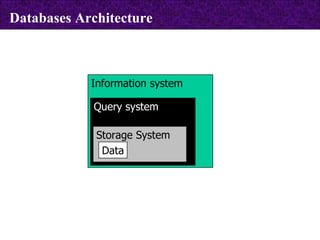
Information system  Query system  Storage System Data Databases Architecture
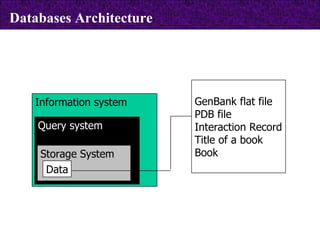
Information system  Query system  Storage System Data Databases Architecture GenBank flat file  PDB file Interaction Record Title of a book Book
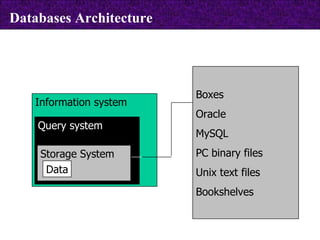
Information system  Query system  Storage System Data Databases Architecture Boxes Oracle MySQL PC binary files Unix text files Bookshelves
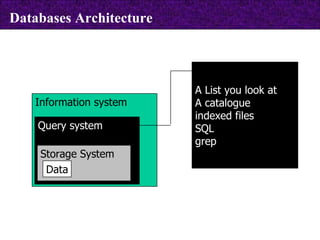
Information system  Query system  Storage System Data A List you look at A catalogue indexed files SQL grep Databases Architecture
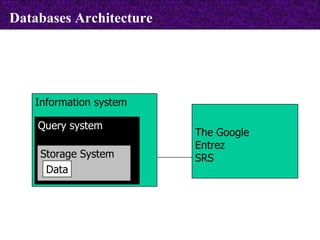
Information system  Query system  Storage System Data Databases Architecture The Google Entrez SRS
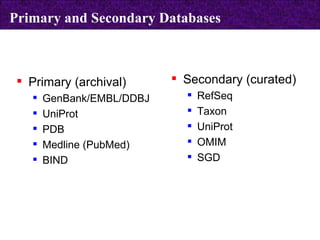
Primary (archival) GenBank/EMBL/DDBJ UniProt PDB Medline (PubMed) BIND Secondary (curated) RefSeq Taxon UniProt OMIM SGD Primary and Secondary Databases
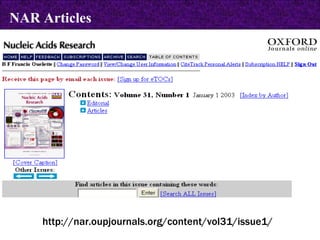
http://nar.oupjournals.org/content/vol31/issue1/ NAR Articles
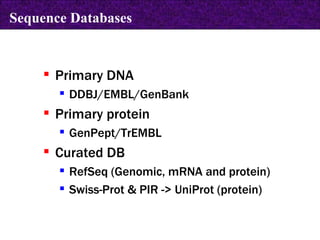
Primary DNA DDBJ/EMBL/GenBank Primary protein GenPept/TrEMBL Curated DB RefSeq (Genomic, mRNA and protein) Swiss-Prot & PIR -> UniProt (protein) Sequence Databases
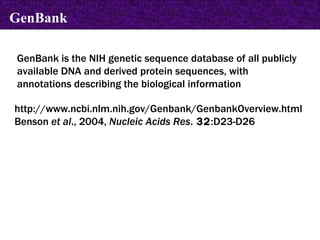
GenBank is the NIH genetic sequence database of all publicly available DNA and derived protein sequences, with annotations describing the biological information http://www.ncbi.nlm.nih.gov/Genbank/GenbankOverview.html Benson  et al ., 2004,  Nucleic Acids Res .  32 :D23-D26 GenBank
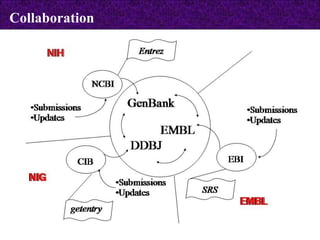
Collaboration
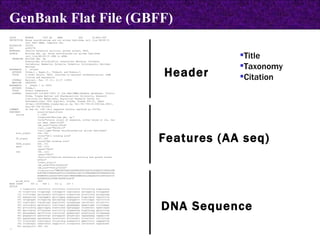
LOCUS  MUSNGH  1803 bp  mRNA  ROD  29-AUG-1997 DEFINITION  Mouse neuroblastoma and rat glioma hybridoma cell line NG108-15 cell TA20 mRNA, complete cds. ACCESSION  D25291 NID  g1850791 KEYWORDS  neurite extension activity; growth arrest; TA20. SOURCE  Murinae gen. sp. mouse neuroblastma-rat glioma hybridoma cell_line:NG108-15 cDNA to mRNA. ORGANISM  Murinae gen. sp. Eukaryotae; mitochondrial eukaryotes; Metazoa; Chordata; Vertebrata; Mammalia; Eutheria; Rodentia; Sciurognathi; Muridae; Murinae. REFERENCE  1  (sites) AUTHORS  Tohda,C., Nagai,S., Tohda,M. and Nomura,Y. TITLE  A novel factor, TA20, involved in neuronal differentiation: cDNA cloning and expression JOURNAL  Neurosci. Res. 23 (1), 21-27 (1995) MEDLINE  96064354 REFERENCE  3  (bases 1 to 1803) AUTHORS  Tohda,C. TITLE  Direct Submission JOURNAL  Submitted (18-NOV-1993) to the DDBJ/EMBL/GenBank databases. Chihiro Tohda, Toyama Medical and Pharmaceutical University, Research Institute for Wakan-yaku, Analytical Research Center for Ethnomedicines; 2630 Sugitani, Toyama, Toyama 930-01, Japan (E-mail:CHIHIRO@ms.toyama-mpu.ac.jp, Tel:+81-764-34-2281(ex.2841), Fax:+81-764-34-5057) COMMENT  On Feb 26, 1997 this sequence version replaced gi:793764. FEATURES  Location/Qualifiers source  1..1803 /organism="Murinae gen. sp." /note="source origin of sequence, either mouse or rat, has not been identified" /db_xref="taxon:39108" /cell_line="NG108-15" /cell_type="mouse neuroblastma-rat glioma hybridoma" misc_signal  156..163 /note="AP-2 binding site" GC_signal  647..655 /note="Sp1 binding site" TATA_signal  694..701 gene  748..1311 /gene="TA20" CDS  748..1311 /gene="TA20" /function="neurite extensiion activity and growth arrest effect" /codon_start=1 /db_xref="PID:d1005516" /db_xref="PID:g793765" /translation="MMKLWVPSRSLPNSPNHYRSFLSHTLHIRYNNSLFISNTHLSRR KLRVTNPIYTRKRSLNIFYLLIPSCRTRLILWIIYIYRNLKHWSTSTVRSHSHSIYRL RPSMRTNIILRCHSYYKPPISHPIYWNNPSRMNLRGLLSRQSHLDPILRFPLHLTIYY RGPSNRSPPLPPRNRIKQPNRIKLRCR" polyA_site  1803 BASE COUNT  507 a  458 c  311 g  527 t ORIGIN  1 tcagtttttt tttttttttt tttttttttt tttttttttt tttttttttg ttgattcatg 61 tccgtttaca tttggtaagt tcacaggcct cagtcaacac aattggactg ctcaggaaat 121 cctccttggt gaccgcagta tacttggcct atgaacccaa gccacctatg gctaggtagg 181 agaagctcaa ctgtagggct gactttggaa gagaatgcac atggctgtat cgacatttca 241 catggtggac ctctggccag agtcagcagg ccgagggttc tcttccgggc tgctccctca 301 ctgcttgact ctgcgtcagt gcgtccatac tgtgggcgga cgttattgct atttgccttc 361 cattctgtac ggcattgcct ccatttagct ggagagggac agagcctggt tctctagggc 421 gtttccattg gggcctggtg acaatccaaa agatgagggc tccaaacacc agaatcagaa 481 ggcccagcgt atttgtaaaa acaccttctg gtgggaatga atggtacagg ggcgtttcag 541 gacaaagaac agcttttctg tcactcccat gagaaccgtc gcaatcactg ttccgaagag 601 gaggagtcca gaatacacgt gtatgggcat gacgattgcc cggagagagg cggagcccat 661 ggaagcagaa agacgaaaaa cacacccatt atttaaaatt attaaccact cattcattga 721 cctacctgcc ccatccaaca tttcatcatg atgaaacttt gggtcccttc taggagtctg 781 cctaatagtc caaatcatta caggtctttt cttagccata cactacacat cagatacaat 841 aacagccttt 1801 cat // GenBank Flat File (GBFF) Features (AA seq) DNA Sequence Header Title Taxonomy Citation
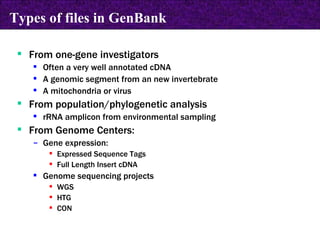
From one-gene investigators Often a very well annotated cDNA A genomic segment from an new invertebrate A mitochondria or virus From population/phylogenetic analysis rRNA amplicon from environmental sampling From Genome Centers: Gene expression: Expressed Sequence Tags  Full Length Insert cDNA Genome sequencing projects WGS HTG CON Types of files in GenBank
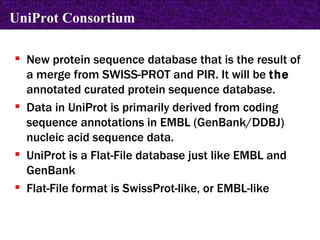
New protein sequence database that is the result of a merge from SWISS-PROT and PIR. It will be  the  annotated curated protein sequence database. Data in UniProt is primarily derived from coding sequence annotations in EMBL (GenBank/DDBJ) nucleic acid sequence data. UniProt is a Flat-File database just like EMBL and GenBank Flat-File format is SwissProt-like, or EMBL-like   UniProt Consortium
SWISS-PROT  an  annotated  universal sequence database, TrEMBL   an  automatically generated  sequence database with    repository character, which supplements SWISS-PROT.  SWISS-PROT [http://www.expasy.org/sprot/]  a curated protein  sequence database which provides a high level of annotation Types of Annotations:   Description of a protein's function, its domain structure, PTMs, conflicts  between literature references and variants.  It also provides a  minimal level of redundancy ,  a high level of integration with other bio molecular  databases , and an extensive external documentation. (Created in 1986:Main Host-ExPaSy) Protein sequence databases
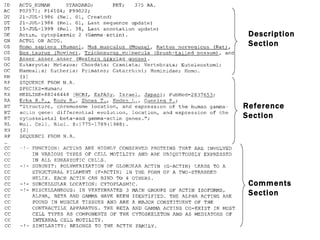
SWISSPROT format  Description Section Reference Section Comments Section
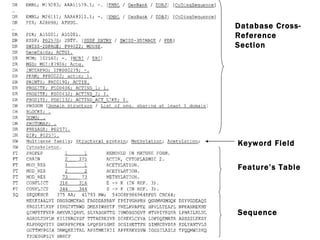
Database Cross-Reference Section Keyword Field Feature’s Table Sequence
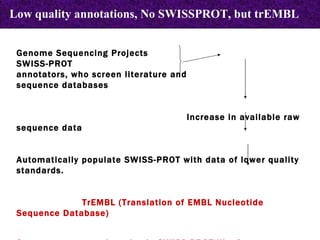
Genome Sequencing Projects  SWISS-PROT annotators, who screen literature and  sequence databases  Increase in available raw sequence data Automatically populate SWISS-PROT with data of lower quality standards.  TrEMBL (Translation of EMBL Nucleotide Sequence Database) Computer-annotated entries in SWISS-PROT-like format .  It is populated by protein sequences translated from the coding sequences  (CDS) in EMBL and is a supplement to SWISS-PROT Low quality annotations, No SWISSPROT, but trEMBL
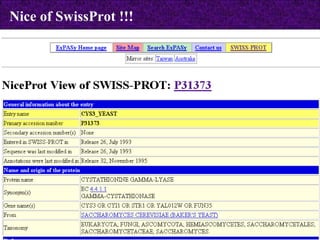
Nice of SwissProt !!!
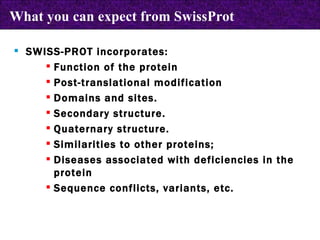
What you can expect from SwissProt SWISS-PROT incorporates:  Function of the protein Post-translational modification Domains and sites. Secondary structure.  Quaternary structure. Similarities to other proteins; Diseases associated with deficiencies in the protein Sequence conflicts, variants, etc.
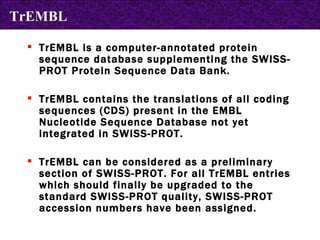
TrEMBL is a computer-annotated protein sequence database supplementing the SWISS-PROT Protein Sequence Data Bank.  TrEMBL contains the translations of all coding sequences (CDS) present in the EMBL Nucleotide Sequence Database not yet integrated in SWISS-PROT.  TrEMBL can be considered as a preliminary section of SWISS-PROT. For all TrEMBL entries which should finally be upgraded to the standard SWISS-PROT quality, SWISS-PROT accession numbers have been assigned. TrEMBL
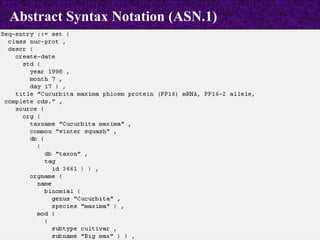
Abstract Syntax Notation (ASN.1)
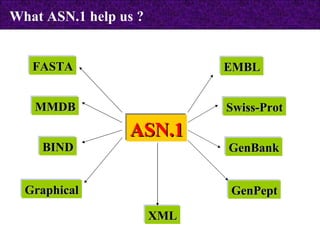
ASN.1 FASTA Graphical GenPept GenBank MMDB Swiss-Prot EMBL XML BIND What ASN.1 help us ?
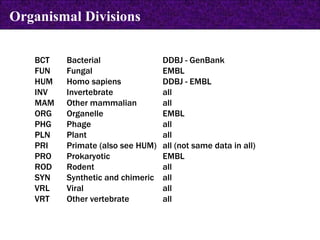
BCT Bacterial  DDBJ - GenBank FUN Fungal  EMBL HUM Homo sapiens  DDBJ - EMBL INV Invertebrate  all MAM Other mammalian  all ORG Organelle  EMBL PHG Phage  all PLN Plant  all PRI Primate (also see HUM) all (not same data in all) PRO Prokaryotic  EMBL ROD Rodent  all SYN Synthetic and chimeric  all VRL Viral  all VRT Other vertebrate  all Organismal Divisions
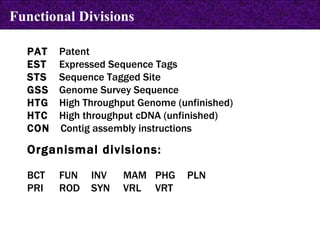
PAT Patent  EST Expressed Sequence Tags STS Sequence Tagged Site GSS Genome Survey Sequence  HTG High Throughput Genome (unfinished) HTC High throughput cDNA (unfinished) CON   Contig assembly instructions Organismal divisions: BCT FUN INV MAM PHG PLN PRI ROD SYN VRL VRT Functional Divisions
You need identifiers which are stable through time Need identifiers which will always refer to specific sequences Need these identifiers to track history of sequence updates Also need feature and annotation identifiers Identifiers
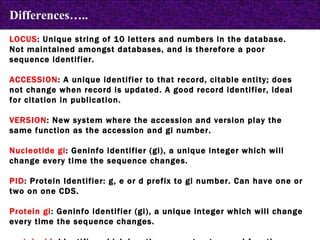
LOCUS : Unique string of 10 letters and numbers in the database.  Not maintained amongst databases, and is therefore a poor sequence identifier.  ACCESSION : A unique identifier to that record, citable entity; does not change when record is updated. A good record identifier, ideal for citation in publication. VERSION : New system where the accession and version play the same function as the accession and gi number.  Nucleotide gi : Geninfo identifier (gi), a unique integer which will change every time the sequence changes. PID : Protein Identifier: g, e or d prefix to gi number. Can have one or two on one CDS. Protein gi : Geninfo identifier (gi), a unique integer which will change every time the sequence changes. protein_id : Identifier which has the same structure and function as the nucleotide  Differences…..
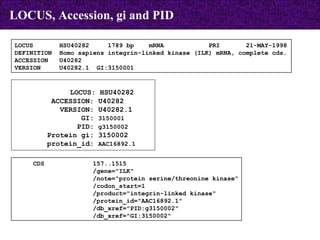
LOCUS  HSU40282  1789 bp  mRNA  PRI  21-MAY-1998 DEFINITION  Homo sapiens integrin-linked kinase (ILK) mRNA, complete cds. ACCESSION  U40282 VERSION  U40282.1  GI:3150001 CDS  157..1515 /gene="ILK" /note="protein serine/threonine kinase" /codon_start=1 /product="integrin-linked kinase" /protein_id="AAC16892.1" /db_xref="PID:g3150002" /db_xref="GI:3150002" LOCUS: HSU40282 ACCESSION: U40282 VERSION: U40282.1  GI:  3150001 PID:  g3150002 Protein gi: 3150002 protein_id:  AAC16892.1 LOCUS, Accession, gi and PID
Expressed Sequence Tags are short  (300-500 bp) single reads from mRNA (cDNA)  which are produced in large numbers.  They represent a snapshot of what is expressed  in a given tissue, and developmental stage. http://www.ncbi.nlm.nih.gov/dbEST/ http://www.ncbi.nlm.nih.gov/UniGene/ Expressed Sequence Tag (EST)
Sequenced Tagged Sites, are operationally  unique sequence that identifies the combination of primer pairs used in a PCR assay that generate a mapping reagent which maps to a single position within the genome. http://www.ncbi.nlm.nih.gov/dbSTS/ http://www.ncbi.nlm.nih.gov/genemap / STS
Genome Survey Sequences are similar in nature  to the ESTs, except that its sequences are genomic  in origin, rather than cDNA (mRNA).  The GSS division contains: random "single pass read" genome survey sequences. single pass reads from cosmid/BAC/YAC ends (these could be chromosome specific, but need not be) exon trapped genomic sequences Alu PCR sequences http://www.ncbi.nlm.nih.gov/dbGSS/ GSS
High Throughput Genome Sequences are  unfinished genome sequencing efforts records.  Unfinished records have gaps in the nucleotides sequence, low accuracy, and no annotations on the records.  http://www.ncbi.nlm.nih.gov/HTGS/ Ouellette and Boguski (1997)  Genome Res.  7:952-955 HTG
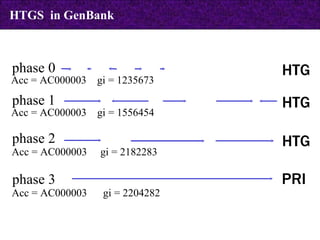
HTGS  in GenBank phase 1 HTG Acc = AC000003  gi = 1556454 phase 2 HTG Acc = AC000003  gi = 2182283 phase 3 PRI Acc = AC000003  gi = 2204282 phase 0 HTG Acc = AC000003  gi = 1235673
GenBank division for unfinished high-throughput cDNA sequencing (HTC). HTC sequences may have 5'UTR and 3'UTR at their ends, partial coding regions, and  introns .  A keyword of "HTC" will be present, in addition to division code "HTC". Those HTC sequences that undergo finishing (eg, re-sequencing) will move to the appropriate taxonomic GenBank division and the "HTC" keyword will be removed. HTC in GenBank
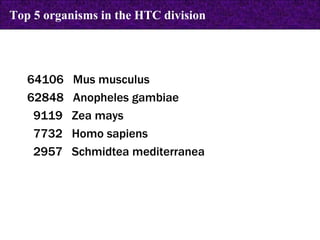
64106  Mus musculus 62848  Anopheles gambiae 9119  Zea mays 7732  Homo sapiens 2957  Schmidtea mediterranea Top 5 organisms in the HTC division
Contigs from ongoing Whole Genome Shotgun sequencing projects The nucleotides from WGS projects go into the BLAST ‘wgs’ database, whereas the proteins go into the BLAST nr database.   WGS in GenBank
Points to files that make the contig, does not actually contain sequence ‘ Invented’ by NCBI to deal with tracking of segmented sets and 350 KB limit in DDBJ/EMBL/GenBank CON in GenBank
LOCUS  AH007743  7832 bp  DNA  CON  26-MAY-1999 DEFINITION  Gallus gallus ornithine transcarbamylase (OTC) gene, complete cds. ACCESSION  AH007743 VERSION  AH007743.1  GI:4927367 KEYWORDS  . SOURCE  chicken. ORGANISM  Gallus gallus Eukaryota; Metazoa; Chordata; Craniata; Vertebrata; Archosauria; Aves; Neognathae; Galliformes; Phasianidae; Phasianinae; Gallus. [....] FEATURES  Location/Qualifiers source  1..7832 /organism="Gallus gallus" /db_xref="taxon:9031" /chromosome="1" CONTIG  join(AF065630.1:1..1903,gap(),AF065631.1:1..435,gap(), AF065632.1:1..509,gap(),AF065633.1:1..722,gap(),AF065634.1:1..707, gap(),AF065635.1:1..836,gap(),AF065636.1:1..1614,gap(), AF065637.1:1..605,gap(),AF065638.1:1..501) // CON in GenBank
SNPs SAGE tags RefSeq (Genomic, mRNA, or protein)  Consensus sequences Sequences NOT in GenBank
No longer publish sequences in Journal Electronic format , is most useful Allows validations testing of data best way to move Science forward Sequences sent to DDBJ/EMBL/GenBank are exchanged daily Best way to exchange new data, and updates Sequences to Public Databases
BankIt : Web based tool which is simple, easy to use, great for simple submissions, but not ideal for complicated ones. Sakura (DDBJ) WebIn (EMBL) Sequin : Client that you need to d/l to your computer, a little harder to learn, but has great documentation, and ideal for complicated, large, multiple submissions. tbl2asn : ideal for batch records, command line, scriptable, can work with sequin   Tools for Submission
Often only use FASTA files (eg for BLAST) GBFF are simply human readable versions of these records GBFF have become a vehicle for a lot more information than they where meant to do Keep in mind that GenBank is DNA centric and is a poor vehicle for protein and mRNA expression/interaction information Closing Notes….
Able to recognize various data formats, and know what their primary use is. Know, understand and utilize all types of sequence identifiers. Know and understand various feature types present in the GenBank flat files. Know and understand the various GenBank divisions.   Closing Notes….
Open access to sequences is not only essential for all of the work we do, if it was not there, there would be no bioinformatics, no BLAST, no CBW As critical as open access to sequence information is the open access to the literature. Closing Notes….
Thank You For Your Attention !!!

Biological databases

  • 1.
    S.Prasanth Kumar, BioinformaticianBiological Databases Bioinformatics and Biostatistics S.Prasanth Kumar, Bioinformatician S.Prasanth Kumar Dept. of Bioinformatics Applied Botany Centre (ABC) Gujarat University, Ahmedabad, INDIA www.facebook.com/Prasanth Sivakumar FOLLOW ME ON ACCESS MY RESOURCES IN SLIDESHARE prasanthperceptron CONTACT ME [email_address]
  • 2.
    Recognize various dataformats, and know what their primary use. Know, understand and utilize all types of sequence identifiers. Know and understand various feature types present in the GenBank flat files. Know and understand the various GenBank divisions. Main Objectives of Biological Databases
  • 3.
    Information system Query system Storage System Data Databases Architecture
  • 4.
    Information system Query system Storage System Data Databases Architecture GenBank flat file PDB file Interaction Record Title of a book Book
  • 5.
    Information system Query system Storage System Data Databases Architecture Boxes Oracle MySQL PC binary files Unix text files Bookshelves
  • 6.
    Information system Query system Storage System Data A List you look at A catalogue indexed files SQL grep Databases Architecture
  • 7.
    Information system Query system Storage System Data Databases Architecture The Google Entrez SRS
  • 8.
    Primary (archival) GenBank/EMBL/DDBJUniProt PDB Medline (PubMed) BIND Secondary (curated) RefSeq Taxon UniProt OMIM SGD Primary and Secondary Databases
  • 9.
  • 10.
    Primary DNA DDBJ/EMBL/GenBankPrimary protein GenPept/TrEMBL Curated DB RefSeq (Genomic, mRNA and protein) Swiss-Prot & PIR -> UniProt (protein) Sequence Databases
  • 11.
    GenBank is theNIH genetic sequence database of all publicly available DNA and derived protein sequences, with annotations describing the biological information http://www.ncbi.nlm.nih.gov/Genbank/GenbankOverview.html Benson et al ., 2004, Nucleic Acids Res . 32 :D23-D26 GenBank
  • 12.
  • 13.
    LOCUS MUSNGH 1803 bp mRNA ROD 29-AUG-1997 DEFINITION Mouse neuroblastoma and rat glioma hybridoma cell line NG108-15 cell TA20 mRNA, complete cds. ACCESSION D25291 NID g1850791 KEYWORDS neurite extension activity; growth arrest; TA20. SOURCE Murinae gen. sp. mouse neuroblastma-rat glioma hybridoma cell_line:NG108-15 cDNA to mRNA. ORGANISM Murinae gen. sp. Eukaryotae; mitochondrial eukaryotes; Metazoa; Chordata; Vertebrata; Mammalia; Eutheria; Rodentia; Sciurognathi; Muridae; Murinae. REFERENCE 1 (sites) AUTHORS Tohda,C., Nagai,S., Tohda,M. and Nomura,Y. TITLE A novel factor, TA20, involved in neuronal differentiation: cDNA cloning and expression JOURNAL Neurosci. Res. 23 (1), 21-27 (1995) MEDLINE 96064354 REFERENCE 3 (bases 1 to 1803) AUTHORS Tohda,C. TITLE Direct Submission JOURNAL Submitted (18-NOV-1993) to the DDBJ/EMBL/GenBank databases. Chihiro Tohda, Toyama Medical and Pharmaceutical University, Research Institute for Wakan-yaku, Analytical Research Center for Ethnomedicines; 2630 Sugitani, Toyama, Toyama 930-01, Japan (E-mail:CHIHIRO@ms.toyama-mpu.ac.jp, Tel:+81-764-34-2281(ex.2841), Fax:+81-764-34-5057) COMMENT On Feb 26, 1997 this sequence version replaced gi:793764. FEATURES Location/Qualifiers source 1..1803 /organism="Murinae gen. sp." /note="source origin of sequence, either mouse or rat, has not been identified" /db_xref="taxon:39108" /cell_line="NG108-15" /cell_type="mouse neuroblastma-rat glioma hybridoma" misc_signal 156..163 /note="AP-2 binding site" GC_signal 647..655 /note="Sp1 binding site" TATA_signal 694..701 gene 748..1311 /gene="TA20" CDS 748..1311 /gene="TA20" /function="neurite extensiion activity and growth arrest effect" /codon_start=1 /db_xref="PID:d1005516" /db_xref="PID:g793765" /translation="MMKLWVPSRSLPNSPNHYRSFLSHTLHIRYNNSLFISNTHLSRR KLRVTNPIYTRKRSLNIFYLLIPSCRTRLILWIIYIYRNLKHWSTSTVRSHSHSIYRL RPSMRTNIILRCHSYYKPPISHPIYWNNPSRMNLRGLLSRQSHLDPILRFPLHLTIYY RGPSNRSPPLPPRNRIKQPNRIKLRCR" polyA_site 1803 BASE COUNT 507 a 458 c 311 g 527 t ORIGIN 1 tcagtttttt tttttttttt tttttttttt tttttttttt tttttttttg ttgattcatg 61 tccgtttaca tttggtaagt tcacaggcct cagtcaacac aattggactg ctcaggaaat 121 cctccttggt gaccgcagta tacttggcct atgaacccaa gccacctatg gctaggtagg 181 agaagctcaa ctgtagggct gactttggaa gagaatgcac atggctgtat cgacatttca 241 catggtggac ctctggccag agtcagcagg ccgagggttc tcttccgggc tgctccctca 301 ctgcttgact ctgcgtcagt gcgtccatac tgtgggcgga cgttattgct atttgccttc 361 cattctgtac ggcattgcct ccatttagct ggagagggac agagcctggt tctctagggc 421 gtttccattg gggcctggtg acaatccaaa agatgagggc tccaaacacc agaatcagaa 481 ggcccagcgt atttgtaaaa acaccttctg gtgggaatga atggtacagg ggcgtttcag 541 gacaaagaac agcttttctg tcactcccat gagaaccgtc gcaatcactg ttccgaagag 601 gaggagtcca gaatacacgt gtatgggcat gacgattgcc cggagagagg cggagcccat 661 ggaagcagaa agacgaaaaa cacacccatt atttaaaatt attaaccact cattcattga 721 cctacctgcc ccatccaaca tttcatcatg atgaaacttt gggtcccttc taggagtctg 781 cctaatagtc caaatcatta caggtctttt cttagccata cactacacat cagatacaat 841 aacagccttt 1801 cat // GenBank Flat File (GBFF) Features (AA seq) DNA Sequence Header Title Taxonomy Citation
  • 14.
    From one-gene investigatorsOften a very well annotated cDNA A genomic segment from an new invertebrate A mitochondria or virus From population/phylogenetic analysis rRNA amplicon from environmental sampling From Genome Centers: Gene expression: Expressed Sequence Tags Full Length Insert cDNA Genome sequencing projects WGS HTG CON Types of files in GenBank
  • 15.
    New protein sequencedatabase that is the result of a merge from SWISS-PROT and PIR. It will be the annotated curated protein sequence database. Data in UniProt is primarily derived from coding sequence annotations in EMBL (GenBank/DDBJ) nucleic acid sequence data. UniProt is a Flat-File database just like EMBL and GenBank Flat-File format is SwissProt-like, or EMBL-like UniProt Consortium
  • 16.
    SWISS-PROT an annotated universal sequence database, TrEMBL an automatically generated sequence database with repository character, which supplements SWISS-PROT. SWISS-PROT [http://www.expasy.org/sprot/] a curated protein sequence database which provides a high level of annotation Types of Annotations: Description of a protein's function, its domain structure, PTMs, conflicts between literature references and variants. It also provides a minimal level of redundancy , a high level of integration with other bio molecular databases , and an extensive external documentation. (Created in 1986:Main Host-ExPaSy) Protein sequence databases
  • 17.
    SWISSPROT format Description Section Reference Section Comments Section
  • 18.
    Database Cross-Reference SectionKeyword Field Feature’s Table Sequence
  • 19.
    Genome Sequencing Projects SWISS-PROT annotators, who screen literature and sequence databases Increase in available raw sequence data Automatically populate SWISS-PROT with data of lower quality standards. TrEMBL (Translation of EMBL Nucleotide Sequence Database) Computer-annotated entries in SWISS-PROT-like format . It is populated by protein sequences translated from the coding sequences (CDS) in EMBL and is a supplement to SWISS-PROT Low quality annotations, No SWISSPROT, but trEMBL
  • 20.
  • 21.
    What you canexpect from SwissProt SWISS-PROT incorporates: Function of the protein Post-translational modification Domains and sites. Secondary structure. Quaternary structure. Similarities to other proteins; Diseases associated with deficiencies in the protein Sequence conflicts, variants, etc.
  • 22.
    TrEMBL is acomputer-annotated protein sequence database supplementing the SWISS-PROT Protein Sequence Data Bank. TrEMBL contains the translations of all coding sequences (CDS) present in the EMBL Nucleotide Sequence Database not yet integrated in SWISS-PROT. TrEMBL can be considered as a preliminary section of SWISS-PROT. For all TrEMBL entries which should finally be upgraded to the standard SWISS-PROT quality, SWISS-PROT accession numbers have been assigned. TrEMBL
  • 23.
  • 24.
    ASN.1 FASTA GraphicalGenPept GenBank MMDB Swiss-Prot EMBL XML BIND What ASN.1 help us ?
  • 25.
    BCT Bacterial DDBJ - GenBank FUN Fungal EMBL HUM Homo sapiens DDBJ - EMBL INV Invertebrate all MAM Other mammalian all ORG Organelle EMBL PHG Phage all PLN Plant all PRI Primate (also see HUM) all (not same data in all) PRO Prokaryotic EMBL ROD Rodent all SYN Synthetic and chimeric all VRL Viral all VRT Other vertebrate all Organismal Divisions
  • 26.
    PAT Patent EST Expressed Sequence Tags STS Sequence Tagged Site GSS Genome Survey Sequence HTG High Throughput Genome (unfinished) HTC High throughput cDNA (unfinished) CON Contig assembly instructions Organismal divisions: BCT FUN INV MAM PHG PLN PRI ROD SYN VRL VRT Functional Divisions
  • 27.
    You need identifierswhich are stable through time Need identifiers which will always refer to specific sequences Need these identifiers to track history of sequence updates Also need feature and annotation identifiers Identifiers
  • 28.
    LOCUS : Uniquestring of 10 letters and numbers in the database. Not maintained amongst databases, and is therefore a poor sequence identifier. ACCESSION : A unique identifier to that record, citable entity; does not change when record is updated. A good record identifier, ideal for citation in publication. VERSION : New system where the accession and version play the same function as the accession and gi number. Nucleotide gi : Geninfo identifier (gi), a unique integer which will change every time the sequence changes. PID : Protein Identifier: g, e or d prefix to gi number. Can have one or two on one CDS. Protein gi : Geninfo identifier (gi), a unique integer which will change every time the sequence changes. protein_id : Identifier which has the same structure and function as the nucleotide Differences…..
  • 29.
    LOCUS HSU40282 1789 bp mRNA PRI 21-MAY-1998 DEFINITION Homo sapiens integrin-linked kinase (ILK) mRNA, complete cds. ACCESSION U40282 VERSION U40282.1 GI:3150001 CDS 157..1515 /gene="ILK" /note="protein serine/threonine kinase" /codon_start=1 /product="integrin-linked kinase" /protein_id="AAC16892.1" /db_xref="PID:g3150002" /db_xref="GI:3150002" LOCUS: HSU40282 ACCESSION: U40282 VERSION: U40282.1 GI: 3150001 PID: g3150002 Protein gi: 3150002 protein_id: AAC16892.1 LOCUS, Accession, gi and PID
  • 30.
    Expressed Sequence Tagsare short (300-500 bp) single reads from mRNA (cDNA) which are produced in large numbers. They represent a snapshot of what is expressed in a given tissue, and developmental stage. http://www.ncbi.nlm.nih.gov/dbEST/ http://www.ncbi.nlm.nih.gov/UniGene/ Expressed Sequence Tag (EST)
  • 31.
    Sequenced Tagged Sites,are operationally unique sequence that identifies the combination of primer pairs used in a PCR assay that generate a mapping reagent which maps to a single position within the genome. http://www.ncbi.nlm.nih.gov/dbSTS/ http://www.ncbi.nlm.nih.gov/genemap / STS
  • 32.
    Genome Survey Sequencesare similar in nature to the ESTs, except that its sequences are genomic in origin, rather than cDNA (mRNA). The GSS division contains: random "single pass read" genome survey sequences. single pass reads from cosmid/BAC/YAC ends (these could be chromosome specific, but need not be) exon trapped genomic sequences Alu PCR sequences http://www.ncbi.nlm.nih.gov/dbGSS/ GSS
  • 33.
    High Throughput GenomeSequences are unfinished genome sequencing efforts records. Unfinished records have gaps in the nucleotides sequence, low accuracy, and no annotations on the records. http://www.ncbi.nlm.nih.gov/HTGS/ Ouellette and Boguski (1997) Genome Res. 7:952-955 HTG
  • 34.
    HTGS inGenBank phase 1 HTG Acc = AC000003 gi = 1556454 phase 2 HTG Acc = AC000003 gi = 2182283 phase 3 PRI Acc = AC000003 gi = 2204282 phase 0 HTG Acc = AC000003 gi = 1235673
  • 35.
    GenBank division forunfinished high-throughput cDNA sequencing (HTC). HTC sequences may have 5'UTR and 3'UTR at their ends, partial coding regions, and introns . A keyword of "HTC" will be present, in addition to division code "HTC". Those HTC sequences that undergo finishing (eg, re-sequencing) will move to the appropriate taxonomic GenBank division and the "HTC" keyword will be removed. HTC in GenBank
  • 36.
    64106 Musmusculus 62848 Anopheles gambiae 9119 Zea mays 7732 Homo sapiens 2957 Schmidtea mediterranea Top 5 organisms in the HTC division
  • 37.
    Contigs from ongoingWhole Genome Shotgun sequencing projects The nucleotides from WGS projects go into the BLAST ‘wgs’ database, whereas the proteins go into the BLAST nr database. WGS in GenBank
  • 38.
    Points to filesthat make the contig, does not actually contain sequence ‘ Invented’ by NCBI to deal with tracking of segmented sets and 350 KB limit in DDBJ/EMBL/GenBank CON in GenBank
  • 39.
    LOCUS AH007743 7832 bp DNA CON 26-MAY-1999 DEFINITION Gallus gallus ornithine transcarbamylase (OTC) gene, complete cds. ACCESSION AH007743 VERSION AH007743.1 GI:4927367 KEYWORDS . SOURCE chicken. ORGANISM Gallus gallus Eukaryota; Metazoa; Chordata; Craniata; Vertebrata; Archosauria; Aves; Neognathae; Galliformes; Phasianidae; Phasianinae; Gallus. [....] FEATURES Location/Qualifiers source 1..7832 /organism="Gallus gallus" /db_xref="taxon:9031" /chromosome="1" CONTIG join(AF065630.1:1..1903,gap(),AF065631.1:1..435,gap(), AF065632.1:1..509,gap(),AF065633.1:1..722,gap(),AF065634.1:1..707, gap(),AF065635.1:1..836,gap(),AF065636.1:1..1614,gap(), AF065637.1:1..605,gap(),AF065638.1:1..501) // CON in GenBank
  • 40.
    SNPs SAGE tagsRefSeq (Genomic, mRNA, or protein) Consensus sequences Sequences NOT in GenBank
  • 41.
    No longer publishsequences in Journal Electronic format , is most useful Allows validations testing of data best way to move Science forward Sequences sent to DDBJ/EMBL/GenBank are exchanged daily Best way to exchange new data, and updates Sequences to Public Databases
  • 42.
    BankIt : Webbased tool which is simple, easy to use, great for simple submissions, but not ideal for complicated ones. Sakura (DDBJ) WebIn (EMBL) Sequin : Client that you need to d/l to your computer, a little harder to learn, but has great documentation, and ideal for complicated, large, multiple submissions. tbl2asn : ideal for batch records, command line, scriptable, can work with sequin Tools for Submission
  • 43.
    Often only useFASTA files (eg for BLAST) GBFF are simply human readable versions of these records GBFF have become a vehicle for a lot more information than they where meant to do Keep in mind that GenBank is DNA centric and is a poor vehicle for protein and mRNA expression/interaction information Closing Notes….
  • 44.
    Able to recognizevarious data formats, and know what their primary use is. Know, understand and utilize all types of sequence identifiers. Know and understand various feature types present in the GenBank flat files. Know and understand the various GenBank divisions. Closing Notes….
  • 45.
    Open access tosequences is not only essential for all of the work we do, if it was not there, there would be no bioinformatics, no BLAST, no CBW As critical as open access to sequence information is the open access to the literature. Closing Notes….
  • 46.
    Thank You ForYour Attention !!!

Editor's Notes

  • #11 Others includes PDB GSDB REFGenes other sequences
  • #16 Includes some PIR sequences Combines/merges records from different organisms
  • #22 Includes some PIR sequences Combines/merges records from different organisms