
Emergence of Indian Tomato Yellow Leaf Curl Viral (TYLCV) Disease:  Insights from Evolutionary Divergence and  Molecular Prospects of Coat Protein   S. Prasanth Kumar 1 , Yogesh T. Jasrai* 1 , Himanshu A. Pandya 1  and Rakesh M. Rawal 2 1 Bioinformatics Laboratory, Department of Botany, USSC, Gujarat University, Ahmedabad- 380 009. 2 Division of Medicinal Chemistry and Pharmacogenomics, Department of Cancer  Biology, The Gujarat Cancer &  Research Institute (GCRI), Ahmedabad- 380 016. S. PRASANTH KUMAR   Bioinformatics  Laboratory,  Department of Botany,  Applied Botany Centre (ABC)  Gujarat University, Ahmedabad, INDIA Category: ORIGINAL RESEARCH PRESENTATION
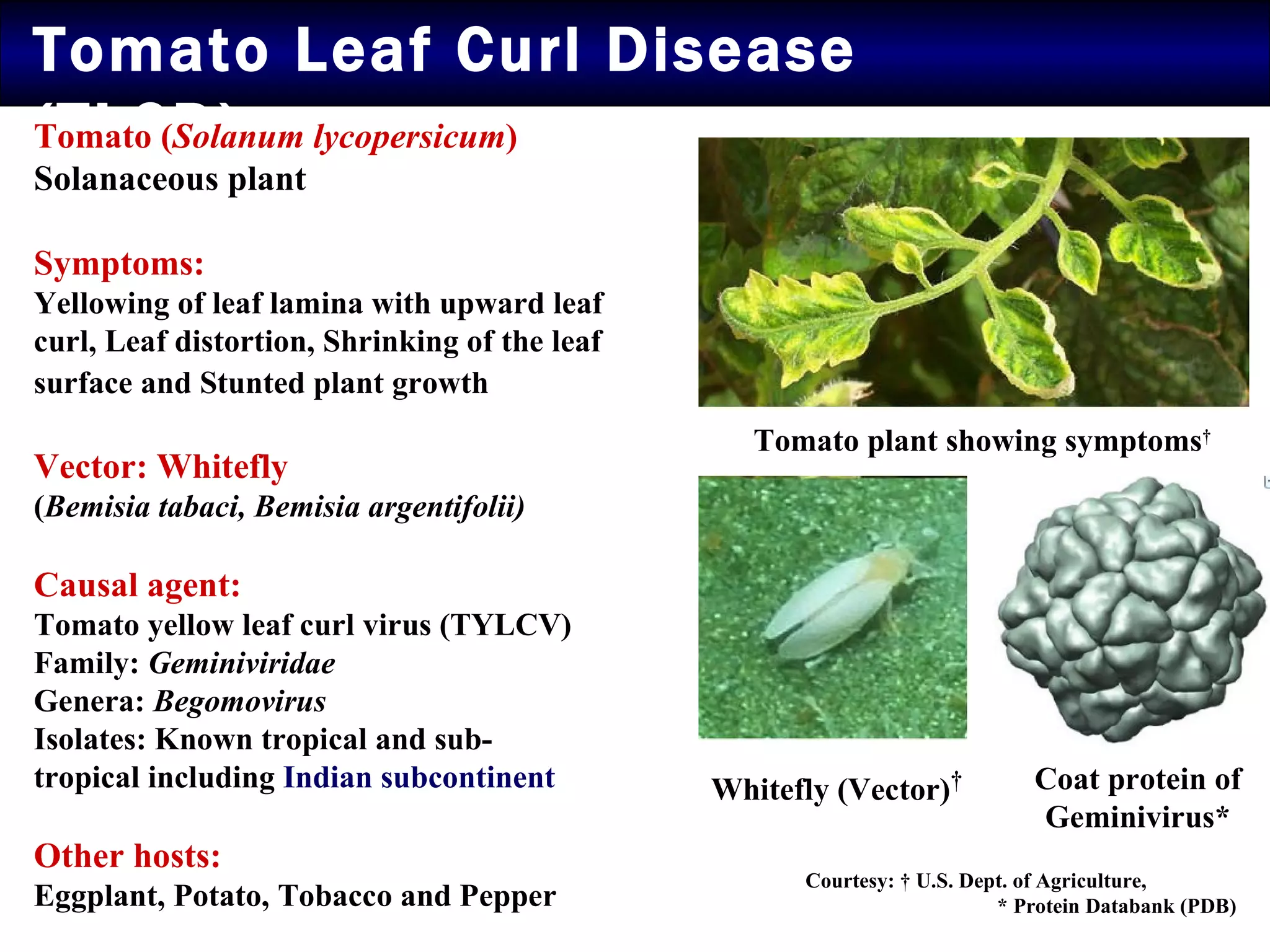
Tomato Leaf Curl Disease (TLCD) Tomato ( Solanum lycopersicum )   Solanaceous plant Symptoms:   Yellowing of leaf lamina with upward leaf curl, Leaf distortion, Shrinking of the leaf surface and Stunted plant growth   Vector: Whitefly   ( Bemisia tabaci, Bemisia argentifolii) Causal agent:  Tomato yellow leaf curl virus (TYLCV) Family:  Geminiviridae Genera:  Begomovirus   Isolates: Known tropical and sub-   tropical including  Indian subcontinent Other hosts:   Eggplant, Potato, Tobacco and Pepper Whitefly (Vector) † Tomato plant showing symptoms † Coat protein of Geminivirus* Courtesy: † U.S. Dept. of Agriculture,  * Protein Databank (PDB)
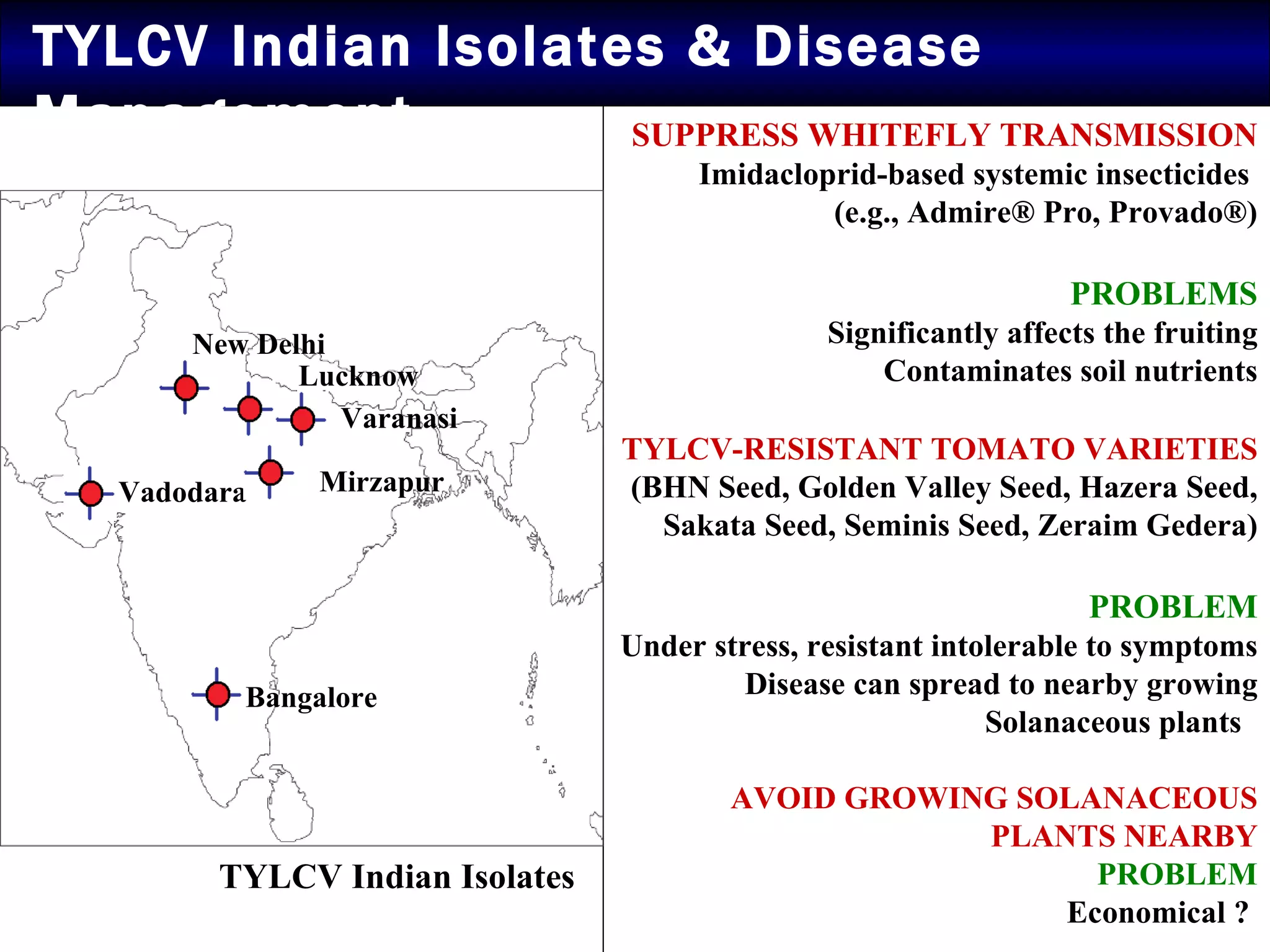
TYLCV Indian Isolates & Disease Management SUPPRESS WHITEFLY TRANSMISSION Imidacloprid-based systemic insecticides  (e.g., Admire® Pro, Provado®) PROBLEMS Significantly affects the fruiting Contaminates soil nutrients TYLCV-RESISTANT TOMATO VARIETIES (BHN Seed, Golden Valley Seed, Hazera Seed, Sakata Seed, Seminis Seed, Zeraim Gedera) PROBLEM Under stress, resistant intolerable to symptoms Disease can spread to nearby growing Solanaceous plants  AVOID GROWING SOLANACEOUS PLANTS NEARBY PROBLEM Economical ?  New Delhi Lucknow Varanasi Mirzapur Vadodara Bangalore TYLCV Indian Isolates
Objectives of the Study Examine the evolutionary background of Coat Protein from Indian strains. Study the molecular properties of coat protein facilitating its biochemical function, virulence.  Learn the electronic features of coat protein essential for interaction with a spectrum of bio-molecules  (ssDNA, dsDNA and virulence protein).    Characterize the hotspot specific amino acid mutations in making Indian isolates, a newly emerging factor for TYLCD.
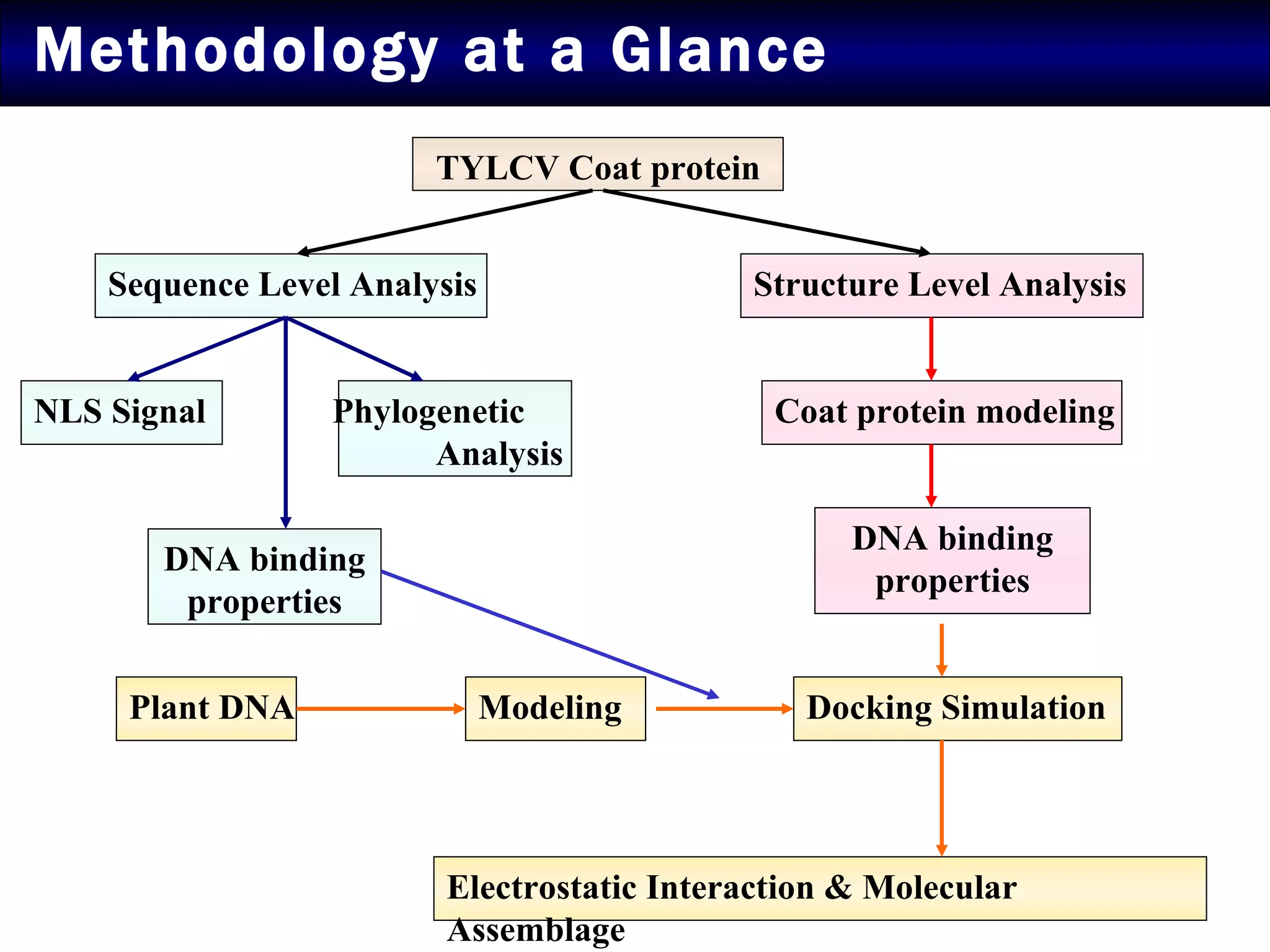
Methodology at a Glance TYLCV Coat protein Sequence Level Analysis NLS Signal Phylogenetic  Analysis DNA binding properties Structure Level Analysis DNA binding properties Coat protein modeling Plant DNA Modeling Docking Simulation Electrostatic Interaction & Molecular Assemblage
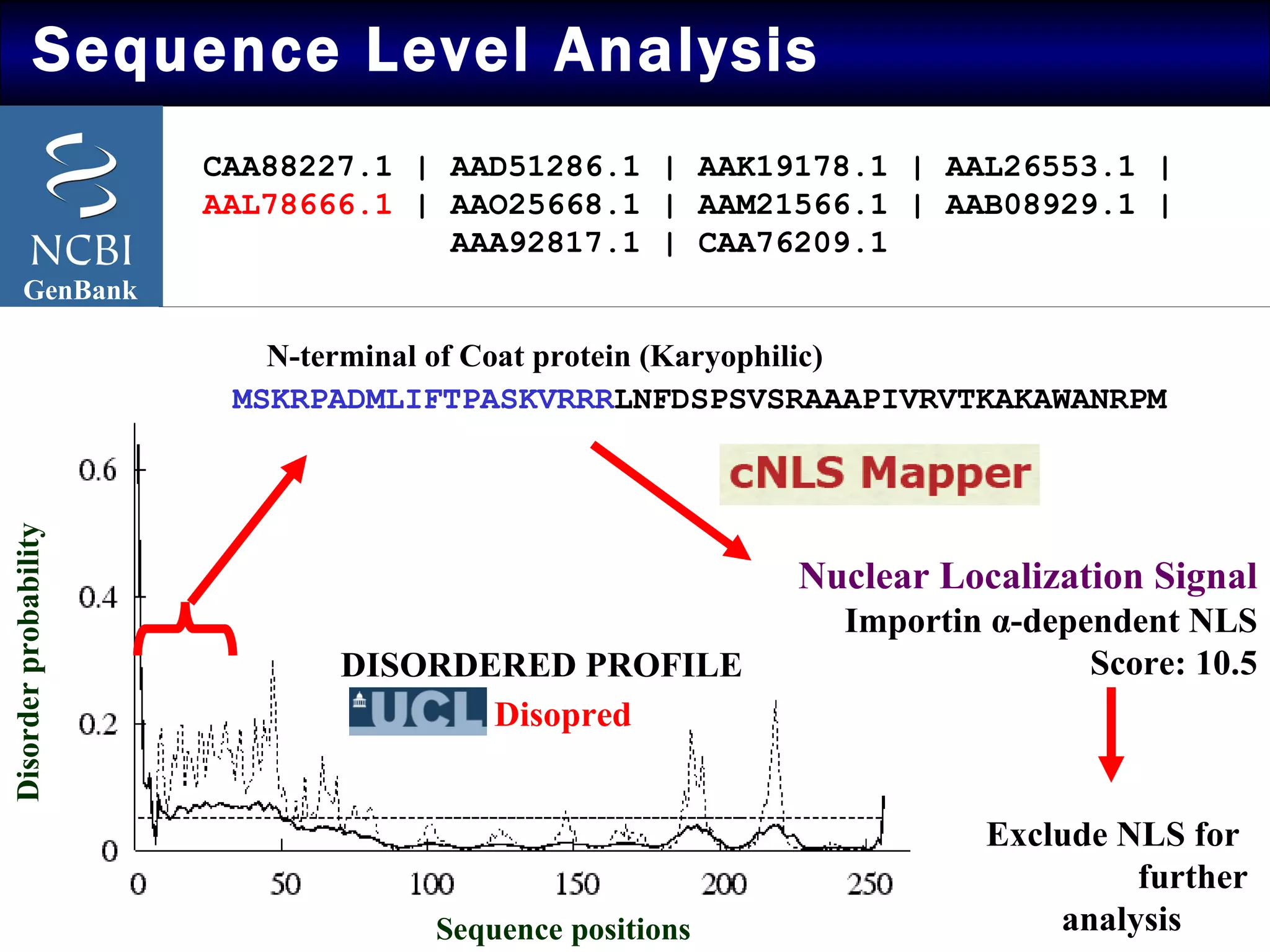
Sequence Level Analysis  GenBank CAA88227.1 | AAD51286.1 | AAK19178.1 | AAL26553.1 | AAL78666.1  | AAO25668.1 | AAM21566.1 | AAB08929.1 | AAA92817.1 | CAA76209.1 Sequence positions Disorder probability MSKRPADMLIFTPASKVRRR LNFDSPSVSRAAAPIVRVTKAKAWANRPM N-terminal of Coat protein (Karyophilic) DISORDERED PROFILE    Disopred   Nuclear Localization Signal   Importin  α -dependent NLS Score: 10.5 Exclude NLS for  further analysis
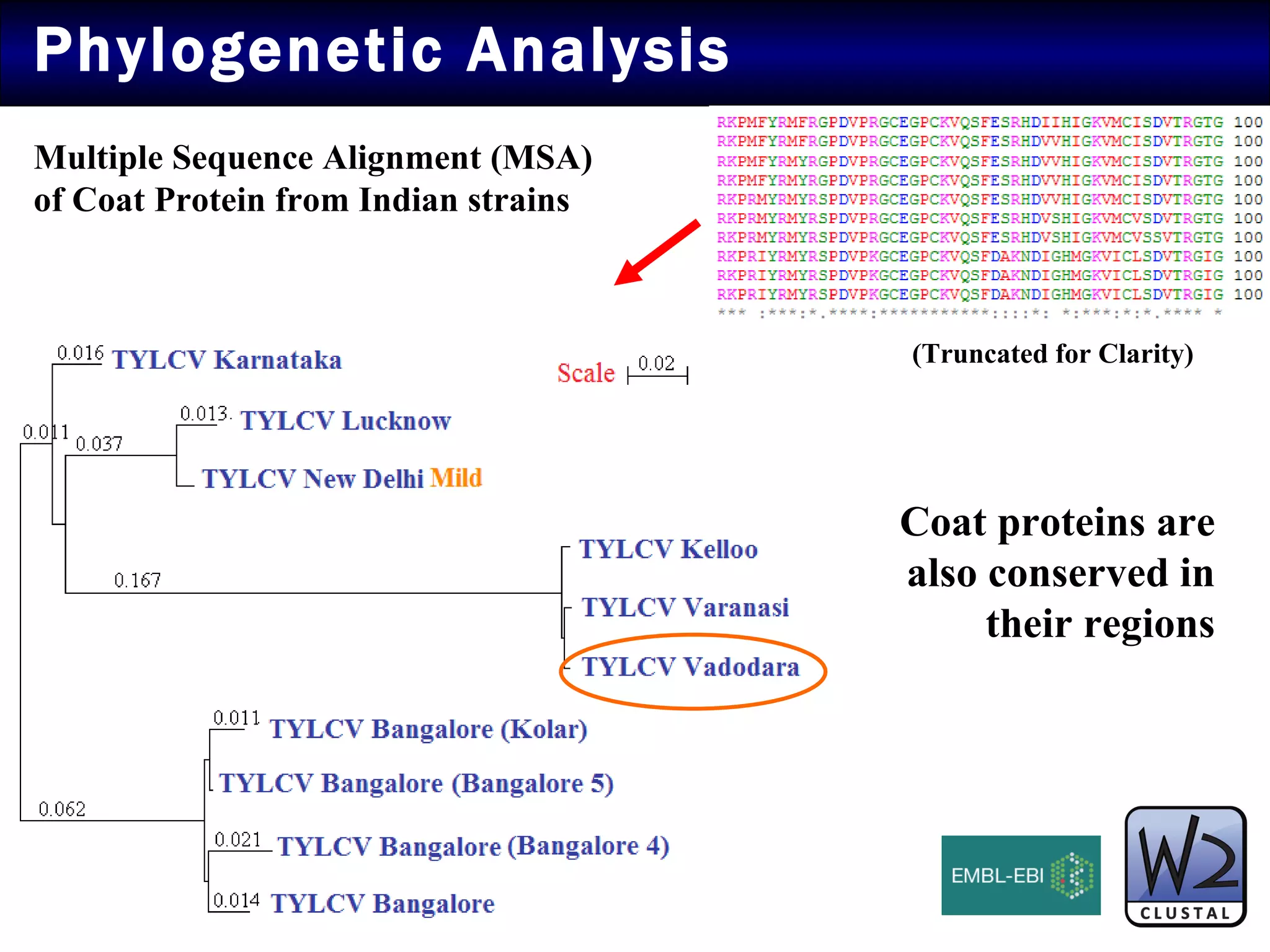
Phylogenetic Analysis  (Truncated for Clarity) Multiple Sequence Alignment (MSA)  of Coat Protein from Indian strains Coat proteins are also conserved in their regions
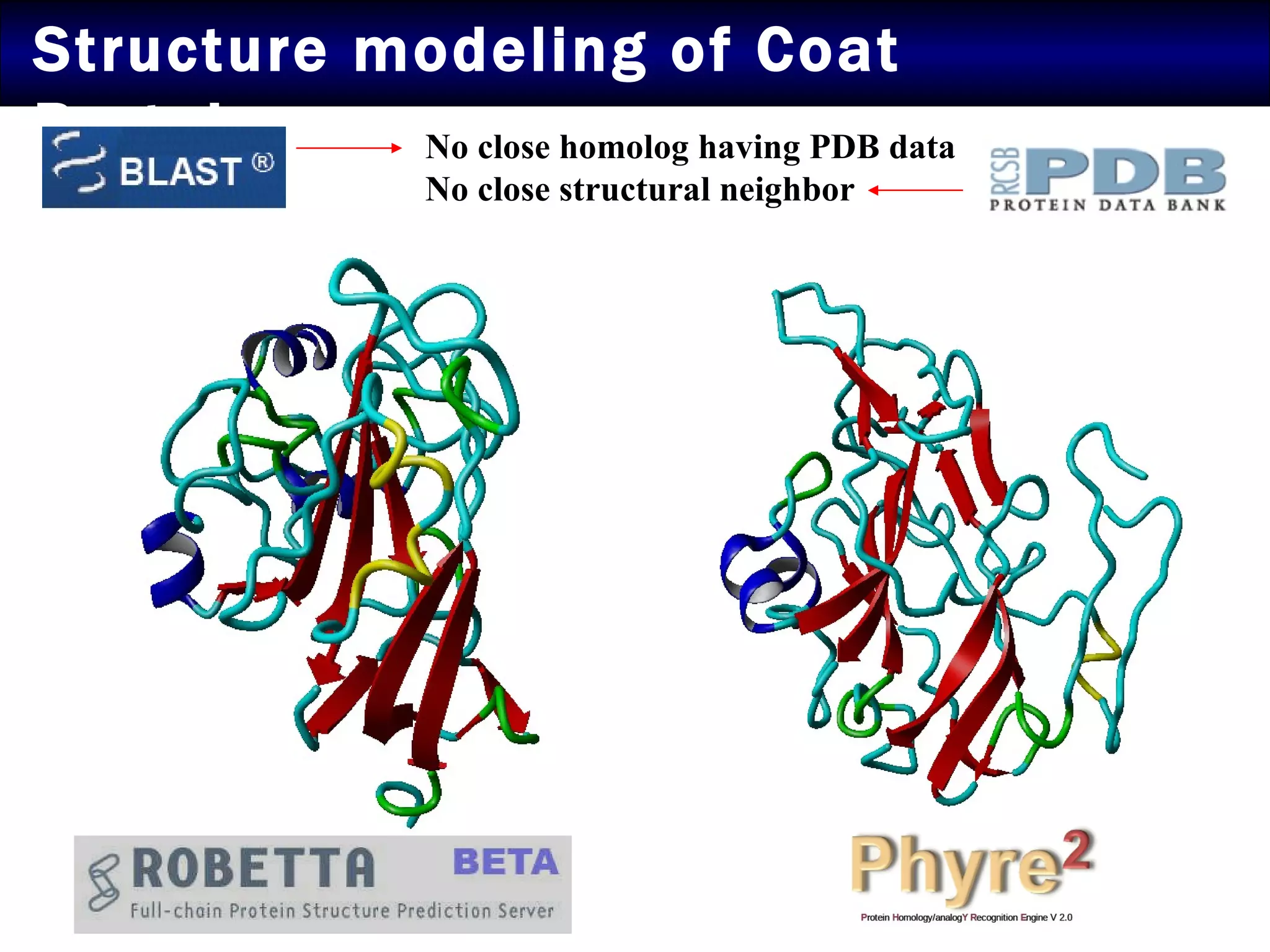
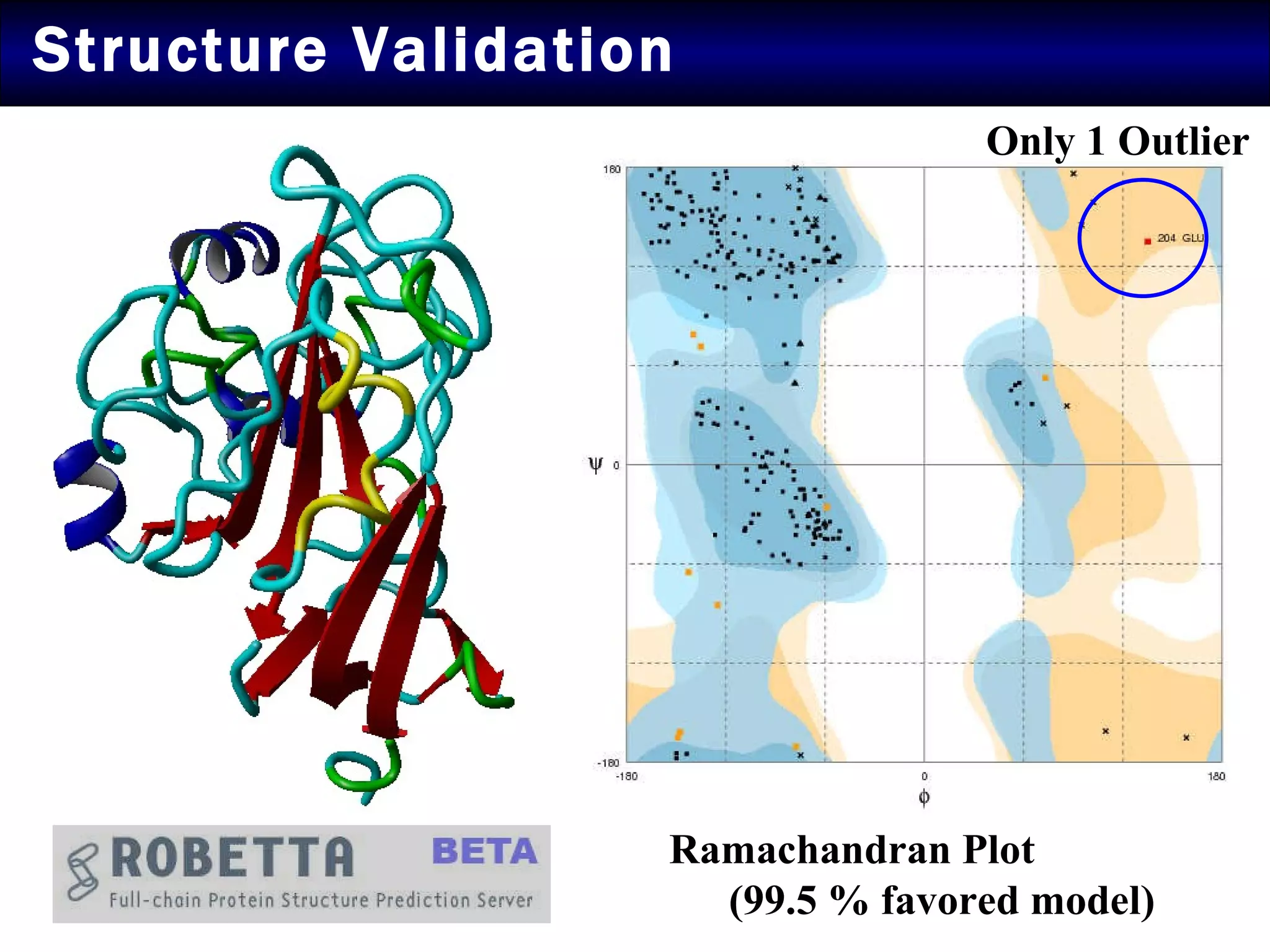
Structure modeling of Coat Protein  No close homolog having PDB data No close structural neighbor
Structure Validation  Only 1 Outlier Ramachandran Plot  (99.5 % favored model)
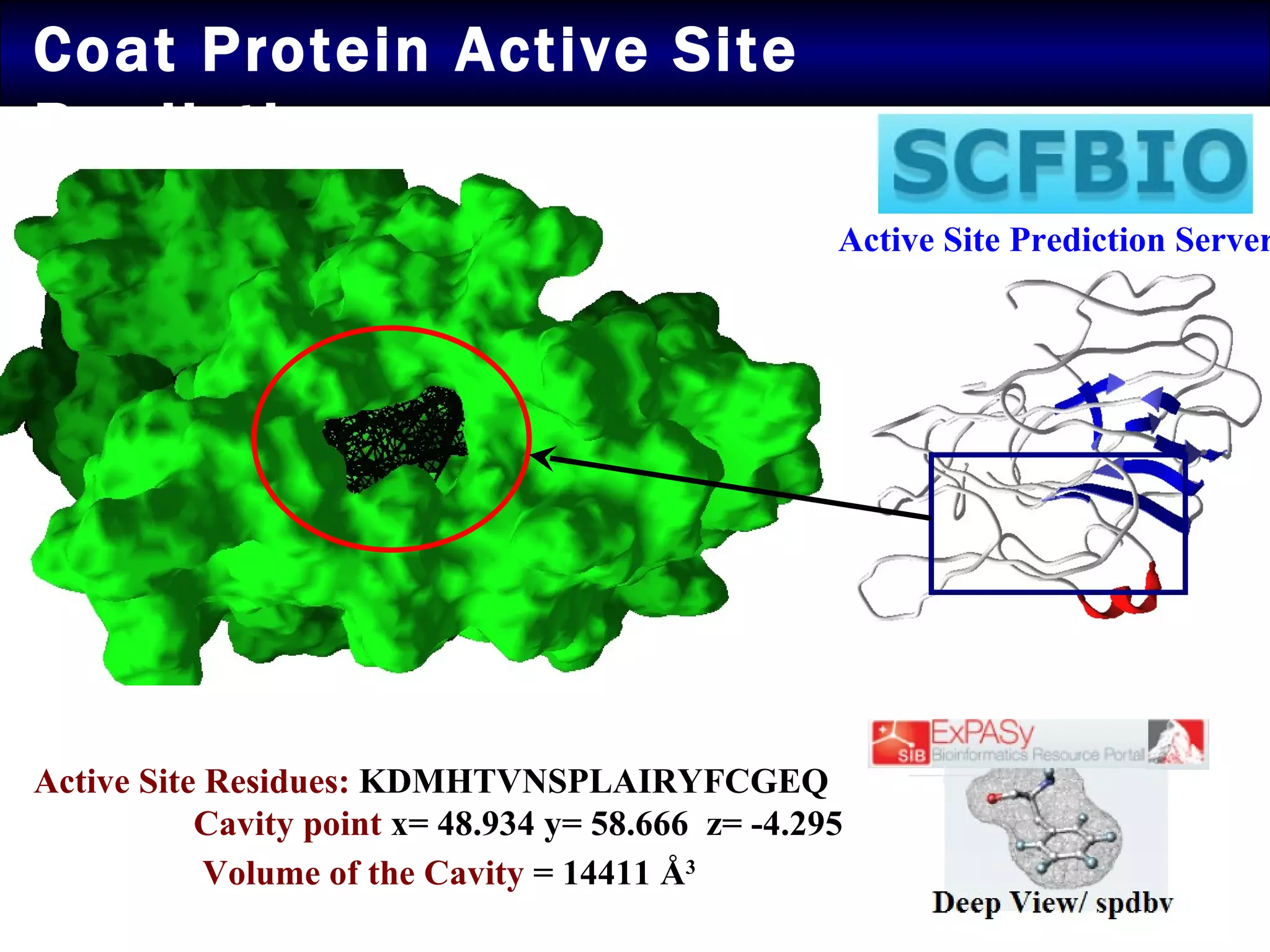
Coat Protein Active Site Prediction Active Site Prediction Server Active Site Residues:  KDMHTVNSPLAIRYFCGEQ  Cavity point  x= 48.934 y= 58.666  z= -4.295  Volume of the Cavity  = 14411  Å 3
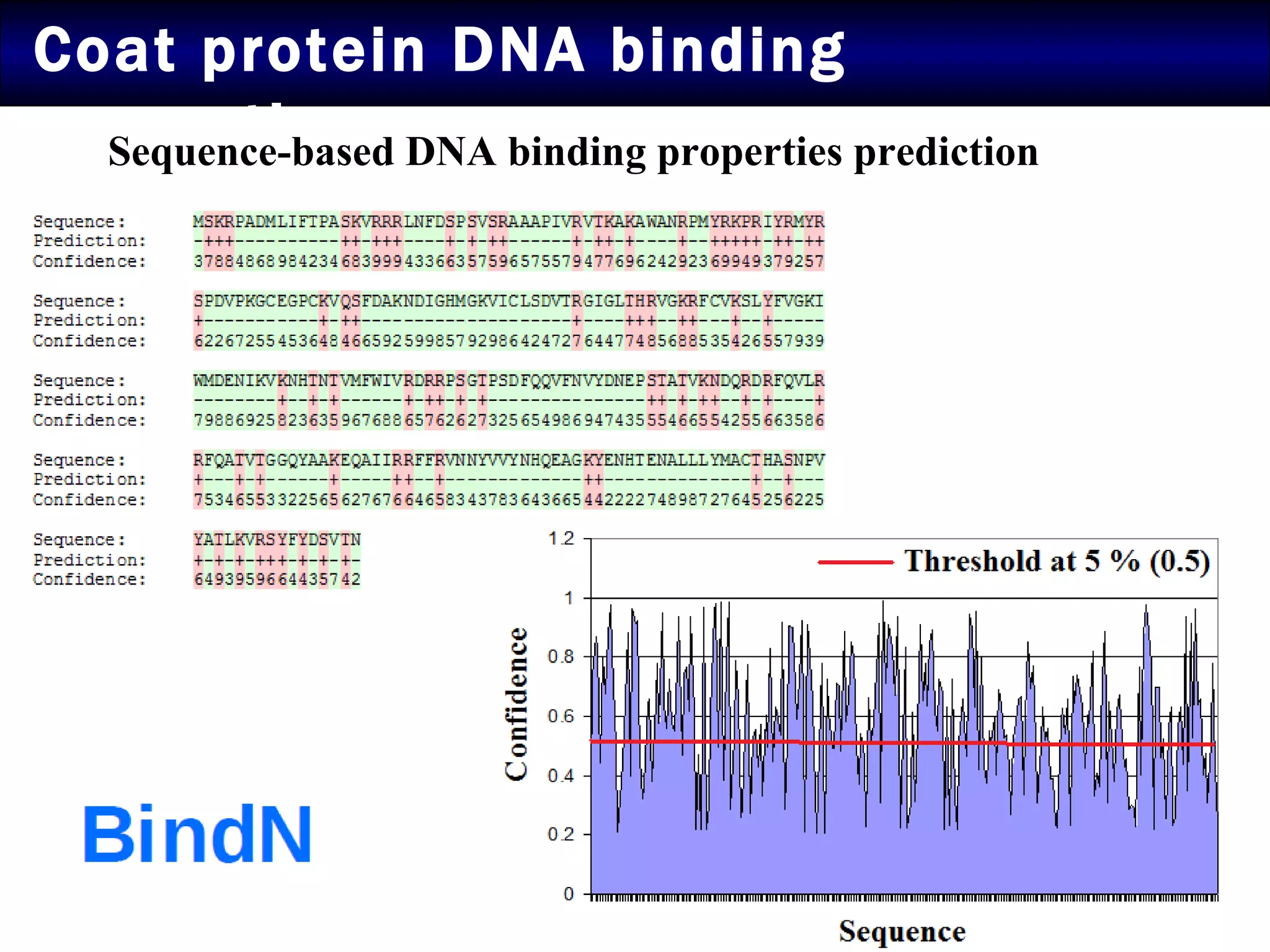
Coat protein DNA binding properties Sequence-based DNA binding properties prediction
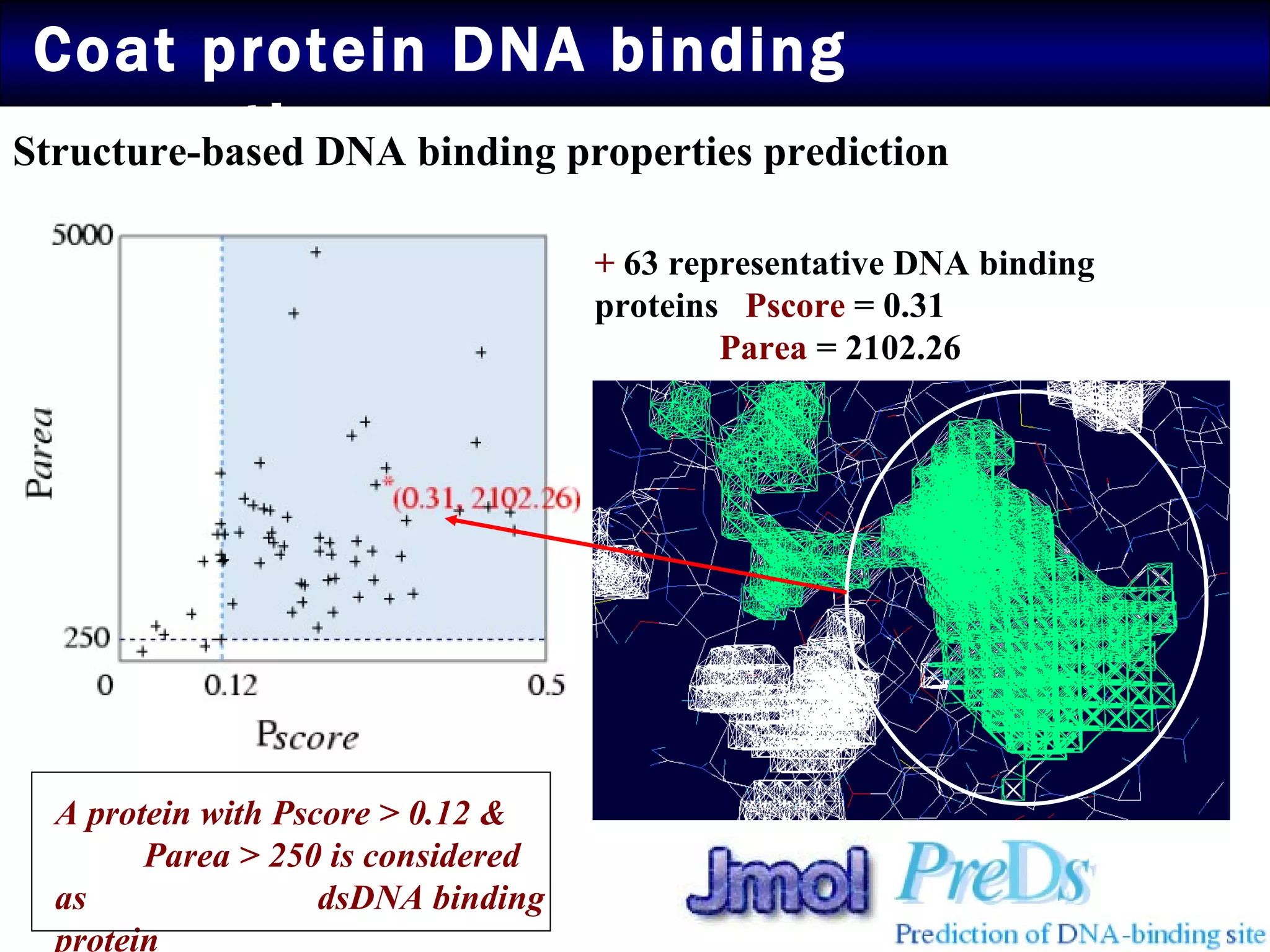
Coat protein DNA binding properties Structure-based DNA binding properties prediction +  63 representative DNA binding proteins  Pscore  = 0.31  Parea  = 2102.26  A protein with Pscore > 0.12 &  Parea > 250 is considered as  dsDNA binding protein
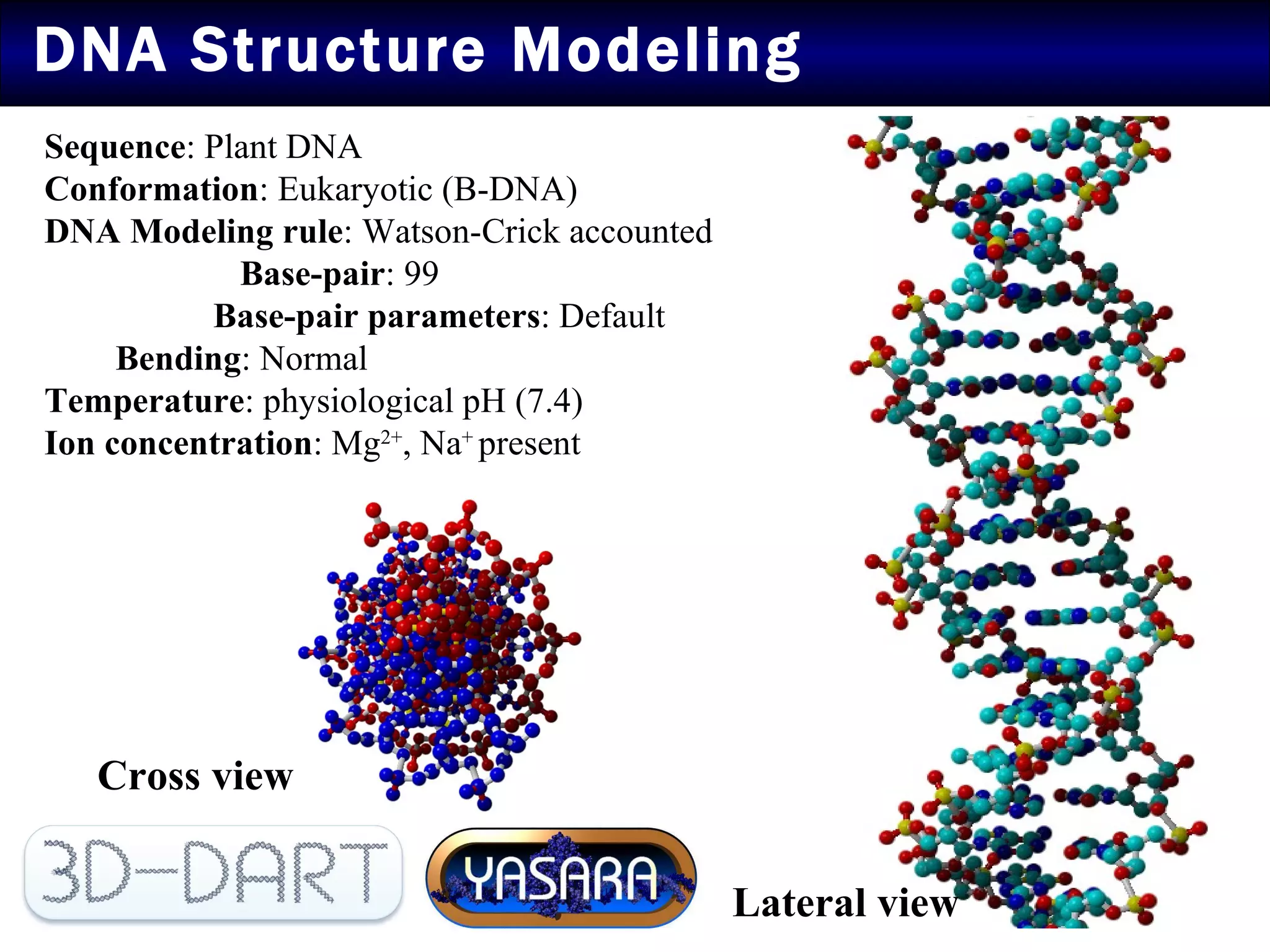
DNA Structure Modeling Sequence : Plant DNA  Conformation : Eukaryotic (B-DNA)  DNA Modeling rule : Watson-Crick accounted  Base-pair : 99  Base-pair parameters : Default  Bending : Normal  Temperature : physiological pH (7.4)  Ion concentration : Mg 2+ , Na +  present Cross view Lateral view
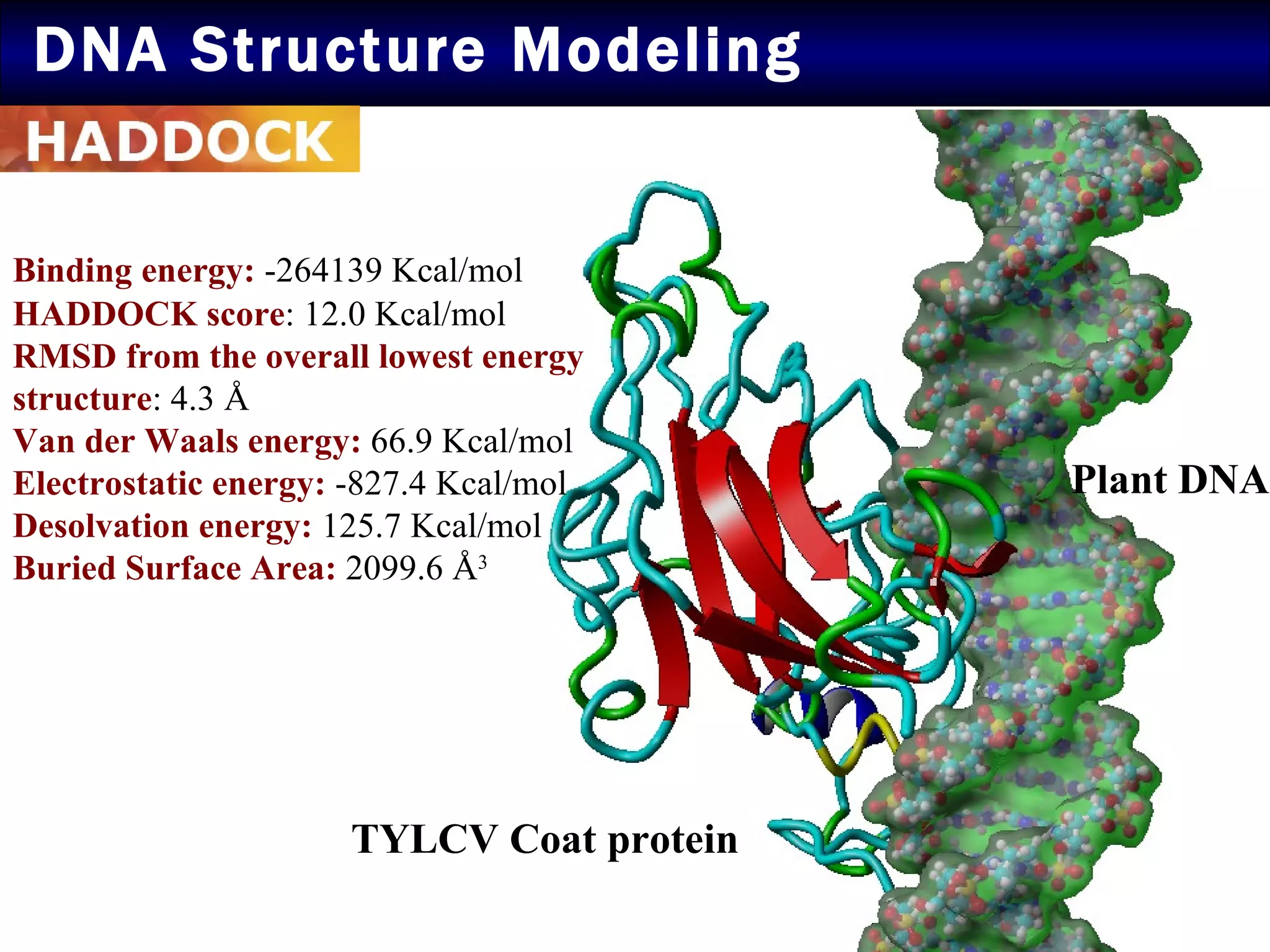
DNA Structure Modeling Plant DNA TYLCV Coat protein Binding energy:  -264139 Kcal/mol   HADDOCK score : 12.0 Kcal/mol RMSD from the overall lowest energy structure : 4.3 Å Van der Waals energy:  66.9 Kcal/mol Electrostatic energy:  -827.4 Kcal/mol Desolvation energy:  125.7 Kcal/mol  Buried Surface Area:  2099.6  Å 3
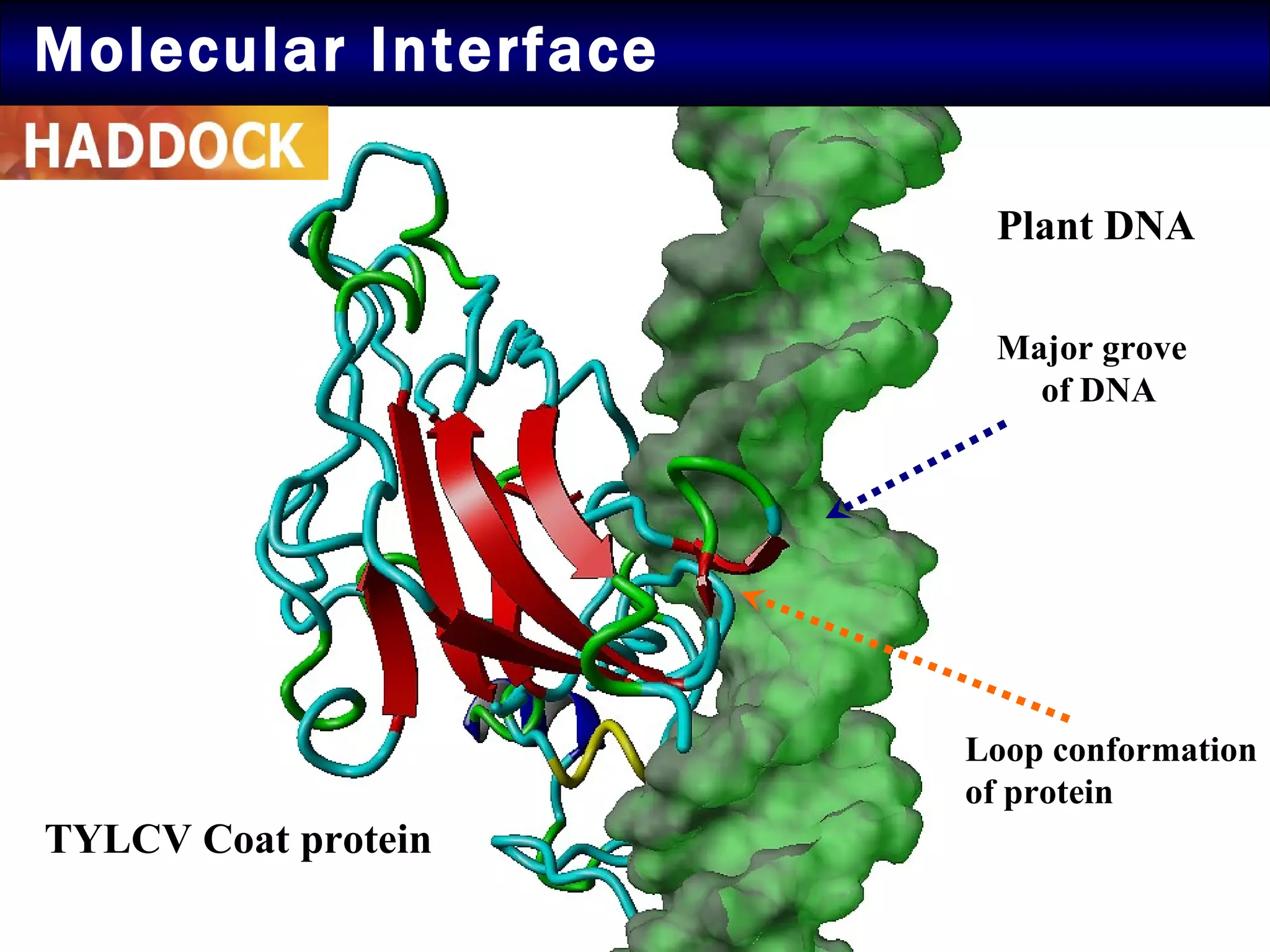
Molecular Interface Plant DNA TYLCV Coat protein Major grove  of DNA Loop conformation of protein
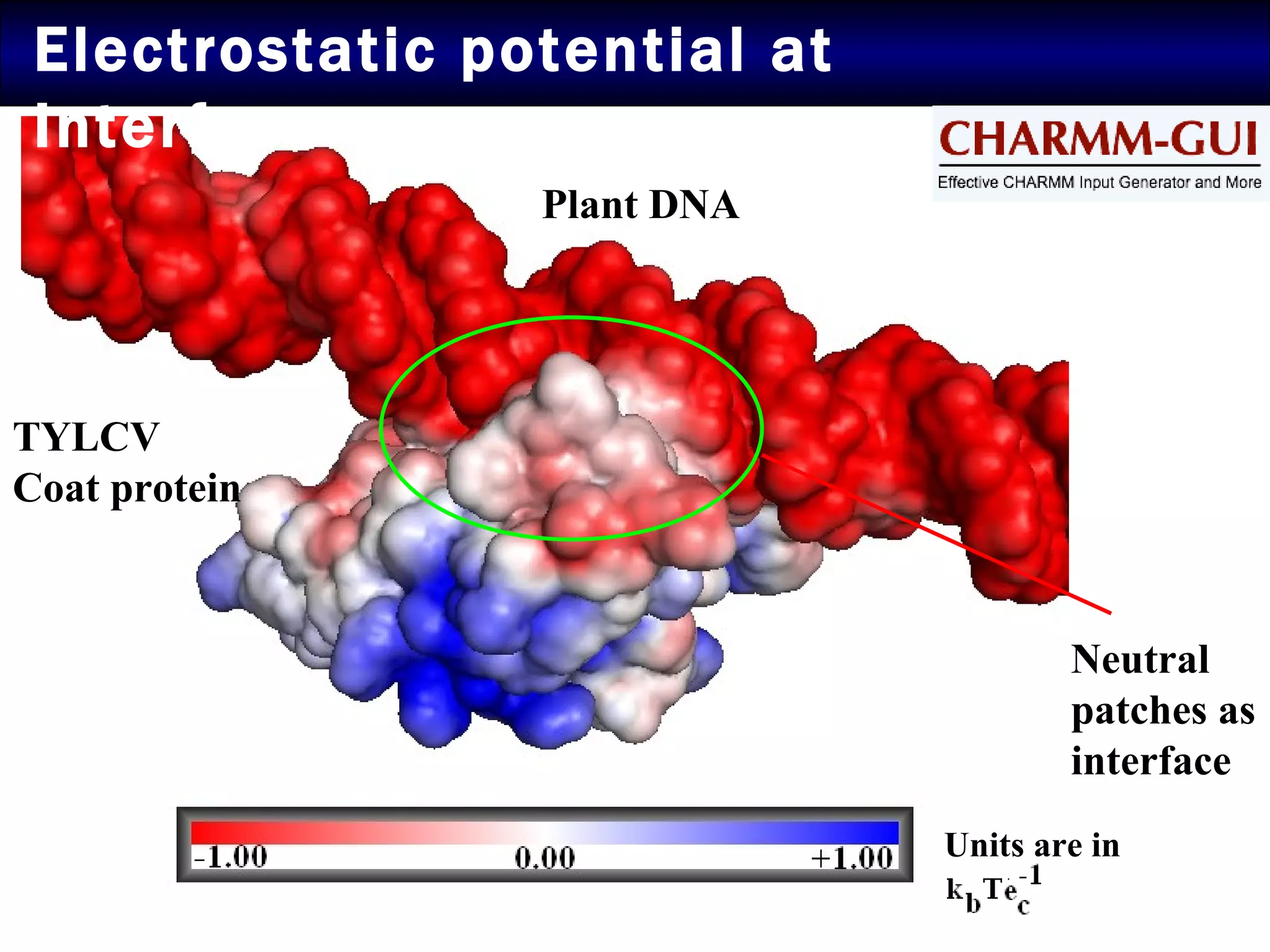
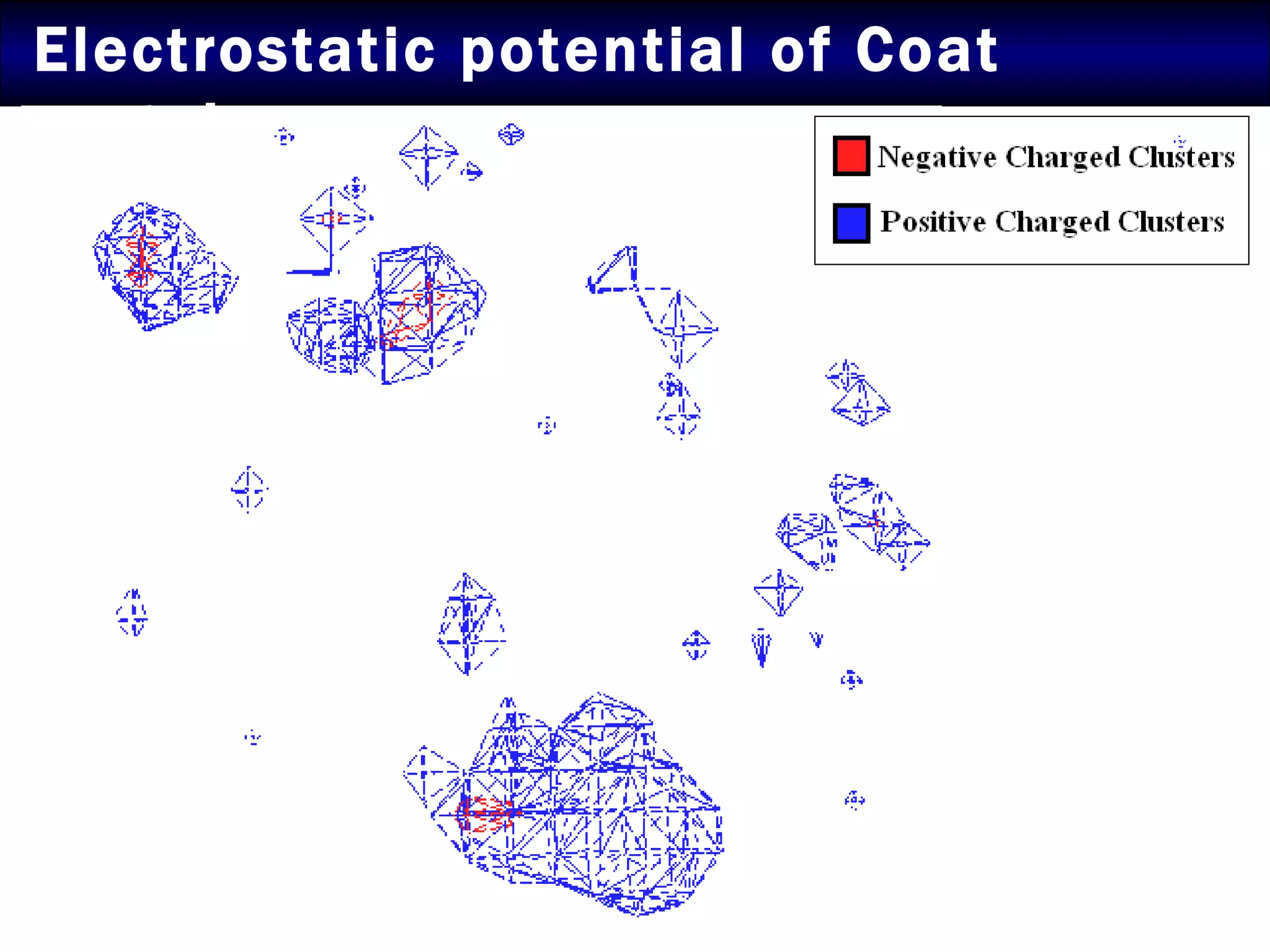
Electrostatic potential at Interface Units are in Plant DNA TYLCV Coat protein Neutral patches as interface
Electrostatic potential of Coat protein
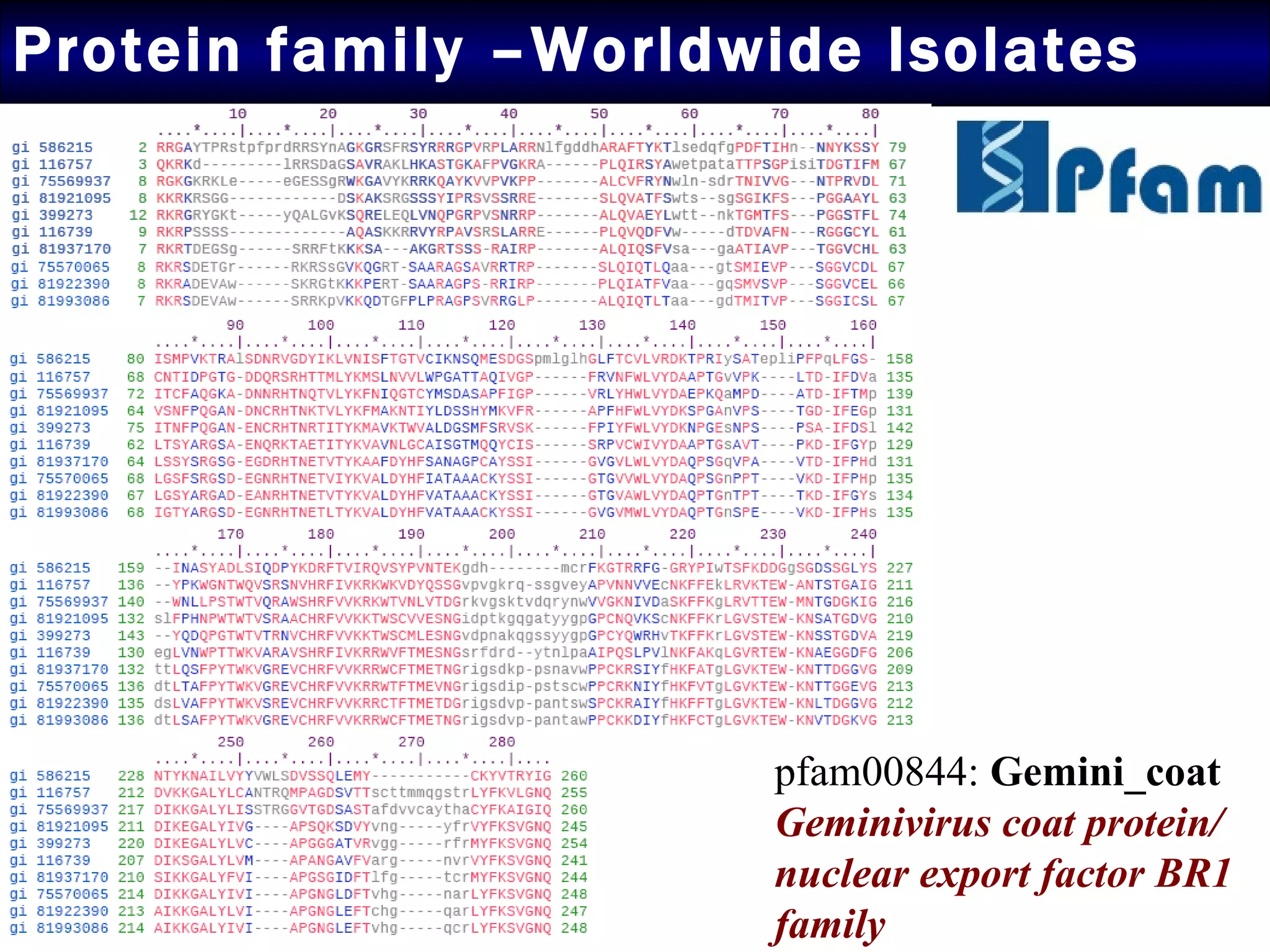
Protein family –Worldwide Isolates  pfam00844:  Gemini_coat  Geminivirus coat protein/ nuclear export factor BR1 family
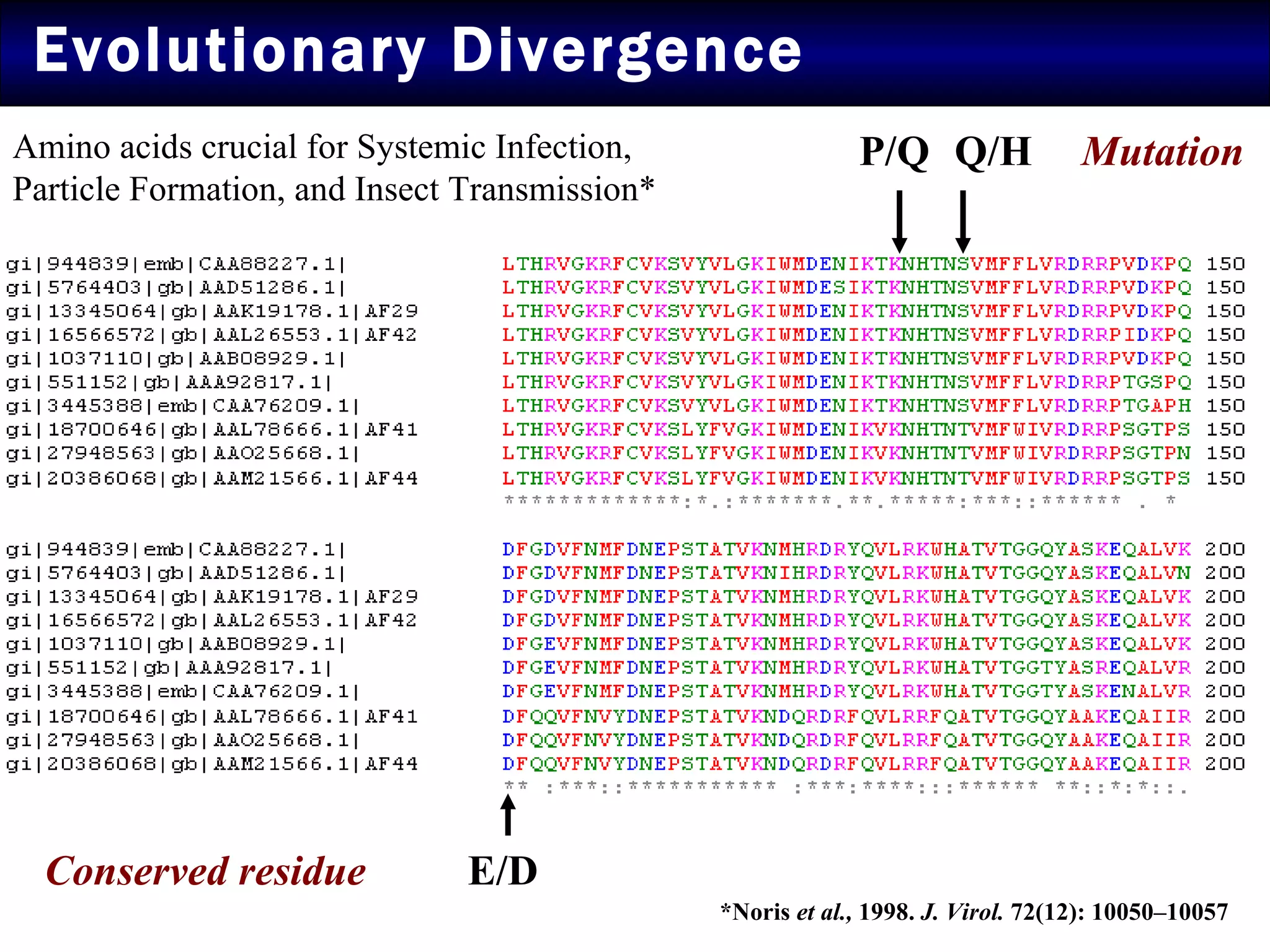
Evolutionary Divergence P/Q Q/H E/D Mutation Conserved residue Amino acids crucial for Systemic Infection, Particle Formation, and Insect Transmission* *Noris  et al.,  1998.  J. Virol.  72(12): 10050–10057
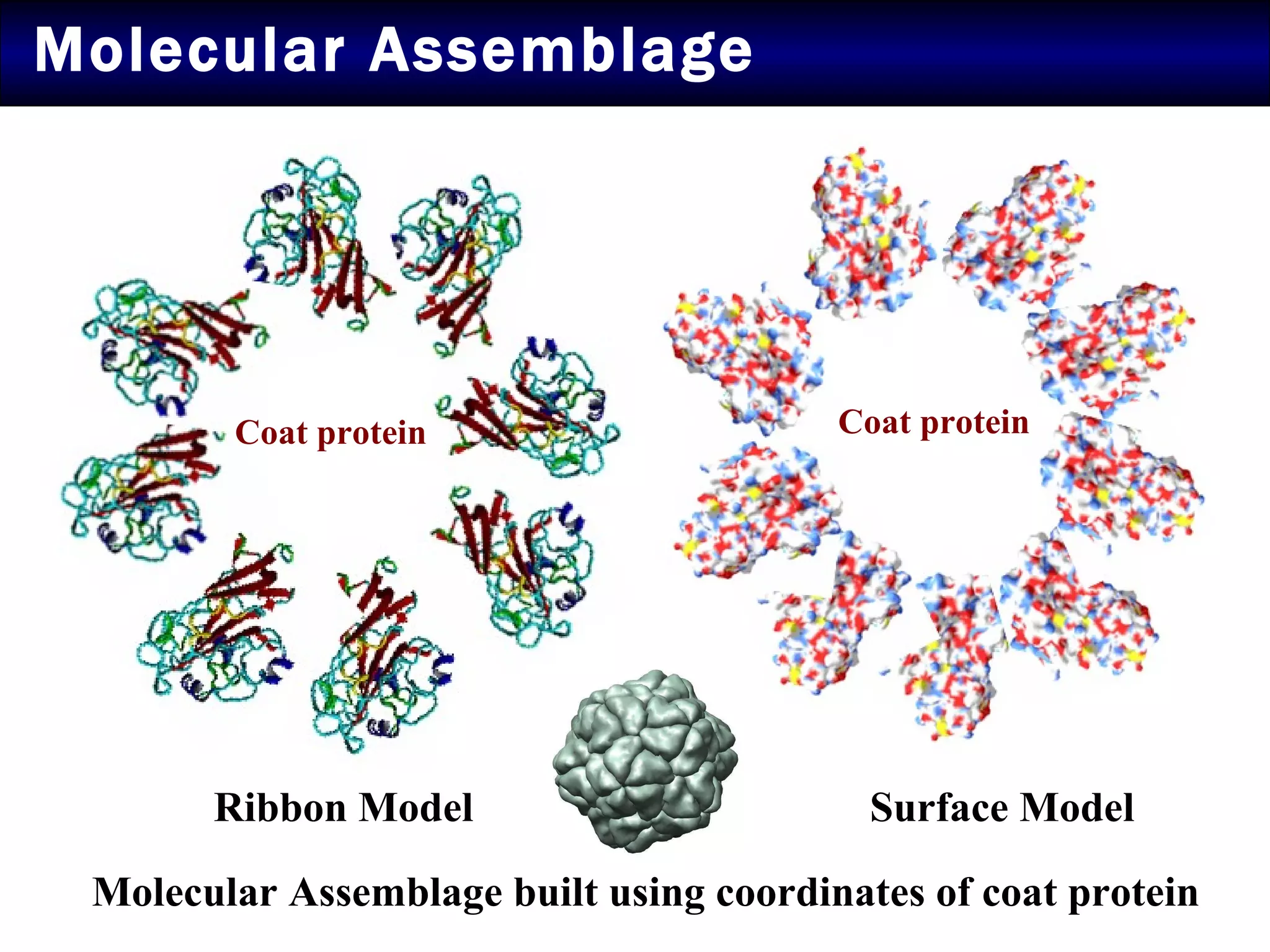
Molecular Assemblage Molecular Assemblage built using coordinates of coat protein Coat protein Coat protein Ribbon Model Surface Model
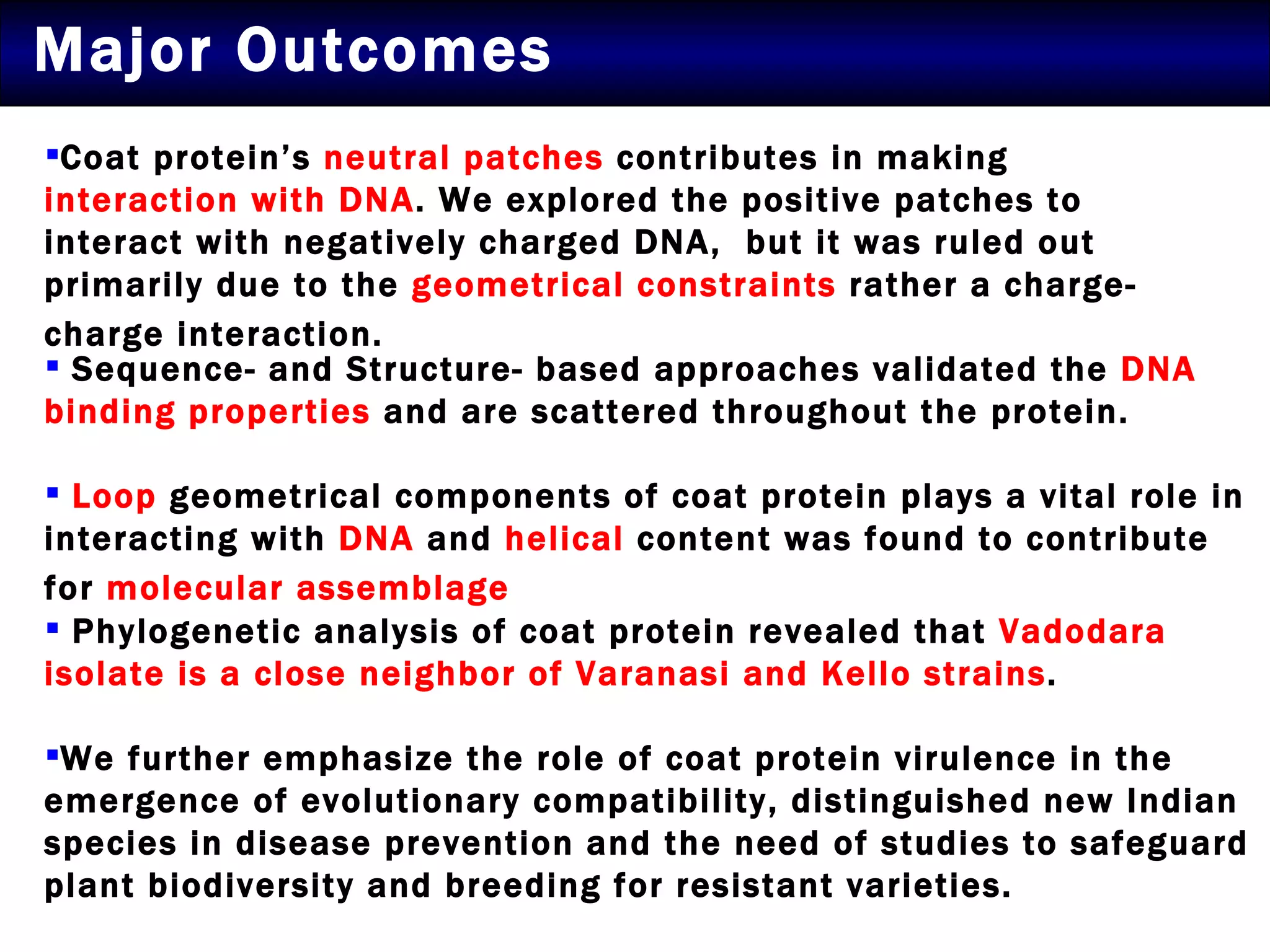
Major Outcomes TYLCV Indian isolates are  conserved among themselves and diverged with respect to geographical locations .  Amino acid  mutations  in the  hotspot of protein  (essential for systemic infection, particle formation and insect transmission) provides signs of evolutionary divergence.  Coat protein’s  N-terminal is karyophilic  in nature as demonstrated by NLS Signal and the member of a nuclear export family BR1 (result of Pfam annotation).  This karyophilic nature is further confirmed by Disordeness peak.  Coat protein beside virulence in nature, also known to  interact  NON-SPECIFICALLY  with other  viral proteins and double stranded DNA   (both viral and plasmid DNA  in vitro* ).  *Liu et al., 1997.  J. Gen. Virol  78, 1265–1270 .
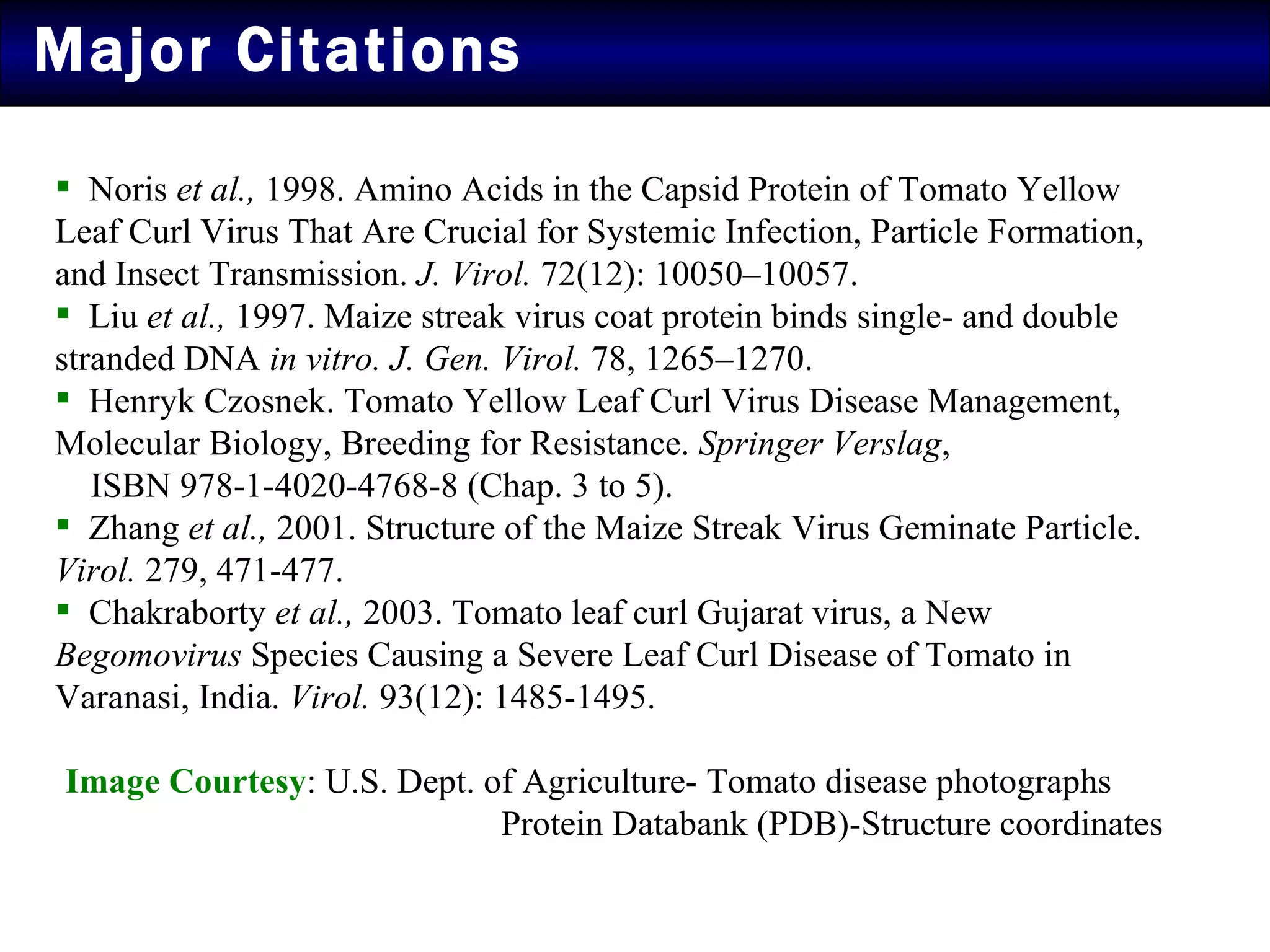
Major Outcomes Phylogenetic analysis of coat protein revealed that  Vadodara isolate is a close neighbor of Varanasi and Kello strains .  We further emphasize the role of coat protein virulence in the emergence of evolutionary compatibility, distinguished new Indian species in disease prevention and the need of studies to safeguard plant biodiversity and breeding for resistant varieties. Coat protein’s  neutral patches  contributes in making  interaction with DNA . We explored the positive patches to interact with negatively charged DNA,  but it was ruled out primarily due to the  geometrical constraints  rather a charge-charge interaction.   Sequence- and Structure- based approaches validated the  DNA binding properties  and are scattered throughout the protein.  Loop  geometrical components of coat protein plays a vital role in interacting with  DNA  and  helical  content was found to contribute for  molecular assemblage
Major Citations  Noris  et al.,  1998. Amino Acids in the Capsid Protein of Tomato Yellow Leaf Curl Virus That Are Crucial for Systemic Infection, Particle Formation, and Insect Transmission.  J. Virol.  72(12): 10050–10057.  Liu  et al.,  1997. Maize streak virus coat protein binds single- and double stranded DNA  in vitro. J. Gen. Virol.  78, 1265–1270. Henryk Czosnek. Tomato Yellow Leaf Curl Virus Disease Management, Molecular Biology, Breeding for Resistance.  Springer Verslag ,  ISBN 978-1-4020-4768-8 (Chap. 3 to 5). Zhang  et al.,  2001. Structure of the Maize Streak Virus Geminate Particle.  Virol.  279, 471-477.  Chakraborty  et al.,  2003. Tomato leaf curl Gujarat virus, a New  Begomovirus  Species Causing a Severe Leaf Curl Disease of Tomato in Varanasi, India.  Virol.  93(12): 1485-1495. Image Courtesy : U.S. Dept. of Agriculture- Tomato disease photographs  Protein Databank (PDB)-Structure coordinates
Thank you for your kind attention

S. prasanth kumar young scientist awarded presentation

  • 1.
    Emergence of IndianTomato Yellow Leaf Curl Viral (TYLCV) Disease: Insights from Evolutionary Divergence and Molecular Prospects of Coat Protein S. Prasanth Kumar 1 , Yogesh T. Jasrai* 1 , Himanshu A. Pandya 1 and Rakesh M. Rawal 2 1 Bioinformatics Laboratory, Department of Botany, USSC, Gujarat University, Ahmedabad- 380 009. 2 Division of Medicinal Chemistry and Pharmacogenomics, Department of Cancer Biology, The Gujarat Cancer & Research Institute (GCRI), Ahmedabad- 380 016. S. PRASANTH KUMAR Bioinformatics Laboratory, Department of Botany, Applied Botany Centre (ABC) Gujarat University, Ahmedabad, INDIA Category: ORIGINAL RESEARCH PRESENTATION
  • 2.
    Tomato Leaf CurlDisease (TLCD) Tomato ( Solanum lycopersicum ) Solanaceous plant Symptoms: Yellowing of leaf lamina with upward leaf curl, Leaf distortion, Shrinking of the leaf surface and Stunted plant growth Vector: Whitefly ( Bemisia tabaci, Bemisia argentifolii) Causal agent: Tomato yellow leaf curl virus (TYLCV) Family: Geminiviridae Genera: Begomovirus Isolates: Known tropical and sub- tropical including Indian subcontinent Other hosts: Eggplant, Potato, Tobacco and Pepper Whitefly (Vector) † Tomato plant showing symptoms † Coat protein of Geminivirus* Courtesy: † U.S. Dept. of Agriculture, * Protein Databank (PDB)
  • 3.
    TYLCV Indian Isolates& Disease Management SUPPRESS WHITEFLY TRANSMISSION Imidacloprid-based systemic insecticides (e.g., Admire® Pro, Provado®) PROBLEMS Significantly affects the fruiting Contaminates soil nutrients TYLCV-RESISTANT TOMATO VARIETIES (BHN Seed, Golden Valley Seed, Hazera Seed, Sakata Seed, Seminis Seed, Zeraim Gedera) PROBLEM Under stress, resistant intolerable to symptoms Disease can spread to nearby growing Solanaceous plants AVOID GROWING SOLANACEOUS PLANTS NEARBY PROBLEM Economical ? New Delhi Lucknow Varanasi Mirzapur Vadodara Bangalore TYLCV Indian Isolates
  • 4.
    Objectives of theStudy Examine the evolutionary background of Coat Protein from Indian strains. Study the molecular properties of coat protein facilitating its biochemical function, virulence. Learn the electronic features of coat protein essential for interaction with a spectrum of bio-molecules (ssDNA, dsDNA and virulence protein). Characterize the hotspot specific amino acid mutations in making Indian isolates, a newly emerging factor for TYLCD.
  • 5.
    Methodology at aGlance TYLCV Coat protein Sequence Level Analysis NLS Signal Phylogenetic Analysis DNA binding properties Structure Level Analysis DNA binding properties Coat protein modeling Plant DNA Modeling Docking Simulation Electrostatic Interaction & Molecular Assemblage
  • 6.
    Sequence Level Analysis GenBank CAA88227.1 | AAD51286.1 | AAK19178.1 | AAL26553.1 | AAL78666.1 | AAO25668.1 | AAM21566.1 | AAB08929.1 | AAA92817.1 | CAA76209.1 Sequence positions Disorder probability MSKRPADMLIFTPASKVRRR LNFDSPSVSRAAAPIVRVTKAKAWANRPM N-terminal of Coat protein (Karyophilic) DISORDERED PROFILE Disopred Nuclear Localization Signal Importin α -dependent NLS Score: 10.5 Exclude NLS for further analysis
  • 7.
    Phylogenetic Analysis (Truncated for Clarity) Multiple Sequence Alignment (MSA) of Coat Protein from Indian strains Coat proteins are also conserved in their regions
  • 8.
    Structure modeling ofCoat Protein No close homolog having PDB data No close structural neighbor
  • 9.
    Structure Validation Only 1 Outlier Ramachandran Plot (99.5 % favored model)
  • 10.
    Coat Protein ActiveSite Prediction Active Site Prediction Server Active Site Residues: KDMHTVNSPLAIRYFCGEQ Cavity point x= 48.934 y= 58.666 z= -4.295 Volume of the Cavity = 14411 Å 3
  • 11.
    Coat protein DNAbinding properties Sequence-based DNA binding properties prediction
  • 12.
    Coat protein DNAbinding properties Structure-based DNA binding properties prediction + 63 representative DNA binding proteins Pscore = 0.31 Parea = 2102.26 A protein with Pscore > 0.12 & Parea > 250 is considered as dsDNA binding protein
  • 13.
    DNA Structure ModelingSequence : Plant DNA Conformation : Eukaryotic (B-DNA) DNA Modeling rule : Watson-Crick accounted Base-pair : 99 Base-pair parameters : Default Bending : Normal Temperature : physiological pH (7.4) Ion concentration : Mg 2+ , Na + present Cross view Lateral view
  • 14.
    DNA Structure ModelingPlant DNA TYLCV Coat protein Binding energy: -264139 Kcal/mol HADDOCK score : 12.0 Kcal/mol RMSD from the overall lowest energy structure : 4.3 Å Van der Waals energy: 66.9 Kcal/mol Electrostatic energy: -827.4 Kcal/mol Desolvation energy: 125.7 Kcal/mol Buried Surface Area: 2099.6 Å 3
  • 15.
    Molecular Interface PlantDNA TYLCV Coat protein Major grove of DNA Loop conformation of protein
  • 16.
    Electrostatic potential atInterface Units are in Plant DNA TYLCV Coat protein Neutral patches as interface
  • 17.
  • 18.
    Protein family –WorldwideIsolates pfam00844: Gemini_coat Geminivirus coat protein/ nuclear export factor BR1 family
  • 19.
    Evolutionary Divergence P/QQ/H E/D Mutation Conserved residue Amino acids crucial for Systemic Infection, Particle Formation, and Insect Transmission* *Noris et al., 1998. J. Virol. 72(12): 10050–10057
  • 20.
    Molecular Assemblage MolecularAssemblage built using coordinates of coat protein Coat protein Coat protein Ribbon Model Surface Model
  • 21.
    Major Outcomes TYLCVIndian isolates are conserved among themselves and diverged with respect to geographical locations . Amino acid mutations in the hotspot of protein (essential for systemic infection, particle formation and insect transmission) provides signs of evolutionary divergence. Coat protein’s N-terminal is karyophilic in nature as demonstrated by NLS Signal and the member of a nuclear export family BR1 (result of Pfam annotation). This karyophilic nature is further confirmed by Disordeness peak. Coat protein beside virulence in nature, also known to interact NON-SPECIFICALLY with other viral proteins and double stranded DNA (both viral and plasmid DNA in vitro* ). *Liu et al., 1997. J. Gen. Virol 78, 1265–1270 .
  • 22.
    Major Outcomes Phylogeneticanalysis of coat protein revealed that Vadodara isolate is a close neighbor of Varanasi and Kello strains . We further emphasize the role of coat protein virulence in the emergence of evolutionary compatibility, distinguished new Indian species in disease prevention and the need of studies to safeguard plant biodiversity and breeding for resistant varieties. Coat protein’s neutral patches contributes in making interaction with DNA . We explored the positive patches to interact with negatively charged DNA, but it was ruled out primarily due to the geometrical constraints rather a charge-charge interaction. Sequence- and Structure- based approaches validated the DNA binding properties and are scattered throughout the protein. Loop geometrical components of coat protein plays a vital role in interacting with DNA and helical content was found to contribute for molecular assemblage
  • 23.
    Major Citations Noris et al., 1998. Amino Acids in the Capsid Protein of Tomato Yellow Leaf Curl Virus That Are Crucial for Systemic Infection, Particle Formation, and Insect Transmission. J. Virol. 72(12): 10050–10057. Liu et al., 1997. Maize streak virus coat protein binds single- and double stranded DNA in vitro. J. Gen. Virol. 78, 1265–1270. Henryk Czosnek. Tomato Yellow Leaf Curl Virus Disease Management, Molecular Biology, Breeding for Resistance. Springer Verslag , ISBN 978-1-4020-4768-8 (Chap. 3 to 5). Zhang et al., 2001. Structure of the Maize Streak Virus Geminate Particle. Virol. 279, 471-477. Chakraborty et al., 2003. Tomato leaf curl Gujarat virus, a New Begomovirus Species Causing a Severe Leaf Curl Disease of Tomato in Varanasi, India. Virol. 93(12): 1485-1495. Image Courtesy : U.S. Dept. of Agriculture- Tomato disease photographs Protein Databank (PDB)-Structure coordinates
  • 24.
    Thank you foryour kind attention