1
2
Group Member
151-15-255 151-15-453 151-15-240 151-15-245
3
4
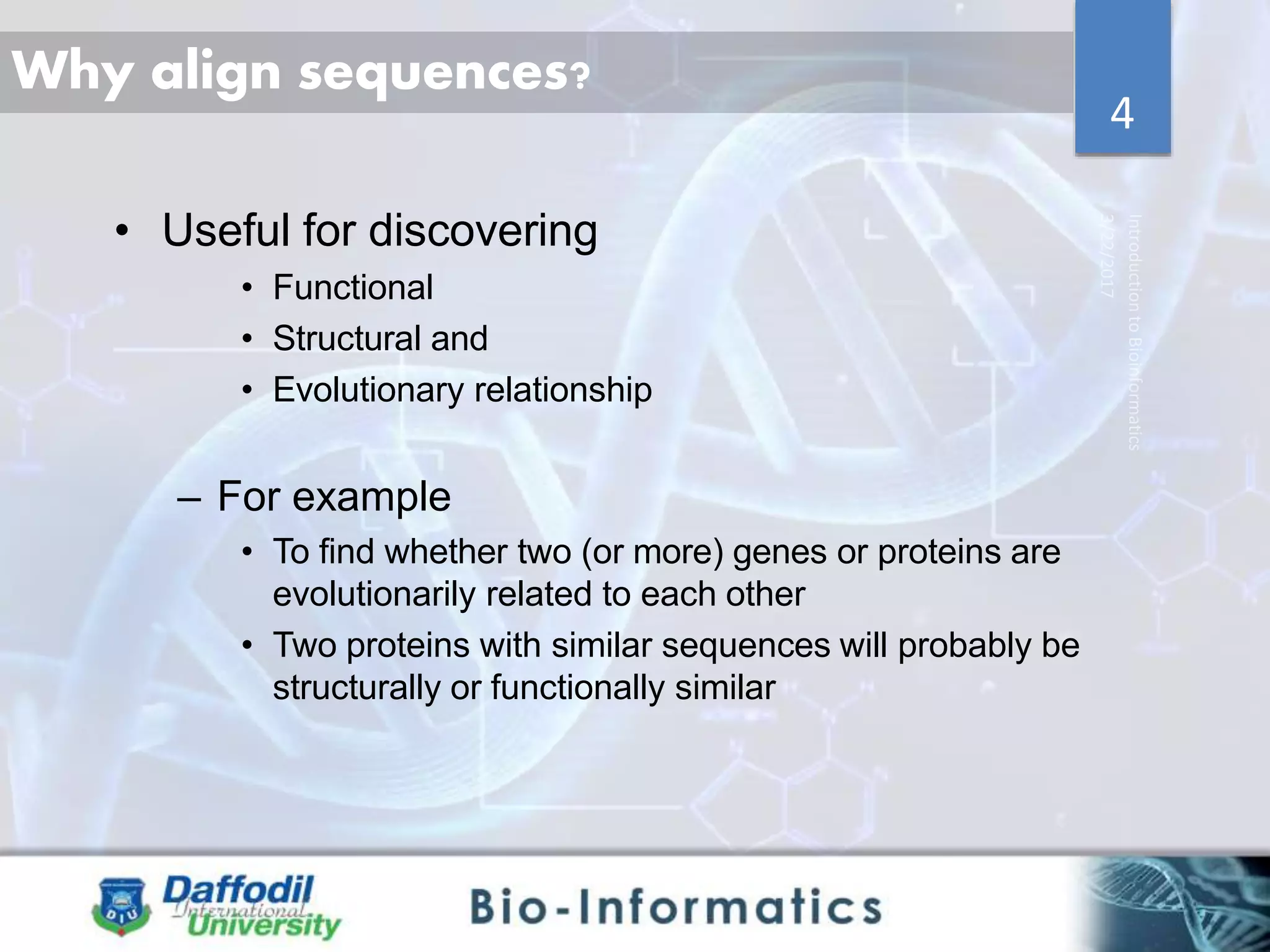
Why align sequences?
• Useful for discovering
• Functional
• Structural and
• Evolutionary relationship
– For example
• To find whether two (or more) genes or proteins are
evolutionarily related to each other
• Two proteins with similar sequences will probably be
structurally or functionally similar
5
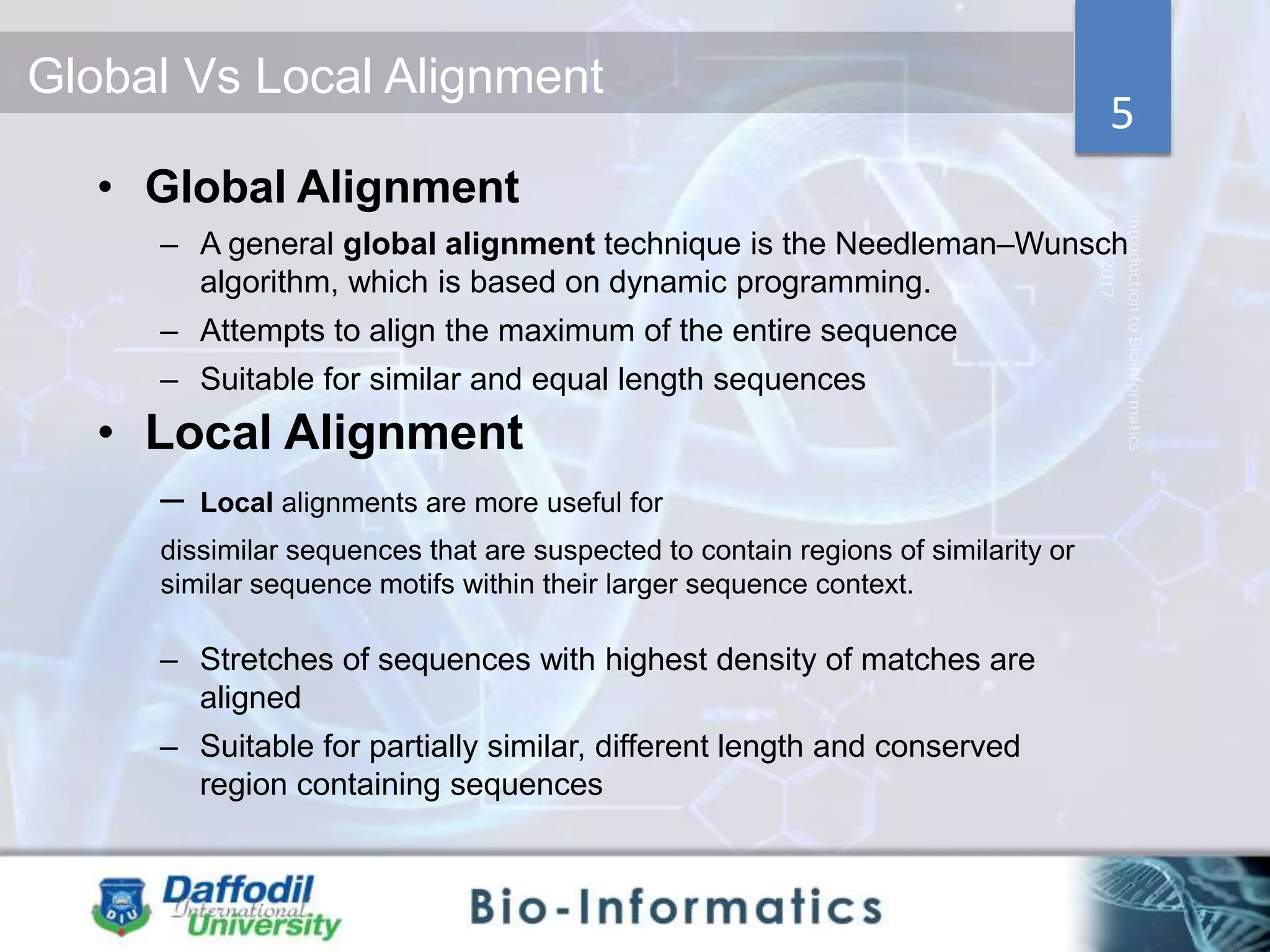
Global Vs Local Alignment
• Global Alignment
– A general global alignment technique is the Needleman–Wunsch
algorithm, which is based on dynamic programming.
– Attempts to align the maximum of the entire sequence
– Suitable for similar and equal length sequences
• Local Alignment
– Local alignments are more useful for
dissimilar sequences that are suspected to contain regions of similarity or
similar sequence motifs within their larger sequence context.
– Stretches of sequences with highest density of matches are
aligned
– Suitable for partially similar, different length and conserved
region containing sequences
6
7
Allows obtaining the optimal alignment with linear gap cost has
been proposed by Needleman and Wunsch by providing a
score, for each position of the aligned sequences.
Based on the dynamic programming technique.
For two sequences of length m and n we define a matrix of
dimensions m+1 and n+1.
Global Alignment
8
Global Alignment
 Three steps in dynamic programming
 Initialization
 Matrix fill (scoring)
 Traceback (alignment)
Smith–Waterman algorithm
9
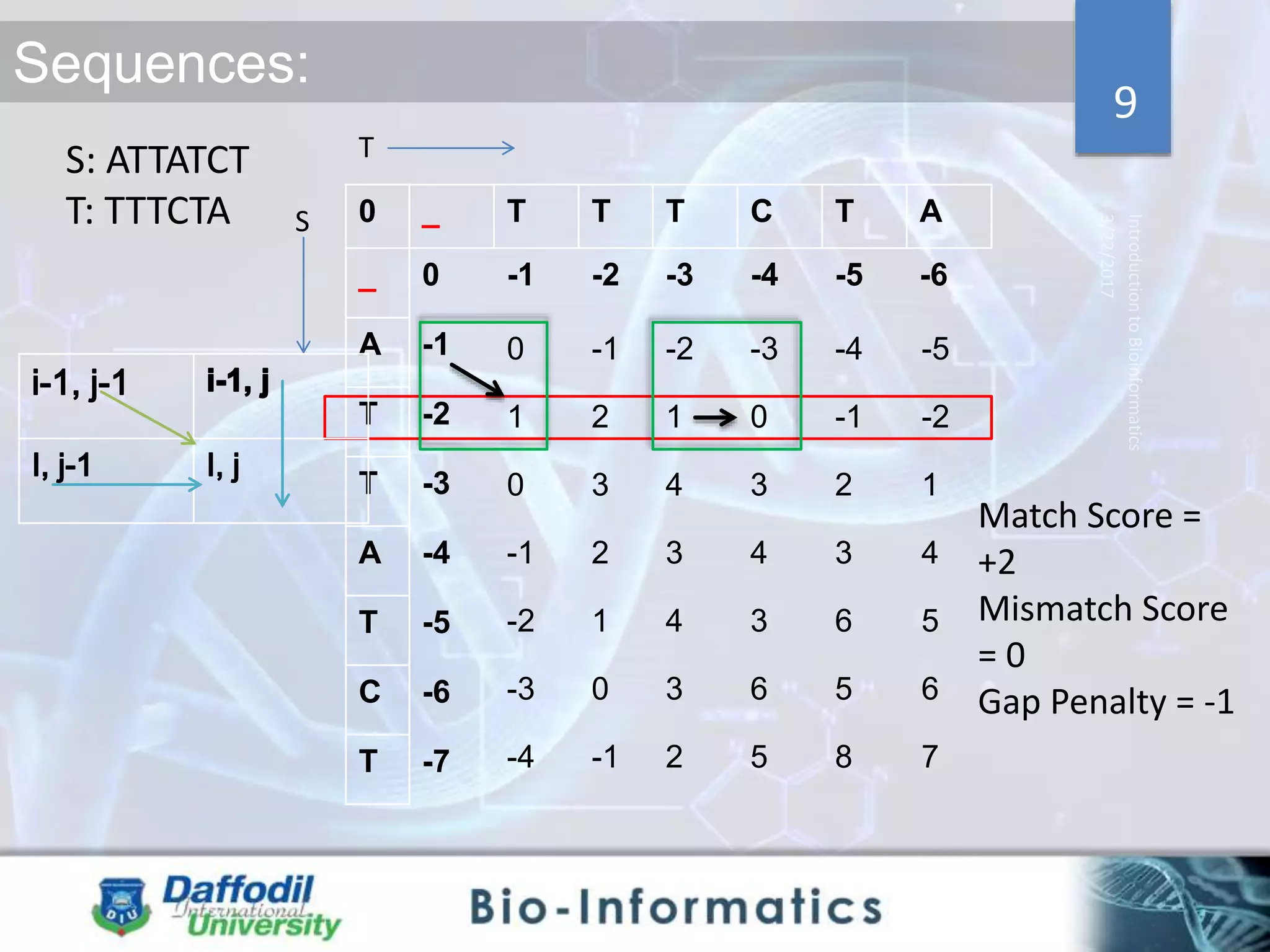
Sequences:
S: ATTATCT
T: TTTCTA
T
S 0
_
A
T
T
A
T
C
T
_ T T T C T A
0
-1
-2
-3
-4
-5
-6
-7
-1 -2 -3 -4 -5 -6
0 -1 -2 -3 -4 -5
1 2 1 0 -1 -2
0 3 4 3 2 1
-1 2 3 4 3 4
-2 1 4 3 6 5
-3 0 3 6 5 6
-4 -1 2 5 8 7
Match Score =
+2
Mismatch Score
= 0
Gap Penalty = -1
10
0
_
A
T
T
A
T
C
T
_ T T T C T A
0
-1
-2
-3
-4
-5
-6
-7
-1 -2 -3 -4 -5 -6
0 -1 -2 -3 -4 -5
1 2 1 0 -1 -2
0 3 4 3 2 1
-1 2 3 4 3 4
-2 1 4 3 6 5
-3 0 3 6 5 6
-4 -1 2 5 8 7
T
S
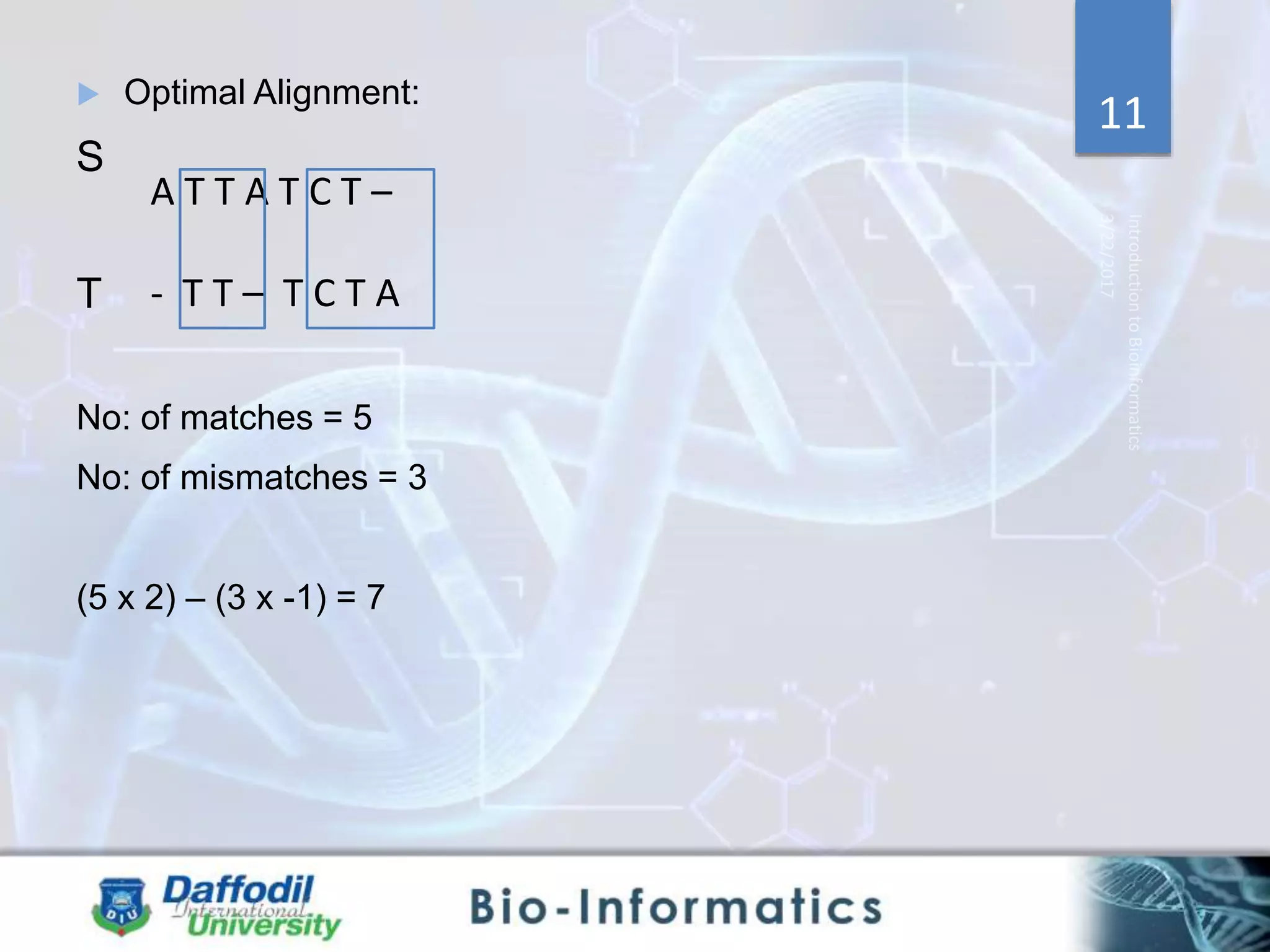
11 Optimal Alignment:
S
T
No: of matches = 5
No: of mismatches = 3
(5 x 2) – (3 x -1) = 7
A T T A T C T –
- T T – T C T A
12
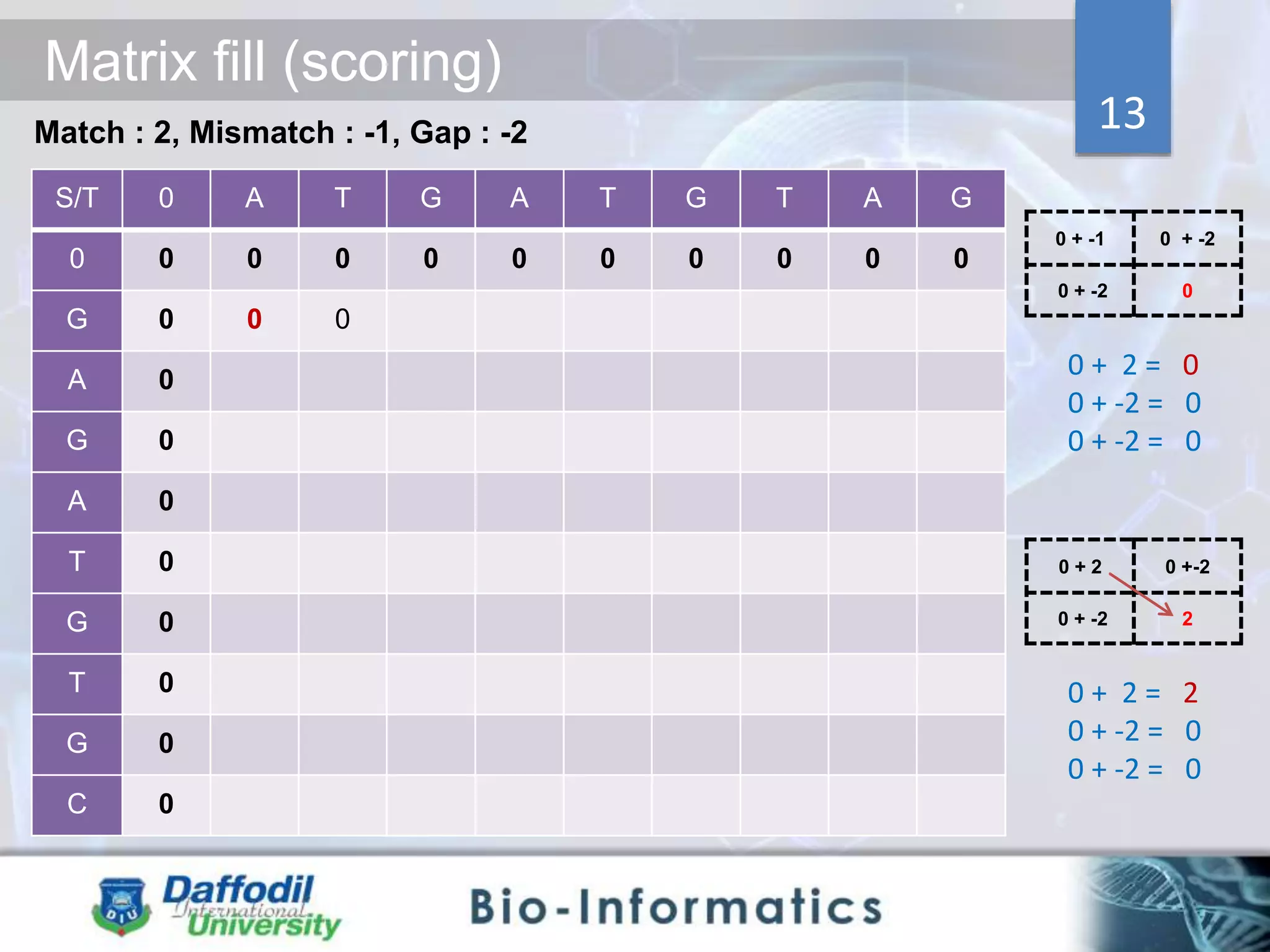
13
S/T 0 A T G A T G T A G
0 0 0 0 0 0 0 0 0 0 0
G 0 0 0
A 0
G 0
A 0
T 0
G 0
T 0
G 0
C 0
0 + 2 0 +-2
0 + -2 2
0 + 2 = 2
0 + -2 = 0
0 + -2 = 0
Match : 2, Mismatch : -1, Gap : -2
0 + -1 0 + -2
0 + -2 0
0 + 2 = 0
0 + -2 = 0
0 + -2 = 0
Matrix fill (scoring)
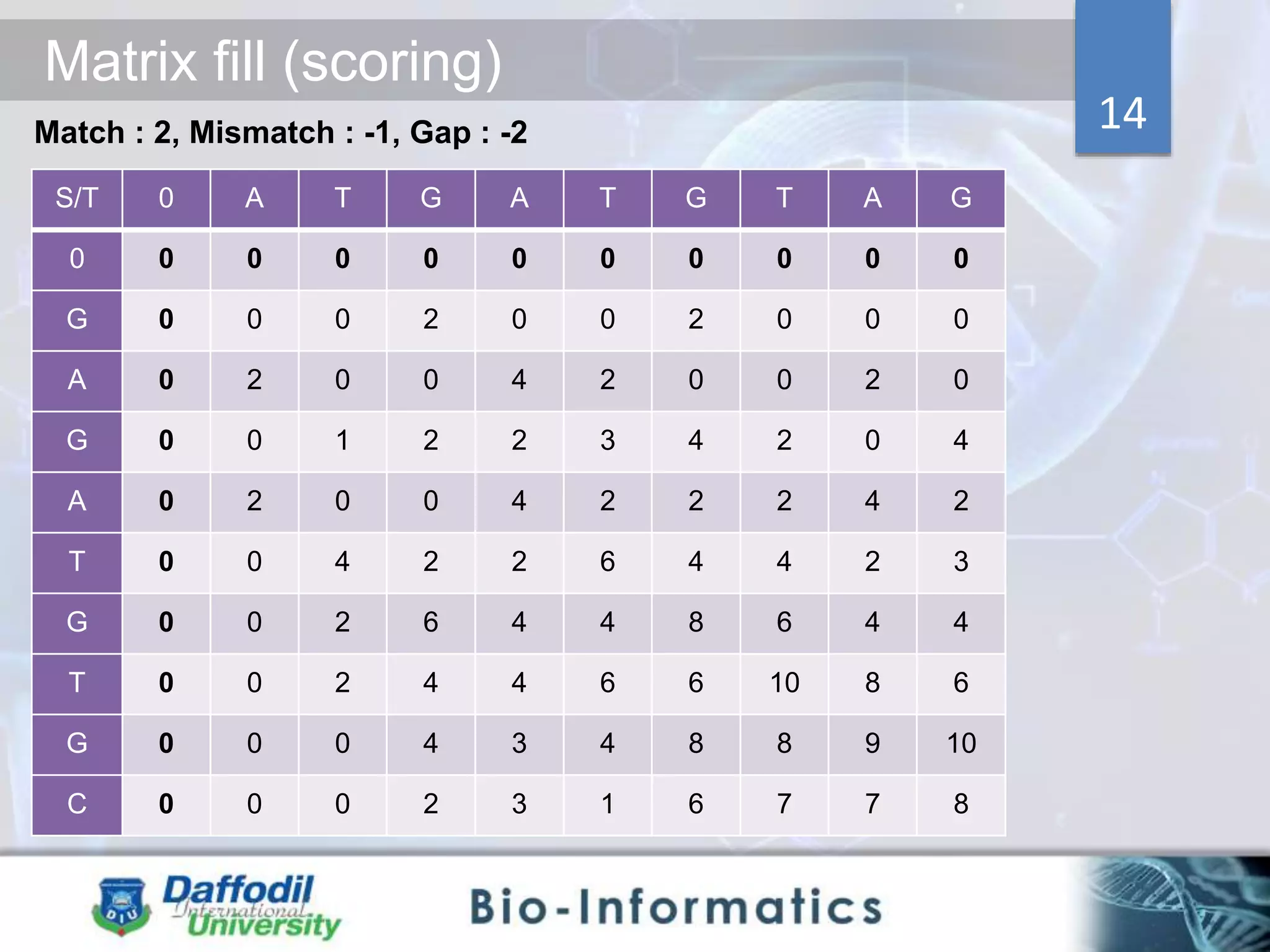
14
S/T 0 A T G A T G T A G
0 0 0 0 0 0 0 0 0 0 0
G 0 0 0 2 0 0 2 0 0 0
A 0 2 0 0 4 2 0 0 2 0
G 0 0 1 2 2 3 4 2 0 4
A 0 2 0 0 4 2 2 2 4 2
T 0 0 4 2 2 6 4 4 2 3
G 0 0 2 6 4 4 8 6 4 4
T 0 0 2 4 4 6 6 10 8 6
G 0 0 0 4 3 4 8 8 9 10
C 0 0 0 2 3 1 6 7 7 8
Match : 2, Mismatch : -1, Gap : -2
Matrix fill (scoring)
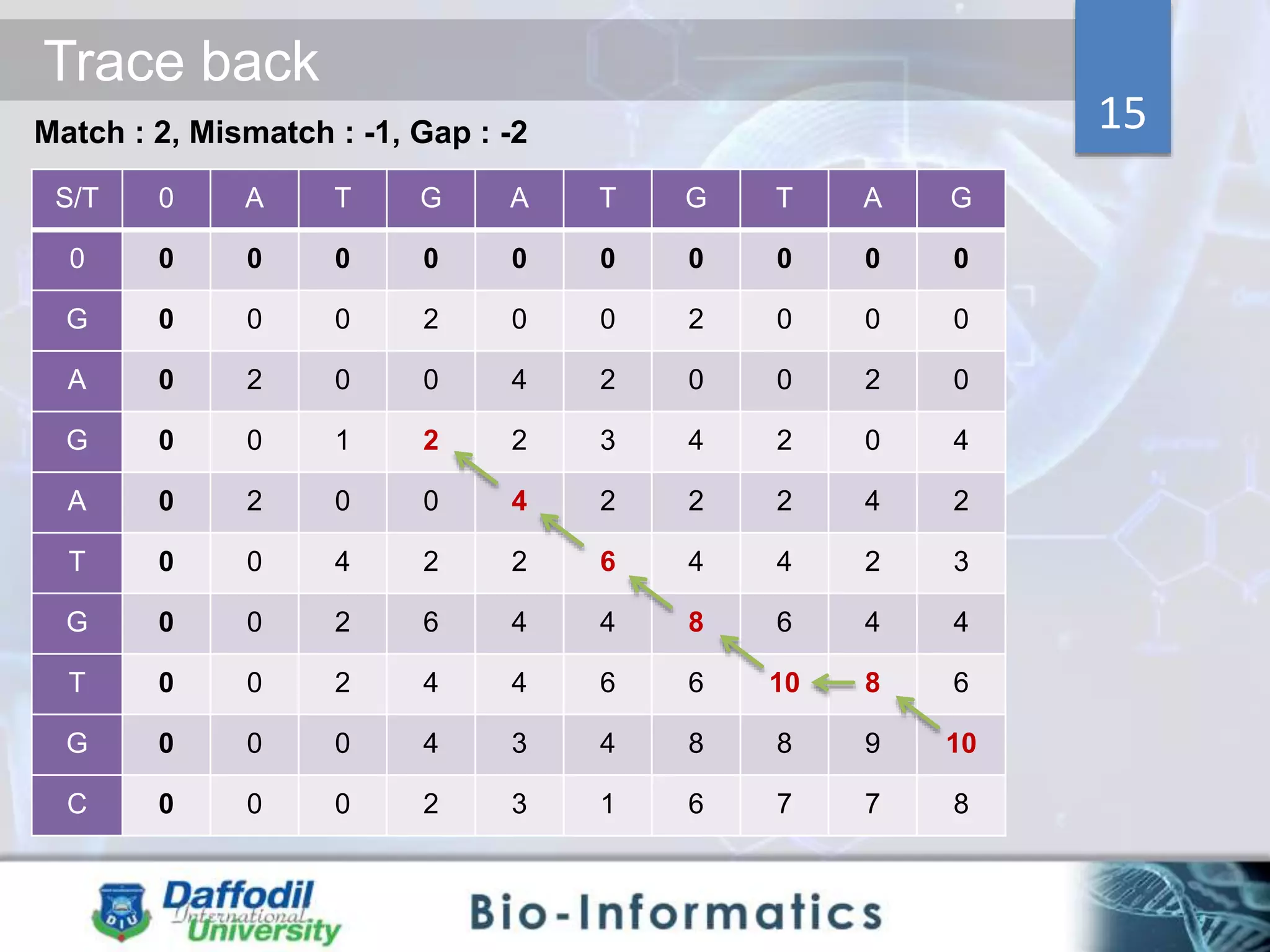
Trace back
15
S/T 0 A T G A T G T A G
0 0 0 0 0 0 0 0 0 0 0
G 0 0 0 2 0 0 2 0 0 0
A 0 2 0 0 4 2 0 0 2 0
G 0 0 1 2 2 3 4 2 0 4
A 0 2 0 0 4 2 2 2 4 2
T 0 0 4 2 2 6 4 4 2 3
G 0 0 2 6 4 4 8 6 4 4
T 0 0 2 4 4 6 6 10 8 6
G 0 0 0 4 3 4 8 8 9 10
C 0 0 0 2 3 1 6 7 7 8
Match : 2, Mismatch : -1, Gap : -2
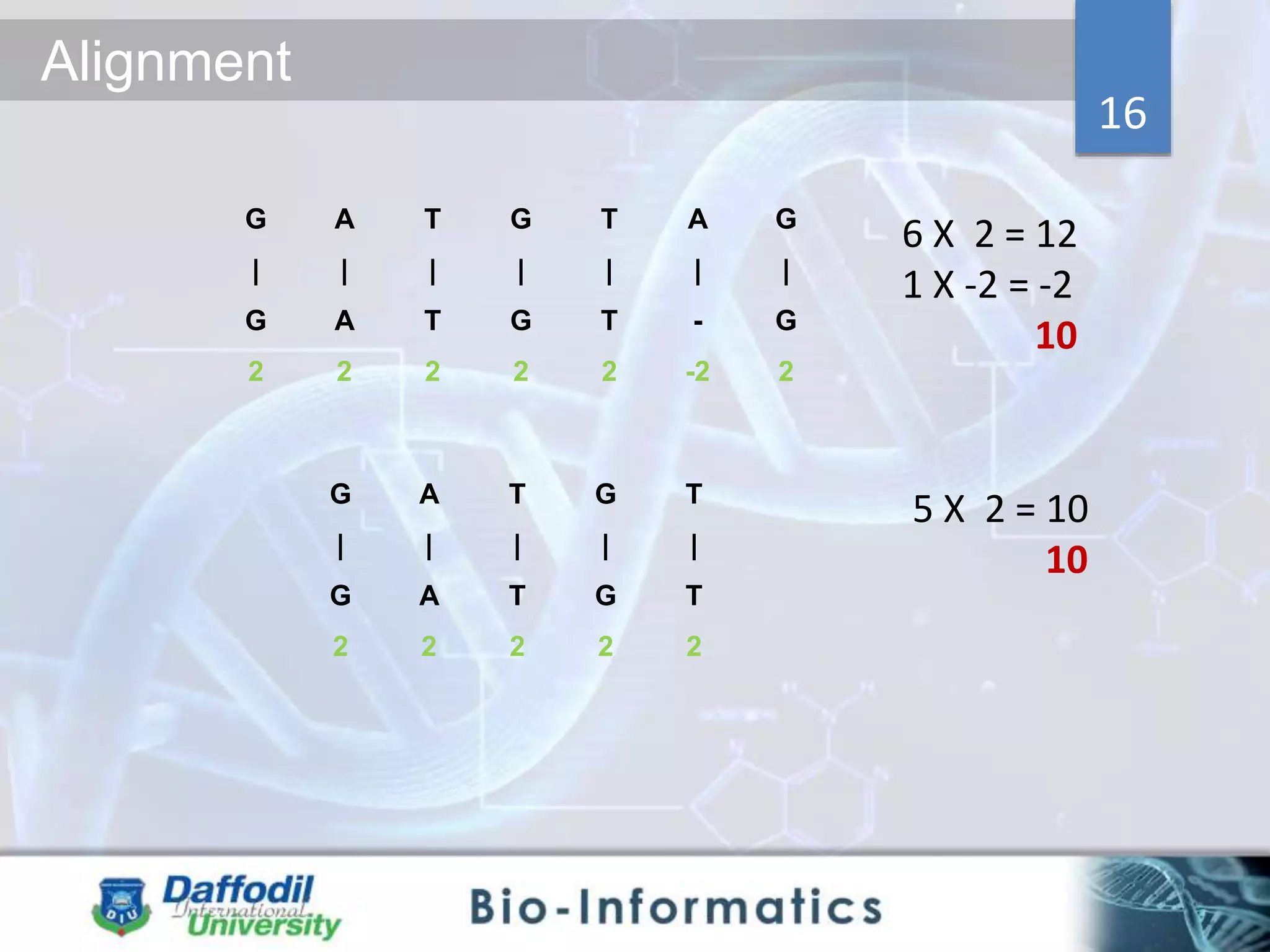
Alignment
16
G A T G T A G
| | | | | | |
G A T G T - G
2 2 2 2 2 -2 2
6 X 2 = 12
1 X -2 = -2
10
G A T G T
| | | | |
G A T G T
2 2 2 2 2
5 X 2 = 10
10
17
18

Global and local alignment (bioinformatics)

  • 1.
  • 2.
  • 3.
  • 4.
    4 Why align sequences? •Useful for discovering • Functional • Structural and • Evolutionary relationship – For example • To find whether two (or more) genes or proteins are evolutionarily related to each other • Two proteins with similar sequences will probably be structurally or functionally similar
  • 5.
    5 Global Vs LocalAlignment • Global Alignment – A general global alignment technique is the Needleman–Wunsch algorithm, which is based on dynamic programming. – Attempts to align the maximum of the entire sequence – Suitable for similar and equal length sequences • Local Alignment – Local alignments are more useful for dissimilar sequences that are suspected to contain regions of similarity or similar sequence motifs within their larger sequence context. – Stretches of sequences with highest density of matches are aligned – Suitable for partially similar, different length and conserved region containing sequences
  • 6.
  • 7.
    7 Allows obtaining theoptimal alignment with linear gap cost has been proposed by Needleman and Wunsch by providing a score, for each position of the aligned sequences. Based on the dynamic programming technique. For two sequences of length m and n we define a matrix of dimensions m+1 and n+1. Global Alignment
  • 8.
    8 Global Alignment  Threesteps in dynamic programming  Initialization  Matrix fill (scoring)  Traceback (alignment) Smith–Waterman algorithm
  • 9.
    9 Sequences: S: ATTATCT T: TTTCTA T S0 _ A T T A T C T _ T T T C T A 0 -1 -2 -3 -4 -5 -6 -7 -1 -2 -3 -4 -5 -6 0 -1 -2 -3 -4 -5 1 2 1 0 -1 -2 0 3 4 3 2 1 -1 2 3 4 3 4 -2 1 4 3 6 5 -3 0 3 6 5 6 -4 -1 2 5 8 7 Match Score = +2 Mismatch Score = 0 Gap Penalty = -1
  • 10.
    10 0 _ A T T A T C T _ T TT C T A 0 -1 -2 -3 -4 -5 -6 -7 -1 -2 -3 -4 -5 -6 0 -1 -2 -3 -4 -5 1 2 1 0 -1 -2 0 3 4 3 2 1 -1 2 3 4 3 4 -2 1 4 3 6 5 -3 0 3 6 5 6 -4 -1 2 5 8 7 T S
  • 11.
    11 Optimal Alignment: S T No:of matches = 5 No: of mismatches = 3 (5 x 2) – (3 x -1) = 7 A T T A T C T – - T T – T C T A
  • 12.
  • 13.
    13 S/T 0 AT G A T G T A G 0 0 0 0 0 0 0 0 0 0 0 G 0 0 0 A 0 G 0 A 0 T 0 G 0 T 0 G 0 C 0 0 + 2 0 +-2 0 + -2 2 0 + 2 = 2 0 + -2 = 0 0 + -2 = 0 Match : 2, Mismatch : -1, Gap : -2 0 + -1 0 + -2 0 + -2 0 0 + 2 = 0 0 + -2 = 0 0 + -2 = 0 Matrix fill (scoring)
  • 14.
    14 S/T 0 AT G A T G T A G 0 0 0 0 0 0 0 0 0 0 0 G 0 0 0 2 0 0 2 0 0 0 A 0 2 0 0 4 2 0 0 2 0 G 0 0 1 2 2 3 4 2 0 4 A 0 2 0 0 4 2 2 2 4 2 T 0 0 4 2 2 6 4 4 2 3 G 0 0 2 6 4 4 8 6 4 4 T 0 0 2 4 4 6 6 10 8 6 G 0 0 0 4 3 4 8 8 9 10 C 0 0 0 2 3 1 6 7 7 8 Match : 2, Mismatch : -1, Gap : -2 Matrix fill (scoring)
  • 15.
    Trace back 15 S/T 0A T G A T G T A G 0 0 0 0 0 0 0 0 0 0 0 G 0 0 0 2 0 0 2 0 0 0 A 0 2 0 0 4 2 0 0 2 0 G 0 0 1 2 2 3 4 2 0 4 A 0 2 0 0 4 2 2 2 4 2 T 0 0 4 2 2 6 4 4 2 3 G 0 0 2 6 4 4 8 6 4 4 T 0 0 2 4 4 6 6 10 8 6 G 0 0 0 4 3 4 8 8 9 10 C 0 0 0 2 3 1 6 7 7 8 Match : 2, Mismatch : -1, Gap : -2
  • 16.
    Alignment 16 G A TG T A G | | | | | | | G A T G T - G 2 2 2 2 2 -2 2 6 X 2 = 12 1 X -2 = -2 10 G A T G T | | | | | G A T G T 2 2 2 2 2 5 X 2 = 10 10
  • 17.
  • 18.