INTRODUCTION TO NCBI,
EMBL & DDBJ.
By
KAUSHAL KUMAR SAHU
Assistant Professor (Ad Hoc)
Department of Biotechnology
Govt. Digvijay Autonomous P. G. College
Raj-Nandgaon ( C. G. )
1. INTRODUCTION.
2. NCBI.
3. EMBL.
4. DDBJ.
5. CONCLUSION.
6. REFERENSE.
 In biology, Bioinformatics is an interdisciplinary field that
develops and improves upon methods for storing,
retrieving, organizing and analyzing biological data.
 A major activity in bioinformatics is to develop software
tools to generate useful biological knowledge.
 Bioinformatics has become an important part of many
areas of biology.
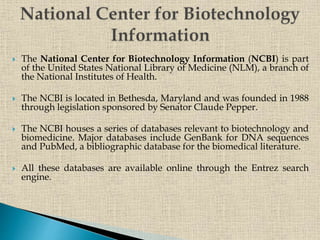
 The National Center for Biotechnology Information (NCBI) is part
of the United States National Library of Medicine (NLM), a branch of
the National Institutes of Health.
 The NCBI is located in Bethesda, Maryland and was founded in 1988
through legislation sponsored by Senator Claude Pepper.
 The NCBI houses a series of databases relevant to biotechnology and
biomedicine. Major databases include GenBank for DNA sequences
and PubMed, a bibliographic database for the biomedical literature.
 All these databases are available online through the Entrez search
engine.
 GenBank coordinates with individual laboratories and other
sequence databases such as those of the European Molecular Biology
Laboratory (EMBL) and the DNA Data Bank of Japan (DDBJ).
 Since 1992, NCBI has grown to provide other databases in addition to
GenBank. NCBI provides Online Mendelian Inheritance in Man, the
Molecular Modeling Database (3D protein structures), dbSNP (a
database of single-nucleotide polymorphisms).
 The NCBI assigns a unique identifier (taxonomy ID number) to each
species of organism.
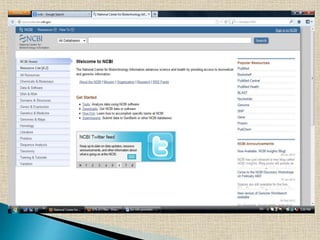
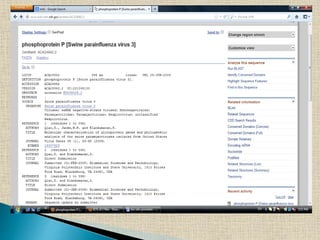
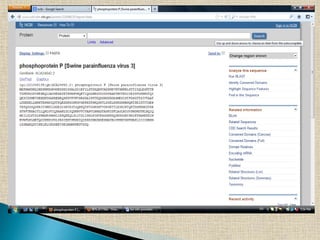
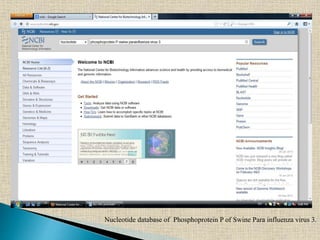
 Firstly the NCBI was type on the google and click
search.
 Then click the National center for Biotechnology
Information.
 NCBI home page was open.
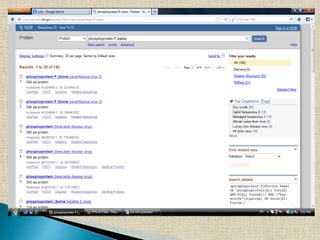
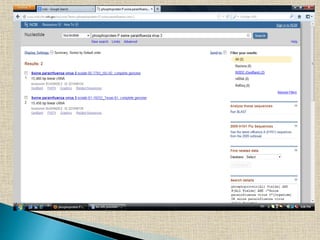
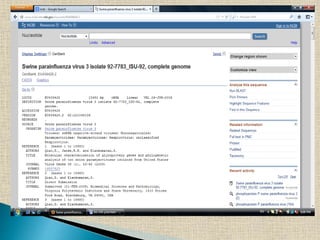
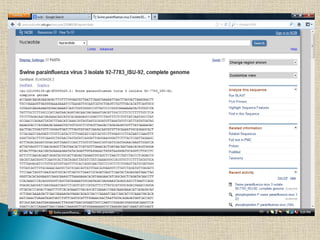
Nucleotide database of Phosphoprotein P of Swine Para influenza virus 3.
 The European Molecular Biology Laboratory (EMBL) is a molecular
biology research institution supported by 20 European countries and
Australia as associate member state.
 EMBL was created in 1974 and is an intergovernmental organization
funded by public research money from its member states.
 Research at EMBL is conducted by approximately 85 independent
groups covering the spectrum of molecular biology.
 The Laboratory operates from five sites: the main Laboratory in
Heidelberg, and Outstations in Hinxton (the European Bioinformatics
Institute (EBI)), Grenoble, Hamburg, and Monterotondo near Rome.
 The cornerstones of EMBL’s mission are: to perform basic
research in molecular biology; to train scientists, students
and visitors at all levels.
 EMBL’s international PhD Programme has a student body
of about 170.
 The Laboratory also sponsors an active Science and Society
programme.
 Many scientific breakthroughs have been made at EMBL,
most notably the first systematic genetic analysis of
embryonic development in the fruit fly by Christiane
Nüsslein-Volhard and Eric Wieschaus, for which they were
awarded the Nobel Prize for Medicine in 1995.
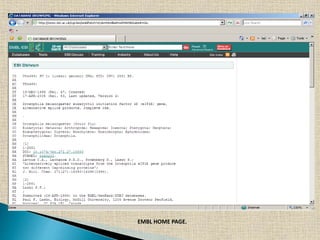
EMBL HOME PAGE.
 EMBL-Bank (www.ebi.ac.uk/embl/), which began its life
as the EMBL Data Library at the European Molecular
Biology Laboratory’s Heidelberg headquarters in 1980,
was the world’s first publicly available database of
nucleotide sequence.
 The cornerstones of EMBL's mission are manifold.
 Basic research in molecular biology and molecular medicine is
performed; scientists, students and visitors at all levels are trained;
vital services to scientists in the member states are offered.
 New instruments and methods in the life sciences are developed;
and there is an active engagement in technology transfer.
 Advanced training is one of EMBL's four core missions.
 Over the years, the Laboratory has established a number of training
activities, of which the EMBL International PhD Programme (EIPP)
is the flagship - it has a student body of about 200, and since 1997
has had the right to award its own degree.
 Other activities include the postdoctoral programme, including the
EMBL Interdisciplinary Postdoctoral programme (EIPOD); the
European Learning Laboratory for the Life Sciences (ELLS) for
teacher training; and the Visitor Programme.
 The European Bioinformatics Institute (EBI) is part of the European
Molecular Biology Laboratory (EMBL) and is located on the
Wellcome Trust Genome Campus in Hinxton near Cambridge (UK).
 The EBI grew out of EMBL’s pioneering work in providing public
biological databases to the research community.
 It hosts some of the world’s most important collections of biological
data, including DNA sequences (EMBL-Bank), protein sequences
(UniProt), animal genomes (Ensembl), three-dimensional structures
(the Macromolecular Structure Database) .
 The EBI hosts several research groups and its scientists continually
develop new tools for the biocomputing community.
 DDBJ; DNA Data Bank of Japan is the sole nucleotide
sequence data bank in Asia, which is officially certified to
collect nucleotide sequences from researchers and to
issue the internationally recognized accession number to
data submitters.
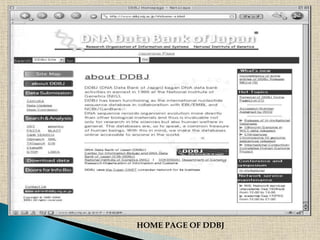
 The DNA Data Bank of Japan (DDBJ) is a biological database
that collects DNA sequences.
 It is located at the National Institute of Genetics (NIG) in the
Shizuoka prefecture of Japan.
 It is also a member of the International Nucleotide Sequence
Database Collaboration or INSDC.
 It exchanges its data with European Molecular Biology
Laboratory at the European Bioinformatics Institute and with
GenBank at the National Center for Biotechnology Information
on a daily basis.
 Thus these three databanks contain the same data at any given
time.
HOME PAGE OF DDBJ
 DDBJ collects sequence data mainly from Japanese researchers, but
of course accepts data and issue the accession number to
researchers in any other countries.
 DDBJ is organized by NIG; National Institute of Genetics with
endorsement of MEXT; Japanese Ministry of Education, Culture,
Sports, Science and Technology.
 99% of INSD data from Japanese researchers are submitted
through DDBJ.
 The principal purpose of DDBJ operations is to improve the
quality of INSD, as public domains.
 The DNA Data Bank of Japan (DDBJ,
http://www.ddbj.nig.ac.jp) provides a nucleotide
sequence archive database and accompanying
database tools for sequence submission, entry
retrieval and annotation analysis.
 The DDBJ collected and released 3 637 446
entries/2 272 231 889 bases between July 2009 and
June 2010.
Since we exchange the collected data with EMBL-Bank/EBI; European
Bioinformatics Institute and GenBank/NCBI; National Center for
Biotechnology Information on a daily basis, the three data banks share
virtually the same data at any given time.
 The NCBI houses a series of databases relevant to biotechnology and
biomedicine. Major databases include GenBank for DNA sequences.
 The EMBL Nucleotide Sequence Database
(http://www.ebi.ac.uk/embl), maintained at the European
Bioinformatics Institute (EBI) near Cambridge, UK, is a
comprehensive collection of nucleotide sequences and annotation
from available public sources.
 The DNA Data Bank of Japan (DDBJ, http://www.ddbj.nig.ac.jp)
provides a nucleotide sequence archive database and accompanying
database tools for sequence submission, entry retrieval and
annotation analysis.
 http://www.ebi.ac.uk/embl/
 http://www.ddbj.nig.ac.jp
 C.S.V. Murthy (2003) Bioinformatics : First
Edition.
 S.C. Rastogi, Namita Mendiratta, Parag Rastogi
(2003) Bioinformatics.

Introduction to ncbi, embl, ddbj

  • 1.
    INTRODUCTION TO NCBI, EMBL& DDBJ. By KAUSHAL KUMAR SAHU Assistant Professor (Ad Hoc) Department of Biotechnology Govt. Digvijay Autonomous P. G. College Raj-Nandgaon ( C. G. )
  • 2.
    1. INTRODUCTION. 2. NCBI. 3.EMBL. 4. DDBJ. 5. CONCLUSION. 6. REFERENSE.
  • 3.
     In biology,Bioinformatics is an interdisciplinary field that develops and improves upon methods for storing, retrieving, organizing and analyzing biological data.  A major activity in bioinformatics is to develop software tools to generate useful biological knowledge.  Bioinformatics has become an important part of many areas of biology.
  • 4.
     The NationalCenter for Biotechnology Information (NCBI) is part of the United States National Library of Medicine (NLM), a branch of the National Institutes of Health.  The NCBI is located in Bethesda, Maryland and was founded in 1988 through legislation sponsored by Senator Claude Pepper.  The NCBI houses a series of databases relevant to biotechnology and biomedicine. Major databases include GenBank for DNA sequences and PubMed, a bibliographic database for the biomedical literature.  All these databases are available online through the Entrez search engine.
  • 5.
     GenBank coordinateswith individual laboratories and other sequence databases such as those of the European Molecular Biology Laboratory (EMBL) and the DNA Data Bank of Japan (DDBJ).  Since 1992, NCBI has grown to provide other databases in addition to GenBank. NCBI provides Online Mendelian Inheritance in Man, the Molecular Modeling Database (3D protein structures), dbSNP (a database of single-nucleotide polymorphisms).  The NCBI assigns a unique identifier (taxonomy ID number) to each species of organism.
  • 6.
     Firstly theNCBI was type on the google and click search.  Then click the National center for Biotechnology Information.  NCBI home page was open.
  • 11.
    Nucleotide database ofPhosphoprotein P of Swine Para influenza virus 3.
  • 15.
     The EuropeanMolecular Biology Laboratory (EMBL) is a molecular biology research institution supported by 20 European countries and Australia as associate member state.  EMBL was created in 1974 and is an intergovernmental organization funded by public research money from its member states.  Research at EMBL is conducted by approximately 85 independent groups covering the spectrum of molecular biology.  The Laboratory operates from five sites: the main Laboratory in Heidelberg, and Outstations in Hinxton (the European Bioinformatics Institute (EBI)), Grenoble, Hamburg, and Monterotondo near Rome.
  • 16.
     The cornerstonesof EMBL’s mission are: to perform basic research in molecular biology; to train scientists, students and visitors at all levels.  EMBL’s international PhD Programme has a student body of about 170.  The Laboratory also sponsors an active Science and Society programme.  Many scientific breakthroughs have been made at EMBL, most notably the first systematic genetic analysis of embryonic development in the fruit fly by Christiane Nüsslein-Volhard and Eric Wieschaus, for which they were awarded the Nobel Prize for Medicine in 1995.
  • 17.
  • 18.
     EMBL-Bank (www.ebi.ac.uk/embl/),which began its life as the EMBL Data Library at the European Molecular Biology Laboratory’s Heidelberg headquarters in 1980, was the world’s first publicly available database of nucleotide sequence.
  • 19.
     The cornerstonesof EMBL's mission are manifold.  Basic research in molecular biology and molecular medicine is performed; scientists, students and visitors at all levels are trained; vital services to scientists in the member states are offered.  New instruments and methods in the life sciences are developed; and there is an active engagement in technology transfer.
  • 20.
     Advanced trainingis one of EMBL's four core missions.  Over the years, the Laboratory has established a number of training activities, of which the EMBL International PhD Programme (EIPP) is the flagship - it has a student body of about 200, and since 1997 has had the right to award its own degree.  Other activities include the postdoctoral programme, including the EMBL Interdisciplinary Postdoctoral programme (EIPOD); the European Learning Laboratory for the Life Sciences (ELLS) for teacher training; and the Visitor Programme.
  • 21.
     The EuropeanBioinformatics Institute (EBI) is part of the European Molecular Biology Laboratory (EMBL) and is located on the Wellcome Trust Genome Campus in Hinxton near Cambridge (UK).  The EBI grew out of EMBL’s pioneering work in providing public biological databases to the research community.  It hosts some of the world’s most important collections of biological data, including DNA sequences (EMBL-Bank), protein sequences (UniProt), animal genomes (Ensembl), three-dimensional structures (the Macromolecular Structure Database) .  The EBI hosts several research groups and its scientists continually develop new tools for the biocomputing community.
  • 22.
     DDBJ; DNAData Bank of Japan is the sole nucleotide sequence data bank in Asia, which is officially certified to collect nucleotide sequences from researchers and to issue the internationally recognized accession number to data submitters.
  • 23.
     The DNAData Bank of Japan (DDBJ) is a biological database that collects DNA sequences.  It is located at the National Institute of Genetics (NIG) in the Shizuoka prefecture of Japan.  It is also a member of the International Nucleotide Sequence Database Collaboration or INSDC.  It exchanges its data with European Molecular Biology Laboratory at the European Bioinformatics Institute and with GenBank at the National Center for Biotechnology Information on a daily basis.  Thus these three databanks contain the same data at any given time.
  • 24.
  • 25.
     DDBJ collectssequence data mainly from Japanese researchers, but of course accepts data and issue the accession number to researchers in any other countries.  DDBJ is organized by NIG; National Institute of Genetics with endorsement of MEXT; Japanese Ministry of Education, Culture, Sports, Science and Technology.  99% of INSD data from Japanese researchers are submitted through DDBJ.  The principal purpose of DDBJ operations is to improve the quality of INSD, as public domains.
  • 26.
     The DNAData Bank of Japan (DDBJ, http://www.ddbj.nig.ac.jp) provides a nucleotide sequence archive database and accompanying database tools for sequence submission, entry retrieval and annotation analysis.  The DDBJ collected and released 3 637 446 entries/2 272 231 889 bases between July 2009 and June 2010.
  • 27.
    Since we exchangethe collected data with EMBL-Bank/EBI; European Bioinformatics Institute and GenBank/NCBI; National Center for Biotechnology Information on a daily basis, the three data banks share virtually the same data at any given time.
  • 28.
     The NCBIhouses a series of databases relevant to biotechnology and biomedicine. Major databases include GenBank for DNA sequences.  The EMBL Nucleotide Sequence Database (http://www.ebi.ac.uk/embl), maintained at the European Bioinformatics Institute (EBI) near Cambridge, UK, is a comprehensive collection of nucleotide sequences and annotation from available public sources.  The DNA Data Bank of Japan (DDBJ, http://www.ddbj.nig.ac.jp) provides a nucleotide sequence archive database and accompanying database tools for sequence submission, entry retrieval and annotation analysis.
  • 29.
     http://www.ebi.ac.uk/embl/  http://www.ddbj.nig.ac.jp C.S.V. Murthy (2003) Bioinformatics : First Edition.  S.C. Rastogi, Namita Mendiratta, Parag Rastogi (2003) Bioinformatics.